




Abstract
Background:
The morbidity and mortality rate is increasing due to cardiovascular disease around the globe. This may be due to drastic changes in lifestyle, food habits, work, stress, genetic factors, and environmental conditions. The present study is undertaken to evaluate the risk factors of cardiovascular disease (CVD) in Shimoga region.
Objective:
Evaluation of risk factors of CVD in patients who admitted for treatment in McGann Teaching District Hospital, Shimoga.
Methods:
A retrospective study was conducted in Mc Gann's Teaching District Hospital, Shimoga from October 2017 to March 2018. Data about sociodemographic parameters such as age, sex, height, weight, smoking, the status of diabetes mellitus, type of occupation, and diet, tobacco, and alcohol consumption were retrieved from the medical record section and statistical analysis was done using Statistical Package for the Social Sciences (SPSS).
Results:
Out of 262 CVD cases, 60% were male and 40% were female. Based on the body mass index (BMI), 1.9% were underweight, 40.1% were normal, 34.4% were overweight, and 23.7% were obese. Sedentary (64.9%) lifestyle was significantly higher when compared to moderate (2.3%) and heavy (32.8%). Diabetes, smoking, tobacco, and alcohol consumption were seen to be significant while food custom was not significant among the study population (P < .05).
Conclusion:
In our study, a higher percentage of CVD patients falls under normal BMI when compared to other studies. This may be due to lifestyle, socioeconomic status, ethnicity, and family heredity. Further extensive studies should be carried out to find the main cause of CVD in Shimoga population.
Introduction
Cardiovascular disease (CVD) is a primary cause of mortality and morbidity in the world. Coronary artery disease mortality is greater in India. Nowadays, these diseases are epidemic in both urban and rural areas due to rapid epidemiological transition, increased life span, lifestyle, food habits, stress life, and genetic predisposition. 1 In India, the mortality rate was 24% in 2008 due to CVD and it is estimated that in 2030 the mortality rate may be increased to 35.9%. 2 CVD risk is observed to be highest in North, Northeast, and South India. 3
There are wide regional variations in cardiovascular disease mortality and burden in India. 4 In South Indian population, many studies were carried out regarding prevalence of CVD and its risk factors in Kerala,5-7 Andhra Pradesh, 8 Tamil Nadu,9, 10 and Karnataka, 11 but retrospective type of studies were less in Shimoga 12 when compared to other districts of Karnataka.13-16 With this background, a study was conducted on cardiovascular disease and its risk factors among CVD patients admitted for treatment in Intensive Coronary Care Unit (ICCU) of General Medicine department of McGann Teaching District Hospital, Shimoga.
Materials and Methods
This is a retrospective study which was conducted in the General Medicine department of Shimoga Institute of Medical Sciences, Shimoga. We collected the data of 262 consecutive CVD patients from medical record section who admitted to ICCU for the treatment, and patient information was anonymized.
Study Population
The original study population included all patients who admitted to ICCU for the treatment from October 2017 to March 2018. Patients who were ≥18 years old and had an established diagnosis for CVD (coronary artery diseases including heart failure secondary to IHD/CAD) were included in this study.
Baseline Characteristics
Data retrieved from the medical record section included sociodemographic parameters such as age, sex, height, and weight. CVD risk factors such as smoking, tobacco, and alcohol consumption, status of diabetes mellitus, type of occupation, and diet were noted. Patients with missing baseline data were excluded.
Age was categorized into four groups such as ≤40, 41 to 50, 51 to 60, and >61 years.
Body mass index (BMI) <18.5 kg/m 2 was classified as underweight, 18.5 to 22.99 kg/m 2 as normal, 23.00 to 24.99 kg/m 2 as overweight, 25.00 to 29.99 kg/m 2 as obese I, and >30 kg/m 2 as obese II. 17
Diabetes mellitus was defined as receiving antidiabetic medications or having a diagnosis made by an attending physician.
Statistical Analysis
The data obtained was coded and entered into Microsoft Excel and analyzed using Statistical Package for the Social Sciences (SPSS) software version 22. Descriptive statistics such as frequencies and percentages, and mean and standard deviation were calculated. Inferential statistics like analysis of variance and Chi-square test were applied. The statistical significance was evaluated at 5% level of significance.
Results
The mean and standard deviation of age and sex ratio were found to be 58.8 ± 13.5 years and 157:105. The BMI was found to be 23.8 ± 2.9 Kg/m 2 .
In this study population, the percentage of vegetarians, smokers, alcoholic, and diabetic was less than non vegetarians, non smokers, and non alcoholic. Diabetes, smoking, tobacco, and alcohol consumption were seen to be significant while food/dietary habit was not significant among study population (P < .05) (Table 1).
Prevalence of Cardiovascular Disease Risk Factors in the Study Population Based on Gender (N = 262).
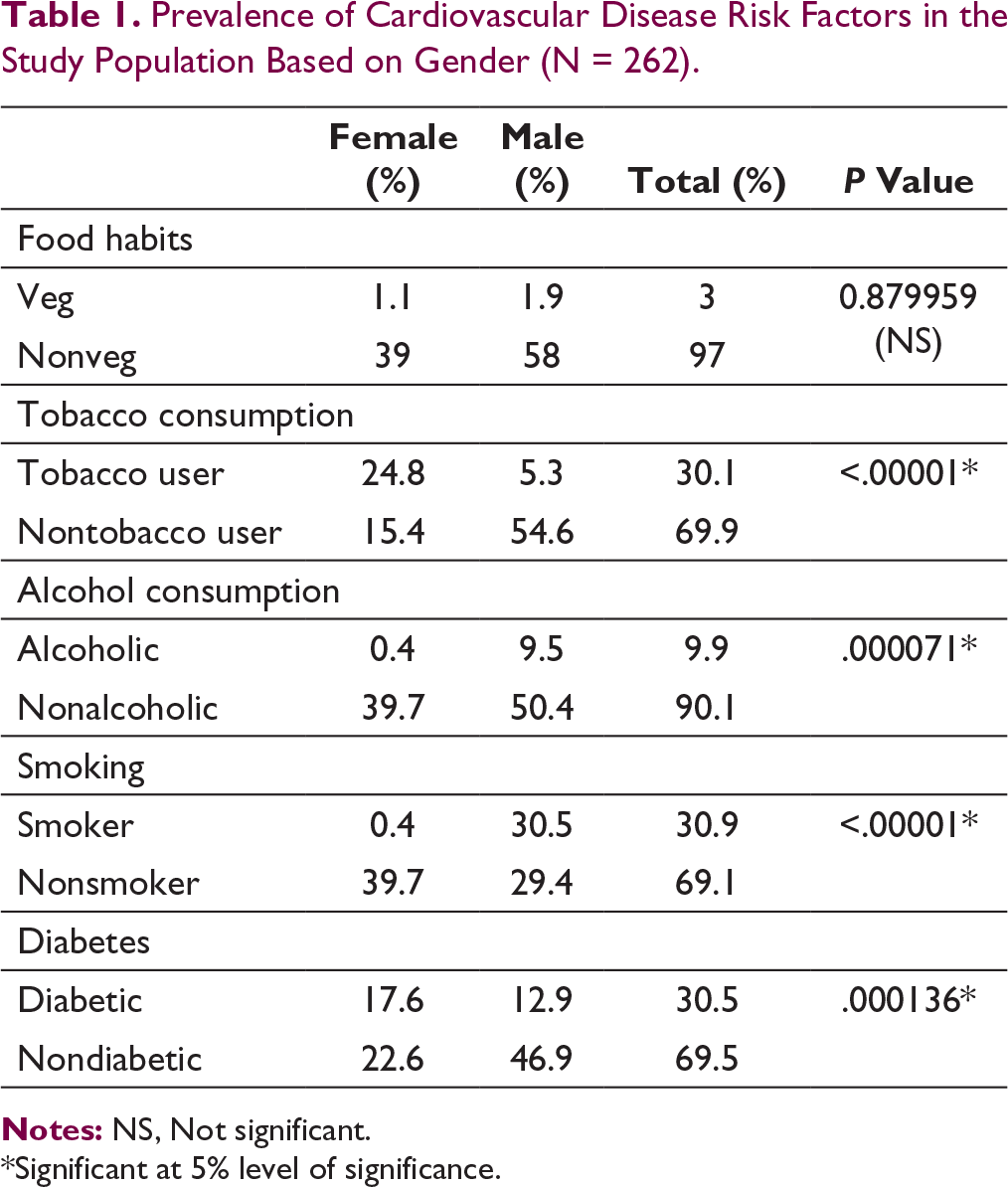
*Significant at 5% level of significance.
The percentage of CVD patients was more in ≥61 years age group when compared to other groups. In all age groups, the number of male was more than females (Figure 1A).
Percentage of CVD v/s Age (A), BMI Classification (B) and Type of Occupation(C).
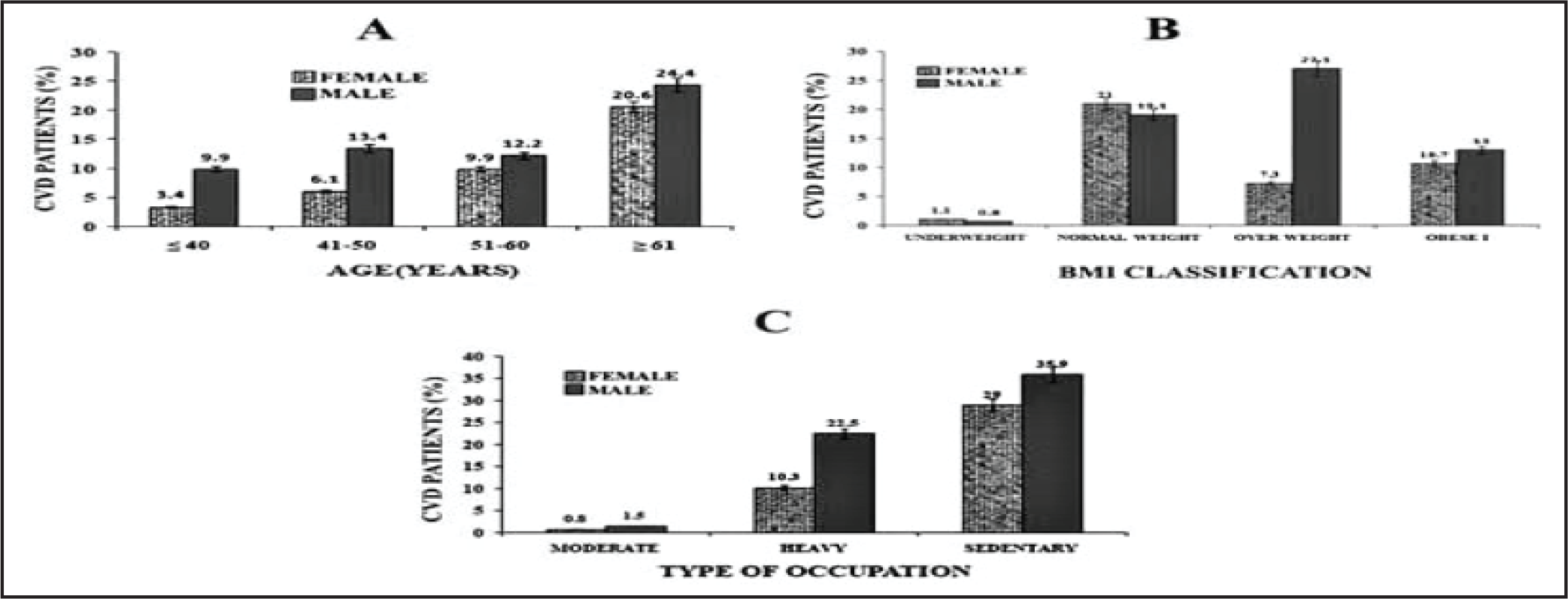
The percentage of CVD patients in underweight, normal weight, overweight, and obese it was found to be 1.9%, 40.1%, 34.4%, and 23.7%, respectively. In normal and underweight group, the percentage of females was slightly more than male, whereas in overweight and obese groups the percentage of male CVD patients was more than female (Figure 1B).
Another risk factor of CVD is lifestyle/type of work of the individuals. In this study, sedentary (64.9%) lifestyle was significantly higher compared to moderate (2.3%) and heavy (32.8%) type of occupation. In all categories of occupation, the percentage of male was more than female CVD patients (Figure 1C).
Discussion
In the present study, among the CVD patients the percentage of male was more compared to female. The mean and standard deviation of study population age was found to be 58.8 ± 13.5 years. The percentage of CVD patients was more in ≥61 years age group (45%) compared to other age groups, as age increases the risk of CVD also increases proportionally due to deterioration in structure and function of the heart and vasculature that likely contribute to the development of CVD, including coronary heart disease, hypertension, and heart failure.15, 18-20 Sedentary lifestyle or physical inactivity was higher in the present study (64.9%) and it was more so among males when compared to females. The physical activity plays an important role in health of the people. Many studies show that there is an association between greater sedentary behavior and an increased risk of CVD among population.20-25
Among study population, the percentage of diabetes was found to be 30.5%. Many studies show that diabetes is also a risk factor of CVD.26-28
Smoking (30.9%), tobacco (30.1%), and alcohol (9.9%) consumption was seen to be significant among our study population (P < .05) similar to other studies. 26 Smoking prevalence ranges from 18.1% to 42%, 29 and the prevalence of tobacco consumption was found to be 9% to 67%. 30 Many studies show that light to moderate drinking could be protective against heart diseases,31-33 but other studies show the contrast evidence related to alcohol consumption and risk of heart diseases.34, 35
In our study, the percentage of nonvegetarian is more than vegetarians. Many studies support that CVD risk is more in non vegetarians compared to vegetarians.36, 37 Generally in south India, people use smokeless tobacco with betel leaves and areca nut. In our study, female smokeless tobacco users were more when compared to males, which was similar to Yuvaraj et al's study.38, 39
Contrasting results were obtained regarding BMI when compared to other studies. This may be due to various factors such as age, gender, dietary habits, socioeconomic status, physical activity, smoking, tobacco and alcohol consumption, and genetic variations.26, 36-44
Limitations
Family history of CVD, and hematological and biochemical parameters of study population were not included in this study.
Conclusion
In the present study, there was an association among age, diabetes, physical inactivity, smoking, tobacco, and alcohol consumption with CVD risk at P value <.05 among our study population. Conflicting results were obtained regarding BMI in our study population. Higher percentage of CVD patients had normal BMI compared to obesity. This may be due to the effect of multi-risk factors such as age, gender, food habits, socio-economic status, physical activity, smoking, genetic variations tobacco and alcohol consumption. The sample size is small, so a further extensive study should be carried out in a larger population to explore the main risk factors of CVD.
Footnotes
Acknowledgements
Authors acknowledge the Department of Health Research, New Delhi, India for providing the facilities at Multidisciplinary Research Unit for the study. They also thank Mrs Revathy, Biostatician, for helping through the statistics.
Notes
Ethical Approval
Taken from Institutional Ethics Committee, Shimoga Institute of Medical Sciences, Shimoga. Ref. No.: SIMS/IEC/210/2015-16.
Funding
The authors disclosed receipt of the following financial support for the research, authorship, and/or publication of this article: This work was supported by Multidisciplinary Research Unit, Department of Health Research, New Delhi, India.