




Abstract
Background:
In Japan, challenges such as bullying, school absenteeism, and rising rates of self-harm and suicide among children and young people have become pressing social concerns, reflecting patterns of emotional distress and social disconnection. Strengthening relational capacities for recognizing suffering and support has therefore emerged as an important educational and public health priority.
Aim:
This study explores how children and young people participating in the Lessons of Life program (LLP) sessions articulate suffering, support, and emerging orientations toward compassion in their written reflections.
Methods:
This practice-based qualitative study analysed written reflections collected between 2018 and September 2025 following the implementation of LLP sessions in formal educational settings across Japan. Certified trainers delivered 1059 sessions. Approximately 65,000 free-text reflections, produced as part of routine educational activities, were examined inductively to identify recurring patterns in how participants articulated experiences of suffering, support, and relational orientation.
Results:
Three overarching themes were identified: (1) noticing suffering and support; (2) reconstructing self-worth and meaning through relational support; and (3) emerging orientations toward compassionate action. Reflections included accounts of previously unspoken distress reframed, through being understood, into intentions for mutual care and supportive action.
Conclusion:
This exploratory study suggests that principles derived from spiritual care may be meaningfully translated into educational contexts. Rather than demonstrating effectiveness, the findings are descriptive and hypothesis-generating, highlighting relational processes through which children and young people may reinterpret everyday suffering, experience themselves as “good enough” through being understood, and sometimes articulate orientations toward compassionate relationships.
Plain language summary
Many children and young people experience distress in their daily lives, such as loneliness, friendship difficulties, or feeling under pressure at school. However, these experiences often remain unspoken until they become serious problems. This study explores how children and young people described their experiences of suffering and support after participating in the Lessons of Life classroom sessions in Japan. The sessions are not therapy and do not aim to solve problems. Instead, they invite students to reflect on everyday difficulties, to notice who or what supports them, and to experience what it feels like to be listened to and understood. We analyzed approximately 65,000 short written reflections collected from students between 2018 and 2025. The analysis focused on identifying common patterns in how students described their experiences, rather than measuring outcomes or effectiveness. The reflections suggest that many students became more aware of their own distress, noticed sources of support they had not recognized before, and sometimes experienced a sense of calm or self-acceptance even when their problems remained unresolved. Some students also expressed a greater willingness to listen to others or to seek help themselves. Importantly, the study does not show that the program causes these changes or that all students respond in the same way. Instead, it offers a descriptive picture of how moments of being understood and reflecting on support may shape how children and young people relate to suffering in everyday school settings. These findings suggest that classrooms can function as relational spaces where emotional experiences are acknowledged without judgment or pressure to “fix” problems. From a public health perspective, such everyday educational practices may contribute to creating supportive environments in which children and young people feel less alone with their difficulties.
Keywords
Introduction
Across Europe and the United Kingdom, growing concern has been expressed regarding children and young people’s mental health, social isolation, and suicide risk. National policy reports consistently document rising loneliness, emotional distress, and school absenteeism, alongside the limitations of specialist-led mental health services in addressing everyday experiences of suffering within ordinary educational settings. Despite sustained governmental efforts, persistent gaps remain between policy intentions and children’s lived realities, particularly in the early recognition of distress and the availability of relational support in daily life.1 –4
Similar patterns have been documented in Japan. In fiscal year 2024, approximately 350,000 elementary and junior high school students were chronically absent from school, and suicide remained the leading cause of death among individuals aged 10–39 years.5 –8 These trends reflect not only acute mental health crises but also widespread, everyday suffering that often remains unarticulated until it escalates. Japanese and international reports alike suggest that while professional systems are essential, they are insufficient on their own to address the relational and existential dimensions of children’s distress as it unfolds in daily contexts.7,9
Within palliative care, spiritual care has been theorized as addressing dimensions of suffering related to meaning, self-worth, and relational connection, particularly in situations where suffering cannot be fully resolved through medical intervention alone. In this context, Murata conceptualized spiritual pain as suffering arising from the disruption or extinction of one’s sense of existence and meaning, structured along existential dimensions of temporality, relationality, and autonomy. 10 This conceptualization, developed through long-term hospice practice in Japan, emphasizes respect for individuals’ freedom in how they face suffering, rather than attempts to resolve or eliminate suffering itself.
Relatedly, Chochinov’s work on dignity-conserving care highlighted the importance of being recognized as a whole person, particularly in contexts where cure or resolution is not possible. 11 Rather than focusing on fixing problems, this perspective emphasizes acknowledgment, recognition, and relational presence as conditions that support dignity, meaning, and a sense of self-worth when suffering persists.
Together, these perspectives suggest that relief or calm may emerge not primarily through the resolution of suffering itself, but through relational presence and acknowledgment that affirm meaning, self-worth, and dignity, even when suffering remains unresolved. 12
Building on these principles, the Universal Hospice Mindset (UHM) was articulated as a practice-derived framework grounded in long-term hospice-based clinical and educational practice in Japan. Elements of this practice have been described in prior reports of the Lessons of Life program (LLP). 13 The UHM translates relational orientations of spiritual care—such as listening in ways that enable a person to feel understood, acknowledging suffering that may be difficult to resolve, and recognizing sources of support—into forms that can be shared beyond clinical contexts. Importantly, the UHM is not a prescriptive model of coping or behaviour change, but a relational orientation toward suffering that prioritizes presence, recognition, and meaning.
For educational application, the UHM was articulated as a set of five guiding orientations for practice rather than as sequential or causal steps (Figure 1). These orientations include: listening in ways that enable a person to feel understood; distinguishing between aspects of suffering that can be addressed and those that cannot be easily resolved; recognizing that calmness may be experienced even in the presence of unresolved suffering through awareness of sources of support; supporting such awareness through dialogue with others; and reflecting on one’s own sources of support as a listener or caregiver. Together, these orientations provide a relational framework for engaging with suffering without requiring problem resolution.

Conceptual orientations of the UHM that informed the design of the LLP.
Building on this framework, LLP was launched in 2018 as an educational initiative designed to embed these relational principles within everyday learning environments. 13 Rather than focusing on death education or clinical mental health instruction, LLP invites participants to reflect on ordinary experiences of suffering—such as loneliness, frustration, or interpersonal conflict—and to notice how understanding and support operate within their lives. In doing so, the program aims to cultivate relational awareness in contexts that precede crisis or formal help-seeking.
An earlier study analysed approximately 50,000 written reflections collected through LLP and described how children articulated suffering, support, and meaning within this educational framework. 13 That study focused primarily on program design and conceptual positioning. The present study builds on this foundation by analysing an expanded dataset of approximately 65,000 reflections, including 15,000 newly accumulated texts.
Rather than evaluating effectiveness or outcomes, this study adopts an exploratory, hypothesis-generating qualitative approach to examine how children and young people articulate experiences of suffering, being understood, and emerging relational orientations toward compassion. In this manuscript, the UHM informs program development and interpretive framing, but is not used as a deductive analytic framework.
By situating spiritual care-derived relational principles within ordinary educational practice, this study seeks to contribute empirically grounded insight into how compassion may emerge through experiences of being understood, and how classrooms may function as early, age-appropriate contexts for cultivating spiritual wellbeing and relational resilience in non-clinical settings.9,14
Aim
This study aims to explore how children and young people participating in LLP sessions articulate experiences of suffering, support, and relational orientation through their written reflections, within an educational program informed by practice-derived concepts from spiritual care.
Objectives
To describe the conceptual background and implementation of LLP, which translates practice-derived principles from spiritual care into educational settings.
To analyse students’ written reflections following participation in the program, focusing on how they recognize suffering, sources of support, and changes in self-understanding.
To explore how these reflections descriptively indicate emerging orientations toward compassionate responses to oneself and others, and to consider their conceptual implications for education and public health, without implying causal or evaluative outcomes.
Methods
Study design
This study employed a practice-based, exploratory qualitative design to examine how children and young people articulated experiences of suffering, support, and relational orientation through written reflections following participation in LLP. The study is based on secondary analysis of routinely collected, anonymized reflections generated in educational settings. The purpose was not to evaluate program effectiveness, establish causal relationships, or measure outcomes, but to descriptively explore patterned meanings expressed by participants and to generate hypotheses regarding relational processes relevant to education, spiritual care, and public health.
Program context and delivery structure
Building on UHM described above, LLP was developed as a practice-based educational initiative designed to translate relational principles of spiritual care into forms accessible within everyday educational settings. 13 LLP was initiated in Japan in 2018 in response to growing concern that existing mental health and educational interventions, while necessary, were insufficient to reach children and young people at scale or to address everyday, non-clinical forms of suffering within classrooms and communities. 13
The program is implemented through a structured delivery system comprising two interrelated components (Figure 2).

Program structure and analytic scope of LLP.
The first component consists of standard educational sessions delivered to children and young people as learners in formal educational settings, including elementary schools, junior high schools, high schools, vocational schools, and universities. These sessions were designed to translate the core relational principles of UHM into language and activities that children could understand and experience as relevant to their own lives, fostering a sense that “this is something I can do,” rather than something reserved for professionals or adults.
To ensure developmental appropriateness, session content and facilitation are adapted according to educational stage. A typical session is delivered as two consecutive 45-min class periods and is structured around three core components:
(1) From suffering to support: Noticing what helps, inviting learners to reflect on everyday difficulties and to recognize sources of support that may have previously gone unnoticed;
(2) When someone suffers: What can I do, focusing on presence, listening, and remaining with distress rather than solving or fixing problems; and
(3) Feeling okay with myself: Just as I am, including reflection on self-acceptance and the legitimacy of one’s own vulnerability.
Sessions typically include short narrative examples, age-appropriate metaphors, and dialogical prompts designed to help learners notice experiences of suffering, recognize sources of support, and reflect on relational ways of responding to distress. Rather than providing prescriptive behavioural instruction, facilitators emphasize listening, repetition of learners’ words, and non-judgmental acknowledgment, creating conditions in which participants may experience being understood.
Following the session, learners are invited to engage in brief, anonymous reflective writing, either during the same class period or subsequently as part of routine educational activities (e.g., homework or scheduled reflection time).
The second component comprises train-the-trainer (TTT) workshops, which are designed to cultivate facilitators’ relational capacities and to support the sustainable dissemination of the program. These workshops introduce the conceptual foundations of LLP, including principles derived from spiritual care and UHM, and emphasize facilitation practices that prioritize presence, listening, and recognition rather than instruction or problem-solving. Certified trainers subsequently deliver sessions on a voluntary basis within their local educational or community contexts and participate in ongoing reflective learning. 13
While both components are integral to the overall program design and dissemination strategy, the analytic scope of the present study is intentionally limited to the written reflections generated by learners following standard educational sessions. Data generated within TTT workshops, including reflections or feedback from trainer participants, were not included in the analytic dataset. This analytic boundary was established to maintain conceptual clarity and to focus specifically on how children and young people articulate experiences of suffering, being understood, and emerging relational orientations within educational contexts.
As illustrated in Figure 2, the dual structure of LLP reflects a core assumption of the program: that compassionate responses to suffering are not only individual learning outcomes, but are enacted through relational roles and social contexts, including facilitation and peer support. In the present study, however, the trainer development system is presented solely as a contextual background for program implementation and is not treated as a unit of analysis.
Participants
Participants included children and young people who took part in standard educational sessions and provided written reflections following program delivery. Participants in TTT workshops were not included as analytic subjects. Data were obtained from formal educational settings, including elementary school, junior high school, high school, vocational schools, and undergraduate university programs.
In this study, the term “children” refers to students in the upper grades of elementary school and junior high school, while “young people” refers to students in upper secondary education, vocational schools, and undergraduate university programs. The educational stage was used as a proxy for age. Sessions conducted in community settings with mixed-age participants, as well as sessions held exclusively for teachers or parents, were excluded from age-stratified analysis, but retained in overall descriptive analyses.
Data collection
Between January 2018 and September 2025, a total of 1059 standard educational sessions were conducted across Japan. Following each session, participants were invited to provide brief, anonymous written reflections describing what they noticed, felt, or learned. Approximately 65,000 free-text reflections were collected as part of routine educational practice. No a priori sample size calculation was conducted, as this was an exploratory qualitative study based on secondary analysis of all available data.
Reflections were collected by teachers or facilitators and shared with the research team in fully anonymized form, with no personal identifiers included. In addition, brief qualitative comments from a subset of teachers who observed or facilitated sessions were collected as part of routine program implementation. These comments focused on student engagement and relational dynamics and were reviewed descriptively to contextualize findings in the “Discussion” but were not included in the formal qualitative analysis. The distribution of participants in the analytic sample by educational stage is summarized in Table 1.
Distribution of participants in the analytic sample by educational stage.

Educational stage was used as a proxy for age. Sessions conducted in mixed-age community settings or exclusively for teachers/parents were excluded from age-stratified analysis.
Statistical analysis
Qualitative analysis was conducted using an inductive, reflexive thematic analysis approach informed by Braun and Clarke’s six-phase framework. 15 Analysis began with familiarization, during which the primary analyst repeatedly engaged with large subsets of anonymized reflections to gain an overall sense of recurring expressions, emotional tones, and narrative patterns. Open coding was conducted, focusing on meaning units related to experiences of suffering, recognition of support, and relational orientation.
Codes were grouped into provisional themes, which were iteratively reviewed, refined, and conceptually distinguished through repeated engagement with the dataset. Themes and subthemes were defined and named to capture patterned meanings across reflections, and illustrative excerpts were selected to support the analytic narrative presented in the “Results” section. Analytic engagement was cumulative and iterative, occurring alongside ongoing program implementation over multiple years; patterns identified in earlier phases were revisited and refined as additional reflections accumulated across different educational stages and contexts.
The analysis was led by the first author, who has a background in education and program development. From 2020 onward, the analytic process was supported through regular research meetings with qualitative research specialists and healthcare practitioners, during which interpretations, analytic decisions, and methodological considerations were critically examined. Formal inter-coder reliability was not calculated, as the aim of the analysis was exploratory and interpretive rather than measurement-oriented, consistent with reflexive thematic analysis. Analytic rigor was supported through sustained reflexive engagement, collaborative interpretive dialogue, and careful alignment between data excerpts and thematic claims. No statistical hypothesis testing or quantitative analysis was performed.
Results
Program implementation and reach
In this section, the term “participants” is used when describing program reach and implementation, while “students” is retained when presenting and interpreting written reflections.
As shown in Figure 2, the present analysis focused exclusively on written reflections generated by learners following standard educational sessions.
Across this period, a total of 1059 standard educational sessions were conducted nationwide as part of the LLP, reaching 81,451 participants across Japan.
Sessions were delivered across educational stages, including 325 elementary schools (31%), 179 junior high schools (17%), 54 high schools (5%), 162 universities or vocational schools (15%), and 339 community or other learning settings (32%). School-based sessions were typically implemented during regular class periods or integrated learning hours, with participation determined by each institution as part of routine educational practice rather than targeted recruitment. No schools were selected based on student mental health status or specific risk indicators.
During the same period, 22 TTT workshops were conducted nationwide, with a total of 710 participants, of whom 269 were certified as trainers (certification rate: approximately 38%). These individuals are reported here to describe the scale and structure of program implementation and dissemination; they were not included as analytic subjects in the present study.
In addition, a small number of individuals who had previously participated in the LLP sessions as learners later chose to engage voluntarily in the TTT workshops and became certified trainers while still younger than 20 years, including university and high school students. This observation is presented descriptively as an example of subsequent voluntary engagement following participation as learners and is not treated as an analytic outcome or evidence of program effectiveness.
These data describe the range of trainer participation across age groups and professional backgrounds, without implying causal effects or outcomes of the program.
Themes identified from students’ reflections
Illustrative quotations are presented below to exemplify recurring patterns in students’ written reflections.
In this section, “students” refers to children and young people participating in formal educational settings; however, the majority of reflections were provided by children in elementary and junior high schools.
Thematic analysis identified three overarching themes. These themes represent an exploratory, hypothesis-generating interpretation of how children and young people described experiences of suffering, support, and emerging orientations toward others in their written reflections:
(1) Noticing suffering and support,
(2) Reconstructing self-worth and meaning through relational support, and
(3) Emerging orientations toward compassionate action.
Each theme comprises multiple subthemes, which are summarized in Table 2.
Themes and subthemes derived from students’ written reflections following LLP.
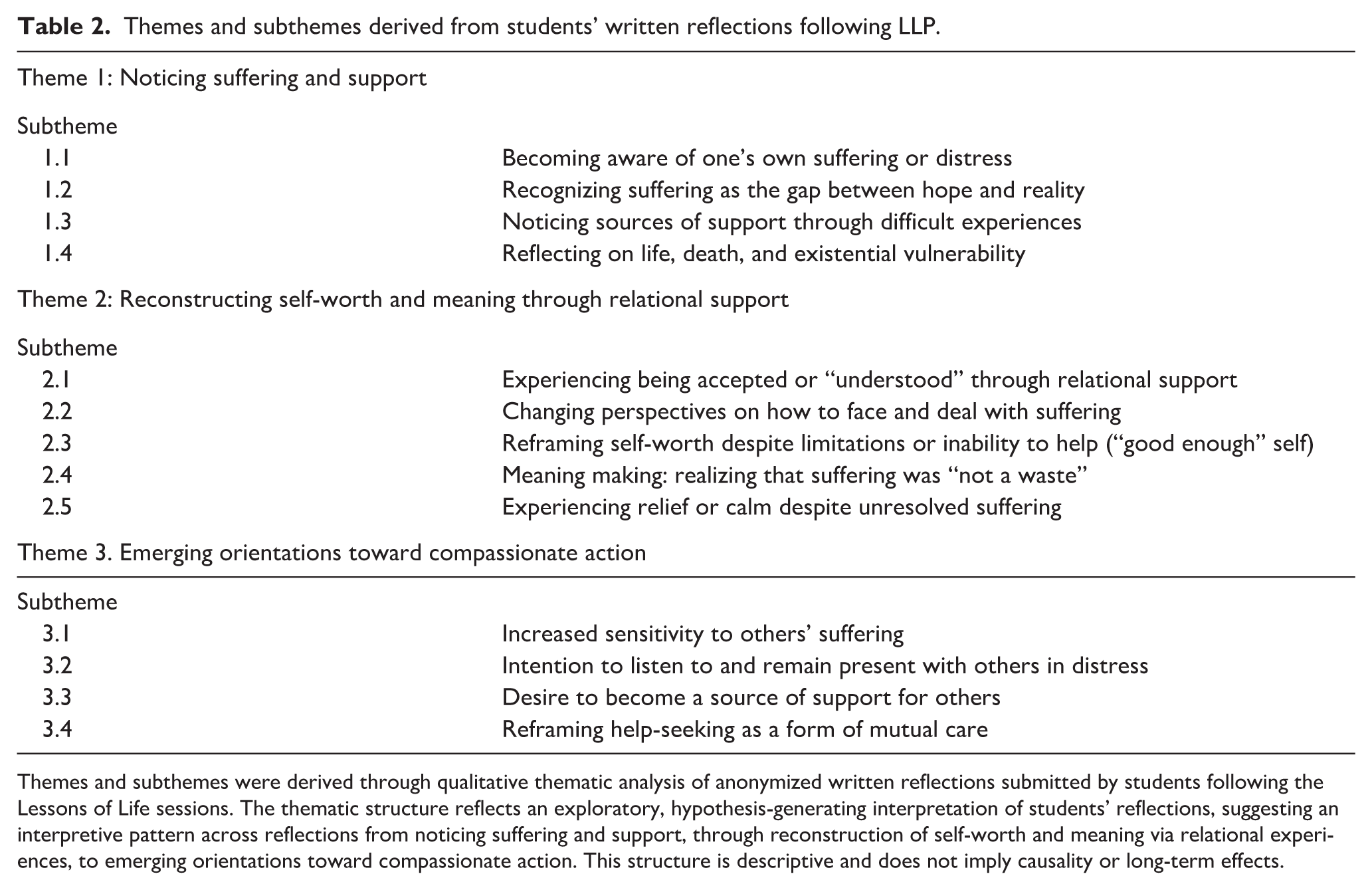
Themes and subthemes were derived through qualitative thematic analysis of anonymized written reflections submitted by students following the Lessons of Life sessions. The thematic structure reflects an exploratory, hypothesis-generating interpretation of students’ reflections, suggesting an interpretive pattern across reflections from noticing suffering and support, through reconstruction of self-worth and meaning via relational experiences, to emerging orientations toward compassionate action. This structure is descriptive and does not imply causality or long-term effects.
Theme 1: Noticing suffering and support
One student wrote:
“At first, I didn’t think that having someone listen would help solve my worries. When I tried to write about my own worries and suffering, I couldn’t do it easily, and I wondered why. That was when I realized that, when I am struggling, my friends around me are actually supporting me.” (Grade 7 student; equivalent to the first year of junior high school in Japan)
The first theme captures students’ initial processes of becoming aware of suffering—both their own and that of others—and recognizing support that had previously gone unnoticed.
1.1 Becoming aware of one’s own suffering or distress
“Recently, I have been holding myself back out of respect for my parents. I would like to take better care of myself and value my own needs, at least a little.” (Grade 6 student)
Students described recognizing feelings such as loneliness, anxiety, or unresolved conflict in their daily lives. For some, this awareness emerged for the first time through the reflective prompts used in the session.
1.2 Recognizing suffering as the gap between hope and reality
“I came to realize that the reason I had struggled so much with my studies was that my parents’ expectations were too high and did not match who I am. Being told over and over, ‘You could do it if you just tried’, had been one of the reasons for my suffering.” (Grade 7 student)
Several reflections described suffering as arising from discrepancies between how students wished things to be and how they actually were, including difficulties with friendships, family relationships, or academic expectations.
1.3 Noticing sources of support through difficult experiences
“I used to be bullied when I was small. I didn’t notice at the time, but I think I was able to keep going because my best friend was always by my side.” (Grade 7 student)
Students described noticing sources of support when reflecting on past difficult experiences.
These sources were described not only as relationships with friends, family members, or teachers, but also as less tangible forms of support.
Some students referred to the presence of deceased loved ones, elements of nature, music lyrics, or personal memories as sources that they perceived as supportive during times of distress.
1.4 Reflecting on life, death, and existential vulnerability
“There was a time in the past when I struggled with something I could not understand and experienced overwhelming distress. At that time, I found it very difficult to continue as I was. Now, I am able to feel, at least a little, that I am glad to be alive. I believe that who I am today exists because of the suffering I experienced in the past. What once felt like unresolved suffering has now become a source of support within myself.” (Grade 8 student)
Without direct prompting about death or mortality, some students spontaneously reflected on life, death, or the value of being alive. A small number mentioned having previously wished to disappear or die, and reflected on these thoughts in relation to the session.
Theme 2: Reconstructing self-worth and meaning through relational support
One student wrote:
“When my parent listened to me and I realized they accepted me, I was finally able to stop hurting myself.” (Grade 11 student)
The second theme reflects changes in how students understood themselves and their suffering after recognizing relational support. These reflections described shifts in self-perception, meaning making, and self-worth mediated through relational experiences, beyond merely noticing support.
2.1 Experiencing being accepted or “understood” through relational support
“There was a short period when I found it difficult to attend school. During that time, my mother said, ‘I see. You were feeling that it was hard.’ In that moment, I felt a sense of relief, as if my heart had gradually become lighter.” (Grade 4 student)
Students frequently described moments in which they felt accepted or “understood” by others. Reflections suggested that this sense of being understood did not necessarily depend on others fully grasping or solving their problems.
2.2 Changing perspectives on how to face and deal with suffering
“After learning that it is possible to feel calm even when suffering is present, as long as there is support, I realized that I had been carrying things on my own. Through this class, I was able to clearly organize in my mind the relationships that can serve as sources of support. From now on, I would like to find ways to become calmer by reaching out to others, such as talking to someone when I need help.” (Grade 6 student)
Some reflections indicated a new capacity to look at problems differently, moving away from avoidance toward reflection and engagement.
2.3 Reframing self-worth despite limitations or inability to help (“good enough” self)
“I often found myself questioning my own existence and feeling that I was a burden to others. Through this class, I learned that there are others who have similar thoughts, which helped ease my feelings. I also came to recognize that there are people around me who support and accept me. From now on, I would like to continue looking for relationships in which people can help one another.” (Grade 7 student)
Students described accepting themselves even when they could not fix problems or be useful to others, suggesting a reconstruction of self-worth not contingent on performance or solutions.
2.4 Meaning making: realizing that suffering was “not a waste.”
“At first, I thought that suffering was only painful and meaningless. But as I listened, I started to remember moments when I thought, “Because that happened. . .” Gradually, I came to feel that although suffering is painful, it gave me a way of thinking like this.” (Grade 7 student)
Students reframed past suffering as having meaning or value, describing it as an experience that contributed to personal growth or understanding.
2.5 Experiencing relief or calm despite unresolved suffering
“Since I became a fifth grader, I had a lot of trouble with my friends, but today’s class itself became a source of comfort, and I felt more at ease.” (Grade 5 student)
Students reported feelings of calmness, relief, or emotional settling even when external problems remained unresolved. Reflections suggested a change in how students related to their suffering, rather than the elimination of distress.
Theme 3: Emerging orientations toward compassionate action
One student wrote:
“I felt my mother was the person and listened to me when I was not able to attend school. She was a ray of light for me. Now it’s my turn.” (Grade 9 student)
The third theme captures students’ emerging intentions to respond to suffering in relational ways, directed toward others and themselves.
3.1 Increased sensitivity to others’ suffering
“At times, I notice people around me who seem discouraged, but I often do not know how to respond. Sometimes I pretend not to notice. Through today’s class, I learned about the practice of ‘repetition,’ and I hope to be able to use it to become a source of emotional support for someone.” (Grade 7 student)
Students described heightened awareness of distress in peers and others around them.
3.2 Intention to listen to and remain present with others in distress
“Even though I had been helped before, when I saw other people struggling or feeling distressed, I felt that there was nothing I could do for them. I kept wondering how I could be of help. But by listening seriously to this talk, I found the courage to face that question.” (Grade 7 student)
Students expressed a desire to listen attentively and stay with others who are struggling, rather than trying to offer advice or solutions.
Some students described a sense of possibility in how they might respond to others’ distress.
3.3 Desire to become a source of support for others
“During elementary school, I experienced repeated interpersonal difficulties with some classmates, which caused me significant distress. I received support many times from teachers, family members, and friends. Through today’s class, the emotional burden I had been carrying has become lighter. In the future, I hope to become a compassionate adult who can support others, drawing on the help I once received and keeping in mind those who are currently struggling.” (Grade 7 student)
Some reflections explicitly described a wish to support others, often framed as a response to having received support themselves.
3.4 Reframing help-seeking as a form of mutual care
“When I was in elementary school, there was a classmate who couldn’t come to school. I felt that I couldn’t do anything for them. But after today’s class, I realized that maybe I could have at least listened. So if someone is suffering, I decided that I will listen. And I also learned that when I am struggling, it is okay for me to rely on others. From now on, I want to do that.” (Grade 7 student)
Notably, help-seeking was often framed not as a sign of weakness, but as an expression of mutual care and relational trust, suggesting a shift in how students understood support within their social worlds.
In addition to student reflections, a subset of teachers provided optional qualitative feedback following the sessions. These comments were not subjected to thematic analysis and are therefore not treated as primary results but are considered in the “Discussion” as contextual perspectives.
Discussion
Summary of observed findings
This section interprets the observed patterns in students’ written reflections through perspectives drawn from spiritual care, compassion education, and public health. Across the dataset, three overarching themes were identified: noticing suffering and support; reconstructing self-worth and meaning through relational support; and emerging orientations toward compassionate action. These themes were observed across educational stages and settings and do not imply a linear developmental trajectory, causal effects, or long-term outcomes. Rather, they represent descriptive patterns derived from thematic analysis of students’ narratives, consistent with reflexive thematic analysis as an interpretive approach. 15
For clarity, the term children and young people is used when considering broader educational and public health implications, while students refer specifically to participants’ written reflections.
Suffering in relation to emerging compassionate orientations
Students’ reflections suggest a possible interpretive process in which awareness of personal distress was sometimes accompanied by recognition of support, shifts in self-understanding, and emerging intentions toward compassionate responses. Importantly, these processes were not described as individual achievements, but as experiences unfolding within contexts where suffering could be acknowledged, shared, or reflected upon, often in relation to others.
Experiences initially described as vague or unarticulated distress were, in some cases, reframed as suffering through the program’s conceptualization of suffering as the gap between hope and reality. This reframing appeared to support meaning-making by providing a language through which previously private or diffuse experiences could become expressible, without implying that such meaning-making necessarily required interpersonal interaction. Such processes are consistent with psychological accounts in which distress is reinterpreted through reconstruction of meaning rather than resolution alone. 16
Students’ accounts do not suggest that suffering itself produces compassion. Rather, relational experiences, particularly moments of feeling accepted or “understood,” appeared to shape how suffering was perceived and held when such experiences were present. This emphasis on relational presence and acknowledgment aligns with spiritual care perspectives that attend to meaning and connection in situations where suffering may be difficult to resolve. 12 Within educational contexts, suffering did not function primarily as a problem to be solved, but at times created conditions in which empathy, intentions to listen, and openness to mutual care could emerge.
Educational and public health implications: Spiritual well-being and compassionate communities
By creating structured opportunities to notice suffering and recognize support, the LLP session positions the classroom as a relational space in which emotional experiences can be acknowledged without pathologization or immediate intervention. From a public health perspective, this aligns with calls to move beyond crisis-driven and individualized models of care, and to strengthen relational and meaning-oriented capacities within everyday community settings. 9
Existing research demonstrates that help-seeking among children and young people is shaped by social norms, stigma, and relational safety within schools, and that supportive relationships play a critical role in whether distress is articulated or remains unspoken.17 –19 These findings suggest that relational disconnection itself constitutes a meaningful risk factor for wellbeing. 18
In contrast to approaches that conceptualize wellbeing primarily as the outcome of targeted interventions or skills acquisition, the present findings suggest that spiritual wellbeing may emerge through relational experiences in which suffering is acknowledged and held within ordinary educational relationships. This connects with non-religious conceptualizations of spiritual wellbeing, emphasizing meaning, connection, and inner calm. 20
This interpretation also resonates with educational scholarship conceptualizing compassion as a relational and ethical orientation cultivated through everyday practice rather than moral instruction alone. 21 Spiritual care likewise emphasizes relational presence and acknowledgment as ways of supporting meaning-oriented processes, particularly when suffering cannot be fully resolved. 12 The LLP appears to translate these layered principles into educational contexts by creating relational conditions in which children and young people can engage in meaning-making through experiences of being heard and understood.
Finally, understood within public health palliative care and compassionate community traditions, such relational capacities can be seen as part of the social infrastructure through which communities respond to suffering.14,22 –24
From self-acceptance to compassionate orientation
While the previous section considered broader educational and public health implications, this section returns to students’ narratives to examine relational processes through which self-acceptance and compassionate orientation were articulated.
Within the LLP, being “useful” or “helpful” is acknowledged as an important source of self-recognition. However, the program also explicitly addresses moments in which children and young people are unable to perceive themselves as useful, strong, or valuable. Students’ reflections frequently described experiences of feeling “not very good,” unnecessary, or as if their existence had little meaning, states often accompanied by significant distress.
Crucially, the program does not attempt to negate these experiences or to replace them with positive self-evaluations. Instead, it invites reflection on the possibility that even when one cannot feel useful or worthy, there may be someone or something that affirms one’s existence as it is. Moments of feeling understood, accepted, or recognized, without the requirement to be helpful or strong, were often described as points at which students could tentatively experience themselves as “good enough.” Such accounts are consistent with dignity-conserving perspectives emphasizing recognition of personhood beyond performance or utility. 11
Importantly, this sense of being “good enough” should not be interpreted as a stable achievement or a guaranteed precursor to compassion toward others. Rather, it appears as a fragile relational possibility: a moment in which self-negation loosens and self-care becomes imaginable. For some students, this opening was followed by expressions of compassion or concern for others; for others, it remained an internal shift without outward orientation. This distinction is also compatible with psychological accounts of self-compassion, which emphasize that kindness toward the self may be difficult to access and may not uniformly translate into prosocial action.25,26
The significance, therefore, lies not only in producing compassion as an outcome but also in creating relational conditions under which self-worth can be reimagined even in the absence of usefulness or resolution, aligning with spiritual care’s focus on relational presence and meaning in the face of unresolved suffering. 12
Limitations
This study has several limitations. First, it was descriptive and exploratory in nature and did not allow for causal inference, evaluation of effectiveness, or assessment of long-term outcomes. The findings should therefore be understood as hypothesis-generating.
Second, data were collected within school-based educational settings that implemented the program voluntarily. The sample was not randomly selected and is not intended to be statistically representative. Classroom norms may also have shaped how reflections were expressed.
Third, participation in reflective writing was voluntary, and reflections varied widely in depth and content. This may introduce selection bias toward students more willing or able to articulate their experiences. Reflections were collected at a single time point following program delivery. The timing of written reflections was not standardized across settings; while some reflections were completed after sessions, others were written later as homework or during subsequent class time, which may have influenced the depth or framing of students’ reflections.
Finally, the study relied on secondary analysis of anonymized data, limiting available demographic detail and precluding subgroup analyses. Reflections written in educational contexts may also be influenced by social desirability.
Despite these limitations, the large-scale, naturalistic nature of the dataset enhances ecological validity and offers insight into how children and young people articulate experiences of suffering and support within everyday educational practice.
Future directions
Future research could extend these findings through mixed methods designs incorporating longitudinal follow-up, classroom observation, or behavioural indicators. Cross-cultural studies, including ongoing pilot initiatives in the United Kingdom, may further clarify how relational frameworks are interpreted across educational contexts. 27
Future work may also examine how compassion-oriented educational practices are experienced by educators themselves. Such inquiry may deepen understanding of compassion as a relational capacity shared among children and adults, while remaining attentive to appropriate study designs and outcome measures.
Conclusion
This study explored how written reflections from children and young people participating in the LLP sessions illuminate possible relational pathways linking awareness of suffering, recognition of support, and emerging orientations toward compassionate relationships. Rather than demonstrating effectiveness or causal outcomes, the findings offer a descriptive, hypothesis-generating account of how children and young people articulate everyday suffering and relational experiences within educational settings.
Across the reflections, moments of self-acceptance were frequently described not in terms of feeling competent, useful, or “very good,” but as arriving at a sense of being “good enough” even when participants felt unable to contribute, meet expectations, or perceive themselves as needed. Such moments often emerged through relational experiences, including feeling listened to, accepted, or understood by others, or recognizing the presence of supportive people or contexts. These accounts are consistent with dignity-conserving perspectives in which personhood is affirmed beyond performance or utility. 11
Importantly, experiencing oneself as “good enough” did not consistently or automatically lead to compassionate action toward others. While some participants articulated intentions toward listening, helping, or caring for others, these orientations appeared as contingent possibilities rather than predictable outcomes. Compassion, when described, was not framed as a moral duty or a learned prosocial behaviour, but as an outward movement that sometimes followed having been recognized or held in one’s own vulnerability. In this sense, self-acceptance functioned less as a precursor to compassion than as a relational condition that may, but does not necessarily, enable compassionate orientation. This framing is compatible with psychological accounts of self-compassion and related relational processes.25,26
Viewed through perspectives derived from spiritual care, these findings underscore the significance of relational presence, acknowledgment, and recognition in situations where suffering cannot be fully resolved.
Importantly, this does not imply that educational settings should function as sites of spiritual or clinical care; rather, it suggests that relational orientations derived from spiritual care may be meaningfully translated into everyday educational practice, where suffering can be acknowledged without demands for resolution, expertise, or intervention.
Rather than emphasizing problem-solving or behavioural change, the reflections highlight how calm, meaning, and dignity may emerge through shared presence and being understood. 12 When translated into educational contexts, such principles suggest that classrooms can function as relational spaces in which vulnerability is legitimized, and suffering is approached without immediate demands for resolution.
From a public health perspective, this study supports understanding education as a potential early, everyday context for cultivating relational conditions associated with spiritual wellbeing, understood in non-religious terms as meaning, connection, and inner calm. 20 Rather than positioning compassion as an outcome to be taught or measured, the findings suggest that compassionate orientations may emerge when children and young people encounter themselves and others as “good enough” within ordinary relationships. In this way, classrooms may contribute to forms of compassionate community grounded not in intervention or expertise, but in recognition, shared meaning-making, and mutual care embedded in daily life.14,22–24
Footnotes
Acknowledgements
The authors express their sincere gratitude to the students and educators who participated in Lessons of Life program (LLP), and to the certified trainers who delivered the sessions across schools and community settings. The authors also acknowledge the supporters who contributed to sustaining the program through their ongoing engagement and assistance. Their commitment made it possible to continue the educational activities that form the basis of this practice-based research.

Ethical considerations
This study involved secondary analysis of anonymized written reflections produced by students as part of regular educational activities conducted in collaboration with schools in Japan. Reflections were collected by teachers during routine classroom practice, and the research team received only anonymized copies for analysis, with no personal identifiers available at any stage. The activity posed minimal risk and did not involve any intervention beyond standard educational practice. In accordance with the Japanese Ethical Guidelines for Educational Research, secondary analysis of fully anonymized classroom materials collected through routine instructional activities, where individuals cannot be identified and no foreseeable harm is anticipated, is exempt from formal institutional review board approval. 28 Therefore, no Institutional Review Board (IRB) approval number was required for this study.
Consent to participate
Participation in the reflective writing activity formed part of the lesson; however, students were informed that they were free to leave questions unanswered, write minimally, or omit any content they did not wish to share.
Author contributions
Funding
The authors disclosed receipt of the following financial support for the research, authorship, and/or publication of this article: This study did not receive any specific funding for research activities, including study design, data analysis, or manuscript preparation. However, part of the educational sessions from which data were derived were conducted as part of a public educational initiative supported by the Cabinet Office of Japan between June and September 2025. In addition, voluntary donations from individual supporters were used to support the implementation of the educational program. Neither the public funding body nor individual donors had any role in the study design, data analysis, interpretation of findings, or the decision to submit this manuscript for publication.
Declaration of conflicting interests
The authors declared no potential conflicts of interest with respect to the research, authorship, and/or publication of this article.
Data availability statement
The qualitative data analysed in this study consist of anonymized student reflections collected through routine educational practice. The timing of written reflections was not standardized across settings; some reflections were completed immediately after sessions, while others were written later as homework or during subsequent class time. Due to ethical considerations and agreements with participating schools, these data are not publicly available. Aggregated data supporting the findings of this study may be available from the corresponding author upon reasonable request.