




Abstract
Background:
Low awareness about palliative care among the global public and healthcare communities has been frequently cited as a persistent barrier to palliative care acceptance. Given that knowledge shapes attitudes and encourages receptiveness, it is critical to examine factors that influence the motivation to increase knowledge. Health information-seeking from individuals and media has been identified as a key factor, as the process of accessing and interpreting information to enhance knowledge has been shown to positively impact health behaviours.
Objective:
Our study aimed to uncover public sentiments toward palliative care in Singapore. A conceptual framework was additionally developed to investigate the relationship between information-seeking preferences and knowledge, attitudes, receptiveness of palliative care, and comfort in death discussion.
Design and Methods:
A nationwide survey was conducted in Singapore with 1226 respondents aged 21 years and above. The data were analysed through a series of hierarchical multiple regression to examine the hypothesised role of information-seeking sources as predictors.
Results:
Our findings revealed that 53% of our participants were aware of palliative care and about 48% were receptive to receiving the care for themselves. It further showed that while information-seeking from individuals and media increases knowledge, attitudes and receptiveness to palliative care, the comfort level in death conversations was found to be positively associated only with individuals, especially healthcare professionals.
Conclusion:
Our findings highlight the need for public health authorities to recognize people’s deep-seated beliefs and superstitions surrounding the concept of mortality. As Asians view death as a taboo topic that is to be avoided at all costs, it is necessary to adopt multipronged communication programs to address those fears. It is only when the larger communicative environment is driven by the media to encourage public discourse, and concurrently supported by timely interventions to trigger crucial conversations on end-of-life issues between individuals, their loved ones, and the healthcare team, can we advance awareness and benefits of palliative care among the public in Singapore.
Plain language summary
Low awareness of palliative care is a barrier that persistently hinders palliative care acceptance among populations in developing and developed countries. As knowledge shapes attitudes and encourages receptiveness, it is vital that researchers uncover factors that influence the motivation to increase knowledge. Health information-seeking is a factor that deserves greater attention in palliative care research because the process of seeking out information on health concerns from other people or the media can greatly increase individuals’ knowledge. As such, this nationwide survey involving 1226 participants was carried out in Singapore to understand the public sentiments toward palliative care. It further statistically analyzed if information-seeking (from individuals and the media) will increase knowledge, attitudes, receptiveness toward palliative care, and comfort level in death discussion.
Our findings indicated that 53% of our participants were aware of palliative care and about 48% were receptive to receiving the care for themselves. Furthermore, while information-seeking from individuals and media increases knowledge, attitudes, and receptiveness to palliative care, people are only comfortable to engage in death discussion with individuals, especially healthcare professionals. Exposure to media alone is not enough to encourage individuals to want to talk about end-of-life issues including palliative care. As Asians view death as a taboo topic, it is important for public health authorities to recognize people’s deep-seated beliefs and superstitions surrounding the concept of mortality. A multipronged communication program is therefore needed to address these fears. It is only when the larger communicative environment driven by the media to encourage public discourse, and concurrently supported by timely interventions to trigger crucial conversations on end-of-life issues between individuals, their loved ones, and the healthcare team, can we advance awareness and benefits of palliative care among the public in Singapore.
Keywords
Background
Access to quality palliative care is both a human right and an ethical imperative. Despite the global acknowledgment of its priority from the public health perspective, only 14% of the world’s population received timely palliative care during serious illnesses.1–3 Although research has demonstrated the benefits of early integration of palliative care into the healthcare system and community in improving the quality of end-of-life (EOL) care,4,5 key barriers exist. In developed and developing countries, these barriers include entrenched misconceptions and perceived lack of training among healthcare professionals, low awareness within the community, and lack of integration of services within the healthcare continuum and community.2,6–10
One of the barriers that have been frequently cited as a persistent factor that hinders the development and receptiveness of palliative care is the lack of knowledge among the public and healthcare community.11,12 As knowledge shapes attitudes and acceptance of palliative care, the lack of awareness can severely deny dying patients from receiving palliative care and inhibit healthcare professionals from improving better care for the terminally ill.13,14 Past studies have shown that healthcare workers who were found to have better knowledge of advance care planning (ACP), for instance, demonstrate favorable attitudes and receptiveness toward policies affecting EOL, while individuals who were more knowledgeable about palliative care reported more positive perceptions of hospice care.15,16
With the unnecessary suffering resulting from lack of access to palliative care and the wide variability in the integration of palliative care for patients with serious illnesses within healthcare systems,6,10,17 there is an urgent need for public health scholars to better understand the growing evidence in awareness disparities, negative perceptions arising from inadequate knowledge, and low utilization of palliative care services.18,19 This is particularly pressing given the rising burden of terminal and life-threatening illnesses due to the global aging crisis. As this phenomenon will inevitably increase demands for health authorities to offer person-centered and integrated health services to support ailing individuals and their families, health advocates worldwide are calling for greater community engagement and education to increase awareness of palliative care. 1 One recommended topic for engagement is to encourage the public to talk about death as such conversations can certainly help to increase knowledge, shape positive attitudes toward EOL issues, and foster greater receptiveness to palliative care. 20
Like many developed nations, Singapore has one of the fastest aging populations in the world. 21 Driven by its falling fertility rates and prolonged life expectancy, 25% of Singapore’s population will be aged over 65 years by 2030. 22 With a rapidly aging population, there is an urgent need in Singapore to make provisions for its residents to age and die well. 23 A recent study showed that less than half of terminally ill cancer patients and their caregivers locally were aware of palliative care. 24 Another non-academic report also showed that only about half the population was aware of palliative care. 25 Over the years, significant efforts have gone into increasing public awareness in Singapore. For example, in 2017, the Ministry of Health invested heavily in supporting the efforts to improve community engagement and awareness among the general public in the city-state (e.g. television commercials, art-based projects). 26
However, increasing the awareness and understanding of palliative care among the general public may not be enough to change attitudes and enhance receptiveness in Singapore. Considering that death is an unavoidable life eventuality, it is vital that individuals facing life-threatening illnesses, together with their loved ones, discuss EOL issues. Aligned with their information-seeking behaviors and decision-making preferences, these discussions will further involve the need to receive palliative care. 27
For this reason, it necessitates that populations are adequately informed of ACP starting from medical prognosis, treatment preferences, and priorities, in addition to hopes and fears regarding dying and death. 28 While the importance of physicians–patients communication in healthcare has long been recognized within medical education, in the context of a growing and aging Singapore population, the propagation and dissemination of knowledge about ACP including palliative care services cannot be provided solely by healthcare professionals.29,30 The right to health and access to quality palliative care must involve death conversations and understanding of EOL care offered in the larger communicative environment driven by public health communication in Singapore.
On this account, the public health approach adopted to promote greater appreciation for palliative care needs to incorporate the roles that mainstream and social media play in transferring the saliency of this health subject to the public. 31 Media coverage helps to set priorities, raises legitimacy in health messages, and influences public trust. 32 Such publicity is influential in driving conversations beyond a single issue of interest or subject as it has the capability to change individuals’ attitudes, perceptions and behaviors toward issues, and ultimately alter the public’s opinion. 33 The ability of the public to access and to be able to seek information from the larger communicative environment is hence critical in raising awareness, fostering positive attitudes, nurturing receptiveness, and generating death conversations to drive understanding of palliative care and its contribution within the healthcare continuum.15,16
Health information-seeking
Health information-seeking is a predictor that past studies have shown to increase knowledge needed to make informed decisions to help change health behaviors. 34 It is increasingly documented as a key coping strategy in health-promotive activities and psychosocial adjustment to illness. 35 Information-seeking refers to the purposive attainment of information through selected channels to contribute to one’s decision-making. 36 It often occurs as a coping manner to reduce the uncertainty created by new information. 37 Prior studies have emphasized the role of information-seeking in reducing uncertainty among patients with cancer. 38 In the context of palliative care, being diagnosed with life-threatening illnesses compels patients and family members to confront a suite of unfamiliar symptoms, and life-changing decisions. 39 Such uncertainty aggravates psychological distress, often resulting in adverse coping and poor decision-making. 40 To bridge the information gap, patients and families often seek and obtain information from multiple sources. 38 Research showed that cancer patients and their caregivers seek information primarily from two groups of sources, that is, individuals such as physicians, family, and friends41,42 and information from the media.34,43
Research objectives
Although some studies have shown that the effects of information-seeking from trusted sources have a positive impact on health-promoting outcomes and behaviors due to increased knowledge and more positive attitudes, existing literature on the extent information-seeking influences public awareness, attitudes, and receptiveness toward palliative care is scarce. Understanding these associations is important to both terminally ill patients and their families as timely and honest conversations on death and dying can help them to make informed care decisions, articulate fears, and make known final wishes to loved ones and improve patients’ EOL. 44 Given the dearth of literature on how health information-seeking behaviors and communication influence public awareness, attitudes, receptiveness, and death talks, this nationwide study aims to first understand public sentiments toward palliative care in Singapore. Second, it purposes to examine the relationship between information-seeking intentions and four variables, that is, (a) knowledge, (b) attitudes, (c) receptiveness, and (d) comfort in death discussions.
Description of conceptual framework
For this study to be able to offer targeted suggestions on public health communication strategies to promote greater community engagement, we have further categorized sources of information from which individuals seek health information to (1) individuals (physicians, family, and friends) and (2) the media (mainstream and social media). Past studies showed that care providers are considered the most trusted palliative care information source.45,46 Providing information is also perceived by patients and caregivers as a key obligation of palliative care clinicians. 46 In addition, social workers play essential roles in offering support to patients and families, which includes the provision of relevant information. 47 Apart from seeking information from professional healthcare providers, individuals also obtain information from family members and friends, particularly those who were themselves patients or caregivers. 48
As mass media are frequently used as platforms for health campaigns to increase palliative care awareness, media form the second set of sources key to information-seeking. 49 In addition to traditional mass media, the internet and different forms of digital media have become primary sources offering information on palliative care. Although previous studies have investigated the influence of digital media platforms such as Facebook, Twitter, and YouTube as information sources for individuals seeking information on palliative care,50–52 few studies have examined their impact on health-promotive activities and psychosocial responses. As such, to close this knowledge gap in health literature, a conceptual framework was developed to hypothesize that information-seeking intentions from individuals and the media will be positively associated with (1) increased knowledge; (2) positive attitudes toward EOL care planning; (3) greater receptiveness toward palliative care; and (4) higher comfort level in death discussion (Figure 1).
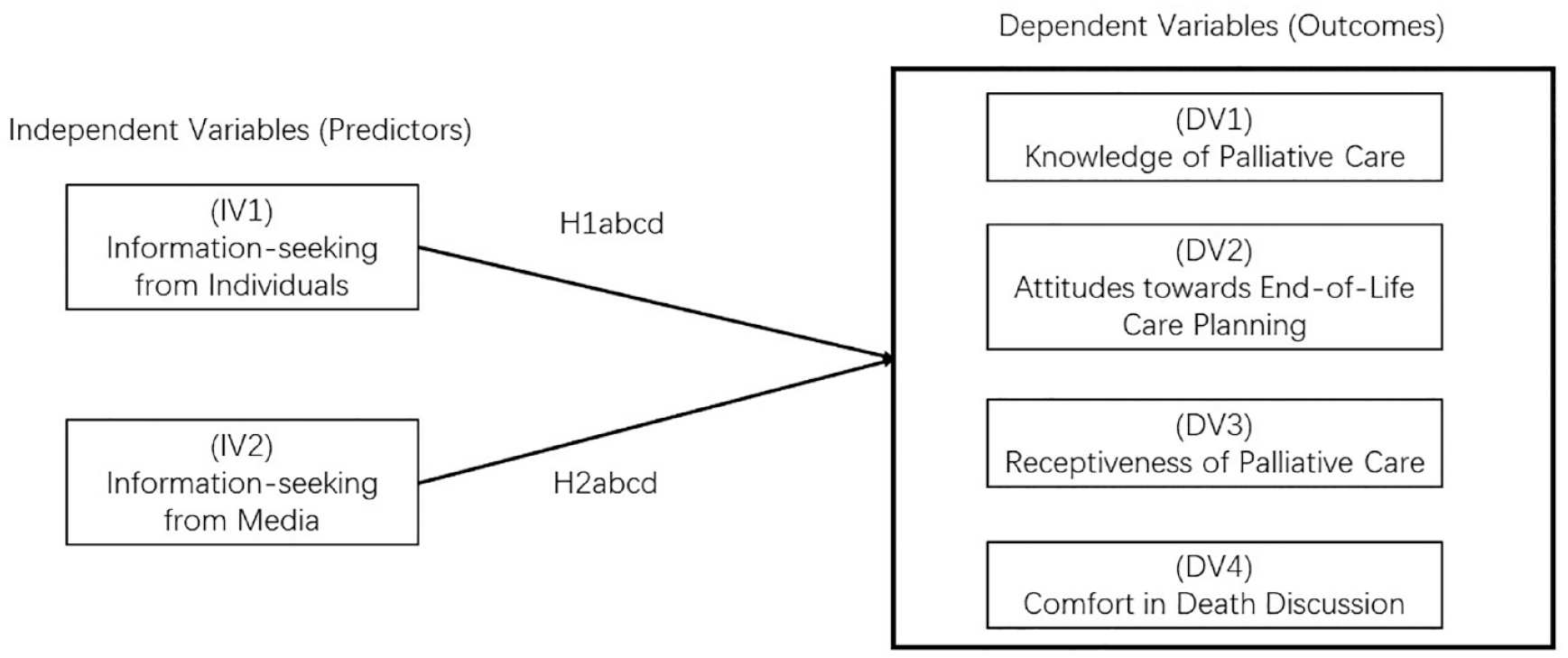
Proposed conceptual framework.
Method
Design and data collection
As this is a nationwide study, our research conducted a cross-sectional survey in both online and offline settings to obtain a nationally representative sample in Singapore. For the online survey, Qualtrics was used to collect responses from 926 participants during April and July 2019. Screening criteria included the following: (a) Singapore citizens or permanent residents, (b) aged 21–60 years, and (c) proficient in English.
Given the concern that the online panels were largely limited to middle-aged adults who were literate and digitally savvy, a local research agency was additionally used to carry out a door-to-door survey to include the elderly who were not proficient in English and had trouble accessing online information. We used the same questionnaire which was translated into Mandarin for the Chinese respondents. As the hired interviewers were ethnically diverse and competent in both languages, that is, English and Mandarin, English and Malay or English and Hindi, they were able to translate and read out the questions in the English or Mandarin questionnaire to all the elderly participants regardless of their ethnicity. The sampling database for this group was purchased from the government statistics with a list of 600 random residential addresses covering all regions of Singapore. Participants were selected by cluster sampling based on a constructed frame of residential addresses from July to August 2019. A total of 300 participants who met the inclusion criteria – 51 years or older, not proficient in English, not digitally savvy – were subsequently approached to participate in our study.
In total, 1226 respondents participated in the study (926 online and 300 face-to-face). As Singapore is a multi-ethnic country, the ethnic ratio of Singapore’s population was also roughly followed to make the national representative samples (i.e. 74.3% Chinese, 13.4% Malays, 9.0% Indians, and 3.2% others; according to the Singapore Department of Statistics, 2018). Data were collected between April and August 2019 after obtaining approval from the Singapore Management University’s Institutional Review Board on 12 March 2019 (Grant Approval No. 18-C207-SMU-017). All respondents gave their informed consent before participating in the survey.
Questionnaire and measures
The questionnaire was developed by integrating modifications of existing scales, and inputs from healthcare experts. Depending on the empirical insights we hope to draw from our data, the scales assembled for the survey comprised nominal, ordinal, and interval scales. The final questionnaire consisted of questions relating to general sentiments about palliative care, information-seeking sources, knowledge, attitudes toward EOL care planning, receptiveness to palliative care, comfort level on death discussion, and demographics (see Supplemental Material for the final questionnaire).
Public sentiments
Questions asked included awareness, receptiveness, objection, perceived affordability of palliative care, and comfort level in death conversations.
Information-seeking sources
Questions asked included information-seeking sources (individuals and media) and the extent participants actively looked for information on palliative care in the past 30 days.
Information-seeking intentions from media
Six items were adapted to measure respondents’ likelihood of seeking information from media, namely (1) newspapers, (2) magazines, (3) radio, (4) television, (5) internet search engines, and (6) social media (e.g. Facebook, Twitter). 53 Composite scores were computed using the average score, with a higher score reflecting greater intentions to seek information from media. This scale was further grouped into two dimensions: mainstream and digital media. Items 1–4 were averaged to create the mainstream media scale (Cronbach’s α = 0.88), and items 5–6 were averaged to create the scale measuring digital media (Cronbach’s α = 0.74).
Information-seeking intentions from individuals
Four items were created to measure the likelihood of seeking information from (1) family, (2) friends, (3) doctors, and (4) nurses (Cronbach’s α = 0.72). Items 1 and 2 were subsequently averaged to create the family and friends scale (Cronbach’s α = 0.75); while items 3 and 4 were averaged to create the healthcare professionals scale (Cronbach’s α = 0.82).
Knowledge of palliative care
This scale was created by the authors who adapted questions from inputs provided by senior medical consultants in the local palliative care sector. Knowledge of palliative care was measured with 10 items (e.g. ‘Palliative care provides psychological and emotional support for the patient’). The answers were marked on a three-point scale (1 = No, 2 = Not sure, 3 = Yes) and the composite scores were added up to create the measurement range. A higher sum score indicated greater knowledge (Cronbach’s α = 0.73).
Attitudes toward EOL care planning
The seven-item composite scale was adapted to measure respondents’ attitudes toward EOL care planning (e.g. ‘It is important to plan for the future’) by indicating their levels of agreement on a five-point scale. 54 A higher score reflected a more positive attitudes (Cronbach’s α = 0.82).
Palliative care receptiveness
Three items were created to measure respondents’ likelihood of considering palliative care (i.e. ‘for yourself’, ‘for family members’, and ‘for close friends’) on a five-point scale. These three items were averaged to create one measurement and a higher score reflected a greater likelihood of considering palliative care (Cronbach’s α = 0.83).
Comfort level of death discussion
This scale measured individuals’ level of comfort in carrying out death conversations. Two items were used to measure the extent respondents feel comfortable when discussing ‘your own death’ and ‘death with someone with a life-threatening illness’ on a five-point scale. Composite scores were computed using the average score and a higher score reflected a greater willingness to talk about death (Cronbach’s α = 0.67).
Demographics
Respondents’ sociodemographic profiles were also recorded.
Statistical analysis
Data analysis was performed using SPSS (Version 25; IBM, New York, NY, USA). Descriptive statistics were compiled for public sentiments and demographic variables, while paired-sample tests were conducted to compare the likelihood of seeking information from the different sources before a series of hierarchical multiple regression were carried out to examine the hypothesized role of information-seeking sources as predictors.
Results
Demographics
Table 1 summarizes the demographic profile of the 1226 survey participants and compared the profile to the national statistics. In terms of language proficiency, more than half of the respondents were most comfortable speaking English (60.8%), followed by Mandarin (28.3%), Malay (5.1%), other languages and Chinese dialects (4.4%), and Hindi (1.4%). Approximately half of the respondents have a higher education degree (47.5%), and the majority (60.8%) of the respondents were married. In terms of gender breakdown, it was close to equal between males (51%) and females (49%). Over half of the respondents also rated their health condition as fairly good or good (58.6%).
Demographic characteristics.

Population aged 20 years or under excluded from national statistics for age.
Ministry of social and family development Singapore.
Statista.
Public sentiments of palliative care
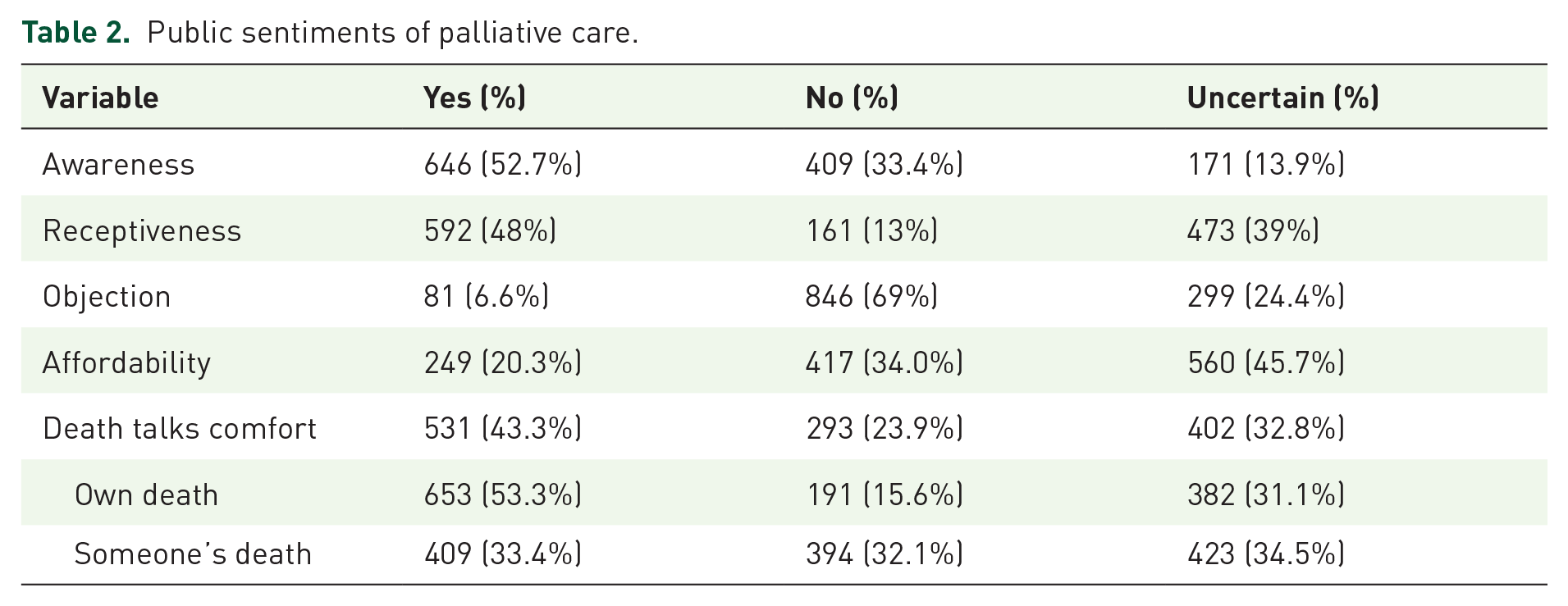
Just over half of the respondents were aware of palliative care (52.7%) and less than half were receptive to receiving palliative care for themselves (48%), while respondents who had heard of palliative care were more willing to receive it for themselves when needed (x2 = 47.06, p < 0.001). While the majority do not object to it (69%), only one-fifth (20%) of respondents thought palliative care was affordable in Singapore. As for death talks, over half (53%) were comfortable discussing their own death while barely a third (33.4%) would do so with someone who is dying (Table 2).
Public sentiments of palliative care.
Information-seeking sources
When asked if participants actively searched for information on palliative care in the past 30 days, only 27% of respondents proactively did. Regarding sources they were likely to seek palliative care information from, respondents reported that they were significantly more likely to do so from individuals (M = 3.64, SD = 0.72) compared to seeking it from media (M = 3.10, SD = 0.84), p < 0.001. The likelihood of seeking information from doctors and nurses was significantly higher (M = 3.83, SD = 0.84) compared to family and friends (M = 3.44, SD = 0.92), p < 0.001. Preference for digital media was also significantly higher (M = 3.32, SD = 1.13) compared to mainstream media (M = 2.98, SD = 1.00), p < 0.001.
Hypotheses testing
Participants’ information-seeking from individuals was positively related to their knowledge (β = 0.10, p < 0.001), attitudes (β = 0.28, p < 0.001), receptiveness (β = 0.27, p < 0.001), and comfort in death discussion (β = 0.11, p < 0.001) (Table 3). Further investigations, however, showed that while seeking information from healthcare professionals was positively related to all four outcomes, seeking information from family and friends showed no significant changes in participants’ knowledge (Table 3).
The role of information-seeking sources in predicting palliative care outcomes.

N = 1226. Demographic variables were controlled.
p < 0.05. **p < 0.01. ***p < 0.001.
DV, Demographic variable; n.s., not significant.
Participants’ information-seeking from media was positively related to knowledge (β = 0.14, p < 0.001), EOL attitudes (β = 0.13, p < 0.001), and receptiveness (β = 0.29, p < 0.001) (Table 3). However, media sources had no significant impact on participants’ comfort level in death conversations, suggesting that seeking information from media did not increase participants’ comfort level in this regard. It is also interesting to note that seeking information from digital media showed stronger effects on knowledge and attitudes compared to doing so from mainstream media.
Discussion
Our nationwide study showed that just over half of the Singapore respondents were aware of palliative care and less than half were receptive to receiving palliative care for themselves. The fact that awareness and receptiveness toward palliative care have remained somewhat static over the years despite intermittent public outreach campaigns over 5 years highlights the need for further investigations and more targeted communication approaches. One possible hindrance, as shown in our findings, may be the discomfort to engage in death talks (see Table 2). As such, while it is encouraging that 70% did not object to palliative care, avoiding death talks may be inhibiting many from deepening their appreciation for palliative care.55–57 The healthcare costs for inpatient palliative care were also perceived by the majority as not affordable which may further explain why most deaths in Singapore occur in the hospital setting. 56 Given these concerns, it is unsurprising that efforts to increase awareness and receptiveness have met with some resistance. Furthermore, while our research revealed that higher information-seeking intentions through individuals and media could potentially increase knowledge, enhance attitudes and receptiveness to palliative care, the comfort level in death discussion was only found to be positively associated with information-seeking through individuals.
Our findings highlight the importance of understanding Singapore’s multi-cultural, multi-faith context, and its associated emotional and psychological barriers toward EOL care receptiveness in the community.58–60 In Asia where traditions are steeped and social customs are closely adhered to, death is a taboo topic. Discussion on issues relating to EOL occurs by association, while talks of palliative care are to be avoided at all costs. The Chinese culture, for example, associates bad luck with death. Hence, conversations on EOL which would naturally lead to the need for palliative care are equivalent to invoking bad luck. 61 In Singapore, the Chinese make up the largest ethnic group. With 74% of the population Chinese, many in the city-state are influenced by the similar cultural belief that the mention of death may jinx one’s fate. 62
On this account, to advance awareness and benefits of palliative care, public health authorities should first aim to recognize people’s deep-seated religious, superstitions, and personal insecurities surrounding the concept of mortality and thereafter adopt multipronged communication programs to address those fears. Messages in public campaigns should be sensitively crafted to calibrate with personal apprehension for mass outreach and palliative care education for community-based medical professionals. The end goal is to encourage a willingness to engage in death talks which will lead to greater motivation to seek a deeper understanding of quality palliative care, correct misperceptions, and differentiate the types of medical offerings for EOL care that correspond to families’ financial and resource abilities.49,63 To this end, comprehending individuals’ use of media, information- and health-seeking behaviors is critical in advancing palliative care awareness.
Our findings further showed that 27% of respondents proactively seek information on palliative care in the past 30 days, which was considered relatively high for a topic that individuals would search for only when they need to or are somewhat involved in this life stage. However, our sample characteristics with 39.4% of the respondents in the study indicating that they are currently caregiving or have previous experience in palliative care probably accounted for this high number. This concurred with our additional analyses which indicated that individuals with experience in palliative care had higher receptiveness, t(653) = 6.60, p < 0.001; higher tendency of death discussion, t(653) = 4.37, p < 0.001; and more favorable attitudes, t(653) = 2.44, p = 0.015.
While information-seeking from both individuals and the media was found to be positively associated with knowledge, attitudes, and receptiveness, the likelihood of seeking information from individuals was higher than doing so from media sources. Further analyses showed that seeking information from doctors and nurses was keener compared to family and friends. This highlights the important role healthcare professionals continue to play as beacons of accurate information in this age of information saturation. It behooves that we continue to upskill the wider community of healthcare providers in basic palliative care knowledge, skills, and understanding of local palliative care services. Past studies have shown that healthcare professionals themselves have suboptimal knowledge of available palliative care services, including resistance to adopt basic palliative care skills and talking about EOL care.46,64,65 When healthcare providers do not recognize the need to introduce palliative care or hold empathetic EOL conversations with their patients, missed opportunities abound. This was evident in a study that showed that less than half of patients with advanced cancer indicated an awareness of palliative care. 24 The reasons cited for not receiving palliative care included having to undergo treatment, not time yet for palliative care and that palliative care did not help much.24,25 Such misconceptions perpetuate the false dichotomy between curative and palliative care as well as the late initiation of supportive and palliative care philosophy in people with life-limiting illnesses.
There is hence an urgent need to map existing informational gaps and narrow the chasm between people’s expectations and their knowledge, attitudes, and reticence of healthcare providers. Given that people trust doctors and nurses more than the media in meeting their informational needs, this presents the opportunity to meld two approaches by engaging healthcare providers to front the far reach of media exposure. In addition, we should promote triggers for timely conversations with frontline healthcare workers, that is, primary care doctors, oncologists, geriatricians, and chronic disease specialists who are usually the first to encounter patients newly diagnosed with life-limiting illnesses.
The means and methods by which information is distributed also remain as salient as the message. Further investigation of media sources showed that respondents demonstrated a greater preference for digital media compared to mainstream media when seeking information on palliative care. This is unsurprising given the current pervasiveness and accessibility of digital information, particularly when dealing with younger generations of patients. 66
However, in this study, unlike when people sought information from individuals, media sources had no significant impact on the comfort level in death discussion. This is salient as web-based ACP tools proliferate in endeavors and have been shown to significantly increase access to ACP information, enhance knowledge and patient communication, and improve documentation and goal concordant care. 67 The findings of our study demonstrated though that neither mainstream nor digital media increased comfort level in ‘die-logues’. This deserves further examination as talking about one’s death and dying remains a taboo and a deeply personal endeavor among Asians that cannot be easily overcome by media outreach. An integrative systematic public health approach driven by health authorities is required to review culturally tailored messages on ACP to address nuances and dispel misconceptions toward palliative care within the population.58,60,64 For taboo subjects, media can only go as far as generating topics to contribute to the public agenda and discourse in the larger communicative environment. Considering that Asian patients are willing to engage in death conversations only in the late stage of the disease which does not allow time for them or their family members to acquire knowledge, change their attitude, or be receptive toward palliative care, 68 health professionals should be encouraged to start EOL care discussions earlier in the course of the disease to increase the delivery of tailored care.28,69
As for efforts to better facilitate the integration of palliative care services within the healthcare sector, creating an open and accepting environment is a vital component for palliative care implementation. Community-based interventions have been applied as an effective approach to preventive health promotion. 70 In the context of palliative and EOL, the community can serve as the setting of care with the growing recognition that EOL care is not only the task of professional care providers. 71 Consistent with our findings supporting the effectiveness of individuals as the primary information source, members in the community have potentially significant roles in supporting the patients and their caregivers facing the challenges of EOL. 72 Therefore, an integrated approach between professional care providers and communities is key in advancing palliative care receptiveness and open death discussion.
Strengths and limitations
Our nationwide study aims to offer empirical evidence and critical insights on public sentiments, and the role of information-seeking intentions on key psychosocial responses toward palliative care in Singapore. It is the first to offer a framework to examine the influence of information-seeking intentions on knowledge, attitudes, receptiveness toward palliative care, and death conversations. It has further successfully recruited a large and representative sample of the Singapore population, including door-to-door with non-English speakers. However, it did not examine the impact of misconceptions and barriers on information-seeking intentions; and how palliative care messages purveyed within public outreach influence knowledge, attitudes, and receptiveness. Future studies may wish to investigate the effectiveness of content formation, such as death topics, and identify effective message sources to better align with culturally diverse audiences.
Conclusion
In the current information age, mass media-generated interpersonal communication as integrated sources of information is critically needed to increase cognitive awareness of palliative care and to change health behaviors. Personal encounters with healthcare professionals as trusted authority figures remain important in seeking information on EOL care. While mass outreach through media is effective in increasing knowledge and fostering positive attitudes toward palliative care, targeted and timely interventions to trigger crucial conversations between individuals, their loved ones, and the healthcare team are equally vital and paramount.
Supplemental Material
sj-docx-1-pcr-10.1177_26323524231196311 – Supplemental material for Public sentiments and the influence of information-seeking preferences on knowledge, attitudes, death conversation, and receptiveness toward palliative care: results from a nationwide survey in Singapore
Supplemental material, sj-docx-1-pcr-10.1177_26323524231196311 for Public sentiments and the influence of information-seeking preferences on knowledge, attitudes, death conversation, and receptiveness toward palliative care: results from a nationwide survey in Singapore by Su Lin Yeo, Raymond Han Lip Ng, Tan-Ying Peh, May O. Lwin, Poh-Heng Chong, Patricia Soek Hui Neo, Jamie Xuelian Zhou and Angel Lee in Palliative Care and Social Practice
Footnotes
Acknowledgements
The research team wishes to thank Singapore Management University-Ministry of Education for the financial support and all members of the Steering Committee for Community Engagement & Strategic Communication at the Singapore Hospice Council for their valuable feedback and input.
Declarations

Supplemental material
Supplemental material for this article is available online.
References
Supplementary Material
Please find the following supplemental material available below.
For Open Access articles published under a Creative Commons License, all supplemental material carries the same license as the article it is associated with.
For non-Open Access articles published, all supplemental material carries a non-exclusive license, and permission requests for re-use of supplemental material or any part of supplemental material shall be sent directly to the copyright owner as specified in the copyright notice associated with the article.
