




Abstract
Background:
Gratitude has sparked interest in the world of health. It is considered as a personality characteristic or as an emotion. However, little has been explored in the context of the interpersonal relationship of caring. An exploration in the context of end of life is ground-breaking.
Objectives:
This study analyses and reflects on the object of gratitude from the perspective of both the persons being cared for and the professionals providing health care. What are patients and their family members grateful for in palliative care? What is the reason for gratitude? What do these health professionals perceive when there is gratitude? These questions were answered considering the gratitude generated in health care encounters, not gratitude as personality trait.
Methods:
The phenomenological approach was used starting from lived clinical experiences. In the light of the dialogue between clinical experiences and philosophy, this study proposes an explanation of the ‘real’ or essential object of gratitude in palliative care. It was conducted within the context of palliative care. The study materials were manifestations of gratitude expressed or felt in clinical encounters and published in newspapers or shared in daily encounters. These were the basis for analysis and reflection and interdisciplinary dialogue.
Findings:
The analyses performed indicated healing or deep relief in serious diseases as objects of gratitude according to patients’ perspective, and professional self-affirmation until the end according to the professionals’ perspective.
Conclusion:
The two perspectives shared an important common fact, namely, the need to consider the persons in their entirety, and the importance of not losing sight of the value they have. This concept would characterize the nature of gratitude, its object being the ‘objective good’ for patients, family members, and palliative care professionals.
Introduction
Gratitude is a universal phenomenon in all cultures and societies. Etymologically, the term ‘gratitude’ comes from Latin. It is related to kindness, generosity, the beauty of giving and receiving, or getting something for nothing. 1 Gratitude is present in the field of health.2,3 Particularly, gratitude can be observed in situations of advanced or terminal diseases. 4 Family members express their appreciation towards the professionals for the care provided to their loved ones. On the other hand, when the professionals perceive that they are recipients of gratitude, they experience, like an echo, their own feelings of gratitude. 5
Studies conducted in the health field have indicated two different perspectives of the gratitude phenomenon. In the field of social psychology, gratitude is considered a characteristic of the personality.6,7 The other perspective understands gratitude as linked to emotions. Schwarz 8 defined gratitude as significant persons’ emotions or emotional responses that arise spontaneously due to something previously received and its meaning. The concept of gratitude as an emotion has gained relevance in positive psychology, that is, positive emotions would be a source of well-being and happiness, 9 which should be fostered through gratitude interventions. 10
Several authors have insisted on the importance of exploring the phenomenon of gratitude, precisely in the context of interpersonal care relationships. 11 Considering the context of end of life and the social association of palliative care with death and negative views, 12 it may seem unusual the existence of gratitude towards professionals when a patient dies. The evidence suggests that it is not uncommon.4,5 Moreover, it seems that such expressions of gratitude may be beneficial for the patients 13 and even for the professionals receiving these expressions.14,15 Initial studies mention specific aspects appreciated on each experience16,17 but, to the best of our knowledge, there has been no in-depth analysis of what is the essence of the object of gratitude. Gratitude emerges as a response to something done altruistically by someone and perceived as good by the other. In this study, the object of gratitude refers to ‘an objective good for the person’. This term – coined by von Hildebrand 18 – is halfway between the two classic categories of goods. The first, ‘important in itself’ or ‘intrinsically important’, refers to anything that we simply recognize as good and worthy of admiration, for example, a generous act that we observe in someone. The second category, as opposed to the first, is ‘merely subjectively satisfying’, and it refers to the particular attractiveness of something as it satisfies or pleases someone, for example, when someone pays a compliment. This distinction between objective and subjective goods has been recognized since Aristotle. 19
Hildebrand’ category has aspects of both: it shares objectivity (its character of good per se, and not only because it is satisfying), and shares the subjective aspect that this good has been given precisely to one individual.8,20 The particularity that a good is granted to someone promotes the peculiar response of gratitude for that good. This also happens in the caring relationship. Understanding the underlying essence of the benefit perceived by the serious ill person that leads him or her to express gratitude to the palliative care professional will help to understand what is essential in this caring relationship and will shed light on the comprehension on its impact in the context of palliative care. In the present interdisciplinary study, we assessed the object of gratitude, the objective good, in the field of palliative care.
Method
In the present study, we used the phenomenological method. This approach is based on what is offered to us in ‘intuition’, taking into account as what is presented as being, but only within the limits in which it is presented there. This principle has been called by Husserl ‘principle of all principles’. 21 Therefore, the first phase is not a theoretical analysis, but the observation of phenomena, the data of the experiences. In our case, we assessed the experience of gratitude in the clinical context of palliative care. The validity of theoretical approaches is not denied, but the analysis of experiences was established as a priority over the comparison of theories.
The phenomenological method was chosen because it allows accessing the ‘essence’ or ‘nature’ of the lived experiences of gratitude, beyond their ‘subjective’ dimension. As the philosopher von Hildebrand 18 pointed out, not all data related to lived experiences are subjective impressions or mere phenomena that differ from the truly objective nature of things. There are necessary data that show the objective nature of the ‘original phenomena’. For this reason, phenomenology does not focus on experience to make mere observations of the existence of some lived experience, but rather seeks their ‘essence’ to know what they are. Therefore, the essences with which phenomenology deals are not abstract but concrete experiences. 22 Gratitude would be one of those original phenomena that need to be clarified through the analysis of the different types of lived experiences related to it.
The phenomenological analysis performed in the present study started by assessing lived experiences of gratitude occurring in the context of palliative care. A variety of data sources were used:21,22 relatives’ gratitude letters received in a hospital palliative care support team, family members’ and health professionals’ personal experiences, and press releases of gratitude from different services and contexts, articles, and books (both biomedical and philosophical) about the concept of gratitude. Besides, based on international publications, key authors on the topic were identified and invited to share their findings about gratitude and to participate in seminars to discuss about the phenomenon of gratitude. This added an external perspective from different countries (i.e. United Kingdom, Switzerland) in the analysis process. Health professionals and philosophers analyzed this evidence, experiences and reflected on them altogether. Concrete experiences, readings, and seminars with international experts chosen for their publications were combined. The analysis process was dynamic and iterative, analyzing and searching for evidence that helped us to reflect, verify or discard those key aspects through the joint analysis of philosophers and clinicians. There was a reflection process on unfolding the experience that combined social science methods (reflexive and empiric methods to collect, reflect and write the lived experience) and philosophical methods (epoché-reduction to reflect and write). The analysis started with the local examples of relatives’ gratitude letters received in a palliative care support team of a hospital. Key aspects were identified and reflected. We considered whether there might be specific aspects to the service and analyzed press releases for other experiences. Thus, we reflected on what laid behind the appreciated aspects, such as pain control, humanity, and about ideas, such as curing, healing, caring, or health. We combined lived experiences and reflexive methods21,22 reading different texts and books about gratitude to help to search for the meanings embedded in texts. The readings provided meanings and clues to deepen the analysis of the rather experiential accounts to identify key aspects of the essence of gratitude in palliative care. The process was complemented with seminars with international experts about their research knowledge about gratitude and a family member and a health professional who also shared their experiences. During these seminars, there was a discussion with people who were not part of the research team to assess if adequately represented their experiences.
Discussions and reflections were recorded during the process to go deeper and discern about the nature of the object of gratitude. The results will be presented next integrating also the discussion of these.
Findings
The object of gratitude
The category of the ‘objective good for the person’
18
fits as the object of gratitude as the experiences transmitted the recognition of something good (i.e. aspects of care received were highlighted) but, at the same time, they recognized how tough the situation was (so not subjectively ‘satisfying’). This is shown in the following excerpt that captures that the experience is hard (not satisfying) but the contribution perceived as something good and addressed to them: The reason for this letter is to thank you for the treatment, both to my mother, Laura, and to all the family . . .. a dry pain, like a ‘sledgehammer’ (referring to the mother death), but mitigated by the company of a handful of professionals who have made a family broken by a six-years pain, to look death in the face, without fear or resentment, and especially, thanks to you, that ‘I don’t know what is’ that death produces, the loss of a loved one, becomes the closest thing to something ‘natural’.
Indeed, it makes no sense that persons are grateful for things that have nothing to do with them, nor for things that only those persons have perceived as pleasant or satisfying. We are not grateful for things that are important in general terms, but for things addressed to us, which shows the relational nature of gratitude. We appreciate a gift because it is addressed to us. Strictly speaking, this fact means that we can only be grateful for objective goods addressed to us. However, we can also indirectly thank those objective goods addressed to persons with whom we have special relationships. Thus, the family members of patients are also grateful for the ‘gift’ made to their loved ones. The term gift is used because of its gratuitous nature, which corresponds to an unconditional logic of action. The act performed without expecting anything in return represents precisely what a gift intends, thus breaking with a reciprocal equivalence or transactional circle. In this context, it is understood that the professionals ‘give a gift’ to the patients; they offer the patients something that goes beyond reciprocity. As shown in the following case: The medical and nursing care provided was necessary for our father’s physical well-being, as we could not fight his illness with other weapons. But it is not only these facts that we want to highlight; the performance and the know-how of the staff of that unit went beyond what we could expect. Our mother, as a companion, and our father, were cared for all their needs as appreciated and loved people, and their stay during the six months was the closest thing to our home . . . They all know that our thanks can never be sufficiently recounted in these lines.
In the context of palliative care, and perhaps in health care in general when there is suffering, this gift has a peculiar qualitative nature. Thus, a relative says: I would like to tell you that, with each passing day, I realize how much you have done, which goes far beyond the obligation to treat a sick person. You were patient, condescending, loving and kind not only to her, but also to me, that I was having a hard time . . .
The persons, who are grateful—patients or their family members—feel that the professionals have considered them with benevolence, as unique persons that have been transcended by the diseases, but who maintain their integrity and preserve their personal dignity intact. Therefore, they feel that they have been the object of a total affirmation and not only of a particular aspect, such as, for example, the suppression of pain or a change in an organ during the disease process (e.g. Figure 1).

Example of gratitude letter received in the palliative care service.
The goal of the present study was to determine the objective good that constituted the object of gratitude in the field of palliative care. The answer to this question depended on determining who the grateful subject was. In this context, the subjects of gratitude can be both patients and palliative care professionals. First, we reflected on what patients and family members were grateful for. Subsequently, the study assessed the objective good of gratitude in palliative care professionals (Figure 2).
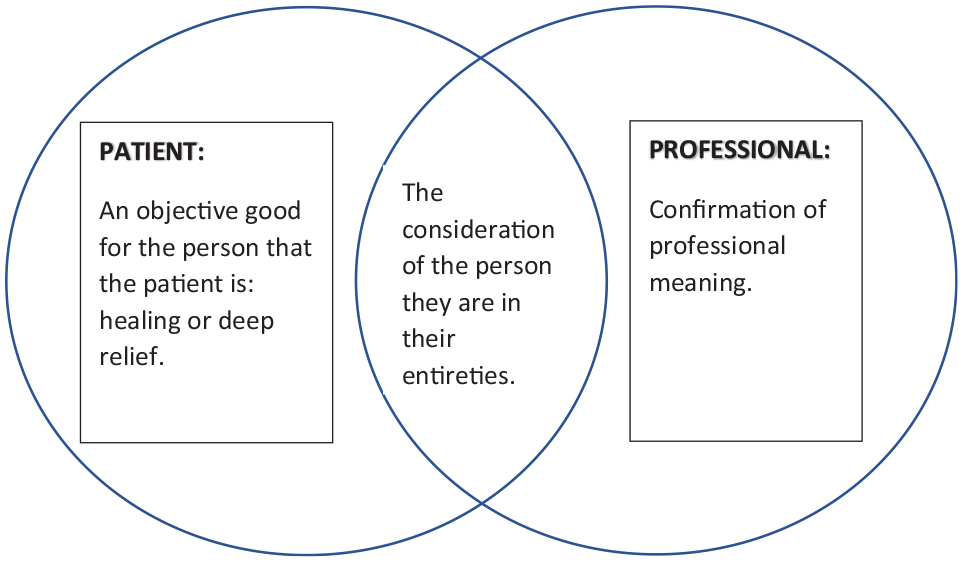
Representation of the object of gratitude in palliative care.
Patient and family members’ perspectives
The object of gratitude for a sick person is health or, rather, recovering it. This may seem logical, but it did not fit with the experiences of family members and required further reflection to identify the essence of what was really appreciated. There is a broad and important debate about what health consists of; however, we could not go into detail in this study. In this sense, 70 years ago, the World Health Organization (WHO) defined health as a complete state of physical, social, and mental well-being, and not only as the absence of diseases. 23 As can be seen, the fundamental concept of this definition is that of ‘well-being’. This term has been defined as the personal experiences of persons relating to their lives, comparing their circumstances with values and social norms. 24 This experience has two dimensions, namely, one subjective (general feeling of well-being) and the other objective (e.g. having a job). 24 This is alike on the consideration of goods. 18 Other conceptions recognize that health and disease are dynamic processes between which persons fluctuate. 25 In addition to the WHO definition, other authors have taken into account nuances, such as the perception of health as a relative state, in which the persons are able to function effectively to express their greatest potential as human beings in their environments, thus contributing to the well-being of the entire community. 26
By including the term well-being in the definition of health, the WHO goes beyond the idea of absence of disease, focusing on what health is, and not so much on what it is not. 27 However, authors, such as Larson 28 and Huber et al., 27 have argued that well-being was complex to define. They pointed out that the requirement of complete well-being not only represented a utopia. It should be considered that, strictly speaking, no one could be considered perfectly healthy.27–29 These authors made a new proposal to define health, arguing the need for a more dynamic perspective, defining health as the ability to adapt to the circumstances and perform self-care in the face of social, physical, and emotional challenges.
In any case, the fact of considering that health—or its recovery—is the object of gratitude for palliative care patients should be clarified. Palliative care patients suffer from incurable diseases and have limited prognoses and life expectancies. Under these circumstances, sick persons do not regain a state of health similar to that prior to the diseases. These patients experience the advancement of the diseases and the progressive deterioration of their health. This aspect can also be found in the testimonies of patients and their family members, mentioning a countdown, such as: ‘. . . during these months when my father’s life was slipping away without remedy . . .’. When expressing gratitude, patients also affirm the difficulty that their deterioration entails and the fact that they feel worse about the symptoms, discomfort, and problems caused by the diseases. Therefore, a reconsideration of the object of gratitude is required, which, in our opinion, involves a broader vision of the concept of health: At a time when sadness invades you and grief overwhelms you, we have found a place where they listen to you, they share your emotional state ‘for real’. They care as much as anyone else for the health of the sick person but also for the health of those accompanying them; not only for the physical health but also for the mental and spiritual health of everyone who feels awful when they see a loved one going through the difficult moments to which a terminal illness has subjected them.
In this sense, it is interesting to reflect on the notion of health in the field of palliative care, relating it to the concept of salus, even to salvation. It has been observed that patients appreciate positive events, namely, the professionals’ concern for them as persons, as transmitted: ‘Nowadays, when everything is reduced to numbers, it is significant, striking and to be appreciated that, in the face of such a painful situation, personal treatment takes precedence over the medical aspect, which is of the highest level . . .’. This concern is especially valued and appreciated by the patients, since they feel treated while their individualities and uniqueness are taken into consideration. They appreciate receiving person-centered care.
In palliative care, patients and their family members do not usually refer to health properly as an object of gratitude. They tend to recognize suffering, and show that, under these circumstances, the presence of the professionals brings relief from suffering in a deeper sense. A daughter explains it: And friends, once again, there you were, silent, being there but not being there, far away but close, her absence and your presence, both silent, and between them, the pain . . . but mitigated by the company of wonderful professionals. Thank you from the bottom of my heart, friends, for your presence and for every grain of sand (referring to contribution) that each one of you contributed to the process.
The active presence of the professionals in the palliative context needs some clarification. It is not a mere presence; it goes beyond the fact of being physically next to the patients. This presence is loaded with meaning, that is, these professionals are ‘completely’ present, bringing their whole being to the encounter with the patients and their family members, at the physical, emotional, cognitive, relational, and spiritual levels. 30 It is a mediating ‘instrumental’ presence, which through listening actively recognizes patient needs, responds to them, and guides them. The presence of palliative care professionals is as a catalyst for relief from deep suffering, and the object of gratitude. Healing, a word derived from health, is appreciated; however, it has a broader meaning than that in common use. It is not possible to restore health—physical healing—but deep or existential suffering can be alleviated.
It has been a balm for us, it has eased our pain, calmed our anxiety and enabled us to cope with the situation. They have not only relieved him physically in his pain, they have also relieved his spirit, they have comforted him to carry his illness with great dignity.
The complex concept of existential suffering encompasses aspects, such as: loss of meaning or purpose in life; search for answers to existential questions, such as why am I here or what is behind death; the lack of links or hope; the fear of being a burden; the feeling of isolation or loneliness; or the fear of dying.
31
Existential suffering results from fearing pain or death, separation from loved ones, dissatisfaction for not having carried out important actions in life, not feeling forgiven, and so on. Also, in these difficult situations, when receiving palliative care, the patients can experience profound relief—healing—and, therefore, generate significant gratitude. As Fagerstrom affirmed, the possibility of personal growth arises from the midst of disease and suffering:
32
I am aware that I have done everything possible to ensure that he suffered as little as possible during the period of his illness, and then in death. But this situation was achieved to a large extent only because of your extraordinary support . . . I will always be grateful to you, and I thank God for being so privileged and for having seen the beautiful face of death which, thanks to you, I know now exists.
Gratitude on the part of sick persons or their family members arises for having perceived compassion, personal accompaniment. In the fact of being cared for by another person, the patients feel recognized or affirmed as persons, and experience peace. A relative state using a quote from Machiavelli: ‘I can only tell you one thing: Thank you. “Everyone sees what you look like, but few feel what you are”’.
The link between health professionals and patients is appreciated, which is ultimately based on the human condition itself. This condition reveals a deep layer of the being, which is precisely what gratitude points to. The professionals who provide care are appreciated for what they are, not for particular traits or characteristics, for example, something that makes them nice. Gratitude in palliative care corresponds to patients’ experience of being recognized or affirmed as persons—sick or even persons with incurable illnesses persons—by the professionals that are present and accompany them. These patients do not perceive help in subordinate and external things—in what they have—but, overall, in what it is through sentences like: ‘we found a place where patients are people, not numbers or commodities . . .’.
Health in the deep sense, the healing that is appreciated, entails the affirmation of the individual and concrete person, the experience of integrity, and wholeness in contrast to feeling hurt, which supposes an experience of suffering and anguish. Gratitude does not arise for having reached a specific level of health as a goal. A regeneration is experienced, an overcoming. The patients perceive that not only the symptoms or problems that they have (the bad thing) are alleviated; they feel reaffirmed in the good things, in what is important, in what is lasting, and in what they are as persons. As Bruera explains, palliative care accepts the challenge of recovering the persons for as long as they live. 33
Sick persons experience this inner healing process while receiving attention from palliative care professionals who perform with their presence as catalysts or facilitators. The concept of ‘co-regulation’, according to which the patients reach levels of serenity, trust, and peace, allowing them to use their own resources, can be established in the authentic encounter between sick persons and health professionals. However, if the situation is characterized by suffering or threat, this process could not take place.
30
He knew he was dying . . . he followed everything as he was told, he was always feeling better because of you and his words were: ‘This is wonderful, these people have understood me so well’.
Perspective of palliative care professionals
How do palliative care nurses or physicians experience being the object of gratitude? In the experience of feeling the recipient of patients’ gratitude, the professionals also experience gratitude. Health professionals do not perform because they want to be thanked for their work. It is common for these professionals to be surprised when receiving gratitude, because they do not expect it and consider that they are ‘doing their job’, or that they have not done anything ‘special’. They think that they have promoted the cure if possible, alleviated problems or symptoms, focused on essential organs functions, and provided support psychologically and spiritually, that is, the normal things. These professionals are surprised when they realize that the patients appreciate something that cannot be easily perceived by themselves,
5
as conveyed in this case: I was impressed because I didn’t do anything special, but I was impressed, overall, by the value of the things we do.
These professionals perceive that healing or deep relief of the patients is rather the result of other factors beyond them. The first factor is the contribution of the patients. However, they perceive that the care they provided is appreciated too, even though they thought they were doing just the normal thing. In this way, these professionals understand a little more about the consequences of professional care and accompaniment. Gratitude, then, reinforces their motivation, as has also been confirmed in previous studies.4,16,34 Thus, the paradox arises, that is, while the care provided seems to be only basic for the professionals, the patients think that the least they can do is being thankful. They sometimes even need to express gratitude very meaningfully, grateful as ‘for life’. And those, who think that they have only done their work, may feel some discomfort due to the disproportion in terms of feelings. A professional conveyed this: For you, what is it like when the family says ‘thank you for not leaving in their last moments’? I feel embarrassed to be told that. Are you embarrassed? Yes, because I think it’s what I had to do. It feels like a done duty. He is thanking me for something, only because he needed it and I have surely well identified that he needed it.
Expectations play an important role in gratitude. It is reasonable for patients to expect professional skills and competencies from physicians or nurses; however, they do not have to expect personal care, time, or affection. They expect attention because they are sick, not because they are persons. Health professionals regard their job of caring as a moral or professional duty. The profound effects in the patients are not expected as a consequence of their performance, and when these effects are communicated with gratitude to them, they receive it as a surprising gift, which, in turn, generates gratitude; as explained in the following quotation: What is gratifying for the patient and is verbalised by him or his family, also becomes gratifying for the professional. It is a kind of reaffirmation of your daily work. That what you are doing makes sense.
All professionals, regardless of their field, enjoy being thanked, as a professional said: ‘Nobody becomes bitter by a candy’ and ‘the manifestations of gratitude received are acknowledged’. Palliative care professionals appreciate the same aspect as any professional, namely, the recognition that their work has served for something and for someone. In palliative care, patients approach the end and die. In their gratitude, the professionals perceive that their contributions have been helpful and that their actions—however, insignificant and small they may seem to them—were really significant for the patients. As a professional stated: Quality control is done by the patients themselves, it is the person you directly relate to, the one who receives your care, it is the patient or the relative, and that is the one telling you: OK, proper care, well done. They say through a letter, or with a bunch of flowers . . .
Professionals are grateful that patients and their family members share with them their intimacy, concerns, fears, joys, conquests, sufferings, and so on. These professionals feel that they have the privilege of approaching these persons who are suffering from severe diseases. There is then a kind of reciprocal recognition. The professionals have recognized persons in the patients, and the patients have recognized persons in the professionals. A professional clearly conveyed this: That lady who, when her husband died, gave me a jewellery box that they had ordered together for me, well, that’s a plus, isn’t it? It’s not what they give you, but the love they put into it or the love I receive . . . Because that shows you the love that those people also put into it or the effort they made to go and buy you that thing especially for you.
This professional recognition has been considered to be linked to the vocation of caring. The experience of having been able to deeply benefit another person constitutes a reaffirmation of what the professionals one day felt called to do.
It’s like a very powerful experience. I’m telling you, of wellbeing, of peace, of enormous vital energy, of meaning. When some colleagues say: ‘palliative care work is hard’, I say: ‘it is very intense’. But this intensity, when you experience things like this, these visits of gratitude, these letters that come to you . . . It’s a rush. It’s like saying: ‘Wow, it was worth it!’
It could, therefore, be said that the objective good of gratitude that arises in palliative care professionals is closely related to the confirmation of their professional mission, that is, showing with their work that patients with incurable situations are never patients that cannot be cared for: For me, the tokens of gratitude from a patient give meaning to my work. That’s why it becomes gratifying for me, because they give meaning to my work.
Conclusion
The present study has presented the first results of an investigation about the object of gratitude in the field of palliative care, from a double perspective, namely: on one hand, that of the patients and their family members; and, on the other hand, that of health care professionals in charge of providing care to those patients. The analyses performed indicated healing or deep relief in patients with severe diseases as objects of gratitude from the patients’ perspective, and professional affirmation until the end according to the caregivers’ perspective. The two perspectives share, in our opinion, an important common fact, namely: the need to consider the persons in their entireties, and the importance of not losing sight of the value they have. This is the nature of gratitude and the objective good that it brings to the patients, their family members, and palliative care professionals.
