




Abstract
Integration of qualitative and quantitative data in mixed methods research generates confirmed, discordant, and expanded findings. Guidance is available about the methods and strategies for the meaningful integration of data. However, little has been written about strategies for managing discordant findings in mixed methods. This paper describes and illustrates practical strategies for managing and integrating discordant findings in mixed methods analyses based on researchers reflections and experiences of managing and integrating discordant findings in convergent and sequential exploratory mixed methods studies. Two strategies, namely, comprehensive case and variable analysis and sociocultural exploration are proposed. Comprehensive case analysis involves identifying discordant findings in quantitative data, identifying supportive data in qualitative data, and selecting variables for mixed analysis and interpretation. Sociocultural exploration comprises qualitative code and quantitative data matrix for themes, identification of discordant findings under each theme, and development of sociocultural profile. Identifying and addressing discordant findings in mixed methods is an essential step of rigorous mixed methods analysis. The comprehensive case and variable analysis and sociocultural exploration strategies emphasize the need to examine discordance in data at an early stage of analysis. Further use and evaluation of these strategies are warranted to expand the body of knowledge about practical methods of mixed methods data analysis.
Introduction
Mixed Methods Research (MMR) is an iterative methodology that hones the strengths of qualitative and quantitative methodologies to strengthen the research conceptualization, planning, implementation, and evaluation.1,2 Various theoretical views and qualitative and quantitative methods of data collection and analyses are combined to develop an in-depth understanding of the studied phenomena, to explain interesting findings, to develop data collection instruments, and to develop, test, and evaluate interventions and programs.1,3 The core aims of MMR are to seek corroboration of findings, explain initial findings, and to explore before conducting further inquiries. 1 To achieve these aims, the integration of qualitative and quantitative approaches, methods, and resulting study findings is of utmost importance.4–6 Therefore, integration could occur at multiple dimensions (e.g. study purpose, research questions, data collection, analysis, interpretation, and reporting) from the conceptualization to reporting. 7
Guidance is available in mixed methods literature about the methods and strategies for meaningful integration (e.g. joint displays, data transformation, and intensive case analysis) of data at these different dimensions.4,6,8,9 At the data analysis and interpretation levels, successful and adequate integration generates three kinds of mixed methods findings: confirmed, discordant, and expanded.1,6 confirmed findings arise when qualitative and quantitative findings are similar and consistent and reinforce each other. The expanded findings arise when qualitative findings provide additional interpretations about the quantitative findings and vice versa or expand insights gained from different phases. The discordant findings arise when qualitative and quantitative findings are inconsistent or contradict each other, and do not converge to support mixed methods interpretations. 1 Bazeley 6 argues that discordant findings are not problematic but, if integrated into the final interpretation, enable researchers to accommodate the multifaceted social realities of the studied phenomena. Therefore, discordant findings should be effectively integrated to develop more comprehensive interpretations and identify any future areas of inquiry. Despite the importance of and need for addressing discordant findings, there is little discussion about the strategies for managing and integrating discordant findings in mixed methods. Therefore, this paper offers some strategies for integrating discordant findings.
Purpose
To describe and illustrate strategies for managing and integrating discordant findings in mixed methods analyses.
Background
Generally, discordance in mixed methods could be perceived as unfavorable to rigorous analysis. However, mixed methodologists have argued about the positive value of discordant findings.3,4,6,10,11 There is an emphasis on integrating discordant findings to understand the context of the findings, develop new hypotheses, generate new insights about the participants and the studied phenomenon.3,4,6 The potential sources of discordant findings are the diversity of methods, participants, situations, and contexts.3,4
Mixed methodologists offered broad conceptual approaches to integrate discordant findings. Greene 10 argued for a dialectical perspective to address discordance in mixed methods at teams, methods, and interpretation levels. Dialectical stance emphasizes the construction of qualitative and quantitative inferences (i.e. conclusions drawn from individual phases) and mixed meta-inferences (conclusions drawn after integrating quantitative and qualitative inferences) by integrating distinct threads and patterns of data. Johnson 12 expanded upon this dialectical perspective. He offered dialectical pluralism as a meta-paradigm to resolve conflicts, discordance, and discrepancies arising in MMR. Dialectical Pluralism encourages researchers to resolve conflicts among team members and stakeholders and develop working solutions to effectively manage discordant findings emerging from the integration of qualitative and quantitative findings.
Pluye et al. 11 reviewed nine mixed methods studies and proposed four strategies to manage discordance. First, reconciliation refers to the re-analysis of data to resolve the discordant findings. Second, initiation pertains to developing new questions and collecting new data to explain discordant findings. Third, bracketing in which any irreconcilable qualitative and quantitative data are labelled as extreme cases, and plausible explanations are developed to understand it. Fourth, exclusion pertains to the notion that the validity of either qualitative or quantitative data should be questioned, or the mixed methods study is considered incomplete. Schoonenboom and Johnson 3 offered two strategies: (a) explore and examine the discordant findings in further research and (b) seek explanations from existing literature. Bazeley 6 proposed three strategies: (i) taking a dialectical perspective on the discordant findings, (ii) intensive, residual, and extreme case analysis, and (iii) further research to understand the source and nature of discordant findings. These are broad approaches and invaluable for planning and conceptualizing purposes, but difficult to operationalize. Hence practical strategies are needed so that researchers can effectively manage discordant findings.
Data sources
Three mixed methods projects served as the basis for articulating and delineating the strategies for managing discordant findings. A brief overview of the three studies is presented with a more explicit focus on data integration methods and the generation of mixed findings.
Study one
Younas and Sundus 13 used a convergent mixed methods design to comprehensively understand patients’ experiences of and satisfaction with the care provided by male nurses in medical-surgical units. Qualitative and quantitative data were collected in a parallel manner. For the quantitative phase, 262 patients completed the translated version of the Newcastle Satisfaction with Nursing Scale. For the qualitative phase, 15 patients participated in semi-structured interviews. The qualitative and quantitative data were analyzed separately and then integrated using the merging technique. The data integration was completed to develop inferences and meta-inferences about three overarching questions: experiences of patients, the satisfaction of patients, and gender-based differences concerning experiences and satisfaction. The meta-inferences were identified as nine confirmed and four expanded. The expanded meta-inferences were identified after re-analysis and re-interpretations of the discordant findings. Therefore, none of the meta-inferences were labelled as discordant. Some of the discordant findings will be presented as exemplars in the later section.
Study two
Pedersen et al. 14 used a convergent mixed methods design to comprehensively understand social inequality in cardiac rehabilitation attendance among patients with acute coronary syndrome. The aim of the study was to explore the extent to which the qualitative and quantitative data converged and explained mechanisms and drivers of social inequality in cardiac rehabilitation attendance. Qualitative and quantitative data were collected in a parallel manner. However, while the quantitative data collection period lasted over 1 year, the qualitative data collection only lasted 6 months and was initiated 5 months after quantitative data collection began. For the quantitative phase, 302 patients hospitalized with acute coronary syndrome were included in a quantitative prospective observational study. Data were collected through self-administered questionnaires. In total, 24 of the patients participated in qualitative semi-structured interviews. The qualitative and quantitative data were analyzed separately and then integrated with joint displays using the merging technique. A series of six joint displays (i.e. visual displays integrating the qualitative and quantitative findings) were developed. Each joint display represented the integration of a single factor hypothesized to be important relative to inequality in cardiac rehabilitation attendance, i.e. travel time, lifestyle/health beliefs, self-efficacy, comorbidity, anxiety/depression, and cohabitation/relatives. Qualitative and quantitative findings primarily confirmed and expanded each other; however, the qualitative and quantitative findings regarding anxiety and depression were discordant.
Study three
Younas et al. 15 used sequential exploratory mixed methods design to understand the challenges experienced by nurse educators while teaching students in undergraduate nursing programs. In the first phase (qualitative), they interviewed 12 nurse educators. They used the themes and sub-themes generated from their data to develop a questionnaire for the subsequent quantitative phase. In the second phase, the developed questionnaire was pilot tested. Its face and content validity and internal consistency were assessed. In the final phase (quantitative survey), 112 educators completed the questionnaire and noted their challenges. The integration occurred in two instances. First, between phase one and phase two, the building technique was used to develop the questionnaire. Second, at the end of phase three, the merging technique was used to integrate phase one and three findings for comparing the qualitative data about educator challenges with the survey responses about personal, institutional, clinical teaching, student related, ministerial, and research related challenges. In total, one expanded and six confirmed meta-inferences were identified and labeled. However, several discordant findings were also generated but not described in the paper in detail. Those discordant findings are presented as exemplars in this paper.
Strategy 1: Comprehensive case and variable analysis
The overall purpose of comprehensive case analysis is twofold: (a) identifying discordant findings and (b) discernment about the discordant findings, which should be integrated and interpreted for the mixed analyses. To achieve the first purpose two approaches can be used, which are discussed as follows. Bazeley’s 6 approach of intensive and divergent case analysis facilities in identifying discordant findings through the comparison of data across demographic variables and groups based on scores of quantitative instruments. Schoonenboom’s 16 approach of case development enables the identification of underdeveloped, moderated, and controversial cases by evaluating cases and the available evidence. In both approaches, the definition of a case is different. For Bazeley, 6 the case could be individuals, groups, and organizations. However, Schoonenboom’s 16 case refers to a theoretical construct that needs refinement with continuous empirical research. Our comprehensive case analysis across two studies was guided by Bazeley’s 6 intensive case analysis. Younas and Sundus 13 based their case analysis on one variable (i.e. patient gender). Therefore, the unit of analysis was the difference in satisfaction and experiences of male and female patients. Pedersen et al. 6 based their analysis on the cases for which complementary qualitative and quantitative data about depression and anxiety was available. For comprehensive case analysis, Younas and Sundus (2018) used a three-step method.
Identification of discordant findings related to quantitative variables of interest
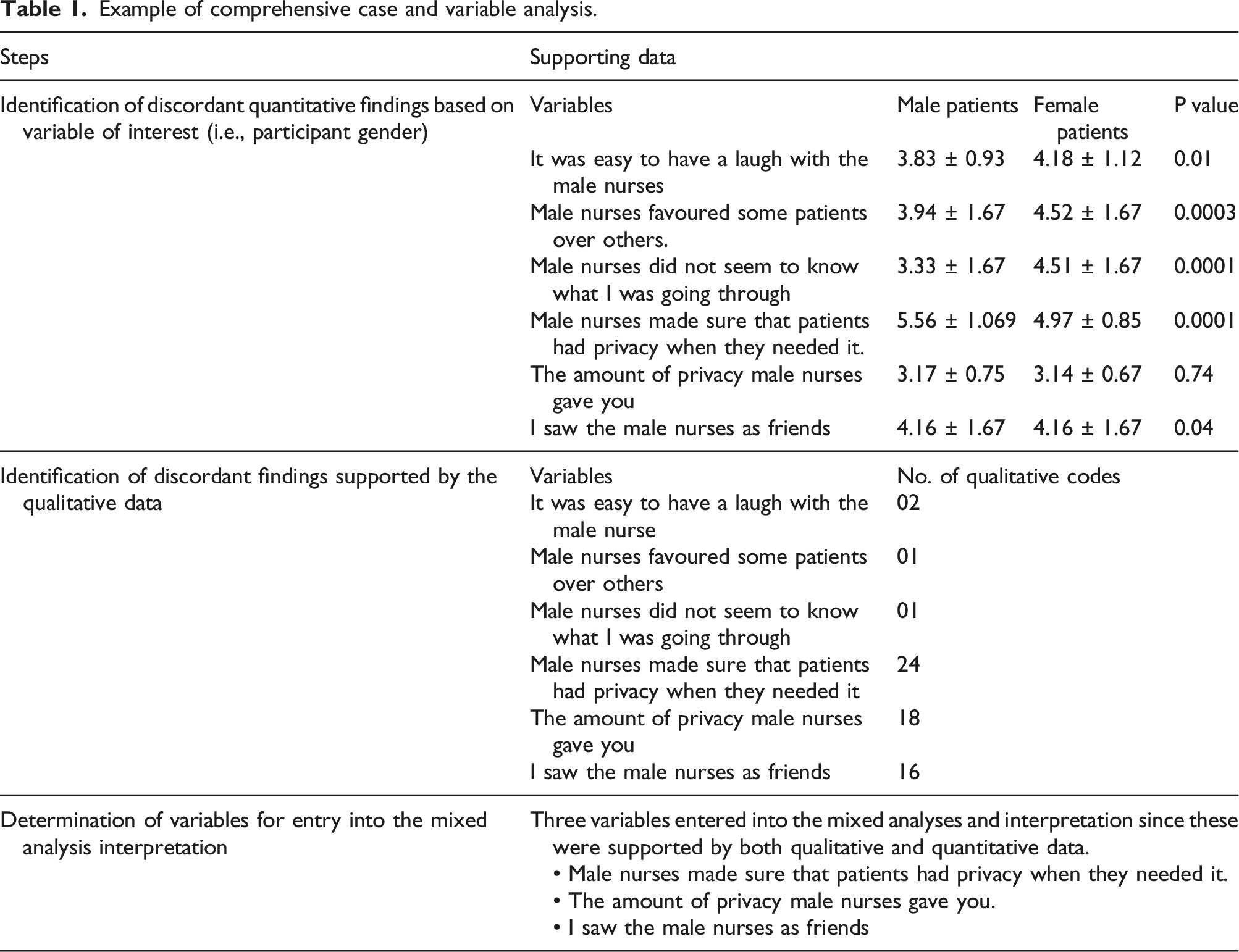
At this step, discordant quantitative findings are identified concerning the quantitative variables of interest. The variables of interest are discerned based on the overall study purpose and the nature of the data. The variables could include participant groups, demographic variables, and settings. For example, Younas and Sundus 13 identified divergent cases based on patient gender (variable of interest). They examined the mean satisfaction and experiences scores of patients on the quantitative instrument and its items. Both the overall mean scores on the subscales and mean scores on the individual items could be considered. However, Younas and Sundus 13 focused on the individual scores of the items. They identified six variables and assessed the statistical difference across the item scores of each of these variables across male and female patients.
Identification of discordant findings supported by the qualitative data
The second step is to assess if the divergent quantitative findings are supported by or explained through qualitative codes and themes. The number of qualitative codes generated for each of the variables are listed in a table or a matrix, and compared with the quantitative data to assess the extent of discordance. The codes and variables could be organized into code-variable-code and pattern matrices for better interpretation. Younas and Sundus 13 identified scores of six items from the patient experience and satisfaction scales as discordant quantitative findings. To assess the extent of support and discordance with the qualitative data, they identified the frequency of qualitative codes for each of the seven items. The frequency and codes were based on the qualitative analysis of the whole dataset. If the qualitative data supported the discordant results, the variables were entered into a subsequent mixed analysis and interpretation phase. Otherwise, the variables were removed from the mixed analysis and explanation and considered to be the areas for future research.
Determination of variables for entry into the mixed analysis and interpretation
Example of comprehensive case and variable analysis.
Pedersen et al. 14 also implemented comprehensive case analysis differently after separate analysis of the qualitative and quantitative data. They explored how anxiety and depression affect cardiac rehabilitation attendance using both qualitative (n = 24) and quantitative (n = 302) data. Cardiac rehabilitation attendance was assessed by self-reported attendance. Quantitative data on anxiety and depression were obtained through the validated Hospital Anxiety and Depression scale (HADS). 17 Quantitative data were analyzed using logistic regression analysis to assess the association between anxiety/depression and cardiac rehabilitation attendance adjusting for age and gender (potential confounders). Complementary qualitative data was collected through semi-structured interviews by asking 24 out of the 302 patients about their experiences with anxiety and depression post-acute coronary syndrome and how their lives (e.g. cardiac rehabilitation attendance) were affected by this. Qualitative data were analyzed using the framework method. 18 Pedersen et al. 14 found discordant results regarding how anxiety and depression affect cardiac rehabilitation attendance among patients with the acute coronary syndrome. The quantitative findings showed that patients with anxiety and depression symptoms during hospitalization were significantly more likely to complete cardiac rehabilitation (OR: 2.01, 95% CI: 1.14–3.55). In contrast, the qualitative findings indicated that feelings of anxiety and depression hampered cardiac rehabilitation attendance and everyday life.
After this analysis, Pedersen et al.
14
explored discordant results within cases. They used Bazeley’s
6
approach of using qualitative data analysis software (QDAS) matrices for comparative analysis using linked data as this approach can be used to identify discordant findings at a case level (qualitative and quantitative data from one person). Pedersen et al.
14
used QDAS NVivo version 11 (QSR International) for this analysis as the software offers a framework matrix feature. For this analysis, only cases for which both complementary qualitative and quantitative data are available should be included—for example, complementary qualitative and quantitative data regarding anxiety and depression. The framework matrices feature in the NVivo software enables the comparison of qualitative and quantitative data case by case. Pedersen et al.
14
did this by adding quantitatively defined cases of anxiety and depression to interview informants and sorting qualitative quotes regarding feelings of anxiety and depression accordingly. This strategy enabled the exploration of discordant findings within single cases. The final findings were then subject to mixed methods analysis (Figure 1). Joint display anxiety and depression in Pedersen et al., (2018). Reprinted with permission from Pedersen et al., (2018). Copyrights owned Journal of Advanced Nursing, Wiley & Sons.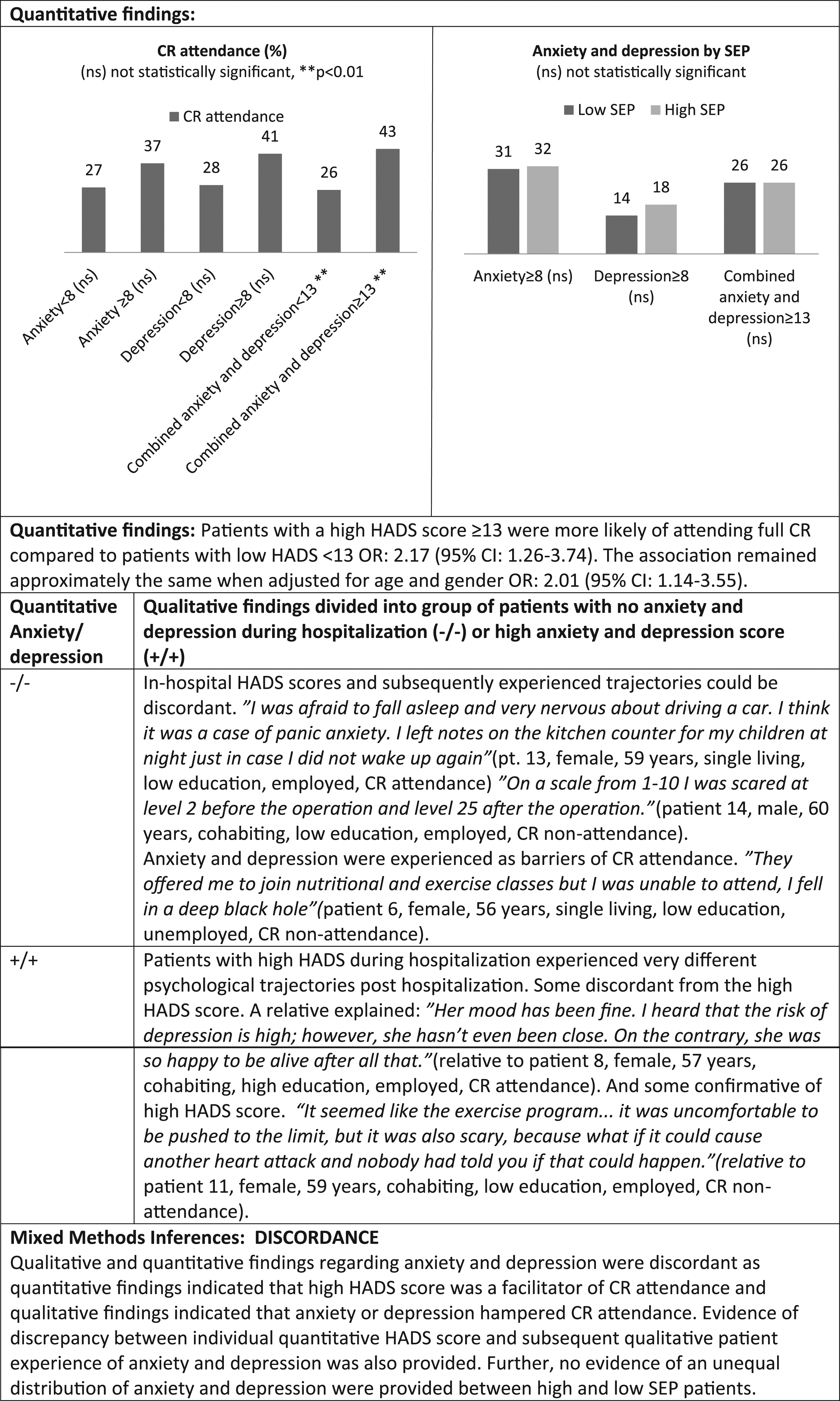
Strategy 2: Sociocultural examination of discordant findings
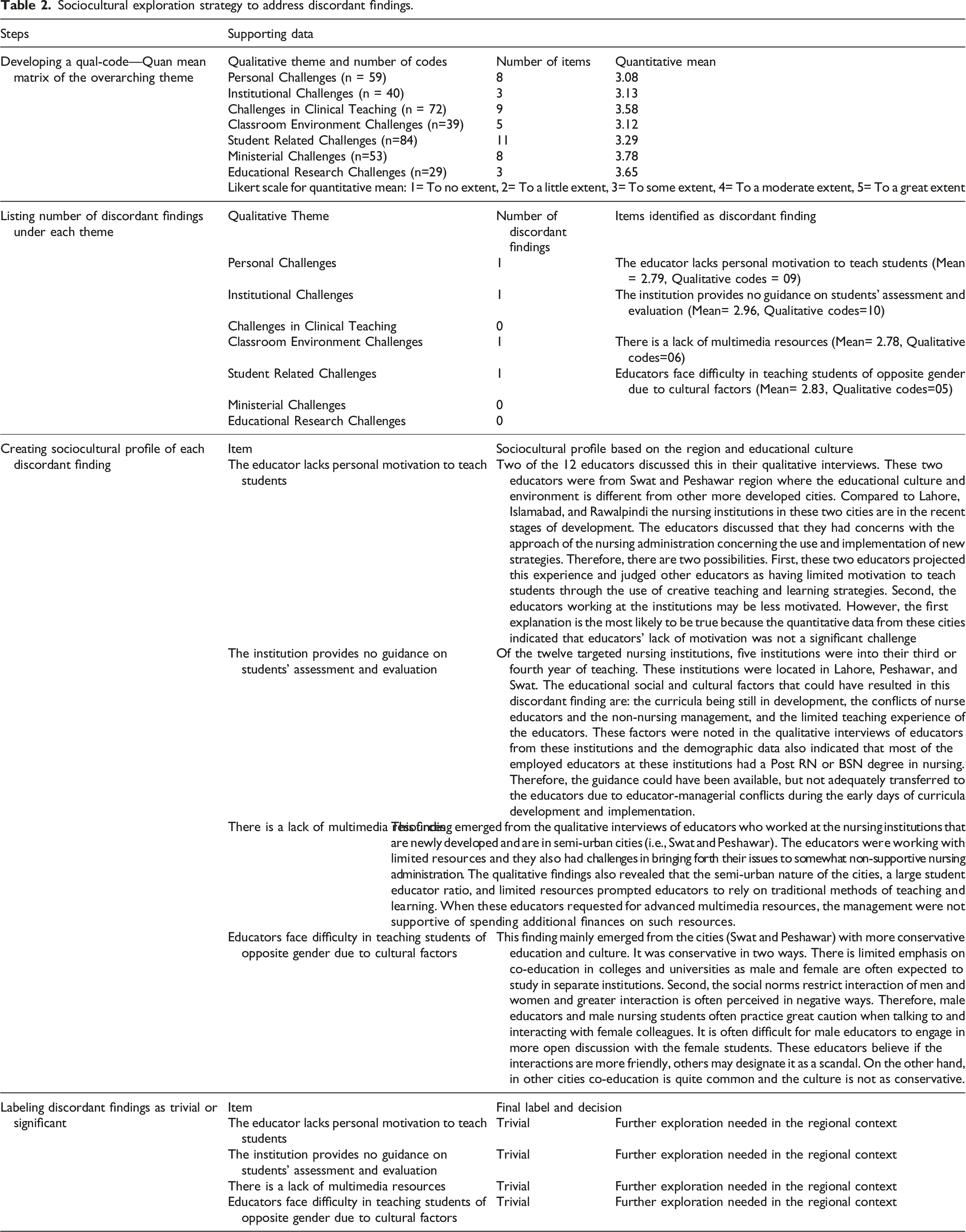
Sociocultural exploration strategy to address discordant findings.
Developing a qual-code—Quan mean matrix of the overarching theme
First, a separate analysis of the qualitative and quantitative data is completed. Then, a qualitative code and quantitative mean score matrix of the generated qualitative themes is developed. A matrix for mixed methods analysis could entail qualitative themes and codes for each theme; the number of sub-themes and the frequency and volume of their codes under each theme; the descriptive and inferential measures for quantitative variables; and the combination of variables, themes, and demographic data.6,20 A matrix provides a quick overview of the prevalence and strength of the themes of interest in the dataset. In the sequential exploratory study, Younas et al., 15 developed a data matrix that included qualitative themes generated as the domains of a questionnaire, the number of codes and number of questionnaire items under each theme, and the mean scores of participants for each theme.
Listing the number of discordant findings under each theme
In this step, the data matrix is further expanded to include the number of discordant findings under each of the themes. Both qualitative and quantitative data for each of the themes and their corresponding sub-themes and items are examined to identify the discordant findings. The number of discordant findings and either qualitative or quantitative or both scores and codes are entered into the data matrix. Younas et al. 15 included the number of qualitative codes and the mean scores for each of the items of the themes. They identified four discordant findings among all the generated themes.
Creating sociocultural profile of each discordant finding
The next step is the creation of a sociocultural profile for each of the discordant findings. We defined a sociocultural profile as a description of the social and cultural context of discordant findings based on the comparative analysis across demographic variables, study settings or regions, and sociocultural constructs (e.g. support system, belief system) studied in the research. Younas et al. 15 collected data from nurse educators in five different cities across different provinces with unique cultural and social systems and educational culture. Some of the educational institutions had more material (e.g. skills labs, mannequins) and human resources (e.g. masters and doctoral prepared nurse educators) compared to others. Therefore, they developed profiles through a comparative analysis of the discordant results across these settings and discussed and discerned the alternative or underlying reasons for discordance. They analyzed the number of codes and mean scores for each of the discordant findings in the sub-samples described based on the city and the institutions from where data were collected.
Labeling discordant findings as trivial or significant
Finally, the discordant findings are labeled as trivial or significant. Trivial discordant findings were defined as those findings that are highly contextualized to one setting or culture of the whole sample and barely visible in participants' accounts from other settings. These trivial discordant findings were not integrated to develop mixed meta-inferences (conclusions drawn after integrating qualitative and quantitative data), 2 and were considered candidates for future research in only the specific regions. On the other hand, significant discordant findings were defined as those which are consistent across the whole sample. If the discordant findings were labeled as significant, then they are subjected to the following outcome. If both qualitative and quantitative data across the whole sample supports the significant discordant finding, the findings are integrated to develop meta-inferences. The detailed strategy of sociocultural examination of discordant findings is illustrated in Table 2.
Discussion
Addressing and integrating discordance findings in mixed methods could be a daunting task and may vary across various study designs and influenced by the nature and quality of data.1,6 We illustrated two practical step-by-step strategies used in convergent and exploratory sequential mixed methods designs to address discordance findings in mixed methods. In line with the advantages of discordant findings in mixed methods,3,4,6 these strategies enable researchers to generate hypotheses and theoretical claims for further research through qualitative, quantitative, and mixed approaches.
The first strategy involves a comprehensive data analysis at the level of individual cases. It emphasizes that greater attention is given to discordance at the case level in order to address discordance at the level of the overall dataset. The potential advantages of the comprehensive case and variable analysis are as follows. First, using comprehensive case and variable analysis, the discordance of data is identified before the initiation of mixed analysis or the integration of qualitative and quantitative inferences. Second, this strategy offers researchers the opportunity to discern possible approaches to address discordance through careful consideration of the nature of qualitative and quantitative datasets, the extent of case-level discordance, and active discussions among the research team. Finally, it offers an opportunity to examine multiple cases and variables at different times and then integrate the results to generate mixed meta-inferences. For example, Younas and Sundus 13 only focused their case analysis on the gender of the research participant. However, Pedersen et al. 14 used two variables, namely, depression and anxiety, for this analysis. Involving more variables and cases in the analysis may contribute towards the depth of data analysis and examining discordance at a deeper level, rather than assessing for discordance after mixed analysis.
The second strategy entails the examination of data discordance within the sociocultural context, highlighting the effect of social and cultural factors on the nature and type of data. The sociocultural exploration strategy can be potentially valuable in mixed methods studies that emphasize exploring and understanding culturally dependent phenomena. The essential step of this strategy is creating the sociocultural profile of each discordant finding concerning different social and cultural aspects (such as education culture, language differences, institutional protocols and policies, political climate). Creating such profiles allows for examining the nuanced differences across multiple settings in multicenter studies. It may also allow researchers to generate any plausible explanation for the discordance results at the initial stage and then further validate those explanations in subsequent studies. While implementing the sociocultural exploration strategy, researchers can use various matrices (such as joint displays, pattern matrices, and profile matrices).6,8,9 following the nature of data and the focus of analysis.
Implementation of these strategies also highlights the potential contribution of dialectical stance and dialectical pluralism.10,12 in enabling researchers to address arising conflicts about discordance findings and negotiate to develop solutions and approaches for integrating and addressing such findings. Active discussions and conflict management in a research team can be potentially valuable for implementing the sociocultural exploration strategy. Researchers can share their distinct insights arising from sociocultural differences and paradigmatic stances, to create more useful social and cultural profiles of discordant findings. Utilizing dialectical stance and dialectical pluralism as the conceptual underpinnings of the proposed strategies allows calls for greater reflexivity on researchers’ part to examine their personal assumptions and biases during data integration and recognition of discordance.
Discordance of qualitative and quantitative findings is often an expected outcome of mixed methods data analysis because it cannot be assumed that qualitative and quantitative data about social and cultural phenomenon is always consistent. 21 Mixed methods literature offers broad approaches (e.g. reconciliation, initiation, bracketing, exclusion) to address discordance in mixed methods data. However, the guidance on managing discordance in real life mixed methods research practice is limited. Addressing discordance can be a messy process in complex mixed methods designs. This paper contributes to the methodological knowledge gap concerning data discordance in mixed methods studies and the integration challenge. This paper focuses on the practicalities of integrating qualitative and quantitative data, and then identifying and addressing discordant findings. The proposed strategies consider the complexity of mixed methods designs and the data analysis and offer tangible guidance on handling and making sense of discordant findings in line with the research purpose and the study context and need.
Conclusions
Identifying and addressing discordant findings in mixed methods is an essential step of rigorous mixed methods analysis. Discordant results should be identified and reported to enhance transparency in reporting and identify further research areas. The comprehensive case and variable analysis and the sociocultural exploration strategies emphasize the need to examine discordance in data at an early stage of analysis. The step-by-step examples presented in this paper can be useful for researchers who plan to address and develop plausible explanations of discordant findings. The steps are flexible and can be tailored to meet the needs of any mixed methods study. Further use and evaluation of these strategies are warranted to expand the body of knowledge about practical methods of mixed methods data analysis.
Footnotes
Declaration of conflicting interests
The author(s) declared no potential conflicts of interest with respect to the research, authorship, and/or publication of this article.
Funding
The author(s) received no financial support for the research, authorship, and/or publication of this article.
