




Abstract
The double hermeneutic is a central feature of interpretative phenomenological analysis (IPA). Typically, this has been considered in relation to individual researchers working with experiential accounts from individual participants. IPA has, however, frequently been applied by multiple researchers; a further layer of complexity occurs when individual or multiple researchers analyse data from group interactions. Little attention has been paid to hermeneutic considerations in these contexts. We present insights into our encounters with multiple hermeneutics as well as our application of the hermeneutic circle; we also consider implications for IPA research. Our multi-vocal approach to analysis requires us to work in a much more integrative manner than is generally represented in IPA literature. Explicitly attending to multiple hermeneutics in focus group situations provides additional insights into the social and cultural contexts within which participants’ experiences exist. This article discusses how the inclusion of multiple hermeneutics adds richness and robustness to IPA.
Keywords
Introduction
Interpretative phenomenological analysis (IPA) is popular within the field of health.1,2 It is rooted in phenomenology, hermeneutics and idiography 3 and, whilst there are many hermeneutic concepts that appear in IPA (e.g. the hermeneutics of suspicion and empathy 4 , 5 ), we focus in this research note on the hermeneutic circle 6 and the double hermeneutic.7–9 We explore how these concepts can be incorporated when working with multiple researchers and groups of participants.
Within the double hermeneutic, experience is accessed through “a process of intersubjective meaning-making” 10 : the participant interprets their experience within the research interaction and the researcher interprets the resulting accounts through their analytic work. While this interpretative relationship between researcher and participant is the general focus within IPA, 3 much research has, in practice, included multiple hermeneutics through the inclusion of collaborating researchers 11 or with multiple participants.12–14 The interpretative relationship is also illustrated through meta-syntheses of others’ IPA studies – a triple hermeneutic (see 9). However, there is generally little explicit attention paid to the theoretical or practical implications of these ideas.
Smith 6 describes the hermeneutic circle as the continual movement between parts and whole e.g., from words, sentences and paragraphs (parts) to an entire transcript (whole) or movement between researcher and participant (parts) in working together to form an experiential account (whole). In the same way that narratives are constructed to situate important elements of an experience within a meaningful whole 15 it is necessary to view these elements in conjunction to achieve a shared understanding. 16 Smith describes the relationship between researcher and participants as two points on a circle around which the analyst continuously moves. Schleiermacher expands this understanding by linking the whole to the wider context of “culture, customs, [and] discourse” 17 within which the participants, researcher and analyst are located. Acknowledging and incorporating the accompanying fore-structures expands the analysis to these wider contexts and gives a broader view of the parts to whole relationship and the contribution to knowledge in the area of interest. 18 Additional researchers or participants mean that further ‘stops’ on this circle are integrated into the developing analysis and interpretation, thus building a richer and more nuanced understanding of the experience under exploration.
We suggest that both the hermeneutic circle and multiple hermeneutics are significant to IPA work and in multidisciplinary fields such as healthcare. Though many researchers collaborate within their research projects, reflections on their research relationships are not clearly explicated within their writing. Similarly, there has been little attention to the role of multiple hermeneutics when working with focus groups in IPA, although an area of growing interest and increasing research. In this research note, we consider the implications of these hermeneutic concepts for our work as multiple researchers with multiple participants, illustrated with data and reflections from our collaborative work in exploring experiences of breast and gynaecological cancer.
Multiple researchers
The challenges and time consuming nature of working in a team using IPA is not clearly described despite the number of IPA articles written by multiple authors. The assumption seems to be that one researcher – typically the one who carries out the interviews – will undertake and write up the analysis. Guides to conducting IPA suggest or explicitly state this, with Langdridge 19 mentioning “the role of the researcher” and Pietkiewicz and Smith 20 referring to “the researcher’s sense making”. Others (e.g. 21 ) make no explicit reference to the analyst/researcher.
Multiple roles are generally indicated in relation to sense checking, for example, McParland et al. 22 Although these strategies clearly reflect the concept of the independent audit proposed for IPA, 3 we suggest that attending to the roles of all researchers in a project can add depth to our understanding of hermeneutics. For example, in our mode of working as a team, we work collaboratively to develop conceptual themes and articulate the evidence for each theme together. This requires sharing interpretations from each of the researchers, which allows the group to distil new meanings from each individual perspective. This brings a real-time auditing of each researcher’s interpretation, challenging each other’s preconceptions and interpretations to come to a new understanding that incorporates all understandings in a new way. We argue that reaching consensus across multiple researchers enables the group analysis to move beyond individual lenses and fore-structures. 23
When considering the concept of the hermeneutic circle,3,15,24 we found a similar lack of detail. Most researchers do, however, outline their development of “thick description” (e.g. 25 ), describing their movement between transcripts in identifying and clustering themes that illustrate the experience under scrutiny. As with discussions of the double hermeneutic, a single researcher seems to be the norm in available descriptions of method: “The researcher constantly weaves in and out of data sets” ( 26 emphasis added). Even when “we” are mentioned in relation to analysis (e.g. 27 , 28 ) the process undertaken by each individual is not clarified.
Within our own writing we, too, have largely ignored the process of research merely stating, for example, “We looked at …” 29 or “Transcripts [were] analysed …”, 30 following the typical patterns of psychological writing. These recognisable descriptions leave a wealth of information unexplored: we inevitably affect the understanding of the topic under scrutiny 31 and reflection on these effects throughout the research development is important. 32
This lack of explicit discussion around the writing process, and our personal experiences of its challenges, led to reflection on our own working collaborations, particularly considering ‘us’ as a team and our negotiation of the complexities of research. The circularity of moving between the parts and whole during analysis, understood as of primary importance in IPA, suggests that multiple researchers might successfully challenge initial interpretations to create more meaningful analytic insights. Focusing on the ‘double hermeneutic’ and reframing it as a ‘multiple hermeneutic’ (taking account of us as multiple researchers sometimes with multiple participants) provides a more accurate description of our research. Describing the interrelated ‘parts’ and ‘whole’ of our research teams has led us to a much clearer understanding of our ways of working.
Reflections on our process
Reflecting explicitly on our research relationships has highlighted their mediation through, for example, our geographical and temporal locations as well as our varied writing styles and research backgrounds in social/health psychology, and education. The insights developed through this variety of practise have affected our approaches to qualitative research and, alongside our research projects, have shaped the development of our collaborations. We are two teams of three researchers, each working on one of the projects discussed here. The circularity of working with text3 neatly sums up the circularity of our analytic collaborations: we each focus on different parts of the research, finally combining them and achieving a greater understanding of our data.
As we mentioned above, this can be linked with Gadamer’s writing on fore-understandings. 23 Each researcher brings their own experience of the data, process and topic, along with their academic background and expertise. Interactions between the group during analysis requires us to notice and observe our fore-understandings of the data as we discuss our interpretations, and aim to overcome our initial prejudices. For example, at one point during the analysis of a transcript from the breast cancer project, two of the researchers had different responses to the data. Through the process of three researchers articulating, clarifying and challenging each other’s initial interpretations, a consensus was achieved around the interpreted meaning-making of the participant. Revisiting the transcript post-publication, the initial differences were no longer clear, reflecting how each researcher’s original ‘horizon’ had expanded during the process of developing a group interpretation.
Our investigation of women’s experiences in deciding not to reconstruct their breast following mastectomy took a traditional IPA approach utilising semi-structured interviews. 2 Members of the team worked individually with the transcripts to formulate initial ideas and thoughts. An overall summary of each transcript, added to our individual ideas, guided our initial joint analytic conversations. Meeting face-to-face we collaborated, line by line, on producing an article with which we all felt comfortable: each quote was discussed at length; its place in the analysis overall agreed on by all.
Our exploration of gynaecological cancer utilised focus groups. One member of the team undertook the initial data analysis and all team members jointly refined this. As we always collaborated at a distance due to geographical location, all quotes viewed as potentially relevant to each theme after the initial analysis were shared electronically. We individually recommended quotes to include using a ‘traffic light’ system. Each researcher allocated quotes to ‘colours’ of ‘red’ (to leave out); ‘amber’ (for further consideration); or ‘green’ (something that really illustrated our message; see Table 1).
Quotes allocated to our ‘traffic light system’.
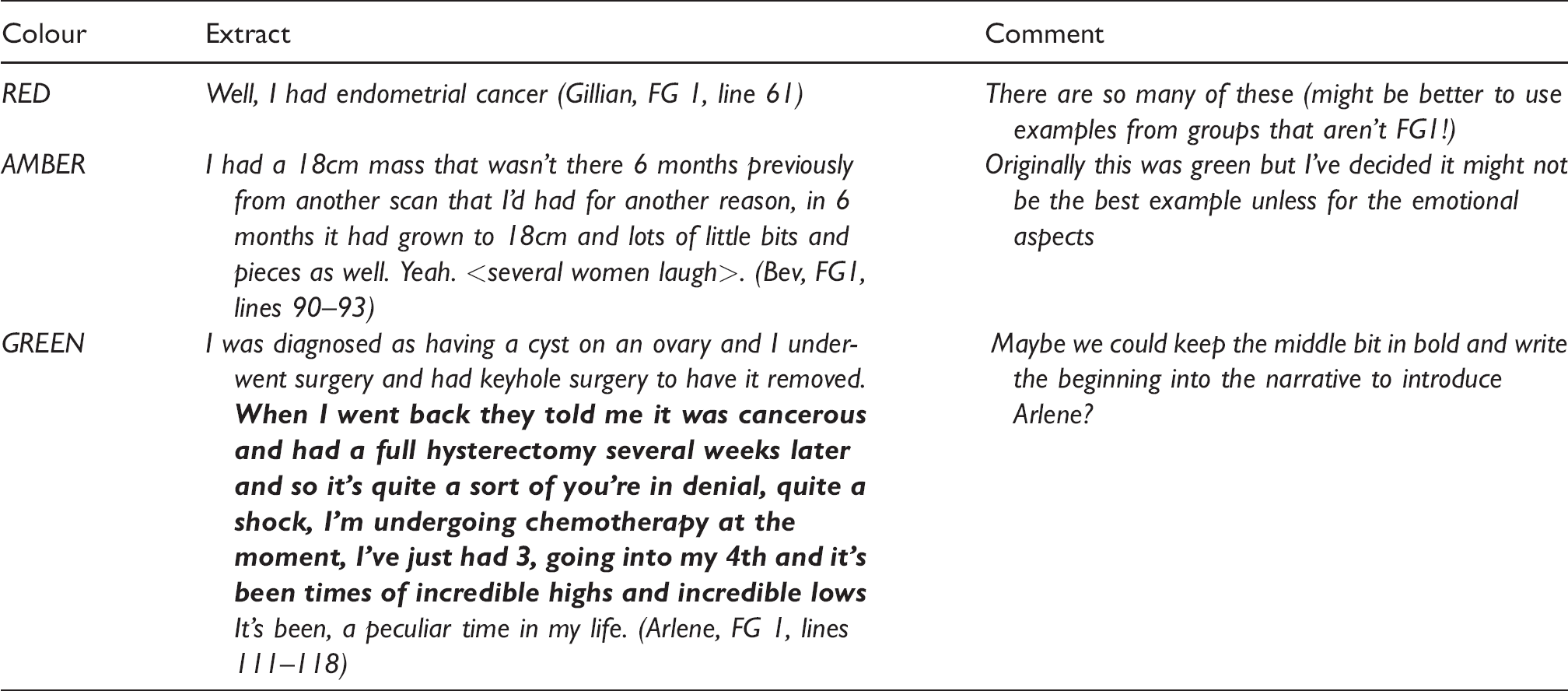
From these categories, decisions were made to help reduce the data and to select the most appropriate extracts which clearly and convincingly articulated each theme. These decisions were sometimes pragmatic, for example, if there were too many quotes from one participant, or if a quote was too descriptive. Sometimes, other team members brought new dimensions of knowledge. For example, having conducted the focus groups and interacted with participants, SA might explain a participants’ background or the wider research context to provide a viewpoint not available to other team members. Within our Skype discussions, we further refined these collaborative decisions, ensuring that we all agreed that the chosen quotes supported our key research message. Overlapping circles of the hermeneutic process were created as we interacted individually with the data and were brought together to achieve an overall consensus. Negotiating back and forth between discussions, quotes, ideas and the full transcripts led to a richer analysis than was possible individually, even though tackled differently in each research team.
Our attention to multiple hermeneutics and the hermeneutic circle was further complicated by the focus group data, where the consideration of multiple participants was foregrounded. This is focused on next.
Multiple participants
While the individual is often “a convenient shorthand” for the idiographic orientation of IPA to the particular, 3 recent explorations have begun to investigate the novel contributions of group-generated accounts.13,33 Increasingly, IPA studies use focus groups as a deliberate choice when a topic is an intrinsically ‘group’ experience,14,34 or if participants wish to share stories. 35 Focus groups can provide mutual reassurance in discussing sensitive subjects 36 and can make social issues explicit, highlighting group norms through humour, disagreement etc. 37
Focus groups offer an alternative method of obtaining individual, personal accounts 8 where discussion stimulates participants’ deeper experiential reflections.8,13 This approach requires particular attention, ensuring that the resulting analyses remain true to the aims of IPA. 38 Within a group setting, participants with similar experiences (‘we’), interactions between participants (‘you’), and multiple third-person perspectives (‘they’) create multiple hermeneutics. The multiple perspectives of the group elaborate the “detailed examination of personal lived experience”, 2 extending hermeneutic interpretation to a wider view of individuals’ lives. In addition, during a focus group, participants enact their shared culture and customs 17 within their discussions. Researchers then bring their own understanding of those to the analysis: their multiple perspectives provide opportunities to acknowledge and investigate this background context, 33 enriching the interpretation of the data by including the shared cultural and social context.
Reflections on the value of multiple participants
The inclusion of focus groups within our gynaecological cancer project was pragmatic: the groups reflected the yoga intervention being studied.29,34 As with our breast cancer project, our initial reporting followed a traditional IPA format. In our 2016 paper, 29 however, we focused on making sense of the ‘groupness’ of our data, and later outlined that perspective. 33 We recognised that ignoring the influence of the group failed to capture any additional insights located within the wider discussion, something we consider in the examples below.
Though influenced by discursive work we focused firmly on interpretation and sense-making within our analysis. We observed thematic similarities that arose within and between groups, and micro-elements of participants’ talk. By moving around the hermeneutic circle we attempted to make sense of these from the perspectives of the other participants. Speculating on where groups might differ from interviews was avoided; however, we did consider how the presence of others might influence a speaker’s sense making and how those others might make interpretations. This is highlighted in the following example:
Jane (focus group 4)
Yes, I think that the breathing and the relaxation must be very good for us and I would think when we go for our follow up appointments, you know, you you [sic]can err perhaps approach them in a more relaxed way, which I think must be beneficial, and if you’re feeling tense then you can tell yourself how to relax, which I feel is good. I’ve had a check-up this week, so you know, I’ve had one and I don’t have to have another for four months now.
Pronoun use 39 is a recurring focus in our work,33,40 illustrated here by Jane switching repeatedly between ‘I’, ‘we’ and ‘you’. Pronouns are significant when studying groups – a generic ‘you’ or ‘we’ requires interpretation: who are participants including in their groupings? How and why do they refer specifically to themselves, or to the group as a whole? A researcher not sharing the cancer experience would not consider themselves included, whereas other group participants might. Using the multiple hermeneutic we considered how other group members might interpret Jane’s changing pronoun use: ‘we’ suggests an experience which is shared by all and other participants may challenge this assumption.
Using ‘I’ is personal and does not claim a position to be common to all, such as in our second example:
Sheila (focus group 1)
I’d done well through the enhanced recovery program, and I thought this would be an addition to hopefully carry on with the way things were moving in my direction <soft laughs from her and others>.
The presence of the group makes recovery a sensitive topic. Interview participants do not have to be concerned about how others interpret their statements, so we might have suspicions about this, but we would not know for sure. What does the laughter mean? Why the first person pronoun? We noticed within our dataset that there was a thematic pattern in how people talked about recovery and improvements: they were reliably first person focused and cautiously introduced compared with sections where participants utilised ‘you’ to talk freely about side effects and difficulties. Our attention to the multiple hermeneutic developed our contextual understanding of participants’ experiences.
Conclusions
We have introduced two strands in relation to analytic insights: the role of multiple researchers, and the contributions of multiple participants. Both have been intertwined with our considerations of multiple hermeneutics and the hermeneutic circle. We have highlighted a lack of detailed explanation in published research of the roles adopted by multiple researchers, or consideration of their roles in the collaborative process (something we have also been guilty of). We have discussed the value of including this and given examples of how doing so has informed our own analytic experiences. Broadening attention away from single researchers working with individual participants to incorporate a multi-vocal approach to analysis adds to IPA’s contribution to our understanding of topics studied, particularly in multidisciplinary fields such as healthcare. Taking a more explicit focus on researchers’ collaborative relationships as well as those between researchers and their participants, provides a further layer of hermeneutic understanding, which can only strengthen the position of IPA research more widely.
Strategies and examples from our own focus group work demonstrate how a multiple hermeneutic can be investigated using the concept of the hermeneutic circle between the participants in a group. Further work may consider the different metalanguages 7 brought by individuals to an analytic project. Focus groups facilitate explicit attention on the social, cultural and environmental context in which participants’ individual experiences are located; another important factor in both IPA and health psychology. 38 Issues remain to be addressed in this area: it is noticeable that while increasing reference is made to the motivations, benefits and approaches of using focus groups, less discussion about the interpretation and contribution of the group-based analysis is included. While it would be inappropriate to speculate on how themes might differ from those resulting from an interview, consideration of how and where group elements contributed to developing themes and provided additional insights and contextual information were discussed. We suggest that researchers conducting IPA focus group research should: a) identify specific objectives for doing so; b) consider how the multiple hermeneutics are relevant to the experience being studied; and c) reflect carefully on how and where themes are identified at individual and group levels, 8 both in light of the aims of the project itself and the IPA focus on the particular. 3
Our experience has highlighted the benefits of collaboration and working in community, particularly in relation to how researchers who are collaborating can attend to the multiple hermeneutic challenges they might encounter. We suggest that working collaboratively provides checks and balances through which an analytic consensus can be reached, providing a richer interpretation and ensuring less likelihood of falling into the traps of description and weak IPA.
Footnotes
Declaration of Conflicting Interests
The author(s) declared no potential conflicts of interest with respect to the research, authorship, and/or publication of this article.
Funding
The author(s) received no financial support for the research, authorship, and/or publication of this article.