




Abstract
Veg*ns of color continue to be underrepresented with their health less understood in veg*n scholarship. As intersectionality and health outcomes remain an understudied focus in anti-veg*n scholarship, the concealable stigmatized identity (CSI) framework offers a way to identify the link between stigmatization and health outcomes for VOC. Using the CSI framework, the paper provides a review of multilevel manifestations of anti-veg*n stigmatization in previous and current veg*n scholarship. The paper offers future directions for researchers to examine stigmatization and its impact on VOC. Recommendations are provided to generate knowledge about the experiences and health of VOC.
To date, vegetarians and vegans of color (VOC) remain underrepresented in veg*n scholarship. Despite veg*n identification growing in communities of color and the documented presence of anti-veg*n bias rooted in the devaluation of nonhuman animals, little is known about the experience with and impact of anti-veg*n stigma on VOC, as related studies do not center them or consider the interconnected effect between racism and speciesism (Harper, 2012; Horta, 2018; Joy, 2009; McCarthy & Dekoster, 2020). Intersectionality acknowledges the interconnected axes of power that expose those with multiple marginalized identities to unique tensions that are individual, interpersonal, and structural in nature (Crenshaw, 1989; Overstreet et al., 2020). The concealable stigmatized identity (CSI) framework positions external and internal processes as instrumental in health consequences for individuals with socially devalued and hidden identities (Quinn & Chaudoir, 2009; Quinn & Earnshaw, 2013). This is especially the case for those with multiple stigmatized identities (Else-Quest et al., 2023; Rosenthal, 2016). As power and domination undergird stigmatization, the intersectional examination of VOC within the CSI framework is cogent. The purpose of this paper, which is grounded in an intersectional lens of the CSI framework, is to articulate how research on anti-veg*n stigmatization can progress beyond the unidimensional analysis of systemic oppression. Specifically, I aim to clarify how interconnected social dynamics shape identities and invoke stigmatization for veg*ns in racially marginalized communities.
The Psychological Well-Being of Veg*ns
Although the mental health of veg*ns has received extensive attention, scholars have predominantly focused on nutrition and consumption practices. Studies have documented mixed findings on whether veg*nism is associated either with the presence or absence (Beezhold et al., 2014; Forestell & Nezlek, 2018; Heiss, et al., 2017; Matta et al., 2018; Rosenfeld, 2018; Ruby, 2012) of psychological distress. Scholars note varied factors such as nutritional deficiencies as causes of psychological distress among veg*ns (Dobersek et al., 2021; Michalak et al., 2012). However, veg*ns generally report positive mental health outcomes. For example, despite reporting higher negative affect, veg*ns had ratings of life and health satisfaction that were comparable to those of non-veg*ns (Pfeiler & Egloff, 2020). Other studies indicate that sociopolitical contexts around veg*n identity have implications for their well-being (Nezlek & Forestell, 2020; Vestergren & Uysal, 2022). For example, one study found that veg*n participants reported a higher number of negative social experiences (e.g., conflict with a person close to them), more negative moods, and lower self-esteem than non-veg*n participants experienced (Nezlek et al., 2018).
Anti-Veg*n Stigma as Understudied in the Psychological Well-Being of Veg*ns
Stigmatization encompasses the pervasive devaluation of an identity rooted in the institutionalization of dominant beliefs, including unaffirming cultural messages, interpersonal discrimination, and internalization of negative beliefs and messages about the identity (Bos et al., 2013; Goffman, 1963; Link & Phelan, 2001). Previous and recent studies on the subject document similar devaluation of veg*ns. Veg*ns have faced historical persecution for their practice. For instance, the Catholic Church declared veg*ns heretics, who were consequently persecuted during the Inquisition (for review, see Kellman, 2000). In one recollection, a band of pilgrims escaped religious persecution from Britain to practice veg*nism (Iacobbo & Iacobbo, 2004). Despite increasing interest in veg*nism to address concerns about meat consumption, anti-veg*n sentiment continues, particularly toward vegans (Dhont & Stoeber, 2020; Earle & Hodson, 2017; MacInnis & Hodson, 2017; Nachiappan, 2020). As an example, anti-vegan stigma is so pervasive that it operates as a barrier to plant-based consumption among non-veg*ns (Corrin & Papadopoulos, 2017; Markowski & Roxburgh, 2019). Stigmatization has been linked to adverse health outcomes for those who wield (in)visible marginalized identities (Bos et al., 2013; Pryor & Reeder, 2011). Therefore, such impact of anti-veg*n stigmatization remains understudied.
Intersectionality as Understudied in Anti-Veg*n Stigmatization
The conception of intersectionality emerged from Black feminist challenges to single identity issues (Hancock, 2016). It contends for the interconnected influence of racism, classism, and sexism in the daily lives of Black women (Combahee River Collective, 2017; Cooper, 1988). Intersectionality, as a framework, uncovers the nuances of experiences shaped by interlocking axes of power and, consequently, matrices of domination, or it reveals a representation of oppression that sustains inequality (Collins, 1990; Crenshaw, 1989). Intersectional research uncovers the complex impact, such as invisibility, of power dynamics on multiple marginalized groups (Purdie-Vaughns & Eibach, 2008). One study documented greater feelings of invisibility, experiences of mistreatment, and stereotyping concerns among participants with two or more marginalized identities than among those with one or no marginalized identities (Remedios & Snyder, 2018). Relatedly, such invisibility limits access to education about and prevention of health conditions. For example, in one qualitative study, Black women with socioeconomic disadvantage described disregard for their concerns and feeling unheard by their medical providers (Okoro et al., 2022). As health prevention and intervention requires multidimensional approaches to address injustices, intersectional research is imperative (Else-Quest et al., 2023; Rosenthal, 2016).
While intersectionality scholarship primarily centers on human oppression, related scholarship contends for the enmeshment of human and nonhuman animal oppression (Roeder, 2021; Spiegel, 1996). For example, antiracist scholarship indicates the intersection of racism and speciesism, wherein systemic oppression faced by racially marginalized communities was historically and contemporarily enacted through nonhuman animal (ab)use (Ko & Ko, 2017; McJetters, 2018), environmental injustices (e.g., animal agricultural factories located near communities of color), and systemic animalization of people of color (POC; Kim, 2011; Ko, 2019; Nicole, 2013). Thus, intersectionality is a cogent lens to examine how anti-veg*n stigmatization manifests with interlocking structural forces that shape nonhuman and human oppression.
Anti-veg*n stigmatization is multisystemic, impacting both veg*ns and non-veg*ns (Brueck, 2017). For example, structural impediment limits access to veg*n practice. Specifically, legislative policies enforce participation in nonhuman animal (ab)use (e.g., taxation toward agribusiness and hunting), businesses offer minimal dining and product options, and medical and pedagogical practices rely on nonhuman animal use (e.g., medical testing, vivisection; Horta, 2018; Kahn, 2011). Also, protections toward veg*n identities remain obscure in the U.S. legal system (Covey, 2018; McKeown & Dunn, 2021; Rhodes, 2014). These policies often intersect with other impediments (e.g., residential segregation), limiting access to veg*n practice and contributing to health disparities faced by communities of color (Carrington, 2018; Rodríguez, 2018). Addressing anti-veg*n stigmatization would be well aligned with the efforts of psychologists to address interconnected societal challenges faced by minoritized communities (Eaton et al., 2021; Neville et al., 2021).
Veg*n Identity as a CSI
CSIs are socially devalued identities that are hidden. CSIs are composed of two components, which are the internalization, anticipation, and experience of stigmatization attributed to the identity and reactions to disclosure of the identity (valenced content) and the degree of integration of identity to one’s self-concept (magnitude). These variables, among disclosure and concealment, impact health consequences for those who hold the identities (Quinn & Chaudoir, 2009; Quinn & Earnshaw, 2011). Past research (e.g., mental illness, history of sexual assault, sexually transmitted infections, chronic illness, and minoritized sexual orientation, see Quinn & Earnshaw, 2013; Quinn et al., 2014) and recent applications to other stigmatized groups (e.g., atheism; see Abbott & Mollen, 2018) document adverse health consequences. CSI studies with an intersectional focus indicate that interactive axes of power contextualize external and internal processes of stigmatization and, consequently, impact health. For example, among 288 people with CSIs, those with multiple stigmatized identities who reported greater anticipation of stigmatization and rumination also reported lower quality of life (Reinka et al., 2020). In another study, it was found that Black and Latinx people with CSIs who reported anticipated stigma and increased racial discrimination also reported greater depressive symptoms (Quinn et al., 2020). Given the devalued status and invisibility of veg*n identity, the CSI framework offers a helpful lens to conceptualize the impact of stigmatization on the well-being of veg*ns, particularly those in minoritized communities. Thus, I propose an intersectional examination of the psychological well-being of VOC through a CSI framework (see Figure 1).
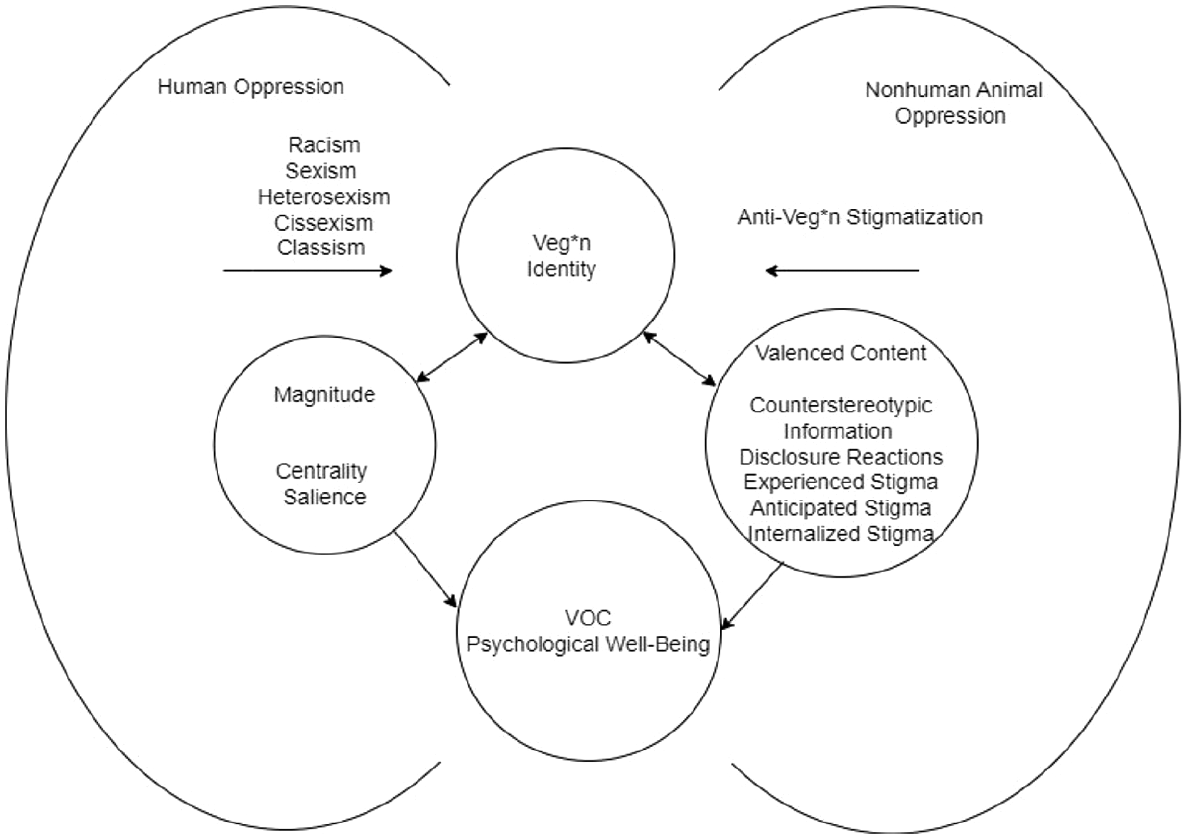
Intersectional Framework of Concealable Stigmatized Identity of veg*n Identity
Valenced Content of CSI
Valenced content encompasses complex beliefs, messages, and experiences attributed to the CSI and reactions to the disclosure of the identity. In several studies, the presence of ambivalent attitudes toward veg*ns was documented such that they were perceived as moral yet arrogant or socially unattractive (De Groeve et al., 2021; Minson & Monin, 2012). In other cases, veg*nism is regarded as deviant, especially when perceived as a challenge to hierarchy-justifying beliefs and attitudes (Bresnahan et al., 2016; Dhont & Stoeber, 2020; Leite et al., 2019). For example, studies documented the association between negative attitudes toward veg*ns and social dominance orientation and right-wing authoritarianism and hegemonic gendered beliefs among non-veg*ns (Judge & Wilson, 2019; Salmen & Dhont, 2021; Stanley, 2021; Timeo & Suitner, 2017). The nature of disclosure reactions, specifically, initial disclosures, creates unique challenges for those with CSIs such that negative reactions are associated with depression and low self-esteem (Camacho et al., 2020; Ryan et al., 2015). Similar outcomes are found among veg*ns, especially when they can experience a range of reactions from confidants (Buttny & Kinefuchi, 2020; Romo & Donovan-Kicken, 2012; Twine, 2014).
Adopting a veg*n identity, unlike other identity dimensions that cannot be chosen, is contentious. Notably, veg*ns face stigmatization for this decision (De Groeve et al., 2021; Joy, 2009). For example, motivations for veg*nism have been found to inform perceptions of veg*ns among non-veg*ns. Specifically, veg*ns motivated for ethical (e.g., (non)human animal welfare) and environmental reasons were perceived more negatively than those motivated by personal health (MacInnis & Hodson, 2017). Despite persisting toward veg*ns, anti-vegan sentiment is particularly potent for vegans (Aguilera-Carnerero & Carretero-Gonzalèz, 2021; Cole & Morgan, 2011). In a study of social media data from an anti-vegan community, it was found that users perceived vegans as emotional, inflexible, and militant (Gregson et al., 2022). Although studies documented anti-veg*n sentiment toward veg*ns, the majority of works featured unidimensional approaches to perceptions of veg*ns. VOC are less represented in mainstream messages and culture, contributing to their invisibility and perceptions of veg*nism as a privileged practice (Greenebaum, 2018; Polish, 2016). For example, in one study, it was found that veganism was perceived as an exclusive practice associated with Whiteness among Black and White U.S. non-veg*ns (Rosenfeld et al., 2023).
People with CSIs actively search for information that is counterstereotypic, namely that which is positive about their identity (Quinn & Earnshaw, 2011). Available studies suggest that veg*ns seek out affirming information about veg*nism. Particularly, the modern interest in veganism among celebrities promotes behavioral intentions toward the practice of vegans (Doyle, 2016; Phua et al., 2020). Although they can offer positive information associated with veg*nism and veg*ns, veg*n-led communities and organizations have been critiqued for minimal diverse representation and unidimensional and, at times, controversial means of advocacy (Chatila, 2018; Wrenn & Johnson, 2013). VOC may regard POC-led veg*n organizations and activists as affirming representations of veg*nism. Organizations such as Black Vegans Rock (2016) and Afro Vegan Society (n.d.) are examples of successful organizations that not only promote social support, role models, and resources for Black vegans but also ground their advocacy in addressing intersecting devaluation of humans and nonhuman animals. Prominent social justice figures (e.g., Dick Gregory, Angela Davis, Rosa Parks, Cesar Chavez, and Coretta Scott King; see Von Alt, 2015) are examples of VOC that espoused and practiced veg*nism as a form of activism to challenge the enmeshment of nonhuman and human oppression (Gregory, 2003; Navarro, 2011; Quichiz, 2019).
The stigma that is experienced, anticipated, and internalized has inimical consequences attributable to CSIs (Bos et al., 2013; Quinn & Earnshaw, 2011). High levels of internalized stigma, or acceptance of negative messages and stereotypes associated with the CSI, predicted lower psychological well-being (Guarneri et al., 2019). Examinations of internalized stigma among veg*ns are limited. However, available studies suggest that veg*ns employ internalizing strategies to navigate experienced and anticipated stigmatization such as acceptance and acknowledgment of hegemonic viewpoints (Greenebaum & Dexter, 2018; LeRette, 2014; Mycek, 2018). Anticipated stigma, or the expectation of discrimination related to the hidden identity and where disclosure of concealed identity has occurred, has been associated with adverse health outcomes (Bos et al., 2013; Chaudoir & Quinn, 2016; Quinn & Chaudoir, 2009). Despite prior studies suggesting that veg*ns anticipate discrimination and prejudice upon disclosure, the relationship between anticipated stigma and well-being remains understudied (Markowski & Roxburgh, 2019).
Mistreatment of veg*ns, ranging from insidious slights and devaluation (e.g., microaggressions, bullying, and ridicule related to veg*n identity), interpersonal discrimination (e.g., social distancing), and life-threatening experiences (e.g., violence) is well documented (LeRette, 2014; Markowski & Roxburgh, 2019; Nachiappan, 2020; Rosenfeld, 2018; Twine, 2014). Though less focused, structural stigmatization influences the experiences of veg*ns. In a survey with 1,000 U.K. vegan employees, 45% felt discriminated against, and a third reported harassment due to vegan practice. In the same study, about 48% of employers accommodated vegetarians over vegans, and 74% of employers were unaware of veganism as a protected identity (Crossland Employment Solicitors, 2019). Despite providing thorough documentation on the mistreatment of veg*ns, the aforementioned studies employed unidimensional approaches (Rosenfeld, 2018). Because VOC are underrepresented, they face unique experiences of invisibility due to their marginalized racial identities (Polish, 2016; Rosenfeld et al., 2023). Consequently, they experience tensions within White veg*n spaces (e.g., racial stress and isolation) and communities of color (e.g., invalidations and accusations of Whiteness; Botchway et al., 2022; Gorski, 2019; Greenebaum, 2018).
Disclosure and Concealment with CSI
Active disclosure and concealment hold complex health implications for people with CSIs (Camacho et al., 2020). On one hand, disclosure is associated with benefits (e.g., social support and authenticity) and challenges (e.g., increased discrimination), such that veg*ns experience authenticity yet face discriminatory behaviors (Greenebaum, 2012; Quinn & Chaudoir, 2011; B. M. Weisz et al., 2016). On the other hand, active concealment, though strategic to avoid stigma, has been associated with lower feelings of belongingness and authenticity (Newheiser & Barreto, 2014). Veg*ns, motivated to mitigate anti-veg*n bias and discomfort amongst non-veg*ns, engage in concealment through impression management such as face-saving strategies (Greenebaum, 2012; Romo & Donovan-Kicken, 2012). In other cases, veg*ns partake in meat consumption and experience guilt, anger, sadness, and fear of practicing veg*nism (Rosenfeld & Tomiyama, 2019). For example, in a qualitative study of Black veg*ns, participants described some hesitance to discuss their veg*nism with peers and family members and did not talk about the practice (Botchway et al., 2022).
Future Directions With Valenced Content
There is much to explore on how identity-related beliefs, feelings, and (mis)treatment impact the well-being of veg*ns, especially those from marginalized racial communities. Though VOC are underrepresented in mainstream media and face racial stress in and outside of their community, much additional research is needed to determine the impact on their well-being. Though it is likely that VOC are more or less affected by these different components, it is difficult to determine the direction in which each component is predictive of health outcomes. As qualitative studies of CSI groups from multiple marginalized backgrounds were found to experience benefits, including empowerment, improved sense of self, and connection with others attributable to positive information about their identity (e.g., atheists of color), more research is needed to understand how such information contributes to overall self-concept for VOC (Abbott et al., 2020).
Magnitude of CSI
The magnitude of the CSI, or the degree to which the identity is integrated into one’s self-concept, is determined by two similar concepts: centrality and salience. Centrality includes the degree to which an identity is important to oneself, whereas salience concerns the frequency with which one thinks about their identity (Quinn & Earnshaw, 2011). Veg*n identity, particularly among vegans, is important in that they view themselves as distinct groups based on their abstention from nonhuman animal consumption (Judge et al., 2022; Rosenfeld, 2019). For example, one study of Turkish veg*ns suggested that perceived discrimination may threaten veg*n identity, indirectly impacting their well-being (Bagci & Olgun, 2019).
Veg*n identity could operate as a buffer to discrimination through identity affirmation (Branscombe et al., 2012). Studies on self-affirmation document the psychological benefits across diverse groups (for a review, see Howell, 2017; Ferrer & Cohen, 2019; Jessop et al., 2023). Research among people with multiple stigmatized identities indicates that affirmations may be helpful (see Meca et al., 2022; Van Laar et al., 2019). In a recent study, it was found that compared to people with CSIs who did not use affirmations, those who used affirmations experienced greater life satisfaction through improved quality of life (Monheim & Himmelstein, 2023). Furthermore, identity affirmation can be helpful for those with multiple stigmatized identities. In one study, it was revealed that identity affirmation was associated with fewer depressive symptoms among queer POC (Ghabrial & Andersen, 2021). Thus, veg*ns, especially VOC, may employ identity affirmation as a resource to buffer the negative psychological consequences in spaces that may threaten their identities.
As scholars note that resistance can be a proactive strategy to challenge structural oppression, VOC may affirm their identity as an act of resistance to social injustices (Forsyth et al., 2012; Suyemoto et al., 2022). In Harper’s (2010) anthology, Black women espoused veganism as a means of resistance against and healing from anti-Black racism inside and outside Black spaces. In an unpublished honors thesis, VOC perceived veganism as a way to redefine activism and to challenge structural oppression (Chatila, 2018). Relatedly, VOC participants rejected the conception of privilege and emphasized focus on affordable practices of veg*nism and on resisting a dominant perspective of veg*nism (Greenebaum, 2018). Thus, VOC may rely on affirmation in the presence of discrimination, especially if adopted in response to social injustices (MacDonald & Struthers Montford, 2014; Meca et al., 2022; Van Laar et al., 2019; Vestergren & Uysal, 2022).
Future Directions With Magnitude
Like valenced content, salience and centrality of identity among VOC offer much to explore. As is the case with other studies on CSIs, little is known about the impact of magnitude on the well-being of veg*ns and even less for VOC. However, given the pervasiveness of anti-veg*n stigmatization, it is likely that magnitude may be attributable to health outcomes for veg*ns. As magnitude varies among veg*ns, it may also vary for VOC. Furthermore, research can explore the possible relationship between protective factors (i.e., identity affirmation) and health among VOC.
Moving Forward With Intersectionality in Anti-Veg*n Stigmatization Research
In summary, there is fruitful direction in undergirding intersectionality within examinations of anti-veg*n stigmatization, especially through the CSI framework. Below, I outline future recommendations for researchers and implications for advocacy.
Recommendations for Future Research and Advocacy in Health Prevention Science
It is imperative that researchers ground intersectionality frameworks throughout the research process. It is recommended that they center VOC in the formation of the research question to the study design, sampling, analysis, and interpretation and dissemination of findings. Consistent with recommendations from intersectionality researchers, attention to sociopolitical and institutional structures that shape the experiences and well-being of veg*ns is imperative (Lewis & Grzanka, 2016; Moradi & Grzanka, 2017). Researchers can employ multiple methodologies to attend to the sociopolitical nature of devaluation and simultaneously center the voices of multiple marginalized veg*ns. Qualitative and mixed methodologies, grounded in an intersectionality framework, offer a cogent understanding of how structural powers intersect to shape the anti-veg*n stigmatization of VOC (Stutterheim & Ratcliffe, 2021; Watson-Singleton et al., 2023). For example, if wanting to design a mixed methodology study on well-being among VOC, a researcher could incorporate systemic-level variables and could quantitatively examine the relationship between well-being and neighborhood level (e.g., segregation of neighborhood, access to veg*n resources, and neighborhood resourcefulness) and qualitatively examine the contextual nature of these relationships.
The well-being of VOC could be explored in great detail with the CSI framework. As prior examinations involving VOC have been qualitative in nature, quantitative studies, particularly grounded in a CSI framework, could examine the relationships between magnitude, valenced content, and well-being among VOC. Given tensions within and outside one’s racial community and challenges to identity, quantitative examinations could elucidate the relationship between disclosure and concealment among VOC. Conversely, strengths-based examinations of veg*n identity, especially those in marginalized communities, are scarce. Though it helps determine the multifaceted impact of stigmatization on those with invisible stigmatized identities, the CSI framework does not explicitly account for protective factors that are individual and collective in nature. Other existing stress frameworks, such as the Minority Stress Framework, may rely on the explicit inclusion of protective factors such as coping, resilience, and group involvement to clarify the impact not captured by the CSI framework (Meyer, 2003). Such employment would be helpful to clarify and expand on how VOC identity operates as a form of resistance and strength.
VOC are not monolithic. With much of the work focusing on Black veg*ns, future research could expand on how anti-veg*n stigmatization manifests across veg*ns from other racialized communities. Furthermore, there is still much to learn about veg*ns across different identities (e.g., atheist veg*ns, see Wrenn, 2019; fat veg*ns, see Wrenn, 2017; older adult veg*ns, see Wrenn & Lizardi, 2020). Thus, it is crucial to amplify the stories and voices of veg*ns with diverse identities and backgrounds. Broadly, qualitative approaches undergirded in grounded and critical theories could help explore the experiences of veg*ns within marginalized communities in the context of intersecting systemic oppressions (Levitt, 2021).
Implications for Advocacy in Health Prevention and Promotion
Interdisciplinary collaborations can be helpful for these efforts, particularly for policy development. Psychologists could consider collaborations with POC-led veg*n organizations, policymakers, and other health professionals to holistically examine the well-being of VOC. The critical dialogue could include how existing policies intersect to impact the experiences of VOC. As anti-veg*n stigmatization intersects with structural racism at the sociopolitical level, policies can target structural barriers (e.g., redlining, gentrification) that impede veg*n practice at the local, state, and national levels (Forbes et al., 2021; Hage et al., 2007). Doing so would improve access to veg*nism and other plant-based practices not only for VOC but also for communities of color. Relatedly, psychologists could support policies that destigmatize veg*nism as an exclusively White practice, and they could promote the visibility of VOC within mainstream media. Psychologists could also support health education programs that are aimed at promoting diverse content of veg*nism and plant-based consumption within communities of color, particularly those that lack access to practice veg*nism.
Conclusions
The concept of intersectionality calls for researchers to shift their focus from an individualist notion of veg*nism to a multisystemic and sociopolitical one. Grounding intersectionality in the CSI framework offers a way to capture how devaluation emerges differently across veg*ns in minoritized communities.
Footnotes
Declaration of Conflicting Interests
The author declared no potential conflicts of interest with respect to the research, authorship, and/or publication of this article.
Funding
The author received no financial support for the research, authorship, and/or publication of this article.
