




Abstract
The goal of the current pilot study was to examine the effects of bystander intervention training on a sample of 27 high school students who were selected by their peers as opinion leaders. Measures of bystander intervention knowledge, attitudes, and behaviors were included in the within-subjects design. Sixteen of the students also participated in focus groups to provide feedback about their experiences with the training. Results showed that participating students reported increases in knowledge about bullying and sexual harassment, confidence in intervening, acceptance of responsibility, knowing what to do, and acting to intervene (including direct intervention, providing support, and reporting to an adult) from pre-to posttest. Themes from focus groups indicated that students found the training relevant and helpful, particularly for focusing on both bullying and sexual harassment and for providing opportunities to learn and practice multiple intervention strategies. Barriers to intervening based on the type of violence (e.g., physical vs. relational or verbal) and relationship with the people involved were also themes. Directions for future research and implications for practice, such as focusing on dissemination to the larger student body and implementing bystander intervention training within the context of a positive school climate that emphasizes social and emotional competencies, are discussed.
Bullying and sexual harassment are prevalent in high school, and the negative short- and long-term effects on adolescent functioning are well-documented (American Association of University Women [AAUW], 2001; Chiodo et al., 2009; Gruber & Fineran, 2016). More specifically, 22% of students of ages 12 to 18 reported being bullied during the school year (U.S. Department of Education, National Center for Education Statistics, 2021), and rates of sexual harassment range from 30% to 81% for middle and high school students (AAUW, 2001; Clear et al., 2014; Hill & Kearl, 2011). Unfortunately, bullying prevention programs have limited and even deleterious effects in high school (Yeager et al., 2015), and sexual harassment is rarely a focus of prevention efforts in secondary schools (Charmaraman et al., 2013; Cook-Craig et al., 2014; Espelage & De la Rue, 2013). Bystander intervention approaches have shown promise, especially among high school students (Polanin et al., 2012), but there are no bystander intervention training programs for high school students that focus on bullying and sexual harassment. The purpose of this mixed-method study was to pilot test NAB IT! (Norms and Bystander Intervention Training) and to assess the extent to which high school students showed changes in knowledge, attitudes, and self-reported bystander intervention after participating in the program. Students’ experiences with and reactions to the program and bystander intervention in bullying and sexual harassment were also explored.
Bullying and Sexual Harassment
Bullying and sexual harassment are forms of hostile and unwanted aggression that can be verbal, physical, relational, or cyber (Gruber & Fineran, 2007; Poteat & Espelage, 2005). Bullying is considered a form of harassment in many federal and state laws (U.S. Department of Education, 2010). Sexual harassment is characterized by its unwanted nature on the part of the victim (AAUW, 2001; Lichty et al., 2008), whereas bullying focuses on the perpetrator’s position of power (Gladden et al., 2014). Nevertheless, bullying and sexual harassment have similar outcomes, including internalizing symptoms, substance use, and dating violence (Chiodo et al., 2009; Espelage et al., 2012).
There have been calls for school-based prevention programs to reduce multiple forms of violence and victimization (Hamby & Grych, 2013). Notably, a randomized controlled trial of a bullying prevention program that included a lesson on sexual harassment reduced the likelihood of middle school students perpetrating sexual harassment and being victimized by homophobic name-calling (Espelage et al., 2015). Espelage et al.’s (2015) findings suggest that providing specific content on sexual harassment, focusing on peer intervention, and targeting multiple forms of victimization are important for effective prevention.
Peer Group as Target for Prevention Efforts
Bullying and sexual harassment often occur and are reinforced within similar peer contexts (Espelage et al., 2003; Low et al., 2013). Peers witness more than 80% of these types of victimization episodes but intervene less than 20% of the time (Atlas & Pepler, 1998; Hawkins et al., 2001), although bystander intervention successfully abates victimization more than 50% of the time (Craig et al., 2000; O’Connell et al., 1999). Indeed, the sexual assault prevention field has shifted to focus on bystanders because of their ubiquitous presence, the difficulty in changing the complex motivation and behavior of perpetrators, and the positive approach of viewing school and community members as allies and potential active bystanders as opposed to potential perpetrators and victims (Banyard, 2015; Moynihan et al., 2010).
Despite the promise of this approach, schools often do not systematically include peers in bullying prevention efforts (Sherer & Nickerson, 2010; Ttofi & Farrington, 2011) and rarely address sexual harassment (Cook-Craig et al., 2014). As such, prevention programs neglect the majority of youth who witness these events (Glew et al., 2005; Rivers et al., 2009). High school students are an especially important population to reach, particularly with a universal prevention approach that focuses on the power of the bystander. Peer acceptance and approval are critical during adolescence (Steinberg, 2014), and bullying and sexual harassment are social events implicitly and explicitly supported by peers (Jones et al., 2012). Most bullying prevention programs have null or even negative effects among high school students (Yeager et al., 2015), so approaches that empower the peer group to intervene are needed.
When targeting peers in public health programs to promote attitude or behavior change, it is common to use opinion leaders (Valente et al., 2003) identified through peer nominations (i.e., asking students to name influential peers; Starkey et al., 2009; Van Woudenberg et al., 2018). Opinion leaders help introduce external change agents to their community, facilitate communication between the community and agencies that implement programs, and act as role models to advocate beliefs and promote behavior changes (Valente & Pumpuang, 2007). Macklem (2003) suggests that students who are influential in the school (i.e., opinion leaders) should be recruited for bystander intervention so that the message can be spread among peers more efficiently. This approach was used in the current study.
Bystander Intervention Training
Bystander intervention training is designed to change the knowledge, attitudes, and behaviors of potential allies through educational, motivational, and skill-building components (for a description of these components see Banyard, 2015; Banyard et al., 2004, 2007; Katz & Moore, 2013). Unfortunately, only a few stand-alone bystander intervention trainings are specifically designed for high school students. Most bystander intervention trainings focus on sexual assault prevention in college settings (e.g., Banyard, 2015; Moynihan et al., 2010) or bullying in elementary and middle school (Johnston et al., 2018). For example, “Stealing the Show,” “Turning it Over,” “Accompanying Others,” and “Coaching Compassion” (STAC) trains elementary and middle school students to be “defenders” of bullying victims (Midgett et al., 2015). STAC has been adapted for use with high school students (Doumas et al., 2019; Midgett et al., 2018), and studies have shown that it increased students’ knowledge about bullying and responsibility for intervening (Johnston et al., 2018), as well as reduced bullying victimization (Doumas et al., 2021). StandUp aims to prevent bullying and to improve high school students’ ability to relate to others in a prosocial way using individualized guidance based on a participant’s bullying experiences and ability to use healthy relationship skills (Timmons-Mitchell et al., 2016). A pilot study indicated that students who completed the training showed decreases in passive bystander behaviors and in the likelihood of experiencing or perpetrating physical or emotional bullying, as well as an increase in the use of healthy relationship skills (Timmons-Mitchell et al., 2016). A limited number of bystander intervention trainings targeting sexual harassment among high school students (e.g., Green Dot) have shown promising results, including reduced dating violence and violence acceptance, as well as increased bystander intervention (Coker et al., 2017, 2019, 2020; Sargent et al., 2016) and reduced violence (Coker et al., 2019, 2020).
While these prior interventions are similar to the NAB IT! in their use of didactics, including educating participants about positive intervention strategies and using role-play scenarios to practice using these techniques (Coker et al., 2019; Midgett et al., 2015), NAB IT! expands on these techniques in a novel bystander intervention training. Namely, NAB IT! is unique in its design specifically for use with high school students, using the five-step model of bystander intervention (Latané & Darley, 1970) as the framework for the training, and it addresses both bullying and sexual harassment.
Current Study
NAB IT! provides a novel take on bystander intervention for high school students. NAB IT! is unique in its organization around the five-step model of bystander intervention (Latané & Darley, 1970): (a) notice the event, (b) interpret it as a problem requiring help, (c) assume responsibility for intervening, (d) know how to intervene/help, and (e) intervene. Students engage in educational, motivational, and skill-building activities that emphasize these five steps and allow them to apply the framework to situations they witness in their own lives. The five-step model applies to bullying and sexual harassment (Nickerson et al., 2014), and NAB IT! addresses both issues under the framework of one training, which is an additional unique aspect of the training.
The purpose of this mixed-method pilot evaluation was to examine the extent to which NAB IT! impacted knowledge, attitudes, and self-reported bystander intervention behaviors of participating high school students as assessed on pre- and post-measures. In addition, through focus groups, we explored students’ reactions to the training in terms of understanding, comfort, relevance, format, feasibility of using the skills, and perceptions of change in their own and peers’ attitudes and behaviors.
Method
Research Design
A concurrent mixed-methods design (Creswell, 2015) was used to evaluate NAB IT! A mixed-methods approach to program evaluation is beneficial, particularly for newly-developed programs such as NAB IT! The combination of quantitative and qualitative methods delivers complementary and rich information to form a nuanced and comprehensive picture of participants’ experiences with the new program (Creswell, 2015). The pre-post self-report ratings from participants reveal one facet of how well the program works toward its goal of effecting change. Supplementing these quantitative measures with focus group interviews yields detailed, qualitative feedback about participants’ perceptions of the training, including information about specific strengths of the training as well as specific barriers to intervening.
Participants and Procedure
Participants (N = 27; 51.9% female; 3.7% Genderqueer/Gender Non-conforming) were students aged 14 to 18 years (M = 15.7, SD = 1.10) from a high school in a relatively affluent suburban area of the Northeastern region of the United States. Participants identified as White (59.3%), Asian (37%), and Multiracial (3.7%) and were in 9th (18.5%), 10th (48.1%), 11th (18.5%), and 12th (14.8%) grade.
The study took place during the 2020 to 2021 school year, while students were engaged in fully or partially remote (i.e., hybrid) learning due to the COVID-19 pandemic. All study procedures took place remotely, including recruitment, training, surveys, and focus groups. Peer nomination forms were administered to 81 students with parental consent in the fall of 2020. Students were asked to nominate up to five students at their school that they considered to be leaders whose voices they would listen to on important matters (Wyman et al., 2010). Naming or listing five influential others is a commonly used method in social network research to identify opinion leaders representing the school population (Starkey et al., 2009; Van Woudenberg et al., 2018). This resulted in 163 students being listed by at least 1 person, with 73 meeting the inclusion criteria of (a) receiving at least two peer nominations or (b) receiving at least one nomination and demonstrating engagement in other aspects of NAB IT! (i.e., pretest and posttest or focus group for another part of the study). Of the nominated students, 29 provided consent (26 parents consented, and 3 students of ages 18 or older provided consent) to participate in NAB IT!; 26 completed the pretest, and 27 students attended the NAB IT! sessions and completed the posttest.
NAB IT! was presented to students in three groups (7–11 students per group) for 1 hour once a week for four consecutive weeks (see details below). Twenty students attended all sessions of the bystander intervention training. Six students missed one session, and one student missed two sessions. All 27 students participated for the duration of the training and completed the posttest at the final session or within a week thereafter. Approximately 5 weeks after completing the training, 16 of the students participated in one of the three focus groups (5–6 students per group). All pre- and post-intervention surveys were administered online via Survey Monkey.
Measures
Bystander Intervention in Bullying and Sexual Harassment
This 16-item self-report measure assesses engagement in the five steps of the bystander intervention model in bullying and sexual harassment: Notice, Interpret, Accept Responsibility, Knowledge, and Intervene. Participants responded on a four-point Likert scale ranging from 1 (Strongly disagree) to 4 (Strongly agree; Nickerson et al., 2014). The single reverse-coded item (“If someone makes sexually inappropriate comments, the student on the receiving end should realize it is just a joke”) had a relatively low factor loading in the Nickerson et al. (2014) study and was revised for the current study (“Sexually inappropriate comments can hurt someone’s feelings, even if the person making the comments says they are joking”). The five subscales have been validated through confirmatory factor analysis in a sample of 562 high school students, with internal consistency coefficients for the subscales all above 0.75 except for the Interpret subscale with the reverse-coded item; convergent validity was demonstrated with measures of attitudes toward bullying and sexual harassment (r = .47) and empathy (r = .56; Nickerson et al., 2014). The measure has also been used for bullying only in 4th through 8th grade samples, which provides further support for convergent validity, internal consistency, and measurement invariance across genders (Jenkins & Nickerson, 2017; Jenkins et al., 2018). For the current sample, Cronbach’s alphas at pretest were as follows: Notice (.72), Accept Responsibility (.66), Knowledge (.68), and Intervene (.70); posttest alphas were: Notice (.49), Accept Responsibility (.79), Knowledge (.89), and Intervene (.86). The Interpret subscale had zero variance at pretest, so Cronbach’s alpha could not be calculated, and this subscale was eliminated from analyses. The total scale’s pretest reliability was .69, and the posttest reliability was .78.
Student-Advocates Pre- and Post-Scale
The Student-Advocates Pre- and Post-Scale (SAPPS, adapted from Midgett et al., 2015), is an 11-item questionnaire used to measure student knowledge of bullying, bystander intervention strategies, and confidence intervening in bullying situations (e.g., “I know what verbal bullying looks like,” “I know how to distract to get attention away from the student being bullied”). Items are rated on a four-point Likert scale ranging from 1 (I totally disagree) to 4 (I totally agree) and summed to create a total scale score. The SAPPS has established content validity and good internal consistency with a Cronbach’s alpha of .83 for the total scale in a high school sample (Johnston et al., 2018). With permission from the scale author, three items were altered slightly to better reflect strategies and language used in NAB IT! (i.e., changed “use humor” to “distract,” “relationship” to “relational,” and “gently confront” to “directly confront”). A parallel version of the SAPPS (11 items) was created for sexual harassment by replacing bullying with sexual harassment and bully with harasser. The alphas for the current study sample for bullying were .70 at pretest and .93 at posttest and for sexual harassment .87 at pretest and .91 at posttest.
Bullying and Sexual Harassment Bystander Actions
Bullying and Sexual Harassment Bystander Actions (Adapted from Jenkins et al., 2022) is the original Forms of Bullying Bystander Actions (FBBA; Jenkins et al., 2022). It assesses bystanders’ reactions to physical, verbal, and social/relational bullying directed toward either a peer whom the respondent does not know or a friend. Response choices were on a three-point scale ranging from 0 (Never) to 2 (Often). In a sample of over 250 middle and high school students, preliminary evidence of reliability and validity for the FBBA was explored (Jenkins et al., 2022). Confirmatory factor analysis supported the four-factor structure corresponding to options of Direct Intervention, Emotional Support, Involve an Adult, and Ignore. Overall, factor loadings were large and ranged from .49 to .97, with most loadings greater than .70. Internal consistency for the factors ranged from .74 to .92. To provide some evidence of validity, subscale scores were correlated with the Defender (i.e., measuring intervention in bullying episodes) and Outsider (i.e., measuring ignoring or pretending not to notice bullying) subscales of the Bullying Participant Behavior Questionnaire (BPBQ; Demaray et al., 2014). As anticipated, correlations between the Defender subscale and the FBBA Direct, Emotional, and Adult subscales were positive and statistically significant. Correlations between Outsider and Ignore were also positive and statistically significant. FBBA Ignore was negatively and significantly associated with the BPBQ Outsider.
In consultation with the measure’s author, changes to the scale made for the current study included combining physical, verbal, and social/relational bullying, identifying the target as “another student,” and creating a parallel subscale to assess bystanders’ actions when witnessing sexual harassment. In addition, the scale’s final item, “Don’t see these things happening,” was reworded slightly and moved to the beginning of the scale, so participants who had not witnessed bullying or sexual harassment skipped the questions that followed about their reactions to such incidents. The present sample’s Cronbach’s alphas were calculated at pretest and posttest for the bullying subscales: Direct Intervention (.53, .70), Emotional Support (.75, .78), and Involve an Adult (.57, .55); although, due to the sample size (n = 7) of the sexual harassment measure, we did not report these scores. Due to zero variance in the items on the Ignore subscale, Cronbach’s alpha could not be calculated, and this subscale was not included in analyses.
Bullying, Cyberbullying, and Sexual Harassment Knowledge
For the Bullying, Cyberbullying, and Sexual Harassment Knowledge scale (BCSHK; Adapted from Campbell et al., 2019), participants were asked to respond either “yes” or “no” to a self-report questionnaire deciding whether 18 scenarios met a provided definition of traditional bullying, cyberbullying, or sexual harassment. Each of these categories had six scenarios, one of which did not meet the definition of the category. Scenarios were adapted from the original measure to include more relevant, updated examples as well as a wider variety of representative names for the students within the scenarios. Reliability and validity of the original scenarios were assessed by a panel of experts across five countries. Although the original measure has been used primarily with a teacher and parent sample, the measure has been updated and used with students aged 6 to 18 years (Campbell et al., 2022). Responses were scored according to whether the scenario was correctly categorized (correct = 1, incorrect = 0); subscales could range from 0 to 6, and the total score could range from 0 to 18.
NAB IT! Bystander Intervention Training
Due to the COVID-19 pandemic, the bystander intervention training was delivered virtually via the videoconferencing platform Zoom. The bystander intervention training included educational, motivational, and skill-building components, emphasizing the five-step bystander intervention model (Latané & Darley, 1968). The educational component of the bystander intervention training included providing accurate information on bullying and sexual harassment, defining the concept of the bystander, and teaching the five-step bystander intervention model and applying it to bullying and sexual harassment situations. In addition, students watched relevant media clips about local and national examples and engaged in small group practices (e.g., role-play) and discussions about appropriate bystander intervention strategies depending on the situation (e.g., in-person vs. online, type of abuse, relationship with the perpetrator).
To address the motivational component, students were asked about their personal experiences when they (a) did or did not intervene in a witnessed situation of bullying or sexual harassment, or (b) saw someone else intervening in such situations. Students reflected on the outcomes of these situations and what might have happened differently if the intervention had or had not occurred.
To promote skill-building, students were explicitly taught strategies for intervening, including direct intervention, redirecting or providing a distraction, reporting to an adult or getting help, and providing support to the target. In addition, example bullying and sexual harassment scenarios were developed for students to role-play with each strategy. At the end of the training, students made a bystander pledge and received their certificate of completion. Students were also reminded about the importance and meaning of their participation in the bystander intervention training and their capability to help others.
Intervention Integrity
An integrity monitoring checklist (IMC) was developed for the current study. The IMC measured content integrity (accuracy of intervention; Gullan et al., 2009), process integrity (quality of the intervention; Gullan et al., 2009), and dose received (measured by student interest, enthusiasm, and on-task behavior). A trained graduate research assistant observed all sessions and rated content integrity by rating each component as 0 = missing or incorrect, 1 = present, but needs improvement, and 2 = present and correct, with a “not applicable” scoring option as well. Process integrity was assessed during each session, and the facilitator was rated on a scale from 1 (extremely low/poor) to 5 (outstanding). Finally, students were rated on their on-task behavior and their interest and enthusiasm during each session on a scale from 1 (extremely low/poor) to 5 (outstanding). The facilitator and students were scored during all components of the lesson, in sections, including the introduction, training, and wrap-up. Overall content integrity ratings across the three groups were 97.45% (range 97.17%–8.11%), process integrity ratings were 99.88% (range 99.66%–00%), and dose received ratings were 88.61% (85%–90.83%).
Student Focus Group Interviews
Following the training, students participated in a focus group discussion of their experiences with the training and their perceptions of bystander intervention. The focus group facilitator asked a total of 25 questions to guide conversations, with follow-up questions being asked as necessary (see Supplemental Materials). Focus groups were conducted via video conferencing (Zoom). The questions asked students to reflect on their general reactions to the training; perceptions of the format, content, and activities; and what aspects of the training they felt were most comfortable, effective, and challenging. Students were also asked about the feasibility of implementing the skills and situations where they may feel more or less comfortable intervening. There were also questions about whether the training had changed their behaviors/attitudes and/or the behaviors/attitudes of other students in the school. Finally, ideas were solicited for spreading the messages taught in the training to the larger student body.
Data Analysis
Quantitative data were analyzed using SPSS (IBM, Armonk, NY, USA) to examine descriptive and outcome-related data. A series of paired samples t-tests were used to compare mean scores at pretest and posttest for all outcome measures. To correct for Type 1 error, given the number of tests conducted, we used a more conservative p-value of .003 (.05/18 tests) to indicate statistical significance. Scales were created so that higher scores indicated better outcomes on all measures. Missing data (n = 1) were deleted-listwise for analyses. Effect sizes were calculated for all t-tests, with d > 0.80 representing a large effect, d = 0.50–0.80 representing a medium effect, d = 0.20–0.50 representing a small effect, and d < .2 representing a negligible effect (Cohen, 1988).
Transcripts of the focus groups were created automatically through Zoom’s transcription feature, and all transcripts were cleaned and corrected by trained graduate research assistants. Qualitative data were analyzed thematically using an iterative multistep process based on the recommendations of Braun and Clarke (2006). The first and second authors created a master coding document to assist with coding, which was adjusted and refined throughout the process. Codes were identified and based on scripted focus group questions. Initial codes were reviewed by four members of the research team and were refined during group discussions. Two research assistants independently reviewed and coded each transcript, comparing and refining codes after completion. Refining involved combining codes, adding new codes, and dropping infrequent, irrelevant codes. Factors considered in coding included the frequency, specificity, emotion, and extensiveness of codes (Krueger & Casey, 2015). Each code was then discussed until an agreement was reached, followed by an identification of coding hierarchies and relationships among the codes and coding categories. The research team looked for relationships between and among the codes and, from this, grouped codes into categories from which themes were generated. Coded text related to aspects of the intervention, as well as perspectives and feedback on the intervention, were analyzed using thematic analysis.
Results
Given that the pilot school was utilizing a partially remote instructional model in response to the COVID-19 pandemic during this study, we aimed to first establish that bullying and sexual harassment were in fact occurring, and thus that implementation of a bystander intervention training was warranted. Consequently, we examined the percentage of participants who reported witnessing bullying and sexual harassment on the first question of the respective FBBA scales. At the pretest, 80.8% and at the posttest, 84.6% of the participants reported witnessing bullying; at both pre- and posttests, 38.5% reported witnessing sexual harassment. These findings suggest that students at the pilot school could potentially benefit from the training and that pre-post analyses on the variables of interest would be appropriate.
Pre- and Post-Intervention
Students demonstrated significant positive growth on a number of outcome measures (see Table 1 for means and standard deviations for pre- and post-intervention scores on all outcome variables, and t-test results with corresponding effect sizes). For the bystander intervention in bullying and sexual harassment, students demonstrated significant improvement on the total scale (p < .001) and three subscales. There were significant differences in Knowledge (p < .001), Accept (p = .002), and Intervene (p = .001) subscales from pretest to posttest. Neither the Notice (p = .833) nor the Interpret (p = .260) subscales showed significant differences.
Paired Samples T-Tests Comparing Pre- and Posttest Scores
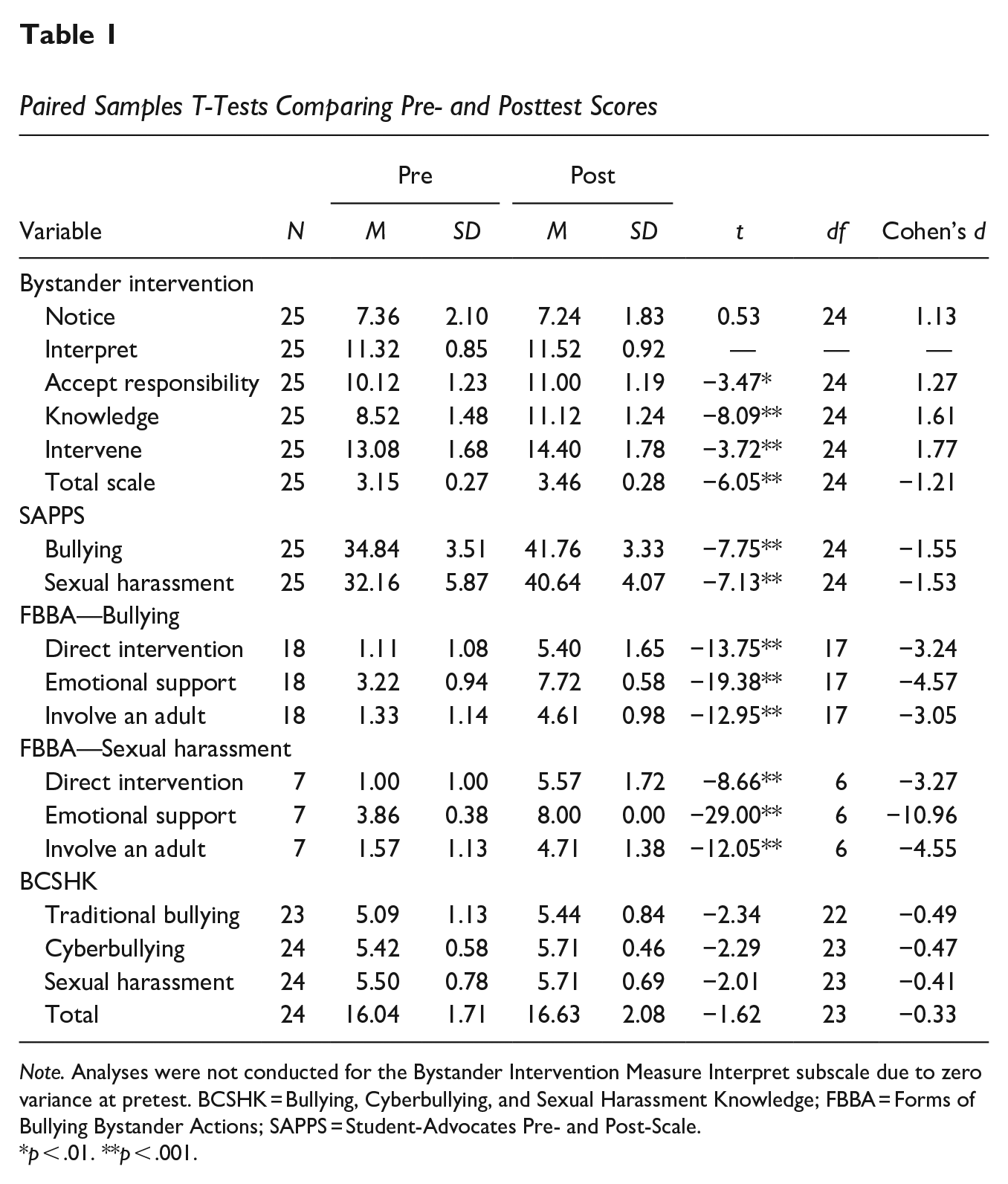
Note. Analyses were not conducted for the Bystander Intervention Measure Interpret subscale due to zero variance at pretest. BCSHK = Bullying, Cyberbullying, and Sexual Harassment Knowledge; FBBA = Forms of Bullying Bystander Actions; SAPPS = Student-Advocates Pre- and Post-Scale.
p < .01. **p < .001.
At posttest, students demonstrated greater knowledge of bullying and of bystander intervention strategies, as well as greater confidence in intervening in bullying on the SAPPS bullying measure (p = .000). This significant improvement was also indicated on the SAPPS sexual harassment measure (p < .001).
Students also showed significant gains on the FBBA bullying and sexual harassment scales. For the FBBA bullying measure, students displayed significant increases on the Intervene (p < .001), Support (p < .001), and Adult (p < .001) scales from pretest to posttest. Students also scored significantly higher from pretest on FBBA sexual harassment subscales, including Intervene (p < .001), Support (p < .001), and Adult (p < .001). Although knowledge of traditional bullying (p = .029) and cyberbullying both showed an increase from pretest to posttest (p = .032), using the more conservative p-value of .003, these changes would only be considered marginally significant.
Focus Groups
Results from the focus groups were organized into four themes: (a) impact of the training on participants and the school community at large, (b) the content and design of the training, (c) barriers to intervening, and (d) personal experiences with bullying and being a bystander.
Impact of NAB IT! Bystander Intervention Training
Many students reported that participating in NAB IT! led them to learn skills and information and improved their thinking and/or behavior. Students said they “know more” and are “more comfortable with it [intervening] now.” Students also noted that they were more able to identify “subtle” forms of bullying and sexual harassment. Many comments regarding the impact of the training focused on building confidence in intervening. Representative comments included: “I think I’m much better prepared after that lesson than I was before,” and “I feel more comfortable with how to sort of like deal with it in a way.”
Students said it would be feasible to use the skills that they learned during the training in real-life scenarios, with one student saying, “everything we learned realistically could be used.” Additionally, some students commented that they had used these skills in their daily life since they received the training. One participant reported intervening directly: “My friends were. . . .gossiping about someone, and I’m like ‘Hey, don’t do that; that’s not a smart idea. . . . don’t spread that because it could get worse, and I literally just learned about this.’” Another participant referenced supporting a target: “I. . . started talking to them so or just told them to ignore them, just help that situation not advance.”
Students also reported having conversations with their friends about the topics discussed during NAB IT!, with one student saying that the friends with whom they discussed the training “found it very helpful” and “definitely wanted to know more.” Students also spoke about how, through their actions, they could create positive change in their school community. For example, one student talked about this sentiment: Once you see someone helping someone else who’s being bullied that would probably inspire you to do it next time around because you know what it is to see someone else do it, . . . you feel good seeing that the situation was resolved. . .so I think it’ll just be much easier to step up when it’s necessary.
Although some positive change was noted, participants also mentioned that some students who were not directly involved in the training failed to receive the messages. One student said that they felt that the training was not being talked about during the school day and so other students “didn’t really know about it.” This was partly due to the conditions around COVID-19, in which many students were either fully or partially remote and had fewer opportunities for social interactions. Students commented on the “disconnected” nature of remote school and that they did not see “as many people as usual.” One student summarized the ambivalent feelings about the impact this training had on others by saying: “I personally haven’t [noticed a change in others’ behaviors], but that’s because I’m fully remote, so I really don’t interact with the people in school, all that much. So, I think we’re gonna have to wait to see the results of that until we got everyone back in the building.”
To disseminate the messages to the larger student body, three possible solutions were suggested: have organized methods for the trainees to train and educate other students, increase the number of students trained, and have teachers facilitate a portion of the training in the classroom. The most popular suggestion with the students in the focus groups was for the trainees themselves to spread the word to the school community directly.
Content and Design of the Training
Many of the comments discussed the design of the NAB IT! training itself, including the format (e.g., length of sessions, remote delivery), specific intervention components (e.g., real-life examples, role plays, topics covered), relevance and reliability of the examples discussed, and the selection of participants. Feedback on the format of the training was overwhelmingly positive. One student said, “I liked how it was separated kind of like into sections of the different topics that were covered.” Another student commented that they liked “how consistent it was. There was always a sense of ‘You can do this. You can do this.’ There was always different ways to deal with a bully.” While one participant said that they would have preferred more sessions for shorter durations, overwhelmingly, students reported that the number and length of the sessions were appropriate and manageable. Many students noted that the school year in which this training (2020–2021) took place was unique because many of the students were remote. Several students said that they were unsure if they would feel the same if this took place during a school year with an entirely in-person schedule with after-school activities and in-person classes; as one student stated, students’ schedules would be “even more hectic and chaotic.” While the training had to be held remotely on Zoom, students felt that the training sessions were “a very comfortable, open space to talk and share what you were thinking.” Moving forward, however, most students suggested that the training would be “more comfortable” and “more effective in person.”
Students found four aspects of the training most effective: (a) using local examples of bullying, (b) teaching specific skills to act as an upstander, (c) providing specific bullying and sexual harassment scenarios, and (d) role-playing what they would do if they were in these situations. Students commented that using local examples was very helpful in highlighting the importance of the skills that they were learning during the training: “seeing the examples from school districts and kids kind of around here. . . was a really good wake-up call.” They went on to say that seeing these scenarios helped them to “internalize that this is an issue that needs to be fixed, not just something you see or hear about that’s far away.”
Several students also mentioned that learning specific skills was a beneficial component of the training as this gave them different options for “how to approach different situations.” One student stated that “[breaking] down the different ways of being an upstander” was a good method of organizing the training as they “never would have thought about [how to intervene in] certain ways.” There were also several positive comments about the examples of bullying and sexual harassment provided to help them think about how they would respond in these situations. This is best reflected in the following quote: “There were lots of good examples. . . I think those were probably the best way, the most efficient way, . . . for me to learn was just by using exercise and saying realistically how would I react to this, if I’m thinking picture my head, what would I actually do.”
Students had many positive comments about the topics covered in the training. Several students spoke about the importance of raising awareness about bullying and bystander intervention and ways to increase their awareness as they became more able to “step up when [they] see something.” These students also said that they appreciated these discussions as they highlighted that these are “nuanced subjects compared to just like the typical beating someone up type of bullying.” Two students suggested that the training should have a stronger focus on sexual harassment and sexual assault prevention in the future. While they appreciated that sexual harassment was included, they felt that this was a topic that students did not hear much about, “especially in the school environment.” Students also said that they “don’t think it’s talked about as much as bullying is” and that the student “wasn’t really aware of many ways how to deal with that and I would have liked to know.”
The role-play component was also well-received. Students liked the hands-on approach to these activities and felt that “practicing a situation was definitely helpful.” Several students commented that it helped them to “think about what [they] would do” in that situation, more than “a hypothetical or like just [being told] ‘this is what you should do.’” The majority of students stated that they felt comfortable engaging in the role-play activities; however, one student did note that they felt that the online format of the training made it “a little bit awkward.”
In general, students reported that the skills taught in the training could be feasibly implemented when they witnessed a bullying or harassment situation occurring. One student spoke to this by saying, “I feel it was more relevant to like the time now and what high schoolers go through in their daily lives, and they could understand what was happening better, and the problems they are trying to show.” Students spoke about the relatability in a general sense, but also during remote schooling, implementing these strategies “even at home” to combat “cyber-bullying [and] sexual harassment over text or social media.”
Some students also spoke about how they felt that they had not witnessed as much bullying as compared to what other students may experience in different school communities: I know in our school . . . I haven’t been exposed to like the bullying or certain types of bullying that we went over on around the school as much. So, I think . . . sometimes it was hard to like try to relate to a situation. . .we did work with like examples and stuff so that made it better.
Students also spoke about how some of the example scenarios that were provided “were a little bit unrealistic, like slapping the book out of someone’s hand.” Another student also commented that due to the remote schooling that was taking place during the 2020 to 2021 school year, “there’s not much physical bullying going on,” and so not all aspects of the training were as applicable during that school year.
There were many comments about having only a small number of students receive the training rather than an entire school. Students generally enjoyed taking this training with a small group of other students, as it allowed them to “hear their opinions on what they would do in a certain situation.” One student commented that being in smaller groups of their peers made it more effective, whereas if it was delivered in a larger assembly format, many people might “just kind of shrug it off.” Although many students appreciated the smaller groups of peer leaders receiving the training, some were concerned about the participants being too narrowly chosen. As one student put it, “I feel like a lot of people that hang out together were involved in [the training], so I think there’s certain groups within the school that the training didn’t reach.” Not all students agreed with this statement, as they commented that they “think the people who took the course will do a good job of spreading their knowledge.”
Barriers to Intervening
Although the majority of students perceived that the training would positively impact them in the future, a few students noted that they “would feel intimidated and still hesitate” to use the skills taught. A prominent theme was that students’ ability and confidence to intervene would differ depending on the situation. Students spoke about how witnessing a physical confrontation, especially in a more extreme case of violence, would make it intimidating to intervene. One student said, “it would definitely be more difficult to intervene if, like there’s physical violence and there’s no adult you can get to get help.” Another student spoke about how seeing physical violence may make it harder to know exactly what the best way would be to intervene, saying, “it was just harder to put two and two together. I was like ‘okay, so this is what I should do, but how would I actually get the job done?’” Other students spoke about how, while it can be intimidating to intervene in these situations, it is important to know and understand the different tools that they could implement, as seen in the following quote: Like if some kid all of a sudden starts throwing punches at some innocent kid, I don’t think just standing there and trying to distract is going to do anything. That might be a situation we have to either go find an adult or like confront the bully. I mean maybe, can try to split it up. But then, if it’s like a cyberbullying, for like that case, you could take screenshots, so that’s a good situation to support someone.
Several students spoke about how their relationship with the perpetrator would make the situation more or less challenging to intervene. The majority of students indicated that it was more difficult to intervene when they did not know the people involved, as the others may not understand the intent of trying to help, which may result in more aggression. Students also spoke about how they felt they would not know the context in these situations (e.g., what people are fighting about, if they are joking or not), making it harder to know if it is necessary to intervene at all. For example, one student said, If it really is just a joke, and no one’s hurt by it, and then you’re just kind of like crashing the party, I might be a little awkward, but I think it’s just looking out for the key signs and you can kind of tell, I guess, if you look at someone’s just facial expression.
In contrast, some students said that being friends with the perpetrator makes it harder to intervene “because you need to go against what their opinion is and kind of like take a stand against your friends.” While students expressed that some situational components make it more challenging to intervene, several students said that they would feel more comfortable since taking the training.
Personal Experiences With Bullying and Being A Bystander
Another central theme that students frequently discussed was their personal experiences with bullying, witnessing intervening, and bystander interventions. Many students mentioned that past bullying prevention programs that they had engaged with spoke more about “Don’t bully. Don’t be a bully yourself,” or that the only way to handle a situation was to “tell a teacher.” These students stated that they appreciated the multiple options that NAB IT! provided for intervening.
Discussion
The purpose of this mixed-methods pilot study was to provide preliminary data on the effectiveness of NAB IT! in changing knowledge, attitudes, and self-reported behaviors of high school students related to bystander intervention against bullying and sexual harassment. NAB IT! is unique in its approach in that it trains peer-nominated student leaders in the five-step bystander intervention model to apply different ways of responding in situations of bullying, cyberbullying, and sexual harassment. The need for such a training might be called into question if bullying and sexual harassment were not occurring at the pilot school due to the school’s culture or to the hybrid learning environment necessitated by COVID-19. In this study, however, more than 80% of the participating students reported witnessing bullying, and over one-third reported witnessing sexual harassment at each timepoint. These findings suggest that it was appropriate to implement a bystander intervention training such as NAB IT! in this context. The quantitative data indicated that, after receiving the NAB IT! training, students’ reported bystander intervention knowledge, confidence, intent, and actual intervention behavior in bullying and sexual harassment incidents increased. Students were knowledgeable about what constituted bullying, cyberbullying, and sexual harassment prior to the training, and this did not improve significantly after the training. Qualitative data supported and enhanced these findings, providing richer data about participating in the training and insights into which aspects of the training were most helpful.
Impact of NAB IT! on Knowledge, Confidence, and Self-Reported Behavior
Students’ self-reported intentions and behaviors around intervening were positively impacted by the training, as indicated by large, significant improvements on the total scale of the bystander intervention measure and the subscales of accepting responsibility, knowing what to do, and acting to intervene. These results were cross-validated with findings of significant improvements from pre- to posttest on knowledge of bystander intervention strategies and confidence in intervening with bullying and sexual harassment as assessed by the SAPPS. These results are consistent with findings from studies indicating that bystander intervention training has positive impacts on high school students with respect to intervening in bullying (e.g., Johnston et al., 2018; Polanin et al., 2012) and extend these findings to include bullying and sexual harassment.
For the smaller subset of students who witnessed bullying and sexual harassment after being trained, there were also remarkable increases in using different intervention strategies, including reporting to an adult, intervening directly, and comforting the person targeted. These are especially significant findings as prior studies have found that students’ feelings of inadequate skills and a lack of responsibility to intervene are two of the most common barriers to intervening in a problematic scenario (Bennett et al., 2014).
Not all outcomes were positively impacted by the training. Students’ scores on the BCSHK, which assessed their ability to identify scenarios as meeting the criteria for bullying, cyberbullying, and sexual harassment, and the step of noticing bullying and sexual harassment on the bystander intervention measure, did not show significant changes. In terms of identifying the situations, it is possible that there were no significant improvements because of a ceiling effect (students scored high on the pretest and posttest) or because of a lack of power with the small sample size. The noticing step of the bystander intervention measure assesses recognizing bullying and sexual harassment in the school setting (e.g., bullying is a problem at this school; I have seen other students being bullied or harassed), as opposed to intervening when it occurs, so it is likely that they did not see changes in bullying and sexual harassment in the school environment as a result of the intervention. As noted previously, due to the inability to calculate the reliability of the Interpret subscale due to zero variance (i.e., all students strongly agreed that bullying and sexual harassment were damaging to others), change was not assessed.
Results from the student focus groups were consistent with those from the pre-/posttest while providing additional context surrounding these findings. Students endorsed feelings of being better able to identify subtler forms of bullying and sexual harassment and having increased confidence to intervene in bullying or sexual harassment, consistent with the quantitative findings. The students reported an appreciation for learning and practicing specific skills that were feasible to put into action, which provides insight into which intervention components are most likely contributing to these changes. These findings are consistent with research showing that teaching explicit bystander intervention skills to high school students increases responsibility for intervening (Johnston et al., 2018). Research on bystander intervention has found that the reduced acceptance of violence and the behavior of bystanders are the mechanisms of change resulting in reduced violence perpetration (Bush et al., 2021). Students contrasted NAB IT! with previous programming that told them not to bully and to report to an adult without being provided with multiple options. These results are consistent with past research finding that bullying prevention programs are less effective with high school students than with younger ages (Yeager et al., 2015). In contrast, bystander intervention approaches have larger effect sizes in high school compared to elementary school populations (Polanin et al., 2012).
Contextual Issues and Feasibility of Making Change in School Setting
Findings from the focus groups highlighted nuances in the students’ feelings and attitudes about the training, often reflecting broader contextual issues about bullying, sexual harassment, and bystander intervention. Specifically, students commented that they felt that the topics of bystander intervention in sexual harassment situations were especially important, as they are not typically covered; however, they wanted more information about how to handle these situations, as well as targeted bystander intervention strategies for sexual assault. Students suggested including a section about sexual assault prevention and focusing on the dangers of these situations and concrete options of what to do if they witness a sexual assault. It is possible that NAB IT! could be used in conjunction with programs like Green Dot, which have been found to decrease sexual violence and other interpersonal violence perpetration in high schools (Coker et al., 2017, 2019), to address the full continuum of interpersonal violence.
Students also recognized that the skills they learned would be helpful in many situations. However, depending on the context, such as the type of aggression and relationship with the people involved, it may be challenging to intervene. In particular, students said that the skills would be less practical when physical violence is involved. This suggests a need to emphasize the importance of one’s own safety and use a strategy, such as getting help instead of intervening directly, when confronted with physical violence. In addition, given that teachers are even more likely to respond to physical bullying than relational or verbal bullying (Yoon et al., 2016), the option of reporting immediately to a trusted adult in such situations should be emphasized. Finally, students reflected on the role of interpersonal relationships; given that this is a salient contributor to bystander intervention (Meter & Card, 2015), trainings should focus on different ways to approach situations depending on the relationships with the people involved.
Limitations and Future Research Directions
Despite the strengths of this study, including the peer nomination process and the use of both quantitative and qualitative data, there are some limitations. The current study was designed as a pilot, and as such, the sample was small in size, with no control group. Future research that uses an experimental design is needed to provide a more rigorously controlled examination of effectiveness. In addition, the sample size was even lower for the FBBA, as this required witnessing bullying and/or sexual harassment, which limits the generalizability of the findings. Furthermore, the internal consistency for some of the subscales was quite low (e.g., FBBA subscales; unable to calculate for Interpret subscale of Bystander Intervention Measure), and therefore results should be interpreted with caution and require replication with larger samples. The study was also conducted during the COVID-19 pandemic, and the training was delivered virtually. Students had fewer opportunities to observe and intervene in bullying and sexual harassment or share information with others due to the incorporation of remote instruction for students. Data collection was limited to students participating in the training and occurred soon after they completed it, restricting the ability to assess the impact on the larger student body or the use of the skills learned in training. Future research should also assess relevant constructs (e.g., bullying, sexual harassment, bystander intervention, school climate) from students and teachers/school staff not involved in the training to assess the greater impact of the intervention.
The NAB IT! training was provided to peer-nominated opinion leaders (Valente et al., 2003; Valente & Pumpuang, 2007), which was supported by most of the students, although a limitation was that the messages did not seem to disseminate to the larger student body other than through informal conversations with friends. Part of this may be due to the training being held somewhat late in the school year and the challenges with hybrid instruction during the COVID-19 pandemic. However, strategies suggested by students for how to further disseminate the information, as well as strategies used successfully in similar peer leader trainings, can be integrated more systematically into NAB IT! in the future. Such strategies include sharing information in assemblies, reading facts during announcements, holding information sessions, and spreading messages through posters and wristbands (Paluck & Shepherd, 2012).
Implications for Practice
Findings from this pilot study suggest that this bystander intervention training approach of teaching multiple options for intervention in bullying and sexual harassment to high school opinion leaders increases knowledge, confidence, and self-reported use of various bystander strategies (e.g., direct intervention, providing support to target, involve an adult). Given the widespread use of similar programs to prevent sexual violence in college and university settings (Banyard, 2015; Moynihan et al., 2010), it is logical and important to introduce this approach at earlier ages, particularly because bullying and sexual harassment are frequent occurrences in high school (Chiodo et al., 2009; Gruber & Fineran, 2016). School-based mental health professionals, such as school counselors, school psychologists, and school social workers, can implement such programming, and it can also be integrated within the curriculum in health and other classes. Our findings suggest that these topics are important to students, yet they do not feel like they are addressed openly (particularly in the case of sexual harassment) and that having multiple options for responding in different situations is directly applicable to them.
School personnel should also be aware of the complexities of interpersonal violence and the importance of their roles in intervening and supporting students in their bystander intervention efforts (Yoon et al., 2016). Although students can and should be empowered to intervene, they are more likely to do so if teachers intervene and schools promote social-emotional learning (Jenkins et al., 2021). Therefore, schools should use programs like NAB IT! as one part of a multifaceted approach to promoting social and emotional competencies and preventing interpersonal violence.
Conclusion
The majority of bullying and sexual harassment incidents at school are witnessed by peers who intervene less than 20% of the time due to various reasons, such as safety concerns and lack of knowledge of how to intervene (Atlas & Pepler, 1998; Hawkins et al., 2001). Studies have shown that bystander intervention successfully prevents victimization more than half of the time (Craig et al., 2000; O’Connell et al., 1999). Given that high schools often do not have a systematic program addressing bullying and sexual harassment prevention knowledge and strategies, the current study is particularly important (Cook-Craig et al., 2014; Sherer & Nickerson, 2010; Ttofi & Farrington, 2011). The results of the present pilot study provide preliminary support that participating in NAB IT! can lead to increased self-reported confidence and bystander intervention skills related to accepting responsibility, knowing what to do, and intervening in bullying and sexual harassment situations from pre- to posttest. Students also reported that the strategies taught in training are practical in real life. The current study has important implications for school-based mental health professionals and personnel to increase their students’ knowledge and skills around bullying, sexual harassment, and bystander intervention and to create a positive school climate.
Supplemental Material
sj-docx-1-prv-10.1177_26320770231200230 – Supplemental material for Bystander Intervention in Bullying and Sexual Harassment Training: Mixed-Method Evaluation of NAB IT!
Supplemental material, sj-docx-1-prv-10.1177_26320770231200230 for Bystander Intervention in Bullying and Sexual Harassment Training: Mixed-Method Evaluation of NAB IT! by Amanda B. Nickerson, Margaret E. Manges, Julianna Casella, Yingqi Huang, Jennifer A. Livingston, Lyndsay N. Jenkins, Gina M. Bellavia and Thomas H. Feeley in Journal of Prevention and Health Promotion
Footnotes
Declaration of Conflicting Interests
The authors declared no potential conflicts of interest with respect to the research, authorship, and/or publication of this article.
Funding
The author(s) disclosed receipt of the following financial support for the research, authorship, and/or publication of this article: This research was supported by the Institute of Education Sciences Award R305A190139 (PI: Amanda Nickerson). The content is solely the responsibility of the authors and does not necessarily represent the official views of IES.
ORCID iDs

Supplemental Material
Supplemental material for this article is available online.
References
Supplementary Material
Please find the following supplemental material available below.
For Open Access articles published under a Creative Commons License, all supplemental material carries the same license as the article it is associated with.
For non-Open Access articles published, all supplemental material carries a non-exclusive license, and permission requests for re-use of supplemental material or any part of supplemental material shall be sent directly to the copyright owner as specified in the copyright notice associated with the article.
