




Abstract
Background:
Epidemiologic studies have shown world-wide increasing incidence of ulcerative colitis (UC) as an autoimmune disease of intestine. In the meantime, gastrointestinal H. Pylori infection is being decreased.
Objectives:
There are very few studies about comparing the presence of H. Pylori in the colon and the disease activity of UC. There is no study form Iran. In this study, we tried to investigate the presence of H. Pylori in the mucosa of colon by molecular and microbiological as well as pathological methods to find any association between the presence of this organism in the colon and the presence and activity of UC.
Patients and Methods:
In 100 patients who referred to colonoscopy clinic, colonoscopy was performed. Fifty-seven patients with the new diagnosis of UC were considered as cases and 43 patients with normal screening colonoscopy for polyps were considered as controls. Colon biopsies were evaluated according to histopathology, clinical findings, and laboratory results to confirm the diagnosis and the degree of activity in the cases of UC. Molecular studies were also performed to evaluate the presence of H. Pylori genome in the colon biopsies. A sample of colon was also cultured for H. Pylori. ELISA test was performed in a sample of blood to evaluate the level of IL-10 and IL-17 as regulatory cytokines of inflammation.
Results:
Cases with the diagnosis of UC showed significantly higher number of positive colonic H. Pylori comparing to normal colonic mucosa. Also, the presence of H. Pylori genome in the colon was associated with higher activity in the cases with UC and higher levels of inflammatory mediators especially IL17 and lower levels of inhibitory mediators such as IL-10.
Conclusion:
Colonic colonization of H. Pylori was higher in the patients with UC and higher activity of this disease comparing with normal control colonic mucosa.
Introduction
Inflammatory bowel diseases (IBDs) are group of chronic and relapsing diseases, involving small and large intestine, mainly composed of 2 types, that is, Crohn’s disease (CD) and ulcerative colitis(UC). The underlying pathogenesis of these diseases are mainly immunologic, and they are categorized as autoimmune diseases. The etiology of IBD is mainly attributed to the interaction between immune system, with host genetic and environmental factors. IBD is most likely caused by an abnormal immune response to environmental factors in a genetically susceptible individual. 1 The incidence of this disease has been increased during the last 2 decades especially in Asian countries. 2
Helicobacter pylori (H.P) is a common bacterium in the acidic environment of stomach. There are some studies about the lower rate of H.P infection in the stomach of the patients with IBD compared to non-IBD controls and also probable protective effect of H.P against IBD. 3
There are controversial reports about the inverse association between presence of H.P infection and presence and severity of IBD (or protective role of H.P against IBD). 4
Some researchers have shown that improving hygienic conditions of life, causes less bacterial infections in the gastrointestinal tract which can be considered as the cause of increasing the incidence of autoimmunity and intestinal autoimmune diseases such as IBD. 3
We conducted this study with 2 main objectives, one is to find out the presence of any association between H.P colonization in the colon and the presence of IBD as an etiologic factor of this autoimmune disease and second to evaluate any correlation of this colonization with IBD activity. There have been very few studies from Iran about the association between H.P infection and IBD from Iran but none of them have investigated the presence of H. P in the colon by molecular and tissue diagnostic methods and its correlation with IBD and severity of activity.
Patients and Methods
The study was prospective. All of the patients with the diagnosis of IBD who have referred to the colonoscopy clinic in the affiliated hospitals of Shiraz University of Medical Sciences were included in the study (during the year 2020). All the patients consented to take part in the study. One hundred patients who referred to colonoscopy clinic, colonoscopy was performed. Fifty-seven patients with the new diagnosis of inflammatory bowel disease were considered as cases (with no history of previous treatment) and 43 patients with normal colonoscopy were considered as controls. Control cases have been patients who referred for screening colonoscopy and their colons were normal).
➢ Inclusion criteria:
(1) All of the patients included in the study were newly diagnosed IBDs (all cases of ulcerative colitis) with no prior treatment. It is worthy to note that the diagnosis of IBD was based on the clinical, paraclinical and pathologic criteria in addition to exclusion of other causes of colitis.
(2) They have not received any other medication for IBD or any other medication such as antibiotics or proton pump inhibitors, and etc. . . during the last 1 month prior to sampling and colonoscopy.
➢ Exclusion criteria:
(1) Previous treatment for IBD or being under any medications or any treatment during the last 1 month prior to sampling.
(2) Any underlying disease other than IBD, such as drug induced colitis, ischemia, or positive culture.
Colon biopsies were evaluated according to histopathology to confirm the diagnosis and the degree of activity in the cases of inflammatory bowel disease. Normal cases were all normal colonoscopy with normal biopsy. Also, it’s worthy to note that all the microbial cultures were negative in the case group, so infectious colitis has been excluded. Activity was determined based on the colon biopsies as the presence of cryptitis was considered as mild activity. Presence of crypt abscess as moderate activity and severe activity when ulceration of the mucosa was present. 4
In 44 patients (20 cases of IBD and 24 cases with normal colonoscopy) concomitant upper endoscopy and gastric biopsy was also performed, which were also investigated for the presence of H. Pylori by the same methods as colon biopsies.
- Microbiological studies: Biopsy samples were cultured for H. P. on Brucella agar.
- Immunologic studies: ELISA was performed for IL10, 17, and Cag-A antigen on the blood sample.
- Molecular studies: Qualitative and quantitative PCR was performed on the tissue of the colon (in all of the 100 cases) and stomach (in 44 cases), for identifying H.P gene (16SrRNA, bab A, and dup A). All the cases were confirmed by sequencing.
- Pathologic studies: H&E slides from colon and stomach (in 44 cases with upper endoscopy due to the presence of upper gastrointestinal signs and symptoms) were seen by an expert GI pathologist to confirm the histopathologic diagnosis of IBD or the presence of any abnormalities. Disease activity was also recorded. In 56 patients, there were no upper gastrointestinal signs and symptoms, so upper endoscopy was not performed.
It is worthy to mention that all the H&E slides were reviewed by the pathologist without any knowledge about the results of the other tests.
Results
Total number of patients (cases and controls) were 100 cases, 57 cases (documented newly diagnosed ulcerative colitis), and 43 controls with unremarkable colonoscopy and normal biopsy findings Table 1 shows details of demographic findings.
Demographic and clinical findings of cases and controls.
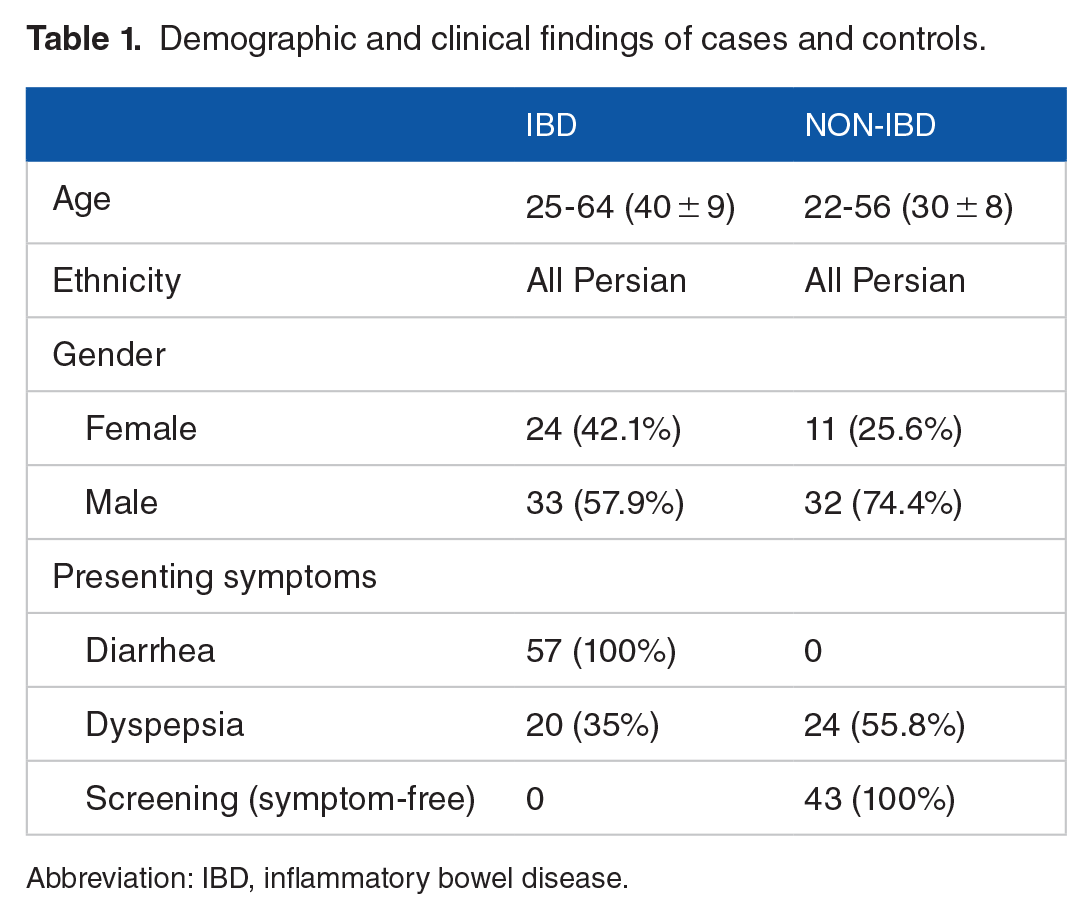
Abbreviation: IBD, inflammatory bowel disease.
There were 65 male patients (43.4%) and 35 females (56.6%). Cases with the diagnosis of IBD presented with various signs and symptoms such as indigestion, abdominal pain, diarrhea, rectal bleeding, and constipation. Controls were asymptomatic.
Results of different modalities were as below:
(1) Microbiological studies: Among 57 cases, 17 colon biopsy tissues were cultured positive for H.P, and H. P has grown on the culture media (Brucella agar). These 17 positive cases were all categorized among the IBD cases with moderate to severe activity (15 of them showed moderate and 2 severely active IBD in the biopsy). None of the mild IBD cases showed positive culture. All of the 43 controls were negative, and no growth was detected. All of the 44 cases with accompanied gastric biopsies (20 cases of IBD and 24 cases with normal colonoscopy) were positive for H.Pylori.
(2) Pathologic examination: Colon and gastric biopsy tissues in formalin have been proceeded as routine and stained by H&E stain. Among 57 cases, there were severe activity in 14 cases, moderate in 28 cases, and mild activity in 15 cases. All 43 colon biopsies labeled as controls were unremarkable and microscopically normal. All of the 44 cases with gastric biopsy showed mild to severe chronic gastritis with positive H.Pylori. Among the cases with upper endoscopy, 20 cases were IBD (6 cases with mild activity, 6 cases with moderate, and 8 cases with severe activity) and 24 cases with normal colonoscopy.
(3) Molecular studies: Real time PCR showed H.P DNA in 27 tissues of 57 cases. All of these 27 positive cases were IBDs, and non-IBDs were all negative for H.P DNA. All of the 27 positive cases showed moderately to severely active IBD, that is, 8 of the positive cases showed severe activity and 19 cases showed moderate activity. None of the mild IBDs showed positive PCR for H.P. All of the cases and controls were negative for bab A, and dupA.
All of the 44 gastric biopsies were also positive by molecular studies.
(4) ELISA tests: Table 2 shows the results of ELISA tests. Cag A was positive in all of the cases in gastric mucosa.
Molecular, immunologic, and IHC as well as pathologic results of cases and controls.

Abbreviations: IBD, onflammatory bowel disease; H.P: Helicobacter Pylori.
Discussion
Inflammatory bowel diseases(IBDs) are groups of autoimmune diseases which are most commonly seen in the patients with some kind of inherited predisposition to abnormal immune response to an environmental trigger such as an infectious agent.5,6 In recent years diagnosis of IBD cases are being increased. 7 At the same time with improved hygiene especially in developing countries, H.P infection in gastrointestinal tract is being decreased. 8 So, there are reports about protective effects of H.P infection and gastritis against IBD development.2,9 There are reports about the possibility of interaction between dendritic cells and H. pylori, which can upregulate regulatory T-cells leading to decreased production of proinflammatory cytokines. 10
Controversial reports have also been published about the treatment of H.P and the development of IBD. 1 Some studies have concluded that H.P eradication can be a predisposing factor for development of autoimmune diseases in intestine. 11 Other studies have concluded that H. pylori eradication therapy does not exacerbate IBD and does not improve disease activity. 12 There are also epidemiological studies which have found an association between H.P infection and development of IBD as it can produce a long standing and chronic inflammatory response with the production of cytokines such as IL-10 which is a regulatory cytokine playing a pivotal role in reducing host immune response to pathogens. H.P infection is associated with low levels of IL-10 that can be a cause a more severe IBD. 13
On the other hand, However, in most of the previous reports presence of H.P has been investigated in the stomach and presence of this bacteria in colon has rarely been studied. 14 In this study, we investigated the presence of H.P in the colon and compared the positive cases in culture with non-IBD control cases. In our study, colonic colonization of H.P was discovered, exclusively in IBD patients especially more active ones and none of the control cases showed positive H.P in colon culture. This possibility has been previously reported that the initiation of the human IBD can be triggered by other types of Helicobacter organisms from colon such as Helicobacter bilis, Helicobacter fennelliae, Helicobacter hepaticus, and Helicobacter trogontum. 7 Also, CagA positivity was higher in the patients with more active IBDs.
It can be hypothesized that H. P infection induces alterations in gastric and/or intestinal mucosal permeability or it may be the cause of immunological derangements in the intestinal environment which can be the cause of the absorption of some antigenic material which can provoke the immune system and causes autoimmunity by various immunological pathways such as anti-inflammatory cytokines like IL10 or increasing of pro-inflammatory cytokines such as IL-17. 15 In this regard, we also tried to investigate the level of inflammatory cytokines and found out that the higher serum level of IL-17 was significantly more common in IBD cases and was correlated with more active IBDs. On the other hand, higher levels of IL-10 were more common in non-IBD and normal control cases and was higher in less active IBD cases.
In addition to colonic H.P., in 44 cases with dyspepsia, upper endoscopy was also performed which showed chronic gastritis and gastric colonization of helicobacter infection, 20 cases were IBD and 24 cases with normal colonoscopy (control non-IBD group). In this study we couldn’t find any correlation between chronic gastritis and IBD activity.
Overall, in conclusion, our results showed that presence of H.P in the mucosa of colon is associated with IBD cases more than non-IBD control cases and also in IBD cases was associated with more activity. In this study, we didn’t include other types of colitis such as ischemic or infectious colitis, more studies are necessary to compare the presence of H.P with other causes of colitis with IBD.
Footnotes
Funding:
The author(s) received financial support for the research from Transplant Research Center, authorship, and/or publication of this article.
Declaration of Conflicting Interests:
The author declared no potential conflicts of interest with respect to the research, authorship, and/or publication of this article.
Author Contributions
Javad Ranjbar: Collecting the cases and sample collection as well as writing the paper; Kamran Bagheri Lankarani: endoscopy and collection of the biopsies and cases as well as writing the paper; Mitra Mirzai and Zahra Jowkar: Performing the PCRs; Elham Moazamian: Design of the project; Bita Geramizadeh: The idea of the project, technical support, writing the paper, Methodology design.
