




Abstract
Background:
Iran is one of the high-risk countries for esophageal squamous cell carcinoma (ESCC). Human papillomavirus (HPV) has been reported as one of the etiologic, pathogenetic, and prognostic factors in this tumor, especially in high-risk geographic areas. Previous reports from our geographic area, that is, the South of Iran failed to show any evidence of HPV in the cases of ESCC by molecular methods.
Objectives:
In this study, we evaluated P16 and P53 immunohistochemistry (IHC) expression in the cases of esophageal ESCC from Fars province in the South of Iran to find the presence of any correlation between clinicopathologic findings with P16 and P53 expression by IHC as etiologic and prognostic biomarkers. We also tried to compare the results from other geographic areas of Iran and the world.
Results:
P16 and P53 expression were found in 42.9% and 66.12% of ESCCs, respectively. No statistically significant correlation was found between clinicopathologic findings and P16 pr P53 expression.
Conclusion:
Although P16 and P53 expression in ESCC in the South of Iran is significant, there is no statistically significant correlation between clinicopathologic findings and outcome in ESCC and expression of these 2 proteins to be considered as biomarkers. Results from other geographic areas of Iran and the world are also very controversial and inconsistent.
Introduction
There are several countries in the world which are at high risk regarding esophageal squamous cell carcinoma (ESCC), such as China, Singapore, and Iran. 1 In these countries, infection by human papilloma virus (HPV) is considered as the possible cause of this malignancy. 1 The first report about the association between HPV and ESCC has been more than 30 years ago; however, it seems that this association depends on the geographic region, that is, it is more prevalent in high-risk countries. 2 There are also some studies about the association of HPV infection and clinical outcome of ESCC. 3
The role of HPV in the cause and prognosis of ESCC is controversial, and some meta-analyses have shown no statistically significant correlation. 4
There are also controversial reports from different geographic regions of Iran regarding the aforementioned association.5-16
Most studies regarding HPV and ESCC have used molecular methods to find HPV genomes in the tumor, and there are very few studies about the protein expression of HPV in the tumor tissue.17-30 In this study, we tried to evaluate the expression of HPV proteins by immunohistochemical methods to find out the correlation of HPV-associated proteins (as an immunohistochemical biomarker) and clinicopathologic characteristics of ESCC in the largest referral center from the South of Iran. We also tried to perform a thorough search in the literature to compare the results from different geographic areas of Iran and the world.
Patients and Methods
In this cross-sectional study for 5 years (2015-2019), all the cases with the diagnosis of ESCC in the affiliated hospitals of Shiraz University of Medical Sciences were evaluated for the presence of suitable tumoral tissue with no necrosis for staining with immunohistochemical markers. There were 71 cases of ESCC among which, 31 specimens had enough non-necrotic tumoral tissue suitable for immunohistochemistry (IHC). The best paraffin block was selected, and IHC was performed for P16 and P53. The characteristics of antibodies are shown in Table 1. The sections were reported as positive and negative according to the documented criteria. 2 P16 staining pattern was qualitatively classified as negative and positive (nuclear-cytoplasmic, and cytoplasmic). Cases with more than 50% positivity were considered as positive. P53 was also scored as <10% (negative), and >10% (positive). Both were also quantitively scored as 0 to 3.
Characteristics of P53 and P16 antibodies which have been used in this study in ESCC.

Abbreviation: ESCC, esophageal squamous cell carcinoma.
Also, clinicopathologic findings were extracted from the patients’ charts and pathology reports.
Chi-square and SPSS 14 were used for the analysis of results and comparison of different prognostic and outcome characteristics. P value less than .05 was considered as statistically significant.
Results
There were 71 cases of ESCC during the last 5 years (2015-2019) in the affiliated hospitals of Shiraz University of Medical Sciences. Female-to-male ratio was 1:1.16 (33:38, 53.5%:46.5%). The age range was 44 to 85 (64.92 ± 12.15) years. Only 31 cases had enough suitable tissue for IHC staining for P16 and P53.
Tables 2 and 3 show the correlation of the clinicopathologic cases of ESCC and positivity of P53 and P16.
The results of P16 and P53 positivity in 31 cases of ESCC.
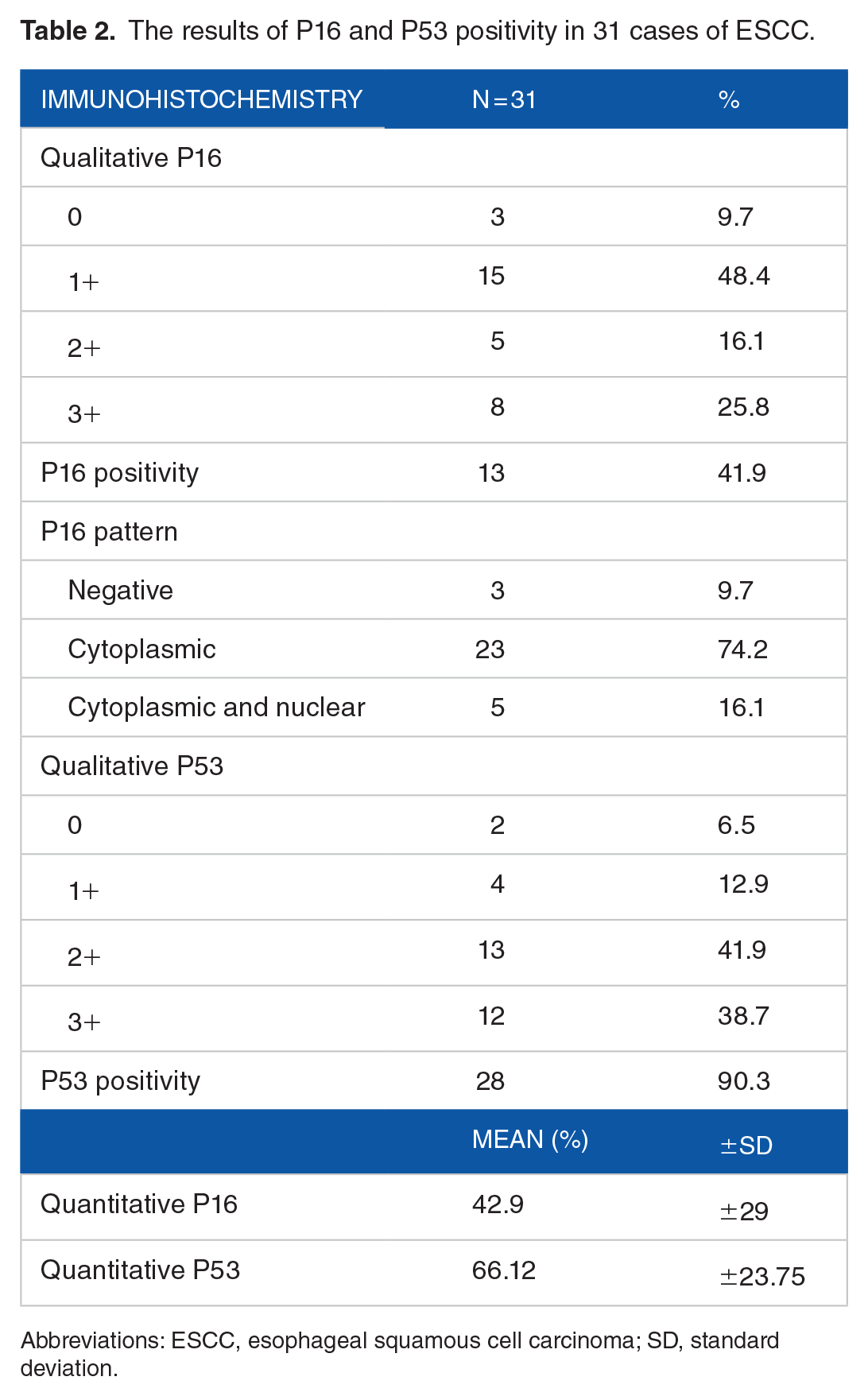
Abbreviations: ESCC, esophageal squamous cell carcinoma; SD, standard deviation.
Correlation between P16 and P53 characteristics and clinicopathologic findings.

Statistically significant.
As Table 2 shows, 41.9% and 90.3% of the cases were positive for P16 and P53, respectively. The significant nuclear and cytoplasmic P16 positivity was seen in 16.1% of the cases with the diagnosis of ESCC.
As the Table 3 shows, there has been no correlation between immunohistochemical positivity of these 2 biomarkers with age, sex, gross findings, grade, and stage of the cases with ESCC.
Discussion
There are controversial reports and studies about the correlation of immunohistochemical positivity of P16 and P53 with the cause, pathogenesis, and outcome of squamous cell carcinoma of upper aerodigestive tract. Most studies have shown that overexpression of P16 can be caused by molecular changes not related to HPV infection and prognosis.2,17 There are other studies which have shown that staining greater than 50% to 75% have a more correlation with the presence of actively transcribed HPV. 3
Other studies showed that chromosomal instability is correlated with persistent high-risk HPV infection, and increased expression of viral oncoproteins, that is, E6 and E7 which can interfere with cell cycle regulation and inactivation of p53. These studies claimed that IHC for p16 and p53 can be surrogate markers of HPV infection and good prognosis. 1
Previous study from our center of the South of Iran and also other studies from Tehran failed to show any evidence of HPV gene in ESCC, by polymerase chain reaction (PCR) method.10,13 Tables 4 and 5 show the studies from Iran and other geographic areas of the world about the presence of HPV infection in the cases of ESCC and the method which have been used to find the genome. As the tables show the reported incidence of the HPV genome is highly variable, that is, there is no consistent results in different geographic areas, either high or low incidence for ESCC.
Results of HPV studies from different regions of Iran.

Abbreviations: HPV, human papilloma virus; IHC, immunohistochemistry; PCR, polymerase chain reaction.
Results of HPV studies from different regions of the world.

Abbreviations: HPV, human papilloma virus; IHC, immunohistochemistry; PCR, polymerase chain reaction.
Our results also failed to show any correlation between clinicopathologic findings of the cases of ESCC and IHC expression for P16 or P53.
Footnotes
Funding:
The author(s) disclosed receipt of the following financial support for the research, authorship, and/or publication of this article: The authors received financial support for the research from Shiraz University of Medical Sciences (Research Project number 21288).
Declaration of conflicting interests:
The author(s) declared no potential conflicts of interest with respect to the research, authorship, and/or publication of this article.
Author Contributions
Bita Geramizadeh: Concept and idea of the research, looking at the slides, writing the paper. Alireza Mohammadian: Analysis and extracting the data, literature search, Alireza Shojazadeh: Literature search and helping to write the paper, Sahand Mohammadzadeh: Helping to look at the slides.
