



Abstract
TV advertisements are a powerful medium of influence in building audience perceptions. Despite significant strides toward gender parity in Indian TV advertising, especially in terms of presence and voice, a deeper examination reveals that the quality of representation for women and girls, and their portrayal often reinforces traditional gender and occupational roles roles and stereotypes. Although there has been progress, with some brands adopting more empowering messages, subtle forms of sexism, coined “sneaky sexism,” persist. These subtler and nuanced biases, while less overt, continue to influence perceptions of gender roles negatively. Advertising plays a pivotal role in gender socialization and current practices frequently perpetuate outdated stereotypes, such as women being predominantly depicted in domestic and beauty-related roles with floral decorations and softer pastel color palettes, and mostly not in paid employment, Around 87% of Indian respondents to a recent survey said that women are typically portrayed in traditional roles in their country’s media, and 86% said the same of the portrayals of men (UN Women). This study aims to evaluate selected Indian TV advertisements to validate the hypothesis using content and discourse analysis, and thematic analysis analysis of recurring patterns/motifs and underlying message/s.
The findings of the study will have a potential impact on positively influencing societal attitudes, looking at specific instances of sexist tropes and how these cause equality/inequality. This will help the media to actively understand and look at subtle sexism and revisit the content in the light of their moral responsibility toward society. The study underscores the need for the advertising industry to move beyond mere representation and address these entrenched stereotypes. By embracing gender-sensitive advertising, brands can contribute positively to gender equality and enhance their market appeal, as consumer attitudes increasingly reject stereotypical portrayals.
Keywords
Introduction
Advertising significantly impacts how gender roles are established. Indian TV commercials, though an engaging form of media, often contain a hidden layer of subtle but widespread sexism. These depictions, although appearing harmless, can deeply influence societal attitudes and behaviors, reiterating harmful norms, restricting opportunities, and sustaining gender disparities. While these broadcasts may appear innocuous, they often harbor “sneaky sexism,” reinforcing traditional gender roles. Research reveals that sexism is still very much present, but the way in which it manifests is more “sneaky” than it once was.
Problem Statement
Although there is some progress in achieving gender balance in representation, analysis reveals significant scope for improvement in the advertising industry in India. The issue is not only that sneaky advertisements reinforce existing stereotypes, but also normalize this societal behavior, thereby encouraging them to learn these incorrect and damaging prejudices.
Women are often portrayed as caregivers of their home and family, or are seen as sex objects, with their value being only their beauty and looks. Men, meanwhile, are depicted as financially independent, powerful, and authoritative, with their manliness frequently associated with their physical strength and dominance. Such portrayals that are already deeply ingrained in Indian society further increase the disparities and restrict equitable representation. It is difficult to notice and act on such issues, as they are usually hidden or manipulated to make them appear equal.
Objective
This article aims to increase awareness of “sneaky sexism” present in Indian television commercials and challenge the existing gender stereotypes depicted therein with the goal of promoting gender equality and a more gender-aware advertising. It involves studying select advertisements to identify the subtle methods through which stereotypes are reinforced. By pointing out these examples, it aims to promote critical thinking and encourage the media to portray gender in a more inclusive way. The end goal is to establish a media environment that mirrors the truths of Indian society and enables people to move beyond the limitations of traditional gender norms.
Literature Review
Masequesmay 1 defines sexism as discrimination toward sex or gender, and specifically toward women. Numerous studies have analyzed how gender is depicted in television advertisements, emphasizing the continuation of stereotypes, mainly with women being used for their looks and as sex objects. Studies by Dwivedy et al. 2 have demonstrated that women are overrepresented in domestic environments with traditional roles, whereas men are depicted in a professional position, mostly with authority.
Additionally, research has shown that women in Indian television advertisements are frequently treated as objects, with their physical features and sexuality being exploited to promote products or services. Lepcha 3 studied how women were shown not only as objects but also without morals in most of these advertisements. Such objectification can lead to various harmful effects, such as struggles with body image and low self-confidence.
Globally, studies show that customers are increasingly saying no to stereotypes in advertisements and prefer balanced and inclusive representations of gender roles. The literature also points out the more discreet ways in which sexism is evident in advertising. Sneaky sexism is a term coined by Jane Cunningham and Philippa Roberts, and explained in their book “Brandsplaining: Why Marketing is (Still) Sexist and How to Fix It.” 4 According to them, “sneaky sexism refers to where brands nod along to the codes of the new era but continue with the old practices in ways that are disguised.” It’s not only about obvious discrimination but also about the implicit messages communicated through language, tone, and visual imagery that can reinforce gender stereotypes and perpetuate inequalities, even if they are not explicitly stated. For example, women are often portrayed as submissive or dependent, while men are shown as assertive and independent.
As brands attempt to align with shifting social ideologies and push back against traditional stereotypes, a new strategy known as “femvertizing” has emerged. While femvertizing ostensibly aims to empower women and promote feminist ideals, researchers such as Varghese and Kumar 5 caution against its execution. They highlight that femvertizing often functions more as a tool for corporate profit than genuine revolution. Consequently, femvertizing can sometimes operate as an extension of “sneaky sexism,” where brands adopt the superficial language of empowerment but fail to provide an authentic, gender-sensitive representation of women.
McArthur and Resko, 6 pioneers to study gender representation in television advertisements, analyzed 199 selected American television advertisements quantitatively through a seven-variable coding scheme: Sex, product user, product authority, role, setting, product category, and scientific/non-scientific roles. Extensive research on the attitudes of consumers toward sexist advertisements has also been conducted, and the results present that these advertisements have a negative impact on consumers,7–9 which in turn affects the brand behind the given advertisement.
In 2019, the Advertising Standards Authority banned “harmful” gender stereotyping in advertisements. Despite having regulations stating that advertisements “must not include gender stereotypes that are likely to cause harm,” sexism continues to exist. A Unilever study 10 conducted in April 2021 revealed that more than 40% of women do not agree with the portrayal of women in advertisements, and that almost one in two people from underrepresented groups felt they had been stereotyped in them. India is far away from 100% compliance with the new set of guidelines provided by the Advertising Standards Council of India to help brands break gender stereotypes.
Methodology
Based on McArthur and Resko 6 coding scheme, 12 Indian TV advertisements were analyzed on four variables: Product user, role, location, and setting, product type, to understand any references to implicit sexism in the selected advertisements. Content analysis has been used to review the 12 selected advertisements across different product areas. Although this framework was originally developed for American television nearly 50 years ago, it remains a highly valid and culturally applicable tool for analyzing Indian media in 2024. The variables established by McArthur and Resko, such as who is using the product, the domestic or professional setting, and the authoritative or dependent role of the actor, are foundational dimensions of visual communication. Because “sneaky sexism” operates through implicit visual imagery and subtle situational cues rather than overt discrimination, this classic framework provides the essential structural baseline required to uncover how traditional gender disparities are still being sneakily maintained in modern Indian commercial contexts.
Exclusion Criteria
Since “sex” or “gender” as a variable is obvious and extensive research on the overt portrayal of women as sex objects has been conducted, advertisements that explicitly use women as objects of physical attraction were excluded from this study.
Inclusion Criteria
Advertisements were selected based on the hypothesis that gender bias is conveyed sneakily or subtly. The manifestations of gender discrimination and inequality were recorded through variables such as omission, professional visibility, and occupational stereotypes, and association with beauty.
Discussion and Findings
Product user and product type: Central figure depicted as a user of the advertised product. Not a single woman is present in advertisements, such as in the Ultratech Cement advertisement, where a man is constructing a house. While women in India are considered the center of a family, the advertisement shows the man of the house makes decisions on his own, consulting only his father as needed. This omission directly relates to the occupational stereotype that women are not represented equitably in the manufacturing industry.
Product Types
In all these advertisements, it is portrayed that the products women use are primarily for caring, be it household, their family, or themselves, but they are not portrayed as users of certain types of products, such as financial or automotive.
Role
Dependent (as a parent/caregiver, spouse, child, homemaker, gender/sexual object). A common form of hidden sexism is depicting women as mainly in charge of household duties and childcare. Advertisements frequently depict women happily engaged in cooking, cleaning, and taking care of children, relegating men to the sidelines or absent altogether. This further supports the idea that household chores are primarily done by women, which continues gender disparities and restricts women’s chances in other areas of life.
Almost all the commercials in the FMCG sector (fast-moving consumer goods) depict a woman as a caretaker. In the Harpic commercial, while the lead actor, Akshay Kumar, serves as the brand ambassador, the actual activity of cleaning is consistently depicted as being performed by a woman. Similarly, in almost all growth drink advertisements, it becomes the duty of the mother to take care of the nourishment of the child. Even where the woman is shown as entrepreneurial in advertisements such as Marie Biscuit, she is shown to run a bakery or child care firm, selling domestic products and food, as well as being responsible for childcare.
In advertisements where men are shown as equally being responsible for household chores, such as in the Surf Excel Matic and Vim Liquid, the implication is that they are using it because it is easy, not because they would like to share the responsibilities.
Location
Domestic setting, occupational/outdoor environment setting: In all the advertisements studied here, women continue to dominate the domestic setting. Even in an advertisement for Britannia 50:50, where the product user is everyone, the setting is set to outdoor sports, and hence, only men are involved.
Advertisements frequently showcase women with perfect skin, flawless hair, and unrealistic body shapes, leading to unreachable beauty ideals and adding to body image concerns. What is seemingly an advertisement breaking stereotypes (Cinthol, Glow, and Lovely) is actually reaffirming some. In the Cinthol advertisement, while the woman has broken occupational stereotypes by becoming a collector, the younger girl who aspires to be a collector is told of challenges in terms of skin care. Is that essential? Similarly, in Glow and Lovely, successful women are shown. How are skin complexion and beauty-related to success (in the fields shown in the advertisement, such as lawyer, etc)? Such advertisements not only affect a girl’s self-image, but also their perception of society and the world at large. Even health-focused advertisements, such as Lipton Green Tea, reiterate gendered beauty standards by framing “belly fat” as a problem unique to women.
Some advertisements depict women as vulnerable and reliant, requiring a man to save them or address their issues. This supports the idea that women cannot face challenges independently and continues the belief that they rely on a man for protection or guidance. In the Ponds advertisement, a woman boarding a train to begin a new job invites her boyfriend to accompany her, implying she requires his presence to achieve her goals.
The study of these advertisements reveals that the findings and patterns published by Artz et al.
11
in their article on “Gender Issues in Advertising Language” largely hold true today as well:
Advertisements continue to depict young women and focus on physical attractiveness. Men are portrayed as authorities, and women are mere product users. Women are shown as subordinate to men or as superficial companions.
These are also true for all the advertisements that were studied in the article and most Indian TV advertisements. According to the UNICEF report, 12 “while girls and women have a strong presence in Indian advertising, they are mostly reinforcing traditional gender roles (domestic and familial) by selling domestic and beauty products to female consumers.”
Conclusion
While there has been tremendous progress in improving gender representation in advertisements, as discussed, sexism is still very much at play, although in a more subtle way. It’s not only about obvious discrimination but also about the subtle reinforcement of gender stereotypes and inequalities. The continuous exposure to these common images can influence how viewers perceive reality, causing them to internalize negative biases and restrict their goals.
Brands are now not focused on the physical appearance alone, but are urging women to be “braver,” “bolder,” and “stronger,” but the most important message to the woman is asking her “to improve or do more to succeed” because they are not good enough. This insistence on women being bolder and more defiant has created an equally unrealistic set of expectations as the previous insistence on all women conforming to an “ideal” body type.
Raising awareness of the subtle forms of sexism in advertising is crucial. Highlighting these occurrences promotes critical thinking and ignites discussions about the importance of fairer and more diverse representations of gender. Advertisers, media organizations, and regulatory bodies each play a part in encouraging responsible and progressive approaches to representation.
To sum it up, in the words of Varghese and Kumar, 5 while there is improved women’s representation in advertisements, the industry must address the “remaining issues of lack of authenticity, dilution of feminist discourse,” to truly align with the shifting social ideologies. It is important to take a step back and understand the women and their needs, and then create advertisements that represent women in the way they want to be seen. Moving forward, media must transition from “femvertizing,” which often dilutes feminist discourse for profit, to authentic representation. While brands such as Ariel, Nike, and Dove have begun questioning stereotypical norms, the industry must involve women more deeply in the creative process to generate truly gender-sensitive narratives.
Footnotes
Data Availability Statement
The datasets analyzed during the current study are available in the Brands and Advertisements section.
Declaration of Conflicting Interests
The authors declared no potential conflicts of interest with respect to the research, authorship, and/or publication of this article.
Ethical Considerations and Informed Consent Statements
This article does not contain any studies with human or animal participants, and informed consent is not required.
Funding
The authors received no financial support for the research, authorship, and/or publication of this article.
Audio Visual Media: Brands and Advertisements.
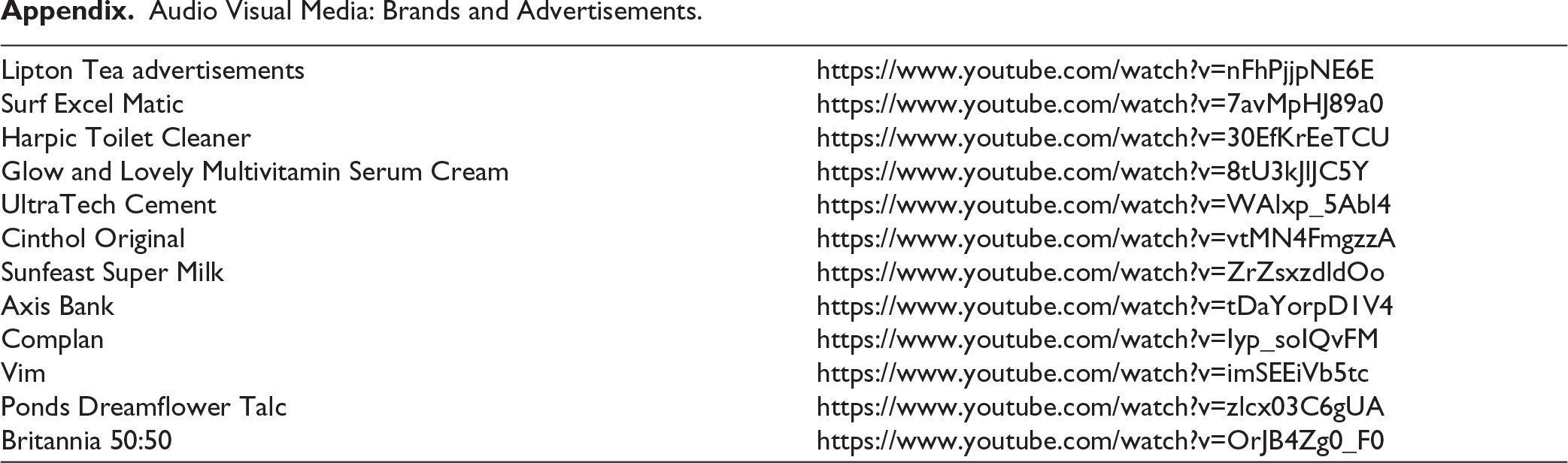
| Lipton Tea advertisements |
|
| Surf Excel Matic |
|
| Harpic Toilet Cleaner |
|
| Glow and Lovely Multivitamin Serum Cream |
|
| UltraTech Cement |
|
| Cinthol Original |
|
| Sunfeast Super Milk |
|
| Axis Bank |
|
| Complan |
|
| Vim |
|
| Ponds Dreamflower Talc |
|
| Britannia 50:50 |
|