



Abstract
Trauma is inevitably ubiquitous wherever there is human existence; its acceptance and denial deconstruct an individual’s identity at the same time. The study scrutinizes the intersection between trauma, neural plasticity, and self-fashioning in Celeste Ng’s novel Everything I Never Told You (2014). Lydia, the middle child, mysteriously dies in the 1970s and shatters the Lee family’s lives. The study delves into how traumatic experiences reshape the characters’ identities and perceptions through an integrated theoretical framework. The analysis based on the current neuropsychological theories argues how trauma-induced neural plasticity influences memory reconstruction and behavioral adaptation in the characters. The description of Marilyn and James Lee’s personal accounts, in conjunction with the repercussions on their children, signifies the transgenerational transmission of trauma. The study examines the complex nexus of trauma and women’s identity and situates the characters’ internal transformations with external societal gravities in a contradictory juncture. The research also advocates for how Ng’s narrative not only presents the negative effects of unprocessed trauma but also renders insights into the potential for plasticity and resilience through self-awareness and redefined relationships. The study broadens literary trauma studies by integrating the significance of neural plasticity and self-fashioning in comprehending the multilayered impacts of trauma on identity.
Introduction
Trauma is a pervasive phenomenon that possesses the capacity to shape and reshape individual identities. In literature, the examination of trauma frequently reveals its complex interactions with memory, identity, and societal norms. Everything I Never Told You 1 offers a rich narrative that investigates these themes, particularly through the lens of a Chinese-American family confronting the sudden death of their daughter, Lydia. What Caruth states in this context is that trauma results from a confrontation with both death and survival, and it paves the path for “the possibility of a future.” 2 The study investigates the intersection of trauma, neural plasticity, and self-fashioning in the novel, focusing on how these elements contribute to the construction and deconstruction of women’s identities and examining the emotional layers of experience. 3 A renowned American writer and psychotherapist, Phyllis Chesler, characterizes neurosis in women as “an intense experience of female biology, sexual and cultural castration, and a doomed search for potency.” 4 The traumatic experiences do not remain isolated incidents in the psyche of the characters; rather, they transform into memories representing a constellation of emotions based on the intensity of the events.
To further elaborate on this context, these memories periodically resurface, creating a significant compulsion in the traumatized individuals to revisit and relive those events in an intensified manner. In the narrative, Marilyn experiences profound grief due to the sudden death of her daughter, acutely feeling her absence. Robyn Fivush observes that “stories [memories] may remain fluid, changing with each retelling. These ever-changing stories [memories] can be disconcerting in their discrepant evaluations.”
5
Regardless of the specific socio-cultural institution, a community of individuals cohabiting in a particular society shares a “cultural life script,”
6
and this script determines the nature of remembrance. It is important to note that trauma, as a universal phenomenon, is not inherently incurable; rather, the identity impaired by the traumatic experience may have the potential for recovery through neuroplasticity. To add to the context, Joshua Pederson elucidates the cognitive aspect of trauma and claims:
Literary trauma theory must continue to grow and evolve as our understanding of the psychology and neuroscience of trauma advances. And literary theorists doing interdisciplinary work with trauma must make some effort to remain conversant with these advances, lest our own analyses become dated or obtuse. Psychologists and neuroscientists are constantly adjusting and improving on our understanding of trauma, and most argue that we still have much to learn about the ways the brain and body process psychic pain.
7
(pp220–221)
Previous research indicates that the narrative is replete with themes of familial estrangement, dysfunctional family dynamics, identity crisis, and the quest for self-discovery. In the article “Alienation of Intergenerational Relationship in Everything I Never Told You,” 8 the author posits that the family, as a cultural institution, is depicted as devoid of attention and affection, instead being characterized by alienation and indifference among its members. The study presented in the article titled “Dishonesty in Celeste Ng’s Everything I Never Told You” 9 elucidates the prevalence of dishonesty in the narrative through various characters’ erroneous assumptions about Lydia. These misconceptions contribute to the disintegration of the Lee family as they confront long-suppressed secrets following her demise. Another article, “Lydia’s Identity Crisis in Everything I Never Told You,” 10 delineates how the emotional chasm between Lydia and her family members engenders a sense of existential absurdity and identity nullification in Lydia. The research work “Negotiating Identity in the Novel of Everything I Never Told You” 11 examines James’s endeavor to negotiate his Chinese identity with the American one, through the denial of his familial background in China and the adoption of practices associated with American individuals. The article titled “Family Ethics in Celeste Ng’s Everything I Never Told You” 12 investigates the educational crisis and ethical issues within a mixed-race family, focusing on conjugal, parent-child, and sibling dynamics. The narrative illustrates how distorted family ethics result in alienation, trauma, and ultimately, Lydia’s death, emphasizing the necessity for healthy family relationships.
The study argues that the issues of trauma, neural plasticity, albeit metaphorical, and self-fashioning of women’s identity are discourses that intersect in a complex and multifaceted manner in the narrative and that are elucidated thoroughly further in the article.
Purpose of the Study
The study aims to scrutinize how trauma-induced neural plasticity as a metaphorical framework and the course of self-fashioning influence the identities of the women characters in Ng’s Everything I Never Told You. After putting the experiences of Lydia, Marilyn, and other female characters under the lens of analysis, the study attempts to uncover the ways in which trauma affects their self-perception, interpersonal relationships, and interactions with societal expectations. The study contributes to the discourse on trauma and identity, particularly apropos of intersectionality, and emphasizes the cumulative effects of race, gender, and family dynamics.
Methods
The study applies a qualitative literary analysis when it comes to methods that employ close textual reading techniques to examine passages in the text, and that elucidate the impact of trauma on the women’s characters’ identities. The research is conversant with neuropsychological theories on trauma and memory, incorporating the concepts of self-fashioning and identity construction. Besides, the study considers the socio-cultural context of the novel, specifically the racial and gender matrix prevalent in 1970s America, providing a comprehensive account of the characters’ experiences.
Analysis and Discussion
Theoretical and Textual Interpretation
Trauma ruptures a woman’s identity through subjugated silence, racialized societal expectations, and maternal projection at home. Lydia’s psychosexual development is strangled by unfulfilled parental fantasies, disturbing emotional regulation, and self-coherence. Arguably, the study signifies intergenerational trauma to women’s mental well-being, unveiling how suppressed agency engenders fragmentation and psychic dissonance. It also draws on a multidisciplinary exploration of the narrative, integrating insights from neurology, literary theory, and cultural studies. Caruth’s work on trauma’s disruptive nature and its impact on memory can be utilized to examine how Lydia’s death creates a fractured narrative within the Lee family. Her theories elucidate how the trauma of Lydia’s death disrupts the linear narratives of each family member’s life, resulting in fragmented identities and memories. It can be observed how Marilyn reconstructs her memories of Lydia, consistently revisiting and reinterpreting them in light of her trauma, exemplifying Caruth’s concept of trauma’s repetitive and “belatedness”
2
nature. The Caruthian conceptualization that underscores the unrepresentability of trauma, the latent effects and their deferred actions, and, most importantly, the aspect of disrupted temporality, is implicitly reflected in the novel. The very palpitation and uncanniness in relation to memory are described in the text:
She thinks of her mother coming home alone all those years to an empty house, the bedroom kept just as it was, with fresh bedsheets, for the daughter who would never return, her husband long since gone, in some other woman’s bed now. You loved so hard and hoped so much, and then you ended up with nothing. Children who no longer needed you. A husband who no longer wanted you. Nothing left but you, alone, and empty space.
1
(p141)
Laub’s theories on the significance of “testimony”
13
and witnessing in the process of trauma recovery could be applied to Lee’s family’s silence surrounding their traumas. The narrative’s lack of open communication about Lydia’s death can be analyzed through Laub’s perspective, emphasizing how the failure to witness and testify to each other’s pain exacerbates family suffering. It underscores how the absence of testimony, Lydia’s inability to express her struggles, and the family’s reluctance to confront their grief contribute to the perpetuation of trauma across generations. Ng states one of such monologues of Marilyn in the text:
Sometimes you almost forget that you did not look like everyone else. In homeroom or at the drugstore or at the supermarket, you listened to morning announcements or dropped off a roll of film or picked out a carton of eggs and felt like just another someone in the crowd. […] And then sometimes you noticed the girl across the aisle watching, the pharmacist watching, the checkout boy watching, and you saw yourself reflected in their stares: incongruous. Catching the eye like a hook. Every time you saw yourself from the outside, the way other people saw you, you remembered all over again.
1
(p110)
Van der Kolk’s research on how trauma affects the brain can be directly linked to the concept of neural plasticity in the novel.
14
His ideas can be utilized to elucidate how the traumatic experiences of characters result in alterations to their behavior and self-perception, as well as how these changes reflect broader neural adaptations. It is evident that Lydia’s attempts to meet her parents’ expectations can be interpreted as modifying her neural pathways, leading to a fragmented sense of self. Marilyn’s shifting memories and behaviors following Lydia’s death are also analyzed through the lens of neural plasticity
Her mother was dead, and the only thing worth remembering about her, in the end, was that she had cooked. Marilyn thought uneasily of her own life, of hours spent making breakfasts, serving dinners, packing lunches into neat paper bags. How was it possible to spend so many hours spreading peanut butter across bread? How was it possible to spend so many hours cooking eggs? Sunny-side up for James. Hard-boiled for Nath. Scrambled for Lydia. It behooves a good wife to know how to make an egg behave in six basic ways.
1
(p48)
Greenblatt’s concept of “self-fashioning” 15 is crucial for analyzing how Lydia and Marilyn construct their identities in response to societal and familial expectations. This theory could facilitate the examination of the tension between internal desires and external pressure. Lydia’s struggle with self-fashioning as she attempts to balance her mother’s academic ambitions with her father’s desire for social acceptance results in an identity that is shaped more by external demands than by her own sense of self.
The evaluation of female neurosis done by Chesler, in relation to cultural and gendered expectations, is significant in analyzing Marilyn and Lydia’s psychological vulnerabilities. The theory can be applied to scale how societal compressions re-experienced by these characters result in internal conflicts and varied neuroses. Marilyn’s neurosis, stemming from her unfulfilled aspirations and its “Nachträglichkeit” 16 or “belated” 2 impact on her relationship with Lydia, leads to the transgenerational transmission of trauma. Derrida, while theorizing defers-differs, throws light on the Freudian theory of “Nachträglichkeit” and contends that “everything begins with reproduction always already: Repositories of a meaning which was never present, whose signified presence is always reconstituted by deferral, nachträglich, belatedly, supplementarily…”. 17 To put it simply, traumatic memories do not affect the survivor, such as Marilyn, in the first place; rather, they revisit after some time in their belated or deferred hours with retraumatizing experiences. The robust conceptualization of Assmann on cultural memory, the role of forgetting and remembering in the context of identity formation, may be applied to the apparatuses by which the Lee family selectively remembers and forgets elements of their past, shaping their identities. 18 This analysis defies how the Lee family’s collective memory of Lydia, influenced by their traumas and retaliations, contributes to their ongoing conflict with identity and sense of belonging amidst psychological turmoil.
Trauma and Neural Plasticity
Trauma as a key moving theme in the novel manifests in umpteen forms, from the sudden loss of Lydia to the everyday microaggressions experienced by the Lee family because of their racial identity. In his influential work Remembering Trauma, McNally opines that “we can never prove a negative-prove that the information [traumatic incidents] is not available in the person’s memory.” 19 The narrative illustrates how these traumatic experiences make their way to profound changes in the characters’ neural pathways, albeit the process is implicit, and influence their behaviors and memories. Lydia’s struggle with her parents’ expectations can be understood as a form of trauma that reformulates her identity and leads to a cycle of internalized pressure and eventual self-destruction. Neural plasticity, which implies the brain’s potential to adapt and reorganize itself in response to challenging experiences, is a crucial concept in mapping how the characters in the novel try to cope with traumatic memories. Marilyn, Lydia’s mother, shows signs of neural plasticity when she deals with the trauma of losing her daughter. Her memories of Lydia appear distorted, colored by regret and guilt; the moments she reconstructs her perception of her daughter’s life and death. The reconstruction is symptomatic of the brain’s attempt to rechannelize traumatic experiences, even when the sense of reality is fragmented and painful.
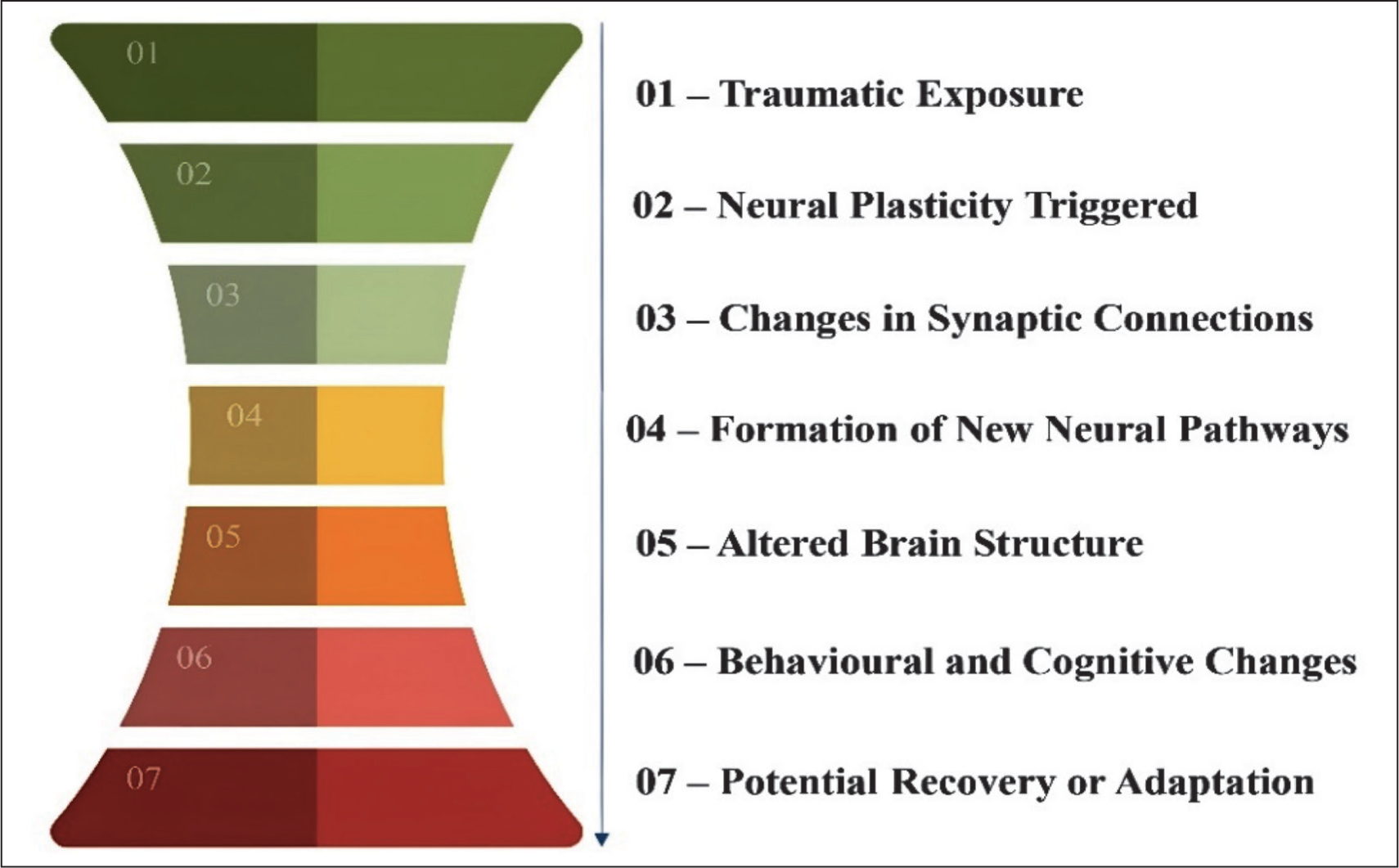
The graphical representation of the sequential stages in Figure 1 puts forward how the brain undergoes variations following exposure to trauma and culminates in adaptation. The seven-step figure illustrates how neural plasticity is activated and how it leads to behavioral changes within the brain of a traumatized subject. It may be elucidated that the employment of neural plasticity in the analysis of the novel is more a heuristic or metaphorical framework than any sort of neurological imaging extensively practiced in clinical care.
Stage-1: Traumatic exposure: This is all about the disruption of normal cognitive and emotional functioning.
Stage-2: Neural plasticity triggered: This stage refers to the brain’s ability to rechannelize itself in response to trauma.
Stage-3: Changes in synaptic connections: This stage reflects how trauma strengthens or weakens neural connections and thereby affects memory and stress response.
Stage-4: Formation of new neural pathways: This stage signifies the brain’s attempt to adapt through neural restructuring. It is either constructive or maladaptive.
Stage-5: Altered brain structure: This stage follows, wherein regions such as the hippocampus and amygdala may exhibit changes, leading to issues in memory and emotional regulation.
Stage-6: Behavioral and cognitive changes: This stage manifests externally as altered behavior, anxiety, or cognitive dysfunctions.
Stage-7: Potential recovery or adaptation: This stage concludes the process, indicating that the individual may recover or adapt, although recovery is not always guaranteed, and maladaptive patterns may persist.
Neural Plasticity in a Traumatized Subject.
Through this healing process and rewiring of a traumatized subject, his/her “mental processing,” 20 particularly the thinking part and the emotional part of our mental processes, come back to a functional track, and the failure of the same cannot arguably be labeled as a “mental defeat.” 21
Trauma and Fluidity of Identity
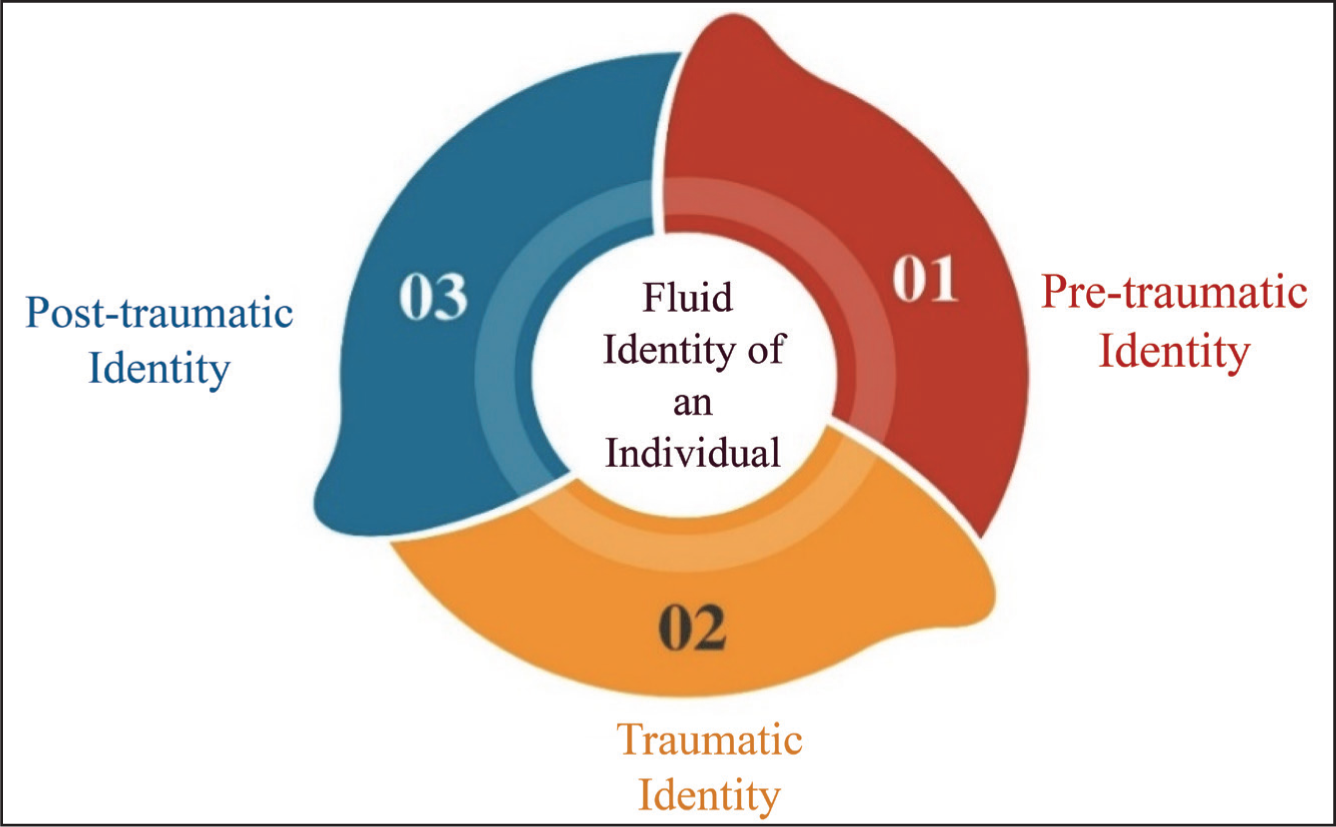
Erikson introduced identity into psychoanalysis as a boundary concept that can be comprehended from both sociological and psychological perspectives. From a psychological standpoint, “identity” functions as the nexus between the “intrapsychic” and the “intersubjective.” 22 In the narrative, the identities of the characters, particularly Lydia, the central figure, and her family, can be explored through the lens of pretraumatic, traumatic, and posttraumatic identity. The malleability of “identity” 23 of an individual before, during, and after a traumatic experience in Figure 2, is observed in the text. It is noticed that all three stages overlap with one another, and therefore, the overall shift from one stage to another takes an indefinite course of time.
Overlapping Cycle of Fluid Identity in a Traumatized Subject.
Pre-traumatic Identity Before Lydia’s Death
Lydia is perceived as an exemplary child within the family unit, with her parents projecting their unfulfilled aspirations onto her. While she presents an outwardly successful demeanor, her internal self-perception is conflicted. She endeavors to meet expectations rather than express her authentic identity. Lydia assumes the role of the “ideal daughter” for her parents, particularly for her mother, Marilyn, who encourages Lydia to excel academically to fulfill her own unrealized career as a scientist. Lydia experiences repressed emotions. She contends with latent insecurities and feelings of isolation, which presage the trauma that will ensue. Lydia possesses limited agency over her own life. Her actions and decisions are influenced by her parents’ ambitions for her, notably Marilyn’s desire for Lydia to succeed in science and James’s wish for her to integrate socially. Lydia’s worldview is characterized by pressure and suppression, yet she conceals it from others. There exists a belief within the family that Lydia will fulfill the family’s expectations, maintaining the appearance of success. The family’s identity is centered on their children’s accomplishments, particularly Lydia’s. James, Marilyn, Nath, and Hannah each occupy distinct roles and expectations in relation to Lydia’s perceived success, establishing a delicate equilibrium.
Traumatic Identity After Lydia’s Death
It is quite discernible in the text that the character Lydia exemplifies a psychologically vulnerable subject suffering from prolonged grief disorder. 24 Prolonged Grief Disorder (PGD) is characterized by intense yearning or persistent preoccupation with the deceased and accompanying symptoms in terms of identity disruption, intense emotional pain, feeling that life is meaningless. that persist more than six International Classification of Diseases, 11th Revision (ICD-11) (ICD-11, n.d.) or 12 months Diagnostic and Statistical Manual of Mental Disorders, 5th Edition, Text Revision (DSM-5-TR) after the loss. 25 Furthermore, to shed more light on the vulnerable situation of Lydia, what Van der Hart states is considerable. In his research, dissociation, what Lydia does in the text, is the fundamental key to perceiving the dynamics of traumatization. 26 The discovery of Lydia’s body in the lake serves as the traumatic catalyst that disrupts the family’s perceived stability and exposes the underlying tensions in their interpersonal dynamics and individual identities. James experiences a profound sense of inadequacy both as a parent and as an individual of minority status in American society. His identity undergoes fragmentation as he contends with feelings of guilt, isolation, and the racial challenges he has encountered throughout his life. Marilyn experiences devastation, interpreting Lydia’s demise as a failure of her efforts to cultivate an independent, intellectually capable daughter. She, being guilty, questions whether her own aspirations for Lydia led to her daughter’s demise. Nath’s identity deforms when he is fanatical about Lydia’s death, only to find himself obsessed with the notion that Jack, a local man, is blameworthy. Undoubtedly, Nath struggles hard to behave as the elder sibling and reveals his own sentiments of jealousy toward Lydia. Hannah, the often-overlooked youngest child in the text, experiences her own type of psychic vulnerability. Her indiscernibility within the family intensifies, and her alienation deepens the lurking anguish. Another pertinent aspect is that the family responds to Lydia’s death through various coping mechanisms, for example, Marilyn withdraws, James engages in extramarital affairs, Nath exhibits hostile comportment, and Hannah preserves a silent and sharp-eyed stance. Emotional dysregulation is evident, with each family member experiencing overwhelming grief, guilt, and confusion. The family’s communication deteriorates completely. In the immediate aftermath of the traumatic event, all family members experience a loss of control over their lives. Their emotional states become destabilized, and they perceive themselves as powerless to restore their disrupted sense of normalcy. The family is persistently affected by memories of Lydia, with each individual recalling distinct aspects of her personality and life. These intrusive recollections serve as a reminder of their unresolved guilt and interpersonal conflicts.
Post-traumatic Identity After Healing Begins
The impact of past paternal experiences, particularly traumatic ones, on child outcomes is a nuanced subject that draws upon various clinical psychology theories focusing specifically on the early years of a child’s life. 27 In fact, in the narrative, psychoanalytic perspectives provide profound insights into the father James’ role within the family dynamics, emphasizing the critical support fathers provide to both children and their partners. The particular identity after post-trauma, if the subject is normal and living his/her life without any psychic dysfunctionality, may be called post-traumatic growth (PTG). 28 Marilyn begins to comprehend the pressure she exerted on Lydia, recognizing that her desire to vicariously experience life through her daughter contributed to Lydia’s internal conflicts. This acknowledgment initiates her healing process. James also confronts his own insecurities, particularly regarding his racial identity and experiences with discrimination. His extramarital affair represents an unsuccessful attempt to escape his identity, but reconciliation with Marilyn suggests the commencement of acceptance. Nath’s identity as a sibling evolves as he begins to acknowledge his feelings of jealousy toward Lydia, his role within the family unit, and the necessity to establish his own path. Hannah begins to assert her presence, emerging from the periphery of the family. She initiates self-assertion and assumes a more significant role in the family dynamic. As the family begins to accept Lydia’s demise and their respective roles in the family dynamic, they commence reclaiming agency over their lives. This is evident in their attempts to communicate and repair interpersonal relationships. Each family member’s perspective is altered. They come to understand that Lydia’s outward success concealed her internal suffering, prompting them to reflect on their expectations and their relationships with one another. The healing process begins as the family members start to communicate more openly about Lydia’s death and their own emotions. Nath and James share a moment of connection by the lake, symbolizing a step toward healing. The family members, particularly Marilyn and James, derive significance from their collective grief experience. They acquire insights from the traumatic event, developing increased empathy toward one another, with the aspiration of fostering a more salubrious family dynamic in the future. Social theorists such as Holmes and Rahe assert that trauma is often considered a “life-changing” 29 phenomenon. Muldoon et al. state that “traumatic events, continuity is not always achievable or desirable. It is not unusual for people to lose or let go of old identities because of a traumatic life change.” 30 The narrative demonstrates the mutable nature of identity before, during, and after a traumatic experience. Each character’s sense of self is influenced by their experiences preceding Lydia’s demise, disrupted in the immediate aftermath, and gradually reconstructed as they endeavor to process their grief and progress. This journey reflects the transformation from pretraumatic identity to a traumatic and eventually posttraumatic identity, illustrating how trauma redefines individuals and their interpersonal relationships.
Self-fashioning of Identity
Identity is that first subjective entity that always becomes vulnerable when trauma hits an individual. The notion of self and the connection of the individual come to a position of crisis. As Peter A. Levine asserts: “Trauma is about the loss of connection to ourselves, to our bodies, to our families, to others, and to the world around us.” 31 Caruth, in her introduction to Trauma: Explorations in Memory, opines that “trauma itself may provide the very link between cultures.” 32 The concept of self-fashioning, particularly in relation to gender and racial identity, is another critical aspect of the novel. Lydia’s identity is a replica chiseled by the continuous strokes of her parents’ requirements and societal prospects, which, in consequence, leads to psychic fragmentation. Marilyn wants Lydia to aspire academically and professionally in her career, which is a type of self-fashioning that imposes, or rather burdens, her own unfulfilled ambitions onto her daughter. The matrix signifies broader societal pressures, although many are stereotypically designed for women to conform to certain roles, often at the expense of their true identities. Lydia’s tragic demise broaches the clash between her internal identity and the external one replete with expectations imposed upon her. What affects her sense of alienation and worthlessness is exacerbated by her experiences of racial discrimination. The novel presents Lydia’s death not merely as a personal catastrophe but as a result of systemic failures that include race and gender as two dominant intersecting elements. The racial and gender rubrics embedded in the family of Lydia get intensified with the afflictions of Lydia’s tragic death. The model dealing with the formation of identities suitably argues the influence of previous memories on individual psychic functions.
In the process of identity formation, both normal and traumatic memories play an influential role, and of all female characters, Lydia in the text exemplifies this. However, the negative memories that are the result of the adverse experiences from parental expectations and socio-cultural beliefs ill-shape the identity of Lydia. These expectations and beliefs that prioritize academic excellence and compliance give birth to cognitive dissonance in Lydia. Her voicelessness and her positioning in the family from which she fails to wriggle out may be accounted as an act of suppression by the family, and as an act of repression by Lydia herself. She is trapped in her myopic aspirations of her mother, Marilyn, who wants her to have an independent academic career, and the appeasing nature of her father, James, who searches for social acceptance for Lydia. This inner conflict, born out of the sense of having no agency, causes an identity crisis, wherein Lydia cannot form her own consolidated self and experiences emotional disintegration. It is symptomatic of a traumatic subject such as Lydia, whose emotional distress is evident through her growing self-isolation, for she becomes burdened in the act of fulfilling societal expectations. Nath, Lydia’s brother, acts as a foil who deconstructs resilience and experiences psychological distress for Lydia’s death; however, he reconfigures his identity in the novel and appears emotionally resilient. The novel illustrates how memory and significant life events can both fragment and reshape an individual’s identity through various mechanisms. When identity is put under the lens of discriminatory social practices such as racism, it engenders a traumatic situation and pushes the subject into a vegetative state, as it occurs in the text:
In all their time together, white has been only the color of paper, of snow, of sugar. Chinese—if it is mentioned at all—is a kind of checkers, a kind of fire drill, a kind of takeout, one James does not care for. It did not bear discussion any more than that the sky was up, or that the earth circled the sun. He had naively thought that—unlike with Marilyn’s mother, unlike with everyone else—this thing made no difference to them.
1
(p115)
The Lee family’s experiences are profoundly rooted in the socio-cultural context of 1970s America, wherein racial discrimination and rigid gender roles significantly influence the formation of the characters’ identities. The novel elucidates the transgenerational transmission of trauma, particularly through the experiences of James and Marilyn Lee. James, as an Asian American man, encounters persistent challenges to his identity and self-worth, which he inadvertently transmits to his offspring. Similarly, Marilyn’s unrealized aspirations and the societal pressures she confronts as a woman contribute to the psychological burden that Lydia inherits.
You saw it in photos, yours the only black head of hair in the scene, as if you had been cut out and pasted in. You thought: Wait, what’s she doing there? And then you remembered that she was you. You kept your head down and thought about school, or space, or the future, and tried to forget about it. 1 (p110)
The study also explores the intergenerational negotiation of trauma and identity. Nath, Lydia’s brother, grapples with his own identity in the context of his sister’s death and his parents’ expectations. His journey exemplifies the persistent impact of trauma within the family, as each member contends with the legacy of Lydia’s life and death. It is posited that when a female child, constrained by socio-cultural impositions and racial subjugation, experiences a crisis of identity or existence, severe consequences may ensue. The culmination of psychic fragmentation in an individual such as Lydia, precipitated by trauma, often leads to significant adverse outcomes. Ng postulates, through the portrayal of Lydia, who embraces disappearance in the lake, symbolizing vastness, and the acceptance of nature, that a traumatic event, if not addressed in a timely manner, ultimately consumes the victim:
Tipping her head back, she could not see the houses or the lake or the lamps on the street. All she could see was the sky, so huge, and dark it could crush her. It was like being on another planet. No—like floating in space, alone. […] This is what infinity looks like, she thought. Their clarity overwhelmed her, like pinpricks at her heart.
1
(p148)
Garloff in his transcultural empathy 33 idea of trauma’s latency resonates with the narrative as the unspoken grief and pressures within the Lee family are passed down through generations, shaping and destabilizing each member’s identity. Lydia’s untreated trauma becomes an implicit medium for the manifestation of the family’s hidden emotional burdens that have been affecting the collective consciousness of the family.
The study synthesizes both self-fashioning and neural plasticity into a dynamic identity formation. Lydia’s self is not only a social construct; rather it is neurologically structured through frequent emotional demands from the parents as well as the society. It is witnessed in the text that the parental projection functions in two ways-ideological scripting and affective conditioning. For instance, James Lee self-fashions himself through the assimilation into American academic, repressing his experience of racial alienation, and Marilyn Lee does through the deferred dream of being a doctor, shunning the conventional roles of femininity. The recurrent societal expectations compel the parents to shape her emotional and cognitive responses, tethering to survival acts. These responses do not move only in the psychic orbit but also become embodied. Self-fashioning is considered as an embodied adaptation:34,35 the brain reorganizes around the roles imposed upon it. Identity in the text thus emerges as a plastic entity (re)constructed simultaneously by cultural power and neural repetition, wherein social scripting and neuropsychological reconfiguration congregate.
Conclusion
The integration of trauma, neuroplasticity, and self-fashioning in Everything I Never Told You renders a reflective observation on the deconstruction of women’s identities. Both individual subjectivity and the societal expectations condition the psyche of the women characters, who fail to defy their constructive dilemma between self and other. Marilyn’s neurosis and Lydia’s shattered identity are the cumulative results of both their individual traumatic phenomena and the cultural milieu in which they dwell. The study holds the arguments that trauma is not just an individual experience but a collective one that vicariously affects families and communities. The Lee family is a miniature of the broader societal rubrics at play and homes in on how trauma can be both a destructive and transformative force in shaping identities. 36 The characters confront the ways in which trauma has shaped their lives and identities, channelizing their ways to self-actualization. 37 The study demonstrates how traumatic experiences identified in the text can lead to profound changes in memory, behavior, and self-perception vis-à-vis societal expectation, or rather constructs. The research also surveys multifarious aspects of trauma and its impact on identity while analyzing the internal transformation under external pressures. The findings of this study contribute to the broader literature on trauma and identity, emphasizing the significance of neural plasticity and self-fashioning in understanding the psychological and social dimensions of trauma. However, Step Craps poignantly argues by critiquing Caruth and Lacapra that trauma theorists often justify their focus on antinarrative, fragmented, modernist forms by pointing to similarities with the psychic experience of trauma. 38 Furthermore, the study underscores the necessity for a more nuanced approach to trauma studies, one that considers the intersectionality of race, gender, and family dynamics in shaping individual experiences.
Limitations
The study is limited by its focus on a single novel and its reliance on qualitative analysis. Future research could expand on this work by examining other literary texts that explore similar themes or by incorporating quantitative methods to analyze the psychological effects of trauma in literature. In addition, the study’s emphasis on neuropsychological theories may not fully capture the cultural and historical specificity of the characters’ experiences, suggesting the need for further interdisciplinary research.
Future Implications
The study, with the employment of neuropsychology with literary analysis, advances trauma-informed criticism beyond metaphor toward embodied neurocognition, affect regulation, and gendered subject formation. This integrated framework may further explore and examine other texts molded by intergenerational trauma, illuminating how neural plasticity, memory reconstruction, and self-fashioning catalyze and facilitate identity formation, resilience, and women’s mental well-being across cultural contexts.
Footnotes
Acknowledgements
The authors express their gratitude to the editorial team of the Journal of Psychosexual Health for giving us the opportunity to be a part of the special issue.
Declaration of Conflicting Interests
The authors declared no potential conflicts of interest with respect to the research, authorship, and/or publication of this article.
Ethical Approval
Not applicable.
Funding
The authors received no financial support for the research, authorship, and/or publication of this article.
Informed Consent
As the article does not involve data regarding patients or participants, informed consent was not applicable.