




Abstract
Background:
The relationship between personality trait expression and gender identity in adolescents and young adults remains underexplored, particularly through a dimensional framework. This study examines associations between maladaptive personality traits, borderline features, and gender dysphoria across developmental age groups.
Methods:
A cross-sectional sample of 269 participants aged 14–26, including both gender-conforming and gender-diverse individuals, completed the Personality Inventory for Diagnostic and Statistical Manual of Mental Disorders, Fifth Edition – Brief Form (PID-5-BF), Borderline Personality Features Scale for Children (BPFS-C), and the Utrecht Gender Dysphoria Scale. Statistical analyses included t-tests, analysis of variances (ANOVAs), and Pearson correlations, with age-stratified group comparisons.
Results:
Gender-diverse participants reported modest elevations in negative affect, detachment, and borderline personality features compared to gender-conforming peers. Age-based analyses showed that younger participants (14–16 years) reported higher mean levels of antagonism, disinhibition, psychoticism, and gender dysphoria. While these differences were statistically significant, all scores remained within non-clinical ranges, and effect sizes were small to moderate. Gender dysphoria was weakly correlated with negative affect, detachment, and borderline features.
Conclusions:
Results suggest that observed variations in trait expression reflect developmental and contextual influences rather than psychopathological characteristics. These findings highlight the importance of non-pathologizing, developmentally sensitive approaches in clinical settings when working with gender-diverse youth.
Keywords
Introduction
In recent years, there has been a substantial rise in the number of adolescents and young adults reporting psychological distress related to gender identity, particularly gender dysphoria (GD). Defined in the Diagnostic and Statistical Manual of Mental Disorders, Fifth Edition (DSM-5), GD refers to clinically significant distress resulting from a mismatch between one’s experienced gender and assigned sex at birth. 1 The International Classification of Diseases 11th Revision (ICD-11; World Health Organization) categorizes this condition as gender incongruence. 2 Clinically, GD has become increasingly prominent in youth mental health services, with earlier age of onset and a rising number of referrals observed across the Western world.3,4
Estimating the prevalence of GD among youth remains complex due to stigma, terminological inconsistencies, and methodological limitations. Existing estimates vary widely—from 0.005% (DSM-5) 1 to 1.3% 5 —depending on how GD is measured and defined. While the etiology of GD is not fully understood, biopsychosocial factors have been proposed, including neurodevelopmental variations, 6 hormonal and genetic influences,7,8 and sociocultural contributors such as peer networks and social media. 9
A robust body of literature has documented elevated levels of psychiatric symptoms—such as depression, anxiety, and suicidal ideation—among adolescents with GD.10,11 In addition, several studies have reported higher rates of personality disorders, most notably borderline personality disorder (BPD), in transgender and gender-diverse (TGD) youth.12,13 However, the conceptualization of personality within these studies often remains categorical, focusing on diagnostic thresholds rather than on dimensional traits that may inform developmental trajectories.
This study adopts a dimensional framework consistent with Section III of the DSM-5, which proposes that maladaptive personality traits represent individual differences in emotional, interpersonal, and behavioral tendencies. 1 These traits exist on a continuum, ranging from typical variation to clinically impairing patterns, and do not, in themselves, constitute mental disorders unless pervasive and dysfunctional. 1 The Personality Inventory for DSM-5 – Brief Form (PID-5-BF) operationalizes five such domains—Negative Affect, Detachment, Antagonism, Disinhibition, and Psychoticism—which are useful in identifying patterns relevant to youth psychosocial functioning without implying psychopathology.
This study focuses on individuals aged 14 to 26, a range that encompasses both adolescence and emerging adulthood. This classification aligns with definitions from several leading health bodies: the International Association for Adolescent Health considers individuals up to age 26 as adolescents and youth, 14 while developmental theorists define young adulthood as the period between ages 18 and 25, marked by identity exploration, emotional regulation shifts, and psychosocial transitions. 15 Including this broader age range allows us to explore developmental differences across the transition to adulthood.
To investigate these differences, we stratify our sample into three age-based cohorts (14–16, 17–19, and 20–26), allowing for a more nuanced understanding of age-related trends in GD and personality traits. Recognizing the limitations of a cross-sectional design, we do not make claims about causal developmental change but instead examine whether observed group differences may reflect age-linked variation in personality trait expression and gender identity distress.
Research Aims and Hypotheses
The primary objective of this study is to examine the relationship between gender identity and personality trait expression among adolescents and young adults. Specifically, we investigate whether individuals who identify with a gender different from their assigned sex display statistically significant differences in maladaptive personality traits and borderline personality features, compared to their gender-conforming peers.
Furthermore, we explore age group differences in these dimensions, with the expectation that younger individuals may report higher levels of emotional dysregulation and GD—potentially reflecting psychosocial adjustment processes—than their older counterparts.
We hypothesize that:
Gender-diverse participants will report higher levels of certain maladaptive personality traits (e.g., negative affect and detachment) and borderline features, relative to gender-conforming peers. These traits will vary across age groups, with younger adolescents exhibiting higher scores than older individuals, reflecting potential age-related variation rather than personality instability.
Method
Design and Participants
This study employed a cross-sectional, observational design to investigate the relationship between personality traits and gender identity among adolescents and young adults. A total of 269 participants were recruited from community-based settings across Europe, including recreational youth centers and online platforms catering to TGD youth. Recruitment targeted both gender-conforming and gender-diverse individuals, with the goal of capturing a broad developmental and identity-based range of experiences.
Inclusion criteria were as follows: (a) age between 14 and 26 years, (b) self-identification either with the sex assigned at birth or with a different gender identity, and (c) provision of informed consent (or assent with parental/guardian consent, where required). Participants were asked whether they had previously received a formal diagnosis of GD or a personality disorder; however, diagnostic status was not used as a criterion for inclusion or exclusion, as the study’s focus was on trait expression rather than clinical diagnosis.
This age range was chosen based on guidelines from the International Association for Adolescent Health, which defines adolescence and youth as extending through age 24, 14 and on emerging adulthood research, which frequently defines young adulthood as lasting from ages 18–25. 15 Participants were divided into three age cohorts for analysis: 14–16 years (mid-adolescence), 17–19 years (late adolescence), and 20–26 years (young adulthood). This stratification was designed to explore potential developmental differences in trait expression across distinct psychosocial stages.
All procedures adhered to the principles of the Declaration of Helsinki. Ethical approval was obtained from the institutional ethics committee, and all participants (or participants together with their guardians) provided informed consent.
Measures
Maladaptive Personality Traits
Participants completed the Personality Inventory for DSM-5 – Brief Form (PID-5-BF),
1
a 25-item measure designed to assess maladaptive personality trait domains as conceptualized in DSM-5 Section III. Responses were rated on a 4-point Likert scale (0 = very false/often false to 3 = very true/ often true). The PID-5-BF evaluates five domains:
Negative Affect Detachment Antagonism Disinhibition Psychoticism
Each trait domain was scored by summing the relevant item scores and dividing by the number of items completed in that domain, resulting in a mean trait score. These traits reflect dimensional psychological tendencies and are not used as clinical diagnoses.
Borderline Personality Features
To measure features associated with borderline personality organization, participants completed the 11-item Borderline Personality Features Scale for Children (BPFS-C), which assesses tendencies such as emotional dysregulation, identity disturbance, and interpersonal difficulties. Each item is rated on a 5-point Likert scale. The scale produces a total score that reflects the intensity of borderline features but does not in itself serve as a diagnostic tool.
Gender Dysphoria
GD was assessed using the Utrecht Gender Dysphoria Scale, an 18-item unidimensional self-report instrument. Participants rated their agreement with items on a 5-point Likert scale. Higher total scores indicate a higher level of subjective gender-related distress.
Statistical Analysis
Scale scores were first calculated as the mean of item responses for each domain. To improve normality and fulfill statistical assumptions, all outcome variables were then transformed using Blom’s normalization formula. These normalized scores were used for inferential testing, while raw means and standard deviations are reported in tables for interpretability.
To examine differences by gender identity, independent samples t-tests were conducted comparing gender-conforming and gender-diverse participants on all trait domains and GD. Cohen’s d was used to estimate effect sizes, with thresholds of 0.2 (small), 0.5 (moderate), and 0.8 (large).
To examine age-based trends, participants were divided into three age cohorts (14–16, 17–19, and 20–26), and one-way analysis of variances (ANOVAs) were used to assess between-group differences across all outcome measures. Where significant effects were observed, post hoc analyses were conducted using Tukey’s Honestly Significant Difference (HSD). Partial eta squared (η²) was used to report effect sizes for ANOVA results.
Additionally, to address the question of associations between GD and trait expression, Pearson correlation coefficients were calculated between GD scores and each of the five PID-5-BF trait domains and borderline personality features.
All analyses were conducted using SPSS (v.26). Assumptions of normality, homogeneity of variance, and independence were checked prior to all inferential tests.
Results
Group Differences by Gender Identity
Independent samples t-tests were conducted to compare personality trait domains, borderline personality features, and GD between participants whose gender identity aligned with their assigned sex (gender-conforming group) and those whose gender identity differed (gender-diverse group). While statistical analyses were performed on normalized scores, raw means and standard deviations are reported in Table 1 to aid interpretability.
Group Differences in Personality Traits and Borderline Features by Gender Identity.
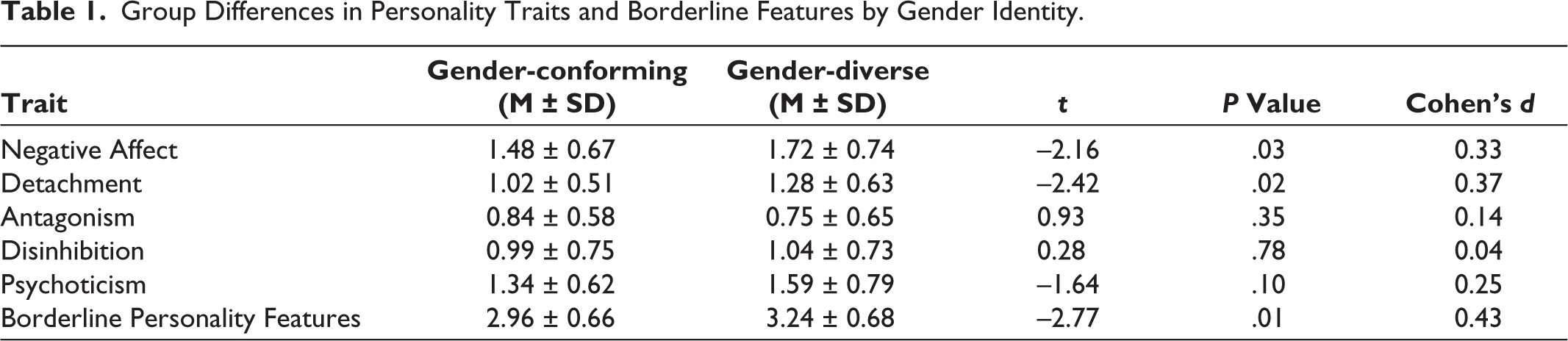
Participants in the gender-diverse group reported statistically significant higher levels of negative affect (t(267) = –2.16, P = .03, Cohen’s d = 0.33), detachment (t(267) = –2.42, P = .02, d = 0.37), and borderline personality features (t(267) = –2.77, P = .01, d = 0.43) compared to their gender-conforming peers. These differences represent small-to-moderate effect sizes according to conventional benchmarks.
Although statistically significant, these group differences were modest in absolute terms. All mean scores remained within subclinical ranges, and caution should be taken not to conflate trait elevation with clinical psychopathology. The elevated scores likely reflect greater emotional sensitivity and interpersonal strain commonly observed in gender-diverse youth (particularly in the context of minority stress), rather than indications of personality disorder.
No significant group differences were observed for antagonism, disinhibition, or psychoticism (P > .05), indicating that these domains may not be differentially expressed in relation to gender identity in this sample.
Age Group Differences
To explore age-related variation in trait expression and GD, participants were grouped into three developmental cohorts: 14-16 years (mid-adolescence), 17–19 years (late adolescence), and 20–26 years (young adulthood). One-way ANOVAs on normalized scores revealed statistically significant age effects in several domains (see Table 2).
Mean Scores for Personality Traits and Gender Dysphoria by Age Group.
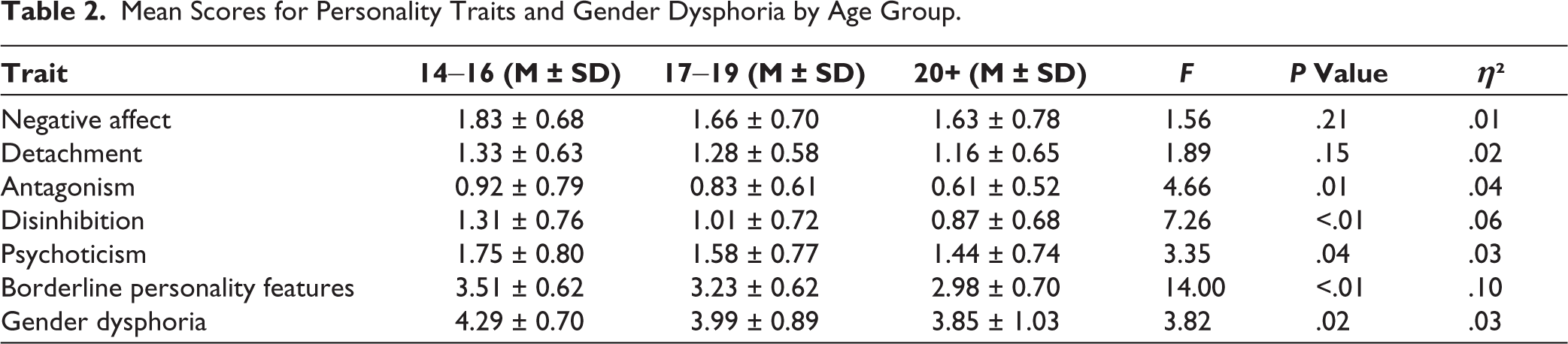
Specifically, participants in the youngest group (14–16 years) had significantly higher mean scores on antagonism (F(2,266) = 4.66, P = .01), disinhibition (F(2,266) = 7.26, P < .01), psychoticism (F(2,266) = 3.35, P = .04), borderline personality features (F(2,266) = 14.00, P < .01), and GD (F(2,266) = 3.82, P = .02).
These findings suggest that younger participants may report greater emotional reactivity, impulsivity, and distress regarding gender identity compared to older peers. However, no significant age group differences were found for negative affect or detachment, indicating these traits may remain more stable across developmental stages.
While these trends align with previous research on adolescent emotional development, it is essential to interpret them cautiously. This study’s cross-sectional design cannot confirm longitudinal or developmental change. Thus, these differences likely reflect group-level variation by age, rather than maturation of stable personality traits. Moreover, environmental factors such as peer context, support systems, and exposure to stigma could plausibly account for some of the observed differences across age groups.
Tukey’s HSD post hoc comparisons indicated that most significant differences occurred between the youngest and oldest groups.
Correlation Between Gender Dysphoria and Personality Traits
To further assess the relationship between GD and personality traits, Pearson correlation coefficients were calculated. As shown in Table 3, GD showed small but statistically significant positive correlations with negative affect (r = 0.22, P < .01), detachment (r = 0.19, P < .01), and borderline personality features (r = 0.24, P < .01). No significant correlations were observed for antagonism, disinhibition, or psychoticism.
Correlation Between Gender Dysphoria and Personality Variables.
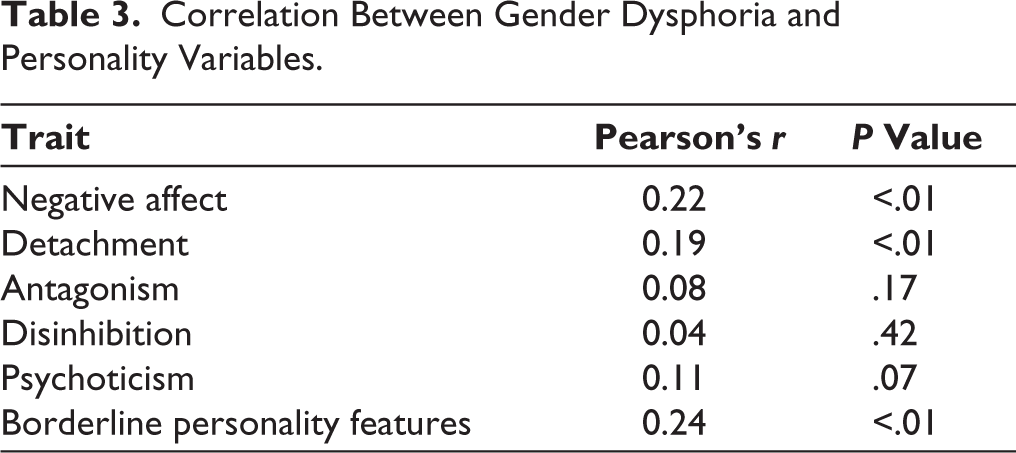
These findings suggest that greater distress related to gender identity is associated with increased emotional reactivity and interpersonal sensitivity. However, the strength of these correlations is modest, and they do not imply causation or diagnostic significance.
Discussion
This study explored the relationship between personality trait expression and gender identity among adolescents and young adults, as well as potential differences in these traits across developmental age groups. Using a dimensional assessment approach, we found that participants who identified with a gender different from their assigned sex reported statistically higher levels of negative affect, detachment, and borderline personality features, relative to their gender-conforming peers. We also observed modest age-related differences, with younger participants showing higher mean levels of certain personality traits, borderline features, and GD.
These findings are consistent with previous literature indicating that gender-diverse youth report elevated emotional and interpersonal challenges.10,11 However, the interpretation of these differences must be approached with caution. Although the observed differences were statistically significant, the absolute values of the trait scores remained within non-clinical ranges, and effect sizes were modest. This suggests that the elevated scores likely reflect greater sensitivity to psychosocial stressors and emotional reactivity, rather than diagnostic levels of psychopathology.
It is also essential to avoid conflating subclinical trait elevations with categorical diagnoses. The personality traits assessed in this study (via PID-5-BF and BPFS) reflect dimensional constructs that may contribute to individual differences in emotional functioning but are not, in and of themselves, indicators of mental illness. As such, higher scores on negative affect or borderline features among gender-diverse youth should be understood as reflecting vulnerability factors or transient psychological states rather than stable personality disorder.
One possible explanation for these findings lies in the psychosocial challenges commonly faced by TGD individuals. Prior studies have highlighted the role of minority stress—chronic stress arising from stigmatization, discrimination, and social exclusion—as a contributing factor to emotional distress in this population.16,17 Indeed, the small but significant correlations between GD and certain personality traits (e.g., negative affect and borderline features) observed in our study may reflect distress reactions to environmental adversity rather than underlying trait pathology.
Age-related findings in this study further support a contextualized understanding of these traits. Participants in the youngest age group (14–16) reported higher levels of disinhibition, antagonism, psychoticism, and borderline features than their older peers. Although these differences may appear to reflect a developmental trajectory, it is important to stress that the study’s cross-sectional design precludes any causal or maturational inferences. Rather, these patterns may indicate that younger adolescents are more vulnerable to emotional and interpersonal distress during early stages of gender identity exploration, a process that may stabilize as they gain greater autonomy and social support.
This interpretation is consistent with findings from longitudinal studies suggesting that gender-related distress often decreases over time, and that emotional regulation capacities improve with age as a result of neurobiological and social development. 18 However, it remains equally plausible that older participants in our sample reported fewer difficulties due to access to gender-affirming care, greater social acceptance, or improved coping strategies.
Clinically, these findings emphasize the importance of non-pathologizing, developmentally informed approaches to supporting gender-diverse youth. Elevated scores on personality trait measures should be interpreted within the broader psychosocial context of identity development, minority stress, and adolescent adjustment. Screening for emotional vulnerability may be helpful when planning interventions, but clinicians must be careful not to misinterpret normative adolescent distress or environmental strain as evidence of fixed personality pathology.
Limitations and Future Directions
Several limitations warrant consideration. First, the study relied exclusively on self-report measures, which may be influenced by response biases or misunderstanding of items. Second, the sample was drawn from community and online support groups, potentially limiting generalizability to gender-diverse youth who are not connected to affirming spaces. Third, the absence of information on mental health history, social support, or gender-affirming care limits our ability to contextualize participants’ psychological functioning.
Importantly, the study’s cross-sectional design prevents conclusions about developmental progression or causality. Longitudinal research is needed to examine how personality traits, identity development, and psychological distress interact over time. Future studies should also incorporate clinician-administered assessments, diverse cultural settings, and consider protective factors such as resilience, family acceptance, and school climate.
Conclusion
In summary, this study contributes to the growing literature on the psychological experiences of gender-diverse youth by examining personality trait expression across developmental stages. Gender-diverse participants reported higher levels of negative affect, detachment, and borderline features than gender-conforming peers, with younger adolescents showing modestly greater distress and impulsivity overall. These findings highlight the potential influence of minority stress and developmental context on psychological well-being during gender identity exploration.
Rather than suggesting fixed or pathological traits, our results emphasize the importance of understanding trait expression in gender-diverse youth as dynamic, context-sensitive, and developmentally modulated. Clinical interventions should be responsive to emotional needs while affirming identity development, and future research should seek to disentangle the effects of trait vulnerability from contextual adversity.
Footnotes
Data Availability
The data supporting the results and analysis in the article are available at the Data Repository DRYAD:
Declaration of Conflicting Interests
The authors declared no potential conflicts of interest with respect to the research, authorship, and/or publication of this article.
Ethical Approval
This study was conducted in accordance with the principles of the Declaration of Helsinki. As it was not a clinical trial, it was not subject to trial registration requirements. Ethical approval was obtained for this study as part of a doctoral research project at Charles University.
Funding
The authors received no financial support for the research, authorship, and/or publication of this article.
Informed Consent
Informed consent was obtained from all individual participants or participants and their legal guardians, when appropriate, included in the study.