




Abstract
Despite the numerous advantages offered by the digital medium, one notable drawback has been the early exposure to sexual content. In contemporary society, the omnipresence of the Internet, coupled with the pervasive influence of social media platforms, exposes children to sexual content, conversations, and vernacular at increasingly younger ages. Such content, ranging from mild-to-graphic representations, poses cultural, legal, and ethical considerations. Previous studies reveal that a significant proportion of adolescent Internet users encounter pornographic material before the age of 18. In this situation, it is very important to understand the factors that influence exposure, with parental oversight and peer-mediated exposure shaping adolescents’ responses. This review examines sociocultural factors contributing to childhood exposure to sexual content using a life-course perspective, its impact on development, and implications for intervention. Through this exploration, we elucidate the intricate interplay between technological advancements, social dynamics, and individual vulnerabilities, offering insights for clinicians, policymakers, and educators alike.
Introduction
In recent years, the integration of digital media into our daily lives has extended to children as well. Particularly during the coronavirus disease 2019 (COVID-19) pandemic, there has been a rapid surge in the use of media devices and Internet access. This increased exposure highlights the substantial impact of media on the psychosocial development of children. 1 In contemporary society, the proliferation of digital technologies has precipitated an unprecedented surge in the accessibility and dissemination of information, including sexually explicit content. 1 This phenomenon has significantly impacted the developmental landscape for children leading to premature exposure of minors to sexualized stimuli. The omnipresence of the Internet, coupled with the pervasive influence of social media platforms and diverse media formats, has created a cultural milieu wherein children are increasingly confronted with sexual content, conversations, and vernacular at earlier stages of their cognitive and socioemotional development.
Sexually explicit content can be words, messages, pictures, audio material, or videos depicted in a manner to arouse or titillate. It may vary in its degree of graphicness or explicitness, ranging from mild-to-extremely graphic representations, and it is often subject to cultural, legal, and ethical considerations regarding its production, distribution, and consumption. The “Triple A Engine” posits that three key factors contribute to the Internet’s potency as a tool for sexual content dissemination: accessibility, affordability, and anonymity. Consequently, sexual content becomes readily accessible to any individual with Internet connectivity, often available at no cost and devoid of the necessity to disclose personal information for access. 2 Prior studies have established that a significant portion of adolescent Internet users encounter pornographic material, with the majority exposed before reaching the age of 18. 3 With the widespread availability of the Internet, social media platforms, and various forms of media, children are increasingly encountering sexualized content at younger ages and this exposure is commencing at progressively earlier stages of development. 2 This early exposure can significantly influence their understanding of relationships, body image, and social norms.
Social learning theory, as proposed by Albert Bandura, posits that individuals acquire new behaviors, attitudes, and beliefs through observation, imitation, and modeling of others within their social environment. In the context of childhood exposure to sexual content, children learn about sexuality and sexual behaviors by observing media portrayals, interactions with peers, and familial influences. Through exposure to sexual content in media or discussions with peers, children may internalize attitudes and beliefs about sexuality, which can influence their own behaviors and perceptions. 4 Therefore, it is crucial to understand the social milieu in which the exposure to sexual content occurs as contextual variables, such as parental oversight of media consumption and peer-mediated exposure, could shape both the choice of sexual media content and adolescents’ cognitive processing and behavioral responses to such content. 5 Through this review, we will explore the sociocultural factors contributing to the premature exposure of children to sexual content, its impact on the developmental trajectory, and implications for intervention.
Sociocultural Contributors to Children’s Premature Digital Sexual Content Exposure
The dynamic interplays between technological advancements, sociocultural norms, familial dynamics, and individual vulnerabilities are central to this inquiry. Technological innovations have democratized access to a vast array of media content, transcending geographical boundaries, and temporal constraints. Table 1 lists and describes some factors contributing to the phenomenon of premature sexual content exposure.
Sociocultural Contributors to Children’s Premature Digital Sexual Content Exposure.
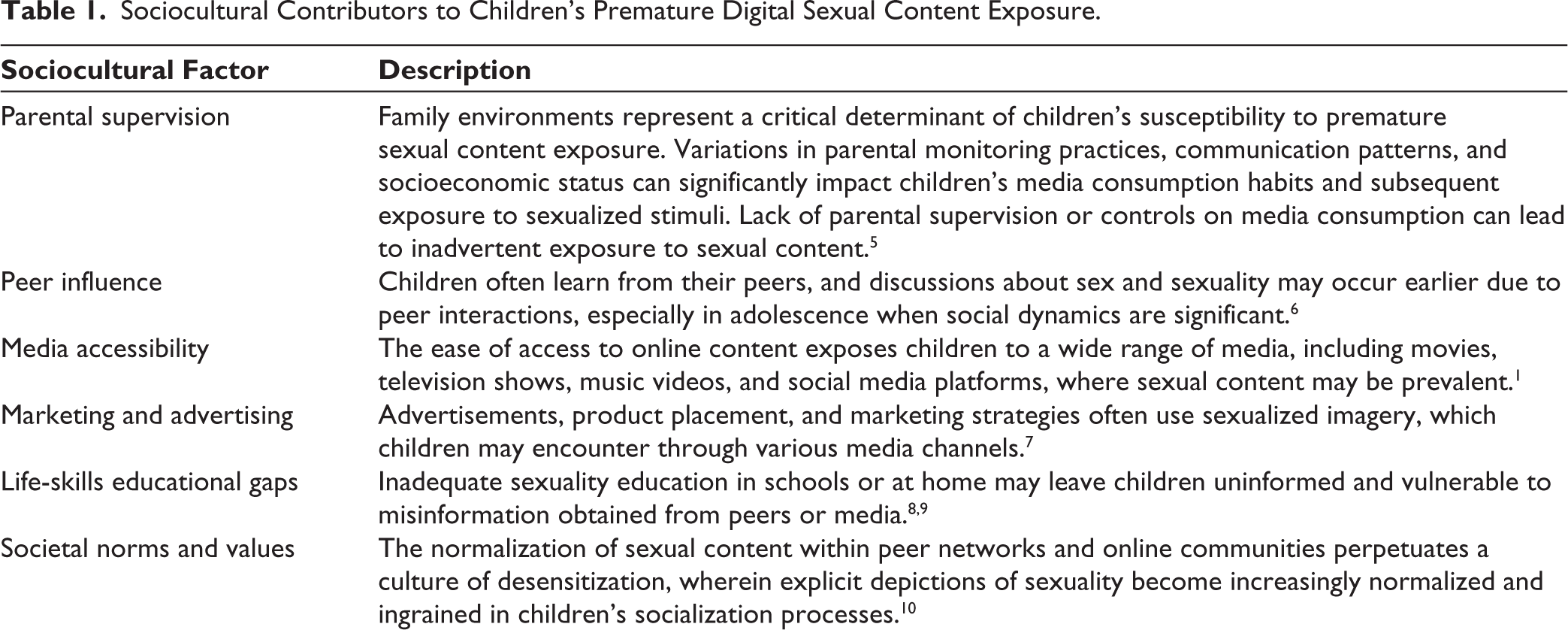
The convergence of social dynamics, media accessibility, and educational curriculum gaps contributes to the premature exposure of children to sexual content. Parental supervision, peer influence, media marketing, societal normalization, and inadequacies in life-skills education collectively shape the environment in which children encounter sexualized stimuli at increasingly younger ages.
Impact of Premature Digital Sexual Content Exposure on the Developmental Trajectory
A life-course perspective is central to developmental psychopathology 11 that can be used to evaluate the potential impact of premature exposure of children to sexual content on their developmental trajectories. This perspective emphasizes the significance of early experiences in shaping long-term emotional and cognitive outcomes. The ramifications of premature exposure to sexual content on children’s developmental trajectories are profound and multifaceted. Empirical evidence suggests that early encounters with sexualized media content are associated with an array of adverse psychological sequelae, including heightened levels of anxiety, depression, and body dissatisfaction.1,12 Moreover, premature exposure to sexual content may precipitate accelerated cognitive maturation, wherein children are prematurely venture into sociosexual paradigms without the requisite emotional or cognitive capacities to navigate such complexities effectively. Table 2 elucidates some effects of the phenomenon on the development of children and adolescents across various domains with a focus on sexual development.
Impact of Premature Digital Sexual Content Exposure on the Developmental Trajectory.
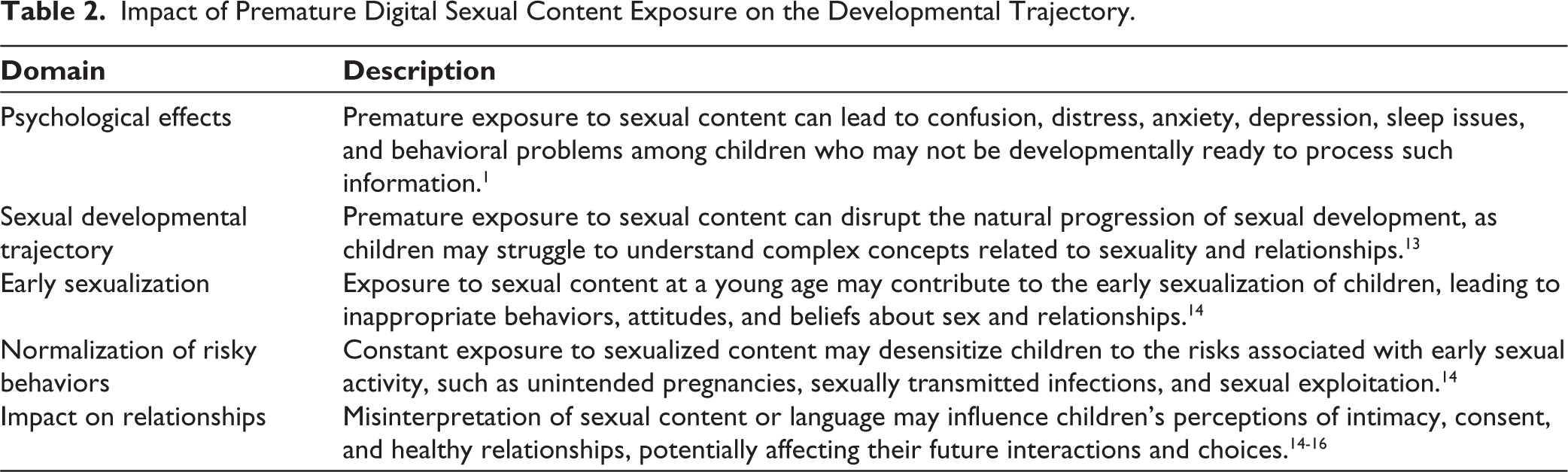
Amidst the rapid expansion of digital platforms and the pervasive nature of media accessibility, heightened apprehensions have arisen regarding the cascading effects of premature exposure to sexual content on children’s developmental pathways. The early exposure of children to sexual content not only poses risks of fostering developmentally inappropriate and potentially harmful sexual behaviors17,18 but also detrimentally impacts their psychosocial development. 1
Implications of Premature Digital Sexual Content Exposure for Interventions
While some sexual behaviors and explorations during childhood are considered normal and aligned with developmental stages, they warrant clinical attention when characterized by aggression, coercion, disparate age or developmental stages between children involved, resistance to adult/caregiver intervention, or causing harm or distress.18,19 Moreover, there is a need for proactive interventions to mitigate the potential psychological and social repercussions, safeguarding children’s well-being and promoting healthy developmental outcomes. Table 3 illustrates some of the systemic interventions at family, school, and societal levels that can effectively address the negative impact of this phenomenon and help in fostering a supportive environment conducive to healthy childhood development.
Implications of Premature Digital Sexual Content Exposure for Interventions.
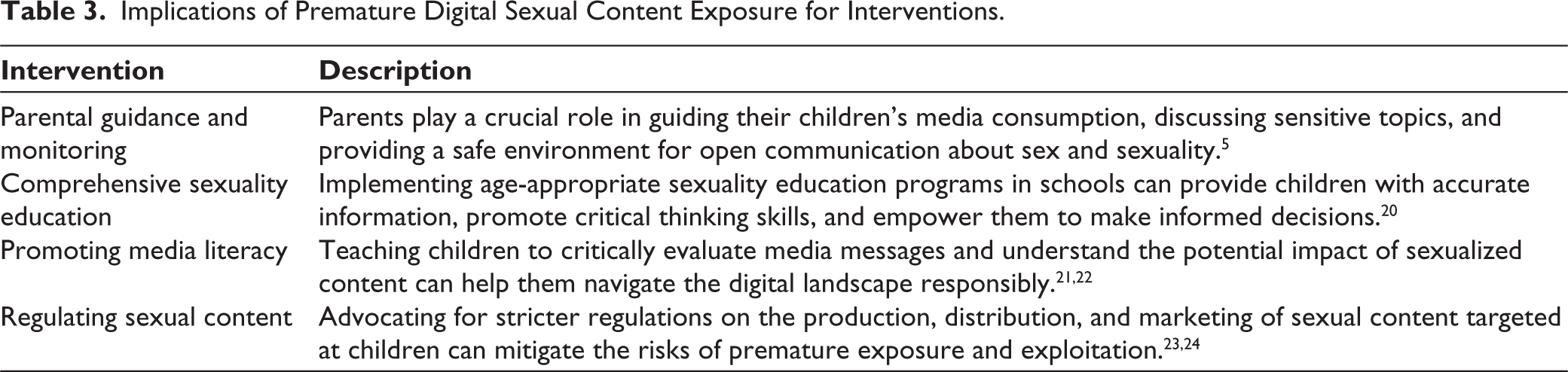
Parental mediation behaviors may encompass establishing guidelines regarding the amount, timing, and type of media content adolescents engage with (restrictive mediation), engaging in conversations about media content with children (active or instructive mediation), and engaging in joint media usage, such as co-viewing television programs. 25 Parental restrictions can decrease children’s exposure to specific types of media content, potentially diminishing their attention to and emphasis on violent and sexual television content. 26 Additionally, restrictions may mitigate sensation-seeking behaviors. 27 The implementation of universal prevention and promotive efforts, encompassing comprehensive sexuality education, media literacy programs, and robust policy and regulation frameworks, is imperative in addressing the complex challenges associated with this early sexual content exposure, fostering informed decision-making and promoting healthy sociosexual development.
Conclusion
Premature exposure to sexual content, talk, and language poses significant challenges to children’s development and well-being. Lack of parental supervision, normalization of sexual content within peer networks and online communities, inappropriate marketing strategies, and inadequate life skills not only have an adverse psychological impact on children but also contribute to deviant sexual developmental trajectories and interpersonal relationship problems. Proactive interventions such as comprehensive sexuality education, enhancing media literacy, parental guidance, and regulating sexual content can safeguard children’s rights, promote healthy sexual development, and foster a supportive environment conducive to their overall well-being. To effectively implement these interventions, a multidisciplinary approach involving educators, policymakers, healthcare professionals, and technology developers is essential. However, addressing this complex issue also requires stronger evidence; this review has methodological limitations, highlighting the need for future systematic reviews.
Footnotes
Authors’ Contribution
LS conceptualized and prepared the first draft.
AJPV, RKM, and JVSK critically reviewed the manuscript.
All the authors read and approved the final manuscript.
Declaration of Conflicting Interests
The authors declared no potential conflicts of interest with respect to the research, authorship, and/or publication of this article.
Funding
The authors received no financial support for the research, authorship, and/or publication of this article.