




Abstract
The importance of social interaction on well-being has been investigated in a variety of social psychological domains (e.g., homelessness, addiction, and immigration); however, little research has been conducted on the associations between social motivation, community, and well-being within BDSM/kink practitioners. Previous literature has found that feelings of in-group inclusion and attending events predicted well-being in other sexual minority communities; therefore, the current study examines the association between social motivation, in-group inclusion, attending events, and well-being within the BDSM/kink community. A mediational model was tested, and it was found that social motivation significantly predicted well-being through both in-group inclusion and attending events. Additionally, beyond the serial mediation model, both identification with the kink community and attending events were significant mediators on their own. Participation in a BDSM community constitutes a large part of kink for many individuals, meaning that feelings of in-group inclusion and attending community events are likely vital for increasing and maintaining well-being. Marginalized communities often find solace, comfort, and acceptance through community, highlighting the importance of socialization for health and well-being. The study concludes with a discussion on implications, future directions, and the value of community in BDSM/kink communities.
Introduction
The relationship between social interaction and well-being has been extensively covered within social-psychological literature.1–3 In particular, social acceptance, in-group identification, and community participation have been found to relate to well-being.4–9 For stigmatized individuals especially (e.g., those with alternative sexual practices like bondage/discipline, dominant/submissive, sadism/masochism, BDSM, or kink), having a sense of community is crucial for protecting against adverse outcomes and promoting well-being. 7 The mechanisms through which these benefits arise are understood within some contexts (e.g., fandoms, immigration, and homelessness); however, it is not understood whether these relationships exist within the BDSM/kink community as well. The aim of the current study was to examine possible mediating variables through which social motivation relates to well-being, including in-group identification and participating in community events, within the BDSM/kink community.
In-group Identification
While it is understood that the term “community” can be conceptualized by various definitions, communities are typically formed through shared goals, interests, and skills rather than geography. 10 As such, a sense of community can be understood as “a feeling that members have of belonging, a feeling that members matter to one another and to the group, and a shared faith that members’ needs will be met through their commitment to be together.” 10 (p9) In the days of contemporary technology, communities can take different forms and serve many purposes. Actively participating in a social or cultural community has been documented to produce tangible benefits for well-being. For example, for new immigrants, cultural communities provide instrumental (e.g., transportation), informational (e.g., advice), and emotional (e.g., reassurance and encouragement) support, 11 and integration into a cultural community has been demonstrated to bolster trust, a sense of acceptance, and the overall well-being for new immigrants.6,12 Shared community responsibility and coordinated efforts during the COVID-19 pandemic predicted increased well-being through community bonding and in-group identification. 4 Similarly, in-group identification was found to be highly valued within homeless youth populations, and greater in-group identification was associated with greater well-being through reciprocity, protection, and feelings of acceptance.13,14 In-group identification has also been linked to better addiction recovery outcomes and greater well-being in sport among Japanese and US samples.5,15
In-group identification, especially within the context of fanship and fandom, has been linked to well-being16,17 and an individual’s sense of self, in that one’s social identity can be informed by their identity as a community member. 9 For many individuals who practice BDSM/kink, their erotic behaviors cannot be separated from their personal identity and constitute a great deal of their daily lives.18,19 Indeed, there has been debate among various scholars as to whether BDSM/kink is a sexual orientation in and of itself.20,21 To that extent, practitioners’ affiliation with a community is central to their social identity, and in-group inclusion is paramount to their well-being. 7
Participation in a BDSM/kink community provides direct benefit to practitioners’ psychological well-being.7,22 Participants in a study discuss inclusion in the community as a space for personal growth and development, self-expression, and “a place to embrace and release psychological baggage.” 7 (p 902) Given the connections between community and well-being in other contexts (e.g., addiction recovery, homelessness, sport, immigration), it is not surprising that similar benefits arise in BDSM/kink communities as well.
The BDSM/kink community, not unlike other community interest groups, is a diverse, wide-reaching conglomerate of like-minded individuals with ample opportunities for social interaction, including national conventions, educational workshops, competitions, local/regional social gatherings (colloquially known as “munches” or “sloshes”), private parties, social clubs, and online forums (e.g., Reddit and FetLife). 7 While the BDSM/kink community is extremely heterogeneous in its membership and specific interests,23,24 there are a number of universal values and benefits of in-group inclusion, including the importance of consent and safety, acceptance, sexual expression, emotional support, personal growth, and philosophical enlightenment.7,25–27
Active Participation in Community Events
The association between social motivation, in-group identification, and well-being has been found to operate through friendship and perceived emotional support.28,29 The relevance of friendship and companionship as a mediator of the relationship between ingroup identification and well-being suggests that mere community membership status is not sufficient for increased well-being; for instance, older adults in a study 28 identified in-person social contact as being crucial for creating strong ties with others. It may be the case that active participation within communities is required to realize these benefits. Another study 30 found that attending arts and cultural social events at least 3–4 times a year was associated with increased life satisfaction and reduced feelings of strain and unhappiness.
While some evidence suggests that there is no difference in accrued benefits between online and in-person social interaction, 31 other scholars have found that participation in in-person community social events is associated with decreased loneliness and greater well-being compared to those who interact with their community in online settings only. 8 For individuals who strongly identify with a shared-interest fandom, having social connections and attending community events in person mediate the relationship between fandom identification and well-being.9,29 Attending events has been implicated in increased well-being in a number of community settings; for individuals involved in “furry” sexual subculture, participation in their community was strongly motivated by social reasons rather than sexual reasons, 32 and community events were found to fulfill their social motivations and increase well-being. 9 Similar results have been found within the BDSM/kink community, in that practitioners who attend smaller regional “munches” are motivated by social reasons rather than sexual or relational reasons. 33
The increased social and personal benefits of in-person social interaction compared to online interaction have also been observed in other contexts. A study 34 found that individuals demonstrated low compliance rates when asked to perform social behaviors online rather than in person and that engaging in in-person social interaction or using mediums that closely resemble in-person interactions (e.g., video call) resulted in greater feelings of closeness than those performed via social media or text messaging. In-person social interaction was associated with greater agreement and more positive first impressions compared to online social interaction. 35 In educational settings, younger undergraduate students reported higher engagement, learning, and understanding during classroom teaching and reported lower satisfaction with transitioning to remote learning. 36
There are unique challenges to online social interaction that render it less connective than in-person social interaction. A study 37 found that greater anonymity associated with online social interaction was positively associated with greater dishonesty in social interactions. Passive social media use has also been linked with increased loneliness and decreased well-being. 38
For many BDSM/kink practitioners, attending social events is highly valued and an integral part of their BDSM/kink lifestyle. 39 The social networks that are accrued by participating in community events are important for more than just social reasons: practitioners identify social networks as an avenue for verifying the legitimacy of new participating members. 7 This “vetting” process ensures the safety of individual practitioners and the maintenance of group values and conduct. The stigmatization of BDSM/kink erotic activities has resulted in serious economic, emotional, physical, and social consequences for practitioners, and as such, individuals report feelings of shame for their interests and a compulsion to be private and suspicious of others.19,20,40–43 Participation in a BDSM/kink community remedies personal stigma and bolsters well-being through feelings of acceptance, sexual freedom, and a sense of belonging.7,40
The Current Study
Previously documented connections between social motivation, community identification and participation, and well-being suggest that there are specific features of communities that promote well-being for individuals. The relationship between social motivation and well-being has been documented within various community contexts and is likely to exist within the BDSM/kink community as well; 7 however, the specific mechanisms through which these benefits arise have been under-investigated. In light of evidence to support the idea that feelings of interconnectedness and in-group inclusion promote well-being,4,7,29 it is likely that individuals benefit from social interaction through feelings of inclusion and acceptance within a community. Feelings of in-group inclusion are fostered by proximity to like-minded individuals; 44 therefore, well-being in the kink community is likely to be caused by increased feelings of in-group inclusion, which are in turn garnered through participation in in-person community events.
The purpose of the present study was to examine in-group identification and attending events as mediators of the association between social motivation and well-being in the BDSM/kink community. The results of this research may provide support for social remedies as distress mitigators and legitimize BDSM/kink community events as positive social interactive spaces for individuals of gender, sexual, erotic, and relationship diversity.
Methods
Participants and Procedure
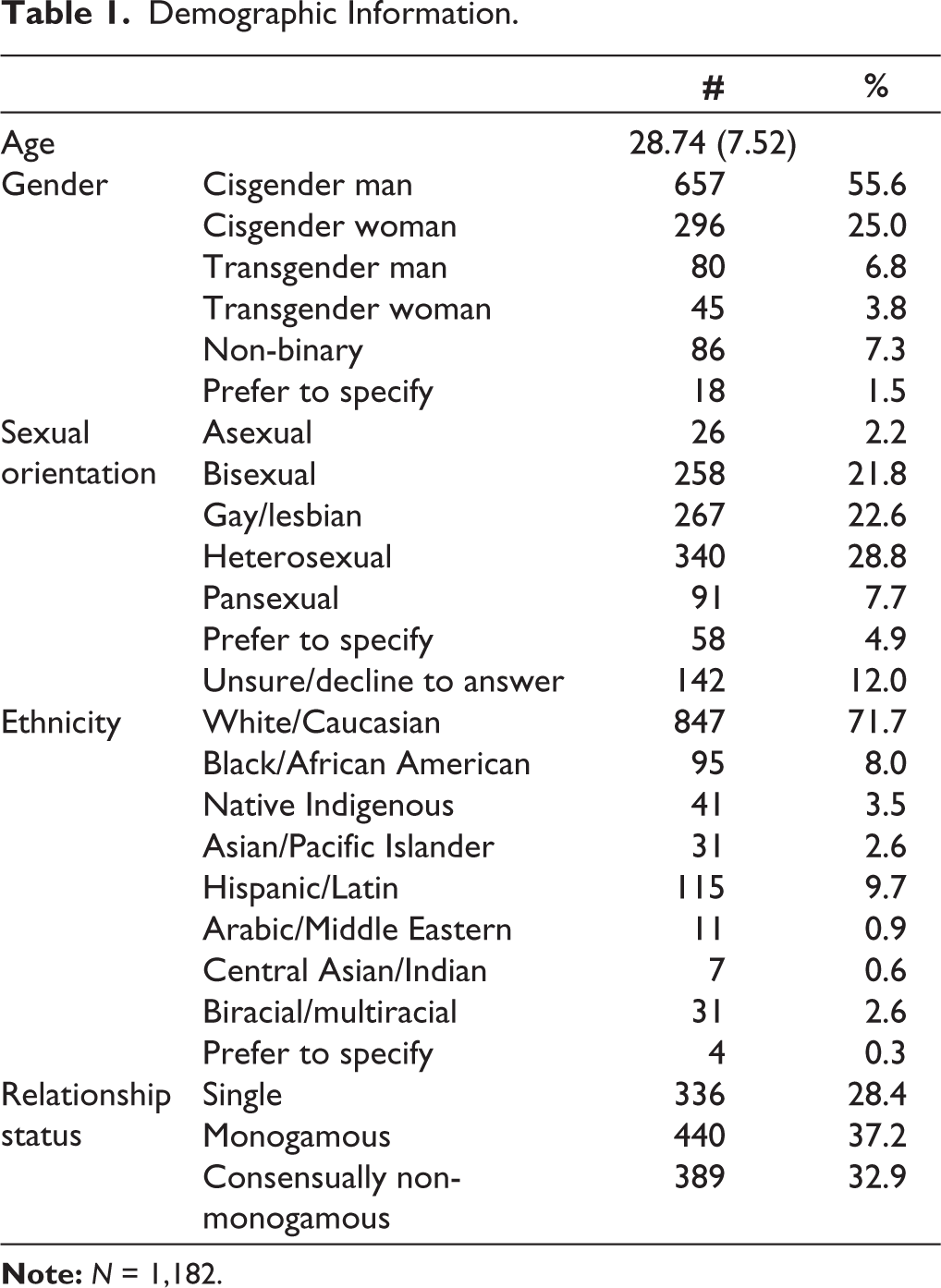
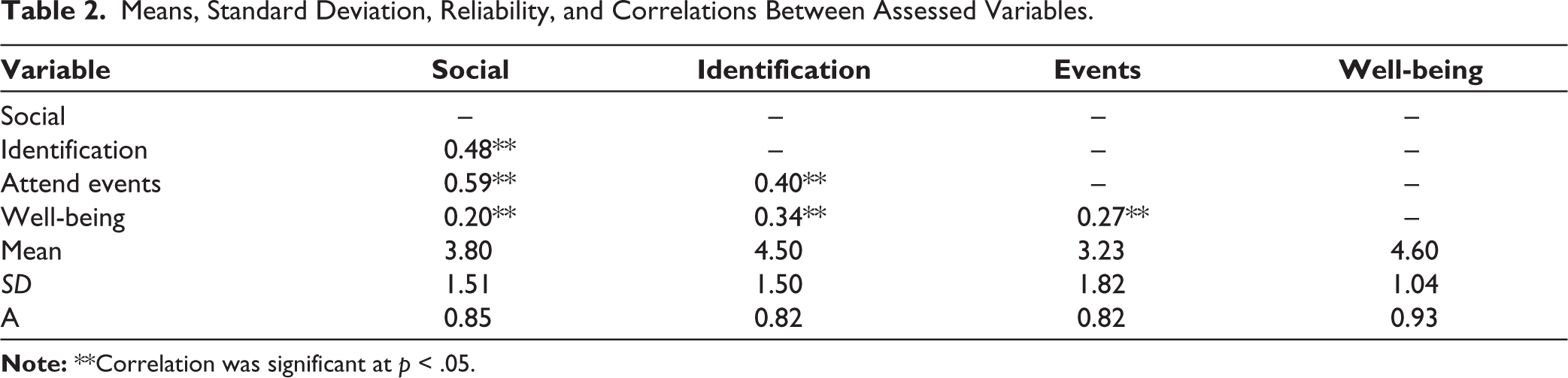
Participants included 1,182 self-identified kink community members recruited from various kink and LGBTQ+ related subreddits (e.g., r/BDSMnot4newbies, r/demisexuality, r/gay, and r/sex). Demographic information of participants can be found in Table 1. 1 After obtaining informed consent via electronic verification, participants completed measures regarding whether they identify as part of the kink community, social motivation, in-group identification, frequency of attending in-person events, and well-being (see Table 2 for means, standard deviation, and scale reliability). This project received ethical approval from Texas A&M University-Commerce (TAMUC IRB #2164).
Demographic Information.
Means, Standard Deviation, Reliability, and Correlations Between Assessed Variables.
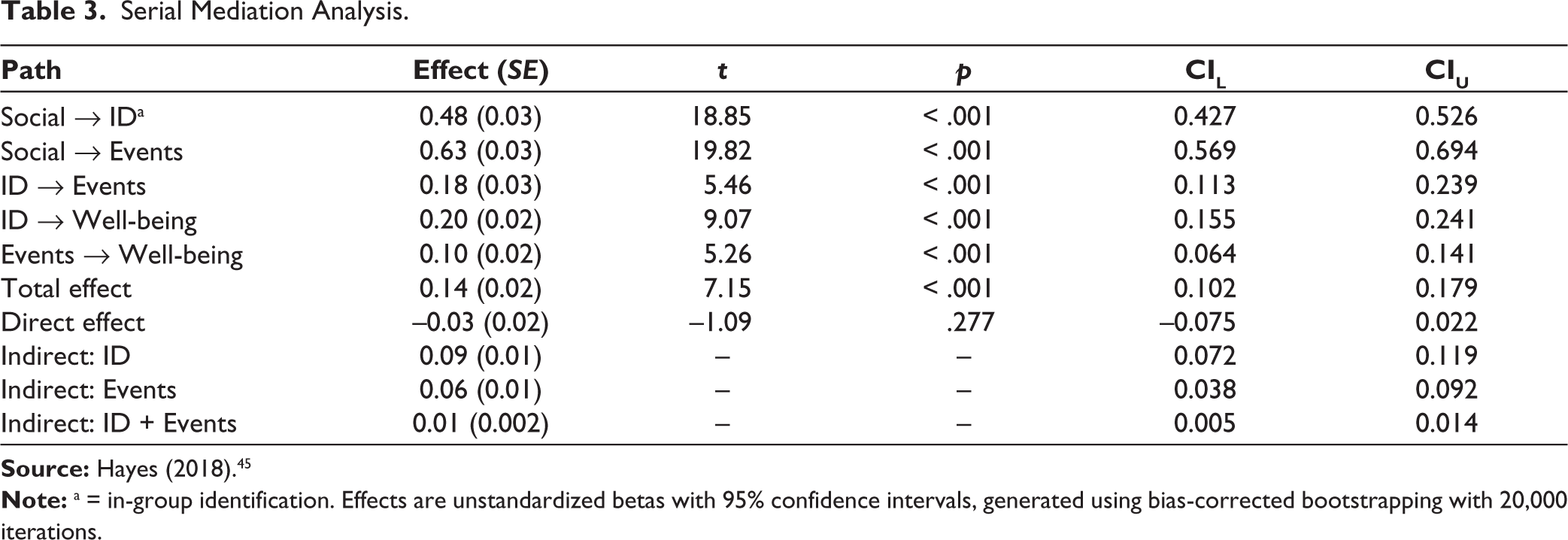
Serial Mediation Analysis.
Materials
Social Motivation
Following the prompt “To what extent is your…,” participants rated four items (“general interest in the kink community motivated by social reasons?” “interest in interacting with other kinky people motivated by social reasons?” “interest in interacting with kinky people specifically in person motivated by social reasons?” and “interest in interacting with kinky people specifically online motivated by social reasons?”) adapted from prior research, 32 from 1 = not at all to 7 = very much.
In-group Identification
Three items (“I strongly identify with other people in the kink community,” “I am glad to be a member of the kink community,” and “I see myself as a member of the kink community”) adapted from prior research46,47 assessed participants’ degree of identification with the kink community (1 = extremely inaccurate, 7 = extremely accurate).
Attend Events
Participants rated two items (“Attending conventions/large gatherings” and “Attending local meet-ups with other fans”) from prior research 9 regarding their frequency of attending kink community events on a 7-point scale, from 1 = never to 7 = often.
Well-being
To assess well-being, we included 24 items (“I feel able to grow and develop as a person” and “I am satisfied with my ability to perform my daily living activities”) from the BBC well-being scale 48 rated on a 7-point scale, from 1 = strongly disagree to 7 = strongly agree.
Results
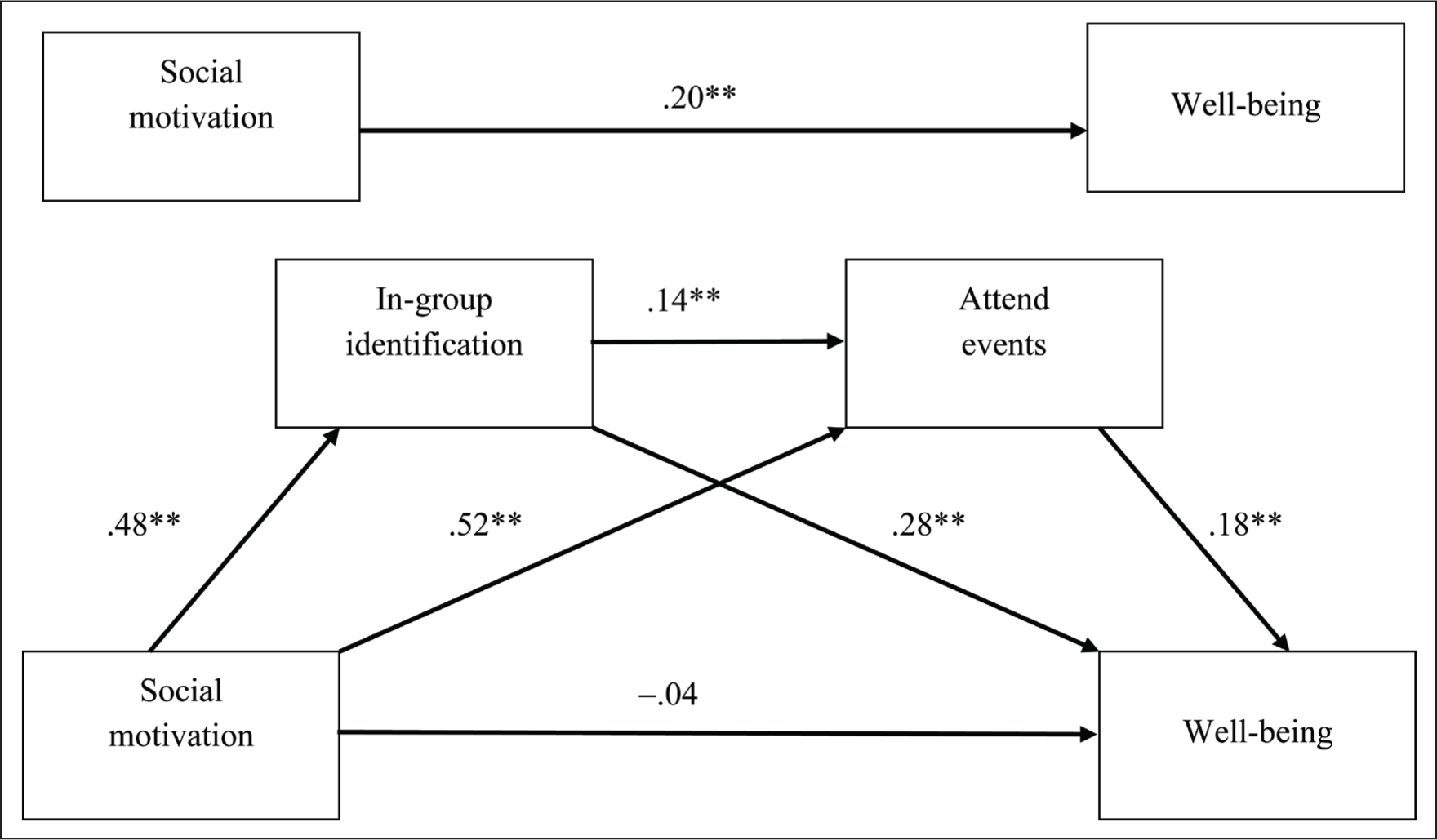
We first examined zero-order correlations among the assessed variables. As shown in Table 1, they were positively associated with one another. Next, we tested a serial mediation model with social motivation as the independent variable, well-being as the dependent variable, and in-group identification and attending kink-related events as mediators. As shown in Figure 1 (Table 2), social motivation predicted higher well-being. Social motivation also predicted greater identification with the kink community, identification predicted greater frequency of attendance at in-person events, and events predicted greater well-being. Additionally, beyond the serial mediation model, both identification with the kink community and attending events were significant mediators on their own. 2
Serial Mediation with Social Motivation Predicting Well-being Through In-group Identification and Frequency of Attending In-person Events. Standardized Betas Presented, **p < .01.
Discussion and Conclusion
The benefits of social interaction on well-being have been observed in a number of contexts.1–3,11 It has been found that, especially in times of hardship, and for those facing discrimination, social interaction with a community and feelings of in-group inclusion have been crucial to the health and well-being of individuals.4,6,7,12–14 Feelings of in-group inclusion have been found to arise through both in-person and online participation in community events; however, some scholars have found that in-person social interaction results in greater increases in well-being compared to online.8,34 The current study aimed to evaluate a model of well-being incorporating in-group inclusion and attending events as mediators of the relationship between social motivation and well-being.
The model was significant in that social motivation does indeed appear to affect well-being through feelings of in-group inclusion and attending events, both individually and in conjunction. For the BDSM/kink community, in-group inclusion and attending events may have complex effects on well-being. The value of community and social interaction within the BDSM/kink community has been previously documented; 7 participating in a BDSM community provides a variety of inter- and intra-personal benefits, such as acceptance, confidence, education, and friendship. BDSM/kink activities have long been regarded with disdain, misunderstanding, and discrimination, to the extent that they threaten individuals’ friendships, employment, and custody of children.19,41 Feelings of in-group inclusion with a BDSM community help remedy feelings of shame, fear, and ostracism for practitioners, which helps bolster well-being and, for some, is crucial in maintaining mental and emotional health and stability. 7
It was also found that attending events was a significant mediator of the relationship between social motivation and well-being. It may be the case that attending community events satisfies some of the desire for social interaction among those who are highly socially motivated, which in turn bolsters well-being. The implications of this finding are complex—while smaller, regional social events are more easily accessible, larger events can be inaccessible, and some BDSM practitioners’ feelings of in-group inclusion may be threatened by lack of access to community events. Participation in BDSM/kink can have a significant financial component: the purchase and maintenance of equipment and attire; travel, lodging, and registration costs of larger events; food and drink at smaller events; club memberships, etc.49,50 These costs can be a deterrent to participating in in-person events, and for many practitioners, community involvement happens almost exclusively in online spaces. 49 Given the results of the current study, it is likely that individuals who participate exclusively online still experience increases in well-being through feelings of in-group inclusion; however, future studies could determine if access to, and participation in, community events increase well-being beyond that of feelings of ingroup inclusion.
There are a number of limitations that should be noted within the current study, the first being the sampling method employed; it is possible that recruiting individuals from social media forums catered to specific demographics or special interest groups (i.e., kink/BDSM/LGBTQ+ affiliated groups) could have disproportionately included individuals with greater perceived importance of community, thus inflating the found effects. Additional sampling biases, such as volunteer bias, should be considered alongside the results. Second, there were a number of parameters that were not tested that may affect the validity of the model, including the potential effects of sexual orientation, personality disorders, or psychiatric comorbidities on well-being. Future studies may endeavor to investigate associations between community involvement, kink identification, sexual orientation, parameters of psychiatric health, and mental well-being to examine the effects of community on mental health. Third, although the measurement of kink identity within the current study allowed participants to express their unique multifaceted understanding of themselves and their role, difficulties arose collapsing identities into discrete categories, and therefore, an analysis of the salience of the current model across role identities was not conducted. Future analysis could examine whether community engagement has similar associations with well-being across dominant, submissive, and switch individuals. Finally, a limitation of the current study is the reliability of the measures of social motivation, in-group inclusion, and attending events. Social motivation and in-group inclusion are complex, nuanced variables that may require many items to adequately capture. However, the specificity of the language of each scale item helped minimize ambiguity for respondents. In this way, what each scale lacks in expansion, it makes up for with brevity. Future studies should use longer, more reliable measures for each construct. Additionally, future studies should examine the mechanisms of in-person social interaction that promote well-being. Although there is evidence to suggest that in-person social interaction garners greater social and interpersonal benefits than online interaction,8,9,29 other scholars have found some advantages of online social interaction that render it preferable to in-person interaction. Some studies51,52 have observed that online communication facilitates easier discussions, in that individuals are afforded the time, space, and emotional safety to carefully craft their self-concepts, responses, and reactions. Indeed, individuals with greater social anxiety were more likely to prefer online social interaction. 52 Given the ease and lowered expectations of online interaction, it would be insightful to understand what features of in-person social interaction are rewarding and increase well-being.
In conclusion, the results of this study support the idea that well-being is increased through feelings of in-group inclusion and attending events within the BDSM/kink community. Individuals who are highly motivated to be social gain benefits from social interaction that bolster their well-being; for many, a sense of in-group belongingness and inclusion constitutes a large part of these social benefits. In-group inclusion is associated with attending events, which suggests that some aspects of physical in-person communities provide unique benefits to well-being that are not realized through online interaction. For BDSM/kink practitioners especially, inclusion in communities may present a safe haven of acceptance, inclusivity, and friendship that diminish feelings of shame and bolster well-being. This study proposes an explanation of the mechanisms through which social motivation influences well-being and supports the notion that social interaction does indeed influence well-being.
Footnotes
Declaration of Conflicting Interests
The authors declared no potential conflicts of interest with respect to the research, authorship, and/or publication of this article.
Ethical Approval
The following research was evaluated and approved by the Institutional Review Board at Texas A&M University-Commerce.
Funding
The authors received no financial support for the research, authorship, and/or publication of this article.
Informed Consent
All participants provided their informed consent prior to participating in the research and were debriefed at the conclusion of the study.