




Abstract
Growing old is related with all human beings, but for those whose sexualities do not follow the social normative structure of family, growing old is more related to loneliness. This article will refer to such people with a different sexual orientation, in this case, mainly gay men. It will deal with the qualitative queer methodologies used for this particular topic.
Queer gerontology has hardly been dealt with anywhere in research in this country; talking about old gay men seems to many that it does not need any methodology to deal with. But when academics try to investigate, interpret and interject many subjects and various areas, it is seen that the ‘queering communications’, ‘queer conversations’ and ’queer(y)ing ethics’ in qualitative methodology are always considered as similar as any social sciences qualitative methodology, or specifically gender qualitative methodology. This article will try to critically analyse how normative gerontology is very different from queer gerontology.
This article includes a sample of 50 gay men in five different categories based on age: 30–35, 35–40, 40–45, 45–50 and 50–55 years. The sample includes gay men from different social and cultural backgrounds, various professional fields and several regions and languages, focusing mainly on people, power and place. Beside these, it will also have two broad categories: one who stays single and one who stays with a partner.
Being a gay man brings lots of packages along with life—discrimination, violence, rights and privileges as a citizen of India are some of them that this article will also deal with. This article will try to bring the queer methodological structure into focus with the area of growing old gay men in a society where the socio-legal conditions consider them as criminals. The socio-psychological aloofness begins at an early age, and as one grows older, it corrugates the lives of such gay men as lonely, abhorrent human beings in society.
Introduction
India serves as a massive field for ethnography and anthropological studies, besides any social sciences and linguistic disciplines. Gerontology in India is also seen majorly by many researchers and academicians, and their field encompasses widowhood and senior citizens in the name of gender(ing) gerontological study. Widows are widely studied—mainly Vrindavan, Mathura, Gaya and Varanasi—and probably no specific areas have been left out in studying the old age of Indians, considering them as ‘senior citizens’, to be politically and constitutionally correct. Amidst all these, old gay men have neither been researched upon in such a detailed way, nor they have any place in the world of academia. Even queer politics unintentionally do not count them as being part of grass-root activism, except that they are stalwarts and ‘pioneering leaders’ of the queer community in this country. For example, Ashok Rao Kawi of Mumbai is the ‘father figure’ of the community. Bimal ‘Bhai’ of Delhi is known as the sole ‘brother’ to lend his shoulders to anyone in the community who needs help; Pawan Dhall of Kolkata is another brother figure in the same picture; and Sunil ‘Appa’ of Chennai follows the same path. But considering the ‘miniscule’ population of the country, there are many faces and community members who have been growing old with their sexuality—suppressed or exuberant.
There are innumerable gay men who did not want to come out of their closeted selves, for many reasons, but mainly considering the protective sanctity of the closet of one self. Some did not want to lose the family they loved, some did not want to lose the love that their society bestowed upon them, some did not want to talk about it purposely, debating that if heterosexuals do not proclaim all the time, why do gays have to do it, while some felt afraid of being discriminated against and punished under the stringent Section 377 of the Indian Penal Code. Whatever their reasons for not coming out to the public about their sexuality, it is totally their own choice, and no one can thrust upon their ideologies and diktats about coming out to them. This study was undertaken with the help of a few known close friends who revealed many things. The first thing that comes to mind is why there are no research methodologies for this particular topic of study. Is it that this area of research is quite new in Indian academia? Or is it that the Indian intelligentsia never gave importance to ageing gay men at all?
Methodology
I have basically taken personal interviews based on qualitative analysis and quantitative dynamics to interview 100 gay and bisexual men through snowball sampling. I have chosen the range of their age, varying from 30 to 60 years. The reason for this choice of this age group is intentional and with a purpose. Actually, in the Indian queer community, especially in the gay men’s world, as one reaches the late twenties, one is no longer in the market for eligibility for sexual pleasure and gradually deteriorates with every passing year. It might sound like all gay men have multiple sexual partners or are promiscuous by nature. It will be an absolutely judgmental allegation if such a comment is made. What exactly I meant by ‘market of eligibility for sexual pleasures’ is taking into consideration the mobile dating applications and websites of gay and bisexual men—especially Grindr and PlanetRomeo—and how the susceptibility and vulnerability of their enlargement of cyberspace reduce with age. Innumerable account holders on these mobile application-based sites very clearly mention that ‘aged people, above 30s, uncles stay away’. So to interview these 100 respondents, I have taken the help of these two mobile application-based sites. Interviewing gay and bisexual men for personal information takes lots of hard efforts, especially to gain their confidence and speak the coded language so that they start building trust with you. Rather, what we call ‘queer conversations’ 1 and ‘queer communications’ 2 become the most important tools as researchers. Therefore, discussing queer methodology in this context becomes necessary.
Conversations and communications with the respondents seemingly appear as any qualitative analysis, but there are certain subtle differences while interviewing gay men. As in any social sciences research, the ‘insider/outsider’ has significance in this too. But there is a very important trait of ‘subjectivity of researcher’ that matters a lot because it leads to auto-ethnographic positionality in relation to the respondents—such as how they interact, where they interact and many more. The dualism of ‘insider/outsider’ fades off easily as the fixity of subjectivity and essentialising of attributes are taken into consideration within a normative dualism. Moreover, the status of ‘insider/outsider’ and the field that I have chosen is queerly constituted research with a significant focus on the particularities of spatial liminality, class positionality, Freudian superiority/inferiority psychology and regionality in queer spaces. These methodologies of interconnectedness and interaction between individuals have been used. For this study, I have chosen only three case studies. All the names and many facts about their identities have been changed for ethical reasons in queer research.
Case Study 1
My name is Mayur Bhattacharjee (name changed). I am 33 years old now. I am a central government employee. It is so unnerving sometimes when my own family members start initiating the discussion of my marriage, as in any Bengali family. Why Bengali? It is possible with any family. But being Bengali gives one the leverage of flexibility in marriage. I have been avoiding this topic for the last 6–7 years. I am not explicit about my sexuality, like many others. No one knows about me, and being a central government employee with a decent designation makes me more introverted by nature, rather closeted. You know it hurts to carry many faces of your own self. But what can I do? I have to always be cautious about my closeted sexuality. I make sure that no one ever comes to know about this side of my life. I am thankful to God that my sister got divorced and is now staying with us. I am fostering my nephew as my son. My dad expired a long time ago, but he left behind many unwanted relationships that are being maintained with very cautious discipline. My dad had two wives, so I have twin brothers from the other mother. He left a four-story house in Mahavir Enclave of West Delhi. You know, sometimes these unwanted incidents work as boons for us, especially closeted gays. My sister moving into the house worked as a remedy for the vacuum of no children for me, especially for the family and the locality I live in. They do not talk anymore about children not being there at my home. Being Bengali again gives you the privilege of knowing that a woman belongs to the family by birth, not necessarily like those of other non-Bengalis who think that woman is a burden on a family, that too, a divorcee. But my younger twin brothers are after me to get married because they are waiting for their chance. This keeps haunting me all the time. I had previously thought that if I find someone special or the right guy, I will tell my family. But you know, the guys on the dating sites think we are old for even being sexual partners. Lest to forget about being a life partner. Some of them did accept my proposal, but later I realised that they were after my money. I have faced many financial crunches because of the wrong affairs I was involved in. I do not know why I fall prey to such guys. Sometimes I wonder why we gays do not get the right guys at the right age. I feel happy and envious seeing those people who are in affairs for so long, some for 5 years, some for even 10 years. If only my fate also gave me that chance to come across someone who would just love me, not for my position or secured job, not for my money, but just for what I am and who I am. But it is only my dreams that I can keep pursuing. Yes, I cannot tell my family because they will be shattered, my sister and nephew might leave us, and they do not have anyone in this world except us. I am the sole breadwinner member of the family. Only last month, after lots of persuasion, my sister started teaching at a local school. But you know, when I return home tired every day, I can feel a void in my life. Although my nephew is there to fill up a different space, you see, a partner is a partner. After all, his one smile or hug can erase my stresses and tensions. Tell me something, did I become gay intentionally, or was it by choice that I adopted this loneliness in my life?
Observations of Case Study 1
Being closeted about one’s sexual identity creates lots of problems not only for one individual but also for all those who are closely knitted to the individual. The intra-dependency and inter-dependency of each other in this case bring out a sense of protection and fulfilment to some extent. In this case, the family cannot be held solely responsible for pressurising the individual into setting up a heteronormative family for himself. But his desire to have a child opens up to some extent that normative structure of family. The most important factor that comes forward is that the place of abode is Mahavir Enclave, which falls in the south-west district of Delhi. Thus, an urban middle-class ambience carries a different kind of spatial locality. The liminality of his movements is fixed within domains of lanes and by-lanes; thus, peeping at each other’s house has become a normal trend in such geographical spaces of Delhi. His upbringing, thus, carries a lot of his psychological frames of coming out and trusting community members at large. 3 Although through his government job, he has earned a social status, still the vulnerability of his sexuality correlates directly to his designation and job, and a sense of fear is always running unintentionally in the minds of such individuals (23 respondents). Other factors, such as the choice of partner, relate to a class-conscious decision and the liminality of educated, English-speaking ones, as he mostly used English during the interview. Thus, he is curbing down a huge number of people who may be potential partners because of ‘inferior’ class and Hindi-speaking individuals. Being Bengali also brings another aspect to the case. His consciousness of being ‘superior’ in culture than others naturally cuts down on many other options.
Case Study 2
I am Bhoop Singh (name changed). I am 44 years old. I am married and have a 12-year-old son. I run my real estate family business. I did not study much, as I grew up in a Jatt family, realising that to earn money, you do not need to study much. But still, I went to college, but only until my second year and left. My grandfather has left behind lots of property, but most of it is in the congested place of Mongolpuri in north-west Delhi. This Pitampura house of ours was bought by dad back in the 1990s, when he opened up his shop in Rohini Sector 16 Market. Being the only son of his father, my dad got all the properties in his name. Today, our monthly income is 4-5 lakhs, mostly from rents and the rest from the business. You know the real estate business has really gone down. We barely earn anything. Thank God that there are these properties. Yes, today you can consider me bisexual. I like having sex with guys a lot. I do not remember when I last had sex with my wife; it may have been a year back. It is like a tradition that you marry for the sake of a child, and my marriage just happened. I was not even prepared for it. I was dating this Bengali guy who was in school in class 9, and I was in my first year. My mom saw me interacting with him, and she had an inhibition that Bengalis know black magic, so she got scared that he might take away my property. Yes, that fear of mom was relevant because I bestowed lots of expensive gifts on him. But after I dropped out of college, my parents got me married to this girl from our Jatt community. I was excited about my marriage because I felt I would get a girl to have sex whenever I wanted to. But believe me, after the marriage thing happened, I lost the charm of it within a few weeks. I do not know; from daily, it was reduced to weekly, then fortnightly, then monthly and now yearly. I do not know the exact reason. I do not care how she sexually satisfies herself. I know these Grindr and PR. Naturally, we Jatts have well-built bodies, so for me, it is not that tough to get guys. Moreover, I have lots of money to splurge on these school guys. You know I have a liking for young, teenage guys, and they are easily available. I am not into sophisticated teenagers or someone who has to be English-speaking like others. By others, I mean gay men. So, a Hindi-speaking teenager will also work. Yes, I am scared sometimes that my son can also be enticed or allured by men like me. A sense of fear is there, but more than that, what matters to me is that I will never want my son to undergo such masked identities. You see how hypocritical I am. On one side, I am pretending to be a good husband and a loving father; on the other side, I am sleeping with guys of my son’s age. I know I should hate myself, but what do I do with my sexuality? I cannot subdue it or suppress it; I have tried that even. I suffered so much that I went into depression. Once, I planned to run away, leaving all these. But I could not, because my son’s attachment stopped me. I really do not know what to do or where to go. But now I have accepted myself like this for the last 10 years. I am not proud, but yes, I am happy.
Observations of Case Study 2
In this case, Bhoop Singh’s geographical positionality of class and culture plays a major role in his closeted sexual identity. Bhoop Singh falls under the nouveau riche class of Delhi. The characteristics of landowners are very clear here. Being in the bordering place of his own state, Haryana, Bhoop Singh is much in a better and more secured position here. Unlike Case 1, this case seems more prone to the establishment of heteronormative structures in both family and society. More than loneliness, melancholy and depression are significant outcomes. The vulnerability of ageing does not seem to have taken over Bhoop Singh at any cost because he has a legacy of heteronormative family structures in society. His respect is earned not through his English, but through his money and power. The sense of superiority is always in his psychological domain, but he never forced any young teenager to have sex.
Case Study 3
I am a doctor by profession, and now I have reached 59. My name is Arun Saxena. I had a long affair for 20 years, but we parted ways, as he was also a doctor and wanted to go abroad and settle down. My whole idea of being gay is leading a life of truth and dignity. It does not at all mean one goes to the middle of the road and shouts out about his sexuality. And why do we have to tell everyone about not getting married? Is marriage the ultimatum of one’s life? I used to get very irritated in my early years when people discussed this topic unnecessarily and dragged me into it. My elder brother is married but had a terrible married life. He never wanted his children to follow what he did. Both my nephews are settled in the States. They come to visit us. Both me and my brother and his wife stay in this house in Green Park in South Delhi. No, I do not feel like cruising; it is humiliating at this age when people point fingers at your wrinkles. My profession does not give me time to feel depressed. I am attached to one of the CGHS dispensaries in South Delhi, so I come across many young guys who show some kind of interest in me. But I deny it, not because I am old but because I have earned my respect and dignity through my profession. How can I destroy it for my sexual urge? Yes, I do feel lonely sometimes, many a times when I do not have work, I feel depressed. I miss my younger days. I have bought a house in Karnal, so I go there and spend a weekend at peace. I have joined this Brahmakumari spiritual group for meditation. To be frank enough, that does not work at all to keep your loneliness at bay. Being an old gay man is depressive; loneliness devours you a lot if you do not keep yourself busy. No one wants you—your extended family might not support you if you do not have property or a bank balance, and your friends avoid your company if you are out. Your demand in the market is almost unworthy. Because I am a doctor, people unwillingly even want to be close to me. You cannot find a partner at this age; you simply become ‘sugar daddy’ to provide them money whenever they want. It is sad and devastating, and so many may develop suicidal tendencies as well. Thank God it is India; your family is always beside you, unlike in the West.
Observations in Case Study 3
Professions have a lot of impact on ageing amongst gay men. It is depressing, melancholic, lonely and may be suicidal in some cases. This case has opened up many questions about family structure. The place where Arun belongs is one of the posh areas of New Delhi. He owns a bungalow on an area of about 500 yards. In simple words, he comes from a rich family. He is himself a doctor and owns a farm house in Karnal. So his case is far above many I have interviewed. His respect that he earned through his profession may make him a victim of financial abuse rather than emotional care. Arun did not try to find love after his affair fell apart. Arun feels more alienated, as he thinks he is quite old for any sexual escapades. It becomes quite evident that property and bank balances and their impact on ageing seem to be directly proportional to each other in the context of ageing and mental health. One’s own risk factor increases how one deals with ageing. This also leaves us with a mere research query: is coming out important, if ageing and money are directly linked to each other?
Understanding This Research
After interviewing around 100 gay and bisexual men ranging in age from 30 to 60 years across Delhi, there have been many research questions that opened up as the six months of research went on. All the respondents are closeted gay and bisexual men. Around 41 of the respondents are married, out of which around 5 continued their extramarital affairs with another man, while the others continued having sex with men, and it increased with age. It did not matter what region of Delhi they belonged to or what class they came from. But their intentions of having sex varied across classes. Respondents from South West and East Delhi chose younger sexual partners; respondents from South and West Delhi chose the same age; and respondents from North, North West and South East did not bother much about age as long as they satisfied their sexual needs. Very interestingly, most of the respondents (38 of them) are open for sex with men of any class, provided they do not ask for money.
All the other 59 gay men are unmarried, and they do not have any intention to marry. It is very interesting to observe that most of the respondents (52 of them) are concerned about the age and class their sexual partners belong to. They did not even mind paying for sex, provided the sexual partners were clean and hygienic.
Rest seven of them are concerned about age, but not that much about class. For unmarried respondents, the choice of their sexual partners has to be what they desire, unlike the married respondents. In the category of unmarried men, respondents across Delhi are into the search for sexual partners mostly on weekends. Unlike married men, weekdays were preferred, especially during office hours or business hours, mainly lunch time. Unmarried men never disclosed what their professions were until that trust built up. Everyone across the board lied to their sexual ‘hunt’ 4 about their professional status, which mostly revealed much lower than their original income, like Bhoop Singh has always been rude to his sexual partners, and much of his inquisitiveness is never liked.
As mentioned earlier, searching out the respondents (especially married ones) has been a tough job, and it is very hard to get into the periphery of their confidence and win their trust. Here, the most banal fact about auto-ethnography is that it works through the ‘insider/outsider’ technique of qualitative research. 4 For example, this community is divided into three broad categories: top (one who penetrates), versatile (one who penetrates as well as gets penetrated) and bottom (one who gets penetrated). Hence, there are typical codes of linguistic structure to deal with community men. Both verbal and non-verbal communications have to be on par with the homo-normative structure that the community follows. The body language, the attributes and the voice modulations have to be in the same arena that these categories belong to. As a researcher, one needs this auto-ethnocentricity to bring up the truth, but a liminal space has to be maintained. 5 The main reason for this limitation is that no sexual favour is given or taken when one approaches, except emotional and moral support.
The graph here clearly shows that married men at their early stage of married life did not involve much in sex with same-sex men, but as the age increased, the tenacity of having sex with another man proportionately increased, especially until they crossed 50 (Figure 1). There are two main reasons behind this phenomenon. The first is that married men tend to be cautious about not getting exposed to their wives and family when they are at their early stage of building up a ‘happy married life’ and their sexuality must not disrupt this happiness. But with age, their suppressed sexual desire wakes up. The second reason is related to this, but to a larger extent—the social status of the respondents. All of them are more concerned about their social status, respect and dignity at the beginning of their marital life, but slowly, as they age, their sense of social respect does not bother them much. They are more concerned with where their sexual partners belong, what class they come from and what they do professionally.
Marital Status of the Respondents.
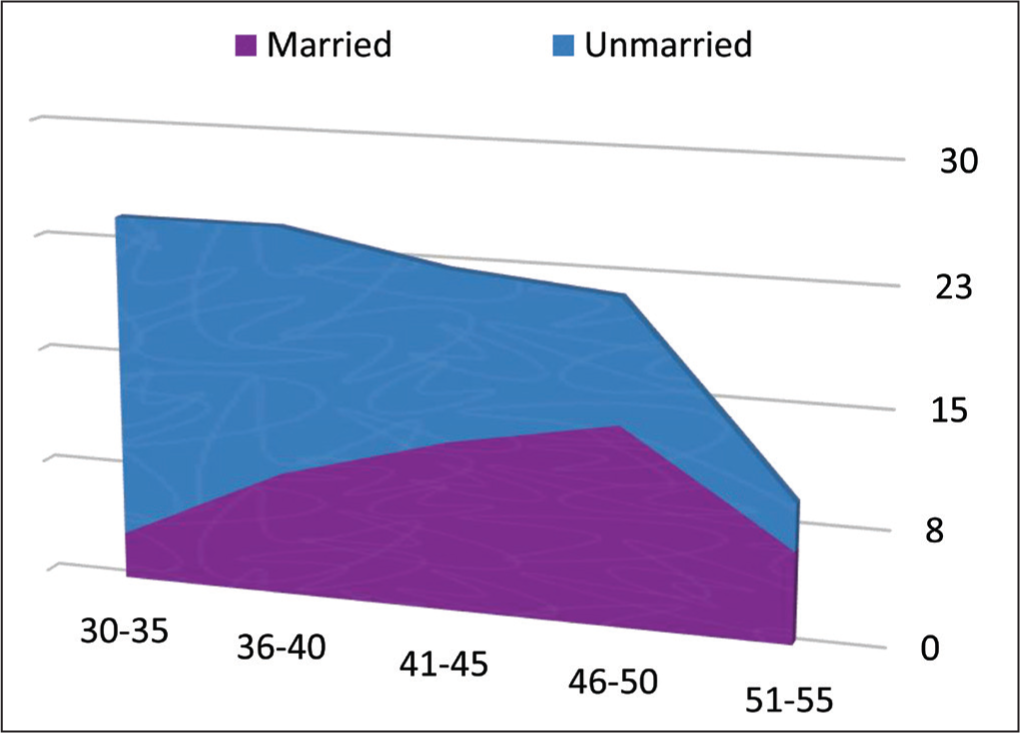
While with unmarried men, it is just the opposite; at their early age, that is, the early 30s, they are more into sexual involvements, but as the age increases, their involvement in sex also reduces. The reason for this, first and foremost, is that being polygamous in their early lives has gotten them tired of moving from one guy to the other in search of a life partner. The second reason is that their ageing relates more to the normative structure of society. Rather, they also want to have a normative family here; class and region do not matter much. But in their cases, their sexual involvement gradually decreases with age, as their concern becomes more about social status, dignity and respect. Conclusively, they also behave like married men as they cross a certain age, mostly after crossing 45 years, across all classes and places they belong to.
Interestingly, for married ones, their social status comes from being a husband and then a father. They acquire that through hetero-normative marriage. As their children become adults, their social status reaches a different level of respect. They never get anything from what they professionally acquire, while in the cases of unmarried men, the professional status is the prime factor—to earn respect. Their professional class creates the respect and dignity for them, which they have been thriving throughout their lives, and this comes only with age and experience.
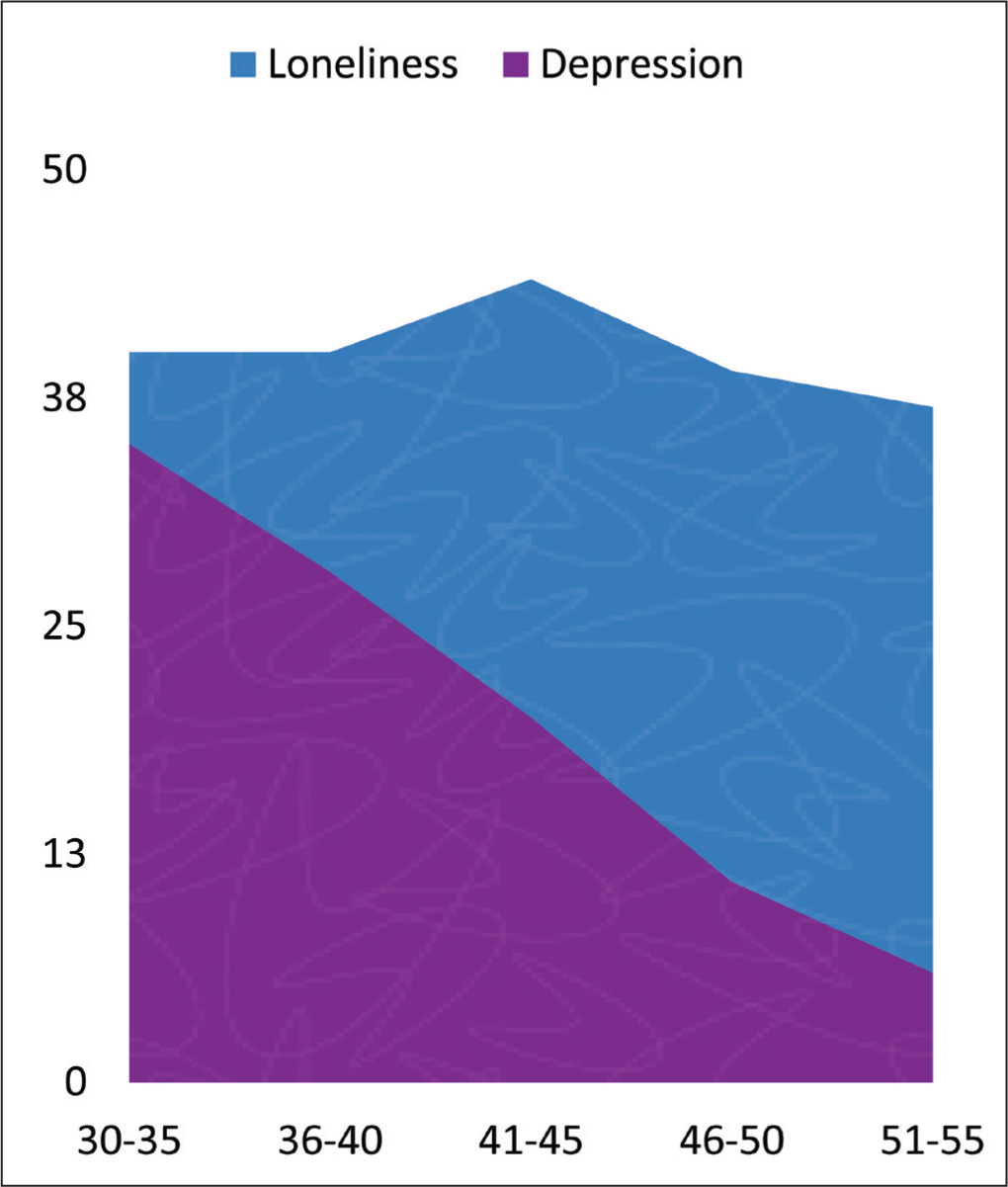
Gerontological epistemology shows many research queries about the paradigmatic structure of family and kinship; its morphology has a harsh truth to reveal about facing discrimination of various kinds. 6 Depression has decreased with age for people with different sexual orientations. In the early 30s, the respondents have been more prone to depression, while after the late forties, the respondents are less likely to be victims of depression. Maybe they have learned to cope with different circumstances and have experiential knowledge of life. While loneliness and alienation scales have sharply increased with age, despite their class and place of residence. The desire to have a partner increases with age. When seeing everyone having a partner to spend their life with, the desire sharply affects them. The quest for a partner haunts them a lot psychologically; may be this is one of the reasons, thinking about such gruesome ageing, all 41 married respondents became victims of emotional blackmailing by family, besides being attracted to their wives. The morphology of sexual desire has a tendency to fluctuate amongst younger gays, but with age, it declines and becomes stronger towards understanding their sexuality. 7 Accepting their sexual orientation matters a lot. Acceptance of denial or rejection depends more on one’s characteristics and the psychological framework of the ego than on their sexuality.
Conclusion
Gerontological queer research has always depicted a severe kind of marginalisation and discrimination among ageing men. This study was carried out across reputation, family status, class and cultural backgrounds. The most ambiguous perspective of this research is the muted erotic subjectivity of the relationship between fieldworker and respondent. 8 To presume one’s sexual positioning stays the same throughout the research period fails to even recognise the intersubjectivity of both the researcher and the informant/respondent. In fact, the shifting of relationships between them becomes a central focus of the research process. This becomes the main reason that ethnographic studies could help broaden the knowledge of queer sexualities. Such research provides an in-depth analysis of the push and pull factors of sexualities and erotic tensions. Therefore, there has to be a change in methods of fieldwork for using queer ethnography and studying gerontological structure using qualitative analysis. Although there is a feminist debate about providing some methodological directions towards queer scholarship, not much has been researched on this topic of ageing gay men. Ageism remains the most significant area that needs to be focused upon by queer researchers, as the inclusion of such sexual orientation needs to be on the agenda of family members of queer men with old age. 4
This chart, in fact, directly points out the fact that depression decreases with age (Figure 2). The main reason for overcoming depression with age is experiential coping with the social stigmatisation and discrimination. As it is the trend in Indian society to overlook the factor of ageing men with lesser obstriction, not to mention that the social dignity that comes from professional status gives the gay men a pivotal factor to overpower depression with other factors. But the increase in loneliness increases simultaneously. The main factor in loneliness is the immediate niche and social surroundings that the respondents live in.
Mental Health of the Respondents.
This germinates a further debate about queer research methodology having no authentication, but the factor of ‘insider/outsider’ techniques of specificity and subjectivity makes the queer research stand apart. The concept of ‘insider’ fixes subjectivities within its essentialised existences and attributes, which work within a normative dualism. This leads the researchers to share the subjectivities of their participants as ‘insiders’ and may grant access to ideas, experiences, attitudes and practices denied to ‘outsiders’. 9 The demonstration of subjectivities is in negotiated spaces, and this gives the researcher the privilege to connect and interact directly. 10
Gerontological studies have shown the socially constructed images of ageing men as respectable and dignified, but the whole idea of being gay destroys this and makes the gay old man more vulnerable to denial, rejection and discrimination not only from society but also from the queer community at large. Thus, loneliness, depression and melancholy become part of their everyday lives. All the respondents are victims of either one or more of them. Except for those who are married, their whole life to them is a masked lie of hypocrisies. Both queer epistemological and ontological perspectives bring out a different methodology of qualitative research that is more concentrated in auto-ethnography. Queer research focuses on the fluidity, intersubjectivity and responsiveness of particularities, as auto-ethnographic research does. Both researchers accept inventiveness and static legitimacy and embrace existing and normalising techniques in qualitative inquiry. Although auto-ethnography hinges on the pull and push factors between and among analysis and evocation, personal experiences and larger social, cultural and political concerns.11–12 Therefore, this article has tried to focus of the gerontological area of queer studies to bring out the visible narrative presence and hegemonic ways of seeing and representing others.
Footnotes
Declaration of Conflicting Interests
The author declared no potential conflicts of interest with respect to the research, authorship and/or publication of this article.
Ethical Approval
Not applicable
Funding
The author received no financial support for the research, authorship and/or publication of this article.
Informed Consent
Not applicable