




Abstract

Introduction
Asexuality is a sexual orientation as per which individuals identifying as asexuals experience limited or no sexual attraction or interest in sexual activities. 1 As asexuality does not refer to individuals not indulging in sexual activities ever or having a low libido, asexuality is an umbrella under which a wide variety of sexual attitudes, experiences, and behaviors fall. The spectrum is often referred to as the “ace spectrum” and the people who identify within the spectrum consider themselves to be part of the “ace community.” 2 The most popular sexualities that fall within the asexual spectrum are demisexuality and graysexuality. At the same time, aromantics (individuals who do not have any interest or desires toward romantic relationships) also fall under the asexual spectrum, though it is restricted to romantic orientation. 3
After the abolition of Section 377 in 2018, awareness about the queer community in India has significantly increased, but not enough attention has been allocated to asexuals. It has been suggested that at least 1% of the world population identify themselves as asexuals. 4 It is essential that one does not mistake asexuality with terms such as celibacy and aromantic. Asexuality, just like other sexual orientations, is not a choice. Unlike “homosexuality,” but like various other sexualities, no set of formal or globally accepted definitions of asexuality has been formed yet.
Though there are similar patterns found, in the way asexuality is described, there are also descriptions that differ from each other. In this research, all the identities that fall within the asexual spectrum have been collectively referred to as asexuals, while asexuality is used to refer to their sexuality. Unless a comparison between the experiences of different identities within the spectrum is being drawn upon.
The most important study on asexuals was done by Paula Nurius in 1983, which focused on the connection between sexual orientation and mental health. 5 In the medical field during the nineteenth century, people were diagnosed with “sexual anesthesia or sexual coldness” if they reported minimal sexual interest. 6 Historically, asexuals have been almost the invisible sexual community and even in the contemporary years are highly underrepresented and misrepresented. Only in recent years, the proper representation of the asexual community in the mainstream media has begun. 7 On the contrary, within society, the perception held of asexuals is quite misleading than the experience reported by asexuals. 8 Lack of awareness about the community contributes to the spread of myths and misconceptions that surround asexuals.
Due to limited evidence, research, and studies done on the concept, asexuality continues to be viewed as a disorder rather than a sexual orientation by most. Additionally, there is a lack of awareness of the asexual spectrum and identities within the community. As a result, there is a domination of false and misleading information when it comes to identities within the asexual spectrum. Such circumstances make it difficult for people to recognize these sexualities and the situation is worse in a country like India where anything and everything related to sexuality is viewed as a taboo.
Henceforth, in this research, the experiences of asexuals in India have been studied, which highlights aspects like the problems faced by them, coming to terms with their sexuality, their coming out experience/ decision of not coming out, romantic lives, social experiences, personal as well as social challenges, their connection as well as relation to the rest of the queer community, and so on. Along with an in-depth understanding, an insight into the lives of asexuals in India has been gathered, and thus the stories of asexuals in India have been brought into the limelight.
In the past few years, work focusing on asexuals has drastically increased not just abroad but in India as well. At the same time, it is far more recent for academicians to focus on the experiences and journeys of asexuals, especially with their psychological, social, and sexual well-being in mind. The majority of literature in academia on asexuality comes from abroad, with a few Indian studies covering the same. This research not only provides rich data on the various struggles that asexuals had to overcome and face in India but also adds to the Indian literature on the subject.
Method
This research is a qualitative study with constructivist interpretivism, as it requires an in-depth exploration of the information that will be shared by each participant. Initially, participants were reached through majorly two social media platforms, namely, “Indian Asexauls” and “Asexuality Asia,” and then snowballing, seven participants ended up being part of the research. As the research collected data through interviews, making it descriptive research, the interview schedule was validated by researchers. The research received ethical clearance from the Institutional Ethics Committee of Christ (Deemed to be) University under the reference number IRB No: Jun223239. The thematic analysis model given by Braun and Clarke 9 was used to analyze the data. Validity was maintained using triangulation. The research sample included Indian young adults between 18 and 25 years of age who identified themselves as asexuals and the research excluded Indian asexuals who were minors and individuals suffering from any form of mental health-related or sexual disorder.
Findings
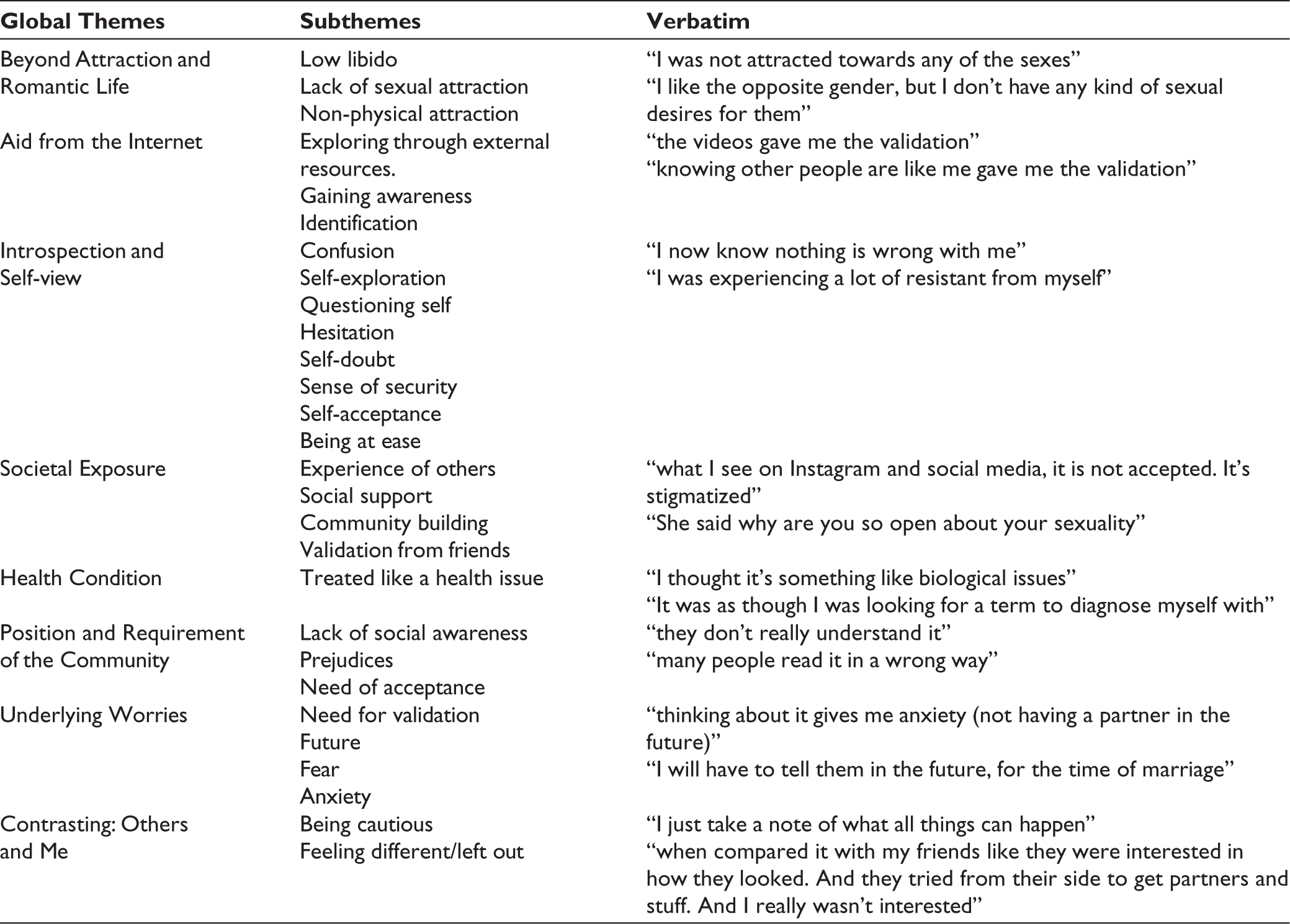
The global themes and subthemes that were identified through the process of thematic analysis are as follows:
Through the analysis of the themes, it can be noted that multiple instances and explanations provided by the participants are similar to the diagnostic criteria mentioned by DSM-5 10 for “Female Sexual Interest/Arousal Disorder” and “Male Hypoactive Sexual Desire Disorder.” However, a few participants have consulted medical and psychological professionals and were not diagnosed with any disorder. Apart from absent/reduced interest in sexual activity, the similarities between the diagnostic criteria and experiences of the participants are also present in expressed sexual/erotic thoughts, sexual excitement/pleasure during sexual activity, and sexual interest/arousal in response to any kind of sexual cues. A distinction needs to be established between asexuals and individuals who are suffering from sexual dysfunctions such as “Female Sexual Interest/Arousal Disorder” and “Male Hypoactive Sexual Desire Disorder.” Keeping in mind that homosexuality was detected as a mental illness until DSM-3 by APA, the creation of this distinction is essential. 11 Additionally, the participants were barely able to receive any help in terms of identifying as an asexual from professionals. Hence, there is an urgency and necessity to establish the distinction. On the positive side, the dip in struggles after accepting their sexuality can be linked to the rise of self-awareness faced by the participants on a personal and societal level. 12 Research from the past few years has given rise to a research gap indicating a lack of evidence-based studies on asexuality. 13 Furthermore, the limited evidence to support any claims about asexuality also functions as a hurdle for asexuals to fight the misconceptions and myths surrounding them. It is only through studies like this, the provision of scientific evidence, and research with the population that these issues can be addressed. The research can function as a baseline study for future research and studies that aim toward spreading authentic information on asexuality among different sections of society, especially medical and psychological professionals, taking a deeper look into the asexual spectrum and being another reason for making sex education a mandate in India.
Footnotes
Declaration of Conflicting Interests
The authors declared no potential conflicts of interest with respect to the research, authorship, and/or publication of this article.
Ethical Approval
The research received ethical clearance from the Institutional Ethics Committee of Christ (Deemed to be) University under the reference number IRB No: Jun223239.
Funding
The authors received no financial support for the research, authorship, and/or publication of this article.
Informed Consent
Written informed consent was acquired from all the participants, after briefing them about the research.