




Abstract
Context:
The assertion that music has an impact on sexual performance is a popular one. However, music is seldom used in clinical settings for enhancement of sexual problems and little is known regarding its scientific proof.
Aim:
To explore available literature on: the interplay between sex and music in the human evolution; brain basis for music and sex; and studies using music to therapeutically enhance sexual performance.
Conclusions:
Evidence suggests an evolutionary basis for the relationship between music and sex. There is converging neurobiological understanding that posits both music and sex to have common brain substrates—the reward pathway, diencephalic structures, limbic system, and prefrontal cortex. Psychological mechanisms hypothesized for a positive role of music in enhancing the act of sex need systematic evaluation. The empirical evidence for the use of music as an adjunct strategy in the treatment of sexual dysfunctions, though positive and encouraging, is still sparse.
Introduction
Music albums containing instrumental, smooth jazzy saxophone music, uniquely titled as “sax for sex,” “sax tonight,” and so on, are promoted to enhance love making. In fact, American singer Robin Thicke titled one of his song “sex therapy”, reflecting the influence that music has on sex. There are classical Indian music counterparts to such albums too, titled “Kamasutra Music.” Perhaps, 2 surveys—1 by Daniel Levitin, across 8 countries with over 30,000 individuals and another from Tracey Cox from United Kingdom—have found that majority, that is, 55% to 60% of population finds “listening to ‘suitable’ music while having sex, ‘betters’ the experience.”1–2 The later survey, in fact, leads to the “Aphro-Deezer-ac Report,” which enlists “10 scientifically proven sensual songs to get you in the mood.” 3 Although “scientifically proven” may have been a recent development, William Shakespeare in his “Twelfth night” emphasizes the importance of relation between music and sex, as early as 16th century AD.
In this brief narrative review, we aim to explore available literature on the interplay between sex and music in the human evolution, common brain basis for sexual responses, and musical processing, the psychological processes underlying the effects of music on sex, and highlight results of clinical studies that use music to therapeutically enhance sexual performance.
Evolution of Music: Role of Sex (Sexual Selection and Mate Preferences)
Bird song, as Charles Darwin suggested, functions to attract sexual mates. At the same time, Darwin also opined that music serves a similar purpose in humans, which he called “sexual selection.” According to him, human music has evolved with corresponding changes in sexual and courtship display preferences. 4 Although bird song and human music do not share phylogenetic origins, modern research suggests that they share a common adaptive function, that is, sexual selection. The relation between music and sexual selection in humans is considered strong citing certain observations. 5
Human music doesn’t serve any direct survival benefits.
Music displays fitness, health, intelligence, and aesthetics, which represent factors that stimulate perceptual, cognitive, and emotional sensitivities.
Music production and selective mate choice together are observed in ancestral hunter-gatherer events. In this context, noteworthy in the Indian tradition is the custom of reciting songs by the bride-to-be during “bridal gaze.”
Musical tastes and musical capacities of humans have been observed to be genetically inherited as is sexual selection.
A very recently proposed unified framework based in archaeology, anthropology, biology, musicology, psychology, and neuroscience posits music as a coevolved system for a larger social bonding, which includes sexual selection as an important component. 6 Furthermore, there is some literature available from experimental psychobiology that gathers support for the notion that music, indeed, has a reproductive function.
Evolutionarily, primate females’ sexual drive and sexual interests have been noted to vary with phases of the estrus cycle. 7 Rather contentiously, women too have been shown to have such variations. Indeed, according to the “ovulatory shift hypothesis,” women’s sexual desire and mate preferences, both in terms of physical and behavioral traits, have been proposed to be vary across various points of the menstrual cycle and be greater at the periovulatory period.8, 9 Such cycle shifts have been found for men’s voices too. 10 Providing more support to the proposal that music does play a role in sexual selection, Charlton 11 showed that women have sexual preferences for men who create more complex music, during peak conception times. A study by Marin et al 12 found that listening to music enhanced the attractiveness perception in women, but not men. In their experiment, women not only reported significantly greater dating desirability but also found men’s facial features more attractive after listening to music than while in silence. More recently, Chang et al 13 showed that “movement-promoting (‘groovy’) background music” enhanced the interest of a person in “meeting a dating partner again.” They also found that “coupled” body swaying in response to groovy background music “predicted their interest in long-term relationship, above and beyond physical attractiveness.”
Although there is evidence that tries to prove the evolutionary aspects of music, from a sexual selection point of view, sex, on the other hand, has the obvious evolutionary advantage of being a basic survival necessity. The human brain systems, especially the reward pathway, are “hardwired” for such a necessity. 14 The next section attempts to understand the human brain systems involved in the processing of music and sex. Do brain systems that process music and sex have anything in common?
Brain Basis for the Effect of Music on Sexual Behaviors
An article that made news (
Recently, Calabrò et al 21 reviewed functional-neuroanatomical correlates of human sexual behaviors. Intriguingly, we find that the brain regions associated with sexual behaviors are implicated for processing of specific music-related functions too. 16 Figure 1 (adapted from Calabrò et al. 21 and Nizamie and Tikka 16 ) shows the implicated brain regions and their corresponding implication in human sexual behaviors and processing of music.
It has also been observed that the neurotransmitter systems implicated in human sexual responses are similar to those involved in the processing of music.16, 22 For both music and sex, dopaminergic system appears to play the prime role while other neurotransmitters—adrenergic, cholinergic, and other neuropeptide transmitter systems—seem to play a modulatory role at the central level. Peripherally, nitrergic system seems to underlie vascular changes leading to vaginal lubrication and penile erection, as part of the sexual response cycle, and in emotional and autonomic processing in response to listening music.16, 22 One neurobiological experiment by Miani, 23 contended as the first empirical support for the role of music in sexual selection and for the common neurobiological substrates for music and sex, has found a significant association between sexual arousal and rhythm synchronization, both of which were shown to be regulated by neuropeptide vasopressin.
Common Functional Neuroanatomical Substrates Implicated in Human Sexual Behaviors and Processing of Music
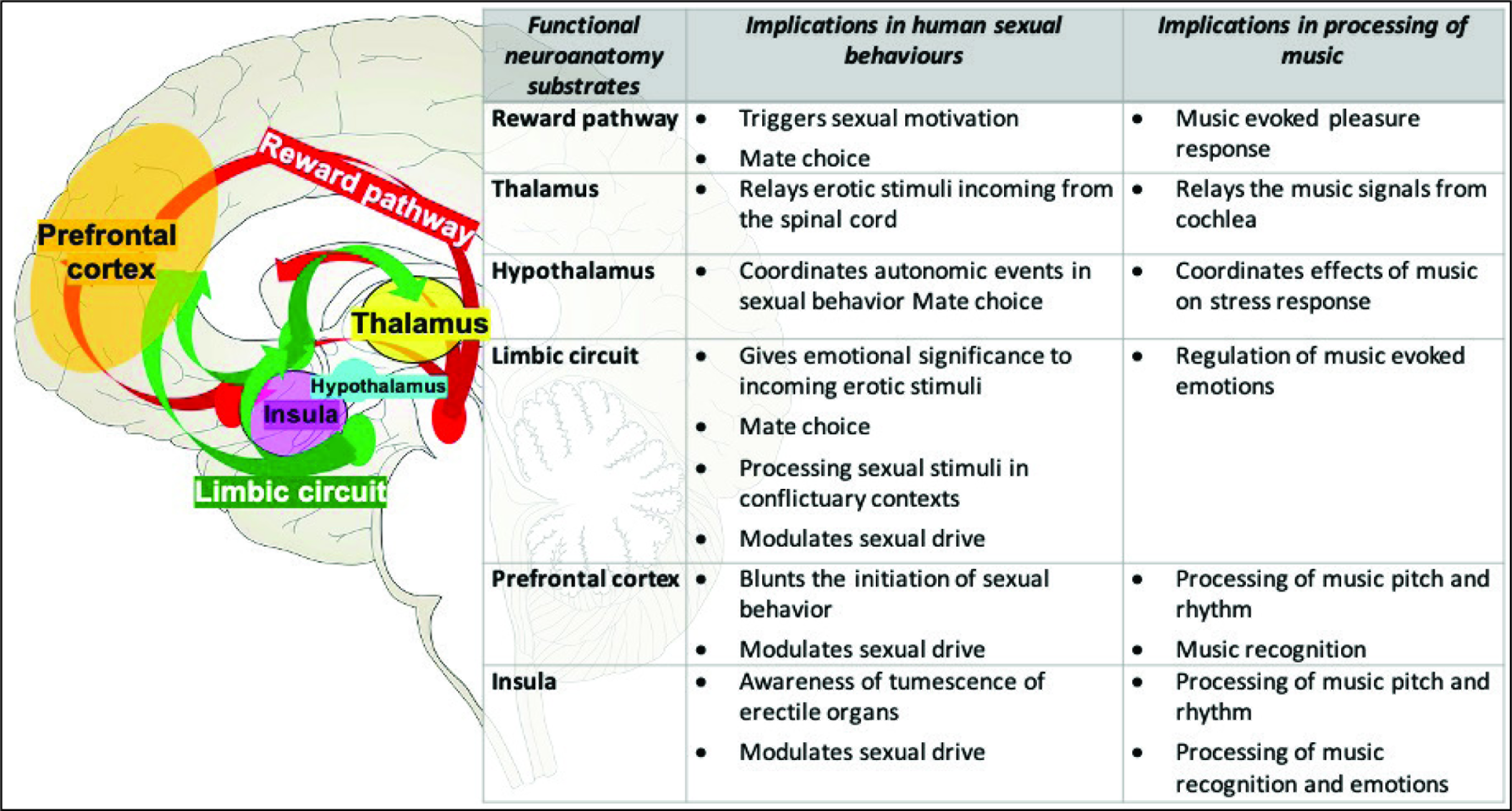
Overall, there seems to be growing empirical evidence for identifying common neurobiological mechanisms underlying the influence of music on sex, and also vice versa. The succeeding section attempts to explore common psychological mechanisms that can complement the neurobiology. Is there enough empirical evidence for psychological processes for the music-sex connect?
Influence of Music on Sexual Experience: Psychological Mechanisms
Although the 2 surveys—by Daniel Levitin and Tracey Cox—as mentioned in the introduction found listening to music to have enhanced sexual experience, there are no empirical psychological studies to support or validate these findings. However, in an attempt to understand the psychology of listening to music during sex, Wahl
24
enlists certain possible psychological mechanisms for music to enhance sexual experience:
Diminishing or relaxing sexual inhibitions. Enhances sexual arousal by elevating the mood. Indirectly enhances sexual arousal and pleasure by reducing stress. Reduces concerns about body image or performance. Enhances confidence. Enhances the focus on the sexual act. Heightens the sense of partner bonding and intimacy. A sync between the musical and the movement rhythms aids sexual performance and satisfaction.
Despite the mechanisms seemingly reasonable, there is lack of empirical evidence to support these mechanisms as scientifically valid and reliable. However, the fact that common brain regions are implicated in sexual response and music processing might perhaps explain these mechanisms.
Music to Enhance Sexual Response: Clinical Evidence
Despite an evolutionary stand and converging neurobiological and psychological mechanisms for a positive role of music in enhancing the act of sex, only a few studies have attempted to assess its clinical value in managing sexual dysfunctions. The small evidence base is narrated in this section.
In one of the earliest studies, Gillan, 25 based on the premise that most traditional sex therapies target anxiety reduction and neglect sexual drive, attempted to use certain socially acceptable approaches to enhance the sexual desire of sexually dysfunctional patients. Along with erotic pictures, stories, and films, she used 2 forms of music to accompany sexual play for enhancing sexual arousal. While 1 form was sexually explicit—the “Japanese Sounds of Sex,” where women vocalized the ecstasy of orgasms, the other was generic stimulating music such as Indian evening ragas. These approaches were used as adjuncts to the modified Masters and Johnson treatment programs and systematic desensitization. She found that both the forms of music were as effective as erotic pictures/stories/films as adjunctive modalities and significantly more effective than control groups where no stimulation was added.
However, recent evidence from a study by Wan and Lalumière 26 that assessed conditioned genital responses in both men and women using penile and vaginal photoplethysmography, respectively, suggests that music alone does not lead to the genital response in either sex. However, they showed that songs paired with a consensual sex story enhanced feeling of sexual desire in both men and women. More recently, a randomized controlled trial by Micoogullari et al 27 found music therapy to be as effective as 30 mg dapoxetine in the management of patients with acquired premature ejaculation. They found improvements in objective measures—intravaginal ejaculation latency time and premature ejaculation diagnostic tool—along with subjective anxiety scores. In the context of the present COVID-19 pandemic, music therapy has been suggested as an alternative treatment in the management of hypersexuality disorder, which might be precipitated by boredom, increasing use of porn, and excessive sexual activity. 28
The evidence so far, although meagre, is positive and encourages the use of music in enhancing sexual desire and in the treatment of sexual dysfunctions. In the next section of this narrative, we briefly suggest certain general directions for future research.
Implications for Future Research
We agree to the proposition that “the neuroscientific study of human sex is still relatively taboo and much remains to be discovered.” 29 This proposition, which still remains a fact till date, necessarily extends to the context of scientific investigations on the relation between music and sex. We deem that the proposed psychological and survey-based hypotheses need to be validated by experimental neuroscience research. Having said that, there is a need for more hypothesis-generating studies too. More randomized control trials may be required to reliably prescribe musical activities for the enhancement of sexual activity or in the treatment of sexual disorders.
Conclusions
There is an evolutionary basis for the relationship between music and sex, specifically sexual selection, as well as the involvement of brain reward system as a common biological substrate. Also, there is converging neurobiological understanding that posits that both music and sex may have other common brain substrates, beyond the reward pathway too. Certain psychological mechanisms have also been hypothesized for a positive role of music in enhancing the act of sex. The meagre empirical evidence in the form of results from experimental studies, both clinical and preclinical, is positive and encourages the use of music as an adjunct strategy in the treatment of sexual dysfunctions.
Footnotes
Declaration of Conflicting Interests
The authors declared no potential conflicts of interest with respect to the research, authorship, and/or publication of this article.
Funding
The authors received no financial support for the research, authorship, and/or publication of this article.