




Abstract
Background:
The COVID-19 pandemic and lockdown measures have affected the sexuality and emotional bonding among the couple across the world.
Objectives:
We aimed to assess the effects of the COVID-19 pandemic and lockdown on the married people’s emotional bonding and sexual relationships in 3 south Asian counties (Bangladesh, India, and Nepal).
Methods:
A cross-sectional online survey was conducted among Bangladesh, India, and Nepal residents from April 3 to April 15, 2020. The survey was designed in English. The participants were selected through convenience sampling technique, the link of the online questionnaire was shared with the participants. Only participants older than 18 years and above, married, and living with their spouses were included in the study.
Results:
A total number of 120 respondents were included finally for analysis from the participating countries (India, Nepal, and Bangladesh). The mean age of the participants was 35.42 (±5.73) years; the majority were males under the age of 40 years and had completed postgraduation as their qualification. Among the study participants, more than half (53.8%) of the women reported being sexually active during the lockdown, whereas 41% of the men reported being sexually active. Among the sexually active participants, most women (57.7%) reported that they perceived positive emotional bonding with their partners. Nevertheless, there was no significant difference observed when compared with men. There are variations in responses. However, no significant association was identified.
Conclusion:
There are a few insights from the study, that is, there was no significant difference found in almost 3 countries in emotional intimacy. There had been a trend that there is improved emotional bonding with their partners, although no significant difference was observed.
Introduction
The year 2020 has been one of the most overwhelming years for the world for a long time. COVID-19 pandemic has influenced all aspects of human life. Sexual health is one of the most critical aspects of human society that has also been influenced. The human psyche is complex and is influenced by many factors across life. Humans are complicated living beings with a vast array of emotions and developed prefrontal cortex and relatively large brains and house complexities of the human mind. Sexuality is an integral part of the human experience, becomes a determining factor for many people affecting companionship and procreation. 1 In addition, the national and regional lockdowns and travel restrictions have changed the world in various ways, including sexual life.2-6
The impact of such social and health restrictions has influenced communication and socialization patterns greatly, and studies have reported that mental health and emotions have also taken a hit during such periods.7-9 However, there is evidence that the COVID-19 pandemic-related social changes facilitated sexual intimacy, and individuals with active sexual life during this lockdown period can cope better.10,11 For example, a study from the United Kingdom revealed that, young individuals, males with poor regulation over emotions, adopted sex for coping with the stress of COVID-19 lockdown. 12
A study from Italy found that more than half of the participants in their study had a decline in the sex life during this COVID-19 pandemic due to the social distancing and intimacy avoidance due to COVID-19 rules. 4 As a result of which people tried new sex positions, sharing their sexual fantasies and sexting. These phenomena are commonly observed among younger individuals living alone and those feeling stressed out. 4 Similarly, increased consumption of pornography and increased frequency of masturbation are also being reported. 3 Furthermore, a study from Italy revealed that people experienced a decrease in desire for sex, lack of psychological stimuli for sex, and compromised privacy during the quarantine period, which adversely affected their frequency of sexual intercourse. 2
The stress of the COVID-19 pandemic can influence how sexual relationships have existed in the pre-COVID pandemic era. Humans’ social structure associates a significant amount of value to the relationships they create in their lifetime, and sexual relationships are often placed in extreme values in the lives of people. 13
A cross-sectional online survey from China reported that 2 out of 10 participants felt decreased sexual desire. Almost half of them experienced a decrease in the frequency of sexual intercourse, and 3 out of 10 reported deterioration of intimate relationships. 5 The pandemic has also influenced access to the services to the sexual and reproductive health like the availability of contraception has been hampered due to the lockdown, resulting in the changes in the sexual relationships. 14 A nationwide study from Spain reported that almost half (47%) of the people faced some issues in their sexual relationships, and almost 30% of women had reported that their sex lives had worsened after the nationwide lockdown was announced. 15
India, Bangladesh, and Nepal are home to more than one-fifth of the world population and are affected by the pandemic and containment measures. Therefore, there is a high possibility of the impact of COVID-19 on the emotional states and the sexual functioning of the people residing in these countries. This study was carried out among 3 south Asian countries, India, Nepal, and Bangladesh, to identify the effects of emotional bonding on the sexual relationships of the married people residing in these countries. The reason for selecting these countries is that they have similar demographic, social, and religious values. The predominantly youth population of India, Nepal, and Bangladesh, their early marriage rates, and conservative societies influence the pattern of sexual behavior among them.
Methods
We conducted a cross-sectional study in 3 southeast Asian countries, Bangladesh, India, and Nepal, from April 3 to April 15, 2020. The study was conducted through an online survey method. Participants who knew English were included as the survey was designed in English. The participants were selected through convenience sampling technique. The link of the online questionnaire was shared with the participants. After filling a brief online summary of the study, and a consent form that popped up after the participant had consented to participate, they were directed to proceed into the appended tool. Only participants older than 18 years and above, married, and living with their spouses were included in the study. After the matching inclusion criteria, they could proceed to the form. The questionnaire assessed the participants’ sociodemographic details, sexual activity, emotional bonding, and medical conditions. One investigator screened the collected data for incompleteness, and appropriateness that was validated and cross-checked by another investigator. Data were analyzed using the free online version of GraphPad statistical software. 16 Initial results were published in our previous article. 7
Tool
The semi-structured tool was developed to measure emotional bonding, sexual behavior before, and during COVID-19 lockdown. The tool consists of basic sociodemographic questions and items related to sexual behavior and emotional bonding. 7 This article highlights the emotional bonding before and after the lockdown among the participants. The items associated with the emotional bonding were assessed on a 10 point where 1 is the least satisfied to 10 being the most satisfied. They were also asked regarding their perception of emotional bonding before and during COVID-19 Lockdown.
Results
The final analysis included a total number of 120 respondents from the participating countries (India, Nepal, and Bangladesh). The mean age of the participants was 35.42 (± 5.73) years; the majority of participants were male, under the age of 40 years, and had completed post-graduation as their qualification. In our previously published article, we had discussed the impact of lockdown on their sexual activity. 7 This article would like to focus on the relationship of emotional bonding with sexual activity during the lockdown. Almost half (45%) of the respondents had reported that lockdown had impacted their sexual lives. The participants responded that lockdown had impacted their emotional bonding (Table 1) with their partners. Among the study participants, more than half (53.8%) of the women reported being sexually active during the lockdown, whereas 41% of the men reported being sexually active. Among the sexually active participants, most women (57.7%) reported that they perceived positive emotional bonding with their partners.
Cross Tabulation Between Background Characteristics of Respondents and Effects on Sexual Life and Emotional Bonding of the Respondents
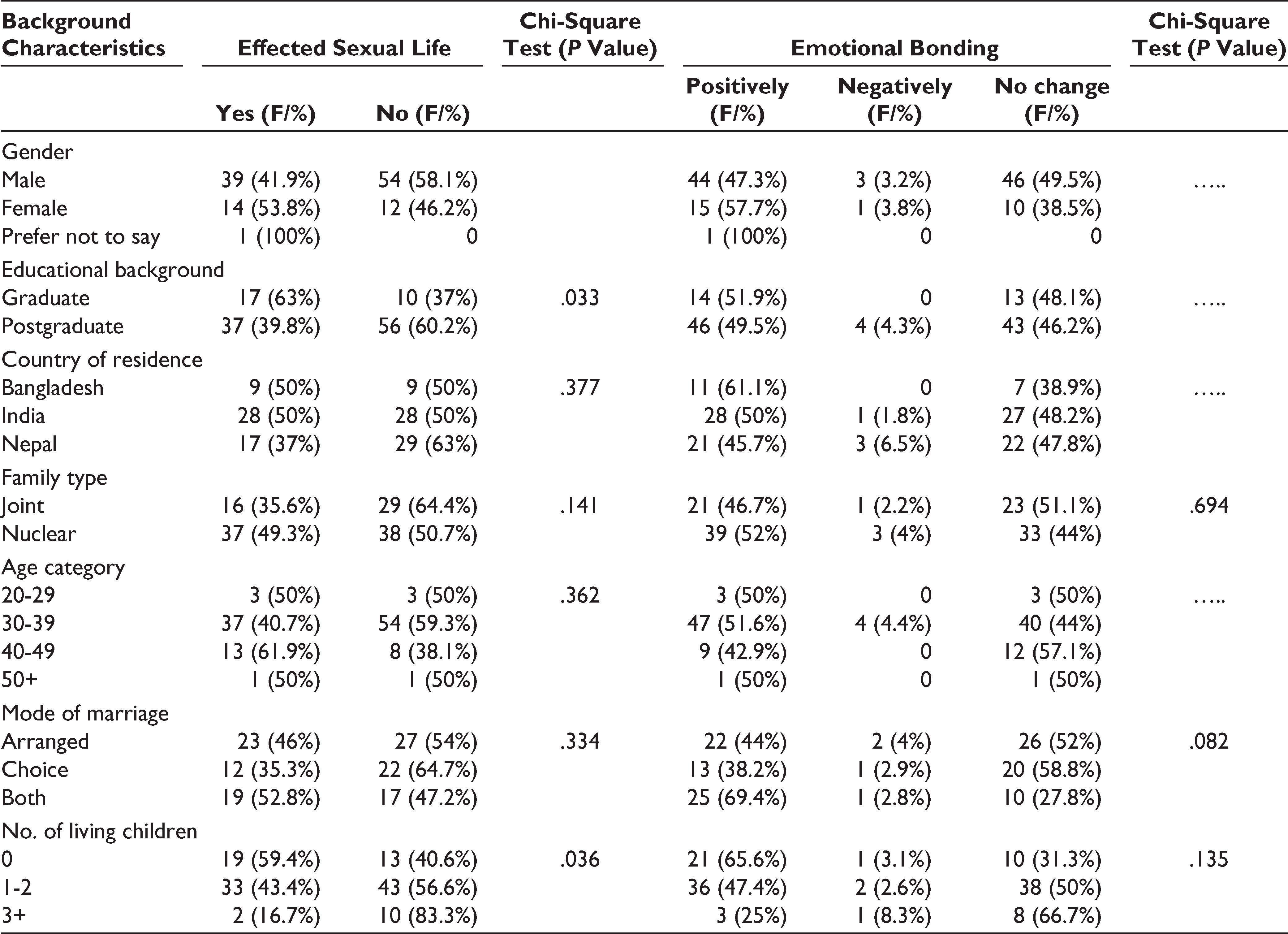
Nevertheless, there was no significant difference observed when compared with men. The majority (63%) of the participants that were educated up to graduation level were sexually active, and participants educated up to the postgraduate level were less sexually active (39.8%), and a significant difference was found (P = .003). Half (51%) of the graduate participants that had experienced sexual activity also experienced positive emotional bonding with their partners. From the participants from Bangladesh and India, half (50%) had active sexual life during the COVID-19 lockdown period, whereas only 37% were actively involved in sexual activity in Nepal. The perceived positive emotional bonding of the participants from Bangladesh, India, and Nepal was 61%, 50%, and 45%, respectively. There was no significant difference in their emotional bonding. The study participants residing in the joint families had lesser sexual activity (35.6%) than those living in nuclear families (49.3%). There was no significant difference between the 2 types of families. The participants that were sexually active and lived in joint families, the majority (51%) perceived no change in the emotional bonding among their partners.
In contrast, most participants living in nuclear families (52%) perceived positive emotional bonding with their partners. The majority of participants within 30 to 39 years were engaged in a sexual relationship with their partners. Among them, almost half of them (51.6%) experienced positive emotional bonding with their partners. The majority of the participants had an arranged marriage; those who had arranged marriage were not sexually active during the lockdown time. The participants belonging to the arranged marriage and choice marriage were not sexually active during lockdown (54%, 64%), whereas the participants who had both arranged and chose marriage engaged more in sexual relationships (52.8%). The participants who had both choice marriage and arranged also reported more positive emotional bonding during the lockdown. Overall, there was no significant difference among the perceived emotional bonding of the participants who had experienced a sexual relationship with their partners during the COVID-19 lockdown. After being classified according to their number of living children, most couples without children were engaged in sexual relationships (59.4%) than couples with 1 to 2 children or more (43.4%, 16.7%). There was a significant difference between the group of couples who had children (P = .036). It was also found that the majority (65.6%) of the couples who did not have children perceived positive emotional bonding, whereas couples who had 1 to 2 children and the couples that had 3 or more children had experienced no change in their emotional bonding during the period of lockdown.
Cross Tabulation Between Current Health Status of Respondents and Effect on Sexual Life and Emotional Bonding
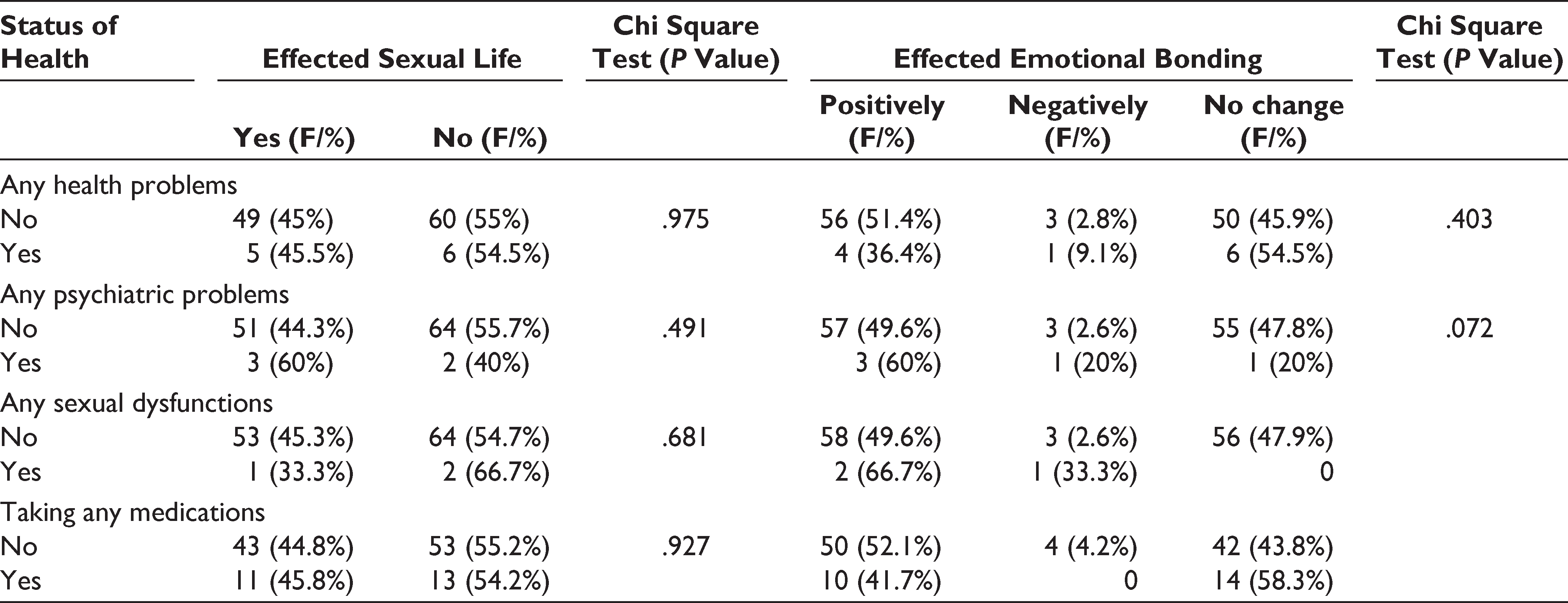
Physical and medical conditions can influence sexual health. We tabulated the health variables of the participants (Table 2). The majority of the participants (55%) did not report any health problem that affects sexual life. There was no significant difference among the participants who reported having an illness that affects their sexual health. The lockdown did not significantly impact the emotional bonding among sexual relationships. Among the study participants, most of them did not have any psychiatric illness. Among them, the majority (55.7%) were sexually active during the lockdown period. Among the participants who did not have any psychiatric illness, almost half of them perceived no change in the relationship (47.8%). The majority of the participants did not have any associated sexual problem, among them (55.7%) were not sexually active during the period of lockdown. Of the sexually active participants who did not have any sexual dysfunction, almost half of them (49.6%) perceived positive emotional bonding, and almost the other half (45.9%) perceived no change in their emotional bonding. The study participants who were on any medication during the period of COVID-19 Lockdown, for more than half of them (55%), perceived no effect on their sexual life. A total of 50% of the participants who were sexually active during the COVID-19 lockdown perceived a positive effect in their emotional bonding, but there was no significant difference in the drug use or participants being affected by sexual dysfunction.
Discussion
Our previous study reported that the COVID-19 lockdown affected sexual health and practice among the 3 South Asian countries (Bangladesh, India, and Nepal). 7 We aimed to find any association between emotional intimacy and sexual practice with sociodemographic variables in this study. The study reported different situations and different results for different demographic variables. However, none of them was statistically significant. Among the participants, most of them were male, and the majority (58%) reported no change in the frequency of the sexual relationships with their partners, whereas, among the women, more than half of them perceived change in their sexual relationship with their partners. Among the men in this study, 49% reported no change in their perceived sexuality with their partners. However, the emotional bonding component reportedly improved the sexual relationship with the partners among the women. The studies from Spain have also reported similar findings in terms of gender. 15
A total of 63% of the respondents educated till graduation level perceived changes in the sexual life during the pandemic, and almost 60% of the people educated till postgraduate levels reported no change in their sexual relationships during COVID-19. When the countries were compared with their educational levels with the sexual relationships and emotional bonding, a significant difference was found between the perceived status of sexual relationships among the respondents educated till graduation and respondents with postgraduates. 7 The COVID-19 lockdown had led to the development of various issues among the individuals’ functioning; few studies recommend sexual activity to develop and maintain healthy relationships among the partners.10,11 The studies have reported that during the initial phase of the lockdown, there was a decrease in sexual activity, and people faced more and more issues related to sexual health, but as time passed, they became comfortable and increase in the frequency of sexual relationships was observed.7,17 Sexual relationships have been reported to be impacted by the COVID-19 pandemic critically. A survey of US citizens reported that they perceived a change in their sexual behaviors due to the lockdown. 18 A study from the Western countries has reported that there had been various factors that influenced the sexual relationships during the COVID-19 pandemic. 6 There have been reports of lack of intimacy and emotional bonding that we have tried to discuss in our article. We also found that various sociodemographic variables with their relationship with the perceived levels of emotional bonding among the couples were found to be affected in our study, but there was no significant difference between most of the variables, only educational background (P = .033) and several children (P = .036) were found to be a variable with the significant difference. 6 Thus, this can be stated that participants who were educated up to graduation level and had children more than 3 had a significant effect on their sexual health with the partners.
Strength of the Study
This is the first study assessing the effect of lockdown on emotional intimacy among the residents of 3 South Asian countries. Responses were collected in an online survey, which reduces the conformity biases regarding the confidentiality issues.
Limitations of the Study
The sample size was relatively small. The samples were chosen in a nonrandomized pattern; only participants who could read and write English could participate, resulting in the exclusion of low-educated persons. As the mode of data collection is self-report, there is the possibility of bias in the people’s responses. Objective information regarding emotional bonding and sexual satisfaction was not assessed in the study as it could not be verified. The validation and reliability of the instrument were not performed due to time constraints.
Conclusion
Sexual health has been one of the most critical aspects of human life, closely related to society’s structure and functioning. India, Bangladesh, and Nepal were studied to identify their sexual functioning pattern during the COVID-19 pandemic. A few insights from the study were, that is, there was no significant difference found in almost 3 countries in emotional intimacy. Therefore, the impact of COVID-19 has had effects on the sexual health of couples. The reason found was the educational status and having more number of children in the family. In addition, there had been a trend that there is improved emotional bonding with their partners, although no significant difference was observed.
Furthermore, the study can be conducted on a larger sample size using other methods to get a representative sample of the study to better understand the emotional bonding among the couples in this region. There is a need to explore factors that make South-East Asia different from Western countries in their sexual and emotional bonding as we observed no change on most of the factors considered in our study. This will help us in understanding the effect and coping of couples during such a stressful global phenomenon.
Footnotes
Declaration of Conflicting Interests
The authors declared no potential conflicts of interest with respect to the research, authorship, and/or publication of this article.
Funding
The authors received no financial support for the research, authorship, and/or publication of this article.