




Abstract
Abstract
Objectives: Online activities have influenced the expression and indulgence in sexual behavior. Sexting has become one of the modality to express sexual behavior. The present study explored sexting in the Indian context as well as its relationship with self-esteem.
Methods: 300 young adults in the age group of 17 to 20 years were assessed for sexting behaviors.
Results: Studies showed that males engaged more in sexting and that there was absence of a significant difference in self-esteem and sexting.
Conclusions: It has implications for screening sexting behavior among youth as well as for enhancing cyberliteracy among youth for sexting behaviors.
Keywords
Introduction
Sexting has become more popular among youth in India in the form of online sexual interaction. Youth are spending 34% of their time on social media and in messaging through their mobiles which is leading to exchange of sexual messages, images, or videos via sexting. 1 It can be defined as sending, receiving, forwarding on, or showing others sexually explicit messages and images via the Internet or a mobile phone. Individuals involve in sexual exchange by sending messages, and semi-nude or nude photographs. 2 A recent meta-analysis conducted showed that the mean prevalence rate of forwarding nonconsensual sexts among adolescent was 12.5% (1 in 8). 1 in 7 sends sexts or posts seminude or nude photographs of themselves, while 1 in 4 receives sexts. It also indicated that consensual sexting is becoming a more common practice among youth, with 14.8% of youth sending sexts and 27.4% of youth receiving them. 3 A review of 12 studies focusing on individuals aged 18 and above concluded that the prevalence rate of sexting among young adult was 53.31% (48.56% for sending and 56.01% for receiving image-based sexts). 4
Sexting behavior could have a negative consequence on an individual and could be associated with various problems such as risky sexual behavior, cyberbullying, and online victimization. Self-esteem has also been investigated in relation to engagement in these types of behaviors. It has been seen that frequency of indulgence in risky sexual behavior is more among adults and adolescents with low self-esteem. 5 There is need to explore sexting in the Indian context as well as its relationship with self-esteem among youth.
Methods
300 young adults in the age group of 17 to 20 years were included in the study. 169 (56.33%) were females and 131 (43.67%) were males, with average age of 18.08 years (SD = 1.09). The approval to conduct the study was obtained from the Institute Ethics Committee.
Tools
Sexting Behaviors Survey
This survey focused on gathering information about the sociodemographic profile, had questions pertaining to sexting, and the definition used. 6 Participants were asked questions about receiving and sending sexts: “Have you ever received sexually explicit images via text message?” (Yes/No). “Have you ever sent sexually explicit images of yourself via text message?” (Yes/No).
Rosenberg Self-Esteem Questionnaire
This is a 10-item scale for measuring the self-esteem of the individual. It is a unidimensional scale. It used 4-point Likert scale format ranging from strongly agree to strongly disagree. 7
Procedure
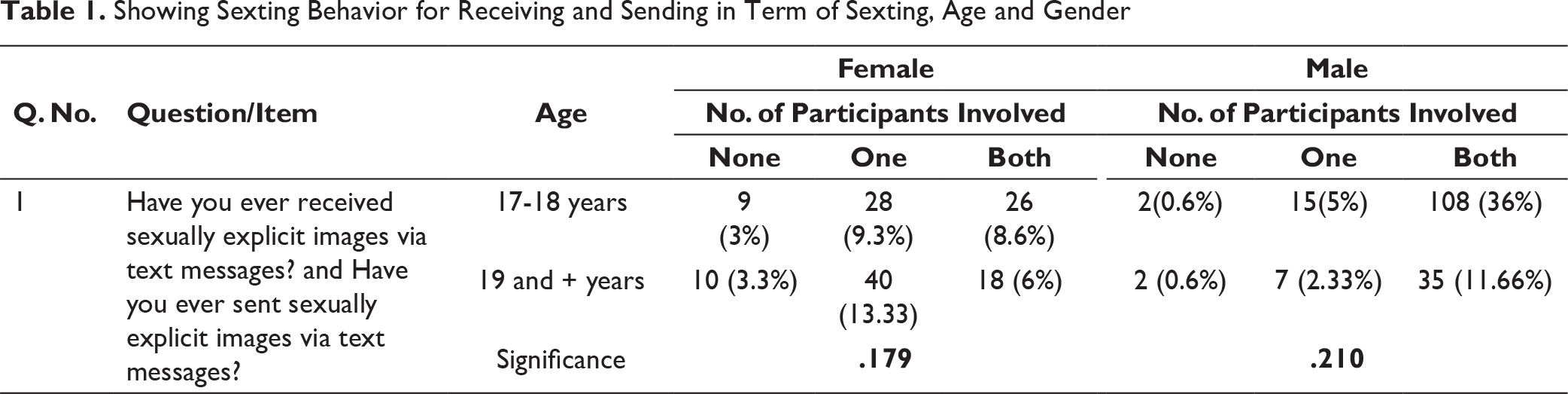
Showing Sexting Behavior for Receiving and Sending in Term of Sexting, Age and Gender
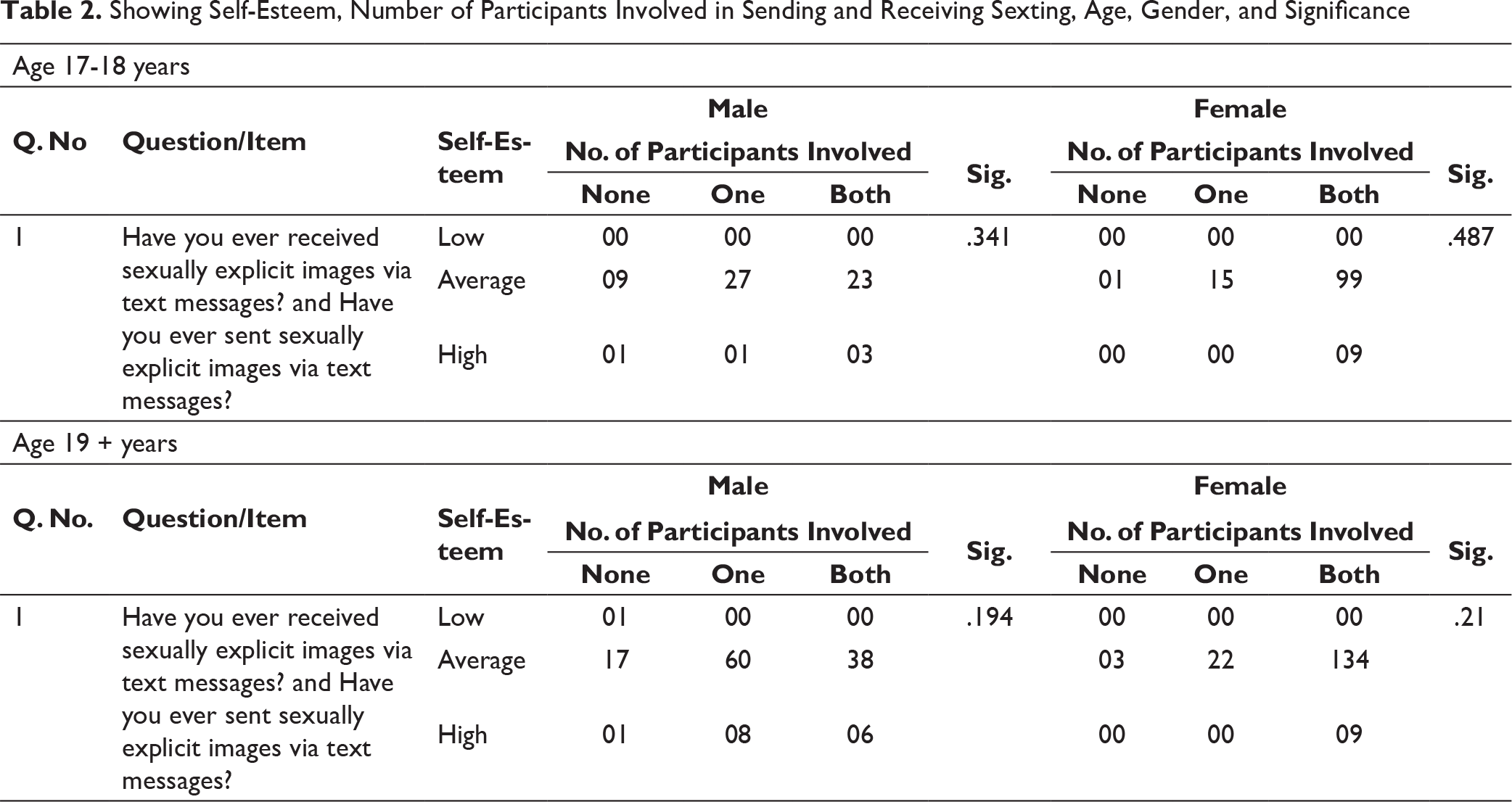
Showing Self-Esteem, Number of Participants Involved in Sending and Receiving Sexting, Age, Gender, and Significance
Results
169 (56.33%) were females and 131 (43.67%) were males, with average age of 18.08 years (SD = 1.09). 188 subjects were in the age group of 17 to 18 years and 112 in the age group of 19 and above years. Participants belonged to middle to upper socioeconomic status.
Table 1 shows that males across different age groups involved more in receiving and sending sexting messages.
Table 2 showed no significant difference in terms of self-esteem and sexting across different age groups.
Discussion
The studies showed that males engaged more in sending and receiving sexting messages and absence of significant difference for self-esteem and sexting (Tables 1 and 2). This has also been corroborated by the available studies. Sexting was found more among males. 4 There has been permissive attitude toward premarital sex. 8 Young adults who have liberal sexual attitudes are found to be engaged more in physical and online sexual behaviors. 9 Sexting behavior (nonsexters, two-way sexters [send and receive], and sext receivers) did not differ in relation to the levels of self-esteem among adults. 10 The self-esteem levels were not associated with the exchange of sexual material through a mobile phone. 11 But on the contrary, high self-esteem was associated with reduced indulgence in exchange of sexual content. 12 Other studies revealed that sexting behavior is associated with low self-esteem among both men and women.5, 13 The user with high self-esteem also indulged in sending and receiving the sexting behaviors due to their high involvement in sexual activities. 14 So there is no clarity regarding casual relationship of self-esteem and indulgence in risky behaviors or an outcome of sociocultural factors contributing to the development of both self-esteem and risk behaviors. 15
Increased use of technology has been seen among all age groups. So, sexting behaviors can be understood in terms of the theory of technology determinism, implying that increased use of computer-mediated communication leads to increased indulgence in sexting behaviors. Teens who texted more per day were found to be involved more in sext also. 16 An association was also seen between internet addiction and sexting, 17 although there may be other variables too that influence the theory of technology determinism such as sensation-seeking behavior, peer pressure, and impulsivity. There is a need for longitudinal qualitative work with multiple data-collection points to understand the association between self-esteem and sexting as well as its relationship with other socio-psycho cultural factors and internet addiction or excessive use of computer-mediated technology. The study however had limitation in terms of the fact that it did not explore the topic among people who are in romantic relationships and those in as well as a casual relationship; also, the duration of engagement in sexting cannot be inferred from the study. Since sexting may become an enabler of sexual behavior. Thus, it must also be addressed as part of sex education in academic setting. The findings of this study imply bringing awareness about physical and mental health, professional screening of sexting as well as cyber literacy among users and the mental implications of indulgence in sexting.
Declaration of Conflicting Interests
The authors declared no potential conflicts of interest with respect to the research, authorship, and/or publication of this article.
Funding
The authors received no financial support for the research, authorship, and/or publication of this article.