




Abstract
Abstract
Introduction
The purpose of psychiatry postgraduate training is to produce competent and skilled psychiatrists. These psychiatrists in future trainings will assume responsibilities for treating persons with mental health issues, training mental health professionals, designing mental health education curriculums, and planning local and national policies. Psychiatrists will also have a role to play in imparting education in human sexuality. 1
Alcohol-use disorders comprise a significant proportion of mental illnesses in India. 2 Alcohol use is associated with high-risk sexual behaviors. 3 In India, medical colleges with postgraduate psychiatry training programs are an important source of mental health care to persons with alcohol-use disorders. 4 Studies have demonstrated that postgraduate psychiatry trainees have difficulties in dealing with issues associated with human sexuality. 5
In this background, the author reports on findings from an audit of charts of persons with alcohol-use disorders with respect to deficiencies in documentation of sexual history by psychiatry postgraduate trainees.
Methodology
The site of the study was a general hospital setting with a postgraduate psychiatry training program. Postgraduate psychiatry trainees usually perform and document the initial psychiatric intake (including sexual history) in this setting as part of the initial patient work-up. These records are checked subsequently by senior residents. All psychiatry case records have a pre-existing intake pro forma that includes documentation of sexual history. The details of sexual history as part of this documentation include the type of sexual orientation, age of first intercourse, number of partners, sexual adjustment with the current partner, and whether using protection during intercourse. The author studied charts of persons with alcohol-use disorders in the years 2014-2015 as part of another study on alcohol-use disorders. The author had obtained approval from Institutional Ethics Committee for the study (IEC No: 103/2015). For the purpose of this study, the author studied the following variables:
Whether sexual history was documented at all
Association of age, marital status, area of residence (rural/urban), level of education with documentation of sexual history
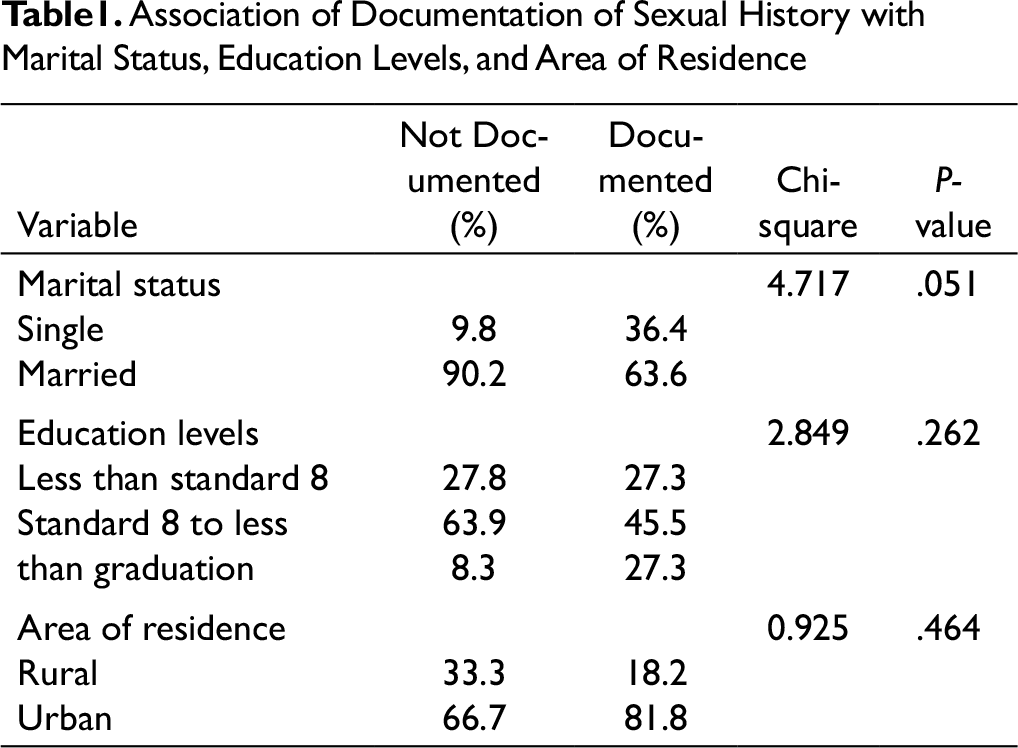
Association of Documentation of Sexual History with Marital Status, Education Levels, and Area of Residence
The author performed statistical analysis using SPSS version 16.0. The sample was separated into two groups: files that had documentation of sexual history and files that did not. The author compared age between both groups using the Mann-Whitney test. She studied association between marital status, area of residence, and level of education with documentation of sexual history using the chi-square test with Fisher’s exact test where applicable. In the event of any significant associations, the author attempted to confirm the same using logistic regression.
Results
The author studied 53 charts. In 42 charts (79.24%), there was no documentation of sexual history. The median age in charts with no documentation of sexual history was 40 years (range: 25-68), while that in charts with documentation of sexual history was 35 years (range: 26-51); Mann-Whitney U: 151. 5 , P < .081. The association of documentation of sexual history with marital status, education levels, and area of residence is represented in Table 1.
As only marital status showed a tendency towards significant association with documentation of sexual history, the author performed a logistic regression to confirm the significance of the association. In charts where marital status was recorded as “being married,” sexual history was significantly more likely not recorded at all (odds ratio: 0.189, P < .042, 95% confidence interval [0.038-0.941]).
Discussion
Studies demonstrate high rates of associations between alcohol use and HIV. 6 There are higher rates of alcohol-use disorders in homosexual men who have risky sexual behaviors. 7 Women with alcohol-use disorders report significantly higher rates of past history of sexual assault. 8 It is thus essential that psychiatrists make adequate attempts to identify and address sexual problems in persons with alcohol-use disorders.
This study shows that in the study site, sexual history is not documented as part of the intake done by postgraduate trainees in majority of persons with alcohol-use disorders. In a recent qualitative study, psychiatry postgraduate trainees reported difficulties in taking sexual history as part of a routine mental health evaluation. 9 In another study that evaluated psychosexual training in psychiatry trainees, only 24% of the respondents reported asking patients routinely about psychosexual history and 81% reported inadequacy while dealing with psychosexual disorders during their psychiatry training. 10 This leads to the inference that most postgraduate psychiatry programs do not focus adequately on training in taking a sexual history.
The author has raised the need to revamp the training of human sexuality as part of postgraduate psychiatry training programs. 11 Various strategies have been described to provide education in taking a sexual history and sexuality. 12 These strategies need to be adapted according to the local culture.
The Indian Psychiatric Society’s unequivocal position has played a major role in decriminalizing homosexuality in India. 13 The Indian Psychiatric Society has also recently released guidelines for management of sexual disorders including the details for sexual history. 14 There is a need for similar guidelines to be instituted for training of human sexuality in psychiatry postgraduate training in India.
Limitations
The sampling was convenient. The details were extracted from the intake and it is possible that sexual history details were collected in detail subsequently. The findings are not generalizable.
Conclusions
This study demonstrates that postgraduate psychiatry trainees document inadequate sexual history as part of intake while taking history in persons with alcohol-use disorders. This finding has important ramifications with respect to education of postgraduate psychiatry trainees about human sexuality.
Declaration of Conflicting Interests
The author declared no potential conflicts of interest with respect to the research, authorship, and/or publication of this article.
Funding
The author received no financial support for the research, authorship, and/or publication of this article.