




Abstract
What makes some organizations stay the course with their social and environmental commitments while others, in the face of political adversity and shifting stakeholder views, do not? In this paper, we argue that the answer to this question lies in capturing the differences in character between organizations and how their character shapes what organizations consider their moral obligations to be. Building on moral philosophy, we expand on the limited writings on organizational character in the literatures on CSR, business ethics and organizational theory. We use our expanded conceptualization to develop a theoretical typology of organizational characters and elaborate a process model that explains when and how an organization may shift in its moral reasoning and develop a different kind of character for itself. Theorizing organizations as agents with a moral character sheds light on the emergence of organizational purpose and offers implications for ongoing research on purpose, CSR, and ethics within organizational theory, research, and practice.
Introduction
From the start of 2025, the second Trump administration has created a more politicized business environment in which organizations operating out of the United States or trading with the country are forced to declare where they stand on their commitments to ESG (environmental, social, and governance disclosures) and DEI (diversity, equity, and inclusion). Where previously such commitments had been promoted by leading executives, investors and industry analysts alike as part of a call for organizations to embrace a broader responsibility towards their stakeholders and society at large (e.g., Schwab, 2019), Trump instead branded such commitments as “woke capitalism.” Through litigation, threats of government defunding and campaigning, Trump has tried to pressure organizations in loosening or dropping such commitments altogether. Some organizations (such as Boeing) have since given in, whereas others (such as Starbucks) doubled down on their ESG and DEI efforts, raising not only the question of what might explain such differences in response, but also more specifically, what drives an organization to be unwavering in the face of political pressures?
Previous work suggests that the concept of organizational character may help address this question. Notably, Basu and Palazzo (2008) made a case for considering organizations as differing in the moral character that they display towards society and in their commitments to follow through and stand firm. They argued that character-based differences determine whether organizations’ commitments involve peripheral, loosely coupled activities that can quickly be overturned or the integration of “responsible corporate processes into organizations’ everyday activities” (Weaver et al., 1999, p. 550). Their line of argument followed Selznick (1949, 1957, 1992) who, reflecting on periods of political and economic upheaval (including the period of the New Deal (1949) and the rise of neo-liberalism (1992)), had throughout his work argued for the importance of framing organizations as moral entities. From Selznick’s perspective, organizations demonstrate to a greater or lesser extent a principled moral character in their behavior and have, based on the strength of their character, the resolve and discipline to stay the course. However, both Basu and Palazzo (2008) and Selznick (1949, 1957) describe this “complex and holistic concept” of organizational character (Ocasio et al., 2023, p. 125) only in very broad and poetic terms (Krygier, 2012) so that this fundamental and potentially explanatory idea has “not been explicitly theorized in much contemporary work [. . .]” (King, 2015, p. 159) even despite the resurgent interest in Selznick’s work (Kraatz & Flores, 2015; Ocasio et al., 2023).
Accordingly, in this paper, we aim to address the question of how we can conceptualize organizational character; and ask more specifically: How is organizational character constituted, what might be variations in types of organizational characters, and under what conditions and how might organizations evolve their character over time? By addressing these questions, we aim to build foundational theory on organizational character and its linkages to concepts such as purpose, corporate social responsibility (CSR), and sustainability. We do so by drawing on moral philosophy of the self (C. Taylor, 1989) that allows us to theoretically elaborate a view of organizations as moral subjects with a specific moral character (Basu & Palazzo, 2008), and contrast this view with prevalent organizational theories in CSR and business ethics that cast organizations as ethical and responsible actors in society (Bromley & Meyer, 2021; Donaldson & Dunfee, 1994; Meyer & Bromley, 2013). Specifically, we argue that organizations may develop a distinct character that reflects their own moral reasoning and their own development as a moral self over and beyond the actor roles they occupy and which in turn theoretically offers the potential “to discriminate [an organization] from other organizations that might adopt different types of sensemaking processes” (Basu & Palazzo, 2008, p. 124).
By intersecting moral selves with actor roles (C. Taylor, 1989), we develop a theoretical typology that in an ideal-typical sense spells out the various moral characters that organizations can have, based on whether they ground their moral reasoning—and thus themselves as agents—in specific actor roles and the institutional domains of which they are a part of, or in their own autobiographically formed moral self-view. Building on these ideal-types, we furthermore theorize how organizations may, through their evolving moral reasoning, shift from one type of moral character to the other and can change their reason for being, or purpose, while doing so. In this way, we demonstrate how character is formative of an organization’s self-declared purpose, so that when organizations aim to pursue a different purpose or set of purposes in society (Hollensbe et al., 2014), an organization first needs to re-articulate who it is and aspires to be or become.
With our theory development, we make two primary contributions. The first contribution is that we offer a more fully developed conceptualization of the concept of organizational character and draw out its relevance to contemporary organizations. Where organizational character has been largely neglected in organizational scholarship since Selznick (1949, 1957), we conceptualize the constituent dimensions of the concept and offer a theoretical typology of ideal-typical organizational characters. Our second contribution is that we elaborate a process model that lays out the triggering and enabling conditions through which character is formed and that captures how developments and variations in the character of an organization directly shape the ways in which organizations set aspirations for themselves and make character-defining choices and commitments.
In what follows, we first briefly review the prevailing view of organizations as responsible “actors” in prior organizational theory on CSR and business ethics. We highlight the limitations of this view and present our arguments for an alternative conception of organizations as moral “subjects” who form and demonstrate their own moral character. Based on our expanded conceptualization, we propose a typology of organizational characters and elaborate the pathways, triggers, and enablers of organizations changing their character and moving between these ideal-types. We end the paper by discussing the implications of our theory development for further theorizing and research.
Organizations as Moral Subjects
Within organizational theories of corporate social responsibility (CSR) and business ethics, for-profit or business organizations are typically cast into notions of actorhood. As “actors” who are part of society, they carry out their fiduciary duties in a responsible manner (Meyer & Bromley, 2013) by meeting their direct and indirect obligations to their stakeholders (Donaldson, 1982; Donaldson & Dunfee, 1994, 1999) and by engaging in an accountable manner in democratic governance within society (Matten & Crane, 2005; Scherer & Palazzo, 2007, 2011). This conceptualization of actors frames organizations as “social constructions, possessing institutionally defined identities including capacities, rights and responsibilities” (Scott, 2013, p. 228) in a particular institutional domain that is governed by norms and rules. An actor is thus a general role-type (Hwang & Colyvas, 2020; Meyer & Bromley, 2013), with actorhood (that is, standing as a recognized agent-in-a-role) being defined as part of a network of related actor roles in an institutional order (Meyer, 2010; Scherer & Palazzo, 2007).
The concept of actorhood has a long and rich tradition in organizational theory (Meyer & Jepperson, 2000), with its guiding premises similarly being reflected in theoretical presuppositions about the roles and responsibilities of organizations within markets and society. For example, theory on contractualistic ethics (Donaldson & Dunfee, 1994) conceptualizes an organization as a “contractor” (Donaldson & Dunfee, 1994) or “a “contractual man” (Van Oosterhout et al., 2006, p. 532) who abides by the rules and norms for interactions in an institutionalized market or societal domain, follows the right kind of contracting procedures and, in enacting such roles, will uphold the communal norms (such as fairness and equity), as defined by that institutional setting. As such, the moral decisions and transactions of an organization are, as Williamson (1985, p. 43ff) noted, simply modeled “as if” they follow the rules and behavioral strictures of “contractual man.” Similarly, virtue-based theories of organizational responsibility and ethics equally conceive of organizations as enacting pre-defined actor roles in the context of institutions. Accordingly, virtuous behavior is perceived as demonstrating alignment with the actor-prescribed rules and norms of such institutions (Sison & Fontrodona, 2012, 2013; Solomon, 1992). For example, Moore (2002, 2005) uses MacIntyre’s neo-Aristotelian model of virtues to identify specific actor roles for organizations. MacIntyre (1985, p. 194) highlights how virtuous actor roles, practices, and institutional domains “characteristically form a single causal order.” When an actor’s acts are in terms of her/his enacted role out of kilter with the institution, the institution corrupts the practice with the result being that the individual or organization becomes a vacuous instead of a virtuous role-based “character” instead (Moore, 2002, 2005<). Characters, in (1985) sense, are thus “social roles of a particular type because not only do they involve definitions of obligation and relationship (as do all social roles) but they also bear particular moral ideals and become representative of their social order through so doing” (Beadle, 2002, p. 46).
While actorhood theories such as these offer stylized pictures that have significant analytical mileage (North, 1990), they also have as a key limitation that they give a muted or “thin” account of morality and of the moral agent (C. Taylor, 1989; Williams, 1985). Such theories largely presume a procedural form of ethics around a defined actor role, where morality is limited to agreeing to specific roles and norm-abiding behaviors at the outset (MacIntyre, 1985, p. 122). In this sense, organizations are not endowed, nor do they need to be, with the capacity of moral deliberation outside of their simply abiding by such norms and knowing their status as part of an institutional domain (Donaldson & Dunfee, 1994). As actors habitually following such behavioral maxims, they in turn do not know or even need to know, as Bernard Williams (1985) quipped, “what selves they are” (p. 86).
When such presuppositions about actorhood are furthermore embedded into the very fabric of a theory, such accounts also risk leading to what Elster (1989) described as “functional explanations,” in which the outcome, often framed in terms of the overall purpose or effective functioning of an institutional domain (that is, the equitable operation of the market or the functioning of liberal Western democracy) affects the explaining processes (role-specific choices and intentions) that we theorize about so that the explained item is either produced or directly entailed by these processes (Ghoshal, 2005). The problem with these kinds of functional explanations, as Elster (1982) argues, is that they “postulate a purpose without a purposive actor” (p. 452). In other words, they effectively level the role of organizations to that of a generalized and ideal-typical “actor” and ascribe certain stylized behaviors as explanatory items to such actor roles in ways that, as self-standing and self-referential explanations, already closely match the purported outcome.
In contrast to notions of actorhood, when organizations are instead framed as “subjects” or “agents” in their own right (Calhoun, 1991) they are endowed with a sense of self and with the capacity for self-reflection and individual agency (C. Taylor, 1989; Williams, 1985). From our perspective, an organization’s sense of self and of its agency is broader and more existential than any enacted roles (C. Taylor, 1989; Williams, 1985) and is not constituted by any given institutional order (Selznick, 1957). While organizations are embedded in society and connected to certain prescribed actor roles, they at the same time have a sense of self that is autonomous and independent. This “self-view” (King et al., 2010) individuates organizations as individual moral beings (Ghoshal & Bartlett, 1997), setting them apart from the general actor categories that they all share. Such a view does not “reject society” but recognizes the individuality of an organization which means that its own morality “is enough unlike others, in its opacities and disorder as well as in its reasoned intentions, to make it somebody’s” (Williams, 1985, p. 224, italics in original). Considering such an first-person sense of self for organizations implies a shift in focus from an ethics of “doing” around actor-prescribed behaviors, obligations, and duties (Geser, 1992), to a processual notion of individual “being” and “becoming” based on an organization’s prospective sensemaking about its moral choices and who it wants to be (Gibel et al., 2021; Selznick, 1992)—which, as already mentioned, goes above and beyond choosing to enact particular actor roles.
In the following section, we develop this alternative moral outlook, informed by moral philosophy of the self (C. Taylor, 1989; Williams, 1985). We develop a theoretical framework of how an organization forms and expresses its own sense of self, which we conceptualized as organizational character, through the aspirations it forms and the commitments it makes in pursuit of its own self-declared purpose. The body of practical moral philosophy of the self (Mayo, 1958; C. Taylor, 1989; Williams, 1985) on which we draw addresses the quest for developing an organizational theory that is able to give an account of organizations as ‘moral selves’ in society (Selznick, 2008). Selznick (1992, 2008) famously called for such an integration of moral philosophy into organizational theory; what he came to refer to as “human science” (Selznick, 1992, 2008). We mobilize moral philosophy here for our theorizing and in doing so aim to extend the thin procedural morality of actor theories with an account that focuses on the thick substantive morality (Donaldson & Dunfee, 1999) of individual organizations making personal moral choices and following through on their commitments towards stakeholders and society (Basu & Palazzo, 2008).
Organizational Character and the Moral Background
Based on the distinction between actorhood and an individual sense of self (C. Taylor, 1989), we propose to conceive of an organization as having moral awareness and a capacity for moral reflection and deliberation that exists outside of any enacted actor roles and provides them with an internalized sense of self, or what we define as organizational character (King et al., 2010; Selznick, 1992). Such a framing does not, as mentioned, ascribe human properties to organizations (Donaldson, 1982) but strictly suggests that there is a “homologous” correspondence between humans and organizations as far as their analogous capacity for moral reasoning is concerned (Selznick, 1992). This view is compatible with Selznick (1992, p. 244, 2008, p. 60) who argued that moral reasoning “governs all moral actors, collectivities and persons alike”, as well as with work that frames organizations as interconnected systems of reasoning (e.g., King et al., 2010; J. R. Taylor & Cooren, 1997).
From this reasoning perspective, organizations consist of ongoing instances of talk and conversations through which members of the organization collectively articulate to themselves and others who they are, why they make certain decisions, and what they stand for (J. R. Taylor & Cooren, 1997; J. R. Taylor & Van Every, 2000). J. R. Taylor and Cooren (1997) explain how in many instances of organizational communication, members act as “agents” on behalf of an organization as the “principal” and invoke an organizational “figure” when they do so. The underlying process here is, however, more profound than simply an agent holding an office, carrying out duties, or speaking on behalf of an organization (Cooren, 2012; Cornelissen, 2008). Instead, the image of an organization as a reasoning person presupposes that individual members of the organization routinely draw on premises (beliefs) as grounds for their day-to-day decisions and actions. These premises when they are uttered as grounds in an organizational context become shared by members and over time contract into a general “self-view” and imputed “character” of the organization as premises build on each other, become fixed in the collective minds of its members and come to take on an autonomous status (in conversations and texts) that exists outside of its members (King et al., 2010; Selznick, 1957).
Conceived in this way, the organization’s status as an independent character is an institutionalized fixture (Kraatz & Block, 2008; Morrison & Mota, 2023) that is made up of past decisions and actions that seem real to its members and that, once established, may be affirmed through the deliberations and actions of everyone in the organization as they seed any further decisions on the basis of fixed “organizational” premises (Selznick, 1957, 1992). Their decisions accordingly are not fully theirs, but those of the organization that they embody and represent (Geser, 1992). Thus, by continuing to act on behalf of the organization, or rather its premises, leaders and other members of the organization maintain the organization’s sense of itself (i.e., “act in character”) and continue its trajectory of decision-making (Basu & Palazzo, 2008).
In this way, the organization’s self-view, or character, is instantiated by both leaders and other members alike and thus “present” in day-to-day actions. Hence, the reasoning of the many becomes in this way the reasoning of the one organization (J. R. Taylor & Cooren, 1997). When we refer to reasoning here, we do not presuppose a strict focus on logic or rationality; our focus is descriptive rather than prescriptive on what organizations do and say (Harman, 1999) when they articulate their role in society (Basu & Palazzo, 2008). We also do not restrict such moral reasoning to an exclusive class of expressions (Hare, 1981) nor as mentioned to certain procedures (Habermas, 1996) or to a specific form that such reasoning might take (Williams, 1985). Instead, we focus on the empirical reality of organizations taking a stance on matters of concern to them, articulating their purposes and roles in society, and making behavioral commitments (Basu & Palazzo, 2008). Organizations routinely do this (Geser, 1992; Gibel et al., 2021), and as part of such stance-taking distinguish what falls within and outside of their purview and indicate what “selves” they are and want to be in society (Selznick, 1957, 1992, 2008). As C. Taylor (1989) argues, this kind of routine moral reasoning implicates the whole self. The same is true of organizations; meaning that the organization’s self is not “prior to morality, but rather [. . .] it is constituted in and through the taking of moral stances” (Calhoun, 1991, p. 233). To this point, Gibel et al. (2021) recently argued that “moral concepts permeate all areas of society and force [organizational] actors to take a position” (Gibel et al., 2021, p. 133, translated from German).
The moral philosopher Charles Taylor (1989) provides a further helpful theoretical vocabulary to conceptualize this process of how organizations reason about their own character and their moral position(s) in society (Basu & Palazzo, 2008; Gibel et al., 2021). Taylor (1989) invokes the idea of a framework, or background picture, that underlies our individual first-order actions, thoughts, and expressions in a particular domain of choices. For each of these behaviors to “make sense” to an agent, they “repose” on “background understanding” (Taylor, 1989, p. 25). Judgments about, say, an actor role that an organization takes up, or its own individually formed aspirations to contribute to society, are grounded in a background framework of values and beliefs. Thus, “frameworks provide the background, explicit or implicit, for our moral judgments, intuitions or reactions” (Taylor, 1989, p. 26). The actual frameworks that are drawn on as a grounding involve “a common cultural store of accounts” (Abend, 2014, p. 36) such as common moral principles and ideals (as “hypergoods”, C. Taylor, 1989), or, alternatively, an organization’s individually formed values and beliefs that it has autobiographically developed over time, and that form the premises for its actions.
In line with Taylor (1989), a framed action furthermore designates a moral commitment on the part of an organization, particularly when such a framing is repeatedly and consistently used over time and is indicative of a dominant logic (that is, fixed premises) in the reasoning of the organization. Simply put, a commitment involves an obligation of the organization to perform some action (or refrain from some action) with an obligation being defined as an overriding reason, or strongly held conviction or norm (Geser, 1989), to act (or not), in the sense that it overrides other reasons to act in contrary ways (Selznick, 1949, 1992). In this way, then, the framing of actions as commitments means that such commitments are morally demanding of organizations even though they are voluntarily taken on by organizations on their own behalf. In short, the background provides the “frame” through which organizations offer reasons for their actions and conveys the basis of their moral commitments.
Taylor (1989) extended this initial characterization of a background framework to a consideration of stance-taking by an agent over time, whereby the frame becomes not only the backdrop for specific actions and a given set of commitments as well as the moral “space” through which the agent maneuvers and through which she furthermore shapes her own moral character. When instances of framing are laid out over time, “what this brings to light is the link between identity [sic] and a kind of orientation.” Such an orientation “presuppose[s] a space-analogue within which one finds one way” (Taylor, 1989, p. 29). The further extension of the spatial framing metaphor in this manner identifies a moral self, or “character,” that transpires from a history of actions and that is constituted by a sequence of framings, as articulated individual “stances” that undergird such committed actions. Extended to the context of organizations, this spatial analogue allows us to identify the organization’s character in its actions and framings over time, evaluating its realized commitments and moral consistency (Basu & Palazzo, 2008).
Importantly, an organization’s character is in this perspective not an “object” that exists outside of its own reasoning or an abstraction away from framed interpretations in context. Taylor (1989) considers such a view “misguided” in that “we are only selves insofar as we move in a certain space of questions” (p. 34). Extending this assumption to the organizational level, we similarly consider an organization’s character not as an abstract definition of “who we are” (Gioia et al., 2013; Whetten, 2006) but as a self-referential disposition or “orientation” (Brickson, 2005, 2007) that is present in, and guides, its actions and framings. In fact, having a sense of self, as an orientation, is not only formative of a chosen framing of one’s actions and of how one relates to others (Brickson, 2007), but also becomes a part of the framing itself. In other words, the self-view or character of an organization becomes a part of its own narrative arrangement of frames over time; “to be a perspective in it” (Taylor, 1989, p. 112, italics in original). Because of this self-reflection, an organization’s view of itself may also change and evolve over time; the focus is not only on an organization’s moral sense of itself as reflective of past commitments (Brickson, 2007, p. 869; King et al., 2010), but also on who an organization, reflecting on itself, aspires to be or become as a moral character and through its further actions.
The concept of aspiration is besides commitment equally constitutive of the moral character of an organization (Mayo, 1958; Taylor, 1989; Williams, 1985). An aspiration involves the stated ideals of an agent and the purpose that it sees for her/himself in society. Transposed to the context of organizations, aspirations are articulated claims or pledges on the part of an organization to strive for a valuable ideal, such as social equity, ecological sustainability, or economic performance (Christensen et al., 2013). Such claims convey a general moral stance in that they articulate where organizations stand on questions of what is good or of value to them, and thus worth pursuing, and which centers their own role and character as part of such a perspective or stance (Taylor, 1989). Such a stance furthermore provides a disposition to act in a certain way (Birnholtz et al., 2007), providing reasons for the organization to commit itself to a particular purpose (reason for being) and course of action contrary to making alternative commitments (Christensen et al., 2013).
Thus, the moral character of an organization involves the joining of a “morality of aspiration” with a “morality of commitment” (Selznick, 1949, 1957) through which an organization not only displays and affirms its moral stance and its commitments to the larger society of which it is a part but also articulates what the organization, as part of its claimed aspirations, considers worth striving for and wants to realize for itself. Our focus here is on the concept of organizational character rather than identity (Hunter, 2000; Selznick, 1992). The main reason for this is that organizational character centers on the moral being and becoming of organizations (Moore, 2005; Selznick, 1992; Wright & Goodstein, 2007). Character captures this moral and personal dimension (Sennett, 1998), whereas the notion of identity in comparison tends to invoke a categorical definition (of who one is) at a point in time (Brickson, 2007). To illustrate this critical distinction, Whetten (2006) famously argued that it is “inappropriate to equate organizational identity with statements of aspiration or intention” (Whetten, 2006, p. 230).
A further key distinction relates to values. Values are individual or shared beliefs in organizations about desirable end states or behaviors that transcend specific situations (Kraatz et al., 2020) and that may define an organization’s culture or sub-cultures. Importantly, however, as Gibel et al. (2021, p. 133), note, values and morality “are not the same,” despite work considering them as functionally equivalent (see, e.g., Kraatz et al., 2020). Values are rather part of the moral background on which organizations draw (Abend, 2014), forming the “symbolic material” that members of the organization draw on for their own reasoning and for the moral position(s) they claim or convey on behalf of the organization. This background may, as already mentioned, involve stock cultural values (Abend, 2014) or common moral principles or ideals (Taylor, 1989), but our primary analytical focus, paraphrasing Hitlin (2003, p. 122), is on “the self-reflective appropriation” of such values, with organizations “refracting” those values (Taylor, 1989, p. 17) into its own morally charged behavior (of claiming aspirations and of making commitments) and having internalized them as “their own” (Gibel et al., 2021, p. 133).
In the next section, we build on this conceptualization of organizational character to flesh out three ideal-typical characters and the distinctive forms of moral reasoning through which they are constituted. As part of our theory-building, we accommodate and reference the limited body of work to date on organizational character (Basu & Palazzo, 2008; Birnholtz et al., 2007; Moore, 2005; Selznick, 1957; Wright & Goodstein, 2007) and, by doing so, elaborate how our conceptualization synthesizes as well as expands existing theoretical understanding.
Organizational Character Types
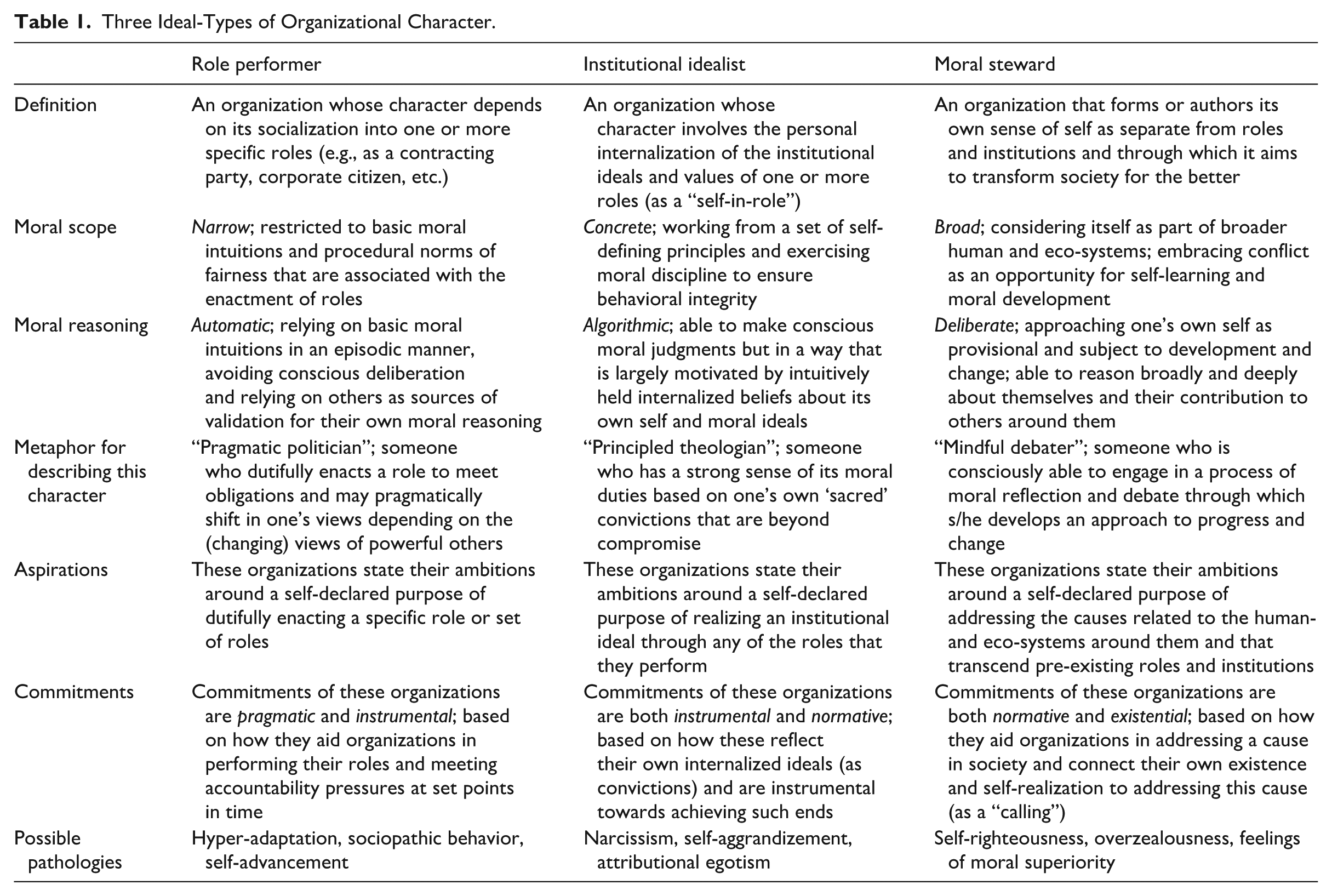
In this section, we first highlight three distinct organizational characters, as ideal-typical moral selves, at the organizational level and describe the typical trajectories of moral reasoning through which these are given shape. Our theorizing here is typological (Cornelissen, 2017; Delbridge & Fiss, 2013) in describing three ideal-types based on a combination of linked qualities in an organization’s moral reasoning. Unlike a taxonomy, this approach is not meant to classify organizations unambiguously into mutually exclusive hierarchically ordered groups (Cornelissen, 2017). Instead, our aim is to develop distinct theoretical ideal-types to which actual organizations can be compared (for an overview, see Table 1).
Three Ideal-Types of Organizational Character.
Role performers
The first ideal-type involves an organization subordinating its own sense of self to prescribed actor-specific roles in an institutional domain (Bromley & Meyer, 2021) such as being a corporate citizen (Matten & Crane, 2005), an equitable contracting party (Donaldson & Dunfee, 1999), or a utility-maximizing economic actor (Fama & Jensen, 1985). Through this subordination, an organization’s individual sense of self is either “absent” (Mayer, 2018) or, where it is present, it does not exist “on its own” (Williams, 1985) in that its individual moral views are wholly consumed by the role-related demands and system of obligations into which it is socialized (MacIntyre, 1990) and with which it strives to comply (Bromley & Meyer, 2021). An organization’s character emerges in turn as an amalgamation of enacted roles as part of the institutional matrix in which an organization is embedded (Bromley & Meyer, 2021).
Instead of an organization deliberating for itself what its reason for being, or purpose, might be in society, organizations follow a role, or set of roles, in an attempt to be accountable and legitimate to powerful others (Lerner & Tetlock, 1999) who either have authority (legal and financial authorities, governments, and governmental bodies) or on whom the organization critically depends, such as its shareholders. Organizations with this role-based character identify with the roles that are prescribed for them and, in doing so, subordinate their own moral self-view to the demands and expectations of others within various institutional spheres (Bromley & Meyer, 2021). These organizations feel an obligation and duty to meet those expectations to be valued and found legitimate by others, and thus in turn to be able to value themselves as legitimate and acceptable “actors” in society (Meyer, & Bromley, 2013). Thus, they are not individually invested in the institutional ideals or values that lie behind any of the roles that they enact but, rather, more concretely in their relationships with valued others that are structured by these institutional arrangements. Their moral scope likewise does not stretch to the ideals or values of institutions as such but remains largely limited to acting out a procedurally defensible role or set of roles.
The moral reasoning of the role-based character is largely intuitive and automatic (Stanovich, 2011) and may be submerged in the background (Taylor, 1989). Organizations have formed basic moral intuitions (Haidt, 2012) around their taken-for-granted roles (Gibel et al., 2021) to justify what is acceptable or not and what is procedurally fair and legitimate behavior consistent with such role(s). For example, they draw on intuitive stock conceptions of care/harm, fairness/cheating, loyalty/betrayal, selfishness/mutuality, and authority/subversion (Haidt, 2012) as procedural norms when encountering decision-making scenarios (Van Oosterhout et al., 2006), and they apply such distinctions in an immediate and automatic manner (e.g., Haidt, 2001). Faced with the question of “what should be done here?” (Taylor, 1989), organizations with this kind of role-based character make direct connections to the moral intuitions already formed and project those without consciously attending to the antecedent beliefs or inferences through which any of their conclusions are reached (Elster, 1989; Taylor, 1989). This “automatic” reasoning process (Stanovich, 2011) is put into relief in situations that present moral dilemmas and competing demands; in such cases, organizations draw on their basic distinctions to convey to themselves and to others what they consider as procedurally fair, even in the face of mounting public opposition or competing moral views that in essence would ask for more conscious moral deliberation.
A good example of such conflict is the case of Booking.com, the largest travel booking website in the world, which defines its role as a platform-based “contractor” for tourism businesses, helping them “to reach a global audience [of customers] and grow their businesses”. After the Coronavirus pandemic, Booking.com applied for governmental support in the Netherlands to pay the salaries of its employees following a plunge in bookings. The company was heavily criticized for doing so, given that the money would come out of the public purse. However, Booking.com claimed that it was procedurally entitled to apply for the government’s financial support scheme towards the sector, despite its accounts showing that it had booked a net profit of $4.9 billion the previous year and had liquidity to last until the end of 2021 to pay the salaries of its staff. When it subsequently paid out hefty bonuses to its top executives, the company was widely criticized for its lack of moral integrity, including by the Dutch government (Niewold, 2021).
As in this example, this ideal-type is often the target of criticism in how its actions reflect a “thin” procedural morality of adapting to multiple institutional demands (Bromley & Meyer, 2021) but lacking any deeper deliberation in the face of moral dilemmas, competing stakeholder demands, and the proclaimed need for organizations to embrace ideals that reach beyond any particular roles (Selznick, 1992). Metaphorically, we can capture this ideal-type with the image of the “intuitive politician” (Tetlock, 2002) who is morally bereft in that s/he is purely pragmatically driven and may opportunistically shift in her/his devotion to a particular role or set of roles depending on shifting accountability and legitimacy pressures.
For role-based performers, as characters, aspirations are limited to dutifully enacting one or more of their prescribed roles (to be a good corporate citizen, an equitable contractor, a value-generating economic actor, etc.). In line with this character type, commitments are focused on means rather than ends (MacIntyre, 2007; Sinnicks, 2018) with organizations following a set of role-prescribed obligations in a rote and often “mindless” manner (Mayer, 2018, p. 45). Such commitments are also largely instrumental in nature, based on how they aid organizations in pragmatically meeting role-related accountability and legitimacy pressures at a point in time (Bromley & Meyer, 2021; Tetlock, 2002). Following Basu and Palazzo (2008, p. 130), instrumental commitments are derived from external incentives, such as accountability or legitimacy pressures (Tetlock, 2002), whereas normative ones stem “from internal and largely moral considerations.” Instrumental commitments tend to be weaker and less integrated. They are typically directed towards peripheral activities that can easily be decoupled from the organization’s core activities (Basu & Palazzo, 2008; Bromley & Meyer, 2021; Weaver et al., 1999) and allow organizations to pragmatically shift to alternatives if the majority view of powerful others changes (Haack et al., 2012, 2021). This dynamic is, for instance, illustrated by the recent policy reversal of organizations on DEI; with companies such as Boeing easily overturning their DEI commitments because of political pressure from the Trump administration.
Role performers may create value for their stakeholders and uphold legitimate role(s) in society (Barney, 2018). They may also have formed a sense of themselves in turn (i.e., reflecting themselves in those enacted roles), with role-affirming images and rhetoric offering sources of identification for its members (Hatch & Schultz, 2002). At the same time, their commitments are not grounded in morally charged convictions. These organizations may accordingly not be too deeply discerning about any of their commitments, as long as they meet the demands for legitimacy of powerful stakeholders in complex institutional environments (Bromley & Meyer, 2021). This dynamic may make them “hyper-adaptive” in response to shifting institutional demands (Bromley & Meyer, 2021; Hatch & Schultz, 2002). They may indeed not have found anything to believe in for themselves beyond a basic sense of self-preservation or self-advancement (MacIntyre, 1985), potentially turning them, as Bakan (2020) has argued, into morally bereft “sociopaths” (see also Ortmann, 2010). Hatch and Schultz (2002, p. 1010) nicely capture the potentially pathological nature of this character when they articulate how role performers, “just as a politician who pays too much attention to polls and focus groups, may lose the ability to stand for anything profound.” Such organizations, they argue, instead fill the “vacuum of meaning” for themselves “by the steady and changing stream of [role-based] images that the organization continuously exchanges with its stakeholders.”
Institutional idealists
The second ideal-type involves an organization self-identifying with one or more roles so that it connects itself with the institutional values and ideals associated with the role and seeks to realize those ideals through everything that it does (Voronov & Weber, 2016). The difference between institutional and role-based character is that here an organization brings its own autonomous “self” to the table and has morally opted to devote itself to a particular role or set of roles and to the institutional ideals or ends that are served by those roles. In other words, there is a fusion of self and role here that leads to the personalization of an institutional ethos (Voronov & Weber, 2016). In effect, realizing the institutional ideals through its role(s) is the organization’s reason for being and what it feels it has been destined to do (Selznick, 1949, 1957, 1992).
Institutional idealists are in terms of their moral scope geared towards the institutional ideals and goals themselves, which they internalize and pursue through a devoted and skillful enactment of associated roles as the means towards those ends. Such internalization involves an organization developing for itself an idealized character, as a self-view, that an organization seeks to maintain and against which the organization assesses its own decisions at points in time (King et al., 2010). When the organization has made the ideals and values of an institution its own, it can stay the course and can continue to make character-defining choices (Voronov & Weber, 2016) and avoid falling victim to choices that signify a goal displacement and that would undermine its pursuits (Selznick, 1992). Organizations are, in other words, bent on demonstrating and sustaining behavioral integrity in their choices, as a form of principled but ego-centered conduct that implies fidelity to self-defining values and beliefs (Selznick, 1992, pp. 322–323), “even though [as an outsider] you [may] not agree with whatever it is that is sustaining them” (Selznick, 1992, p. 386).
The moral reasoning of institutional idealists is a combination of automatic-intuitive and deliberate reasoning. Organizations with these characters can exercise discretionary judgment and can deliberate the pros and cons of various choices but do so in ways that are motivated by their deeply held beliefs—as convictions—which are core to their institutionalized character (Taylor, 1989). Stanovich (2011) refers to such reasoning as “algorithmic” in that it involves an active deliberation of choices but in ways that are directly motivated by a coherent body of character-defining beliefs which are applied in a rote and intuitive (“algorithmic”) manner to decision-making situations. Such belief-driven reasoning (Weick, 1995) is ego-centered and serves the twin goal of justifying one’s reasons to others while simultaneously reinforcing one’s own personal beliefs and the appropriateness of any moral distinctions and interpretations associated with such beliefs (Taylor, 1989). While institutional idealists can reflect on, and deliberate, the means for attaining institutional goals, they are less likely to reflect critically on the institutional ideals they have internalized as part of their self-view or character. As such, their moral reasoning is motivated as well as myopic.
Concretely, this kind of motivated reasoning involves organizations communicating character-defining beliefs and motivated arguments that embody their values and ideals and morally justify their decisions to others (Cornelissen & Werner, 2014). When they communicate beliefs and arguments, institutional idealists are cognizant of the views of others and consider those alternative frames of reference as indicative of different moral positions and characters. Institutional idealists have however developed such a strong sense of their own individuality and their associated purpose—in short, their character—that they have the capacity for making conscious and deliberate choices in relation to the expectations of others according to their own beliefs. As such, these characters are also comfortable with conflict and generally do not shy away from proactively or reactively espousing their own ideals and values.
A good example of an institutional idealist is Shell, the multinational petroleum company, who over the years has made no secret of its character of being a utility-maximizing economic actor. In fact, the company has bolstered its personal ethos in recent years, pursuing risky but potentially profitable oil exploration projects and making efficiency-maximizing commitments to sustain its value-generating capitalist ideal. Even in the face of public criticism of its direct and indirect contributions to climate change and of the environmental damage and degradation that its oil drilling activities have led to in places such as the Niger Delta (Livesey, 2001), Shell (2025) has been defending its purpose as a value-maximizing “business” that operates within the law, is focused on growing returns and free cash flow for its shareholders, and has no broader societal responsibility. As such, consistent with its type, Shell draws clear symbolic boundaries between its own character and that of other organizations and groups who may have different moral positions and sources of identification. When challenged, as in the case of Shell, institutional idealist organizations revert to character-affirming frames that reduce dissonance and rationalize their continued investment in their institutional goals. Metaphorically, we can refer to this character type as a “principled theologian” (Tetlock, 2002) who has a strong moral conviction and a cognitively entrenched position, and who treats its own values and ideals as “sacred” and beyond compromise.
Organizations with this character type aspire to live up to the ideals that they have made their own. As such, they also tend to be steadfast in the commitments that they make in line with this self-image and, as in the case of Shell, may not easily waver from what they see as the morally charged course for themselves (Selznick, 1992). Their commitments are both instrumental and normative. Any change from such commitments would imply a fundamental overhaul of their character. Selznick (1957, p. 40) talked in this case of the “irreversible” nature of commitments, which, he argues, are character-confirming “ways of acting and responding that can be changed, if at all, only at the risk of severe internal crisis” (p. 40). In turn, this means that if, for example, investments in DEI are considered as part of its institutionalized character, it is likely to lead to a strong normative dedication to and integration of DEI practices into its core operations. For example, in the wake of the ongoing culture wars around DEI, Starbucks (2025) has bolstered its resolve towards inclusion, setting binding pledges towards inclusive representation and in 2023 defined “belonging” as a core company value and as central to its aspiration of bringing people and communities together.
As with the role-based character discussed above, institutional idealists may deliver value for stakeholders and for society. Such organizations may even be recognized and admired by stakeholders and broader society as “deep purpose” organizations (Gulati, 2022) who go out of their way to realize their ideals, and who fervently believe that by doing so, they directly further the institutional ideals and goals of society. The dutiful submission of these organizations to institutions may, for example, involve a devotion to a hybrid mix of institutional ideals (Selznick, 1949, 1992) but may equally involve, as in the case of Shell, a singular commitment to a neo-liberal version of global capitalism. Its principled character may, as mentioned, be admired, but an organization’s absorption in self-referential, ego-defensive processes of expressing who they are and what they (morally) stand for in comparison to others may also lead to character-based pathologies such as narcissism, self-aggrandizement, or attributional egotism.
Moral stewards
The third ideal-type involves an organization actively deliberating about itself and its evolving purpose (reason for being) in society, as an ongoing process of self-development and learning. Moral stewards consider their character as transformative and place it in society as an object of reflection, assuming an open future ahead of them with multiple possibilities of developing their character and the purpose(s) they see for themselves. The way in which their character develops, as a process of self-realization, is a product of both their own reflection as well as their interaction with others (Taylor, 1989; Williams, 1985). Bernard Williams (1985, p. 9) captures the distinction between this ideal-type and the others when he writes: obligation and duty look backwards, or at least sideways. The acts they require, supposing that one is deliberating what to do, lie in the future, but the reasons for those acts lie in the fact that I have already promised, the job I have undertaken, the position I am already in. Another kind of ethical consideration looks forward, to the outcomes of the acts open to me.
As essentially active reasoners (Weick & Roberts, 1993), the moral scope of these organizations is both broader and deeper than that of the other two ideal-types. In terms of breadth, moral stewards engage in a continuous and systematic exploration of a range of beliefs about themselves and about institutional obligations and thus entertain a far wider breadth of potential scenarios and outcomes. Their moral reasoning can be described as deliberate and provisional (Stanovich, 2011). Their reasoning is deliberate in the sense that organizations can reflect on, and entertain, multiple beliefs and bodies of knowledge before arriving at a conclusion (Mercier & Sperber, 2011). Moral stewards also embrace a more provisional form of reasoning. They hold tentative and provisional beliefs about themselves and their purpose(s) in society, which they accept for the time being and work from in order to propel themselves forward. Indeed, their own character is itself seen as an evolving project of identity work (Lawrence & Philips, 2019). They engage in “actively open-minded thinking,” whereby organizations question their own premises, engage in counterfactual thinking, and remain flexible to alternative viewpoints (Stanovich & West, 1997).
A well-known example of such a process of “actively open-minded thinking” is Buurtzorg, a Dutch home-care provider, which has done away with traditional notions of management and growth in this sector and has built its organization around self-governing nurse teams who do not simply provide care but actively help patients to become self-sufficient and lead autonomous, happy, and healthy lives. Through this purpose, Buurtzorg does not pursue growth through billable hours, but aims to make itself irrelevant in their patients’ lives as quickly as possible. This purpose reveals the organization’s counter-factual thinking that breaks with existing roles and institutions in the sector and through which Buurtzorg has been very successful; Buurtzorg patients get released from care twice as fast as from competitors’ clients and they end up claiming far less that the prescribed hours of care. It has been estimated that if Buurtzorg were to provide all home care in the Netherlands, the Dutch economy would save around 2 billion euros a year (Laloux, 2014).
As indicated by this example, moral stewards do not stand apart from their environment. They differ, however, from the other ideal-types in their ability to reflect on the institutional arrangements they see around them and spotting opportunities for personal moral development that transcend any of the roles and institutions in place (Perkmann et al., 2022). This does not mean that they are ignorant or oblivious of the usual demands and accountability pressures that are placed on organizations, but rather that they consider how as part of a process of “self-authorship” or “self-formation” (Taylor, 1989) they can co-opt those demands but simultaneously strive for new and broader aspirations and commitments for themselves (Selznick, 1992). They can interrogate and question the roots of systems of values and beliefs, such as existing institutions and any prescribed roles, and deliberate their consequences. And because of their tentative stance towards established systems of thinking, they can compare sets of beliefs and maneuver in between them (Furnari, 2014) to develop creative and innovative solutions, reinventing systems of thought and positioning their own character accordingly.
As part of their deliberation, these organizations also engage with willing others in a collaborative or communal endeavor (MacIntyre, 1985; Selznick, 2008). They see their ties to others and the communities around them as inherently relational and interdependent in nature (Hollensbe et al., 2014; Lawrence & Maitlis, 2012) and as presenting opportunities for joint growth and development. As such, any conflicts or challenges that arise in interactions with others are not considered as occasions for moral discipline to protect a core ethos or for a retreat into role-based norms and procedures (Selznick, 1957, 1992). Rather, such occasions present fault-lines and contradictions that expand the “space of reasons” (Sellars, 1956) that may be turned into new possibilities (e.g., new joint aspirations, creative “win-win” solutions) for collaboration and communal change that might benefit all.
Moral stewards thus engage in deep and complex forms of moral reasoning. Compared to more motivated forms of reasoning that are fixed around conventional procedures or ideals, thinking through entire systems of beliefs is taxing (Crilly & Sloan, 2012) and far more resource-intensive in terms of the ongoing dialogue and interactions that it requires within the organization (Weick & Roberts, 1993). Metaphorically, moral stewards approximate the image of a “mindful debater” in its structures and behaviors, allowing and encouraging its members to discuss alternative viewpoints and dilemmas. For example, Patagonia (2025), the outdoor clothing company, openly discusses dilemma situations in its operations and marketing in the context of its declared purpose of “saving our home planet”. Hollensbe et al. (2014, p. 1229) refer to these kinds of organizations as “learning environments where good behaviors can be practiced and character [is] formed.” The metaphor that therefore best describes moral stewards is the human image of a “mindful person” who has reached a higher stage of moral “consciousness” (Laloux, 2014; Mayer, 2018) and who through the breadth and depth of her reasoning not only evolves her own understanding but can also adapt her own self-view and role at the behest of society.
To orient their reasoning, moral stewards typically anchor their aspirations on a cause or common good in society, such as reconfiguring an entire system of care (Buurtzorg), mainstreaming circular production methods (Interface), or repurposing fashion to meet climate goals (Patagonia). Doing so means that moral stewards find their purpose and reason for existence outside of themselves (Brownlee, 2010; Lukes, 1985), rather than it being based on a self-centered role or internalized ethos. It also means that they often insert themselves into the broader system to make headway on their cause. Their commitments to such causes are accordingly not only normative but deeply existential, tying themselves and their whole being to the stewardship of a cause (Lukes, 1985). Such existential commitment can be described as a “calling” (Schabram & Maitlis, 2017), i.e., a personally meaningful beckoning toward transcendent goals that are morally and socially important and significant (Wrzesniewski, 2012). Moral stewards with such a calling see themselves not only as on a “quest” towards a purpose (see MacIntyre, 1985; Moore, 2005) but consider both the work itself as well as the cause-related goals that they are pursuing as inherently meaningful ends in themselves (Carton, 2018).
Moral stewards have the potential to add significant value to society. Their value generally comes from inversing the main logic of social responsibility (Selznick, 1992). Instead of focusing on supporting social and environmental issues that align with an organization’s core strategy and operations (outside-in), their focus is on understanding the interconnections at the macro level (society and ecological systems) and using its powers of reasoning to change their character so as to focus on optimizing the outcomes for this larger human eco-system. As such, moral stewards consider themselves as a fundamental part of society (Hollensbe et al., 2014) and transform the approach to such issues, which means that they are often recognized as thought leaders and as instigators of new movements at the vanguard of societal change (Birkinshaw et al., 2014). Because of their focus on the entire system, moral stewards are also less concerned about their own self-preservation and ego compared to role performers and institutional idealists. In fact, when they realize their initial purpose, they either cease to exist or evolve into a new, more encompassing purpose which as a systems-level cause is far greater than themselves. For example, when Interface, a global manufacturer of commercial flooring, reached its initial purpose of eliminating any negative impact on the environment ahead of its 2020 target, it formulated a bold, unprecedented new purpose of building and restoring natural eco-systems through its business activity.
While its visionary, enlightened character may be admired, not least for its potential for change, moral stewards may also come across as self-righteous and overzealous characters with a strong belief in their own evolved moral superiority, a tendency to judge others harshly, and a keen interest to constantly debate with others to convince them of the overarching cause. As such, they may, in interactions with others, also come across as tiring, as unnecessarily difficult, and as too much of a maverick in breaking with conventions and the status quo (as has been the case with Buurtzorg). To avoid this pathological side, the challenge for moral stewards is primarily a reasoning one (Mercier & Sperber, 2011); in bridging to the views of others and by unfolding in a dialogic manner their abstract ethical principles and system-level thinking, particularly where these principles and thoughts conflict with existing institutions or social norms.
Organizational Character Pathways
The three ideal-type organizational characters describe distinct centers of moral grounding, with different characters being linked to differences in moral reasoning and moral pursuits. This also implies that if organizations wish to pursue a different purpose for themselves, they need to reason differently about who they are and want to be in society (Hollensbe et al., 2014). From this perspective, the three ideal-types can be arranged as part of a progressive developmental process (Taylor, 1989), whereby an organization, through its members, increasingly starts to reflect on its own personal aspirations and commitments, expands its moral horizon, and shifts its focus and attachment to a different purpose. This progression is based on a shift in the scope and basis of an organization’s moral reasoning and on how it sees itself. That is, whereas role performers rely on powerful and respected authorities as sources of validation for their own moral reasoning and thus for their own moral aspirations and commitments, institutional idealists have evolved to form an individual sense of self allowing them to take responsibility for their own aspirations and to do what they believe is right. Moral stewards in turn have progressed to a higher level of deliberation and reflective consciousness which allows them to reconfigure their very being to serve the needs of society. The shifts in reasoning that this progression implies are, however, challenging for organizations, as they imply an “epistemological change” (Kegan, 2000, p. 48) for organizations. To move from one stage to the next requires that organizations engage in more demanding processes of moral reasoning and re-imagining themselves in ways that move beyond the certainties of conventional actor roles and institutions.
In this section, we theoretically elaborate this process and the conditions that might trigger and enable an organization to evolve from one to the other type of character. Building on the above typology, the main focus of this process model (Figure 1) is the nature and scope of an organization’s moral reasoning process (centered in the middle of the Figure as “accounting for oneself”), which, as a result of particular triggers, may evolve in form and scope, and in doing so may engender the development of a different kind of character for an organization. We conceptualize these processual shifts in moral reasoning and the character types that ensue. Our theorizing here is inevitably stylized in outlining the broad contours of the processes involved, but in the discussion section below we highlight specific questions and concrete directions for further research.

Processes between organizational characters.
Starting with the character of the Role Performer, this type can easily maintain its character when there are no further demands placed on the organization by powerful or authoritative others. It is only when additional demands are voiced and accountability pressures towards a shift in behavior are activated as powerful others wade in that the role-based character may be instrumentally triggered to change and evolve its commitments. Prior research suggests that role-based characters may be “tricked” into a process of “moral entrapment” whereby they are pressured to shift from instrumental to normative commitments and from a ceremonial to substantive adoption of standards and practices (Haack et al., 2012, 2021). The idea here is that when organizations are targeted by NGOs, civil society organizations, or other stakeholders to make a commitment towards a broader sense of responsibility, for example in the form of a CSR standard (see Figure 1: commitment trigger), the organization is put under the spotlight and may even be “named and shamed” vis-a-vis referent organizations within and outside of its industry. When such public attention then creates perceived accountability and legitimacy pressures (Figure 1: activated accountability pressures), it compel an organization to start to entertain such a commitment. When organizations in turn decide to follow suit, they will in the first instance make instrumental commitments consistent with their role-based character (Haack et al., 2012, 2021). However, the very fact that they then make a commitment and make this public (Figure 1: pledging of commitment) may set in motion a process towards a “creeping” moral commitment (Haack et al., 2012) where through continued pressure of outsiders the organization gradually changes its own sense of self and what it believes the nature of its own commitments should be. Prior literature refers to the onset of this process of character change as one of organizations starting to “walk the talk” (Christensen et al., 2013) by aligning substantive practices with their previously espoused commitments. In other words, organizations start to “reduce the gap between actual and projected reality, [which] eventually leads to corrective behavior that adjusts self-perceptions to the interpretations of external observers” (Haack et al., 2012, p. 822).
Often such corrective behaviors remain primarily instrumental and externally driven. For an internal, morally charged commitment (Basu & Palazzo, 2008) to fully unfold, however, something more is required. We argue that a role-performing organization will be triggered to make a deeper normative commitment when the demands placed on the organization “individuate” the organization and articulate expectations for the organization that make it “personal.” This for example happens when outsiders point out that an organization falls short of a certain standard in light of its stated aspirations, when the organization is pointed out as the odd one out in its industry, or where in the name of consistency or sincerity (based on past commitments) another type of behavior is expected from the organization in question (Cuypers et al., 2015). Such individuation (Love & Kraatz, 2009, 2017) leads to a surfacing of moral character-related questions within the organization, with leaders and members of the organization being enticed to reconsider the moral position of the organization. Instead of falling back on stock intuitions, they are instead encouraged to form inferences that link the organization’s past commitments and aspirations with the observations and expectations of others and assess whether these lead to a coherent and defensible account of the organization. If they come to the conclusion that such an inferential link is plausible, the outcome of such deliberations may be that they direct the organization as a whole to start to “internalize” these externally voiced expectations (Figure 1: accounting for oneself) and form a “personal” moral commitment (Basu & Palazzo, 2008). If the result of their reasoning is, as in the case of Booking.com mentioned above, that such internalization does not make sense, because they cannot attribute the asked-for commitment to an action to their own moral selves, organizations will instead revert back to their role-based character.
When a personal commitment is starting to be formed by means of internalizing institutional values, it creates the potential for a shift to another character type. Internalizing a commitment urges the organization to deliberate more generally where it stands, moving beyond moral intuitions and towards offering personally motivated moral judgments for its commitments. Such a moral awakening may create a “fork-in-the-road” moment for an organization (Whetten, 2006) with leaders and other members of the organization starting to reflect on the organization’s moral scope and aspirations. They may reflect on historical premises and decisions (such as mission statements or principles of founding) as a possible means to give shape to the question of who they are and what the organization’s personal stance should be, going forward. Their internal deliberations may alternatively be more forward-minded and involve prospective forms of moral reasoning of the organization’s responsibility towards others and towards broader causes in society (Lawrence & Maitlis, 2012). Depending on the form that such collective reasoning takes, and depending on whether leaders, as part of this process, allow for others to engage in more retrospective or prospective deliberations, the organization can potentially evolve into the character of either an Institutional Idealist or Moral Steward.
When leaders and other members of the organization direct the internal discussion towards justifying a sense of self based on past commitments and any of the organization’s previously enacted roles, they effectively engage in a process towards the formation of an Institutional Idealist. They then instigate a deliberate but motivated collective reasoning process which involves members of the organization collectively attempting to form a narrative of how the organization is part of a larger unity through one or more of the primary roles that it performs and the commitments it has made in the past (Figure 1: narrating a self-in-role). Such narration, as a form of inferential reasoning, is historically centered; with leaders and members of the organization trying to establish a coherent narrative about the personal continuity or “authenticity” (MacIntyre, 1985) of the organization in any of its roles and the ends or ideals that it has served by doing so (Figure 1: establishing narrative coherence). When, as part of such an exercise, leaders and members fail to compose any coherent linkages between the organization, its roles, and the ends that it serves, the organization ends up with a “pale” role-based character that lacks any teleology (MacIntyre, 1985, pp. 33–34). However, when leaders and members of the organization do manage to construct a character-defining narrative with a specific moral scope and believe it has personal fidelity (as in the case of Shell mentioned above), it allows them to lay down a set of self-defining beliefs (premises) about who they are as an organization and how the organization is part of a larger set of histories and institutions that they see as not only justifying their past commitments but as continuing to place strong moral demands on them (MacIntyre, 1985; Selznick, 1992). When, in turn, the organization, through its members, starts to enact and reaffirm such self-defining aspirations and commitments, the underlying premises may become naturalized and taken for granted (Figure 1: enacting and institutionalizing the self-in-role), creating a core “ethos” (Gibel et al., 2021; Voronov & Weber, 2016) and providing the basis for the organization’s ongoing “algorithmic” reasoning about its role and purpose in society.
The other possible process towards a Moral Steward is triggered when the moral awakening (Figure 1: accounting for oneself) leads to a deeper questioning of the organization’s role and impact on others. This happens when leaders and other members in the organization personally experience a disconnect between what the organization does and what they realize others need (Lawrence & Maitlis, 2012). Such an emerging moral awareness in turn fosters perspective-taking (Figure 1: centering on others); with leaders and other members of the organization collectively elaborating and evaluating what the organization’s past commitments have directly and indirectly meant for others in society (Hollensbe et al., 2014). Such collective perspective-taking is likely to expand the moral scope of an organization. The organization starts to consider the wellbeing and demands of “others” in society beyond its immediate, powerful stakeholders (such as future generations beyond the present, the poorest of the world that are somehow affected but “exist” outside of an organization’s domestic markets, etc.) and shifts its focus to their needs and away from specific interests. The likely outcome of such perspective-taking is a compassion for others (Miller et al., 2012) and a general disposition and “desire to expend effort to benefit other people” (Grant, 2008, p. 49). Nussbaum (2001, p. 319) argues that “in order for compassion to be present, a person must consider the suffering of another as a significant part of his or her own scheme of goals and ends.” Knowledge of how others see the organization and of what they need may in turn lead to a deeper exploration of what kind of self the organization could potentially be (Figure 1: exploring possible selves). Leaders and members become motivated to change the organization’s current character in order to resolve an uncomfortable tension within itself (Meyerson & Scully, 1995) and in ways that address the plight of others (Levinas, 1972).
Taking the needs of others as a starting point allows organizations, as moral stewards, to question existing roles and institutions and to start to explore the ways in which a character can be constructed that paradoxically incorporates both existing institutional demands as well as the needs of others. To the extent that such an exploration of its own character is, as a reasoning process, sufficiently open, it powers a moralization process that expands the moral scope of the organization further to “causes” to be pursued instead of specific issues and interests to be accommodated and to a consideration of an organization’s calling and broader purpose in society (as in the example of Buurtzorg mentioned above). The character that leaders and members in turn provisionally settle on is one that helps them create a moral self-regard for themselves by doing something valuable and good for others, freeing themselves in turn of the moral guilt of what continued inaction would mean for others (Solinger et al., 2020). The development of such an organizational character requires leaders to act as “moral guardians” (Solinger et al., 2020) and create “safe spaces” (Gamson, 1996) that protect the organization’s projective agency from institutional discipline (Zietsma & Lawrence, 2010), including from its own institution-minded stakeholders inside and outside of the organization (Figure 1: fostering a process of moral development). Creating and maintaining such spaces as open learning environments (Hollensbe et al., 2014) is crucial for allowing members to keep exploring possibilities for change and for moral development without being directly judged or nudged back into the path of an Institutional Idealist. The maintenance of such a protected yet open environment for moral development ensures that the moral reasoning of the organization remains provisional and deliberate as it starts to pursue its newly established purpose(s) in society.
Figure 1 displays these processes in a theoretical model, highlighting the intersections between the development paths and outlining the specific processes that shape the formation and subsequent development of each character. In this way, the model elaborates when and how organizations may come to engage in a different form of moral reasoning and gradually shift to another type of character and purpose. While we discussed the model starting with the Role Performer, analytically the process could be entered from the perspective of the other character types as well and be used to trace possible shifts in moral reasoning and character types. For example, a social enterprise such as Fairphone (Cornelissen et al., 2021) has evolved the initially expansive moral reasoning of its founding team (as a Moral Steward) with a broad, encompassing focus on addressing important causes and underserved stakeholder needs (of Chinese factory workers, pollution belt pickers, child laborers in mines in the DRC, etc.) associated with capitalist systems of production in general to a singular narrative (as an Institutional Idealist) of offering a more sustainable and fair product for a responsible form of consumption in the mobile handset market. Another example is a case like Unilever, which, under the leadership of Paul Polman, had been one of the driving forces behind the UN’s Sustainable Development Goals and had spearheaded a new, morally expansive business logic of imbuing products and brands with a purpose of serving progressive causes such as hygiene and sanitation, food shortages, plastic pollution, and gender equity (Moral Steward). The company has since, as a result of shareholder activism and changes in executive leadership, reverted back into the character of a Role Performer with its focus being its own economic preservation and opportunistically adapting its ethics to the demands of its majority shareholders (Speed, 2024).
Discussion
In this paper we have developed theory on how organizations, as “moral selves,” are variably aware of their role in society (Hollensbe et al., 2014; Selznick, 1992) and demonstrate their “character” in pursuing a self-defined purpose or set of purposes for themselves. Whereas past and contemporary research has hinted at the role of character in addressing an organization’s morality and purpose (Selznick, 1949, 1957, 1992), direct and explicit theorizing on the concept has so far been limited. With our theorizing, we aim to address this shortcoming; we define the concept of organizational character, conceptualize a typology of ideal-typical organizational characters, and elaborate the processes through which these characters are formed and given shape. In doing, our aim has been to build a theoretical foundation that not only defines the concept of organizational character but also elaborates the key constituent processes through which character is formed and how this affects the pursuit of an organization’s self-declared purpose(s) and its commitments to society. Here, we briefly discuss the implications of our theorizing for further research.
Theoretical and research implications
We have developed a theoretical typology of three ideal-typical organizational characters and have elaborated the processes of moral reasoning through which each of these types is constituted. The style of theorizing that we followed here is typological (Cornelissen, 2017; Delbridge & Fiss, 2013), with an organization’s character being defined as a typical “configuration [that] consists of morally relevant, variably integrated capacities and commitments” (Selznick, 1992, p. 35) that reflects a specific form of moral reasoning.
Theoretically, each of these ideal-types provides opportunities for extended theorizing and empirical research by themselves. As integrated configurations of moral reasoning-related processes they provide direct connections for empirical research. For example, further theoretical and empirical research could explore in more detail the differences in moral scope of organizations; investigating and elaborating whether there are clearly demarcated differences between organizations in terms of the extent of its moral scope, and whether it primarily relies in its moral judgments on moral intuitions, on a self-disciplining ethos, or on a process of moral deliberation and development. Similarly, research may explore and extend our theoretical suggestion of considering not only instrumental and normative commitments in practice (Basu & Palazzo, 2008; Bromley & Meyer, 2021), but also whether a deeper existential form of normative commitment exists in organizations in the form of a “calling.” We believe that there are strong theoretical grounds to make this distinction, and empirical cases abound (e.g., Patagonia, Interface, Buurtzorg) that signify such a form of commitment. Further theoretical and empirical work may usefully explore this distinction, either in a separate manner or as part of the broader theoretical ideal-types that we have distinguished.
Besides the direct insights that such a program of research on each of these organizational characters would give, such an effort brings other leads for research as well. For example, one salient question is whether organizations are always consistent in their aspirations and commitments. Selznick (1992) argued that most organizations demonstrate a general consistency, or “behavioral integrity” (Selznick, 1992), between aspirations and commitments and considered such integrity as “the centerpiece of morality and the main concern of the moral actor” (Selznick, 1992, p. 212). But what if that is not always the case, including in instances when organizations seek to change their character and knowingly aim to be character-breaking or “hypocritical” (Christensen et al., 2013) for a period of time to change and evolve their commitments to CSR or sustainability?
Using the process model as a starting point, further theoretical and empirical research may study these processes in more detail; identifying with more precision and detail when and how a for-profit organization may shift in its moral reasoning and be potentially on the way towards forming a different character and purpose. Our theorizing is here, in line with our typological approach (Cornelissen, 2017), stylized in that we extend our assumptions about the key features of moral reasoning at the core of each ideal-type to a set of associated processes. Further research may therefore usefully add further depth and nuance to the organizational processes involved, as well as explore the boundary conditions to our arguments. Research may for example unpack each of the organizational-level processes that we have conceptualized by focusing in more detail on the conversations and interactions between leaders and employees (Seivwright & Unsworth, 2016) within the organization to give a deeper and varied understanding of the way in which a coherent sense of the organization’s character emerges.
A final critical reflection concerns the fact that, when conceptualizing the character of organizations, we have intentionally centered our theorizing on the processes rather than the contents of their moral deliberation. The main reason for doing so is that, compared to a particular ethical point of view, such a process focus captures the breadth and variety of moral reasoning involved. Organizations, as we have highlighted, not only inhabit institutionally defined roles and obligations, meeting communal norms in the process, but may also intentionally push beyond such roles and norms based on their own self-proclaimed aspirations and moral convictions to contribute to society and societal welfare. Accounting for such variety in moral reasoning processes would therefore be central, we argued, in order to capture differences in organizational character, even though one may morally disagree with whatever it is that sustains any of these organizations (Selznick, 1992, p. 386).
While we felt that this scope was necessary for theory-building purposes, it also leaves ample space for more normatively guided ethical deliberation and research. For example, one question that further research might pursue is whether the depth and breadth of an organization’s moral reasoning is connected to specific legitimate ethical positions, content-wise, that organizations take up in society (Selznick, 2008). Another question that further normative research might explore is how, when organizations deliberate beyond institutionally prescribed norms and obligations, this can be ethically judged in specific instances and cases. Such deliberations may, on the one hand, involve aspirations to address broader societal causes or gaps left by state, market, and other civil society actors (as moral stewards), but may also suggest a degree of individual opportunism and risk-taking that, from a normative standpoint, might, on specific occasions, be seen to challenge and undermine those very institutions.
Conclusion
In this paper, we have conceptualized organizations as moral agents who vary in their moral make-up, or character, and who, depending on their character, pursue a self-defined purpose and set out a broader or narrower societal remit for themselves. By offering this conceptualization, we extend the limited writings on character in organizational theory and develop theory on how an organization’s character shapes the purpose(s) it pursues and the commitments it makes to its stakeholders and to society. We hope that this theoretical foundation will inspire future research as well as provide practical recommendations to organizations wishing to change or evolve their aspirations and commitments in pursuit of a purpose that benefits society.
Footnotes
Acknowledgements
We are grateful for the guidance from our editor Sigrid Quack and the comments from our expert reviewers. We also benefitted from the feedback of executive students on the MSc programme in Corporate Communication at RSM and from comments received on earlier versions of our paper from seminar participants at London Business School, WU Vienna, Liverpool University Management School, University of Lugano, Audiencia Business School, and the Department of Organization Science at VU University Amsterdam.

Funding
The authors received no financial support for the research, authorship, and/or publication of this article.
Declaration of conflicting interests
The authors declared no potential conflicts of interest with respect to the research, authorship, and/or publication of this article.