




Abstract
Scholars have used network concepts and methods to explain a wide range of organizational phenomena. Despite this broad interest, prevalent approaches tend to neglect a critical constitutive dimension of network ties: their history. We invoke the concept of relational history to signify the temporal path and biography of a network tie. We argue that a network tie’s history shapes what the relationship means to the parties involved, what can be accomplished in and through the relationship, and how the relationship might further evolve. In directing the attention of organizational network researchers to the relational history of network ties, we aim to complement and expand the field’s predominant focus on structuralist, ahistorical and reductionist views of relationships and networks. We highlight how a relational history perspective has the potential to reorient core debates in organizational network research, such as those around network cognition, agency, brokerage and multiplexity. We also illustrate the implications of adopting the proposed relational history perspective for the data and methods used by network researchers. Overall, we argue that accounting for relational history can stimulate new research across a broad spectrum of organizational phenomena.
Keywords
Introduction
Over three decades ago, Granovetter (1992, p. 34) criticized network scholarship for its ‘temporal reductionism’, a tendency towards ‘treating relations and structures of relations as if they had no history that shapes the present situation’, arguing that ‘[i]n ongoing social relations, human beings do not start fresh each day, but carry the baggage of previous interactions into each new one’. Since Granovetter’s observation, considerable research has explored how entire networks evolve over time (Chen et al., 2022; Jacobsen et al., 2022). Yet, in conceptualizing and measuring individual relationships – or network ties – the focus has mostly remained on capturing and explaining the present, the here and now, rather than an examination of historically patterned relationships and the structures they give rise to over time.
Relationships – between individuals, units, organizations – are the analytical backbone of organizational network research. Whether the objective is to explain access to knowledge (e.g. Parker & Brennecke, 2025; Phelps et al., 2012), coordination across boundaries (e.g. Brennecke et al., 2025), or the emergence of trust (e.g. Soda et al., 2025), organizational network research rests on claims about how the properties of a tie shape the cognition, behaviours and outcomes of the connected actors. These claims have traditionally aligned with two dominant views of what network ties are and what they do. The networks-as-pipes metaphor conceptualizes ties as conduits through which information, influence, or other resources flow, positioning actors within distinct socially structured sets of constraints and opportunities (Burt, 1992). The networks-as-prisms metaphor views network ties as interpretive filters that convey information not just about the actor’s network position, but also about their identity, status, or alignment with a reference group (Podolny, 2001).
Despite their differences, both views commit Granovetter’s fallacy of ‘temporal reductionism’ by relegating relational history to the status of background context, rather than treating it as an explanatory dimension in its own right. This is evident, for example, in the concept of network embeddedness, the bedrock of much organizational network research to date. Granovetter’s (1985) core insight that economic action is embedded in social relations recognizes that it takes time to build deep, trust-based relationships that transcend the logic of economic exchange. Yet, even when it emphasizes the emotional, normative and experiential content of relationships (Uzzi, 1996), research on network embeddedness remains largely silent on how a relationship’s history shapes its present meaning, capacity for action and future outlook for the actors involved.
We propose correcting for this temporal myopia by advancing a relational history perspective of dyadic ties; one that conceptualizes a relationship as being on a historically unfolding course that is shaped by (1) how it was formed, (2) how it has evolved and (3) the critical events that have punctuated its path. These three parameters – founding conditions, trajectories and critical events – constitute what we call a tie’s relational history. The relational history perspective, as conceived in this manner, positions time as intrinsic to how relationships acquire meaning and capacity, rather than as a control variable to be added to existing models that are otherwise kept intact.
By making relational history explicit, we clarify ambiguities across the networks-as-pipes and -prisms views. In the networks-as-pipes view, ties of similar structural position may differ greatly in their effectiveness depending on their historical evolution. A bridging tie that has emerged through cumulative trust and reciprocity may facilitate knowledge transfer, while one formed hastily or under forced circumstances may underperform despite occupying an equivalent structural location. In the networks-as-prisms view, the symbolic or signalling value of a tie is often shaped by how it has developed, what it has endured and how it has been interpreted by others. What a tie does and means is not only socially constructed; it is also historically sedimented.
Glossing over the relational history of ties might previously have been a useful simplifying assumption in advancing network research to its present state. At the same time, as can happen in maturing areas of inquiry, this approach may curtail the field’s ability to accurately explain critical phenomena, continue to generate novel research questions and chart new theoretical ground. In the following, first, we define the concept of relational history and distinguish it from related notions. We then explain how adopting the relational history perspective can advance current debates in organizational network research, specifically those on network cognition, agency, brokerage and multiplexity. Next, we outline the methodological implications of studying relational history, focusing on data collection and analysis. Finally, we identify broader avenues for future research. By introducing a relational history perspective, our goal is to reorient the key unit of analysis in network research – the relationship – and invite researchers to take seriously the biographical character of network ties. By embedding history within the dyad, this approach would open up new explanatory possibilities – ones that bring greater nuance, realism and depth to how we understand networks in organizational settings.
What is Relational History?
Conceptualization
We define relational history as the temporal path or biography of a network relationship. Drawing from prior work on the life course and dynamics of individuals (Elder, 1974) and organizations (Aldrich, 1999), as well as from broader theoretical and methodological considerations on the importance of time (Abbott, 2001), we focus on three critical parameters that constitute relational history: founding conditions, trajectories and critical events.
First, the founding conditions of a relationship describe how and why the relationship initially came into being. This can comprise both contextual factors, such as individual or organizational conditions under which the relationship was created (Doz, 1996), as well as processual considerations, such as the speed (Brennecke et al., 2024) with which it was established. Founding conditions can lay the foundation for the development and evolution of a relationship as well as for the returns that it may bring about. For example, McEvily et al. (2012) speak of network imprinting in their investigation of network ties formed by early-career lawyers during the formative years of their careers with more experienced mentors. The authors show that ‘imprinted’ ties formed under favourable learning conditions, as compared to non-imprinted ties, provide enduring benefits to the lawyers’ firms.
The trajectory of a relationship is the second parameter that relational history encompasses. Trajectories of ties refer to the patterns or pathways that a relationship follows over time, when observed from a bird’s eye perspective. Trajectories may be considered in terms of relationship strength, such as ties becoming stronger or weaker (Lopez-Kidwell et al., 2018), or symmetry, such as exchange relationships becoming more or less reciprocal. Trajectories sometimes display a clear upward or downward trend; at other times they exhibit fluctuations or vacillations (Olekalns & Caza, 2024). For instance, studying the evolution of entire networks, Burt and Merluzzi (2016, p. 368) describe the phenomenon of network oscillation as a ‘period of deep engagement in a group (closure), followed by a period of connecting across groups (brokerage), followed by deep engagement in a group, followed by brokering, and so on’.
Finally, relational history includes critical events that occur within the life of a relationship. Critical events might be key interactions, conflicts, or collaborative successes, which can be turning points (Abbott, 2001), anchoring events (Ballinger & Rockmann, 2010), or relational fractures (Jackson & Tewfik, 2025; Olekalns et al., 2020) that (re)define the nature of the relationship and have implications for its future trajectory and any (further) network returns. For interpersonal relationships, Burt and Opper (2024) recently showed how critical events are inherent to the development of Guanxi relationships among Chinese entrepreneurs. In terms of inter-organizational ties, a recent review study (Bouazzaoui et al., 2020) found that specific events or interactions can significantly impact how organizations perceive fairness and justice in their partnerships, which in turn affects the overall quality and longevity of these relationships. In an early study, Ring and van de Ven (1994) examined how cooperative inter-organizational relationships develop over time, particularly those involving transaction-specific investments. Their analysis suggests that certain events or milestones in the relationship’s development can significantly reshape its nature. These events might include joint investments, successful collaborations, or conflict resolution, which can either strengthen or weaken the relationship depending on how they are managed.
These three parameters are related to each other, as founding conditions can influence the initial trajectory of a relationship, which might then be changed by a critical event. Similarly, some founding conditions and trajectories might make the occurrence of certain types of critical events more likely. By articulating relational history through these three parameters, we offer a reconceptualization of what network relationships are. In contrast to structural research on the evolution of entire networks or process research on events unfolding within networks, we suggest that temporality is an inherent part of the relationships themselves. This reconceptualization can be incorporated into the main premises of both the pipes and prisms views, as outlined above, and extends these fundamental theoretical perspectives, as we will show below, by explaining how resource flows and the symbolic value of ties are likewise historically formed by founding conditions, trajectories and critical events. Figure 1 provides an illustration of the three parameters.
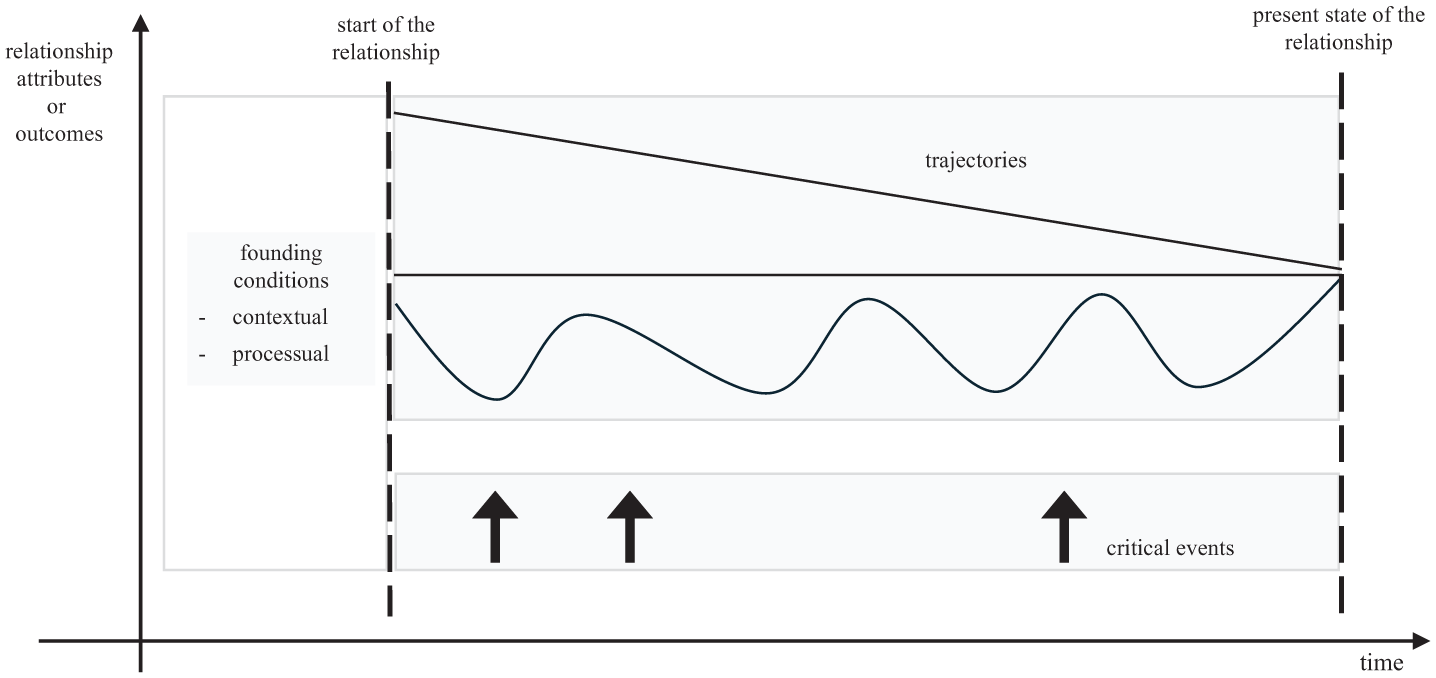
Parameters of relational history.
Difference from relational embeddedness and relationship age
Relational history, as we conceptualize it, is related to but different from embeddedness, and specifically relational embeddedness, as per Granovetter (1985, 1992). Relational embeddedness is about the dyadic relations between the actors in a relationship, also referring to the ‘kind of personal relationship they have, which is determined largely by a history of interactions’ (Granovetter, 1992, p. 35). Granovetter’s discussion about relational embeddedness is mostly about its positive aspects; for example, referring to one’s ‘attachment’ to the other party and how this might influence one’s preferences about putatively purely economic exchanges. This can encompass multiple facets, such as respect and friendship, trustworthiness, overlapping identities and solidarity (e.g. Moran, 2005; Nahapiet & Ghoshal, 1998), but has also been understood to refer to tie strength alone, for example as captured in frequency of interactions (Rowley et al., 2000).
Relational history is associated with relational embeddedness insofar as it relates to the biography of a network relationship and what has transpired in it before its present state. However, in clarifying the parameters for which the history of a relationship can be examined (i.e. founding conditions, trajectories, critical events), we see relational history as both a clearer and a more general concept than relational embeddedness. It is clearer in that it provides an analytically more tractable and decomposable (i.e. the three parameters) focus on a relation’s biography (while embeddedness is more of an assigned quality or state of the relationship at the present, or at a point in time). In this sense it can be used to more systematically examine relational embeddedness around founding conditions, trajectories and critical events. Relational history is also more general than embeddedness in the sense that, as a lens, it allows events and trajectories to refer to, and result in, phenomena that might be desirable, undesirable, or be more nuanced yet for one or more actors in the relationship. This neutral and flexible conceptualization reduces the risk of relational history being used mostly as a shorthand or proxy for the positive quality, closeness, or strength of a relationship (as relational embeddedness often is).
Having thus discussed the nuances between relational history and embeddedness, we also briefly discuss how it can be contrasted to relationship age. Although relational history emphasizes the temporal dimension of relationships, that temporality is not effectively summarized by the mere duration or age of a relationship. While conceptualizing the history of a relationship in terms of its duration can be a useful approach (e.g. Podolny & Baron, 1997), unlike our proposed relational history perspective, the concept of tie duration generally implies a linear and unidimensional representation that often oversimplifies a relationship’s past. For example, although tie strength is often taken to increase with tie duration, there are also long-established relationships that are riddled with conflict and negative emotions (Labianca & Brass, 2006). The nuanced understanding of relational history that we advocate would reveal that relationships which are equally old may function very differently, depending on the founding conditions, trajectories and critical events that characterize them. For example, scholars studying interfirm alliances have argued that the effects of relational and structural cohesion on firms’ withdrawal decrease with alliance duration (Greve et al., 2010). A relational history perspective would add that this moderating effect is likely to depend on the alliance’s historical trajectory (e.g. an old alliance that is on a downward, decaying trajectory is likely to be less robust than a young alliance that is on an upward, rising trajectory) and critical events (e.g. an old alliance that is tainted by a trust betrayal event may dissolve as soon as the betrayed party reduces its dependency on their partner). In sum, compared to the multifaceted theoretical understanding of relational history that we propose, a focus solely on relationship age or duration risks fixing us on an ahistorical and reductionist perspective on how the past shapes relationships.
How Relational History can Reorient Social Network Research
Above, we outlined our conceptualization of relational history. Next, we demonstrate why this perspective can be adopted widely, by discussing how current debates in network research would be advanced significantly – in both scope and depth – by incorporating parameters of relational history (founding conditions, trajectories and critical events). In particular we explain how the temporal myopia that implicitly or explicitly characterizes much of the investigations across the debates on network cognition, agency, brokerage and multiplexity can be rectified or complemented by bringing in our proposed notion of relational history.
Relational history and network cognition
Network cognition is an umbrella term that refers to the mental processes involved in perceiving social networks, encoding and recalling ties and structures, and using this information to form, maintain and mobilize relationships (Brands, 2013; Smith et al., 2020). In the following, we highlight how two core concepts (network accuracy and network activation) within network cognition research, as one of the key contemporary debates in organizational network research, could be fundamentally extended by an integration of relational history and its parameters.
Within the networks-as-pipes view, one way that cognition has been studied is by focusing on network accuracy – individuals’ ability to accurately perceive the relationships and network structures that surround them (Byron & Landis, 2020; Landis et al., 2018). High accuracy has been shown to facilitate movement into advantageous positions (van Liere et al., 2008) and the formation of effective coalitions (Janicik & Larrick, 2005) that enable resource access. To date, however, network accuracy research has remained largely ahistorical, focusing on actors’ perceptions of the presence or absence of current network ties. By integrating relational history into this stream of work, we expand the notion of what it means for an actor to perceive relationships or networks accurately. Just as we, as scholars, deepen our understanding by accounting for the parameters of relational history, network actors themselves could gain advantages by considering how a relationship (whether that relationship involves themselves or is among others) has arrived at its present state, i.e. considering its founding conditions, trajectory and any critical events, to better grasp its potential for resource flows, trust, or coordination. For instance, a tie that an actor perceives as stable purely from the viewpoint of the present may in fact be brittle when accounting for its history, including past conflicts and a trajectory of declining trust. Or, as another example, consider two long-tenured colleagues who frequently clash in meetings, yet consistently have each other’s back when critical decisions are made. By making a purely static, synchronic observation, researchers – as well as third parties perceiving the relationship – would struggle to accurately pinpoint the nature of the relationship. If we look at the relationship historically, however, we may learn that these colleagues share a rich and meaningful past together: they met long before most of their current colleagues joined the company, they were there together when critical events happened, and their relationship has gone through many ups and downs both professionally and personally. These two colleagues may have come to a point where disagreeing vehemently with each other is part of their relationship, but they also know that their bond is too deep to ever really break. Thus, what might statically appear like an incomprehensible relationship between two idiosyncratic people emerges as a strong, trusting relationship that thrives on conflict when understood historically – a dynamic that resonates with Simmel’s (1955) view of how strong ties necessarily hide positive and negative sentiments. Returning to cognitive accuracy: some third parties in the network of these colleagues may know about this history, while others do not. While the former thus see the bigger historical picture and enjoy the show, the latter will have a highly inaccurate network perception (‘those two are weird!’), that may influence, for instance, how they would approach the two. As per these examples, incorporating relational history allows cognitive network accuracy to move beyond static (mis-)alignment between perceptions of network ties and their actual substance. In this sense, the concept of network accuracy can be extended to include historically informed accuracy, which refers to the alignment between an actor’s perception and both the current configuration of a tie or network and the developmental processes that shaped it. This means recognizing not only who is connected to whom, but also how those ties were formed, how they evolved over time and what key events may have altered their function, meaning, or stability.
Indeed, if accuracy were to be understood as historically informed, then its drivers should include not only individuals’ cognitive capacity for deciphering networks, but also their exposure to, memory of and attentiveness to the history of ties and networks. For instance, actors who have witnessed the founding of a relationship among other actors are likely to hold more accurate perceptions of that tie, compared to those who have only heard about the origin story secondhand. Perhaps more interestingly, the parameters of relational history themselves might shape (historically informed) accuracy: certain founding conditions, such as initial asymmetries in status, may systematically distort later perceptions of relational strength or reciprocity; trajectories, such as an oscillating pattern in tie strength, may influence which aspects of that tie are more or less accurately perceived; and critical events may be cognitive anchors that improve memory but could also lead to biases in perception if their salience overshadows other aspects of the relationship.
As to the consequences of historically informed accuracy, the implications likely go beyond better-informed decisions or strategic positioning. An actor who accurately perceives not just the existence and patterning, but also the history of ties and of entire networks, for example, may better anticipate coalitions, sense latent conflict, or identify potential for future collaborations. Additionally, historically informed accuracy, as defined above, might help actors to counterbalance the influences of the founding conditions or trajectory of a tie. That is, such influences, as argued above, may constrain the future development of the relationship or the returns one can extract from it. However, this constraint may lessen to the extent that actors accurately perceive the history of that relationship and of the surrounding network.
Taken together, accounting for relational history allows us to move beyond the traditional view of accuracy as alignment between perceived and actual ties and structures in the present. Our extended historically informed conception of accuracy considers where relationships have come from, how they have evolved and how their histories shape what they are, what they mean and what they can enable. Table 1 summarizes this shift by contrasting the assumptions underlying traditional cognitive accuracy with those of historically informed accuracy. Similar contrasts apply to the following debates, for which we provide more concise comparisons in the text.
Comparison of assumptions and emphasis across traditional and historically informed cognitive network accuracy.

Note: The historically informed perspective should be seen as an extension of the traditional view: it incorporates the present-focused assumptions while adding temporal aspects that highlight how founding conditions, trajectories and critical events matter.
Relational schema inference: The use of generalized mental templates about how relationships ‘should’ work (e.g. friend-of-a-friend logic) to fill in gaps when perceiving networks.
Narrative accounts: Stories about the history of a relationship, told by the actors themselves or circulating in an organization, which frame how ties are perceived.
Episodic memory: Memory for specific events (e.g. a crisis meeting or joint success), which actors draw upon when evaluating relationships.
Transitivity schema: The tendency to assume that if A is connected to B and B to C, then A and C are also connected (even if no such tie exists).
Linear ordering schema: A cognitive bias where individuals impose a hierarchical rank order on relationships (e.g. status, influence) even when ties are not structured that way.
Historical anchoring: The tendency for salient past events (e.g. betrayal, crisis collaboration) to disproportionately shape present perceptions of a tie.
Valence bias: A memory bias where emotionally positive or negative past events overshadow neutral ones, skewing perceptions of a relationship.
Asymmetric recall: Systematic differences in what parties remember about a shared past, such as one recalling a conflict vividly while the other minimizes or forgets it.
Seen from the networks-as-prisms view, network cognition is inherently interpretive, reflecting not just the perception of ties, but the meanings assigned to them. One particularly relevant cognitive process here is cognitive network activation, that is, who in an individual’s network is recalled in a particular situation (Smith et al., 2012). Research in this vein, which we see as primarily ahistorical, demonstrates that individuals’ perceptions of who is connected to whom can shape attributions of power in organizations (Krackhardt, 1990). Smith et al. (2012), for example, show that status shapes how individuals cognitively activate their networks in response to job threat: higher-status individuals are more likely to recall structurally diverse contacts, whereas lower-status individuals activate emotionally close ties, reinforcing familiar and affirming relationships. Integrating relational history with cognitive network activation would highlight that who an actor thinks of as relevant, trustworthy, or instrumental in a specific situation is not merely a function of the present. It is historically inflected: recall of contacts in a given situation is shaped not only by present attributes or context but also by founding conditions, trajectories and critical events that have influenced how relationships have evolved over time and what they have come to represent. Founding conditions may shape enduring perceptions that influence whether and how a relationship is activated and subsequently mobilized, i.e. put to use. For instance, a mentoring relationship formed in a highly supportive context may lead the mentee to perceive future interactions through a consistently positive lens, regardless of actual relational dynamics. Even if the relationship weakens, early conditions of support may bias the mentee’s perception, prompting them to continue activating the tie and mobilizing it in ways that may or may not suitably leverage its actual state. Cognitive interpretative mechanisms such as these may contribute to the imprinting effects identified by McEvily et al. (2012), as well as to self-fulfilling prophesies regarding the perceived quality of the relationship. To provide another example of such an historically inflected notion of network activation, a distinct contact may be recalled in a given situation, not because of their expertise but because of a steady upward trajectory of the relationship or a critical event that has established them as a reliable partner. As these examples illustrate, relational history can clearly imbue relationships with symbolic meanings that influence activation. Conversely, actors’ cognitive representations of their networks, including which contacts are likely to be recalled in high-stakes situations, may shape the history of a tie: if a professional perceives a colleague as an influential connector in numerous different networks, this perception might lead that person to invest more time and resources into their own relationship with the colleague. As a result, the tie may be set on an upward trajectory, consistently strengthening over time (or become more likely to be one in which critical events transpire, such as undertaking and succeeding at high-risk initiatives together). From this perspective, relational history and cognitive activation are mutually constitutive: how a relationship is interpreted depends on how it has developed over time, and what is recalled about that development influences how it further evolves and is used in the future. To summarize, traditional network activation refers to the recall of contacts in a given situation based on present-time attributes or contextual cues. By contrast, a historically inflected view of activation recognizes that recall is also shaped by a tie’s founding conditions, trajectory and critical events, which imbue relationships with enduring symbolic meanings that influence whether and how they are cognitively brought to mind.
Relational history and network agency
Another current debate in network research is driven by scholars’ interest in agency (for a review see Tasselli & Kilduff, 2021). We focus on the notion of network agency that ‘concerns purposive actors who display creativity and choice in social action, which should include strategies for networking’ (Bensaou et al., 2014, p. 29), which is narrower than the more general, phenomenologically rooted sociological understanding of agency (Emirbayer & Mische, 1998). Prevailing approaches to network agency tend to adopt an implicitly ahistorical view, treating actors’ networking strategies as reflecting structural opportunities and constraints as they are presently. Extending these approaches through a relational history perspective allows us to foreground how agency itself is situated in, and influenced by, the evolving biographies of ties. Specifically, we suggest that network agency, first, unfolds within the constraints and affordances offered by relational history and is thus historically constituted, and, at the same time, it shapes the history of a relationship. This dual perspective brings to light the dynamic interplay between actors’ purposeful actions and the histories of their ties over time.
Within the networks-as-pipes view, agency typically manifests itself in the strategic pursuit of network advantage: actors seek to access resources by creating and utilizing ties and optimizing their network positions (e.g. Bensaou et al., 2014; Vissa, 2012). In this context, relational history would reveal how the founding conditions, trajectories and critical events that constitute a tie’s biography create conditions that can facilitate or hinder such a strategic pursuit of network advantage. In other words, the relational history perspective allows us to reconceptualize network agency as historically constituted. To illustrate: an upward trajectory, for instance between two firms in a research collaboration, developing steadily from an initially arms-length, purely transactional tie towards an increasingly embedded, trusting relationship, can allow for riskier or bolder actions. This trajectory may allow inviting potentially risky third parties into the collaboration – such as a visionary startup with the potential to become a disruptive innovator – because the trajectory provides confidence to the main parties to navigate and absorb frictions and make such an action conceivable in the first place. Similarly, the same trajectory likely makes it easier to request favours, such as one firm asking for access to proprietary tooling from the other to meet an unexpected deadline, which would be interpreted not as opportunistic but as a continuation of a jointly constructed path. While in this illustration the temporal perspective we propose explains how relational history expands the scope of action in terms of networking choices (and agency more broadly), different historical parameters might conversely constrain network agency as well. In this sense, the notion of historically constituted agency aligns with arguments on relational embeddedness (Granovetter, 1985; Uzzi, 1996), which emphasize how trust and norms enable ongoing action. However, the relational history perspective offers greater precision and depth by explicitly accounting for how founding conditions, trajectories and critical events influence agentic behaviour.
The influence which flows the other way around, i.e. the idea of agency-shaped history, draws attention to how actors’ prior agentic behaviours, such as networking behaviours and strategies, shape the biographies of their ties. Specifically, relationships for which agentic networking is an inherent part of their founding conditions and utilization (as opposed to ‘naturally occurring’, haphazard, or serendipitous relationships) may follow a distinct historical trajectory. In an entrepreneurial context, two people may meet at a match-making event for founders, team up and found a new business together. This intentional choice to form a partnership establishes a founding condition of commitment and alignment, which sets the collaboration on a trajectory of mutual exchange, increasing strength and ultimately high task performance. Huang and Knight (2017) develop an exchange-theoretical model that extends this idea from founding conditions to further trajectories: relationships between entrepreneurs and investors are not static, but are actively constructed over time through continuous bidirectional exchanges of resources. These agency-driven exchanges create reinforcing cycles that shape the trajectory of the relationship, with reciprocal investments and commitments accumulating over time. While not using history in their theorizing, the authors’ model highlights how entrepreneurs’ deliberate networking decisions establish the relational trajectories that underpin resource access and venture growth. Beyond founding conditions and trajectory, purpose and proactivity regarding networks and relationships may also affect the impact of critical events and their likelihood of becoming relational turning points. For instance, a lack of agency, e.g. proactive or reactive mollification, to address conflict in a professional relationship may lead to it becoming weaker. In sum, a historically informed view of network agency in the networks-as-pipes view emphasizes both historically constituted agency, whereby a tie’s founding conditions, trajectory and critical events enable or constrain its functionality as a conduit for resources, and agency-shaped history, whereby actors’ purposive choices set relationships on distinct temporal paths.
From the networks-as-prisms view, agency is less about proactive navigation of resources and more about how actors deliberately signal and interpret meaning through network ties. Imbuing this view with relational history allows us to consider how a relationship’s history shapes the scope and interpretation of future agentic action on the one hand (historically constituted agency) and how actors can agentically shape the narrative interpretive context for future interactions within a tie on the other (agency-shaped history).
In terms of historically constituted agency, the parameters of a relationship’s history (such as an upward trajectory) can function as signals that influence the scope of future network action. As an example, consider two engineers who were assigned to a time-sensitive project, in which they had to collaborate closely under tight deadlines and high pressure. The speed and context of this tie formation might create a strong initial bond and a shared sense of urgency and purpose. How the two engineers handle their collaboration under these conditions might affect their visibility and credibility throughout the organization as well, thereby influencing their opportunities for action and decision-making power – and thus their agency. More broadly, the evolving biography of a tie affects how agentic behaviour is interpreted; whether by the other party in a relationship or by third parties: the same action, such as initiating dissent, may signal status in one relationship but Machiavellianism in another, depending on founding conditions, critical events, or trajectory. What happens in the history of a relationship, in terms of founding conditions, critical events, or trajectories, can thus become part of its own self-defining narrative (Abbott, 2001; Ballinger & Rockmann, 2010) with positive or negative implications, including repercussions beyond the focal relationship (e.g. attracting new collaborators). Without attending to relational history, the networks-as-prisms view risks ignoring that the narratives and symbolic meanings it foregrounds are themselves products of historical contingency.
Further extending the prisms view, agency-shaped history allows for explaining how past agentic networking actions can construct the interpretive context within which an actor is perceived, for instance as authentic or instrumental, and how this influences relationship trajectories or critical events. For example, a professional’s decision to proactively initiate a collaboration establishes a founding condition imbued with symbolic meaning, signalling intent, and setting the collaboration on a specific trajectory from the outset. Deliberate maintenance efforts can reinforce that trajectory, not only leading to an upward trend in strength, but also signalling interest and trustworthiness to the other party (and possibly to third parties as well, in cases where such efforts are visible). Similarly, agentic responses to conflicts or challenges can shape critical events by signalling resilience, adaptability, or, conversely, fragility, influencing whether a relationship strengthens or fractures. Over time, such agentic actions accumulate into a relational biography of a tie that informs how future behaviours are perceived and interpreted by the direct contact and/or by others. In this connection, a lack of agency in managing a specific relationship, if seen that way by others in the broader network, might have ripple effects for that network, as the individual might become less attractive as a professional contact in the organization. A way to specify and test these ideas would be to leverage Bensaou et al. (2014) with respect to the distinction these authors make between devoted players, selective players and purists as profiles of professionals with distinct levels of agency in networking. Based on this distinction, one can investigate if there are variations across the history of network relationships of professionals in different profiles. Overall, a historically informed view of network agency in the networks-as-prisms view emphasizes both historically constituted agency, whereby a tie’s founding conditions, trajectory and critical events shape how agentic actions are interpreted and what meanings they carry; as well as agency-shaped history, whereby actors’ deliberate networking behaviours construct the narrative and symbolic context that then influence subsequent interpretations of a relationship. By bringing temporality into the analysis of network agency, the relational history perspective thus reveals facets that both structure-focused and ahistoric agency approaches hide: how agency waxes and wanes, transforms and is enabled or constrained through the evolving histories of ties.
Relational history and brokerage
Network brokerage, one of the most prominent topics in organizational network research, refers to the act of bridging between otherwise unconnected actors or groups, or ‘structural holes’ (Burt, 1992). The value of brokerage has been well established by a large empirical literature. In many organizational contexts, brokers enjoy superior performance outcomes thanks to their privileged access to diverse information, control over resource flows and higher status (Burt, 2004; Stovel & Shaw, 2012). Much of the existing research on brokerage adopts a networks-as-pipes view, focusing on the structural positions that enable brokerage and the informational or control advantages they afford. Yet brokerage also carries symbolic and interpretive dimensions that align with a networks-as-prisms view: who connects to whom, for example, can also signal status (Burt & Merluzzi, 2014).
The relational history perspective we propose suggests that structural brokerage alone does not determine what brokers can accomplish; the biographies of the ties that constitute brokerage pathways fundamentally shape their capacity as pipes and their meaning as per the prisms view. Take, for instance, the founding conditions of a bridging tie. A tie that emerged from an agentic and mutually beneficial encounter, such as a deliberate attempt by professionals to connect across functional silos for a shared innovation goal, may carry strong norms of reciprocity and openness that facilitate later brokerage advantages (Flynn, 2005). In contrast, a tie formed hastily under coercive conditions or through political maneuvring may become a fragile conduit, less conducive to trust and information sharing. Thus, even when two actors occupy identical brokerage positions, the effectiveness of those positions can diverge significantly due to differences in how the underlying ties were formed.
Consider, as an example, the case of a senior manager who, during a company crisis several years earlier, brought together two department heads who had never previously interacted. The three of them spent long nights in war rooms, discussing possible layoff decisions and their reputational risk. That intense, shared experience forged bonds of mutual respect that outlived the crisis itself. Years later, the same manager is seen casually connecting these two individuals in a cross-functional project. To outsiders, it may look like routine brokering. But the relational history – their memories of shared emotions and joint accomplishments coupled with a lasting sense of mutual respect and gratitude – imbues the connection with a robustness that makes the brokerage both effortless and trusted.
Trajectories of brokerage ties also matter. Research has shown that the relational activation of bridging ties evolves (Quintane & Carnabuci, 2016), yet we know little about how the longitudinal path of these ties affects brokerage behaviour. A bridging tie that has steadily deepened over time, for example through repeated and increasingly successful collaborations, may support ever more generative forms of brokerage by encouraging actors to take greater risks and invest more in each other. Conversely, a bridging tie that frequently oscillates between engagement and withdrawal, or that has weakened due to past disappointments, may limit a broker’s willingness to activate the relationship except when strictly necessary. The relational history perspective prompts scholars to examine not only whether brokers span structural holes, but also how the past experiences embedded in the tie shape the forms of brokerage that are conceivable and desirable.
Critical events are another crucial component. A turning point, such as a betrayal, an act of solidarity during organizational upheaval, or a breakthrough project, can redefine a bridging relationship, either entrenching trust or seeding suspicion. For instance, if a broker once connected two actors for a joint project that failed amid blame-shifting, subsequent brokering attempts across that triad may be fraught or avoided altogether. Conversely, if a broker successfully mediated a tense dispute, that event may reinforce their centrality and expand the relational scope of their brokerage ties.
These histories are not always visible to third parties. An observer might see a broker introduce two adversaries and be baffled by their apparent cordiality, unaware of a pivotal retreat five years earlier where a difficult but productive off-the-record conversation planted the seeds of their mutual respect. To those in the know, the broker is navigating complex relational terrain with detailed historical knowledge in mind; to others, the move may seem reckless or even ill-advised. As with network cognition, perceptions of brokerage are shaped by whether observers grasp the historical context or merely see the structural present.
Bringing relational history into brokerage research thus extends our understanding in two directions. First, it enriches our conceptualization of brokerage ties as historically situated rather than merely structurally equivalent. Second, it encourages a shift from static assumptions about the functionality of structural holes toward a more dynamic and nuanced view – one in which the historical path of relationships shapes the possibilities and limits of brokerage itself. In sum, an historically informed view of brokerage emphasizes that the effectiveness and meaning of brokering are not determined solely by present structural positions, but are shaped by the founding conditions, trajectories and critical events of the underlying ties. This shift invites organizational network scholars to examine brokerage not only as a structural opportunity but also as a historically conditioned practice, whose viability and legitimacy depend on the history of the relationships through which brokerage occurs.
While so far we have focused on the implications of a relational history perspective for our understanding of dyadic (brokerage) ties, its relevance extends to the broader network structure around the dyad. The relational history perspective promises to offer useful new insights also when adopting this broader network perspective. Consider, for example, the widely used distinction between three forms of brokerage: tertius iungens (i.e. brokers bring disconnected parties together), tertius gaudens (i.e. brokers extract rents from keeping disconnected parties apart) and tertius separans (i.e. brokers actively sustain or deepen separation between unconnected parties). These manifestations of brokerage are typically theorized as behavioural orientations or strategies chosen by brokers (Kwon et al., 2020; Obstfeld, 2005). A relational history perspective reframes this agentic view by foregrounding how the histories of the relevant ties (between the broker and each alter, and between the alters themselves) make certain brokerage forms more viable, legitimate, or attractive than others.
Work by Quintane and Carnabuci (2016) provides initial empirical support for this idea by distinguishing between brokerage enacted through embedded ties (i.e. long-term, recurrent relationships) and unembedded ties (i.e. short-term or one-off interactions). Their findings suggest that brokers are more likely to adopt a tertius iungens approach when working through embedded ties, where shared history supports trust, open communication and mutual accommodation. In contrast, when brokers operate through unembedded ties, which, in terms of relational history, may lack steady trajectories or meaningful events, they are more likely to behave as tertius gaudens, interposing themselves between their contacts who may not trust one another or lack the context to coordinate directly.
Relational history offers a deeper explanation for these patterns. It highlights that trajectories and critical events shape not only whether brokerage is feasible but also which forms feel legitimate and appropriate. For example, a broker may avoid reconnecting two colleagues whose past relationship was marred by unresolved conflict or asymmetry, instead adopting a gaudens or separans orientation that keeps them apart. Conversely, a dormant but meaningful shared history, such as surviving a crisis together, may embolden the broker to bring them together, enacting a iungens role.
In this view, brokerage strategies are not merely individual orientations or tactical reactions to static structural holes; they are historically formed moves rooted in accumulated experiences. Brokers may find themselves constrained not only by present relational tensions, but by the echoes of past conflict, solidarity, or role asymmetry. Similarly, the viability of a separans strategy, where the broker actively keeps network partners apart, may stem not from manipulation or control, but from a historically grounded assessment that bringing them together would reignite unproductive or even dysfunctional dynamics.
While structural holes mark the absence of current ties, relational history draws attention to what once existed, what has changed and what that evolution means for brokerage decisions. Future research might explore how brokers interpret and narrate these tie histories as part of their behavioural repertoire, and how actors’ awareness of tie histories influences the perceived appropriateness and success of brokerage efforts.
Relational history and multiplexity
Multiplexity is the coexistence of more than one type of relationship between two network actors. In their review, Ertug et al. (2023) propose theorizing about multiplexity using mechanisms about relational harmony, task complementarity and relational scope. We refer to these mechanisms to explain how a relational history perspective can advance research on multiplexity. While Ertug et al. (2023) do not make this point explicitly, the studies in their review, and therefore the mechanisms they identify, are primarily about research adopting a networks-as-pipes perspective.
A relational history perspective can introduce trajectories into the study of multiplexity by considering the sequence in which relationships become multiplex. Some studies indicate that such an approach would prove fruitful. For example, Knoben and Bakker (2019) show that start-ups that first form a board interlock with a promising partner and subsequently form a strategic alliance perform better than those that follow other sequences. Building on this example, explicitly incorporating trajectories into multiplexity research would help integrate such insights into a systematic area of inquiry.
To illustrate, imagine two colleagues connected by a workplace friendship (David et al., 2023). In one scenario, these two were close friends before working together. They used to socialize outside of work, share personal struggles and build trust informally. A year later, one of them brings the other into a cross-functional project. In another scenario, the same two individuals are randomly assigned to work together on a high-stakes initiative. Only after a period of close collaboration do they develop a personal bond. In both cases, the relationship becomes multiplex (i.e. both instrumental and affective) but the sequence or trajectory differs, which may lead to differences in relational scope, i.e. the range of action that the multiplex relationship allows. In the friendship-first scenario, the personal history may allow for greater tolerance of conflict or informality in task coordination, but it may also blur role boundaries and make it harder to surface performance issues. That is, this trajectory may compromise relational harmony, as long-standing personal feelings can become entangled with the consequences of newly added professional roles and expectations. By contrast, in the task-first scenario, emotional rapport may be more bounded, but task expectations are likely to be clearer and easier to renegotiate.
One can also contrast a trajectory in which a previously multiplex relationship is now uniplex (e.g. individuals who were both friends and business partners, but where the friendship has ceased) with a relationship that was, and remains, uniplex (e.g. individuals who were and remain business partners only). These different trajectories, both of which result in a relationship that is uniplex at the present, are likely to generate differences in relational harmony, task complementarity, or relational scope. This brief illustration suggests that the trajectory through which multiplex ties form can have a profound impact on the nature, meaning and capacity of a relationship. Such differences are obscured by the prevailing ahistorical approach in the literature, which implicitly treats relationships as equivalent based solely on their current multiplex structure.
Theoretical debates on multiplexity can be further enriched by bringing in other parameters of relational history as well. In terms of founding conditions, for example, the relational harmony, task complementarity and relational scope implications of different trajectories can be compared to those of multiplex relationships where the relationships arise effectively at the same time, e.g. at an industry conference during which two individuals hit it off both as friends and as professional partners. Similarly, in light of critical events, the presence of an event that led a friend in dire straits to approach someone urgently with a business proposition, is likely to have different implications for the relational scope of this ‘initiating actor’ than a case where the business partnership emerged steadily through mutual interest from both friends. As another illustration, if the transition from multiplexity to a uniplex relationship was due to a gradual process or instead a sudden critical event that led to an abrupt cessation of one of the relationships, the repercussions for how the uniplex relationship would function would differ.
Incorporating relational history into the study of multiplexity equally points to new avenues for research in the networks-as-prisms paradigm as well. To illustrate again using trajectories, we would expect that how others (i.e. ‘audiences,’ or those who are not part of the focal relationship) perceive the parties in a multiplex relationship would be influenced by how, and the order in which, the different relationships arose. Consider a case where a relationship turns multiplex by adding a task (or instrumental) component to what was a friendship (or expressive) relationship. The audiences’ interpretation and evaluation of the motives, agency and goals of the parties might be influenced by whether there is status asymmetry between the parties, which party (and how agentically and in what manner, i.e. through a common third party or by making a direct appeal) approached the other to initiate adding the instrumental component, and the passage of time from the start of the friendship to the desired expansion of adding the instrumental component (i.e. networking speed, see Brennecke et al., 2024).
These illustrations point to ample opportunities for generating new knowledge to refine and clarify how multiplex relationships that appear to be equivalent, if seen solely from a ‘here and now’ perspective, might in fact have disparate implications for the mechanisms (i.e. relational harmony, task complementarity and relational scope) used in examining multiplexity. In sum, a historically informed view of multiplexity emphasizes that the meaning and functionality of multiplex ties depend not only on the current coexistence of relationship types, but also on the founding conditions, trajectories and critical events through which these relationships have emerged. Developing terminology to capture these ideas can facilitate further research efforts. For example, ‘relational contraction’ (or ‘relational expansion’) can describe ties that are currently uniplex but were previously multiplex, or ties that now encompass additional relational dimensions compared to the past. ‘Relational drift’ or ‘relational push/pull’ can refer to relationships formed on account of one type of relationship, e.g. purely expressive or purely instrumental, but have since expanded to encompass another type of relationship.
What Relational History Means for Data and Methods
Advances in organizational network research, perhaps more so than in other areas of organizational studies, have traditionally been anchored in and influenced by methodological considerations and, specifically, the available toolkit of social network analysis (SNA). Reliance on this toolkit, comprising predominantly static measures of key concepts such as centrality (Freeman, 1979), brokerage (Burt, 1992) or tie strength (Granovetter, 1973), may have contributed to the temporal myopia that is prevalent in current organizational network studies. Even the most commonly used model to investigate network dynamics, the stochastic actor-oriented model (Snijders et al., 2010), explicitly builds on Markov assumptions (i.e. the future state of a network depends only on its current state, not on the sequence of events that preceded it) to reduce computational complexity. That said, there are recent attempts to bring in dynamic measures and models to better understand long-term patterns of network change and the consequences of such change (Lee et al., 2024; Quintane et al., 2022; Schecter & Quintane, 2021), to overcome myopia in the investigation of entire networks. These novel methods within the current SNA toolkit could be used in empirical investigations of relational history. At the same time, further integrating relational history into organizational network research would most likely also make it necessary (as well as present an opportunity) to expand this toolkit with new and alternative approaches for data collection and analysis. In the following, we provide some suggestions for such an expanded toolkit to further incorporate relational history in organizational network research.
Data collection
Concerning the founding conditions of a relationship, we can build on and expand existing efforts in social network research. For example, McEvily et al. (2012) investigate whether professional relationships were created in the formative years of lawyers’ careers. The authors do so by measuring whether a lawyer was early or late in their career, based on when they took the bar examination and when they formed a given relationship. Similar approaches can be used to capture contextual conditions surrounding relationship formation. To generate a more in-depth understanding of founding conditions, scholars can also leverage qualitative approaches. For example, historical or life-history interviews can help explore the origin stories of relationships, such as the context that led to the formation of the relationship (e.g. ‘What led to you meeting this person?’) as well as the founding process and formative characteristics (e.g. ‘How quickly did you begin collaborating?’).
Increasingly, scholars collect longitudinal network data by surveying individuals about their networks at multiple points in time. While this research typically focuses on the existence or non-existence of ties across survey waves, such an approach could easily be extended by questions about relationship characteristics, such as tie strength, reciprocity, or multiplexity, and would hence allow investigations about trajectories, their drivers and consequences. Work that is ongoing in this general direction indicates that such an effort would be productive. For example, Parker et al. (2016) show that performance feedback drives changes in tie strength over time, such that positive feedback leads to a further strengthening of strong relationships, while negative feedback causes individuals to reduce their engagement with weak relationships. Moving beyond survey research, the increasingly rich and often time-stamped archival data that accumulate in the digital domain also present ample opportunities to capture different parameters of relational history. Most notably, organizational network scholars have started using email data and interpret the ongoing exchanges of emails (‘relational events’; Borgatti & Halgin, 2011) in terms of more long-term ‘relational states’ between individuals (Quintane & Carnabuci, 2016; Woehler et al., 2021). Similarly, for inter-organizational relationships, such as alliances or joint ventures, archived corporate and press materials may allow researchers to (re)construct the history of a given tie by finding out about founding conditions, trajectories and critical events, such as joint successes but also tensions or conflicts. While information from such materials can be manually coded, state-of-the-art machine learning techniques increasingly allow for automated extraction and coding, as well as for the identification of themes in the description of relationships.
Finally, Burt and Opper (2024) recently devised an approach to capture critical events in and for network analysis. They asked survey respondents ‘to describe five significant events in the history of his or her business’ and combined this question with a name generator typical for SNA surveys, asking ‘for the name of the person who most helped the respondent get through the event’ (Burt & Opper, 2024, p. 8). One way to adapt this approach to capture critical events for individual relationships could be to ask respondents for their five most important contacts and to describe for each of these contacts any significant events that influenced the development of their relationship. The descriptors could then be categorized using criteria, such as whether they were positive versus negative, or caused by external circumstances as opposed to initiated by one of the individuals involved. By additionally asking about when in the relationship such events occurred, and capturing information on relational characteristics such as tie strength, it might be possible to collect data for investigating how a given event might influence the trajectory of a relationship, i.e. function as a potential turning point.
Data analysis
Concerning analytical approaches for the study of relational history, qualitative analyses, as commonly used to generate process theories (Jarzabkowski et al., 2017), seem to be a prime candidate to develop an in-depth understanding of the history of a network tie. For instance, researchers can create a timeline of critical events that occur within a relationship over time, analysing how each event is tied to the previous one (‘process tracing’) and shapes the relationship’s trajectory, e.g. leading to turning points, and potentially draw conclusions on the current state of the relationship and the returns that it generates. Qualitative comparative analysis (QCA, Misangyi et al., 2017), including fuzzy set QCA, could also be leveraged to understand how relationships that differ across various dimensions, including aspects of their history, can yield similar outcomes. For example, two relationships that differ in their current relational and structural characteristics might still yield similar outcomes, based on differences in their relational history regarding founding conditions, trajectories and critical events. Alternatively, even when the focus is on the overall repercussions of relational history itself, such methods can be used to see whether there might be different configurations of founding conditions, trajectories and critical events that might nevertheless yield similar outcomes in terms of the quality and outcomes of the relationship in its present form.
In addition, given that SNA remains primarily a quantitative field, and that our aim is to stimulate a deeper integration of relational history into organizational network analyses, we here present specific suggestions for quantitative approaches. As we have noted, there are recent developments that allow for investigations of long-term patterns of whole network change, which also have potential to address the history of specific relationships. Perhaps the most promising analytical approach within this set is relational event modelling (REM), which allows accounting for sequences of change (i.e. moving beyond Markov assumptions) in entire networks (Schecter & Quintane, 2021). Quintane and Carnabuci (2016), for example, use REM to provide a temporal understanding of the process of brokerage between individuals in an organization. Kitts et al. (2017), likewise, apply the same model to identify two patterns of inter-organizational patient transfer reciprocation among hospitals. The authors distinguish dependence reciprocation, as a short-term mechanism based on immediate resource needs, from embedding reciprocation, as a long-term mechanism that develops gradually as organizations repeatedly interact and develop shared routines. These studies highlight the potential of using REM to investigate certain phenomena related to relational history, i.e. at the dyad level, such as, in this case, identifying trajectories of reciprocation, but potentially also multiplexity.
To account for other types of trajectories (e.g. in terms of tie strength) and to investigate the role of founding conditions or critical events, it may also be fruitful to look beyond the current SNA toolkit. For example, sequence analysis aims to deal with pattern recognition and testing for temporal data. Poole et al. (2017) distinguish informal methods of sequence analysis, similar to the qualitative processual approaches mentioned above, from formal (i.e. more quantitative) sequence analysis. Borrowing from those formal methods can enable organizational network scholars to address questions related to relational history. Specifically, some of the methods for sequence identification described by Poole et al. (2017), such as sequence mining, as well as methods to identify relationships among sequences, could be used to identify, for instance, what might be typical patterns of sequences characteristic for certain types of relationship – say mentoring, that give rise to strong and enduring mentor–mentee ties. Similarly, it might be possible to identify which founding conditions of a relationship are more likely to lead to certain trajectories. These formal methods could also be extended to link identified sequences to outcomes, allowing for the investigation of how networking processes, such as the speed of tie formation, influence relational outcomes as suggested by Brennecke et al. (2024); or analytically investigate sequences of events that are more likely to lead to Guanxi (as per Burt & Opper, 2024).
Another class of models that may prove useful in analysing relational histories quantitatively is latent growth curve analysis (LGCA; Bollen & Curran, 2006; Meredith & Tisak, 1990). Based on structural equation modelling, LGCAs may be used to model change trajectories in various relational attributes, such as tie strength, reciprocity, or multiplexity. These models might also therefore enable researchers to identify whether a relationship’s trajectory is linear, exponential, or shows signs of plateauing; providing insights into the developmental patterns of network ties. Another possible advantage of using LGCAs to examine relational trajectories is that such models can represent unique curves for each individual unit (i.e. relationship), allowing researchers to capture the heterogeneity in relationship trajectories that may be lost when using methods that rely only on sample averages. Because LGCAs can incorporate both time-invariant and time-varying covariates, furthermore, they may be leveraged to examine how a wider set of variables influence the trajectory of relationships. For example, one could study how the strength of mentoring relationships changes over the course of several years, while simultaneously exploring whether certain founding conditions (e.g. if the mentoring arrangement was established during a period of resource munificence or scarcity within the organization) lead to different relational trajectories.
Beyond statistical models per se, another opportunity is to make use of temporal dynamic network measures that have recently been developed by Quintane et al. (Falzon et al., 2018; Lee et al., 2024; Quintane et al., 2022) to capture temporal network centrality and temporal brokering. Using the latter measure as an independent variable in a regression, Lee et al. (2024), for example, found that the process of keeping colleagues apart, rather than bringing them together, leads to higher experiences of burnout. We see great potential in this direction in terms of further developing temporal measures of relational history that capture within-relationship variation over time, for instance with regard to tie strength, and use them as dependent or independent variables to examine various phenomena.
Future Research Directions
In this section, we identify four directions for future research that build on our relational history perspective. The first direction focuses on sharpening and refining the core parameters of founding conditions, trajectories and critical events. The second explores how relational histories are cognitively represented and narratively constructed. The third extends the perspective to the study of broader network structures. The fourth offers two concrete illustrations of how applying this perspective can enrich research on widely studied organizational phenomena, specifically interpersonal collaboration and innovation. Together, these directions deepen and extend our core conceptualization and connect it to broader empirical and theoretical concerns in organizational network research.
Extending the relational history framework
Our core conceptualization distinguishes between three key parameters of relational history: founding conditions, trajectories and critical events. We see considerable potential for future research to further refine these parameters and their conceptualization.
For founding conditions, refinements could include both contextual factors (e.g. the institutional setting or the specific occasion in which two individuals met) and processual factors (e.g. the speed with which tie formation unfolded). Beyond these, future research could scrutinize dimensions such as the symmetry or asymmetry between actors at the point of tie formation (e.g. in terms of status, expertise, or power), the intentionality of the tie (e.g. strategic versus emergent) and the immediacy of engagement (e.g. swift versus gradual onset). Brennecke et al. (2024) already highlight how the speed of tie formation would affect later attributes of a relationship. Future work, from both the networks-as-pipes and networks-as-prisms perspectives, could build on this insight by examining how the congruence of actors’ motivations at tie onset and the broader institutional context of tie formation shape not only subsequent tie attributes but also the meaning and symbolic capacity of the relationship.
Relational trajectories may show variation with respect to direction (upward, downward), monotonicity (stable vs. oscillating), steepness and velocity. A tie that strengthens rapidly under crisis conditions, for example, may generate different expectations and interdependence patterns than a tie that grows gradually over years. Understanding these dynamic profiles may yield insights into when and how relationships are more resilient, brittle, or prone to rupture.
Critical events can be differentiated by their valence (positive or negative), locus of agency (endogenous to one or both parties, or exogenous), timing (early vs. late in a relationship’s life) and recency. For example, recent developments might carry more weight than earlier ones do in shaping the present state and meaning of a relationship. Thus, differentiating between a long-term and a short-term horizon, and examining factors that can shift the calculus between earlier and recent developments, can allow us to more accurately and parsimoniously characterize the impact of relational events. More broadly, these dimensions may influence whether an event becomes a true turning point, a temporary disruption, or a latent anchor that resurfaces later. Future research could develop typologies of such events and explore their differential effects on relationship meaning and capacity.
Cognitive and narrative construction of relational history
White (2008) has argued that ties are constructed through the stories that actors tell about them. In a similar vein, and as broadly aligned with the networks-as-prisms view, relational histories are not just chains of events that are ordered one after another: they are narrative constructions that are remembered, interpreted and told by and to social actors. Recognizing that the stories that actors carry about a relationship’s past shape its present meaning and future trajectory opens avenues for future research. Which features of relational history are retained, which decay over time? When do narratives about a tie crystallize into dominant accounts that guide behaviour? Under what conditions do memories of key events become shared across both parties, and how does such shared memory affect coordination, trust, or conflict?
There is also scope to investigate how cognitive representations of tie history affect relational strategies. Actors may behave in ways that are based on partial or biased recollections, and such misalignments can themselves become sources of misunderstanding or opportunity. Stories that actors tell about a tie’s origins or turning points may also function as resources for identity work, political positioning, or legitimation within the broader network. As such, while we have considered the interplay between relational history and network cognition in a dedicated section earlier, there are also ample opportunities to integrate relational history with yet further streams of cognition research, for instance drawing on dual-process theories of cognition (e.g. Kahneman, 2011) or integrating knowledge on different cognitive styles (Carnabuci & Diószegi, 2015).
Relational history and broader network structures
While our primary emphasis has been on dyadic ties, the theoretical and empirical implications of relational history extend to actors’ positions within larger network structures. Accordingly, future research can explore how the biographies of individual ties interact with structural properties such as brokerage, centrality, constraint, network status and considerations of an actor’s core–periphery positioning in a broader network to shape behaviour and outcomes.
Brokerage is a particularly promising context in which to examine such extended dynamics: because brokers often operate at the intersection of otherwise unconnected or weakly connected actors, the relational histories of their constituent ties can significantly affect both the form and efficacy of brokerage. For instance, a broker connecting two individuals with a history of conflict may find tertius iungens behaviour difficult or counterproductive. Conversely, shared historical milestones or critical events can create fertile ground for successful brokerage. Similarly, brokers may invoke past relational narratives to justify their interventions or avoid replicating failed patterns.
Yet the relevance of relational history is not confined to brokerage alone. Actors occupying high-status positions may face distinct vulnerabilities or advantages depending on the historical qualities of their ties. For example, high-status ties formed under symmetric, trust-rich founding conditions may bolster one’s standing by enhancing durability and cooperation. By contrast, status that rests on historically fragile ties may be more susceptible to disruption, particularly in the face of critical events.
Actors in structurally constrained or peripheral positions may also experience different relational trajectories based on how their ties have evolved. Peripheral actors may benefit from historically resilient ties that facilitate access and integration, while constrained actors might be limited by path-dependent histories that lock them in to suboptimal network configurations.
Finally, a network’s macro-structure may itself emerge from and be shaped by the historical properties of its constituent ties. For instance, core–periphery structures might reflect long-standing relational trajectories that differ systematically in terms of their founding conditions and accumulated critical events. Similarly, relational history may influence perceptions of legitimacy or appropriateness in cross-status or cross-group interactions.
In sum, relational history also provides a generative perspective for understanding how structural positions are enacted, maintained, or transformed over time. It highlights that structural advantage is not solely a function of present topology but is also shaped by the temporal and historical character of the relationships which constitute that position. Hence, future work should pursue designs that link historical features of dyadic ties to enduring properties of network structure.
Applying relational history to core organizational phenomena
Finally, future research can apply the relational history lens that we have developed to key empirical domains within organizational network research. We illustrate this potential by focusing on two such domains: interpersonal collaboration and innovation.
In the context of collaboration, relational history may help explain variation in the functioning of dissonant ties; that is, relationships that combine task dependence with relational difficulty (Brennecke, 2020). For instance, a tie may become dissonant due to a recent conflict (a critical event), or it may have unfolded along a path marked by recurring interpersonal friction (as a trajectory). Alternatively, a dissonant tie may have been preceded by a long period of effective collaboration, which might buffer the effects of current strain. These different trajectories are likely to shape both the willingness to continue collaborating and the effectiveness of such collaboration. Hinting at such strategies, Brennecke (2020) quotes a worker stating: ‘I just swear at him and tell him where to go, but I get a huge amount of work out of him.’ Building on this example, there is significant potential to use qualitative interviews more systematically to delve deeper into the history of dissonant ties and probe our understanding of how that history matters for the consequences of these kinds of relationships.
For innovation and creativity, we suggest that a tie’s relational history shapes not only its present capacity for information exchange but also the interpretive frames through which novelty is recognized and acted upon. Founding conditions may set expectations about openness or hierarchy; a trajectory of deepening collaboration may foster creative risk-taking; and prior joint successes or failures may calibrate how actors assess and pursue novel ideas. Berg (2022) argues that the historical development of a person’s career conditions their future creative potential by shaping the portfolio of outputs that audiences and gatekeepers associate with them. Similarly, we propose that the history of a relationship can make certain creative paths possible or more likely, while excluding others. With respect to a relationship’s founding conditions, for example, are relationships formed in contexts or periods of high creativity more likely to be structured around interactional rules that facilitate creative exchanges among collaborating partners? With respect to a relationship’s trajectory, does the creative potential of a relationship change as the relationship fluctuates between periods of increasing vs. decreasing closeness or competition among the parties? When thinking about critical events within the history of a relationship, how do positive versus negative events influence the creative potential inherent in a relationship? For example, how does a sudden shift in the status position of an organization affect the innovativeness of its collaborative ties with partner organizations whose status position remained stable?
Conversely, relational history can be examined as an outcome: creative successes may redirect a tie’s trajectory or precipitate critical events that redefine its meaning. For example, a breakthrough innovation achieved by two collaborating parties might elevate the tie’s status in the broader network, lead to increased investment of time and resources, or change the expectations surrounding the relationship. What was once a low-stakes collaboration might become a central, high-risk-high-reward partnership. In some cases, the creative success itself may function as a critical event, altering the affective tone of the relationship, reshaping its goals, or catalysing new forms of multiplexity. Over time, this shift can set the tie on a different historical path than it would have otherwise followed, illustrating how relational history is not merely a backdrop for creativity but also a consequence of it.
In sum, applying the relational history lens to widely studied organizational phenomena promises both theoretical innovation and greater empirical precision. This agenda can be further enriched by considering how relational history interacts with attributes such as tie strength, multiplexity, or duration, thus offering a richer account of the temporal life of network relationships in connection to such phenomena.
Conclusion
Aligned with recent efforts in organization and management studies to theorize time as intrinsic to social and organizational life (e.g. Bansal et al., 2025; Boon et al., 2025; Shipp & Cole, 2015), we invoked the concept of relational history to signify the temporal path or biography of a network tie. We have argued for the systematic and broad use of a relational history perspective to correct for the temporal myopia (confining the focus to the ‘here and now’) that characterizes much of organizational network research to date. We proposed that the history of a relationship comprises three constitutive parameters; namely a relationship’s founding conditions, trajectory and critical events. We argued further that wider adoption of a relational history perspective can strengthen organizational network research across both the predominant theoretical perspectives of networks-as-pipes and networks-as-prisms in several crucial ways. First, by conceptualizing relational history and its parameters, it can enable organizational network scholars to better capture and analyse network relationships as they naturally evolve. Second, it can enhance the precision, depth and scope of our explanations. Finally, it can boost the field’s vitality. Regarding the latter, we suggested multiple avenues in which core debates in organizational network research could be extended by accounting for ideas such as historically informed network accuracy, agency-shaped history, or relational contraction. These ideas open up new theoretical pathways to understanding the temporality of network ties and invite future research to engage with relational history as a critical constitutive dimension of how networks function and evolve.
Footnotes
Acknowledgements
We would like to thank Matthew S. Bothner, Martin Gargiulo and Eric Quintane for their feedback on previous versions of our manuscript. We are also grateful to Joep Cornelissen for his excellent general editorial guidance, as well as numerous sharply observed specific suggestions. Standard disclaimers apply.

Funding
The authors received no financial support for the research, authorship and/or publication of this article.
Declaration of conflicting interests
The authors declared no potential conflicts of interest with respect to the research, authorship,and/or publication of this article.