




Abstract
We build a comprehensive and coherent understanding of organizational purity as an organization’s steadfast adherence to a single institutional logic. This logic becomes the core tenet of its identity, an end in itself rather than a means toward survival. Instead of responding to institutional pressures, pure organizations may self-categorize vis-à-vis a potentially threatening ‘other’ through their own identity work. They mark and pursue their distinction from others, structure themselves to preserve their purity, and favor strategies that express the logic they embody. In so doing they may fail more often than organizations that are more responsive to institutional pressures. When pure organizations enter new institutional fields they can act as change agents, but where their logic dominates, they may block change. Different audiences, in turn, affect the success and survival of pure organizations by conferring authenticity, legitimacy or contempt, depending on their alignment with the pure organization’s logic. Further examining purity will enable organizational theorists to better account for non-rational action and extend work on institutional logics.
Introduction
Organizations that adapt appropriately to institutional pressures are believed to gain legitimacy, avoid sanction, and prosper (Mizruchi & Fein, 1999); this adaptation may happen through isomorphic processes that make organizations similar (Powell & DiMaggio, 1991) and decoupling, i.e. when their practices are not aligned with their policies (Bromley & Powell, 2012). Research generally predicts that those who do not adapt will usually fail (Greenwood et al., 2011). Conceptualizing organizations as loosely coupled – distinctive yet responsive – systems (Orton & Weick, 1990; Vaughan, 1999; Weick, 1976) has enabled organizational theorists over the years to examine how organizations respond to institutional pressures.
More recent research has found that some organizations prioritize particular logics over others, thus engendering field-level heterogeneity (Oliver, 1991; Pache & Santos, 2010; Thornton et al., 2012). This broad finding suggests that organizations respond differently to the constellation of logics present in their complex institutional environments (Värlander et al., 2016). Organizations may in fact deploy a wide array of strategic responses to institutional pressures, ranging from passivity and acceptance to outright rejection and resistance (Oliver, 1991). In some cases they position themselves vis-a-vis diverse and sometimes incompatible demands (Pache & Santos, 2010), which may lead to conflict, failure or creative solutions. In observing these responses, a common assumption – shared across research streams in organizational theory and allied disciplines – is that organizations (for-profit and non-profit alike) have a survival motive (Aldrich & Ruef, 2006, p. 38). In this overriding sense, strategic reactions to institutional pressures – whether plural or not – are widely believed to be driven by survival concerns. So although we know that organizations’ unique identities – that which is central, distinctive and enduring about them (Albert & Whetten, 1985) – reflect their level of alignment with different institutional logics, current theoretical frameworks do not address why and to what degree organizations integrate one logic over another for motives that are not related to survival.
Purity, we argue, offers such a motive. While ‘identity can be contested and reconstructed, or “worked”’ in institutional processes (Lok, 2010, p. 1306), it can also be a motive to oppose institutional pressures and demands by adhering to a self-affirming logic, to the point of defying strong external constraints and competing demands, and possibly reducing the organization’s viability. Bringing the concept of purity into the organizational theory literature can enable us to better understand why and how organizations rely on identity work (Beech, 2008; Brown, 2022; Ibarra & Petriglieri, 2010; Winkler, 2018) to prioritize various logics and choose to respond differently to institutional pressures.
We define organizational purity as a steadfast adherence to a single institutional logic, the latter being a system of values and practices (Greenwood et al., 2011; Thornton et al., 2012) that influences how identity work is used to navigate and prioritize these pressures. Whereas the dominant institutional literature presupposes generic identities to which organizations adhere for survival, we take a more agentic perspective – via identity work – in which organizations construct and then adhere to a single logic (purity). Although the concept of purity is mostly used in research on morality (Kollareth et al., 2023; Reid & Ramarajan, 2022), its presence in sociological and anthropological research can be mobilized to inform its use in organizational theory, the general idea being that adhesion to unsullied practices and ideas are deemed ‘pure’ (e.g. Abbott, 1981; Douglas, [1966] 2003; Dumont, [1966] 1970). Drawing on this body of work, we propose that pure organizations have embedded agency expressed in their identity work (i.e. they respond to pressures in different ways and to different degrees), embody a single logic for themselves, and only selectively respond to their environment.
That purity is an internalized steadfast adherence to a single institutional logic means that an organization gives primacy to that logic. This primacy is substantiated by subordinating other logics and practices as instruments to fulfil the preferred logic’s ends. We understand these logics as being plastic as organizations engage in institutional adaptation to ever-changing contexts (Lok & de Rond, 2013). In this sense, logics ‘provide a network of accessible structures to guide’ (Thornton et al., 2012, p. 84) representations and actions. They are constantly adopted and adapted but, while most organizations discard them as needed (e.g. when they become inconvenient), pure organizations will not.
We acknowledge that in practice purity is a matter of degree and that absolute purity may exist only in theory. For the sake of theorizing, however, we focus on more extreme cases – ‘purer’ organizations – to create an understanding of an ideal type of pure organization (Weber, [1921] 1978). We distinguish purity – an organization’s steadfast adherence (in action) to a single institutional logic – from authenticity – an audience’s attribution of an organization’s fit with a socially constructed category (Carroll & Wheaton, 2009; Fine, 2003) and address how a pure organization’s behaviour may (or may not) inspire attributions of authenticity.
Our perspective on organizational purity does not invalidate views such as institutional pluralism (Kraatz & Block, 2017), since many organizations do attempt to reconcile or make sense of conflicting logics, this process being central to their identity work and a testimony to the plasticity of institutional logics. Neither do we challenge the complex micro underpinnings of pluralism (McPherson & Sauder, 2013). Rather, we develop a theoretical perspective on pure organizations with the understanding that they put adherence to a logic above anything else, this being the core tenet of their identity and an end in itself rather than a means of survival. Identity is a strong motive driving behaviour (Foote, 1951), and actions and identities tend to align. In this sense, purity is an identity-driven motivation achieved through identity work.
Our contribution is fourfold. First, we help sharpen scholars’ understanding of the dynamics of institutional logics (Alvehus & Hallonsten, 2022) by bringing in the concept of purity. We propose an alternative non-survival-seeking reason for organizational action that may, like survival-seeking, enable organizations to persist and in some cases thrive by adhering to a single logic (although, as we argue below, it may lead to their disappearance). Second, by exploring how pure organizations selectively respond to institutional pressures, we expand organization theorists’ knowledge of the relationships between organizations, their different audiences and the constellation of logics present in a given interinstitutional environment. Third, we build on the work of scholars such as Oliver (1991) and Pache and Santos (2010) who describe organizations’ varied responses to institutional pressures, adding that in some cases organizations simply ignore these pressures because they focus exclusively on identity work aligned with their logic. In doing so we provide an explanation for organizational actions that are otherwise inexplicable. Lastly, parsing how pure organizations’ embodiment of a logic can prompt distinct attributions – authenticity, compliance or deviance – from different institutional audiences, we highlight how organization–audience logic (mis)alignment can generate status (and thus surplus resources), garner support, or lead to failure.
The remainder of this paper is organized as follows. First, we examine how scholars have envisioned purity, and describe purity as a non-valenced and continuous construct that can originate in both intention and action. Second, we draw on these approaches to understand the mechanisms underlying purity and how organizations’ purity is motivated not by survival but by identity work, including their self-categorization vis-à-vis some potentially threatening ‘other’. Next, looking at the implications of purity, we describe how taking purity into account changes our understanding of organizations’ structure, strategies and survival, and discuss how pure organizations can variously act as institutional entrepreneurs or obstacles to institutional change. We propose that different audiences’ alignment with a pure organization’s logic will determine whether they confer status, legitimacy or contempt upon it. We conclude with a discussion of how purity broadens our understanding of institutional logics and identity work, and propose potential paths to integrate purity into future research.
Institutional Logics and Purity: What is purity? Where does it come from?
Organizations and their audiences are embedded in complex interinstitutional systems: social, cultural, and political contexts governed by different, sometimes conflicting, institutional logics (Friedland & Alford, 1991; Granovetter, 1985; Greenwood et al., 2011; Thornton et al., 2012; Zukin & DiMaggio, 1990). Organizations’ unique position in their environment exposes them to different pressures from distinct institutional logics or systems of values and practices; they draw on those they perceive to be most salient in determining if, and how, to respond (Greenwood et al., 2011; Thornton et al., 2012). The understanding of institutional logics has changed over time, reflecting evolving interests among institutional scholars (Quattrone, 2015). Institutional logics originally referred to a limited number of socio-cultural formations encompassing broad swaths of social life, such as religion or the economy, asserting themselves and surviving through rituals (Friedland & Alford, 1991). A more recent focus on conflictual logics has explored how new logics may replace old ones, take hybrid forms or coexist for a while (Dunn & Jones, 2010). All these approaches have in common the notion that, above all, logics guide action. For Friedland and Alford (1991, p. 248), a logic is ‘a set of material practices and symbolic constructions’ which ‘is available to organizations and individuals to elaborate’. Similarly, Thornton and Ocasio (1999, p. 804) refer to institutional logics as ‘socially constructed, historical patterns of material practices, assumptions, values, beliefs, and rules by which individuals produce and reproduce their material subsistence, organize time and space, and provide meaning to their social reality’ which guide attitudes and behaviours (Thornton et al., 2012). They define the social rules of engagement and legitimate means and ends within a given interinstitutional environment.
Through institutional logics, people ‘interpret organizational reality, what constitutes appropriate behaviour, and how to succeed’ (Thornton, 2004, p. 70). In that sense, logics are cognitive tools used by individuals in daily interactions to conduct, interpret and justify their actions (McPherson & Sauder, 2013). Quattrone (2015), via a focus on routines and practices, attempted to revisit the original perspective on logics and how logics themselves provide impetus rather than what lies at the interstice (conflicts, hybridization). This ‘procedural’ take on institutional logics highlights the role of endogenous processes to explain their dynamics (Power, 2021), echoing a recent call to avoid reifying logics and account for their complexity (Lounsbury et al., 2021). For an organization, adhering to a single logic to the exclusion of all others (defined here as being pure) is achieved through identity-driven practices that can be routinized, and through values that give meaning to these practices. This form of identity work reinforces the organization’s commitment to a single institutional logic, helping to consolidate the practices and values that maintain its purity.
Purity as non-valenced
Purity is by nature exclusionary. Taking the perspective of either those doing the excluding or being excluded, scholars have traditionally positioned purity as valenced, judging it either inherently positive or negative. Scholars who view purity as virtuous have generally taken the perspective of those who exclude (not the excluded). For Douglas ([1966] 2003) – who built on Durkheim’s ([1912] 1995) classical sacred/profane dichotomy – purity reduces uncertainty, reinforces social boundaries and thus shields a given group from the dangers of pollution by outside influences (Norton, 2014). Similarly, the existentialist philosopher Kierkegaard (2008) argued that individuals labouring toward religious purity experience freedom and empowerment over worldly concerns.
In contrast, the contrarian view of purity has generally examined its negative effects on ‘the other’ – the excluded. Lugones (1994), for example, sees purity as placing restraints on multi-cultural individuals in the United States context: ‘The logic of impurity, of mestizaje, provides us with a better understanding of multiplicity’ (Lugones, 1994: 475). Similarly, for Janicki (2006), linguistic purism – the immutable, ‘proper’ use of a language – reflects the hegemony of elites seeking to erect stringent boundaries around their cultural group. Purity’s valence, then, is a function of position. For those who employ purity to defend against what they perceive to be contamination, it may be beneficial; for those excluded, it may be detrimental.
Considered as such, purity is not inherently valenced (or binary, simply ‘positive’ or ‘negative’). When considered in an organizational context, it reflects an organization’s adherence to a single logic as its self-declared and self-affirming way of being. Thus, for example, a bank wholly aligned with a market logic is just as pure as a fundamentalist religious group whose actions embody their religious logic. In contrast, a bank that subscribes to several logics such as community and market (Battilana & Dorado, 2010) and a religious group that serves ‘God and mammon’ (Agle & Van Buren, 1999), i.e. whose religious beliefs are tainted by concerns with profit and material wealth, would both be impure.
Purity in intention and in action
Purity is located either in intention or in action. Carroll and Wheaton’s (2009, p. 255) ‘moral authenticity’ is akin to a purity of intention. They define it as occurring when ‘the decisions behind the enactment and operation of an entity reflect sincere choices (i.e., choices true to one’s self) rather than socially scripted responses’. As they note, however, the alignment between motive and the action that substantiates moral authenticity is nearly impossible to verify.
The social sciences and human practice largely focus on observable purity. For example, food is kosher if the producer adheres to accepted practices and a beth din issues a hechsher to confirm this is so (Douglas, [1966] 2003). Similarly, a medical professional is pure to the extent that their practice involves books and data-intensive research rather than contact with live patients (Abbott, 1981). So, while we recognize that organizations may intend to maintain purity, true adherence to a logic is demonstrated through their actions. And although there often exists a positive correlation between intention and behaviour (Ajzen, 1991; Ajzen et al., 2004; Ouellette & Wood, 1998), audiences who judge such instances of (im)purity evaluate and classify organizations based on samples of observable behaviour (Webster & Entwisle, 1976).
Indeed, scholars document field- and organizational-level institutional logics in practices and artifacts (Anteby, 2010; Dunn & Jones, 2010; Lok, 2010; Lounsbury, 2007; Thornton et al., 2005; Thornton & Ocasio, 1999; Zamora-Kapoor et al., 2020). If logics are thus observable, it follows that strict adherence to a logic, as the defining feature of pure organizations, will similarly be observable. Thus, although organizations may or may not intend to be pure per se, purity as adherence to a logic in action would be observable. This observability is apparent both to the focal organization’s members and to external audiences. While we discuss factors that motivate purity and focus on the impact of perceived purity below, we do not provide insights into whether the purity of intentions can be assessed. We consider organizations that strictly adhere to a specific logic in action as pure, hoping that future research will further explore the relationship between purity in intention and in action.
Purity as continuum
Although some sources in anthropology and philosophy envision purity as dichotomous (Douglas, [1966] 2003; Kierkegaard, 2008), most studies regard it as constituting a continuum. Dumont ([1966] 1970, pp. 389–390) observed that purity in the Indian caste system is traditionally based on the amount of physical contact with the profane (e.g. death) or social contact with individuals who were thus defiled. Upper castes had the least contact, and were therefore the purest. In Abbott’s (1981) conceptualization of professional purity, distance from patients (‘human complexity’) defines purity for medical professionals: the purest are those who focus exclusively on research and theory, and the least pure is the general practitioner whose daily schedule is filled with the corporeality, messiness and unpredictability of sick patients. In an example closer to organizational theory, Thornhill and White’s (2007) definition of strategic purity sees purity as relative, based on an organization’s deployment of single or mixed strategies.
An organization’s purity, then, depends on the degree to which it responds to institutional complexity, as seen in Figure 1. On this continuum, organizations may exhibit (im)purity in one or more areas of operations. That said, just as completely decoupled systems do not exist in the real world, complete purity may only exist in theory.
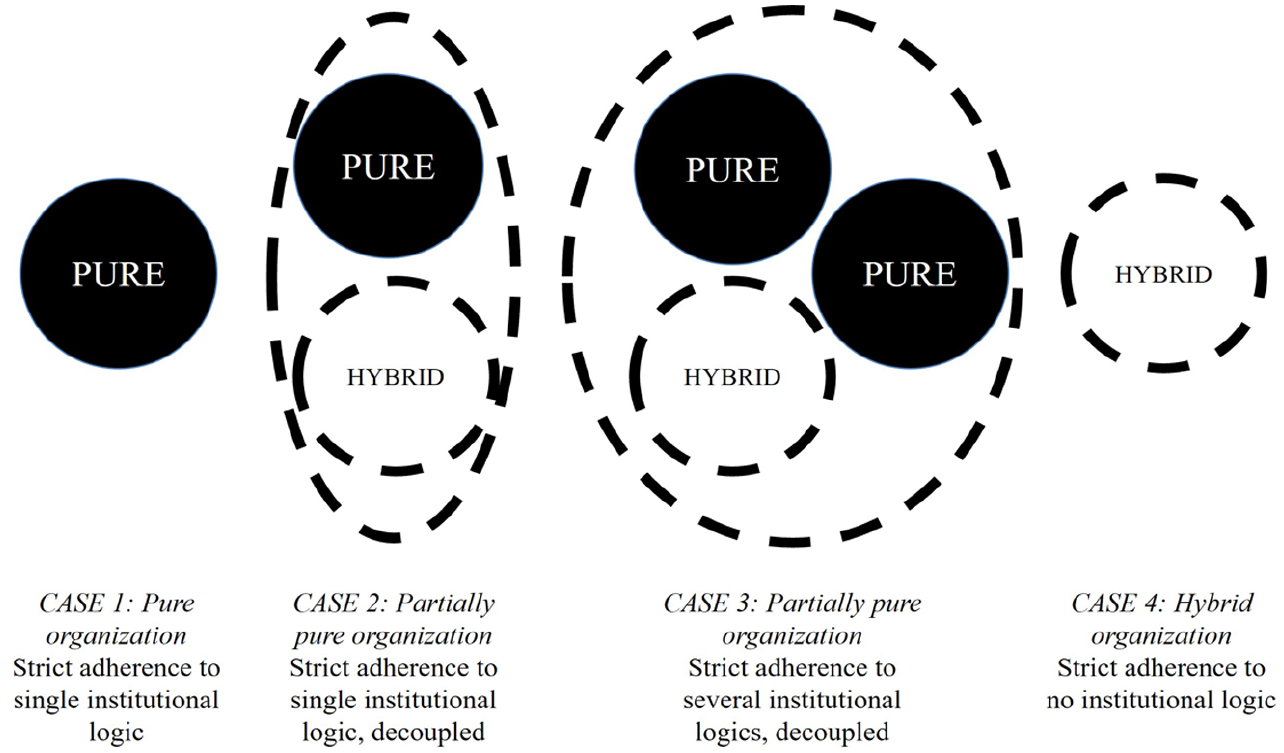
Instantiations of Purity.
At one extreme (case 1), organizations are fully aligned with a single institutional logic. Such organizations – according to organizational theory – are selectively responsive to institutional pressures (Orton & Weick, 1990) in accordance with the single institutional logic to which they adhere. They only heed the demands of institutional stakeholders similarly embodying the same logic.
Organizations may also exhibit purity to different degrees in different areas of their operations to respond to institutional complexity and competing institutional demands (cases 2 and 3). For example, an organization may generally subscribe to a single logic but exhibit purity only at its technical core (Thompson, 1967) (case 2). As such, different parts of the organization may adhere to competing logics. One could also argue that competing demands originating from within the same logic – intra-institutional complexity (R. E. Meyer & Höllerer, 2016) – may lead to similar configurations, for example with two parts of the organization being pure but interpreting the logic in different ways (case 3).
Whether purity is antithetical to hybridization is a thorny issue since hybrids can themselves become new logics. In that sense, organizations that adhere to several logics may become purer, whereas those that respond through identity work to multiple institutional demands by fully integrating various logics into their operations would be impure (case 4). This group would include organizations that mix market and community logics in different ways, attempting to maintain profitability while also creating social value (Battilana & Dorado, 2010); or organizations that transform existing logics to create something new (DeJordy et al., 2014). In all these cases we can see the possibility that in trying to resolve institutional conflicts and meet different audience demands, organizations may lose the essence of who they are: identity work can thus be used to maintain purity or be the source of its demise.
Mechanisms Underlying Purity
If organizations’ purity is demonstrated through their actions, then pure organizations would behave in ways arguably different from those more responsive to their institutional environment. If responsiveness to institutional demands originates from concerns about gaining legitimacy and avoiding sanctions (J. W. Meyer & Rowan, 1977), purity must be motivated by something else. We now explore the social mechanisms (Hedström & Swedberg, 1996) motivating organizations to adhere to a single institutional logic – to align their actions with the expectations and principles of this logic in ways that simultaneously reflect and affirm their own identity.
Purity as clear and stable identity
Purity, as defined here, is a matter of identity. It implies that the organization considers no other course of action – no other identity – possible, and this drives clarity and stability. The defence of specific principles expressed in a logic, even when this requires sacrificing one’s viability, is a mark of such purity. In this sense, purity is an internalized ethos (Voronov & Weber, 2017) which drives fidelity to self-defining values (Selznick, 1994) and related actions that can in turn be routinized to sustain endogenous and procedural dynamics (Power, 2021; Quattrone, 2015). For example, Japanese firms have traditionally sacrificed profit to follow a cultural logic that prescribes a lifelong commitment to employees (Toivonen et al., 2011). Pure organizations, equating a violation of their logic with a violation of their identity, willingly (even if perhaps not happily) sacrifice themselves to preserve their prevailing principles.
Although steadfast adherence to a logic acts as a watershed for self-definition, an organization’s identity is also bounded by its embeddedness in a field. In other words, while purity determines the clarity and stability of an identity, its specifics are field-dependent and require constant identity work because of ever-changing conditions (Brown, 2022; Brown & Toyoki, 2013; Lok, 2010). For example, two high-end luxury companies relying on craft skills may belong to different fields with contrasted understanding of craft. In watchmaking, technical prowess in the design of mechanisms is crucial (Godart et al., 2020), whereas in fashion, connecting brand identity with ever-changing trends is critical (Godart, 2012). However, their steadfast adherence to the craft logic will make them pure in the eyes of each other.
Identity induces action (Foote, 1951), so purity delimits what an organization will or will not do. For example, a pure symphony orchestra adheres to an aesthetic, rather than market, logic – music for music’s sake – as evidenced by its performance of works from a demarcated classical music canon (Allmendinger & Hackman, 1996; Glynn & Lounsbury, 2005). Similarly, professional purity entails the ‘ability to exclude nonprofessional issues. . .from practice’ (Abbott, 1981, p. 823), thus marking a distinct path for pure professionals.
Purity as self-categorization
Purity as a vehicle for self-categorization fits with Douglas’s ([1966] 2003) idea that cultures establish rules and taboos to protect themselves from danger and ambiguity. These rules encourage contact with easily categorizable acts and entities while discouraging those that violate established categories (Douglas, [1966] 2003). Similarly, academic facilities’ rules and taboos for the procurement and use of cadavers preserves the boundaries between moral and immoral organizations in the human cadaver trade (Anteby, 2010).
Conversely, impurity inhibits categorization. The word itself implies dilution (J. W. Meyer & Rowan, 1977) or mestizaje – mixing (Lugones, 1994) – of pure elements. Purists view that which is impure as tainted, distorted or out of place (Douglas, [1966] 2003; Vollmer, 2012). Lugones (1994) uses the metaphor of egg white tainted by yolk, and mayonnaise curdled by the addition of vinegar. In the organizational context, Yanow (2004), using Orr’s (1996) case study of copy machine technicians, describes how workers on an organization’s geographic periphery used ‘tainted’ knowledge gained through informal interactions with other technicians rather than strictly adhering to the diagnostics in the machines’ service manuals. Such contamination of pure elements violates the rules of how things ‘should be’ according to some established logic.
In this sense, purity acts as a self-governing force that separates and creates boundaries between organizations in their social relations. In other words, it is driven by categorization (Zerubavel, 1996). Purification rituals have long been known to be used to mark the end of liminal states where members have no clear status (V. W. Turner, 1967; Van Gennep, 1960). Accordingly, Japanese culture, steeped in the Shinto ethic, understood the resignation of Toshiba’s directors following the 1980s Toshiba-Kongsberg scandal (where Toshiba sold machine tools to the USSR) as necessary to purify the company – and, by proxy, the country – especially in the eyes of offended Cold War allies (Wargo, 1990). On a more general level, the practice of organizational downsizing acts as a modern-day business purification ritual – in principle, the pruning of the organization provides the firm an opportunity to flourish (Gabriel, 2012) at the cost of individual suffering. In the case of Toshiba, purification separated ‘sullied’ outsiders from insiders who remained ‘undefiled’.
Achieving purity requires dividing the world into categories with clear and simple definitions, avoiding mixtures (Lugones, 1994). This may be easily achievable when an organization’s physical and/or membership boundaries are unambiguous. In day-to-day organizational life, medical facilities achieve purification and separate themselves from the contaminated outside world through a staff dress code (Rafaeli & Pratt, 1993); when staff arrive they enter aseptic terrain. Within the hospital milieu, caregivers communicate professional purity by their dress: long white lab coats for licensed medical doctors, shorter jackets for medical students (Wear, 1998), making it clear what (or who) does and does not belong.
Pure organizations thus categorize themselves and others based on similarities and differences to establish and affirm their own distinctiveness. In this sense, categorization into pure/impure has a defensive purpose: doing so helps differentiate between safe and unsafe interaction partners (i.e., those worthy and unworthy of time and resource investment) (Brewer, 2003; Deaux, 1996; Strejcek & Zhong, 2012; J. C. Turner, 1987). In creating clear categories, pure organizations exert control and reduce ambiguity for themselves and others through such identity work. Another example is provided by Japanese traditionalists defending the employment system from change: In Japan, the continued cultural centrality of the long-term employment system has led to an increasingly divided situation where those who fail to enter it are generally considered inferior in terms of status – as if they were contaminants to be kept in the margins so as to not taint a system that is itself pure. (Toivonen et al., 2011, p. 3)
In a similar mode, academically housed human cadaver procurement programmes distance themselves from ‘immoral’ (for-profit) independent procurement programmes. One of Anteby’s (2010, p. 621) respondents indicated that the programmes’ categorization even extended to the physical separation of the products they managed: ‘We do not allow our specimens to mix with other groups [of specimens]. . . I will not allow my specimens to be used with specimens from private brokers or for-profit ventures.’ Similarly, scholars operating on a pure theory of law basis attempt to separate positive law from other considerations, their position being that ‘the specific science of law, the discipline usually called jurisprudence, must be distinguished from the philosophy of justice, on the one hand, and from sociology, or cognition of social reality, on the other’ (Kelsen, 1941, p. 44). Where organizations have unambiguously definable and communicable physical and/or membership boundaries, purity, as strict adherence to an institutional logic, is more likely to be observed.
Implications of Purity for Organizational Structure, Strategy and Survival
Defined in this way, purity has important implications for organizational structure, strategy and survival. Pure organizations will not follow the behavioural rules laid out by traditional organizational theory, including institutional theory. When attempting to follow the norms of several institutional logics, organizations will be likely to structurally compartmentalize pure areas to protect them from outside influences, akin to ambidextrous organizations that attempt to separate exploratory activities from exploitative ones (Raisch et al., 2009). In markets, pure organizations will be predictable due to the clarity and stability of their identities. However, purity may reduce their resource base if they find fewer sympathetic audiences, and even potentially sympathetic audiences may avoid investing in an organization they see as rigid and ultimately likely to fail. At the field level, pure organizations may be able to change market dynamics.
Implications for organizational structure
Organizations attempting to appease different audiences often engage in means–ends decoupling (Bromley & Powell, 2012), whereas pure organizations pursue activities with clear connections to outcomes and that are clearly integrated with core goals via identity work. Trappist breweries, for example, are involved in economic activity to achieve monastery self-sustainability as Saint Benedict’s Rule demands, but this requires them to engage with the world outside the monastery walls. Although they may follow brewing and bottling requirements that enable them to avoid sanction from hygiene authorities, this is only a means of fulfilling their religious duty. In an apt illustration of the type of identity work entailed by steadfast adherence to a logic, when asked why he would not increase production to meet skyrocketing demand, the abbot of the Westvleteren abbey (a famous Trappist brewer) explained: ‘We are not brewers. We are monks. We brew beer to be able to afford being monks’ (Stott, 2014). Trappist brewers are monks who seek religious self-actualization and a happy afterlife, not consumer-driven success in the beer marketplace. To avoid defilement they compartmentalize (Reay & Hinings, 2009) their interactions with the market. A few select monks interact with intermediaries, who, in turn, sell the product to distributors. The monks themselves do not sell beer to the consumer.
Compartmentalization of purity can also be found in the case of haute couture. This very high-end custom-fit clothing is considered the purest form of fashion (Aspers & Godart, 2013) and embodies the idea of design for design’s sake. Fashion houses such as Chanel maintain the haute couture tradition, strictly adhering to a crafts logic in this area of their operations. Haute couture substantiates Chanel’s identity (Cattani et al., 2023) but serves such a restricted market that sales cannot ensure financial sustainability. Rather, the organization maintains profitability via its ‘industrialized’ product lines such as accessories. Its balance sheet suggests that it thrives under this segmented structure. Without at least one part of the organization subscribing to a market logic, the firm would lack resources, but it is the adherence to craftsmanship in haute couture that endows the organization with a unique identity; the concomitant attribution of ‘authentic luxury’ by its audience provides status (and the resulting mark-up) for mass-produced products.
By compartmentalizing, pure organizations can respond to diverse institutional pressures while also protecting areas where purity is fundamental to their identities. Yet both organizations compartmentalizing purity and those aligning their full selves with a single logic face trade-offs: Whenever a strict pattern of purity is imposed on our lives it is either highly uncomfortable or it leads into contradiction if closely followed; and if not observed, hypocrisy. That which is negated is not thereby removed. The rest of life, which does not tidily fit the accepted categories, is still there and demands attention. (Douglas, [1966] 2003, p. 164)
Although in theory a range of purity manifestations exists, we would expect to observe compartmentalization in only two types of cases. In its most integral form, pure organizations will strictly and completely adhere to a specific logic. Their structure and actions – indeed their entire identity – will embody that logic. Here, full alignment with a logic would inhibit compartmentalization; rather, they will demonstrate that part of the ‘coupling’ continuum where organizations are distinctive but unresponsive to institutional pressures – to use the terminology of Orton and Weick (1990), decoupled systems (p. 206).
As noted earlier, complete purity is rare in the organizational world, but other forms of purity are more common. First, organizations may be pure in several areas, while strictly adhering to separate institutional logics. Chanel’s craft-tied haute couture and market-driven businesses provide one example. Their operations are separate but under one organizational umbrella, sharing one brand and some support functions. Whereas the former would never tailor its product to consumer taste, the latter is defined by it. In a different industry, 3M is known for separating its most innovative research units to keep a pure research agenda from more exploitative units that focus on maximizing profit from existing products such as Post-it notes (Hindo, 2007).
Second, organizations may adhere to one logic but be pure in only one part of their operations and manifest less rigidity and perhaps hybridization in others. Glynn (2000), for example, describes the Atlantic Symphony Orchestra where musicians ascribed to an aesthetic logic (‘music for music’s sake’) while the bottom-line driven board of directors sought to integrate a market logic into programming and production.
Finally, organizations that only weakly subscribe to an institutional logic will not exhibit purity in any area. These loosely coupled organizations will be distinctive in their context, but also highly responsive to the demands of the institutionally complex environment (Orton & Weick, 1990; Weick, 1976). Not subscribing to a rigid set of expectations, their identity would reflect a mixture of logics. Thus, in seeking alignment to gain legitimacy, they would have much less need to protect certain areas from outside influence. An adverse consequence of this may be that they lose the ability to categorize themselves and end up being disregarded for want of a clear and stable identity.
Implications for organizational strategy
Chandler (1962) famously observed that organizational structure follows organizational strategy. For pure organizations we propose that strategy follows the (observable) pattern of steadfast adherence to a single institutional logic. Pure organizations will be consistent and unwavering. Their goals will be aligned with the logic they embody, and hence will show no decoupling between means and ends in their structure (Bromley & Powell, 2012). As with pure strategies in game theory, where a player will always play the same move regardless of what other players do (Athey, 2001), pure organizations are predictable – in some cases, perfectly predictable. For example, because Trappist monks’ beer brewing activity is an outgrowth of their strict adherence to a religious logic that requires them to work and be self-sustaining, a Trappist brewer’s production will be predictably restricted to the amount needed to support the monastery and charity work. The strategy and tactics used to achieve this would reflect the relevant logic.
Implications for organizational survival: Is there a purity discount?
As past research has demonstrated, organizations which make no attempt to gain legitimacy or adapt to their audience(s) may find themselves with less support than those that do. Responsiveness to only a small insular group may cause the organization to lose relevance outside of this group, as occurs with ‘professional regression’ (Abbott, 1981, 1984) whereby professionals become so specialized that they lose the ability to relate to all but very specialized audiences. The same can be seen with inflexible, fading languages that are dominated by purists and out of reach to potential (non-native) speakers (Cosslett, 2013). Social movements demanding purity may experience the same issue. For instance, factions within the American feminist movement of the 1960s and 1970s sought ideological purity as expressed in radical self-identities. Research suggests that their rigidity and the resulting intragroup conflict ultimately left the movement rudderless and reduced its base of support (Ryan, 1989). With purity limiting the number of potentially sympathetic audiences from which to gain resources, it follows that such rigidity will undermine survival rates (cf. Carroll & Hannan, 2000; Staw et al., 1981).
Beyond a reduced supportive audience, purity may further reduce organizational survival rates due to what we call a purity discount: audiences that might otherwise consider the pure organization authentic or legitimate may limit their support, anticipating its potential demise. This support (or lack thereof) will likely vary with the audience’s alignment with the pure organization, and can be mitigated by audience expectations being heeded and aligning with an organization’s purity. The reverse scenario, where audiences’ expectations change and bring them out of alignment, may raise the purity discount due to perceptions of the pure organization as particularly rigid.
Implications for fields and markets dynamics
We have argued that, unlike most organizations, pure organizations consider a restricted audience – that of other purists. This changes how we think about the roles different organizations have. The traditional perspective, the basis for much network and market theory, views organizations as rational market players who observe other players to determine the correct course of action (White, 1981). Pure organizations, however, may be endowed with a market position not because they have strategically entered a particular market (as defined by others) but simply through happenstance – such that their presence in a given market enables them to engage in identity work to fill the obligations of adherence to the logic they embody.
Purity can also help explain social movements and shifts in institutional logics. In Scott’s (2001, p. 184) examination of institutional change, he highlights how ‘the weakening and disappearance of one set of beliefs and practices is likely to be associated with the arrival of new beliefs and practices’. Friedland (2009) posits that attempting to transform institutions requires power, resources, organization and the use of coercion to gain support. In such situations, organizations are dependent on an audience to consent to a shift (Emerson, 1962), and thus gain legitimacy. Here the message is that institutional change occurs when social and environmental factors align to incubate the seeds of change. Pure organizations may serve as a catalyst in that process. When they move into a new institutional environment, power may emanate from their lack of survival-seeking. Because their actions reflect identity expression or self-categorization rather than survival, existing institutional arrangements will hold less sway, hence they may inspire change. Religious investors, for example, started the social investing movement when they began aligning their financial decisions with their religious logic (Peifer, 2014). Their willingness to risk their economic resources for the sake of their values – and gain market share while flouting established economically rational investing principles – inspired others to found related endeavours.
Several scholars have described how, through time, one logic within a field or industry emerges and replaces an existing logic (e.g. Rao et al., 2003; Thornton, 2002). The purer the organization, however, the less likely it will be to adapt to demands for a shift in logic. Organizations aligned with the dominant logic are particularly immune to pressures for institutional change (Thornton, 2002). As unchanging embodiments of a logic, pure organizations ‘constrain, regulate, organize, and represent at the level of the field itself’ (DiMaggio, 1991, p. 268). In so doing they define and defend the field as it is, or as they see it in their own image.
Yet even among pure organizations in the same field, perceptions of the appropriate interpretation and enactment of a logic may differ. Organizations may adhere to a single dominant logic, but use other logics as lenses (Greenwood et al., 2010). For example, religious educational institutions may interpret purity vis-à-vis a religious logic differently. Their identity work may lead them to adopt a transformative strategy (DeJordy et al., 2014) that embraces a single superordinate logic – their presence in the educational field being faith in action. What strict enactment of a religious logic means, however, may differ in practice across organizations or religious groups. Whereas some religious institutions see it as requiring an educational focus on religious doctrine, Jesuit institutions employ a modernist lens that supports the idea of ‘God in all things’ and justifies non-religious inquiry (DeJordy et al., 2014). An overarching religious logic dominates in both cases, but the interpretation of what adherence to that religious logic is differs.
Audience Responses to Organizational Purity
In institutionally complex environments, different organizations can align themselves to greater or lesser degrees with different logics (Greenwood et al., 2011). How that alignment affects them will depend on how different audiences interpret their resulting actions – how closely they align with an audience’s perceptions of how the world should be (Stoll, 1968; Zuckerman, 1999; Zuckerman & Kim, 2003). Whereas economically rational organizations strategically manage different institutional pressures to gain legitimacy from as many powerful audiences as possible to ensure their survival (Oliver, 1991; Pache & Santos, 2010), pure organizations will behave in ways consistent with the logic they embody regardless of contextual demands and environmental pressures.
Pure organizations do not attempt to appease audiences representing diverse logics, and hence provide a theoretical testing ground to explore how different audiences react to the same behaviour. We predict that a given audience will award a pure organization status, legitimacy, or contempt depending on the degree to which its behaviour aligns with the audience’s expectations. In line with institutional theory, we predict that the resources gained from audience evaluations may enable it to survive and thrive. However, to predict survival in the pure organization’s case, one must also consider audiences who award it excess resources, and those who attempt to destroy its resource accrual.
Authenticity and status
Authenticity in the eyes of audiences is socially constructed and context-dependent (Carroll & Wheaton, 2009; Fine, 2003; Peterson, 2005; Potter, 2010). In organizational studies, authenticity is an attribution of ‘whether an entity is true to its associated type [or category]’ (Carroll & Wheaton, 2009, p. 255). Authentic organizations, then, are those that embody what an organization of their type (according to a given audience) should be. Music critics, for example, deem authentic those symphony orchestras that only perform pieces from the established classical musical canon (Glynn & Lounsbury, 2005). Pure organizations may elicit judgements of authenticity because of their stability and clarity of purpose, the consistency of their values, and the alignment of their actions with their principles. Conversely, they could be seen as inauthentic, for example, if their adherence is perceived to be too strict given the prevailing social reality: authenticity is often believed to require (some) change and adaptation (Levy, 2011).
Pure organizations exemplifying an audience’s constructed categories – those the audience considers authentic – gain status and, consequently, superior access to resources (Bothner et al., 2022; Boyle, 2003; Carroll & Wheaton, 2009; Glynn & Lounsbury, 2005; Lehman et al., 2014; Leory et al., 2012; Potter, 2010; van Knippenberg & Hogg, 2003). Institutional gatekeepers differentiate between those that are worthy of resources and those that are not, bestowing status on those that fit with their expectations (Kerckhoff, 1976). For example, Anteby’s (2010) academically housed cadaver programmes readily provided cadavers (‘social distributions’) to other programmes adhering to an ‘academic’ logic even when these implied a time and an opportunity cost, and left their own needs unmet. This generosity did not extend to the independent ventures that followed a market logic, although the cadavers from different programmes often met the same end. As described earlier, Abbott’s (1981) story of professional purity demonstrates how it begets professional status. Professionals who function untainted by the problems of the mundane substantiate the profession: they reflect their peers’ understanding of what the profession should be. As such, they are deemed authentic and gain status.
Compliance and legitimacy
Organizations in general gain legitimacy when their actions comply with established norms in their environment or their characteristics fit with established categories (Baum & Powell, 1995; Tolbert & Zucker, 1983). Achieving compliance with some ‘taken-for-granted’ category or institution provides access to resources (Elsbach & Kramer, 2003; Lounsbury & Glynn, 2001; Navis & Glynn, 2010; Zuckerman & Kim, 2003).
However, pure organizations primarily only seek legitimacy from stakeholders that subscribe to the same institutional logic. Westvleteren monks, for example, may consult with other Cistercian (or Trappist) monasteries to understand how to better embody Saint Benedict’s Rule in the changing world outside the monastery, regardless of the markets within which these other members sell their goods. Trappist breweries, however, do not seek legitimacy from organizations in the beer market, and certainly not from commercial brewers.
Although pure organizations will not seek legitimacy from outside those described above, their actions may fit with a market’s established categories and thus comply with a given audience’s expectations. In such cases the pure organization will nonetheless gain legitimacy based on its behavioural compliance with common norms. Trappist breweries, for example, fit the market’s definition for breweries: their product fits into the category the market has designated for (high-quality) beer. As a result, these monks have gained legitimacy from beer market consumers and regulators for their products.
Deviance and contempt
Contempt is a negative moral emotion that expresses disapproval of an organization’s behaviour (Ekman & Friesen, 1986, 1988; Izard, 1977; Rozin et al., 1999). The outcome of contempt is social exclusion – the rescinding of relationships and resources (Izard, 1977). When a pure organization’s behaviour violates the categories and norms related to an institutional logic to which an audience subscribes, it endangers the audience’s sensemaking and social system. Audiences whose expectations are violated will view the pure organization as deviant and react with contempt (Friedson, 1965). That pure organizations do not attempt to appease external audiences makes them particularly unambiguous in their perceived deviance and therefore a target of contempt. Pure organizations function as the prototypical incarnate. For example, a financial services organization that focuses only on financial value creation – and ignores other logics – may attract contempt from proponents of other logics (e.g. religious, community, anti-capitalist activists) by exclusively embodying the financial logic.
Thus, an audience’s understanding and treatment of a pure organization will depend on both the compatibility of the institutional logic they themselves subscribe to versus that embodied by the organization, and on the degree to which they strictly adhere to the organization’s logic. The pure organization’s behaviour, however, is not likely to change. Its unchanging behaviour may therefore exemplify, comply with, or violate different audiences’ norms. Thus, a pure organization awarded status by one audience may be simultaneously held in contempt by another.
The literature provides several examples of this. In a study by Lehman et al. (2014), restaurants which customers deemed most authentic also had higher numbers of infractions for failing to comply with hygiene requirements. Those which garnered status (positive reviews and high online rankings) from an appreciative consumer audience also garnered fines for norm violation from the Department of Health. In classical literature, Don Quixote’s adherence to an alternative institutional logic – the ‘impossible dream’ that guided his chivalrous quest – cost him time, his health and the respect of a social circle who viewed him as deviant. A failure to his peers, Don Quixote today is seen as heroic. Some, such as organizational theory luminary James March, have even suggested that leaders should learn from the Man of La Mancha’s passion and discipline in the way they manage and inspire their organizations (Augier, 2004).
Purity, then, and the restricted course of action it allows, can prompt different responses from different audiences based on how those actions support or violate associated social norms. Figure 2 delineates these possible audience responses to organizational purity.

Responses to Purity.
Discussion
In organizational theory, rational organizations tailor their actions to what will ensure their survival and yield the best outcomes, based on potential rewards and punishments as defined by the institutional logics that dominate their social structure. This structural embeddedness restricts the choices organizations see as possible or desirable (Granovetter, 1985). Acknowledging that, within an interinstitutional system, organizations often enact different preferences and integrate several logics into their operations, we understand pure organizations as those that strictly adhere to a single institutional logic, giving it primacy over all others. This means that these organizations’ actions within the institutional environment will likely be distinctive but, since they reflect their identity rather than a survival motive, they will not conform to multiple institutional pressures.
We have positioned purity in line with previous work, drawing on the institutional logics perspective. We have argued that purity stems from an organization’s identity work (Beech, 2008; Brown, 2022; Brown & Toyoki, 2013; Ibarra & Petriglieri, 2010; Winkler, 2018) and related self-categorization motivations. These identity-related processes result in organizations that consider a reduced set of audiences – those aligned with the logic they embody – and in so doing affirm their own purity. Different audiences will react to such behaviour differently, depending on their alignment with the particular logic the pure organization embodies. We have also outlined how purity affects organizational structure, strategy and survival. Integrating considerations of purity into the institutional logics perspective adjusts our understanding of organizations’ motivations, behaviour and outcomes. We argue that organizations that strictly adhere to a single institutional logic in a self-defining way are motivated by gaining legitimacy from audiences in as far as far as this legitimacy relates to the logic they embody.
Our theorizing makes, we believe, the following contributions. First, exploring organizations’ purity provides further nuance to institutional theory. Neo-institutional theory has enriched our understanding of how social structures and institutional demands shape organizations’ identities and behaviours, as well as providing evidence of organizations seeking legitimacy and avoiding sanctions (Powell & DiMaggio, 2023). However, although it has fuelled interest in studying organizations that have such motives, it has largely overlooked those that do not. Using a purity lens broadens the scholarly scope from understanding that organizations simply respond to institutional pressure to examining the degree of their response and the set of audiences to which they react. We thus acknowledge that organizations do not deem all audiences equally important, and that flouting the norms of certain audiences may bring success (i.e. the resources that come with status) rather than a coup de grâce. Accordingly, organizations viewed as un-legitimated from one audience’s perspective may be deemed authentic by another. Purity gives institutional scholars a base from which to compare organizations adhering to different logics based on the degree of their adherence. We have framed this paper around the idea of purity as an unvalenced construct that is conceptualized along a continuum. Just as hybrids that follow similar strategies are expected to act in comparable ways regardless of the logics they combine (Battilana & Dorado, 2010), pure organizations can be expected to similarly disregard institutional complexity.
Second, the concept of purity highlights the importance of individuating institutional audiences. If, as we have argued, an audience’s alignment with a focal organization’s logic leads them to expend different resources either to ensure or undermine the organization’s success, considering the number and types of relevant institutional audiences requires that we measure organization success vis-à-vis specific audiences. Traditional literature on organizations’ search for survival tends to see the organization–audience relationship as dichotomous: either the organization succeeds in positioning itself in an appropriate and supported category and survives (in terms of financial and material resources), or does not (e.g. Negro et al., 2010; Vergne & Wry, 2014; Zuckerman & Kim, 2003). In contrast, pure organizations tend to survive when they gain enough resources from audiences – via legitimacy or authenticity – and are only sanctioned by a few, thereby avoiding failure. An organization receiving strong support from one type of audience and strong sanction from another may, in effect, gain more resources than another that obtains lukewarm legitimacy with many (cf. Kovács et al., 2014).
Our conceptualization of purity has implications for other streams of organizational research as well. In the social networks literature, for example, scholars have called for more attention to self-ties – actors’ understandings of themselves – and how these affect their creation of ties with others (Silver & Lee, 2012). Purity suggests that organizations’ identities and need for self-categorization play an important role in determining how many and which audiences an organization heeds, and which interaction partners it attends to. The purer the organization, the fewer stakeholders will be considered valid reference points for interaction. This brings nuance to the literature on identity and categorization, particularly the notion that organizations seek to position themselves in markets and fields based on notions of ‘optimal distinctiveness’ (Durand & Haans, 2022). By implementing strategies to be optimally distinctive, organizations aim to conform enough to normative pressures from others so as to meet social expectations, and thus gain legitimacy as a category member while remaining different enough to be understood and appreciated as a unique and differentiable player (Alvarez et al., 2005; Askin & Mauskapf, 2017; Burgdorf, 2024; Zhao & Glynn, 2022). Yet while recent research has called into question organizations’ motivation and ability to pursue optimal distinctiveness strategies (Durand & Haans, 2022), it still largely assumes that organizational survival propels market behaviour and strategy.
In contrast, our conceptualization of purity suggests that even without such motives, distinctiveness (and superior performance) may be randomly attained from pursuing identity-based objectives. As Durand and Haans (2022) suggest, this leads to descriptive rather than prescriptive theory; the latter may be better suited for organizations that seek growth in markets with pure players (like the beer brewers who see themselves as competitors to the Trappist monks).
In terms of further research, our integration of the purity construct into the organizational theory literature opens various doors for future studies. These include questioning which and how many audiences (or of what size or reputational bearing) organizations must, at a minimum, please to survive in a given interinstitutional environment. We believe that studying specific cases of survival or failure based on audience support could further reveal how shared identities foster the creation of categories at the organizational level (Durand & Paolella, 2013).
As mentioned above, purity also offers organizational theorists a basis for comparing organizations to better understand the effects of environmental complexity. Future scholarship, then, could examine organizations that adhere to the same logic but that range in purity, or those strictly adhering to different logics. A third avenue filled with potential comes from further exploring the type of identity work inherent in adhering (or not) to an institutional logic and the implications of the notion of identity work at the organizational level of analysis. Although most identity work literature is rooted in the individual level of analysis (Brown, 2022), there is a precedent for examining efforts to retain or segment from certain categories; the original perspective on identity work (Snow & Anderson, 1987) explored how unhoused people reacted to being labelled ‘homeless’. We believe that our conceptualization lays the groundwork to explore ‘the range of activities [organizations might] engage in to create, present, and sustain’ their identities (Snow & Anderson, 1987, p. 1348).
In this paper we have combined an institutional logics lens with an identity work perspective to understand how pure organizations manage to stay true to their logic despite constant institutional pressures to adapt. Our goal has been to provide a coherent definition of purity that is both useful and tractable in organizational theory. Embedding purity in institutional theory – defined as steadfast adherence to a single institutional logic that reflects and affirms an organization’s sense of itself – broadens our understanding of organizations in their institutional environment while providing a strong base from which to explore a longstanding construct in philosophy and the social sciences (Abbott, 1981; Douglas, [1966] 2003; Dumont, [1966] 1970; Kierkegaard, 2008) that has hitherto not been integrated into organizational theory. Our focus on the relationship between organizations which seek survival (or not) and audiences that may or may not provide desirable evaluations creates space for both organization and audience agency while remaining faithful to the idea that both are embedded in an interinstitutional system.
Footnotes
Acknowledgements
We wish to thank Joep Cornelissen, Roger Friedland and Markus Höllerer for their feedback and suggestions. Mistakes remain ours. Previous versions of this paper were presented at the 2016 Annual Meeting of the American Sociological Association (Seattle, WA) and at the 2015 European Theory Development Workshop (Cardiff, UK). Authors made equal contributions.
Declaration of conflicting interests
The author(s) declared no potential conflicts of interest with respect to the research, authorship, and/or publication of this article.
Funding
The author(s) received no financial support for the research, authorship, and/or publication of this article.

Author biographies
Frédéric Godart is an Associate Professor (with tenure) of Organizational Behavior at INSEAD in France. He received his PhD in Sociology from Columbia University. He also holds an MPhil in Social and Political Sciences from the University of Cambridge (Trinity College), an MSc in Management from Sciences Po Paris, and was a fellow of the École Normale Supérieure in France. He is the co-editor-in-chief of Poetics: Journal of Empirical Research on Culture, the Media and the Arts. His research on the dynamics of creative industries has been published in top academic journals including the Academy of Management Journal, the Annual Review of Sociology, Harvard Business Review, Organization Science, Organization Studies, Social Forces, and the Strategic Management Journal.
Sarah Wittman did her PhD at INSEAD. Her current research focuses on organizational transitions; obstacles and opportunities in these transitions; and the social, technological, and learning support systems that can help make these comings and goings more personally and organizationally successful. Her research has appeared in top academic journals such as the Academy of Management Annals and the Academy of Management Review, and has received funding from the Institute for Digital InnovAtion (at George Mason University), the U.S. Army Research Institute, and the U.S. National Science Foundation.