




Abstract
More than a decade ago, Thornton and colleagues added community to the inter-institutional system and argued that the community logic shapes individual and organizational behavior, determines organizing principles, and influences community–organization relationships. In justifying this addition and defining the ideal type, they drew mostly upon the literature on local communities and organizations. However, the increasing relevance of other types of communities to organization studies necessitates a re-examination and further specification of this framework. This article starts with a review of 172 papers from highly ranked organization and management journals over the last 30 years and summarizes insights on four types of communities for which discussion has flourished: communities of place, of practice, of users, and of firms. This is followed by pattern matching to explore whether these four types follow the initial description of the community logic. We find four variants of the community logic, one for each type of community. We show that all the reviewed types organize around a common boundary, which yields a new definition of the community logic. This commonality also offers scope for comparative research and reconceptualization of community–organization relationships. Furthermore, by specifying the organizing principles that vary, we extend previous research and explicate the main underpinnings of community organizing. The paper ends by suggesting avenues for future research that further embrace an institutional logics perspective on communities.
Introduction
Acknowledging the enduring relevance of communities in modern societies and their influence on organizations (e.g., Dunham, Freeman, & Liedtka, 2006; Marquis & Battilana, 2009; O’Mahony & Lakhani, 2011), institutional scholars have recently framed community as an institutional logic (Marquis, Lounsbury, & Greenwood, 2011) and as one of the seven societal forces in the inter-institutional system (Thornton, Ocasio, & Lounsbury, 2012). The community logic encourages actors to prioritize their common values, practices, and pursuits, and inspires trust, reciprocity, and moral responsibility (Thornton et al., 2012). As a result, it triggers resistance against conflicting logics (Marquis & Lounsbury, 2007), filters the influence of other logics (M. D. P. Lee & Lounsbury, 2015), endorses organizations that are committed to the community (Almandoz, 2012), and shapes organizational activities (Marquis, Glynn, & Davis, 2007).
Yet this understanding of community mainly builds upon the literature on local communities and organizations (Thornton et al., 2012). As such, other types of communities (e.g., Bradshaw, 2008; Brint, 2001; O’Mahony & Lakhani, 2011) may differ in ways that require closer empirical and theoretical attention. Indeed, a handful of studies have already claimed that some communities do not follow the usual ‘community logic’ (Adler, Kwon, & Heckscher, 2008; Adler, 2015; Almandoz, Marquis, & Cheely, 2017). Highlighting this puzzle, Mutch (2021) recently argued against the existence of a distinctive community logic, mentioning that community should rather be considered as social context. Thus, our grasp of the community logic is still limited, if not outdated and prone to challenges. Even assuming that it exists, how is it manifested in the various types of communities of the organization and management field? The answer seems tantalizingly elusive.
This article first takes stock of the organizational and management research on communities over the last 30 years (1991–2020). Building on a sample of 172 papers published in highly ranked journals and using bibliographic coupling, we summarize key insights on four types of communities that scholars have mainly delved into: communities of place (e.g., Marquis & Battilana, 2009), of practice (e.g., Lave & Wenger, 1991), of users (e.g., Jeppesen & Frederiksen, 2006), and of firms (e.g., Snow, Fjeldstad, Lettl, & Miles, 2011). Next, we conduct pattern matching (Reay & Jones, 2016) to see if the initial description of the community logic applies to these four types. We find that each type follows a unique variant of the logic. After briefly analyzing each variant, we note that all the reviewed types organize around a common boundary that serves to better define the community logic, renewing our confidence in the community construct (Dunham et al., 2006; O’Mahony & Lakhani, 2011), offering scope for comparative future research and responding to Mutch’s (2021) thesis.
Specifying the organizational principles that vary, we also answer the call by Almandoz et al. (2017) to explore intra-logic heterogeneity and highlight the differences among community types. In doing so, we extend previous research on the topic by exploring a larger number of communities than earlier studies (Adler et al., 2008; Almandoz et al., 2017; M. D. P. Lee & Lounsbury, 2015). Furthermore, we show that each type of community represents a distinctive form of organizing and set out their organizing principles (Marquis et al., 2011; O’Mahony & Lakhani, 2011). Taking an institutional logics approach to community–organization relationships, we argue that organizations can only access community resources if they are perceived as lying within the community boundary, and view their relationships as the interplay of the logics that exist in and around this boundary. The paper ends by proposing avenues for future research.
Theoretical Background
Community as an institutional logic
Institutional logics are taken-for-granted understandings, values, beliefs, rules, and assumptions that guide individual and collective behavior, create social order, and determine ways of organizing (Thornton et al., 2012). They provide a basis around which individual and organizational goals, strategies, and practices are assessed (Thornton & Ocasio, 1999) and cognition and emotions are shaped (Lounsbury, Steele, Wang, & Toubiana, 2021). They also direct actors’ attention (Ocasio, 1997) and forge collective identities (Rao, Monin, & Durand, 2003).
Considering the institutional orders spawning logics, Friedland and Alford (1991) stressed the importance of the capitalist market, state, religion, family, and democracy, whereas Thornton (2004) emphasized the influence of markets, corporations, professions, states, families, and religions. Reflecting the growing interest in the notion of community as an institution (e.g., Almandoz, 2012; Marquis & Lounsbury, 2007; Marquis et al., 2011), Thornton et al. (2012) finally added community to the preceding list. These authors also proposed a number of categorical elements for comparing the seven institutional orders. They argued that each institutional order includes a distinctive root metaphor, sources of legitimacy, authority, norms and identity, and unique bases of attention and strategy. Under this framework, community is determined by a common boundary (i.e., root metaphor), inside which unity of will, trust, reciprocity (i.e., sources of legitimacy) and commitment to community membership, values and ideology (i.e., source of authority and norms) inspire members to connect emotionally with fellow community members (i.e., source of identity), support each other and their common practices as well as invest in the community (i.e., basis of attention and strategy).
The initial conceptualization of the community logic, as set out above, primarily reflects findings and insights from studies of local communities (Thornton et al., 2012). For instance, Marquis and Lounsbury (2007) showed that community members created and supported community banks to resist bank acquisitions by outsiders. Similarly, Almandoz (2012) showed that founding teams with a local community orientation were more likely to attract local support and establish their business (in that study, local banks). Furthermore, Marquis et al. (2007) viewed local communities as institutions and highlighted the impact of local culture, regulations and norms on corporate social action. Hence, the community logic appears to set boundaries of individual and organizational behavior and endorse commitment to the community.
Despite the stress on local communities, Thornton et al. (2012) argued that the community logic is also found in other types of communities. Indeed, a closer look at communities of product users shows that they are driven by consciousness of kind, trust, reciprocity, and moral responsibility towards fellow community members (Mathwick, Wiertz, & De Ruyter, 2008; Muniz & O’Guinn, 2001). Likewise, communities of practice are formed around a sense of joint enterprise, mutual engagement, and common boundaries — among other things (Wenger, 1998). Hence, it is safe to assume that many community groups follow this logic, whether or not their members share the same geographical space.
Nevertheless, one cannot expect the community logic to materialize uniformly in all types of communities. For instance, Thornton et al. (2012) argued that the visibility of actions is the logic’s informal control mechanism. This might apply to local communities but is less relevant to non-proximate communities of users and practice. In other words, there might be an intra-logic variation, depending on the type of community. Almandoz et al. (2017) were the first to explore this type of variation. Using the aforementioned categorical elements (root metaphor, etc.) as a guiding framework and basis of comparison, the authors pointed out significant differences between geographical and affiliation-based communities in terms of how the logic materializes. They stressed that members of affiliation-based communities identify with and are driven by community values and goals. This contrasts with geographical communities, in which members mostly commit to the community itself.
Yet Almandoz et al. (2017, p. 206) warn that ‘this simple categorization [geographical versus affiliation-based communities] hides an enormous amount of diversity’. To illustrate this, they classify both occupational and brand communities as affiliation-based ones. Nevertheless, these types of communities do not follow exactly the same logic. For example, professionals might associate with their practice (Gittelman, 2007), while consumers might be driven by an emotional connection with the brand (Muniz & O’Guinn, 2001). Therefore, a fine-grained understanding of the community logic requires exploring each type of community and unpacking its unique variant. Moving toward this direction, Adler et al. (2008) discuss the development of a collaborative community among medical professionals, which ‘transcends the limitations of the craft guild and the liberal profession’ (p. 365) and takes a qualitatively different form from traditional communities. Thus, given the relevance of various types of community to organization studies, it is important to review the organization and management literature, identify the most frequently discussed communities and explore whether they follow a distinctive variant of the logic.
Community groups and societal transformations
Several social scientists have delved into the concept of community, its rapid evolution, and the implications of this trend. Over 100 years ago, Ferdinand Tönnies (1887/2017) was one of the first sociologists to claim that there was a shift in social relations from Gemeinschaft (community) to Gesellschaft (society). In his seminal work, he defined Gemeinschaft as living in the same place and being ‘intimate, private and exclusive’ (p. 33). He went on to explain that communities are based on natural will, where shared liking, habit, and memory are the guiding principles for action and interaction, and are usually inhabited by small numbers of people, who commit to common ways of life and beliefs. By contrast, Gesellschaft was described as a set of contractual and superficial interactions, in which the rational will dominates (Tönnies, 1887/2017).
Tönnies’ implicit argument (namely that human relationships gradually weaken and revolve mostly around self-interested goals) has characterized much of classic and contemporary sociology. For instance, Giddens, Duneier, Appelbaum, and Carr (2018) recall that capitalism and the industrial revolution changed cultural traditions and social relations, forcing millions of people to leave their villages to find new jobs in cities. This process sundered meaningful ties in what Zygmunt Bauman (2001) pointedly calls ‘an act of dispossession, an uprooting and eviction from a defensible home’ (p. 30). These views echo those of Marx and Engels (1848/1977) (among others) for whom the emergence of a capitalist mindset left ‘no other nexus between man and man than naked self-interest, than callous “cash payment”’ (p. 44). An additional layer was added by Weber (1922/1978) who saw this trend as accompanied by growing bureaucracy and rationalization. These arguments still ring true today, in a society in which as the expression has it, individuals seem to be ‘bowling alone’ (Putnam, 2000).
Rebutting this line of thought (the so-called ‘community lost’ standpoint), Wellman (1979) was among the first to put forward and test the ‘community liberated’ perspective. In addition to scope for close relationships among neighbors and kin, he showed that intimacy and social support exist among co-workers and friends who are spread out, emphasizing that the quality of relationships is a more important variable than a common geographic setting. Similarly, various scholars have revealed the existence of non-geographic communities (Bradshaw, 2008), such as those stemming from ideological groups, online forums (Brint, 2001), and shared lifestyles and tastes (Maffesoli, 1996), or even those existing in members’ imagination (Anderson, 1983). For our purposes, communities can also reside inside, among and around organizations, creating both opportunities and threats for organizations (O’Mahony & Lakhani, 2011), and alternative ways of organizing (Adler et al., 2008). Thus, community seems to flourish or re-emerge in various forms and social spheres.
Here, one might ask whether such diverse communities follow the same logic. As contemporary communities tend to become ever more unlike Tönnies’ (1887/2017) conception of them, there is a growing need to identify variants of the community logic and to examine the guiding principles of each type (Adler et al., 2008; Almandoz et al., 2017). Otherwise, one might argue that such communities do not embody the aforementioned logic, or that the community logic framework does not adequately represent the diverse communal relationships that exist in, among and around organizations, as it initially intended. In the following sub-section, we briefly discuss a recent challenge to the community logic and show how our analysis deals with the criticism.
Criticism of the community logic
This proliferation of research around communities and the community logic collides with a recent challenge to the logic. In an article at Organization Theory, Mutch (2021) argued that community lacks the coherence to be considered an institutional logic at the societal level and we should rather view it as a social context. One of his core arguments was that Thornton et al. (2012) referred to academic sources that are poorly aligned. For example, on the one hand, O’Mahony and Lakhani (2011) discussed the formation of various kinds of contemporary communities, such as ones of practice. On the other hand, Brint (2001) asserted that communities of practice might center on rational interest and, therefore, should not be considered communities. Summarizing his argument, Mutch (2021) mentioned that ‘what the example of communities of practice suggests is the wide nature of the social formations that are covered by the term community and, by association, casts doubt on the existence of a distinctive community logic’ (p. 8). In addition, he claimed that the concept of community logic might obscure internal differences and tensions, such as those related to class, gender and ethnicity in local communities.
Starting with his first argument, we concur that the term ‘community’ is used to refer to many (possibly dissimilar) social groups. Yet this does not necessarily imply that community cannot be considered a distinctive logic. It only means that the literature has yet to evolve to the point where it can identify variations from the initial conceptualization depending on the type of community. After all, logics tend to take different forms in various kinds of social grouping (Ocasio & Gai, 2020). This is not an issue so long as their configurations prove coherent and durable in a given context (Lounsbury et al., 2021). Moving to Mutch’s second argument, tensions within social groups do not challenge the status of community as a logic. On the contrary, they demonstrate conflicts around organizing principles, which may lead to the emergence of unique variants. In other words, we argue that a deeper understanding of the community logic would allay such concerns. This article’s goals are thus to: (1) improve our understanding of the community logic; (2) show how it materializes in the different types of communities that have been formed through societal transformations; (3) respond to the above-mentioned criticism; and (4) identify implications for research on communities and organizations.
Research on Communities of Place, Practice, Users, and Firms
In this section we summarize the literature on communities in the organization and management field. We draw on a sample of 172 papers published in 39 highly ranked journals (i.e., 4 and 4* as defined in the ABS list of 2018) and included in the Business Source Premier database. Since the concept of community has been extensively used, we chose only articles that included the term in the title. Bearing in mind that some leading journals do not use author-supplied keywords, we narrowed down our search on relevant subject terms (expert-supplied keywords), such as ‘organization’, ‘business’, ‘management’, ‘entrepreneurship’, ‘stakeholder’, ‘institution’, and ‘logic’. We started our review from 1991—arguably the date when the institutional logics perspective emerged (Friedland & Alford, 1991)—to make sure that any community studies using this lens would be included. Our review thus spanned 30 years (1991–2020). The distribution of papers across journals and decades is shown in Table A1 (see Appendix).
Given the richness and diversity of the literature on communities, we aimed to identify the main themes scholars have delved into. Pinning down these themes in conceptual terms is challenging, given the field’s fragmentation, the many definitions and typologies, and the lack of convergence on a level of analysis—a point that has often been made before (see Dunham et al., 2006; O’Mahony & Lakhani, 2011). Yet our aim is not to resolve these debates. Instead (and having already mentioned how the community logic is described by Thornton et al., 2012), our main goal is to conduct pattern matching and compare the most prevalent themes against this description (Reay & Jones, 2016). To this end, bibliometric methods were used to reveal the main themes on which discussion has thriven.
For these reasons, we undertook bibliographic coupling, a method that is more accurate than other bibliometric methods (Boyack & Klavans, 2010) and which claims that papers citing the same sources focus on similar themes (Kessler, 1963). Using VOSviewer software (Van Eck & Waltman, 2009) with fractional counting (Perianes-Rodriguez, Waltman, & Van Eck, 2016), we reveal four clusters of themes or types of communities, as shown in Figure 1—namely those of: place (e.g., Marquis & Lounsbury, 2007), practice (e.g., Boland & Tenkasi, 1995), users (e.g., Jeppesen & Frederiksen, 2006), and firms (e.g., Sytch & Tatarynowicz, 2014). It is worth noting that online communities do not represent a distinctive type, confirming previous studies (Almandoz et al., 2017; Marquis et al., 2011). Next, we coded the reviewed studies to assess whether the community logic materializes differently in these four types. Although this list of communities may not be comprehensive, it encompasses the most frequently discussed types in the organization and management field. Thus the available evidence facilitates the institutional logics-based comparison and provides a good basis for theorizing on the logic. The next section briefly presents the literature on these four types.
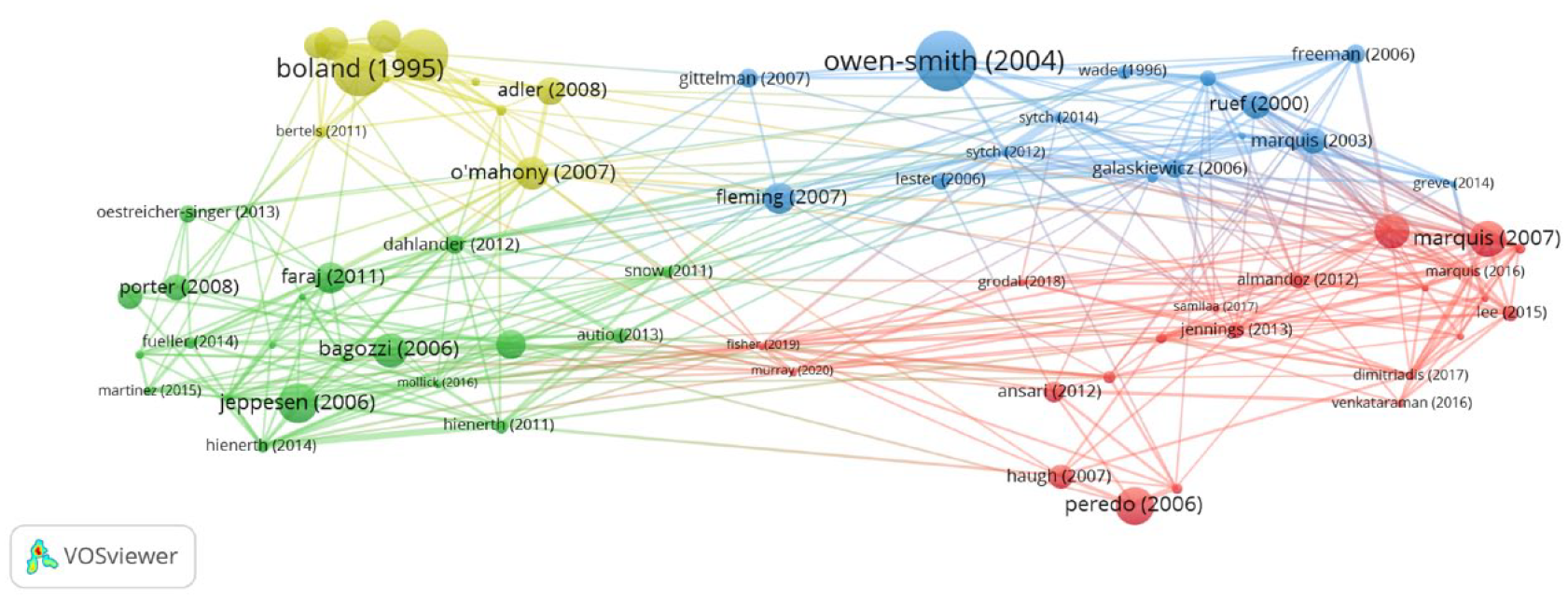
Bibliographic coupling on the literature review’s sample.
Communities of place
Organization and management scholars are still interested in communities of place. These communities are formed in geographic settings, which enable (and even enforce) frequent interaction among members and embody ‘elements of local culture, norms, identity, and laws’ (Marquis & Battilana, 2009, p. 286).
Many studies emphasize the importance of homogeneity, which usually leads to favorable communal and organizational outcomes. Religious homogeneity, low economic inequality (Yue, 2015), low racial diversity (Longhofer, Negro, & Roberts., 2019), and low national origin diversity (Greve & Kim, 2014) strengthen community cohesion and collective action. Heterogeneity, in contrast, raises concerns for communities and organizations alike. First of all, it may limit organizational activities. According to one study, female founders of social ventures were less likely to incorporate commercial activities when there were no female business owners in the region to serve as an example (Dimitriadis, Lee, Ramarajan, & Battilana, 2017). In addition, although integration is considered vital for the creation of business networks (Ring, Peredo, & Chrisman, 2010) and for economic growth and entrepreneurship (Samila & Sorenson, 2017), separation between different community subgroups may be associated with tensions, conflict, and violence; and some studies find that it can make employees less open to organizational diversity (Brief et al., 2005) and more aggressive (Dietz, Robinson, Folger, Baron, & Schulz., 2003). This is not to say that separation is harmful for all the residing organizations, though, as the development of enclaves might benefit some entrepreneurs by giving them better access to suppliers, employees, and customers (Peterson & Roquebert, 1993).
The literature has also delved into the potential of such communities to organize and achieve collective goals, such as creating entrepreneurial culture (Marti, Courpasson, & Barbosa, 2013), lowering crime rates (Sharkey, Torrats-Espinosa, & Takyar, 2017), challenging the status quo (Venkataraman, Vermeulen, Raaijmakers, & Mair, 2016), and showing resilience in times of crisis (Cheng, Yu, Shen, & Huang, 2020). In some cases, such initiatives have been conceptualized as community-based enterprises that build upon previous collective experience, existing social structure, and available community skills (Peredo & Chrisman, 2006); are guided by community values and heritage (Murphy, Danis, Mack, & Sayers, 2020); and can facilitate the creation and preservation of accessible and collectively managed resources (also known as ‘the commons’) (King, 1995; C. Meyer, 2020). It has been said that community organizing can gain more legitimacy than elected officials (Levine, 2016).
Communities of practice
Another kind of community studied by organization and management scholars is that of practice. It comprises professionals who share vocabularies, understandings, assumptions, and practices (Brown & Duguid, 2001; Wenger, 1998), and usually pursue learning, innovation, and knowledge exchange.
Fostering communities of practice requires a shared repertoire of resources (Wenger, 1998), loose organizational structures (Thompson, 2005), significant material and financial investments (Roberts, 2006), and open communication within and among communities (Boland & Tenkasi, 1995). In addition, it demands managerial support (Bertels, Kleinschmidt, & Koen, 2011) and minimizing the a priori cultural differences among members (Stensheim, 2012). It is important to note that the presence of multiple communities within an organization necessitates the creation of common ground, which cannot always be taken as given. As illustrated in Bechky’s (2003) ethnography of a Silicon Valley company, differences among practitioners (i.e., engineers, technicians, and assemblers) emerged ‘on the basis of their language, the locus of their practice and their conceptualization of the product’ (p. 314).
Regardless of the challenges, communities of practice help decision-makers make more informed decisions (Steward, Narus, & Roehm, 2018) and enable community members to discover, evaluate, and exploit new entrepreneurial opportunities (S. H. Lee & Williams, 2007). They also shape economic growth (Kerr, 2008) and assist scientists in developing patents and producing highly cited academic contributions (Gittelman, 2007). Moreover, they sometimes serve as settings for turning newcomers into professionals (Ross, 2007). It is important to note that such communities are usually considered suitable for knowledge exchange, learning, and innovation, as they do not favor strong appropriability regimes and are more capable of managing tacit knowledge (Adler et al., 2008).
Communities of users
Communities of users have recently attracted the attention of organization and management scholars. They are usually formed around a product, service, or platform, and satisfy the members’ need to exchange information, solve user problems, exploit entrepreneurial opportunities, and express values.
Let us begin with communities that are directly related, sponsored, and sometimes managed by firms. The best-known example in this category is the brand community, which is a ‘specialized, non-geographically bound community, based on a structured set of social relations among admirers of a brand’ (Muniz & O’Guinn, 2001, p. 412). Firms use these communities to foster trust and make customers more loyal and willing to share personal information, and keen to co-develop products (Porter & Donthu, 2008). Such communities boost sales (Adjei, Noble, & Noble, 2010) and shape meanings for products and brands (Cayla & Eckhardt, 2008). Turning to users’ motivations, they may take part and contribute because they see the activity as a hobby, are early adopters, or are incentivized by the focal firm’s recognition (Jeppesen & Frederiksen, 2006). Some communities of users also foster social identification and mobilize resources for entrepreneurs (Murray, Kotha, & Fisher, 2020). In some cases, information about user needs (Autio, Dahlander, & Frederiksen, 2013), publicity, brand transfer (Hienerth, Lettl, & Keinz, 2014), and support by fellow users (Hienerth & Lettl, 2011) have enabled entrepreneurial initiatives by community members.
Other commonly discussed communities are peer-to-peer problem-solving and open-source software communities, which are not usually directly related to or managed by established firms. Interestingly, these communities present such a valuable alternative to the firm-based creation of knowledge (G. K. Lee & Cole, 2003) that companies have started realizing the benefits of partnering with them (Shaikh & Levina, 2019). Members may engage in these communities to acquire knowledge and resources (Kane & Ransbotham, 2016), but long tenure also inspires identification with the community and more social interactions (Bagozzi & Dholakia, 2006), satisfying the need for camaraderie and social support (Mathwick et al., 2008). It is worth mentioning that, according to the literature, these communities encourage sharing and criticism, limit the authority of the leaders (O’Mahony & Ferraro, 2007), and serve as a vehicle for individuals to express their values. For instance, some open-source software developers did not commercialize their software because they identified with a community whose norms and goals are incompatible with those of a mainstream firm (Mollick, 2016).
Communities of firms
Organization and management scholars have also paid attention to communities of firms. They are usually formed around symbiotic or collaborative relationships, an element that sets them apart from strategic groups and their accompanying focus on rivalry and competition (e.g., McGee & Thomas, 1986).
Symbiosis among firms may emerge for various reasons, the most important being membership in the same or interdependent organizational populations and fields. Drawing on insights from organizational ecology, scholars have shown that firms are more often founded near populations that could become either suppliers or consumers of their products (Audia, Freeman, & Reynolds, 2006). Moreover, being a member of an organizational population implies occupying a particular identity space (Staber, 1992), which helps firms mobilize social and cultural resources. As such, they may get involved with, expand, or contract an organizational field (Grodal, 2018). However, given limited resources, it is little wonder that high saturation makes it hard for organizational forms with a similar identity to emerge and heightens competition among existing organizations (Ruef, 2000).
Communities of firms may also be formed around common opportunities and goals. For instance, companies developing and selling blade servers (a computer technology whose market potential at that time was hard to forecast) formed a community to develop capabilities and share knowledge in a safe environment (Snow et al., 2011). Another illustrative example is that of the early film industry in the United States, in which production, distribution, and exhibition firms created opportunities for one another (Mezias & Kuperman, 2001). Firms might also engage with one another because they face similar problems and aim to develop common practices and problem-solving techniques (Lester & Cannella, 2006). Nevertheless, as noted by some studies, communities of firms often face tensions: for example, membership dynamics (e.g., firm centrality and membership turnover, Sytch & Tatarynowicz, 2014) and the involvement and dominance of public organizations (Owen-Smith & Powell, 2004) affect the distribution of benefits among community members.
Toward an Institutional Logics Approach to Communities
After briefly summarizing the organizational and management literature on communities, we notice significant differences in their characteristics, and how they organize and influence companies. For instance, communities of place frequently mobilize to protect their fellow members’ organizations (Almandoz, 2012; Marquis & Lounsbury, 2007) and their heritage (Murphy et al., 2020), while some communities of firms are formed to dominate a market (Snow et al., 2011). Taking another example, members of communities of practice usually identify with their practice (Gittelman, 2007), while some communities of users might identify with a brand (Muniz & O’Guinn, 2001). In other words, each type of community sets distinct priorities and follows slightly different organizing principles.
The institutional logics framework is well equipped to identify such nuances since it sees such logics as determining ‘unique organizing principles, practices and symbols that influence individual and organizational behavior’ (Thornton et al., 2012, p. 2). Hence, in this section we use the initial conceptualization of the community logic as a point of reference and conduct pattern matching (Reay & Jones, 2016) to uncover the intra-logic variations that materialize in each type. Specifically, we compare the four types with one another and with Thornton et al. (2012)’s description on the basis of the classic categorical elements (e.g., root metaphor, source of legitimacy, etc.). Even if most of the reviewed studies do not explicitly use the institutional logics perspective, we still identified multiple, vivid descriptions of the underlying root metaphor, source of legitimacy and other organizing principles.
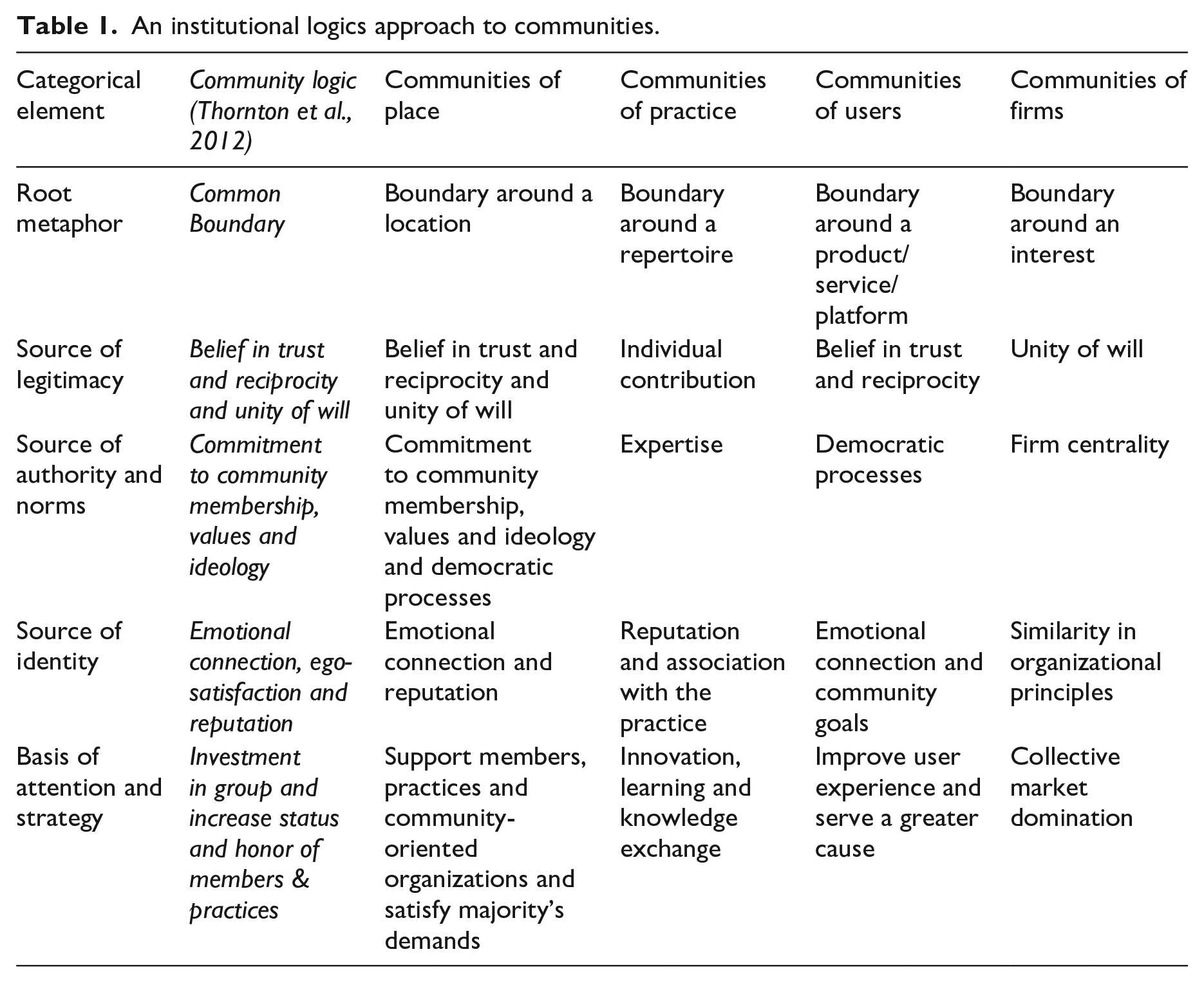
The results of the analysis are summarized in Table 1. On the Y-axis, we use the categorical elements of the institutional logics perspective (Thornton et al., 2012; see also Almandoz et al., 2017) as points of comparison. Borrowing some relatively recent definitions of these elements (Almandoz et al., 2017), we understood ‘root metaphor’ as determining ‘the manner in which knowledge is structured and action is organized’ (p. 195) and ‘source of legitimacy’ as ‘the means by which power or influence is institutionalized and given a moral grounding’ (p. 196). ‘Source of authority and norms’ refers to the rationale behind accepting subordination and restrictions, and ‘source of identity’ to the commonalities that connect individuals. Finally, the ‘basis of attention and strategy’ is the element that individuals attend to and are motivated to pursue when they adhere to an institutional logic. On the X-axis, we present the initial conceptualization of the community logic and the four variants identified. We notice marked differences among the four types in terms of their basis of attention and strategy, as well as their source of authority and norms. In other words, different types of communities appear to be driven by distinctive goals and are subject to dissimilar norms and forms of authority. However, a closer examination also reveals similarities, which provide implications for communities and organizations alike. Before embarking on this discussion, we zoom in on the unique variant of the logic that each type follows and suggest implications for community–organization relationships.
An institutional logics approach to communities.
The variant of communities of place
Given that the initial conceptualization of the community logic was mainly inspired by research on communities of place, this variant as we identified it in the literature does not depart much from Thornton et al.’s (2012) framework. To begin with, studies show that a boundary around a location defines membership in the community. Either in terms of a neighborhood (Marti et al., 2013), a metropolitan area (Marquis et al., 2007), or isolated rural communities (Arenas, Murphy, & Jáuregui, 2020; Ring et al., 2010), this boundary organizes access to resources (King, 1995), enables shared frames of reference, and distinguishes insiders from outsiders (who may be treated with suspicion) (Marquis & Lounsbury, 2007). This boundary is further reinforced by cultural beliefs (Dimitriadis et al., 2017; Marquis, 2003) and isomorphism (Marquis et al., 2007), which facilitate convergence and unity of will. Moreover, members believe in trust and reciprocity, which are considered crucial for community (Peredo & Chrisman, 2006) and nonprofit organizing (Galaskiewicz, Bielefeld, & Dowell, 2006), as well as for members’ entrepreneurial activities (Kwon, Heflin, & Ruef, 2013).
Authority and norms stem from the commitment to community membership, values and ideology and, in some cases, from democratic processes. Members usually support actors that work toward community goals (Levine, 2016; Marti et al., 2013), and follow tradition in defining acceptable behaviors (Venkataraman et al., 2016), and in establishing leadership criteria (Peredo & Chrisman, 2006). Yet studies have found that elected governments also hold some authority (Berrone, Gelabert, Massa-Saluzzo, & Rousseau, 2016). Moving to the sources of identity, members usually share a sense of belonging and emotional connection (Flaherty & Brown, 2010) and appear to prioritize their social prestige and reputation with other community members (Berrone et al., 2016). Last but not least, they often aim to: support one another and their fellow members’ organizations (Almandoz, 2012; Marquis & Lounsbury, 2007); protect their heritage and practices (Murphy et al., 2020); work toward the collective good (e.g., Sharkey et al., 2017); and satisfy the demands of the majority (Marquis, Davis, & Glynn, 2013).
Overall, communities of place mainly follow the initial conceptualization of the community logic. However, insofar as the demands of the majority are important (Marquis et al., 2013), one can see the introduction of democratic processes. Thus, organizations that interact with communities of place not only need to pay attention to community values and ideology but also to build coalitions promoting shared interests (i.e., community and organizational ones). This entails understanding community demographics and also the relevance of other logics. For instance, some members might identify more with people of their race, economic class, and religion than with other community members, especially in circumstances of racial diversity, economic inequality (Longhofer et al., 2019), and religious diversity (Yue, 2015).
The variant of communities of practice
Membership in communities of practice is limited to those who identify with a boundary around a shared repertoire (Wenger, 1998), comprising artifacts, routines, documents, stories, styles, language (Bechky, 2003), and community-specific job titles (Thompson, 2005). Typically, individual contribution matters for garnering legitimacy; it is a requirement for newcomers to move from the edges of the community to full participation in it (Lave & Wenger, 1991), and to gain respect from colleagues (Stensheim, 2012). Furthermore, expertise is a key source of authority and norms—something that strengthens the position of ‘old hands’, who may raise barriers to newcomers (Roberts, 2006) or form coalitions to dominate the community and the company they work for (Fox, 2000).
Collective identity stems from both reputation and association with the practice. First of all, community members usually aspire to be well-respected by one another (Thompson, 2005). In addition, in contrast to the alienation of the modern work environment and conditions (Adler, 2015; Gusfield, 1975), they associate with and are strongly attached to their practice, which helps them to deeply connect with each other and feel somewhat distinct from other organizational members (Rennstam & Kärreman, 2020; Thompson, 2005). This also drives them to work with individuals from other firms (Gittelman, 2007). Finally, community members are motivated to pursue innovation, learning, and knowledge exchange (e.g., Adler, 2015; Boland & Tenkasi, 1995; Lave & Wenger, 1991).
To conclude, communities of practice also operate around a common boundary but in this case it happens to be based on a repertoire of shared language, routines and artifacts. Firms interacting with communities of practice might not benefit from imposing their own logic and from trying to alter and control community dynamics (Thompson, 2005). In fact, one might doubt they can do so even if they wished to (Rennstam & Kärreman, 2020). That is because it is hard to align corporate and community goals, and finding a productive balance requires being sensitive to the interplay of the competing institutional logics.
The variant of communities of users
The root metaphor for communities of users is a boundary around a common product, service or platform. Although users can join and leave the community fairly easily (especially in the case of online communities), studies have shown that frequent contributors usually commit to one or more of the following: (1) a brand (Muniz & O’Guinn, 2001); (2) the free sharing of knowledge (Mollick, 2016); and (3) product development and innovation diffusion (Hienerth & Lettl, 2011). Members rely on trust and reciprocity, which are the sources of legitimacy in such communities. First, members trust other users, assuming their high integrity (Mathwick et al., 2008). Second, when they support one another (for instance by endorsing entrepreneurial initiatives) (Dahlander & Frederiksen, 2012; Hienerth et al., 2014), they expect that other users-entrepreneurs will build on their contribution and reciprocate by developing products that better satisfy their needs.
Regarding authority and norms, democratic processes play a vital role in these communities. Members voluntarily take part so it is reasonable to expect that hierarchical relationships are limited, leaders can be recalled, and majority voting may be adopted (O’Mahony & Ferraro, 2007). In such a context, leaders are usually members who engage in brokerage and boundary-spanning (Fleming & Waguespack, 2007). Turning to the sources of identity, one notes that intense emotional connection and devotion to their common goals (Bagozzi & Dholakia, 2006; Mathwick et al., 2008; Muniz & O’Guinn, 2001) bring community members together. In terms of attention and strategy, members are motivated to improve user and consumption experience (Autio et al., 2013; Setia, Bayus, & Rajagopalan, 2020). Furthermore, they aspire to serve a greater cause, which is reinforced by the introduction of rituals and traditions (Muniz & O’Guinn, 2001). This motivation might explain why they sometimes abstain from commercializing their products (Mollick, 2016), and feel gratification and pride in being recognized by the firm-sponsor (Jeppesen & Frederiksen, 2006).
All in all, communities of users usually set a common boundary, just like communities of practice. What mainly sets this variant apart is its commitment to democratic processes, emotional connection among members, and trust and reciprocity. Although we can think of very technical communities of users in which expertise and practice are important, these elements carry far less weight (O’Mahony & Ferraro, 2007) than in a regular community of practice. This is perhaps why reputation does not emerge in the literature as a key source of identity, as it did in the previous variant. As a result of these internal dynamics, companies may collaborate with such communities by prioritizing value creation over value capture (Shaikh & Levina, 2019); otherwise, community members would feel that the company does not reciprocate and would doubt its intentions (see Table 1, Source of Legitimacy). In addition, organizations that are seen to serve a greater cause, or at least to have invested their brand with meaning (Muniz & O’Guinn, 2001), would benefit more from the formation of such communities.
The variant of communities of firms
Membership in communities of firms is limited to organizations within some boundary around a common interest, usually defined in terms of industry (Sytch & Tatarynowicz, 2014), standards (Cole & Barberá-Tomás, 2014), or organizational form (Staber, 1992). Community members demonstrate unity of will by adopting shared practices (Mezias & Kuperman, 2001), establishing reputation systems (Cole & Barberá-Tomás, 2014), and providing complementary contributions (Snow et al., 2011). Nonetheless, often the most central and successful firm in each community controls the flow of information (Owen-Smith & Powell, 2004), such that other organizations follow its rules and practices to collaborate with it (Lester & Cannella, 2006; Snow et al., 2011). Regarding the source of identity, we note that communities of firms are developed around common organizational forms (Ruef, 2000), ownership structures (Lester & Cannella, 2006), and strategies (Bubna, Das, & Prabhala, 2020), showing that similarity in organizational principles is a key factor. Last but not least, members are motivated to create business opportunities for one another (Mezias & Kuperman, 2001) and set industry standards (Snow et al., 2011) to collectively dominate the market.
Therefore, communities of firms also create and maintain a common boundary. However, given that they mainly seek to advance their rational interests, it is little wonder that they differ markedly from other kinds of community. Specifically, their members acknowledge and respect the authority of the most central firms, which enforce unity of will. Thus, they cannot rely on trust and reciprocity and democratic processes, as communities of users, or on expertise and practice, as communities of practice.
Discussion
The first part of this article reviewed the organization and management literature and, after bibliographic coupling, delved into the four most frequently discussed types of communities. Communities of place are mainly described through their homogeneity-inducing nature and their potential to organize around common goals. Communities of practice are examined in terms of the conditions that enable them to thrive and the unique role they play in learning, knowledge exchange, and innovation, among others. Communities of users are discussed in two main ways: as a vehicle for users and firms to engage and exchange resources, and as a forum for independent, democratic, value-laden interaction and knowledge creation. Finally, communities of firms are analyzed through their symbiotic or collaborative potential, as they share goals, stakes, or organizational principles. One should note that these four types of communities are not mutually exclusive, thus providing a fluid and flexible view of the construct. For instance, a community of practice might form a community of users (i.e., around the tools they use). Likewise, a community of firms might be formed by members of a community of place.
This initial review prepared the ground for analyzing whether these communities follow the same or different manifestations of the community logic. Our coding revealed some similarity across the four types of communities in terms of their root metaphor (i.e., boundary). This consistency implies that a key pillar of the logic, as described by Thornton et al. (2012), is relevant to these diverse forms of social grouping. Therefore, the community logic might be defined as the logic of creating and maintaining boundaries, within which members establish ‘thick’ relationships and work together in pursuing interdependent goals. This boundary, which is not necessarily geographical or fixed across time and space, separates insiders from outsiders, and shapes individual and collective behavior. To describe communities and the community logic, we prefer using the term ‘thick relationships’ (Arenas & Rodrigo, 2013; Walzer, 1994) to ‘meaningful’ ones (Almandoz et al., 2017). Since meaning is determined by all institutional logics, meaningful relationships can be established through the influence of any logic. The metaphor of ‘thickness’ (in contrast to ‘thin’ relationships) signals deep investment, attachment, and a sense of devotion among individuals, as one would expect to occur inside communities. We believe that the notions of boundaries and thick relationships are consistent with the dual character of the community logic: its bright and dark sides, as it promotes cohesion and mutual support, as well as exclusion and suppression of difference.
This similarity across community types is an important finding as it implies that communities should no longer be seen as a ‘sort of error term containing all sorts of interests and externalities that fail to find homes within customer, supplier, employee, or shareholder groups’ (Dunham et al., 2006, p. 24), nor as an inadequately defined and fragmented construct (O’Mahony & Lakhani, 2011) but rather as groups that create and maintain boundaries. The commonality of boundaries also reveals that the community logic remains coherent, recognizable, and durable (Lounsbury et al., 2021), despite the development of new forms of communities, and enables comparative research and insights that can be leveraged across types of communities. Finally, it helps distinguish the community from other logics, which do not rely as much on setting and maintaining boundaries.
Responding to the recent call by Almandoz et al. (2017), this article sheds light on intra-logic variation and highlights the differences among the reviewed community types. As mentioned above, all four types follow the initial conceptualization of the community logic to some degree but there are also significant variations. This is hardly surprising given the societal transformations, the interpenetration between Gemeinschaft and Gesellschaft (Adler et al., 2008), and the non-zero-sum game between these two forms (Gusfield, 1975). Our analysis advances the argument by Adler et al. (2008) on the development of communities with non-traditional characteristics, yielding evidence of this phenomenon in the four most discussed types of communities and specifying the organizational principles that vary. Bearing on this, the study also highlights how the community logic manifests itself through a larger number of communities than that found in previous research (Almandoz et al., 2017; M. D. P. Lee & Lounsbury, 2015). In doing so, it demonstrates that each type of community represents a distinctive form of organizing and explicates the pillars underpinning their organization (Marquis et al., 2011; O’Mahony & Lakhani, 2011). Hence, our study helps answer the call by R. E. Meyer and Höllerer (2014) to study ways of organizing beyond formal organizations, which are increasingly the focus of institutional research (Casasnovas & Ventresca, 2019). Equally important, moving from community groups to mainstream organizations, the four variants also help us better explore the different ways in which organizations can mobilize the community logic, depending on the actors they aim to appeal to.
Responding to Mutch (2021), our analysis first shows that the existence of diverse types of communities does not imply that the community logic is irrelevant. On the contrary, it offers the opportunity to broaden our understanding of the logic, expose variants, and identify how different communities organize and form relationships with organizations. Mutch (2021) also claimed that the concept of the community logic might hide internal tensions. We noted that evidence of such tensions in communities abounds in the organization and management literature (e.g., Fox, 2000; Roberts, 2006). However, we argue that the institutional logics perspective is uniquely positioned to highlight internal dynamics instead of concealing them. By tracing the organizing principles or categorical elements of each type, we reveal potential conflicts that community groups face. Therefore, a nuanced understanding of the community logic can shed more light on internal tensions and conflicts, as well as on their consequences. In fact, we firmly believe that institutional tensions and contradictions open and shape the scope for action (Friedland & Alford, 1991), enabling community members to escape determinism and transform traditional (perhaps insular) communities to forge new forms of organizing that better meet contemporary realities (Bauman, 2001). A more pluralistic, but coherent, view of the community logic, like the one we have tried to sketch here, fosters a more dynamic, agentic, and historical view of the various forms of communities, some of which may thrive while others perish over the course of time.
Last but not least, an institutional logics approach to communities provides a lens for understanding community–organization relationships. First of all, the four types of communities reviewed here incorporate some of the most important corporate stakeholders, such as employees, consumers, local community residents, and competing or collaborating firms. The variants of the community logic may provide meaning and shape behavior in ways that do not align with organizational goals. This important theoretical and practical insight confirms that ‘community forms have become no longer a side dish but rather an entrée to organizational theory’s main menu’ (O’Mahony & Lakhani, 2011, p. 6) and play an important role in strategic management (Fisher, 2019). Relatedly, a common theme across the four communities is that members collaborate and share resources inside a common boundary. Therefore, for organizations to have access to the community’s resources, they need to show that they lie within this boundary, at least as far as community members see things—otherwise there may well be negative repercussions (e.g., Marquis & Lounsbury, 2007). One way to achieve this would be to adopt the community logic. Evidence shows that community members are keen to support actors who follow their logic (Almandoz, 2012; Almandoz et al., 2017) and that organizations frequently mobilize that same logic to gain legitimacy and access to community resources (Fisher, 2019; Shaikh & Levina, 2019). Moving beyond these findings, we show variation in the logic among the different types. As a result, organizations do not necessarily have to diverge significantly from their own logic in all cases, as they may have compatible principles with some types of communities. For example, they could also aim to improve user experience, aligning with the motivations of communities of users. Some organizations could also follow democratic processes, such as cooperatives, or nurture emotional connection among their members. Therefore, it is reasonable to expect that organizations would naturally have better relationships with some types of communities than with others, due to logic compatibility. To conclude, community–organization relationships are determined by the interplay among various logics that exist within and around a community boundary.
Future Research
As various forms of communities are developed in, among and around organizations, it is reasonable to expect that they will have different characteristics, priorities, and organizing principles. This leads to the development of novel variants of the community logic, a topic which requires empirical future research. Having already unpacked four variants of the community logic and identified similarities and differences across types of communities, researchers could validate our analysis, reflect on possible discrepancies, and conduct comparative research. Furthermore, future research could explore cases in which community groups face institutional complexity (Greenwood, Raynard, Kodeih, Micelotta, & Lounsbury, 2011). Scholars might benefit from identifying key situational and temporal factors facilitating the emergence, domination, and possible blending of institutional logics in communities. How do communities respond to institutional complexity (e.g., M. D. P. Lee & Lounsbury, 2015)? Do they become hybrids? If so, how do they manage to maintain their hybrid nature in the long term? It is true that social enterprises usually serve as a context for studies of institutional complexity and hybrid organizations but community groups might yield equally interesting contexts.
Moving to the individual level of analysis, how far do the identified variants of the logic become a source of tensions and paradoxes for members (Smith & Lewis, 2011) and lead to diminishing consciousness of kind and ‘sense of community’ (Boyd & Nowell, 2014)? How do actors respond to contradictions and create novel arrangements (Seo & Creed, 2002)? How do community actors conduct institutional work to maintain the logic of the community? What practices are deliberately established to preserve the basis of the logic—the common boundary—beyond the ones described in our analysis?
Turning to the study of community–organization relationships, stress on the logics that communities and organizations mobilize is crucial for identifying patterns of symbiotic relationships. How do communities and organizations achieve and signal convergence to each other’s logics? Similarly, how do organizations attempt to infuse the corporate, market, and professional logics in communities? How do they shape variants of the community logic? In the event of conflicting logics, which mechanisms enable communities and organizations to work together while acknowledging the underlying conflict (e.g., Reay & Hinings, 2009)? Which circumstances enable communities to become formal organizations themselves and, in such cases, do they still follow the community logic?
In taking on this ambitious research agenda, the fragmentation of the literature, the multiple typologies, and the lack of convergence at the level of analysis all pose hurdles. Our analysis reveals that an institutional logics lens is a promising avenue for understanding community dynamics, delving into similarities and differences across communities, and unpacking community–organization relationships. Following this path, qualitative researchers may find it helpful to use the methods for capturing institutional logics reviewed by Reay and Jones (2016), namely pattern deducing, pattern matching, and pattern inducing. Quantitative researchers may benefit from some of the measures already used as proxies for the community logic, such as those measuring collective mobilization for a particular cause (M. D. P. Lee & Lounsbury, 2015), individual contributions to the community (Almandoz, 2012), or firm acquisitions by outsiders versus by insiders (Marquis & Lounsbury, 2007), or propose new operationalizations.
Conclusion
This article starts with a literature review on communities in the organizational and management field. Applying an institutional logics lens, it then reveals four variants of the community logic and discusses the implications stemming from both similarities and differences among these variants. This typology of logic variants contributes to a more flexible view than the initial description of the community logic. It stresses that communities are alive in many aspects of modern social life, rather than being remnants of premodern, traditional societies. In different ways, communities actually contribute to and thrive in modern social and economic life, rather than being in decline or becoming obstacles to modernization. Notwithstanding societal transformations, the community logic still provides resources to its members, shapes organizing, and determines community–organization relationships. We argued that an institutional logics approach to communities can breathe new life into the construct, help us explore the community logic, unpack internal dynamics of diverse social groups, motivate comparative research, and yield a better understanding of community–organization relationships and community organizing.
Footnotes
Appendix
Distribution of the reviewed articles per journal and per decade.

| Journal | 1991–2000 | 2001–2010 | 2011–2020 | Total |
|---|---|---|---|---|
| Academy of Management Journal | 1 | 5 | 5 | 11 |
| Academy of Management Review | 1 | 3 | 2 | 6 |
| Administrative Science Quarterly | 0 | 4 | 2 | 6 |
| American Journal of Sociology | 1 | 2 | 1 | 4 |
| American Journal of Sociology | 0 | 1 | 0 | 1 |
| American Sociological Review | 0 | 1 | 4 | 5 |
| Annual Review of Sociology | 0 | 1 | 0 | 1 |
| British Journal of Industrial Relations | 0 | 0 | 2 | 2 |
| British Journal of Management | 0 | 0 | 2 | 2 |
| Business Ethics Quarterly | 2 | 2 | 2 | 6 |
| Business History Review | 0 | 1 | 0 | 1 |
| Economic Geography | 0 | 1 | 0 | 1 |
| Economic History Review | 0 | 0 | 1 | 1 |
| Entrepreneurship: Theory & Practice | 1 | 3 | 0 | 4 |
| European Journal of Operational Research | 0 | 1 | 3 | 4 |
| Human Relations | 3 | 0 | 2 | 5 |
| Industrial Relations: A Journal of Economy and Society | 0 | 0 | 1 | 1 |
| Information Systems Research | 0 | 0 | 1 | 1 |
| Journal of Business Venturing | 0 | 2 | 5 | 7 |
| Journal of Consumer Research | 0 | 4 | 0 | 4 |
| Journal of Economic Geography | 0 | 0 | 3 | 3 |
| Journal of Financial & Quantitative Analysis | 0 | 0 | 1 | 1 |
| Journal of International Business Studies | 1 | 0 | 0 | 1 |
| Journal of Management | 1 | 0 | 0 | 1 |
| Journal of Management Information Systems | 2 | 0 | 3 | 5 |
| Journal of Management Studies | 1 | 4 | 1 | 6 |
| Journal of Product Innovation Management | 0 | 0 | 7 | 7 |
| Journal of the Academy of Marketing Science | 0 | 1 | 2 | 3 |
| Journal of World Business | 0 | 1 | 0 | 1 |
| Management Science | 0 | 4 | 0 | 4 |
| MIS Quarterly | 2 | 0 | 5 | 7 |
| Organization Science | 2 | 10 | 12 | 24 |
| Organization Studies | 0 | 5 | 2 | 7 |
| Public Administration Review | 4 | 4 | 6 | 14 |
| Research Policy | 0 | 0 | 2 | 2 |
| Review of Economics & Statistics | 0 | 1 | 0 | 1 |
| Risk Analysis: An International Journal | 0 | 2 | 5 | 7 |
| Sociology | 1 | 0 | 2 | 3 |
| Strategic Management Journal | 0 | 0 | 2 | 2 |
| Total | 23 | 63 | 86 | 172 |
Acknowledgements
The authors are grateful to the Associate Editor Joel Gehman and two anonymous reviewers for their guidance and feedback throughout the review process. The authors would like to thank several individuals, whose feedback has proven invaluable in the development of this paper: Ignasi Marti, Tobias Hahn, Ruth Aguilera, Tony Choi and Nathania Chua. We would also like to acknowledge the contribution of the members of the ESADE Institute for Social Innovation and the participants of the 15th Organization Studies Workshop, the AOM Annual Meeting 2022 and the IABS Annual Conference 2020.
Declaration of Conflicting Interests
The author(s) declared no potential conflicts of interest with respect to the research, authorship, and/or publication of this article.
Funding
The author(s) received no financial support for the research, authorship, and/or publication of this article.
