




Abstract
We develop a typology of sensemaking in organizations that reconsiders existing sensemaking research by providing a more coherent and integrative conceptualization of what defines sensemaking and how it is connected with organizing. Drawing on existential phenomenology, we make the following core claims: (1) sensemaking is not a singular phenomenon but comprises four major types: immanent, involved-deliberate, detached-deliberate, and representational sensemaking; (2) all types of sensemaking originate and take place within specific practice worlds; (3) the core constituents of sensemaking within a practice world (sense–action nexus, temporality, embodiment, and language) are played out differently in each type of sensemaking. Furthermore, we elaborate the links between sensemaking and organizing, focusing especially on the connections between types and levels of sensemaking, and the consequences of sensemaking outcomes for organizing. Finally, we discuss how the typology contributes to the existing sensemaking perspective, outline methodological implications, and suggest ways of advancing sensemaking research.
Keywords
Sensemaking research in management and organization studies has been prolific and variegated, especially since the publication of Weick’s (1995) seminal book on the topic (Brown, Colville, and Pye, 2015; Kudesia, D., 2017; Maitlis & Christianson, 2014; Mills, Thurlow, & Mills, 2010). The mainstream view has it that sensemaking is episodic-deliberative (Maitlis & Christianson, 2014: 62–67; Weick, 2010: 542–543): it is triggered by episodic interruptions of organizational activities, forcing agents to deliberately search for how to restore the interrupted activity. This view has been increasingly questioned, as research has revealed that sensemaking in organizations does not consist of one, but of several different types.
One proposed type is “immanent” sensemaking (Sandberg & Tsoukas, 2015: 23–24), which points to the kind of sensemaking that takes place when actors are absorbed in routine action (Guiette & Vandenbempt, 2016: 87–88; Introna, 2019: 745)—namely, action that is habitual, ongoing, and non-deliberate (Dreyfus, 1995, 2014; Wrathall, 2014). Two other proposed types are “second-order” (Sandberg & Tsoukas, 2015: 23) and “detached coping” sensemaking (Guiette & Vandenbempt, 2016: 89). Although distinct, both portray a kind of sensemaking in which actors are variously detached from the organizational activity they try to make sense of, relying on explicit intentions and language-mediated reflection (Dreyfus, 2014: 79).
The existence of different types suggests that sensemaking is not a singular but a variable phenomenon (Guiette & Vandenbempt, 2016: 87; Sandberg & Tsoukas, 2015: 9; Schildt, Mantere, & Cornelissen, 2019). This is further supported by recent reviews and contributions (Cunliffe & Coupland, 2012; Holt & Cornelissen, 2014; Kudesia, 2017), which highlight that key constituents of sensemaking, such as sense, embodiment, temporality, and language, vary empirically and conceptually. Treating sensemaking as a uniform “umbrella construct” (Hirsch & Levin, 1999; Kudesia, 2017: 6) may therefore obscure its different meanings and usages within management and organization studies and reduce “construct clarity” (Suddaby, 2010). This is problematic as it makes it difficult to evaluate or coherently integrate research findings from sensemaking studies, something that Maitlis and Christianson (2014) have noted in their review.
The variation in views may be partly accounted for by differences in the theoretical approach adopted to the study of sensemaking. As several reviews have shown, two main theoretical approaches are used—namely, cognitivism and constructionism (Maitlis & Christianson, 2014; Sandberg & Tsoukas, 2015; see also Maitlis, 2005: 21). For cognitivists, sensemaking is a process of interpreting stimuli and constructing cognitive frames and mental schemata (Elsbach, Barr, & Hargadon, 2005; Weick, 1995: 111). For constructionists, sensemaking is a language-mediated process of interpreting others’ accounts and negotiating shared understandings (Boje, 2014; Brown, Stacey, & Nandhakumar, 2008; Gephart, 1993). Accordingly, sensemaking research is oriented towards studying empirical phenomena, in which, respectively, cognition or language use dominate. It should be noted, however, that the boundaries between cognitivist and constructionist approaches are permeable (Maitlis, 2005: 22; Sandberg & Tsoukas, 2015: S26).
Although identifying different theoretical approaches is useful, it is not enough for obtaining a more comprehensive and differentiated understanding of sensemaking in organizations. For example, in their laudable effort to reconcile cognitivist and constructionist perspectives, Maitlis and Christianson (2014: 67) define sensemaking as “a process promoted by violated expectations that involves attending to and bracketing cues in the environment, creating intersubjective meaning through cycles of interpretation and action, and thereby enacting a more ordered environment from which further cues can be drawn.” Notice that even such a broad definition is implicitly predicated on the singular episodic-deliberative sensemaking type (“violated expectations”), thus leaving out the “immanent” and the “second-order” sensemaking types. What is missing from current attempts to grasp and define sensemaking more comprehensively is a deeper exploration of the ontology of sensemaking.
Such an exploration is critical because the ontology underlying prevailing sensemaking research privileges an ontological split between subjects and the world, which makes it too narrow for investigating and grasping sensemaking more comprehensively. The main problem of this ontological split is that it only foregrounds one particular way of engaging with the world—namely that agents, in their deliberation, stand separated from the world (see Dreyfus, 2014: 77–78; Sandberg & Tsoukas, 2011: 344–346; Wrathall, 2014: 2–3). What is left out of consideration is the more fundamental way in which agents relate to the world—namely, their immersed and skillful engagement with it (Dreyfus, 1995, 2014; Sandberg & Tsoukas, 2011. Crucially, standing separately from the world to deliberate is derivative from their immersed and skillful engagement with it (Heidegger, 1962/1927). Moreover, there are several ways of standing separately from the world (Sandberg & Tsoukas, 2011). Thus, if we are to understand sensemaking more comprehensively—that is to say, if we are to account for types of sensemaking other than the episodic-deliberate type—we need to move beyond merely identifying different theoretical approaches, valuable though this is, to broaden the ontological ground of sensemaking. How could this be done? A more comprehensive account of sensemaking would need to be ontologically grounded on agents’ different ways of engaging with the world. Moreover, it would need to conceptualize with sufficient detail how each type of sensemaking is constituted and how they relate to each other. And, finally, it should provide the conceptual resources to explore the links between sensemaking and organizing, which have remained relatively underexplored (Maitlis & Christianson, 2014; Sandberg & Tsoukas, 2015).
Although some promising efforts for understanding sensemaking more comprehensively already exist, they do not go as far as they could. Grounded on Heideggerian ontology, Guiette and Vandenbempt (2016: 87) have sought to go beyond received—mainly cognitivist—understandings of sensemaking by focusing on the “phenomenal qualities of sensemaking.” However, while pointing in the right direction, their argument leaves important gaps. First, it misses “second-order” sensemaking (Sandberg & Tsoukas, 2015: S23)—the kind of sensemaking public inquiries typically do—thus omitting a substantial body of sensemaking research. Second, the different types of sensemaking are not conceptually described in detail, particularly how sense is created, and how bodily perception, language, and time are implicated in each type. Similarly, whereas Introna’s (2019: 745) observation that sensemaking is “not simply at the disposal of human subjects” but that “sense is always and already given and made simultaneously” is illuminating, particularly in regard to “immanent” sensemaking (Sandberg & Tsoukas, 2015: 23-24), it needs to be fleshed out analytically: what does already-given sense consist of? Moreover, we need to know more about the kinds of sensemaking, which, while founded on sense already given, are nonetheless more explicit, depending on how agents relate to the world. Additionally, while Schildt et al.’s (2019) typology of sensemaking processes sheds much-needed light on power in sensemaking (the main focus of their exploration), it has an “episodic” slant and, therefore, a cognitive-discursive orientation. As a result, the ontological subject-world split is implicitly maintained, thus neglecting sense that is already given (or immanent), while “second-order” sensemaking (Sandberg & Tsoukas, 2015: 23) is not considered.
In light of the above, the purpose of this paper is to expand the sensemaking perspective, by offering a typology of sensemaking that is broad enough to do justice to its diverse types. Such a typology will yield several benefits: it will increase construct clarity; it will show what each type of sensemaking consists of and how different types are related; it will demonstrate how sensemaking and its outcomes are related to organizing; and it will indicate how future investigations and theorizing may proceed. For this to be possible, in line with phenomenologically inclined organizational researchers (Guiette & Vandenbempt, 2016; Holt & Cornelissen, 2014; Riemer & Johnston, 2017; Sandberg & Tsoukas, 2011), and enactivist cognitive scientists (Gallagher, 2017; Kiverstein & Wheeler, 2012; Stewart, Gapenne, Di Paolo, 2010), we will ground sensemaking on existential phenomenology, as elaborated by its most prominent proponents, Heidegger (1962/1927) and Merleau-Ponty (1962/1945), and their leading interpreters, especially Dreyfus (1995, 2014, 2017a). As we will show, existential phenomenology offers an ontology spacious enough to allow us to elaborate the various aspects of each type of sensemaking, without privileging the subject–object separation, and show how the various types are related.
The paper is organized as follows. First, we briefly introduce basic concepts from existential phenomenology. Using these concepts as an ontological platform, we thereafter outline a typology of sensemaking, in which four different types of sensemaking are presented and elaborated through four core constituents of sensemaking (sense–action nexus, temporality, embodiment, and language). We then expand on how the different types of sensemaking are related to each other and to organizing at large, focusing on three sensemaking outcomes—organizational stability, learning, and change. Finally, we discuss how the typology contributes to the existing sensemaking perspective, generates methodological implications, and show how it may advance further sensemaking research.
Expanding the Ontology of Sensemaking Through Existential Phenomenology
As we indicated previously, the ontology underlying the prevailing cognitivist and constructivist orientations in existing sensemaking research privileges an ontological split between subjects and the world (Sandberg & Tsoukas, 2015). Taking this ontological split as the point of departure means that sensemaking is assumed to start when organizational activities are interrupted in some way or another. Although Weick is ambivalent on this point (Sandberg & Tsoukas, 2015: 9), most researchers presume that actors create an initial sense of the interrupted situation by first extracting cues from their lived experience of the interrupted activity and thereafter interpreting these cues as a way of developing a more complete sense of the interrupted activity through cognition or language use (Sandberg & Tsoukas, 2015). In this way, sense and action are conceived by most researchers as sequential; sense is seen as first created in our minds, language, or social interaction, which we subsequently act on. Consequently, privileging the ontological split between subjects and world makes existing sensemaking research able to study only one type of sensemaking, namely episodic-deliberate sensemaking, an approach that is too narrow for capturing the variety of different types of sensemaking.
Hence, to make it possible to develop a sensemaking typology, namely for the diversity of sensemaking types to coherently fit together, we need to overcome the limitations imposed by the subject–object split within existing sensemaking research. Existential phenomenology, through the work of Heidegger (1962), Merleau-Ponty (1962) and their interpreters, like Dreyfus (1995), Sheehan (2015), Blattner (2006), and Schatzki (2002), and, closer to home, organizational scholars like Sandberg and Tsoukas (2011), Chia and Holt (2009), and Riemer and Johnston (2017) provides a rich vocabulary to accomplish this.
In this section, we elaborate and provide an ontological platform informed by existential phenomenology. In the rest of the paper, we will consistently draw on this ontology to develop a typology of sensemaking by distinguishing between, and elaborating on, different types of sensemaking. We focus on four main ontological categories that recent reviews of sensemaking research have suggested to be constitutive of sensemaking in organizations (Brown et al., 2015; Holt & Cornelissen, 2014; Maitlis & Christianson, 2014; Sandberg & Tsoukas, 2015): being-in-the-world, temporality, embodiment, and language. We will devote more space to “being-in-the-world,” since it is the most foundational category of this ontology.
Being-in-the-world
In contrast to traditional ontology, which views social reality through the subject–object relation (Mesle, 2008; Sandberg & Tsoukas, 2011), existential ontology stipulates that the subject–object relation presupposes—is derivative from—our being-in-the-world. The concept of being-in-the-world highlights that we are always already immersed within specific sociomaterial practice worlds (hereafter for brevity: practice worlds)—namely, within relational ensembles involving people, objects, and tools—which give meaning to what we do and who we are. A practice world is a meaningful, purposive whole that specifies a particular way of being and acting, in which embodied agents are immersed (Spinosa, Flores, & Dreyfus, 1997: 17–20). We, therefore, never encounter objects, tools, and other people as completely freestanding entities to which we, subsequently, attach a meaning. Instead, material things only become meaningful to us “within an intelligible ensemble of other meaningful things” (Sheehan, 2015: 117–118; see also Gallagher, 2017: 49; Spinosa et al., 1997: 18). For example, to a pilot flying an aircraft, a cockpit is not an array of externally related objects to be contemplated, as it would be for an outsider, but a meaningful unified whole that is available for action (Gallagher, 2017: 49; Merleau-Ponty, 1962/1945: 137). Thus, the practice world that agents inhabit forms the primary meaning-giving background context against which people, objects, and tools appear as meaningful in the first place (Dreyfus, 2017a; Seidl & Whittington, 2014).
Although inhabiting a practice world necessarily involves a cognitively aided learning process (Hodgkinson & Healy, 2008; Marshall, 2008), “learning is made possible through our entwinement with our world, rather than in terms of a subject in relation to an object” (Dall’Alba & Sandberg, 2014: 106). Initially, newcomers experience a distance from their practice world, which is perceived as a set of contingently linked items (Dreyfus & Dreyfus, 2005). But as newcomers become immersed in their tasks, a “phenomenal transformation” (Polanyi & Prosch, 1977: 35) takes place whereby a new sensory experience occurs: the world no longer appears as a collection of contingently linked items but as a meaningful relational whole that affords certain possibilities for action (Dall’Alba & Sandberg, 2014; Merleau-Ponty, 2004: 61–63; Tsoukas, 2011: 462; Yanow, 2015: 279–283).
More specifically, our most fundamental way of engaging with the world is “absorbed coping” (Dreyfus, 1995: 69; see also Sandberg & Tsoukas, 2011: 344). Through it, we instantly respond to an evolving situation we are facing, as, for example, plant operators working in a nickel plant do when feeding a ball mill (Ribeiro, 2017: 187–189). It is only when feeding the ball mill gets momentarily disturbed that plant operators start paying deliberate attention to what they do and switch over to the subject–object relation, moving from absorbed coping to “involved thematic deliberation” (Dreyfus, 1995: 72–73; Sandberg & Tsoukas, 2011: 344; Yanow & Tsoukas, 2009: 1352). If, however, the interruption is more severe and persists, the operators become detached from the situation, looking at it from the “outside”—either paralyzed (i.e., not knowing what to do) or viewing it as an array of discrete objects with causally related properties (e.g., how the various parts of the ball mill are connected). The operators have then entered a situation of “abstract detachment” (Tsoukas, 2015: 65), although remaining within the same practice world, since their abstract analysis aims, ultimately, at informing their practical re-engagement with (i.e., restoring the performance of) the activity at hand. If, however, the plant operators are unable to restore the dysfunctional ball mill themselves, needing to involve experts from, say, an external engineering consultancy firm, those experts will look at it with “theoretical detachment” (Dreyfus, 1995: 79–81)—namely, they will view the faulty machine from within their own consultancy practice world. The faulty ball mill thereby changes practice world—from the primary practice world of operating the ball mill to the secondary practice world of the consultancy firm trying to understand what is faulty.
Temporality
Following Heidegger (1962/1927), our living engagement with the world is temporally constituted in that it inevitably unfolds in and through practical, chronological, and existential time (Blattner, 1999; Introna, 2019; Schatzki, 2010; Spinosa, Hancocks, & Glennon, 2017).
Practical time, with its immediate and anticipatory character, is constitutive of absorbed coping (Bourdieu, 1990: 80–81; Heidegger, 1962/1927: 384). This is evident in sports (McGinn, 2008), but equally in organizational practices (Aroles & McLean, 2016; Kaplan & Orlikowski, 2013), such as when TV journalists anticipate and adjust their plans when new stories break (Patriotta & Gruber, 2015), or when medical professionals anticipate each other’s embodied conduct during an operation (Hindmarsh & Pilnick, 2007: 1405).
However, when agents’ absorbed coping gets interrupted (intentionally or not), chronological time (Ancona, Goodman, Lawrence, & Tushman, 2001; Kunisch, Bartunek, Mueller, & Huy, 2017: 1009–1013; Schatzki, 2010: 205) comes to the fore—that is, time as a succession of past, present, and future (Spinosa et al., 2017). For example, in strategy away-day sessions managers make up strategic plans, stipulating where the organization was, is, and should be in the future (Hodgkinson & Wright, 2002; Johnson, Prashantham, Floyd, & Bourque, 2010). Similarly, in planned organizational change, additional chronological features include sequence, timing, pacing, rhythm, and polyphony (Bartunek & Woodman, 2015: 168–171).
Ultimately, however, agents’ engagement with specific worlds is constituted by existential time (Heidegger, 1962/1927; Sheehan, 2015). In contrast to practical and chronological time, in existential time, the dimensions of past, present, and future take place not sequentially, but simultaneously (Heidegger, 1988/1928: 265–274; Schatzki, 2010: 27; Spinosa et al., 2017). For example, one’s sense of being a teacher is temporally constituted by the simultaneity of past (I’ve been a teacher), future (I’m pressing ahead with being a teacher), and present (I’m being a teacher) (cf. Hernes, 2017; Introna, 2019; Schultz & Hernes, 2013; White, 2005).
Embodiment
Our living engagement with the world is not only temporally but also bodily constituted (Dreyfus, 2017b). For Merleau-Ponty (1962/1945), what we ordinarily take to be mental activities are constituted by bodily engagement with the world (Romdenh-Romluc, 2011: 2). “Motor intentionality” (as opposed to mental intentionality) is Merleau-Ponty’s (1962/1945: 110) term for highlighting the unmediated, intentional contact between embodied agents and the world (Gallagher, 2017: 77–79). He stresses that embodied agents, immersed in a practice world, operate in a “practical” (rather than a “geometrical”) space, which is brought about by agents’ learned bodily movement (hence motor intentionality; Morris, 2008: 114–116). For example, a pilot’s eyes relate to flight instruments not as located in a geometrically configured panel but as usable in the practice of operating the plane; flight instruments are part of the practical space inhabited by the pilot.
Bodily movements within a practice world are “a finely coordinated ensemble of motions intentionally organized [. . .] towards targets that are to be meaningfully moved” (Morris, 2008: 116). Merleau-Ponty calls such an ensemble a “body schema” (see also Yakhlef & Essén, 2013: 884–885). Body schemas are an inherent part of practical activity: they furnish agents with a bodily readiness to anticipate important features of the world as, for example, medical practitioners in an anesthetic room do, anticipating the embodied actions of their colleagues (Hindmarsh & Pilnick, 2007: 1405). Yakhlef and Essén (2013: 885) remark that “the body schema manifests itself in the form of habits,” establishing “a stable perceptual background against which practitioners perceive and respond to changes and movements in their environment” (see also Bourdieu, 1977: 659).
Motor intentionality comprises two dialectically related sides, the habitual and the expressive (Merleau-Ponty, 1962/1945: 82). The habitual side consists of the body schemas developed—the ways in which the body has lived in the past (Bourdieu, 1977: 659), which it brings forth at each new present, thereby “already laying down the general form of a future it anticipates” (Langer, 1989: 32). The expressive side is the bodily sensing of the unfolding situation, making constant adjustments to the particularities of the situation at hand (Dreyfus, 2014: 81). In this sense the body schema is never fixed, but dynamic and constantly adjusting itself to emerging situations (Langer, 1989: 32). Moreover, the bodily sensing of the world and the disposition to action are shaped by the “moods” (Heidegger, 1962/1927: 179–182) that agents find themselves in (e.g., feeling elated, depressed, cynical, etc.)—that is, the affective way the world matters to agents (Flores, 2012: 61–66; Gallagher & Zahavi, 2008: 155–156).
Language
Acting in the world involves the use of language: a semantic space is carved out within which distinctions are drawn, meanings are created, and utterances are made (Dreyfus, 1995: 63; Heidegger, 1962/1927). How language is used reflects the way in which agents engage with the world (Dreyfus, 1995: 65–66). Thus, in absorbed coping, language is used like all other kinds of equipment: performatively—to get things done (Cooren, 2007; Flores, 2012; Ford & Ford, 1995; Whittle, Mueller, Gilchrist, & Lenney, 2016). When, for example, a surgeon, in the middle of an operation, shouts “scalpel,” she uses language performatively (Blattner, 2006: 103–108; Dreyfus, 2000: 317).
When, however, absorbed coping is interrupted and agents shift to involved thematic deliberation, they start paying deliberate attention to what they do and, as a result, mental content emerges to various degrees, consisting of explicit beliefs, desires, and propositional attitudes (Gallagher, 2017: 78–79; Schatzki, 2000: 35). The surgeon may now say “this scalpel is not sharp enough.” Again, no assertion is made here but a primarily performative utterance is articulated, implicitly requesting another scalpel. In abstract detachment, however, after the operation is over, while reflecting on the equipment used in order to avoid encountering similar problems in the future, the very same statement (“this scalpel is not sharp enough”) points to an abstract property (sharpness) and to the scalpel in a more general sense than before (i.e., not only to this particular scalpel, but to this type of scalpel in general). Although still in a practical context, language is used here in a representational way (Dreyfus, 2000: 317–318), namely to refer to abstracted features of the object at hand and the regularities they imply (Gallagher, 2017: 83–84).
Finally, in theoretical detachment, language has a “quantum” status—that is, it is used both representationally and performatively. Specifically, outside the primary practice world to which performative utterances are tied, language is used representationally when regularities and causal relationships are ascertained. However, since representational language is necessarily constructed within a practice world (e.g., that of an accident investigation committee or a scientific laboratory), such construction takes place through the making of performative utterances. For example, to study the property “scalpel sharpness” in a research laboratory (i.e., in a secondary practice world), performative utterances are used within it, like in any other practice world (Latour, 1987). But insofar as the results of the study are communicated to the primary practice world of clinical medicine, this is done through representational language that states assertions (Dreyfus, 2000: 317; Tsoukas, 2015: 66).
Summary
The existential ontological platform elaborated above consists of four basic key categories. Being-in-the-world is the most fundamental category, stipulating that we are not primarily separated from, but always already entwined with, the world through our ongoing engagement with specific practice worlds. Specifically, it highlights four different modes of engagement: absorbed coping, which is the most basic, followed by involved thematic deliberation, abstract detachment, and theoretical detachment. The temporal category stipulates that our engagement with specific practice worlds is inevitably temporal, as it unfolds in and through three basic modes of time, namely existential temporality, practical time, and chronological time. Embodiment stipulates that our engagement with specific practice worlds is necessarily bodily, as we are always engaged with specific practice worlds through our bodily senses, both in an habitualized and in an expressive way. Finally, language as an ontological category emphasizes that we fundamentally engage with specific practice worlds within and through the performative-representational nexus of language.
A Typology of Sensemaking
Drawing on the existential phenomenological ontology outlined in the previous section, we elaborate in this section a typology of sensemaking, which is summarized in Table 1 and further developed below. In brief, we argue that sensemaking necessarily takes place within specific practice worlds, of which we distinguish two: a primary and a secondary practice world. The former provides the context within which actors in organizations are accomplishing the organizational activities related to the primary task of their organization (policing, firefighting, manufacturing, etc.). The latter provides a context for members of inquiry committees or academics who are representing, reflecting on, thinking about, and explaining the accomplishment of organizational activities that are part of the primary task of the organization under focus (e.g., public inquiry and research laboratory). Sensemaking in the primary practice world is an ongoing process, shifting back and forth between three types: immanent, involved-deliberate, and detached-deliberate. Insofar as sensemaking takes place in a secondary practice world, it takes the form of representational sensemaking. These four types of sensemaking reflect, respectively, the different ways in which practitioners engage with organizational activities—absorbed coping, involved-thematic deliberation, abstract detachment, and theoretical detachment. Importantly, as we will further describe below, the different ways of engaging with the world shape the core constituent of sensemaking, namely sense–action nexus, in that a shift in ways of engaging with world changes the configuration of the sense–action nexus in sensemaking. Moreover, although the object is the same for all sensemaking types, namely organizational activities, each type serves a different purpose in accomplishing organizational activities, and, subsequently, what specific sense they generate.
A Typology of Sensemaking.
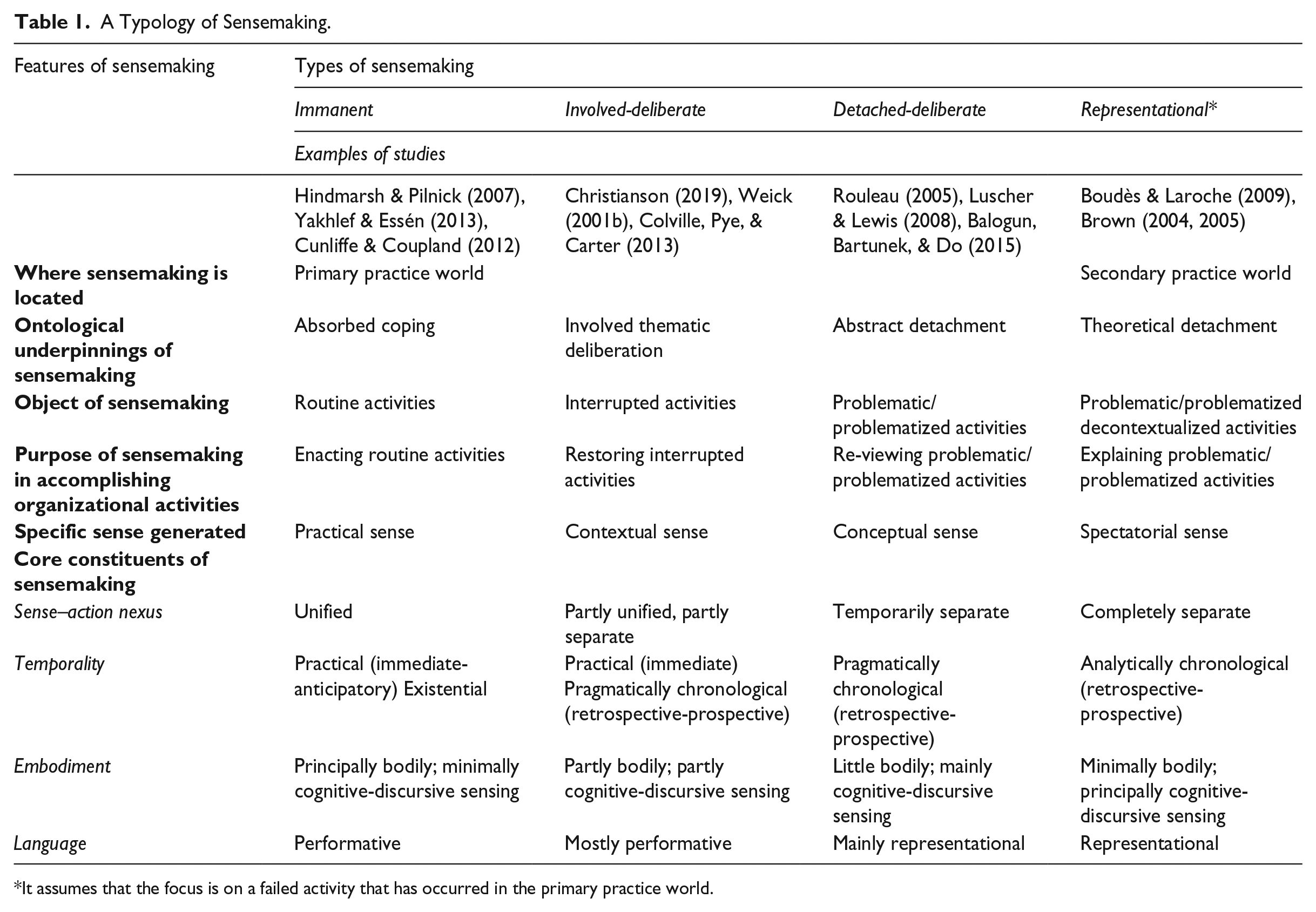
It assumes that the focus is on a failed activity that has occurred in the primary practice world.
Below, we describe each type of sensemaking and its main features in terms of four core constituents of sensemaking: sense–action nexus, temporality, embodiment, and language. Specifically, we elaborate how these constituents are played out differently in each type, and, thus, give rise to substantially different types of sensemaking. It should be noted, however, that although we for analytical reasons present the different sensemaking types and their constituents as distinct, in reality they form a continuum, overlapping with each other to varying degrees at different points in time and, thus, likely to be less discrete in practice. This is particularly true for the three sensemaking types within the primary practice world, which are shifting back and forth as organizational actors continuously vary their engagement with their organizational activities in response to a constantly evolving situation.
Sensemaking in the primary practice world
Immanent sensemaking
It is the most basic type of sensemaking in organizations, and is implicated in agents’ skillful enactment and performance of routine organizational activities. Immanent sensemaking is practical (Bourdieu, 1990) in that it is accomplished by agents sensorially grasping the meaning of an evolving situation (Carman, 2008: 51; Matthews, 2002). It thus differs significantly from mere intellectual understanding, insofar as the agent is in direct bodily contact with the world rather than with its representations (Carman, 2008: 52). For example, a student taking a seat in class does not wonder what the amphitheater is for or what a lecture is. She already comes to the class practically knowing what teaching is about and what the teacher’s and her roles are. In other words, since immanent sense is acquired and sustained through inhabiting a specific practice world it is already meaningful (Merleau-Ponty, 1962/1945: 52).
Immanent sensemaking is richly illustrated in Yakhlef and Essén’s (2013) study of elderly home care workers in two Swedish care organizations. In carrying out their tasks skillfully, care workers spontaneously refine their responses, based on their sensorial and verbal experience of interacting with seniors. In the practice world they inhabit, care workers have become, through routine action, familiar with what they must do on each occasion, for the purpose of serving the seniors as best they can.
Sense–action nexus
In immanent sensemaking, sense and action are not separate but merged as a single ongoing response to the particularities of the unfolding situation. This capacity for constant self-correcting while in action is at the heart of immanent sensemaking (Carman, 2005: 69; Matthews, 2002). Practical sense is what enables absorbed practitioners to keep in tune with unfolding organizational activities as they are performed (Dreyfus, 2014: 90). This constant tuning is clearly evident in, among others, the “flow” literature (Csikszentmihalyi, 2000, 2014). In conditions of flow, there is no distance between practitioners and their activities—they are all one. Similarly, Yakhlef and Essén’s (2013) care workers and Benner’s (1994) nurses exemplify well this “oneness” between agents and their activities. The respective practitioners feel their way around the situations they handle, habitually calibrating their responses by virtue of having been inhabiting a particular practice world and drawing on the sensory background it carves out for them. The sensemaker and the situation are fused together.
Temporality
Immanent sensemaking has two distinctive, but inherently related, temporal features: it is immediate and anticipatory. It is immediate because it takes place simultaneously with the accomplishment of the organizational activity in question, enabling practitioners to make instant adjustments to the unfolding situation. It is also anticipatory in that the practitioners absorbed in carrying out an organizational activity make anticipatory sense of how the present situation will unfold, enabling them to smoothly and skillfully accomplish it. As Yakhlef and Essén’s (2013: 890) ethnography shows, having developed “a feeling of what to do” provides experienced care workers with an anticipatory sense of where their situated, embodied interaction with seniors is going (Bourdieu, 1990: 80–81). Finally, the existential time of the specific practice world in question teleologically directs immanent sensemaking. The connection between past, present, and future sense experience is not causal but existential: experience, as well as the pull of the pursued end, hones and directs the skills that make the present sense possible. For example, what care workers do is critically shaped by their experience over time and by the purpose driving their practice world, “what is good for [elderly people]” (Yakhlef & Essén, 2013: 891).
Embodiment
Immanent sensemaking is mainly accomplished bodily. This is so because making immediate sense of the particularities of unfolding activities requires that the activities performed have “motor meaning for my body” (Mooney, 2011: 366). In other words, it is only because we have the world in our body schemas that we are able to make immediate and anticipatory sense of the unfolding situation (Ingold, 2000: 353). More specifically, bodily sensing consists of a habitual and an expressive side (Merleau-Ponty, 1962/1945: 82), forming a “sensorimotor gestalt cycle” (Fuchs & De Jaegher, 2009: 475). While the habitual side makes anticipatory habitual sense of the unfolding activities, the expressive side makes sense of them adaptively and creatively. For example, the habitual side of a firefighter’s motor intentionality towards extinguishing fires is at his disposal in each new situation, providing a general sense of extinguishing fires (Klein, 2009: 88; Weick, 2007: 17). The expressive side enables the firefighter to constantly adjust to the unfolding particularities in each new fire-extinguishing situation (Weick, 2009: 17).
Language
The function of language in immanent sensemaking is performative. When, for example, a flute maker remarks, “This is a clunky flute” (Cook & Yanow, 1996) or a ball mill operator utters, “Listen! The mill is hitting balls” (Ribeiro, 2017: 189), they all use different kinds of performative language in routinely carrying out their tasks. The illocutionary force of such language (i.e., what effect it is intended to have) is to accomplish a task in the primary practice world of the agents.
The use of performative language can take the form of any combination of Searle’s (1969) speech acts: commissives, assertives, directives, expressives, and declarations (Flores, 2012: 3–16; Ford & Ford, 2009: 98), depending on context and task. Thus, through commissives, commitments (e.g., promises) are undertaken (e.g., “I will cover the office for you this afternoon,” Flores, 2012: 9); through assertives, empirically verifiable statements are made (e.g., “Well, everything is in order,” Yakhlef & Essén, 2013: 891); through directives, requests and orders are given (a fire commander to his crew: “Get ready to go in [a house in flames]”, Klein, 2009: 88); through expressives, emotions are stated (an experienced nurse for a baby held in the intensive care unit: “I don’t like the way she looks,” Klein, 2003: 16–17); and through declarations, the world is changed to correspond to the propositional content of the utterance (e.g., “You are in charge”). It should be noted that in immanent sensemaking, even when assertives are used, they are not used for the sake of explaining something but for pointing out features of the world that are relevant to smooth action. More generally, in immanent sensemaking speech acts are used non-propositionally in the context of practical skills deployed in a particular situation (Dreyfus, 2000: 318).
Involved-deliberate sensemaking
This type of sensemaking emerges when the routine performance of organizational activities is interrupted (by an unexpected or deliberately created event, an anomaly, etc.), which forces practitioners to shift from absorbed engagement to paying deliberate attention to what is going on in order to restore the interrupted activity. The distinguishing feature of involved-deliberate sensemaking is that, although the performance of an ongoing activity may have been interrupted, it does not lead (at least not initially) to a complete standstill. Instead, agents typically continue striving to perform their activity but are now required to pay specific attention to it. The immanent sense that was previously brought to what they were unproblematically doing is now foregrounded and becomes deliberate (Christianson, 2019; Weick, 2001a, 2001c). Hence, involved-deliberate sensemaking is about how people make sense of ambiguous and problematic circumstances while still striving to perform their organizational activities. The sense generated is contextual—trying to get a contextual grasp of what is going on, aiming to restore an interrupted activity from the “inside.”
A typical case of involved-deliberate sensemaking is the successful landing of US Airways Flight 1549 on New York City’s Hudson River in January 2009, after the plane was struck by a flock of birds shortly after takeoff. Through a phenomenologically rich first-person account (Sandberg, 2000; Van Manen, 2014), Captain Sullenberger describes in some detail his sensorial experience, such as bodily sensations, the emotions he felt, and his coordination effort with copilot Skiles (Sullenberger & Zaslow, 2009: 209–215). In an interview soon after the incident (Wilson, 2009), Sullenberger described how he momentarily considered and rejected alternative landing options (initially LaGuardia airport and then Teterboro) before settling for the Hudson. His recovery effort was made possible by virtue of bringing to the troublesome situation an immanent sense of flying, acquired by his long membership of a practice world (as both a pilot and an investigator of airline accidents), whose purpose, meaning, and background distinctions he had picked up (discursively, mentally, and bodily) as a result of his long inhabiting it (Rivera, 2009; Schatzki, 2002: 87). Body schemata, practical and existential time, and the holistic grasp of the evolving situation are all important aspects of immanent sensemaking, which have a crucial bearing on involved-deliberate sensemaking.
Sense–action nexus
As the Hudson landing case and Christianson’s (2019) research on medical teams show, in involved-deliberate sensemaking, sense and action are partly unified, partly separated. Sense involves both a spontaneous grasp of the meaning of an evolving situation, enabled by immanent sensemaking (e.g., “normal engine noises” are lost; it is “eerily quiet” (Sullenberger & Zaslow, 2009: 209; see also Wilson, 2009), and a deliberate understanding of the affordances of the troublesome situation obtained by probing into it (e.g., unable to restart the engines despite several efforts; judging whether LaGuardia or Teterboro can be reached). While inevitably pressing ahead in the midst of action, agents simultaneously look back to make sense of what the situation has come to mean, as a result of their previous actions (Christianson, 2019). Agents grasp what they are facing by seeing retrospectively how the situation responds to their probing (Weick, 2001c: 463).
Temporality
The main temporal features of involved-deliberate sensemaking are immediate, retrospective, and prospective. It is immediate since agents are still pressing ahead with actions, whose timeliness they must grasp (e.g., judge the right time to land the plane on the river, Sullenberger & Zaslow, 2009: 238), while making instant adjustments as they see fit (e.g., “keep the wings level,” “keep the nose up,” Sullenberger & Zaslow, 2009: 238). It is retrospective since agents try different probes in order to elicit responses, whose meaning they subsequently ascertain (e.g., “find the most appropriate procedure for our emergency,” Sullenberger & Zaslow, 2009: 215; Teterboro is a possibility which, upon further examination, is ruled out). And it is prospective in that, aiming to restore a disrupted activity, agents form expectations about how the troublesome situation will unfold (e.g., “Once I turned toward LaGuardia, it would be an irrevocable choice [. . .],” (Sullenberger & Zaslow, 2009: 224). It is the ongoing spiral between looking back to construct a plausible account that provides temporary sense (e.g., both engines are lost; LaGuardia and Teterboro are unreachable) and acting forward to explore possibilities in the unfolding situation, which is the most critical feature of involved-deliberate sensemaking (Christianson, Farkas, Sutcliffe, & Weick, 2009; Colville, Pye, & Carter, 2013; Weick, 2001c: 460).
Embodiment
Involved-deliberate sensemaking is partly an embodied and partly a cognitive process. It is an embodied process throughout, insomuch as the body forms a sensorimotor loop with the people and objects the agent interacts with in the unfolding situation at hand. References to the body abound in Sullenberger’s description: his sensorial experience indicates that something very unusual had taken place; his bodily sensations (Sullenberger & Zaslow, 2009: 211) made him affectively aware of the gravity of the situation (Sullenberger & Zaslow 2009: 212), while, at the same time, realizing that he needed to get a grip on himself (Sullenberger & Zaslow 2009: 211) (see also Wilson, 2009).
Involved-deliberate sensemaking is partly a cognitive process in that agents pay deliberate attention to the contextual features of the troublesome situation in order to find out how to restore the interrupted activity; they reflect on what previously was, for the most part, spontaneously (pre-reflectively) handled (Kudesia, 2017: 10). Thus, Captain Sullenberger reflected, even momentarily, on whether he could make it to LaGuardia or Teterboro and how to fly the plane to the Hudson. Without the habitual side of his embodied sensemaking, he would have been unable to identify the severity of the situation and the likely options available. And without the expressive side, he would have been unable to identify the affordances provided by the uniqueness of the situation: the inability to reach nearby runways and the possibility of landing on the river (Sullenberger & Zaslow, 2009: 225).
Language
In involved-deliberate sensemaking, language, in so far as it is used, is mostly performatively applied. Captain Sullenberger, for example, indicates that at times he coordinated with the copilot even without speaking (Sullenberger & Zaslow, 2009: 215), not needing to verbalize their common awareness of the situation (Sullenberger & Zaslow, 2009: 212). But when applied, language is mainly used in a performative manner (Weick, 2001d: 135–137). Throughout the incident Sullenberger, the copilot, and the traffic controller exchanged performative utterances, mostly in the form of assertives (“birds,” Sullenberger & Zaslow, 2009: 207; “Loss of thrust on both engines,” Sullenberger & Zaslow, 2009: 215), directives (“Get the QRH [Quick Reference Handbook]” (Sullenberger & Zaslow, 2009: 215), expressives (“Oh, shit,” Sullenberger & Zaslow, 2009: 207), and declarations (Sullenberger to traffic controller: “We’re gonna be in the Hudson,” Sullenberger and Zaslow, 2009: 230).
Detached-deliberate sensemaking
If the interrupted organizational activity persists, gets worse, or, in some extraordinary situations, even comes to a standstill, agents shift, while still located within their primary practice world, to an abstract-detached way of engaging with their activities, leading to the detached-deliberate type of sensemaking. Sensemaking, then, becomes mainly cognitive-discursive and it involves engaged abstraction that generates conceptual sense of the troublesome activity. Its main feature is that agents re-view the key features of the troublesome activity from the “outside,” reflecting on, and looking for, patterns of relationships, while remaining embedded in their primary practice world. As several review papers have shown (Brown et al., 2015; Kudesia, 2017; Maitlis & Christianson, 2014; Sandberg & Tsoukas, 2015), the detached-deliberate type has attracted significant interest in empirically oriented sensemaking research (although it does not use this term).
Studies that explore detached-deliberate sensemaking are typically of two kinds. One kind focuses on unexpected temporary disorientation. It occurs when the organization experiences a sudden and highly disruptive incident (Gephart, 1984; Weick, 1988), which it needs to come to terms with (e.g., a major failure or accident). A second kind, far more common in organizations, focuses on intended distanciation. Here, the purpose is to deliberately disrupt participants’ immersion in their habitual organizational activities (Luscher & Lewis, 2008; Pratt, 2000) and shift them into a detached mode of engagement with their organization, in order to investigate it from the “outside”—namely, to view it as if it were an object of study, whose properties might be dissected and discussed, and plans drafted (Tsoukas, 2017: 69). Such deliberate disruptions include setting up strategizing episodes (Hodgkinson & Wright, 2002; Hendry & Seidl, 2003; Johnson et al., 2010), organizational development and change-related events (Bartunek & Woodman, 2015), participative consulting (Cooperrider, Whitney & Stavros, 2008; Schein, 2016), and debriefing sessions (Ron, Lipshitz, & Popper, 2006).
Both kinds of detached-deliberate sensemaking bring about “cognitive disorder” (Balogun & Johnson, 2004: 524; Balogun, Bartunek, & Do, 2015: 960; Luscher & Lewis, 2008: 221) and anxiety (Maitlis & Sonenshein, 2010; Stein, 2004), since what agents have taken for granted, which has enabled them to engage immanently with their tasks, now breaks down (Barry & Meisiek, 2010). As several studies have shown over the years (Balogun et al., 2015; Bartunek, 1984; Bartunek, Balogun, & Do, 2011; Michel, 2014), when established meanings are disrupted, experiences of ambiguity intensify (Luscher & Lewis, 2008: 222). As a result, managers need to “understand, interpret, and create sense for themselves and others of their changing organizational context and surroundings” (Rouleau & Balogun, 2011: 955; see also Balogun & Johnson, 2004; Bartunek et al., 2011), making sensemaking both vital and difficult to accomplish.
Sense–action nexus
In detached-deliberate sensemaking, the subject–object separation is foregrounded (something which is not experienced when agents are immersed in the routine flow of their practice world), converting agents to Cartesian subjects seeking to conceptualize objects and, subsequently, creating a momentary separation between sense and action. Sensemaking then becomes primarily interpretation, and sense amounts to intellectual understanding (conceptual sense), involving mainly cognition and representational language. For example, in Luscher and Lewis’s (2008) study of strategic change at Lego, such an object of attention is managers’ felt experiences of divergence between old and new interpretive schemata; and in Hodgkinson and Wright’s (2002) strategizing episode, the object is the organization at large, whose strengths, weaknesses, and prospects participants are invited to reflect on. In all these cases, agents’ particular experiences are foregrounded, against the background of their total organizational experiences.
Temporality
Since, in detached-deliberate sensemaking, agents focus upon a distinct experience, they thematize its temporality, becoming aware of the past and the projected future. Detached-deliberate sensemaking is thereby predominantly defined through the retrospective–prospective temporal dimensions. Time is no longer practical, as it would be when their experiences were not thematized (see Csikszentmihalyi, 2014; Yakhlef & Essén, 2013), but pragmatically chronological, whereby the temporal continuum is split into the familiar regions of past, present, and future, in order for past patterns of action to be reflected on and future action to be envisaged and planned. Organizational members tend to think more explicitly about “how we/I used to be” and, if prompted, “how we/I want to be” (see, for example, the studies by Balogun et al., 2015; Luscher & Lewis, 2008).
Embodiment
Since detached-deliberate sensemaking is primarily cognitive, the body, although implicated, is accorded a secondary role. Interpretive schemata, cognitive categories, and reasoning procedures are explicitly mobilized for making conceptual sense. For example, in post-flight reviews in a fighter aircraft squadron, pilots focus on what happened during their sorties in order to improve performance in the future, thus turning their first-person experience of flying aircrafts into an object of analysis (see Ron et al., 2006). Similarly, when a group of executives analyzes the pros and cons of their organization’s current business model, they turn the latter into an object of study, with the body having a background role (Hodgkinson, Whittington, Johnson, & Schwarz, 2006; Rouleau, 2005). Although in each case their first-person experience of, respectively, flying an aircraft or enacting a business model is bodily grounded, the body takes the back seat, insofar as agents’ experience is thematized and objectified.
Language
In detached-deliberate sensemaking, language is used for talking about activities, rather than performing activities. In other words, language is mainly used representationally for identifying and relating properties in objects (Dreyfus, 2000: 316). Agents’ mental content thereby acquires a quasi-propositional character, albeit they are still involved in their own practice world (Dreyfus, 2000: 316–317). Thus, Lego managers’ felt experience of divergence between old and new interpretive schemata is no longer a situational feature (Dreyfus, 2000: 316) of the work lives of particular people but an abstract property that transcends specific individuals. Quasi-propositional assertions are thus made about “divergence,” which has now become a thematized object, outside any local situation.
Sensemaking in the secondary practice world
Representational sensemaking
The last type of sensemaking is representational. What, above all, sets it apart from the previous types is that it takes place in a secondary practice world—that is, in a context other than that in which the primary task of the organization normally takes place. Specifically, representational sensemaking “de-worlds” (Dreyfus, 2000: 317) a particular situation (e.g., a major organizational accident or failure) from its primary practice world and reinserts it into a secondary practice world (e.g., an independent inquiry committee). Such sensemaking is representational since the targeted (i.e., problematic or problematized) organizational activity is abstracted from its original context, reconstructed, and interpreted within the practical concerns of another practice world (Gallagher, 2017: 83–84). Thus, the sense generated is “spectatorial” (Dreyfus, 2014: 100)—that is, sense is made by disengaged agents, members of another practice world, with the purpose of explaining the targeted activity from outside (that is, suggesting the causal mechanisms that generated an event or a regularity of events; Elster, 2007; Reason, 1991, 2008). Importantly, in representational sensemaking, the agent–observer separation that is characteristic of deliberate sensemaking (especially detached) reaches its extreme. As external observers, representational sensemakers inquire about events and activities that took place in another practice world. As agents, however, the account they construct is produced from within the particular practice world they inhabit.
We distinguish two secondary practice worlds for representational sensemaking: public and scientific inquiries. We will focus on the former since they have been a major part of sensemaking research. Typically, public inquiries are set up by governments or regulatory authorities in the aftermath of a major organizational accident or failure, serving normally the purposes of accountability, learning, and policy making (Brown, 2000; Dwyer & Hardy, 2016; Nathan, 2004). Those inquiries typically address the question: what went wrong, why, and how can such incidents be prevented in the future? (For relevant examples, see the studies by Boudès & Laroche, 2009; Brown, 2004, 2005; Colville et al., 2013; and Cornelissen, Mantere, & Vaara, 2014). In such inquiries, the object of inquiry (i.e., a failed organizational activity) clearly changes practice world: from the primary practice world within which it took place to the secondary practice world of the inquiry committee.
Sense–action nexus
The implications of shifting from the primary to a secondary practice world are significant for sensemaking. Inquiry members’ sensemaking is spatially and temporally removed from the primary practice world, which results in their sense being completely disconnected from the action of the agents within that world. Specifically, to use Bourdieu’s term, inquiry teams adopt a “scholastic attitude” (1990: 127–140), in contrast to the primary-world agents, who, immersed in their practice world, are imbued with a “practical attitude” (Bourdieu, 1990: 130–134)—namely, trying to resume their disrupted organizational activity.
Although making spectatorial sense involves action (i.e., obtaining testimonies and laboratory findings, interrogating, discussing, etc.), that action is unrelated to the primary-world agents’ sensemaking. However, representational sensemaking is a practical accomplishment in itself. Thus, viewing inquirers as agents (i.e., treating the secondary practice world as if it were primary), their sense–action nexus involves making spectatorial sense through the enactment of particular language games, in which concepts are used in particular ways (Rawls, 2011). For example, incidents under investigation are represented, framed, and inserted in particular narrative forms that are deemed plausible in the practice world of the public inquiry (Bennett & Feldman, 2014; Boje, 2014).
Temporality
Since inquirers deal with the reconstructed workings of some failed activity, the time dimension that is mostly relevant is chronological time. This is because, in order to make sense of the troublesome organizational activity, inquirers begin by listing retrospectively the events and activities implicated (see relevant examples in the Piper Alpha disaster, Barings Bank collapse, and Hudson River accident reports—Brown, 2000, 2004, 2005; Aircraft Accident Report, 2010), while their recommendations have prospective relevance. Moreover, since chronological time is removed from the primary context of the failed activity, it is treated analytically rather than pragmatically. However, viewing an inquiry team as agents dwelling within their own practice world involves all other temporal dimensions too, as in the previous three types of sensemaking. There is the existential temporal structure of the inquiry practice world that purposefully guides the enactment of its activities. There is also the practical time of the inquiry practice, such as its distinct rhythm and tempo that provide direction for the enactment of its activities (Bartunek & Woodman, 2015: 170).
Embodiment
Since representational sensemaking involves a primarily intellectual understanding, bodily sensations are less prominent than in the other three types of sensemaking. Mental activities—cognition and language use—dominate. As spectators of events that took place in another place and time, inquirers cognitively assess and discursively analyze what happened during the episodes they explore; the subject–object split is complete. For example, the Hudson River accident report states events and, with the help of simulations, assesses both the action the airplane pilot took and the alternatives he considered (Aircraft Accident Report, 2010). The sense constructed is spectatorial. However, when spectatorial sense is viewed from within the secondary practice world in which inquiry activities take place, the body is implicated as in the previous three types of sensemaking, although its role is likely to be less prominent, since sensorial experiences tend to be more limited than the richness of those in the primary practice world under consideration.
Language
Several scholars have noted that the illocutionary force of public inquiry reports (i.e., the effect they are intended to have) is to restore trust and legitimacy and, thus, reduce public anxiety through rational analysis (Boudès & Laroche, 2009: 379; Brown, 2000, 2004). To achieve this, the inquiry report must construct authoritative claims that follow the rules of its genre, such as offering vicarious experiences to readers backed up by a solid argument (Brown, 2005: 1583), through the use of language (Dreyfus, 2000: 317) that includes empirically backed assertions (Brown, 2005). Objects and events are assigned abstract “properties” (Dreyfus, 2000: 316), whose pattern of relationships is to be explored. The language used in inquiry reports is thereby startlingly different from that used in first-person accounts reporting immanent and involved-deliberate sensemaking. For example, whereas Captain Sullenberger’s language is distinctly phenomenological (e.g., it highlights the importance of sensorial experience), the language of the Hudson River accident report is emphatically third-person, matter-of-fact, and abstract (Aircraft Accident Report, 2010). Assessment and recommendations are provided through the use of assertives and directives (e.g., “The NTSB concludes/recommends . . .”; see Aircraft Accident Report, 2010: 86, passim). However, looking into the process through which such a report has been produced (namely, looking into the workings of the inquiry team as participants in their own practice world) will likely reveal the interplay of all speech acts and the choice of particular rhetorical strategies for enhancing plausibility (Sillince, Jarzabkowski, & Shaw, 2012).
In conclusion, drawing on the ontology suggested by existential phenomenology, we have in this section elaborated a typology of sensemaking (summarized in Table 1) to account theoretically for the different types of sensemaking encountered in organizational research. Our main claims have been as follows. First, sensemaking consists of four major types: immanent, involved-deliberate, detached-deliberate, and representational. Significantly, although organizational activities are the primary object for all sensemaking types, each type is involved differently in accomplishing organizational activities, serving a distinct purpose. Immanent sensemaking enacts rou-tine activities; involved-deliberate sensemaking restores interrupted activities; detached-deliberate sensemaking re-views failed or problematized activities; and representational sensemaking explains problematic or problematized activities. Immanent sensemaking is foundational: all other types of sensemaking presuppose, refer to, and/or derive from it. Second, all types of sensemaking originate and take place within specific practice worlds: the sense made of an organizational activity (interrupted or not) is shaped by the practice world in which the activity is embedded. Immanent, involved-deliberate, and detached-deliberate sensemaking take place inside the primary practice world in which the organizational activities in question are situated. Repre-sentational sensemaking takes place within a secondary practice world, such as a public inquiry. Third, the core constituents of sensemaking—sense–action nexus, body, language, and temporality—are played out differently in each type of sensemaking.
Sensemaking and Organizing
Having outlined a typology of four different types of sensemaking in organizations and discussed their main features, in this section we show how the different types enable organizing. As Weick (1979, 1995) has argued over the years, sensemaking enables organizing insofar as interacting agents strive to maintain, on an ongoing basis, a common sense of the activities in which they are engaged. Our typology sheds light on this process. Specifically, we argue that sensemaking is the logic of organizing in that it generates the sense by which agents create and sustain coordinated collective action. We describe this by showing (a) how the sensemaking types are connected to different levels of sensemaking in organizing, and (b) how the outcomes the sensemaking types generate, especially stability, learning, and change, enable organizing.
Types and levels of sensemaking in organizing
Although the organizational context has been emphasized by Weick (1995: 69–76, 113–118), sensemaking research has mainly focused on individuals’ sensemaking. As a result, how collective sensemaking enables organizing (Colville, Brown, & Pye, 2012; Weick, 1995; Weick, Sutcliffe, & Obstfeld, 2005) has been underexplored (Stigliani & Ravasi, 2012). Moreover, it has often been noted that the bulk of sensemaking research has not sufficiently dealt with how extra-organizational contexts influence the practice worlds within which sensemakers are immersed (Maitlis & Christianson, 2014; Sandberg & Tsoukas, 2015; Weber & Glynn, 2006). Below, we show how our typology makes it possible to correct these weaknesses.
Weick (1995: 70–71) usefully distinguishes three levels of sensemaking in organizing above the individual: intersubjective (agents interact to synthesize new meaning, i.e., agents negotiate their different understandings so that a “joined” or “merged subject” emerges; Weick, 1995:71); generic subjective (agents become substitutable in filling in roles and following scripts, i.e., agents behave in a uniform manner by following commonly available standard plots); and extrasubjective (agents enact taken-for-granted institutional meanings, i.e., meanings made available to agents through their participation in an overarching cultural order, e.g., concerning how markets function, the role of government, what counts as success etc.; O’Leary & Chia, 2007). Weick describes organizing in terms of “bridging” (Weick, 1995: 73) the intersubjective and the generic subjective levels. Linking these two sensemaking levels, notes Weick (1995: 73–74), is accomplished by routines and their corollary—habituated ac-tions. This is insightful, and our typology shows how it may be further developed.
To put it generally, by engaging in habituated action within a practice world, embodied agents learn to inhabit it and, thus, develop relevant “body schemas” (Birnholtz, Cohen, & Hoch, 2007: 317; Merleau-Ponty, 1962/1945: 203; Morris, 2008: 116; Smith, 2007: 13–14) and “shared understandings” (Dionysiou & Tsoukas, 2013: 196–197; Sandberg & Targama, 2007) that enable them to respond “spontaneously” (Kudesia, 2017: 23) to the challenges of their tasks (Dreyfus, 2014: 120–122; Gallagher, 2017: 115–121). Members of a practice world become familiar with “prototypical” (Dionysiou & Tsoukas, 2013: 196) instances of their tasks and the affordances they provide (i.e., the responses they elicit) (Leonardi, 2011), as well as with deviations from them (i.e., “nonprototypical” instances; see Dionysiou and Tsoukas, 2013: 196) and the actions they require (e.g., coping with a broken bag-valve-mask; see Christianson, 2019: 53).
Sensemaking at the intersubjective level occurs in an involved-deliberate or detached-deliberate manner, when agents, while carrying out their routine tasks, encounter situational anomalies (i.e., nonprototypical cases), ranging from small to significant interruptions (intended or not), calling for a “synthesis” of understandings (Weick, 1995: 71). Through involved-deliberate sensemaking, efforts to synthesize meaning to restore interrupted activities occur within a particular context of action, as, for example, in the Mann Gulch fire (Weick, 2001a) and Christianson’s (2019) simulation teams. Such a synthesis is more likely to be effective, the more agents “heedfully” interrelate to one another (Weick & Roberts, 1993: 361). Through detached-deliberate sensemaking, efforts to synthesize meanings occur conceptually —through “cognitive reorientation” (Balogun et al., 2015: 960; see also Gioia & Chittipeddi, 1991) and/or “narrative evaluation” (Balogun et al., 2015: 976; Sonenshein, 2010). New frames or stories are worked out and new connections between past frames or stories and present cues or experiences are forged (Weick, 1995: 111; Boje, 2008, 2014), sometimes with the mediation of outsiders who question the sense already made (Strike & Rerup, 2016).
Sensemaking at the generic subjectivity level occurs immanently, to the extent to which agents can substitute for one another in smoothly enacting a routine. Through taking the role of the other, in the context of routine action, individual lines of action are fitted together. Substitutability reaches its fullest insofar as the agent addresses him- or herself from the standpoint of the “generalized other” (Mead, 1934: 150–155)—namely, from the position of an abstract “they” (Blumer, 2004: 61; Dionysiou & Tsoukas, 2013: 187). A generic self thus emerges, reflecting, at the organizational level, shared understandings and body schemas. In generic subjectivity, frames or stories cast in a cognitive/narrative form (see Balogun et al., 2015: 962; Weick, 1995: 110–111, 130–131) together with shared body schemas (Bourdieu, 1977: 659) are developed, enabling coordinated action.
Sensemaking at the extrasubjectivity level also occurs immanently. However, unlike sensemaking at the generic subjectivity level, in which the generic self is defined by the organized context of the joint activity, at the extrasubjectivity level, immanent sense is created by the “unobtrusive premises” (Weick, 1995: 114–115) provided to agents by extra-organizational (i.e., epistemic and institutional) practices (Hui, Schatzki, & Shove, 2016; Nicolini, 2011: 602; Schatzki, 2002; Weber & Glynn, 2006). Specifically, a focally relevant practice world is nested within a nexus of other practice worlds (Hui et al., 2016; Nicolini, 2011: 6), which provide epistemic and institutional resources for making sense. Ideology, pre-judgments, and tacit assumptions, grounded on social class, national culture, race, profession, etc., become salient (Weick, 1995: 114–116). Thus, for example, in strategy-making workshops, sense has already been discursively made through the very vocabulary (and associated meanings) with which strategy is considered (Ezzamel & Willmott, 2008; Knights & Morgan, 1991; Seidl & Guerard, 2015; Vaara, Sorsa, & Palli, 2010). That vocabulary typically reflects currently dominant values, concerns and ideologies, which are already discursively operative in particular institutional fields (Grant, Hardy, Oswick, & Putnam, 2004; Hultin & Mähring, 2017; Kornberger & Clegg, 2011; Whittington, 2017: 395).
The performance of routine organizational activities—namely, in Weick’s terms, the enactment of recurrent behaviors—involves a variable mixture of sensemaking at the extrasubjectivity, generic subjectivity, and intersubjectivity levels. Insofar as routine activities have been sufficiently practiced, agents have come across prototypical cases and, thus, their body schemas and shared organizational understandings are likely to have been well developed; generic subjectivity is therefore enhanced. In contrast, insofar as routines have not been sufficiently practiced, agents have not come across sufficient prototypical cases and, thus, relevant body schemas and shared organizational understandings are likely to have been weakly developed. In this case, generic subjectivity (and, therefore, immanent sensemaking) tends to decrease, while extrasubjectivity, through unobtrusive premises, becomes more salient (Danner-Schröder & Geiger, 2016; LeBaron, Christianson, Garrett, & Ilan, 2016). When, in either case, particular organizational forms and/or interaction processes impede the synthesis of perspectives, as, for example, occurred at Mann Gulch (Weick, 2001a: 108–109) and in one of Christianson’s (2019: 71–74) simulation teams, sensemaking at the intersubjective level is likely to suffer and, as a result, deliberate sensemaking (in either of its two types) is likely to weaken. The opposite occurs when interaction, either endogenously (Christianson, 2019: 63–65) or mediated by outsiders (Strike & Rerup, 2016: 898), takes the form of a “productive dialogue” (Tsoukas, 2009: 944–946) or “heedful interrelating” (Weick & Roberts, 1993: 361)—that is, when agents generatively engage with one another (Kudesia, 2017).
Organizing depends heavily on sensemaking, since it involves reconciling agent substitutability with synthesized understandings. Specifically, agent substitutability, namely having interchangeable agents follow standard frames or plots of action (i.e., generic subjectivity), is required for organized action to consistently take place across space and time (Tsoukas, 2019: 26–27; Weick, 1995: 71–72). However, a synthesis of understandings is necessary (i.e., intersubjectivity), insofar as substitutability is inherently incomplete, since human action occurs in open contexts in which new meanings invariably emerge (Tsoukas, 2019: 27–29; Weick, 1995: 73). Alternating between sensemaking at the generic-subjectivity and the intersubjectivity levels, namely between organizational frames and negotiated joint meanings, is the hallmark of “adaptive sensemaking”—that is, agents’ ability to revise their sense as the situation develops (Christianson, 2019: 45–47; Cornelissen et al., 2014: 703; Maitlis & Sonenshein, 2010: 565; Strike & Rerup, 2016: 882). In adaptive sensemaking, agents are less likely to be locked into a given or “entrapped frame” (Strike & Rerup, 2016: 892)—that is, to be caught in a self-reinforcing loop (Christianson, 2019: 50)—when the “quality of [their] interaction” (Weick, 1995: 73) is such that the likely imbalance created by attention to either organizational frames or joint meanings is corrected by paying attention, in turn, to the other part (Tsoukas & e Cunha, 2018: 395; Weick, 2001a: 117).
An illustration
To illustrate how different types are connected to the different levels of sensemaking in organizing, consider the case of the wrongful shooting of Jean Charles de Menezes by the London Metropolitan Police Service on July 22, 2005 in London (known as the Stockwell shooting; see Stockwell One, 2006), insightfully studied by Colville et al. (2013) and Cornelissen et al. (2014). Both teams of authors underscore the cognitive dimension of sensemaking, highlighting “framing” and “cues.” However, our typology and the links we postulated between sensemaking and organizing enable researchers to see that sensemaking, on this occasion, involves more than cognition.
Specifically, the Stockwell shooting demonstrates, fundamentally, a failure of involved-deliberate sensemaking at the generic subjective level coupled with a failure of immanent sensemaking at the intersubjective level. The counterterrorist (CT) officers were enacting a new routine (called “Kratos”), designed to tackle suicide bombers, in the aftermath of the terrorist bombings in London on July 7, 2005 (Stockwell One, 2006). As Colville et al. (2013) and Cornelissen et al. (2014) make clear, the new routine the CT officers were following had not been sufficiently practiced and, as a result, their appropriate body schemas and shared understandings had not been sufficiently developed. Thus, the meaning of the fatal executive order “stop him” was ambiguous: while in the context of the old anti-terrorist routine, it had typically meant “stop and detain him” (which is what the designated senior officer, who uttered it, said he had meant), in the context of the new routine it meant “incapacitate/kill him” (which is what the CT officers said it had meant to them) (Colville et al., 2013: 1217; Cornelissen et al, 2014: 712). In other words, immanent sensemaking at the generic subjective level, in the context of the new routine, was relatively weak.
Moreover, when, as events unfolded, an interruption occurred—namely, when the CT officers started wondering whether de Menezes was indeed the suicide bomber they had been suspecting—doubts arose as to what they should do next. The different views required a “synthesis” (Weick, 1995: 71; see also Weick, 2001d: 143) of agents’ involved-deliberate sensemaking at the level of intersubjectivity. However, such a synthesis did not occur: “a lack of prototypical past moments [prolonged] the search for meaning” (Colville et al., 2013: 1215) (our italics). Moreover, in conditions of perceived time pressure and a police culture of command-and-control, in which officers’ interpretations and actions had been expected to be “aligned with those of their superiors” (Schildt et al. (2019: 11), the CT officers failed to engage generatively with one another (including their superiors) to loosen up commitment to the initial frame/story of de Menezes being a likely suicide bomber (Cornelissen et al., 2014). Involved-deliberate sensemaking failed to be adaptive: the entrapped frame was not “punctured” (Strike & Rerup, 2016: 880) or “updated” (Christianson, 2019: 49–51) (see also Brown, 2018: 54).
Sensemaking outcomes and their consequences for organizing
A central question raised by the proposed typology is: what kinds of outcomes does each sensemaking type generate, and how do those outcomes enable organizing? We address this question below by discussing three different kinds of outcomes: stability/renewal, learning, and change.
Organizational stability/renewal
Each type of sensemaking generates different degrees of stability/renewal of organizing over time. Given its strong reliance on the body schemas developed, immanent sensemaking generates a high degree of stability in organizing (Chia & Holt, 2009: 131–133), ensuring “the active presence of past experience” (Bourdieu, 1990: 54). However, it may turn to rigidity, as it acts as a conservative force by pressing agents into reproducing existing ways of organizing. For example, Starbuck (1985: 354–355) has described how a worker, who had learned from experience to draft production schedules, developed the capacity to estimate machine run times. When he was shown an equation he could use to produce his speed times more accurately, he declined to use it: “six years of habit and the frame of reference that went with it were too strong.” In other words, bodily inscribed tacit knowledge makes it harder to switch to discursively mediated change (Bourdieu, 1990; Hadjimichael & Tsoukas, 2019; Hindmarsh & Pilnick, 2007; Wright, 2019).
As involved-deliberate sensemaking is not only bodily but also cognitive in character, it potentially generates higher flexibility in, and adjustment of, organizing (Christianson, 2019). Detached-deliberate sensemaking, due to its predominantly cognitive and discursive character, has the potential to generate a high degree of renewal, since it is not immediately involved in enacting the current way of organizing. Finally, representational sensemaking has the potential to generate an even higher degree of renewal, especially as it is not constrained by the tempo and urgency of organizing as currently enacted in the primary practice world. However, given its disconnect with the latter, its outcomes are likely to have a more precarious impact on organizing in the primary practice world (Dwyer & Hardy, 2016).
Organizational learning outcomes
Crucial for renewing existing ways of organizing is organizational learning (Guiette & Vandenbempt, 2016), to which different types of sensemaking contribute. We will show how by using Christianson et al.’s (2009) study of the way organizational learning took place at the B&O railroad museum in Baltimore through a rare event, namely the collapse of the entire museum roof due to a snowstorm, which led to the temporary closure of the museum. Organizational learning took place between the closure and the reopening. While Christianson et al. (2009) describe the sensemaking that was involved in the singular (i.e., as detached sensemaking), we will show, through our typology, how three different types of sensemaking were implicated, each producing distinct learning outcomes in different phases of the museum’s organizational learning.
The collapse of the museum roof gave rise to intense detached-deliberate sensemaking among staff: not only the museum’s entire response repertoires (e.g., stock of routines, habits, and roles in organizing) (Christianson et al., 2009: 847) were questioned and revised, but also its organizational identity (Christianson et al., 2009: 855)—namely, what kind of museum it had been and would like to be. For example, through their detached-deliberate sensemaking, the museum staff came to realize that the museum had been “operated like a university, very much an academic institution” (Christianson et al., 2009: 855). This realization led to the development of a new conceptual sense of a museum with a more commercial outlook. Moreover, implementing this envisaged transformation required developing several new routines and sets of skills, such as expertise in relating to media and large-scale event organizing. Involved-deliberate sensemaking enabled staff to simultaneously run the museum as normal (i.e., in line with its existing identity and routines) and develop a contextual sense of the new skills and routines required by its new direction. Finally, immanent sensemaking enabled the museum staff to develop a new practical sense that fully embodied and routinized the new skills and activities, thereby providing stability and constancy to its new commercial direction.
Organizational change outcomes
Different types of sensemaking allow for a better understanding of organizational change outcomes. We will show how by drawing on Luscher and Lewis’s (2008) study of change at the Danish company Lego. In contrast to Luscher and Lewis (2008), who approach change only through one kind of sensemaking (i.e., detached-deliberate), our typology enables us to distinguish three types of sensemaking and see how each contributes to different stages of the organizational change at Lego. A similar analysis may be applied to the change described by Balogun et al. (2015).
In the late 1990s, Lego experienced rising competition and a stagnating market (Luscher & Lewis, 2008: 223), which triggered extensive detached-deliberate sensemaking among its executives about how to respond. A central outcome was the idea to transform Lego from a hierarchical to a team-based organization. Specifically, the conceptual sense of the executives’ change initiative was “to implement self-managed teams at every level and to integrate middle- and lower-level managers” (Luscher & Lewis, 2008: 223). The middle managers, who were both the target of, and agents for, this change initiative, “experienced intense pressure to make sense of, and act according to, the organizational changes” (Luscher & Lewis, 2008: 223) (see also Balogun et al., 2015: 974–975).
In order to work out the executives’ conceptual sense of what the organizational restructuring meant in practice, middle managers engaged predominantly in involved-deliberate sensemaking of the change initiative (Balogun et al., 2015; Gioia & Chittipeddi, 1991; Sonenshein, 2010). This enabled them to develop a contextual sense of Lego’s organizational restructuring in order to flesh out its actionability: what new meanings and skills they needed to develop to make change work. In effect, it made it possible for managers to run Lego in the old way and, simultaneously, generate an actionable sense of the new way of organizing. Similarly, our typology enables researchers to disentangle the “dual sensemaking roles” that Balogun et al. (2015: 975) identified when discussing the “dual change roles” of senior divisional managers: as recipients of corporate-level executives’ plans, managers embed the plans to wider organizational change narratives (conceptual sense), while, as change agents, they embed change to local narratives (contextual sense).
Finally, immanent sensemaking enabled Lego managers to generate gradually a practical sense of enacting the company’s new way of organizing—namely, develop the body schemas and shared understandings that provided stability in Lego’s new organization over time.
Moving on to representational sensemaking, the latter differs significantly from the other three types in that it is not internally but externally related to organizing in the primary practice world, and, thus, it is completely disconnected from the latter’s urgency, practicality, and temporality. An illustrative case of representational sensemaking outcomes entering the primary practice world is Dwyer and Hardy’s (2016) study of the learning that took place during and after three large public inquiries into bushfires in Australia. According to the authors, all three inquiries generated sets of abstract recommendations, which relevant organizations tried to implement. Dwyer and Hardy (2016: 59) call for more research to “examine the process of ‘transitioning’ out of the inquiry into the organization.”
Our typology enables us to analytically disentangle the different types of sensemaking implied by Dwyer and Hardy (2016) and see the different processes involved. The transition process from abstract recommendations formulated in a secondary practice world to implementation in organizations in the primary practice world starts with detached-deliberate sensemaking, in which agents, embedded in the primary practice world, try to make conceptual sense of what the recommendations may mean for their particular organization. This is followed by involved-deliberate sensemaking, which enables agents to develop a contextual sense of the recommendations—the new routines and skills needed to perform the new directives. Finally, a shift to immanent sensemaking will generate fluency and stability in performing the new routines through the development of body schemas and shared understandings.
In conclusion, based on the proposed typology, we have discussed in this section how sensemaking enables organizing (as summarized in Figure 1). Each type of sensemaking that occurs within the primary practice world provides the logic of organizing in that it continuously generates a specific sense (i.e., conceptual, contextual, and practice) by which agents create, sustain, and change coordinated collective action. In contrast, the sensemaking outcomes generated by representational sensemaking in the secondary practice world shape organizing indirectly, depending on how abstract recommendations are received, acted upon, and finally turned to new routines.

Sensemaking: the logic of organizing.
Discussion and Conclusions
In this paper, we have proposed a typology of sensemaking that reinterprets the existing sensemaking perspective in significant ways. Moreover, the proposed typology enables a better understanding of the links between sensemaking and organizing. In this final section, we summarize our contributions and describe some methodological implications, while offering suggestions for further and new lines of inquiries for sensemaking research.
Contributions
The typology contributes to the existing sensemaking perspective in three ways. First, it significantly reshapes our understanding by providing a more comprehensive and differentiated view of sensemaking in organizations than the existing perspective. Crucially, the most basic and common of all types—immanent sensemaking—has not traditionally received much attention, since the emphasis has tended to be on deliberate sensemaking (either involved or detached). Similarly, although representational sensemaking has been studied, there has been limited acknowledgment of its distinguishing features. The typology helps correct these imbalances. In addition, our typology shows that sensemaking originates neither in cognition nor in social interaction alone, but in specific meaning-giving practice worlds, which agents inhabit.
Second, the typology reconfigures existing sensemaking research in two major ways. As we showed in the two previous sections, the typology makes it possible to differentiate and reposition existing sensemaking research through the different types of sensemaking. In addition, the typology reconfigures existing sensemaking research by overcoming several conceptual dichotomies (e.g., bodily–cognitive, retrospective–prospective, ongoing–episodic, deliberate–immanent), opening up new paths for more integrative future research (Tsoukas, 2017).
Thus, grounding sensemaking in the mode of agents’ engagement with organizational activities shows that it tends to be (a) mainly sensorially (pre-reflectively) accomplished when agents engage in immanent sensemaking, in the context of routine action (Wright & Manning, 2004: 624); (b) more cognitively-discursively accomplished when agents deliberate (in either an involved or a detached manner) on what they need to do, following an interruption (Christianson, 2019; Weick, 2001a, 2001c); and (c) even more cognitively-discursively accomplished when agents, inhabiting a secondary practice world, engage in representational sensemaking (Brown, 2000, 2004). Similarly, our typology helps dissolve the question of whether sensemaking is continuous or episodic. Sensemaking never stops (Weick, 1995: 43). The always-already character of immanent sensemaking (Wright & Manning, 2004: 638) enables us to appreciate its irreducibly continuous character from which particular sensemaking episodes may emerge. The agents who skillfully engage in habitual action do not need a trigger to activate their sensemaking—sense is always-already made by virtue of agents’ immersion in their respective practice worlds (Guiette & Vandenbempt, 2016: 86). Episodic sensemaking (in its several guises) occurs on the background of ongoing immanent sensemaking.
Third, the typology helps renew the agenda for sensemaking research. It provides a broader range of options for conducting sensemaking research. Instead of being confined to studying only episodic sensemaking, the typology enables researchers to explore several types of sensemaking, how they continuously shift depending on agents’ mode of engagement with the world, and how they are connected with organizing. Moreover, it enables study of how sensemaking is shaped by the practice world in which it is situated. And in addition, by emphasizing the ongoing character of sensemaking, it helps us see the broader trajectory of sensemaking—before, during, and after an interruption (Boje, 2008; Gabriel, 2000; Weick, 1995). For example, our typology makes it possible to explore how in-situ stories related to involved-deliberate sensemaking (i.e., inchoate, action-driven ante-narratives; see Boje, 2014; Boje, Haley, & Saylors, 2015) may become emplotted, discursive objects after-the-event, thus helping shape practitioners’ identities through detached-deliberate sensemaking (Colville et al., 2012; Gabriel, 2000; Van Hulst, 2013; Whittle & Mueller, 2012). It also enables researchers to explore how public inquiry findings travel back to the primary practice worlds they refer to and, how, accordingly, some of their findings are received and constitute “learning cues” (Dwyer & Hardy, 2016: 55), which reshape practices and engender action.
Methodological implications
The proposed sensemaking typology has important methodological implications for sensemaking research. Most significantly, the typology provides a broader ontological ground, which makes it possible to study the following empirically: all types of sensemaking; how the specific practice world significantly shapes agents’ sensemaking; and how agents continuously accomplish sensemaking. Moreover, a major implication is that the typology makes it possible to capture the duality of sensemaking in the primary practice world: that is, how immanent sensemaking takes place ‘inside’ organizational activities, and how deliberate sensemaking (involved and detached) takes place, to varying degrees, “outside” organizational activities. We expand on these implications below.
Since the typology situates sensemaking, even in its most abstract forms, in a relational whole—a practice world—that agents inhabit (Hui et al., 2016; Sandberg & Dall’Alba, 2009; Sandberg & Tsoukas, 2011), an important challenge for researchers is to capture sensemaking from within its practice world. In order to do so, researchers need to approach sensemaking as an accomplishment—a process through which embodied agents, “always already entwined with others and things” (Sandberg & Tsoukas, 2011: 343; see also Gehman, Treviño, & Garud, 2013), undertake purposive, temporally oriented organizational activities, often involving the use of language. The sensemaking-as-accomplishment approach can be applied to all sensemaking types, although it is most visibly relevant for the study of immanent and involved-deliberate sensemaking, since these two types essentially depend on agents’ embeddedness inside the organizational activities they are enacting.
When studying sensemaking-as-accomplishment empirically, the emphasis is on obtaining “rich accounts” (Weick, 2007: 17) that aim to capture, as much as possible, how agents continuously accomplish sensemaking in carrying out their organizational activities (Nicolini, 2017). Rich accounts may be obtained by reconstructing sensemaking processes through open-ended interviews and conversations, archival records, direct observation, and personal experience. Another way of obtaining rich accounts is through the use of real-time process data. These make it possible to capture agents’ lived experience of making sense rather than their “reported” experience in interviews (Samra-Fredericks, 2003: 142). Microethnographic methods (LeBaron et al., 2016; Streeck & Mehus, 2005) seem most suitable for generating real-time process data (Christianson, 2019) concerning how sensemaking is accomplished.
When the organizational activity carried out within the primary practice world gets interrupted (intentionally or not), agents’ sensemaking becomes less immanent and more deliberate; consequently, the organizational activity enacted also becomes an object of deliberation. Agents are still, to varying degrees, embedded “inside” the organizational activity they are enacting, while also retrospectively reflecting on the interrupted activity from the “outside” (Weick, 2003). In other words, the more severely organizational activities get interrupted, the more agents make deliberate sense of them from the outside. The inside–outside duality of sensemaking, illuminated by the typology, implies that researchers can study deliberate sensemaking (especially its detached-deliberate version) through either an etic or emic approach (Morris, Leung, Ames, & Lickel, 1999; Van de Ven, 2007: 26–28).
An etic approach involves studying from outside the primary practice world (i.e., from the researcher’s perspective) how agents make deliberate sense of an organizational activity—that is, how agents, prompted by researchers’ queries, describe the properties of their sensemaking, which researchers then abstract, seeking to infer patterns of association. In such an approach, sensemaking is likely to be viewed as a relatively well-bounded phenomenon (hence, inclined to be seen as episodic rather than ongoing), whose cognition-related and/or language-use-related properties may be abstracted and their associations studied in a systematic manner. Importantly, when using an etic approach, deliberate sensemaking is not presented to researchers as experienced by agents embedded in their primary practice world, but as it shows up in response to researchers’ queries (Dreyfus & Dreyfus, 2005: 781). In other words, researchers, through their queries, are “forcing out” the agents from their primary practice world, requesting them to make representational sense of their deliberate sensemaking of the problematic or problematized organizational activity within the primary practice world (Dreyfus, 2014: 166–167).
For example, in their study of sensemaking narratives, Brown et al. (2008: 1041) interviewed actors in a software development company, asking them to respond to the questions: “What are the problems you find in your work?” and “What are the toughest decisions you have to make as a games designer?” From interviewees’ responses, the researchers were able to infer patterns in the individuals’ representational sensemaking narratives of their detached-deliberate sensemaking of the problematic or problematized organizational activity and what they accomplished (preserving and enhancing self-esteem, impression management, etc.). Another example is Cornelissen’s (2012) study of the detached-deliberate sensemaking of corporate communication professionals, who were prompted to reflect on (i.e., make representational sense of) their detached-deliberate sensemaking of critical incidents. Cornelissen’s model aimed to capture, ex post facto, snapshots of detached-deliberate sensemaking processes (see, e.g., Cornelissen, 2012: 127). In both studies, agents were asked to report how they made detached-deliberate sense of a particular activity or episode that had occurred in the past, which was now foregrounded by researchers’ questions.
In contrast, an emic approach involves studying from inside the primary practice world (i.e., from the agent’s perspective) how agents’ variously deliberate sensemaking is accomplished—that is, how sense is created through agents using particular tools (Stigliani & Ravasi, 2012), especially language (Bolander & Sandberg, 2013), and drawing on certain practices. Since deliberate (especially detached-deliberate) sensemaking involves some abstraction of the organizational activity at hand (be it a particular way of working, a strategy pursued, etc.), what can be fruitfully explored is how this abstraction is achieved, by focusing on agents’ performative use of language, authority, and tools (Cooren, 2007; Taylor, 2016). An example of using an emic approach for studying detached-deliberate sensemaking is Samra-Fredericks’ (2003) year-long research into a group of executives who were trying to hammer out the strategic direction for their company. Through audio recording and close-up observations of the strategists’ talk-in-interaction in various meetings and workshops, Samra-Fredericks (2003: 149) was able to generate a fine-grained empirical account of how the strategists’ unfolding real-time deployment of specific linguistic methods gradually generated an agreed “sense of the future.”
Furthermore, representational sensemaking is the most abstracted type of sensemaking, since it “de-worlds” (Dreyfus, 2000: 317) problematic or problematized activities in the primary practice world and inserts them into a secondary practice world. A central question here is how de-worlding is accomplished, and vice versa: that is, how the recommendations made through representational sensemaking enter into and are taken up by the organization concerned. Researchers who have studied public inquiry reports have usefully noted that the practical purpose of such reports is to “establish accountability, rebuild public confidence, and restore an organization’s legitimacy where failure is evident” (Dwyer & Hardy, 2016: 48; see also Brown, 2000, 2004). How such objectives are accomplished, through the use of language and/or embodied interaction and objects, is of paramount importance for public inquiries, and this has received limited attention in sensemaking research (for an exception, see Brown, 2000, 2004). Similarly, how public inquiry recommendations are received by the focal organization—that is, the work that is necessary for recommendations to be contextualized and made practical—is an important topic to pursue (Dwyer & Hardy, 2016).
Additionally, our typology proposes a “zooming in, zooming out” approach (Nicolini, 2009) to empirically study the relationship between sensemaking and its practice world. Zooming in means focusing on how sensemaking is accomplished at a local level (e.g., enacting a specific routine, such as pursuing a suspected terrorist); and zooming out means focusing on how that sensemaking is made possible and structured by the broader practice world in which it is situated (e.g., the broader practice of policing). This is important, since, as described earlier, sensemaking is directed not only by the specific purpose of the unfolding organizational activity which it enables, but also by the purposiveness of the specific practice world to which it belongs. Zooming in and zooming out make it possible to empirically study sensemaking at these two levels.
Finally, one may ask what type of sensemaking scholars are engaged in when trying to make sense of immersed actors’ sensemaking in their organizations. Insofar as scholars study others’ sensemaking, they necessarily de-world the latter and insert it into the world of academic discourse. Does this, then, make scholarly sensemaking inherently representational? Not necessarily. True, the distance between scholarly and practitioners’ sensemaking cannot be eliminated: sensemaking as experienced by practitioners is bound to be different from researchers’ sensemaking of the practitioners’ sensemaking. However, what is lost through de-worlding is potentially gained by offering practitioners the opportunity to elucidate what was necessarily opaque in their sensemaking (Sandberg & Tsoukas, 2011: 354; Shotter & Tsoukas, 2011: 328), such as the disintegration of role structure in Mann Gulch (see Weick, 2001a: 108) or the breakdown of coordination at the Tenerife air disaster (Weick, 2001d: 132).
To the extent that scholars conduct their research from within the framework of “practical rationality” (Sandberg & Tsoukas, 2011), they seek to emically grasp how sensemaking is accomplished by situating it within the “unfolding relational whole” (Sandberg & Tsoukas, 2011: 352) of the primary practice world. This is the closest researchers can get to capturing agents’ experience of sensemaking, and their account is therefore non-representational (Cadman, 2009; Dreyfus, 2009) and elucidatory (Shotter & Tsoukas, 2011). For example, the richness of Maclean’s (2017) empirical evidence about the Mann Gulch disaster enabled Weick (2001a) to both grasp important aspects of smokejumpers’ unfolding experience and elucidate them, making manifest what was previously opaque or implicit in smokejumpers’ sensemaking.
However, to the extent that researchers conduct their research from within the framework of “scientific rationality” (Sandberg & Tsoukas, 2011), they become spectators of how sensemaking is accomplished within the practice world in question, and, consequently, sensemaking shows up to them as an object whose properties they seek to explore. What makes this possible is that, in agents’ variously deliberate sensemaking, the interrupted activity acquires the status of an object that is amenable to reflection. Thus, both the scholarly distance and the object-like experience of agents’ deliberate sensemaking make representational sensemaking plausible.
In conclusion, the typology suggested here significantly reshapes and reconfigures existing sensemaking research by providing a more coherent and integrative conceptualization of what defines sensemaking and how it is connected with organizing. It thereby sharpens the focus and extends the scope of the sensemaking perspective; helps clarify conceptual ambiguities; and enables researchers to better locate existing research contributions and develop new lines of research. Finally, the typology provides a methodological framework that makes it possible for researchers to see that what they identify empirically as sensemaking is not uniform, but critically depends both on practitioners’ mode of engagement with the world and on researchers’ mode of engagement with the phenomenon at hand.
Footnotes
Acknowledgements
We thank Organization Theory editors Joep Cornelissen and David Seidl for their very helpful comments and guidance on an earlier version of this paper. Our thanks also to Cynthia Hardy, Gerardo Patriotta, Ted Schatzki, Roy Suddaby, and Dvora Yanow for taking the time to insightfully comment on earlier drafts of the paper.
Funding
The author(s) received no financial support for the research, authorship, and/or publication of this article.
Author biographies
 ) is the Columbia Ship Management Professor of Strategic Management at the University of Cyprus and a Distinguished Research Environment Professor of Organization Studies at Warwick Business School. He is an Honorary Professor at the University of Sydney and at Queensland University; former Editor-in-Chief of Organization Studies and co-founder (with Ann Langley) of the annual International Symposium on Process Organization Studies; and author of Complex Knowledge and Philosophical Organization Theory, both published by Oxford University Press.