




Abstract
This article explores the significance of human resource (HR) practices in Indian startups, with a specific emphasis on recruiting practices and its influence on organisational culture, productivity, and employee satisfaction. The article emphasises the nation’s conducive environment, and the proficient pool of qualified individuals, with a special emphasis on fresh MBA graduates and their successful narratives in different startups. HR practices play a crucial role in organisations, specifically in startups, in developing recruiting tactics that are specifically designed for the business life cycle to create their employer branding. The article highlights the need to ensure that recruiting procedures are in line with the aims and values of the organisation. Additionally, it underscores the relevance of prioritising employee well-being, work-life balance and career development to cultivate a favourable workplace culture. Three real-life situations in three different startups, which differ not only in their sizes but also in levels (local, national and multinational), exemplify the influence of strategic recruitment on employee contentment and the achievement of organisational objectives. Thorough recruiting procedures draw in skilled individuals who share the company’s vision and values, promoting possibilities for professional development and establishing vibrant work atmospheres. To summarise, this article emphasises the crucial significance of strategic HR practices in influencing the culture, productivity and development path of Indian startups. Startups may use the potential of their human resources to foster innovation, enhance competitiveness and achieve sustained success in the dynamic business environment by placing emphasis on efficient recruiting tactics and cultivating a supportive workplace culture.
Introduction
Startups
Startups are entrepreneurial ventures that aim to develop innovative products or services to disrupt existing markets or create new ones. These companies are typically characterised by their high growth potential and ability to adapt quickly to changing market conditions. Startups often operate in technology, e-commerce, biotechnology or fintech industries, emphasising innovation and disruption. The passion and vision of their founders, who are fearless in taking chances and questioning established business models, drive these businesses. Additionally, startups often rely on venture capital funding to support their growth and development. Startups are newly established businesses with an innovative focus on addressing a particular issue or market need. These entrepreneurial ventures often operate in industries with high growth potential and are characterised by their agility, risk-taking mindset and disruptive business models. Startups typically rely on limited resources and seek external funding to fuel their growth and scale their operations. They are crucial in economic growth, job creation and technological advancements in various sectors. Entrepreneurs establish startups and creative dynamic businesses catering to a specific need or problem. These companies often operate in rapidly evolving industries, such as technology or healthcare, and aim to disrupt traditional business models with their unique products or services. Startups typically have limited resources but possess a strong drive to succeed, often fuelled by the passion and vision of their founders. They face numerous challenges, including securing funding, building a talented team and navigating the competitive landscape. Despite the risks involved, startups have the potential for significant growth and can be crucial in driving economic development and fostering innovation.
Indian Startups
Indian startups have been gaining significant attention and momentum in recent years. With a growing number of entrepreneurs and a supportive ecosystem, the startup scene in India is flourishing. These startups are making waves domestically and expanding globally, attracting investments from domestic and international investors. The startup scene in India is flourishing and gaining momentum in recent years. This growth can be attributed to various factors, such as the availability of skilled talent, technological advancements and government initiatives promoting entrepreneurship. Additionally, the success stories of Indian startups like Flipkart and Ola have inspired aspiring entrepreneurs and instilled confidence in the potential of the Indian market. Additionally, these success stories have highlighted the impact and potential of the Indian market.
HR in Startups
To understand the HR practices in startups, especially in the Indian context, we need to understand the culture. Culture plays a crucial role in shaping HR practices in startups, influencing how employees are hired, managed and motivated. In the Indian context, startups often prioritise a collaborative and flexible work environment that encourages innovation and creativity. They may also emphasise a strong sense of camaraderie and teamwork to foster a supportive and inclusive workplace culture. This is evident in the emphasis on open communication and flat hierarchies, where employees are encouraged to share ideas and contribute to decision-making processes. Moreover, startups in India often prioritise employee well-being and work-life balance, offering perks such as flexible working hours and remote work options to attract and retain top talent. These practices benefit employees and the company by fostering a positive work environment and boosting productivity.
In the startup life cycle stage, the corresponding HR practices are associated with flexible patterns of work, recruitment of highly motivated and committed employees, competitive pay, little formality and no concept of unions (Armstrong, 2000).
CB Insights identifies lack of market demand, insufficient funding and team-related problems as the primary causes of company failure. Research showed that 75 per cent of venture-backed enterprises with more than $1 million in funding fail (Ghosh, 2012). Lack of financial resources and lack of market needs cause failure (Keir, 2019). The causes of startup failure from the perspective of HRs and human-based variables, including quality and efficiency, innovation, lack of focus and strategy account for 60 per cent of the failures (Calderón et al., 2018).
The recruitment strategy is an essential plan that is the foundation for all recruitment-related activities within an organisation (Shammot, 2014). According to Breaugh (2008), an effective recruitment strategy includes activities and practices that aim to hire the best people based on their good behaviour and the right skills.
Despite having material resources, technology and other items such as equipment and money, many organisations still need to realise their aims. The failure in many situations can be attributed to the absence of a competent human element inside the business that can efficiently manage and utilise these resources to fulfil the organisation’s objectives. This is particularly evident in developing a competitive edge for the organisation, which sets it apart from others and ensures its survival and longevity. Numerous studies in the literature address the recruitment process from various perspectives (Shammot, 2014). Recruitment is all about an integrative theory of multidimensional fit: P-O (Person-Organisation), P-V (Person-Vocation), P-J (Person-Job), P-P (Person-Preference for Culture) and P-T (Person-Team) (Wheeler, 2005).
The primary focus of the recruiting process in the present day is to ensure the placement of the most suitable individual in the appropriate position (Knowles et al., 2002). The most valuable asset of a corporation is its human capital, as it is the determining factor for success or failure (Croy & Duggan, 2005). Hence, conducting the recruitment process methodically is imperative to effectively accomplish the recruitment objectives, termed ‘A model of the organisational recruitment process’ (Shammot, 2014).
The model (Figure 1) suggests the first stage as the essential one to specify objectives without the recruitment strategy will be meaningless (Rynes & Barber, 1990), including the identification of vacancies in terms of need assessment, for whom, where and when to recruit, identifying job analysis and job specifications for the person to be recruited (Carroll et al., 1999). There must be a consensus between organisational strategy and HR strategy (Sheehan & Scafidi, 2005) to measure key recruitment metrics, such as the time frame to fill up the positions, number of applicants, expected job performance of newly hired, expected retention rate of new hired and expected job satisfaction of newly hired candidates.
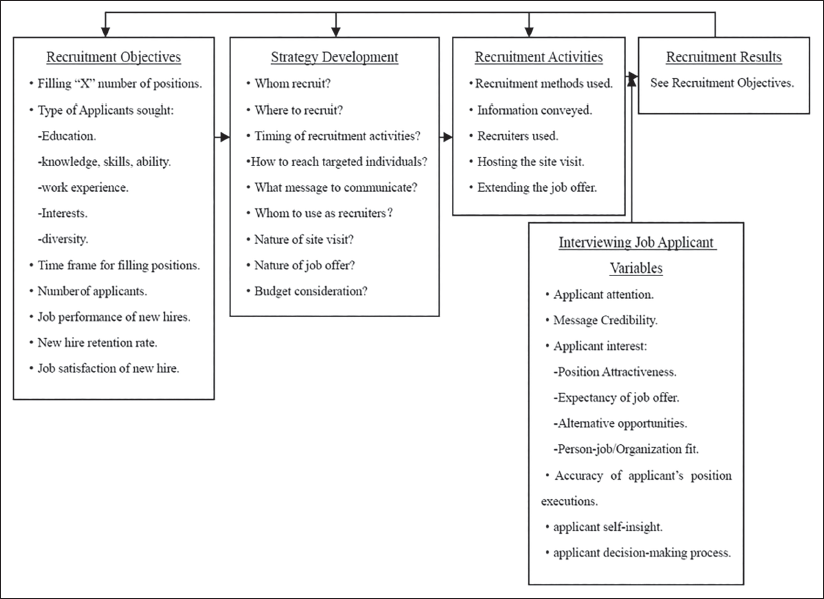
In the second stage, to develop strategies, organisation’s HR department designs a recruitment plan in coordination with other departments of that organisation (Mayer & Davis, 1999) by answering the following questions, such as starting time, catchline to attract the best talents and defining recruiters (Breaugh, 2008)—this stage is termed as ‘person centred’ (Alvesson & Willmott, 2002) approach integration in understanding intangible qualities of applicants, namely, values and attitude matching with the organisation’s belief or not (Townsend, 2007).
‘Employer branding’, a key strategy to focus organisation’s potential employees (Sullivan, 2004), is also attributed to an essential technique of recruitment (Backhaus & Tikoo, 2004) as well as organisational communication to its current and prospective employees (Lloyds, 2002).
At the next level is the strategic decision of whether they allow internal resources (Hoye & Lievens, 2005) or external sources of recruitment (Fisher et al., 1993), considering the strategic factors, such as finding the appropriate recruiters for the recruitment process, how to find appropriate candidates and budgets. The right recruitment activities accompany this process at the next level to find ‘the right candidate at the right place at the right time’ using appropriate tools and methods, ultimately leading to ‘the selection of the right candidate who accepts the job offer’. In the end, the employee must fit with the organisational culture and job and be able to perform, leading to the sustainability of organisations.
Cases from the Real World
Scene 1
As the warm rays of the spring sun streamed through the office window, illuminating his desk, Arijit could not help but feel a sense of contentment. He had only sometimes been passionate about his work at the startup. However, being a B-school graduate, this job brought him immense joy to be part of a team constantly pushing boundaries and innovating. With each passing day, Arijit’s ambition grew stronger, and he found himself yearning for new challenges beyond the confines of his current role. The dream of an international posting had become a recurring daydream during those rare moments of respite in his busy schedule. The thought of immersing himself in a different culture, tackling fresh projects and expanding his professional network, plus concurrent recognitions from his mentor, excited him to no end. Little did he know that this seemingly ordinary spring noon would begin an unexpected journey that would test his skills and resilience and ultimately lead him towards fulfilling his dream. Arijit has quite a lot of experience in hard-core sales.
After graduating from a B-school, he pondered a Singapore-based startup after three rounds of interviews. He accomplished aptitude testing, accompanied by an interview at the next level and a final round with the sr—one, founded in 2014. The offices are located in two international cities other than two Indian metropolises. The company’s expertise lies in understanding each organisation’s unique needs and challenges, allowing them to tailor their marketing strategies accordingly. With a team of experienced professionals, they can deliver effective and impactful campaigns that drive results for their clients.
Additionally, they constantly stay updated with the latest trends and technologies in the market to ensure that their clients stay ahead of the competition. Arijit now remembers his dream of joining a multinational corporation (MNC) before joining here. In that way, he envisioned a successful profession and a luxurious lifestyle. He had no idea what life would be like before entering. The interview never threatened him. After the aptitude test, the interview was ‘nice’. They assessed individuals’ sales and marketing knowledge, vision and abilities. He now has the same work that requires dedication, innovation and problem-solving. A nice package made life happier.
Scene 2
Sanchari, an active MBA graduate, has 2 years and 8 months of experience in operations and a dry spell in HR, her area of interest. For 1.4 years, she has been working in her core domain. Her family now pushes her to be in good company. Her father, employed in the state government, repeatedly advises her to obtain a stable career. Last night, she argued with her father. Now it is 7.30 p.m. She is returning to her home from the office, a 35-km journey. However, she always felt energised from covering this distance. She is reconsidering today and trying to introspect. Sanchari likes her job and wants to stay the same. She values work satisfaction. She is working for a budding regional startup with a team of 50 dedicated members. They provide IT and content writing solutions.
She dove deep into that time when she was looking for a change. After applying, she got her first call from an intern—a screening round that was never difficult—and it is still fresh in her mind after 1.4 years. Then, she got a writing assignment to give a test on her domain expertise, and lastly, they called her for the third round. She pondered her selection in the final round. She later discovered a detailed verification. She joined the firm. Her duties now include payroll, compliance and performance reviews, among other functions in HR. The company plans to expand its product line, product base and HR rank. She is eagerly waiting to lead her team now. Her preference for the candidate must be a desire to learn, regardless of experience. Sanchari likes her job. She advises learners to join startups where they can make a difference and quickly advance professionally, where they will learn multitasking and adaptability to different roles and responsibilities can make a real difference in the company’s success, and where they can also be part of a strategy development team that links business strategy with domain strategies to ensure market success and growth, as she has learned and is continuously growing.
Scene 3
In a manufacturing startup, Surajit has worked for 2 years and 10 months. Ever since it started, the firm has expanded. He oversaw crucial sales roles throughout India as part of the sales division. His remarkable salesmanship and knack for establishing lasting customer bonds brought him great renown. His contributions boosted the company’s client base and revenue. However, for some reason, he began to dread going to work each day. He needed a change of pace or a new line of work. The man joined an MNC in the Middle East after 2.8 years. Its market in India is being invaded, even though it already has an established market elsewhere.
After some reflection, Surajit realised that his option was the optimal one. His new position is challenging him, but he is loving it. The possibilities for development and expansion that India presents fascinate him. However, his first encounter completely absorbed the root. After completing three rounds of interviews, he was hired. His duties and obligations in the workplace were defined precisely. Pushing oneself, learning new things, understanding possibilities, facing hurdles, warming up new businesses and staying motivated are all things he has mastered. He has gained self-assurance and is ready to succeed in his new position.
Because of his time here, Surajit has been able to progress professionally, and for that, he is eternally thankful. He is grateful for the chances for career growth and the encouraging atmosphere at work. Surajit is pleased to be a part of the company’s continued success in India and is sure that joining was the correct choice.
Conclusion
The three case studies presented show that the hiring systems employed by Indian startups significantly impact organisational culture, productivity and employee morale.
In the first scenario, Arijit’s experience showcases how a rigorous yet comprehensive hiring process can lead to the recruitment of talented individuals aligned with the company’s values and goals. Arijit’s journey from initial aspirations of joining an MNC to finding fulfilment in a startup environment highlights the importance of aligning personal ambitions with organisational culture.
In the second situation, Sanchari’s story illustrates the significance of providing opportunities for growth and learning within startups. Despite familial pressure for stability, Sanchari’s preference for job satisfaction and opportunities for advancement within her role in HR demonstrates how startups can foster a sense of fulfilment and professional development among their employees.
Finally, the last scenario presented with Surajit’s experience underscores the impact of a dynamic and challenging work environment on employee engagement and satisfaction. Surajit’s transition from feeling stagnant in his role at a manufacturing startup to finding excitement and growth opportunities in an MNC highlights how effective hiring processes can attract talent that thrives in dynamic settings.
Finally, these case studies emphasise the importance of strategic hiring practices in shaping organisational culture, driving productivity and enhancing employee morale within Indian startups. By prioritising alignment with company values, providing growth opportunities and fostering dynamic work environments, startups can attract and retain top talent, ultimately contributing to their success and continued growth in the competitive market.
Footnotes
Declaration of Conflicting Interests
The author declared no potential conflicts of interest with respect to the research, authorship and/or publication of this article.
Funding
The author received no financial support for the research, authorship and/or publication of this article.