



Abstract
This paper analyses the role of money laundering in contemporary financial capitalism and how it consolidates synergies between corporations, crime and corrupt governments. Through a case study of a fuel smuggling operation by an alleged criminal syndicate based in Malta, it examines how systems criminality operates across a continuum of legality and illegality driven by a strategic network of individual, corporate and state actors. It also examines the wider socio-economic, political and imperialist implications of money laundering on both the local and global spheres. As the rise in money laundering merges with the proliferation of other criminal offences, dissecting this crime nexus calls for increased synergies in transnational solidarities against capitalism, imperialism, and systems criminality.
The Money Laundering Troika
The Maltese Islands in the Central Mediterranean have a long and varied history but since their colonisation by Imperial Rome, oppression and inequality have been a constant source of misery for the many and opulence for the few. Attracted by its geographical location between Africa to the South and Europe to the North, and conveniently situated on the trade route from and to the East, Malta’s safe harbours and friendly people have been coveted by many an imperialist power over the past two millennia. It is, therefore, an interesting country to take as a case study of the crime nexus not least because its institutionalised inequality has been the cause and the consequence of corruption (Mintoff, 1990).
The British Colonial Office worked through its appointed British Governor to expand or decrease its military dominance of Malta and its people depending on the exigencies of Empire, until the 1971 Labour Government determined to demilitarise the islands while transforming the political economy. It sought new partners willing to invest in necessary infrastructure, and new goods and services that it could produce. Markets for these goods expanded with Malta’s entry into the European Union in 2004. Malta remains in the British Commonwealth and has been directly influenced by the global rise of finance capital over industrial capital and its increasing fiscal corruption. This paper analyses the growing crime of money laundering and one of its predicate crimes of oil smuggling in Malta in order to deepen understanding of their prevalence, advance a critical Marxist theory of corporate-state crime and seek equitable solutions.
Recently, there has been growing national and international concern that money laundering is undermining economic performance, the rule of law and democracy (Van Dijk, 2007). Multinational business tycoons with an abundance of capital are powerful lobbyists, policy manipulators and traditional evaders of capital and labour regulations. Elected officials tend to listen to big money without adequate public accountability and transparency. For example, apart from illicit practices such as tax evasion, fiscal corruption is also characterised by legitimate procedures which promote the interests of the powerful, thus furthering systemic inequalities in society (Hock, 2023). Resultant practices of corruption and capital flight (Baker, 1999; Hock et al., 2023) have led to the growth in crime syndicates. Thus, a powerful troika – big business, organised crime and politicians – is emerging as the decisive determinant of current and future policies.
During the 20th century, big business in collusion with government has been responsible for many travesties, in particular the fomenting of war and the exploitation of workers and natural resources. Indeed, most contemporary ‘democratic’ governance systems are characterised by crony capitalism, whereby business accomplishment depends on affinity with administrative officials and unfair preferential treatment in the allocation of legal permits, public contracts, subsidies and taxation deduction (Bakre, 2013). Likewise, success in politics depends on closeness with the corporate elite for campaign funding and post-political career opportunities.
Further, the distinction between legitimate and illegitimate business is blurred as tax-evaded profits and other criminal gains merge in money laundered capital flows. Similarly, the difference between good and bad politics is indiscernible as corruption and abuse of power for personal gain has become an ordinary way of governance. The money, muscle and power troika conduct a wide variety of illicit activities systematically in order to increase profits, power and political influence. This growing crime nexus undermines responsible government and democracy (Burcher, 2017). Corporate crime networks in the state, security and judicial systems impair the state’s function to protect the population as it increasingly promotes economic and financial crime (Green & Ward, 2019; Kenny & Serrano, 2012). Concomitantly, democratic measures to tackle organised crime are significantly undermined through bribery and corruption (Sung, 2004). Indeed, through such processes, economic and political commitments to advance the public good are corrupted (James, 2008) as democracy and the rule of law are perverted by a plutocracy (Davis, 2003) that can develop into a kleptocracy and a criminal state (Bayart et al., 1999). Indeed, systematic theft by ruling elites through the confluence of state and corporate crimes results in ‘immeasurable harm’ (Green & Ward, 2019)
Turning to theoretical approaches, behaviourists argue that “greed is the most acknowledged motive for financial crime by white-collar offenders” (Gottschalk, 2022, p. 4), so the rationale for most money launderers is financial gain, which signifies social approval and power within a consumerist liberal economy. For example, official crime statistics in England and Wales demonstrate that acquisitive crime has shifted from theft to fraud due to greater accessibility and lower risks for the offender (Button et al., 2023). These circumstances may also be influential factors in the rising prevalence of money laundering.
Lupsha (1996) outlines an elite exploitative model to understand the growth of money laundering. Political authorities, driven by the pursuit of personal gain, regard organized crime syndicates as ‘cash cows’ that can be manipulated and exploited. Politicians seek to control and extort criminal groups while providing immunity from regulations, monitoring and enforcement. At the same time, “intentional ambiguous laws and regulations are put in place” to be “only erratically enforced” (Bakre, 2013, p. 9). Through such processes, traditional methods of crime deterrence deteriorate (Lupsha, 1996). Indeed, the political strategy of tolerating local criminal groups to raise national wealth brings unexpected results as it lets the “Trojan horse of racketeering and grand corruption into the walls of government” (Van Dijk, 2007, p. 54).
In their advancement of the fraud field theory which can be effectively applied to money laundering, Button et al. (2023) present a fluctuating view of acquisitive crime, based on opposing forces of ‘Threats’ and ‘Safeguards’. The three main threats leading to an increase in fraud are: opportunities, number of fraudsters, and range of enablers while the three safeguards that would reduce fraud are: a culture of honesty, effective laws, and resilience of industry. Button et al. (2023) argue that safeguards are weak and we need a collective national strategy to strengthen them to reduce fraud. The theory is helpful in clarifying some of the opposing forces at work and how the extent of economic crime can increase over time to a new steady state level but it abstracts from contemporary political economy and the exploitation, inequality and contradictions of neocolonial capitalism.
In a Marxist framework, money laundering is analysed not just at the individual but also at the systemic level within a context of expropriation and growing inequalities (Fine, 2014). Capital accumulation largely rests on the exploitation of human and other resources and the theft of the real value of labour and other factors of production. Based on the radical inequality between capitalists and workers, capitalism is inherently criminogenic (Bonger, 1916). Since the 1980s, many critical criminologists have exposed the fact that the crimes of the powerful far outweigh those of the powerless. Criminogenic factors within the capitalist states operate on different organisational levels beyond the individual to become the rockbed of economic strategies that sustain criminal practices (Green & Ward, 2019). In addition, lawmaking and law enforcement provide preferential treatment for the rich, often resulting in lack of access to justice for the working class (Gordon, 1971). Chambliss (1975) further argues that at the heart of capitalism lies private property that is overwhelmingly owned by the capitalist class which is ruthless in its protection and aggrandisement. Crime is thus primarily determined by class inequality and only through a classless society can a crime-free society be achieved.
Drawing on the work of Lapavitsas (2014), we locate the unprecedented growth in financial activities and financial profits during the past three decades in the state deregulation of labour and financial markets, and the accumulation of capital surplus especially by global companies. This growth in financial profits and international flows of capital has led to an asymmetry between the production and distribution domains. The dominant neo-liberal agenda that prioritises business profit-making leads to new forms of orchestration and interdependence between states and big corporations (Braithwaite, 2013; Geis, 2016; Levi, 2008; Pearce, 1976).
In Marxist analysis, the central antagonism between capital and labour is recognized at the root of the domination of legal and illegal capital flows. Indeed, sustained attacks on workers’ rights fundamentally erode freedom and democracy whilst increasing excessive profits, poverty and displacement (International Trade Union Confederation, 2022). At heart, is the systemic tendency in capitalist, especially neo-liberal imperialist systems to increased domination by the few and subordination of the many. Most countries in the world, including Malta, are impacted by neo-colonial capitalist agendas of exploitation and domination that are shrouded in secrecy and impunity. Low risks and lucrative rewards are associated with imperialist plunder, international bribery, and transnational tax evasion (Zabyelina, 2023). In this environment, organised criminal groups flourish (Bayart et al., 1999; Zabyelina, 2023).
Shaxson (2016, pp. vii–viii) shines light on finance capital’s imperialist trajectory from the City of London to ‘treasure islands’ and from off-shore to on-shore havens in the USA where “tax havens and the offshore system are at the heart of the world economy.” These recent trends have deepened imperialism and made it more complex. In addition, finance capital is increasing the extraction of private profits out of personal income as public provision of essential services such as health, housing, education, transport, insurance, and pensions has deteriorated (Lapavitsas, 2014). Meanwhile, banks and financial institutions have distanced themselves from industrial and commercial investments and turned to proprietary trading and extracting fees and commissions from clients while directly speculating in financial markets. Furthermore, central banks allow speculative financial excess and then rescue financiers using public money.
In more and more countries, scholars are examining the emerging symbiosis of muscle, power and money and its implications for democracy, freedom and equality (Chin, 2001; Idris, 2022; Kenny & Serrano, 2012; Lessig, 2011; Morris, 2009; Sung, 2004). The development of a symbiotic nexus blurring the distinction between criminals, politicians and business tycoons is evident in the changing patterns of organized crime in commercial activities such as restaurants, night clubs, construction companies and more recently futures trading and collusive bidding for government projects (Chin, 2001). This pattern reflects the recent history of money laundering in many nations where it has become convenient for criminals, with the help of the powers that be, to convert illicit gains into legal ventures. Indeed, “the way this corruption works is through favours, access, lucrative contracts and the authorities turning a blind eye to flat-out embezzlement” (Galeotti, 2019, p. 60).
This involvement of a wide spectrum of actors, entities, and processes enmeshed in a complex web of varying degrees of participation and involvement (Nollkaemper & Van der Wilt, 2009) could be considered as a form of system criminality. The concept of system criminality enables the bridging of “organisational and network theoretical concepts” (Rothe & Collins, 2011, p. 26), going beyond the individual level by taking into account relationships as well as the interplay between different types of actors on the individual, corporate and state level. System criminality indeed provides a good conceptual framework to the case study of fuel smuggling and associated money laundering hereby presented for analysis.
Aims and Objectives
The paper’s focus is an alleged multi-million-euro fuel smuggling operation and subsequent international money laundering operation based on the small island state of Malta. This ‘classic case study’ analysis (Dyer & Wilkins, 1991) allows for an in-depth instrumental understanding of the context, processes, main actors and drivers involved in the fuel-smuggling and associated money laundering case.
As with any other methodological design, the case study presents a number of strengths and limitations. It is particularly suited to ‘how’ and ‘why’ inquiries of an explanatory nature (Easton, 2010), enabling to “tease out and disentangle a complex set of factors and relationships” consonant with processes of money laundering (Easton, 2010, p. 119). It also enables flexibility due to the use of “multiple sources or data…through an iterative research process (Easton, 2010, p. 119). Whilst it allows for an in-depth and holistic analysis of the phenomenon under investigation (Fletcher & Plakoyiannaki, 2011), findings are however constrained to the confines of the analysed case and thus lack generalization. It is also heavily reliant on the availability, accessibility, and selectivity of existing documentary data which may lend to an incomplete or biased analysis of the totality of the case. The case study adopted for this research primarily draws on court transcripts, governmental documents and investigative reports. Apart from the fact that due to “processes of knowledge management present in court proceedings, the all but complete “truth” presented as juristic facts, and the exclusion of evidence for various reasons” (Rothe & Collins, 2011, p. 27) may impact on the wider evidence of the case, as in many other large-scale economic crimes, this fuel smuggling case remains sub-judice, posing limitations on access to evidence (Tombs & Whyte, 2002).
The paper is guided by the underlying objectives of exposing corruption, violence, human rights violations, and inequality. Drawing from Scheper-Hughes’ (1995) notion of ethical orientation, it examines money laundering and its wider political, economic, social and legal implications for democracy and economic and social justice. Adopting a Marxist framework, its premise is that crime has its origins in an unjust economic system. In the contemporary capitalist system, corporations owning the means of production and distribution are the dominant force. But although corporate crime is widespread and growing, it is seldom prosecuted.
The research relies on a contextualised explanation for theorising and generating understanding of the investigated case (Welch et al., 2011) through a critical realist approach. Through this lens, the analysis is grounded in the recognition that whilst there exists an independent external reality, our understanding of this reality is subjective and ideologically laden (Bhaskar, 1998). Thus, whilst not claiming universal and objective truths, the paper postulates explanations of the issues emerging from the case study backed up by theoretical and empirical analysis. Due to this “compelling third way”, critical realism has emerged as a “viable paradigmatic alternative” to positivism and interpretivism (Reed, 2009), particularly for conducting research on complex phenomenon (Wynn & Williams, 2012, p. 805). Concomitantly, the case study is considered as the best suited method for critical realist analysis which seek to “develop causal explanations of complex events” (Wynn & Williams, 2012, p. 788). Indeed, as acknowledged by Easton (2010, p. 123), the “critical realist case approach is particularly well suited to relatively clearly bounded, but complex, phenomena”. By overcoming ontological and epistemological inconsistencies prevalent in other research standpoints (Smith, 2006), case study research grounded within a critical realist approach complements “the value of research to praxis (Wynn & Williams, 2012, p. 806).
Money Laundering: Its Nature, Processes and Prevalence
Money laundering includes all forms of finance that escape regulation or constitute a breach, non-fulfillment or evasion of financial obligations. As in the case of other economic crimes, it is often characterised by “financial motivation, deception, secrecy, absence of physical force and the intention to make a gain or cause a loss” (Button et al., 2022, p. 13). Lack of effective government regulations and of professional business ethics facilitate inappropriate practices and policies, including money laundering. Khan (2021) estimates that the two main predicate crimes of global money laundered value are fraud (38.6%) and drugs (27.5%).
The art of deceptive money transfers has a long history, dating over 2000 years, when Chinese traders developed money laundering practices by steering money through other dealings and businesses to hide their income from government bureaucrats (Unger & Van der Linde, 2013). The specific term money laundering arose from Al Capone’s alleged practice of hiding criminal proceeds from his whisky, prostitution, extortion and gambling in cash-only laundromats in the 1920–30s in the US (Camacho, 2016). The expression became popular during the 1970s Watergate Scandal to refer to how illegal political campaign contributions paid to Richard Nixon’s re-election committee were moved to Mexico, then brought back to the USA.
The first international address about money laundering took place at the ‘United Nations Convention against Illicit Traffic in Narcotic Drugs and Psychotropic Substances’ (1988) wherein it was acknowledged that money laundering carries “devastating social consequences…[it]…provides the fuel for drug dealers, terrorists, arms dealers, and other criminals to operate and expand their criminal enterprises” (Financial Crimes Enforcement Network, 2023, para. 3).
With globalisation, developments in information technology and the financial markets, the nature and processes of money laundering have metamorphosed, becoming more intricate, refined and difficult to detect. For example, cryptocurrencies now provide the opportunity to transfer money anonymously and without bank controls. Indeed, it is estimated that approximately $76 billion of illicit activity annually involves bitcoin, equivalent in scale to the European and U.S. illegal drug markets (Foley et al., 2019). Indeed “new types of fraud have emerged from the toxic nexus between cryptocurrencies, greed, irrationality and the lack of regulation” (Button et al., 2023, p. 4).
Money laundering is increasingly obscuring the distinction between licit and illicit fund sources, making it harder to differentiate between these money flows. Through multiple financial transactions and fraudulent cover-ups, emerging from the placement, layering and integration stages, it is impossible to trace the source of illicit funds. As exemplified in Figure 1, predicate crimes (on the left) that generate dirty money include amongst others: fraud, tax evasion, bribery and corruption, oil smuggling, firearms dealing, drug dealing, human trafficking, prostitution and usury (FIAU, 2021). At the heart of the inner circle is the ‘art’ of money laundering which is most often accomplished through fraud, bribery, tax evasion and corruption. Thus, some predicate crimes also form an integral aspect of the money laundering process where through obscuring methods, an indeterminate amount of company profits join the stream of criminal gains. On the righthand side, clean assets include financial investments, property and companies, and luxury goods often ostentatiously displayed in yacht marinas, vehicles, and fancy restaurants. Money laundering: predicate crimes and integration techniques.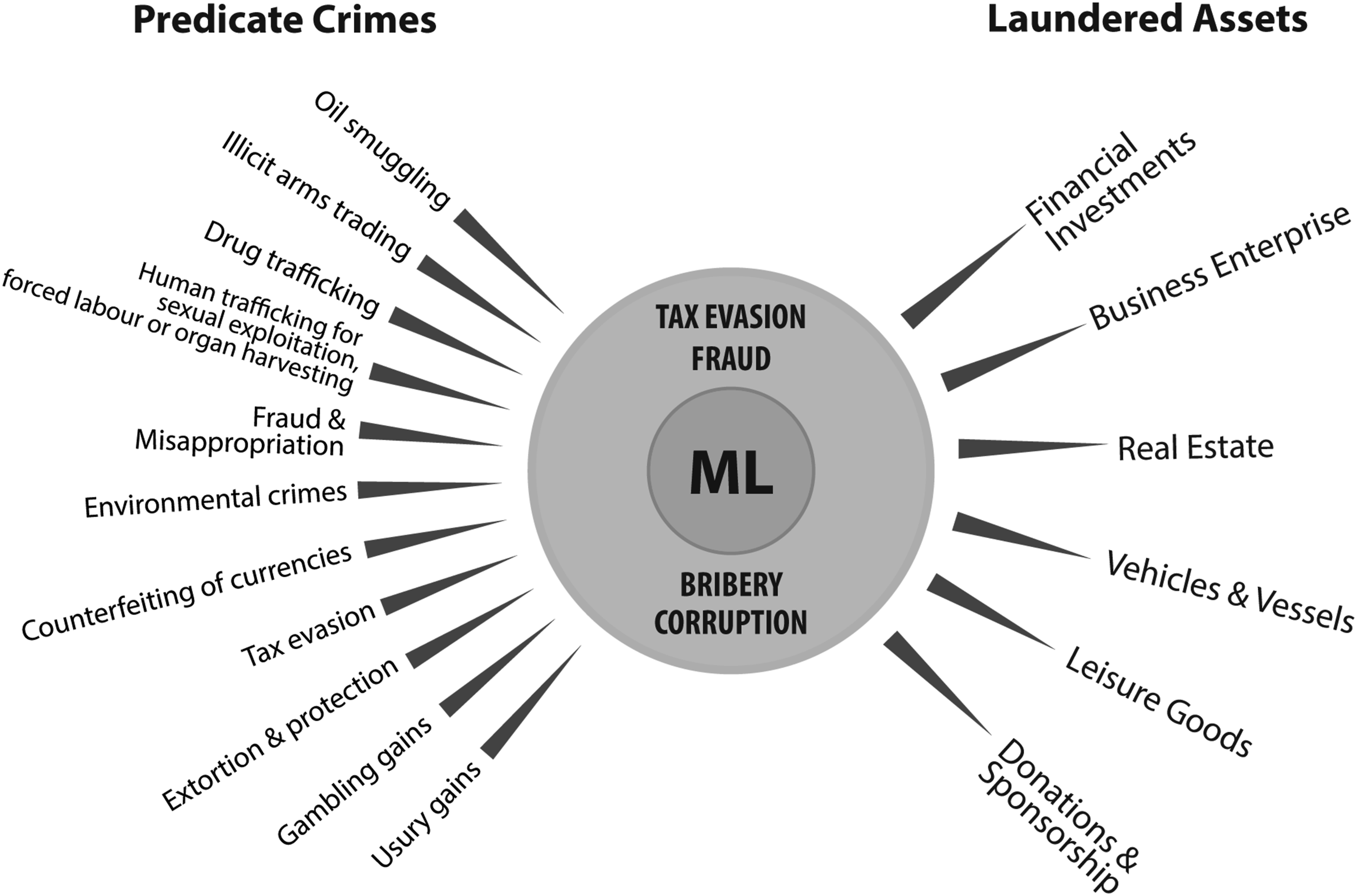
Tax havens with low corporate taxes, high secrecy, and financial innovations, facilitate money laundering. Henry (2016) estimated that in 2015 tax havens held between $24 and $36 trillion in secret financial wealth, the majority owned by the top 0.1%. Zucman (2017) estimated individual and corporate capital flight held in tax havens amounted to 8% of the world’s financial holdings, leading to a global loss in tax revenue of at least $200 billion annually. Europe’s percentage of financial wealth held offshore was the highest at $2600 billion followed by USA with $1200 billion, representing respectively 10% and 4% of these nations’ financial wealth (Zucman, 2013). Profit shifting and tax evasion by multinationals has been increasing, with 55% of foreign profits of US companies booked in tax havens (Zucman, 2015).
Globally, money laundering from environmental crimes, such as illegal logging and oil pillaging is widespread and it usually converges with other criminalities such as; tax evasion, smuggling of goods (guns and drugs), corruption, human trafficking, migrant smuggling, and violent insurgency (Financial Action Task Force, FATF, 2021). 1 Thus, integrated networks are created, establishing lucrative global pathways for many different criminal businesses. The success of criminal groups “is strongly linked to corruption which facilitates access to the source as well as the global movement of the resource” (FATF, 2021, pp. 57–9). Money laundering is also abetted by unregulated financial markets and over-the-counter derivatives markets (Biggins, 2013), often through the use of fraudulent or sham intermediaries such as shell companies, joint ventures, middlemen and dummy accounts (Unger, 2009)
As money laundering grows as a global phenomenon, it has itself become a globalizing force, extending the nexus of crime beyond and across nations and jurisdictions. Yet, as other forms of economic crime, due to its “complexity” and “erroneous perception” of being “victimless”, money laundering remains undervalued on both a theoretical and practical level (Button et al., 2022, p. 2) across domestic and international spheres. The following section will address the nature and extent of money laundering in Malta.
Malta: Money Laundering
Malta’s 21st century economic growth is largely based on cheap labour, a construction boom and deregulated financial markets. Malta has become a world-renowned iGaming and betting hub, and innovative financial technology and currency exchange hub with growth in blockchain technology, crypto currencies, and initial coin offerings. Accompanying this formal economy is an extensive informal economy. For instance, money lending through usurious loans is widespread (Vella & Mintoff, 2022, 2022b). Money laundering based on transnational flows is also a significant contributor to Malta’s exceptional economic growth as it fuels licit and illicit enterprises. According to Raineri (2019, pp. 11–13): “Malta maintains a singular regime of bank opacity…and provides a haven for companies and individuals who hide behind Malta’s registered trusts”. Yet, “legislators seem unable or rather unwilling to address this state of affairs” (Vella, 2020, p. 292).
After Malta gained formal independence from the British in 1964, real estate offered “a brand of neo-colonialism whose advance guard was the building contractor” (Fitzwalter & Taylor, 1981, pp. 135–136). The stage was set for the rise of construction magnates and property speculation. In the long period of neo-liberal governance, ranging between 1987 and 2013, privatization and deregulation created a more favourable environment for bad business. Despite the former strength of the labour movement between 1970 and 1987, the new Labour Government, formed in 2013 and headed by a financial consultant, consolidated neo-liberalism and financialisation of the economy, while promoting a cheap labour economy and a racialized labour market. Today, the favourable business climate attracts finances and investments from all over the world, including the criminal world. The result is a new structural synergy between business, crime and politics.
Since the primary purpose of money laundering is to obscure the original source of illegally gained funds, Malta’s innovative financial vehicles, gaming hubs and online casinos have become increasingly attractive to money launderers. 2 The rich and powerful, regardless of their reputation, also have access to Malta’s individual investor programme to gain Maltese citizenship and thus unhindered access to EU markets.
In tandem with increased money laundering activities in Malta, corruption has become institutionalised - “the investigation of high-level corruption cases remains lengthy. Results in terms of final judgements are still lacking” (European Commission, 2022, p. 1). Malta’s former political trio, the then Prime Minister, Chief of Staff and Health/Energy Minister, are currently under investigation for corruption in connection with the multi-million euro ‘Electrogas’ deal, the fraudulent privatisation process of three hospitals where the Auditor General found evidence of lack of due diligence on the investors (National Audit Office, 2020), and the Pilatus Bank laundromat, amongst other scandals (Camilleri, 2021). In 2019, the ‘Organised Crime and Corruption Reporting Project’ (2019, para. 11), stated: Malta under Muscat had become a haven for organised crime and corruption: golden visa fraud; smuggling of weapons, oil, drugs, and people; illegal fishing; money laundering; and allowing Italian criminal groups to operate extensively from the country.
In 2021, Muscat’s chief of staff Keith Schembri was charged with money laundering, corruption, fraud and forgery. Under Muscat’s successor PM Robert Abela, €22 million in direct order contracts were given by Infrastructure Malta in the first 6 months of 2022, following a total of €27 million in direct contracts in 2021, raising serious issues of good governance (Arena, 2022).
Malta: Ineffective Anti-Money Laundering Action
Malta enacted ‘The Prevention of Money Laundering Act’ in 1994, followed by the subsidiary legislation ‘The Prevention of Money Laundering and Funding of Terrorism Regulations’ in 2018 (Malta Government, 1994). Money laundering is deemed an offence if property is acquired, possessed, used, converted or transferred and concealed or disguised with the knowledge that such assets are the direct or indirect outcome of criminal proceedings. The penalty established for a conviction of money laundering as per Article 3 is a fine not exceeding €2,500,000 and/or imprisonment for a period not exceeding 18 years. In the Court of Magistrates, the penalty carries a term of imprisonment between 6 months and 9 years, or/and to a fine of between €2329.37 and €116,468.67. Under Article 5, the Act also provides for the confiscation and forfeiture in favour of the Government of proceeds derived from or obtained, directly or indirectly, through criminal activity yet this is rarely effectively executed on account of the legal safeguards provided for under Article 8 of the EU Directive (2014) that “a fair balance must be found between the protection of property and the requirements of the general interest in defence of alleged corporate money laundering and against the sequestration of individual and company assets” (Constitutional Case, 2021, p. 4).
Malta’s subsidiary legislation (2018) within the context of corporate crime, sets out measures which professionals, particularly those working in the financial and legal sectors, must adhere. The regulations also address politically exposed individuals, one’s family members and/or others close associates as potentially high-risk individuals (FIAU, 2019). These domestic legal provisions transpose the various EU directives aiming to provide a harmonised legal and regulatory framework to inhibit and combat money laundering across the union.
Yet, despite these various legal provisions and the structures and measures that were set in place to combat money laundering, such as prohibition of cash transactions of over €10,000, Malta was internationally denounced in 2021 for its ineffectiveness in addressing money laundering. Coinciding with the FATF, 2021 ‘grey listing’, the country experienced a substantial increase in money laundering reports. Indeed, Malta’s financial regulator in the prevention of money laundering and the financing of terrorism, the Financial Intelligence Analysis Unit, reported a 28% increase in suspicious reports filed between 2020 and 2021 (FIAU, 2021). 3 This increase may be explained by various factors including enhanced awareness of the importance of reporting. An increase in the allocation of resources to monitoring and regulating structures may have led to the detection and arraignment of additional cases. It may also be the case that crime arising from money laundering is simply on the increase. 4
According to the EU Justice Scoreboard, in between 2017 and 2019: “Malta continues to rank last among the 27 EU countries, with an average of 1644 days to conclude a money laundering case” (De Gateano, 2021, para. 4). Despite improvements undertaken to address judicial issues such as efficiency, quality and independence, Malta’s ability to combat high level crime, including money-laundering remained in question in 2022. The Council of Europe’s anti-corruption body GRECO in its fifth evaluation of Malta’s compliance report in regard to averting corruption and promoting the integrity of high executive functions and enforcement agencies decreed that the Malta government has not carried out vital reforms recommended in 2019, including the implementation of an anti-corruption strategy and the development of a human rights institution (GRECO, 2022).
Malta’s small size and geo-strategic location are factors that further the nexus between business, crime and politics (Raineri, 2019). Market globalization, the country’s proximity to strategic crime routes and its large surrounding maritime space facilitate illicit economies and facilitate the prospects for external actors to engage in political corruption and business interests (Albanese, 2000). For example, there is evidence that the ‘Ndrangheta mafia clan, among others, benefits from Malta’s lax tax system and corporate friendly regulatory framework to promote money laundering (Direzioni Investigativa Anti-Mafia Rapporto, 2021). Such that, “in illegal bookmaking and money laundering through illicit online gaming servers, mafia clans well and truly excel in Malta” (Lindsay, 2022, para. 18). Malta’s entry into the European Union in 2004 provided a special added advantage as a gateway for many illicit goods, including drugs, oil and human trafficking, into a larger market.
The vulnerability of Malta’s political institutions to conflicts of interest and corruption (Council of Europe, 2022) and the systemic lack of equality of citizens before the law are important factors leading to the immunity of the crime nexus (Burcher, 2017). Opportunities for organized crime to collude with political parties arise when the latter lack sufficient transparency and internal democratic mechanisms (Briscoe & Goff, 2016). In addition, legislators are usually powerful politicians with connections to law enforcement and the judiciary, making them important brokers for organized crime networks. Thus, politicians can create and maintain a lax legal environment for illicit activities to flourish (Burcher, 2017).
These are the major characteristics of Malta’s current economic and socio-political landscape that are conducive to the interests of a powerful troika of politicians, businesses and criminals.
Fuel Smuggling: A Case Study of Money Laundering
This fuel smuggling case study based on two Italian Guardia di Finanza investigations: ‘Operation Proteus’ in 2013 and ‘Operation Dirty Oil’ in 2017 reveals how business flourished in a regulating, monitoring and enforcement vacuum over the past decade in Malta’s large search and rescue zone. Situated between Libyan oil wells and Italian mafia syndicates, Malta’s maritime criminals, their political guardians and business partners were, and continue to be, in an ideal position to garner huge profits from oil and weapons smuggling. Furthermore, drugs, cigarettes, counterfeit clothes and human trafficking regularly emerge as illicit Central Mediterranean trade (Camilleri, 2021).
An illicit trade in firearms and ready-to-use diesel oil began to boom in the Central Mediterranean after the assassination of Ghaddafi in 2011 and the subsequent outbreak of civil war in Libya (UN Security Council, 2016, 2021, 2022). Huge profits were then laundered through banks registered in Malta. 5 The Malta Government did little to ensure that the pillaging of war-torn Libya and subsequent money laundering were regulated. Indeed, corruption and money laundering became a modus vivendi as scandals multiplied in connection with various high-ranking executive and political figures.
From the ‘Tribunale di Catania Sezione del Giudice per le Indagini Preliminari’ (2017), 6 detailing illegal oil shipments from June 2015 to June 2016, evidence emerges that Darren Debono acquired one of the largest local market shares of illegal oil by 2014. Debono incorporated World Water Fisheries Ltd. in 1999 (ICIJ, 2017) and ADJ Trading Ltd. in 2007 (ICIJ, 2017) with the same auditor Christopher Baldacchino as well as two new shareholders: Libyan Fahmi Ben Khalifa (Slim Fahmi) known for links with ‘Libyan militias’, human trafficking, weapons and oil smuggling (Vella, 2017), and Egyptian ship owner Ahmed Arafa, who provided oil tankers Basbosa Star and Sea Master X. Maltese fleet owner Gordon Debono (owner of PetroPlus Limited) also became a key partner (Catania Tribunal, 2017).
Debono developed links to access the large fish and oil markets in Europe. In Italy, he collaborated closely with Massimo (Marco) Porta, Director of Maxcom Bunkers SpA (Rome and Genoa) and with Nicola Orazio Romeo (Catania Tribunal, 2017). In addition, Debono built useful relationships in other countries, including in Turkey and in Spain (Marlowe, 2015). Thus, using strategic international links, Debono allegedly became a key player in illicit diesel oil trade and money laundering (Bagnoli, 2022). According to the Catania Tribunal hearings (2017), the Maltese branch of the fuel smuggling operation was responsible for the vessels and the journey from Libya, for the transshipment operations and for final delivery to Italian ports.
The massive profits made through the sale of illicit diesel oil in Malta, Italy, France and Spain went through foreign current accounts set up in the names of shell companies based in Malta and Tunisia (Catania Tribunal, 2017). Allegedly, Tareq Pababb Dardar managed wire transfers through a shell company Al Kamal International Trade established in Malta by Darren Debono and Nicola Orazio Romeo to funnel funds to accounts in Libya and the United Arab Emirates (Catania Tribunal, 2017).
In 2017, Slim Fahmi was arrested in Libya for alleged fuel smuggling, human trafficking and money laundering denounced by the Libyan Rada Special Deterrence Force as “one of the biggest smugglers of hydrocarbons and manipulators of Libyan assets, the famous ‘smuggling king’ of Zuwara” (Vella, 2017). Fahmi’s collaboration with Debono in the multi-million fuel smuggling operation from Libya to Malta and Italy was exposed in US Office of Foreign Assets Control (OFAC, 2023) reports which Malta’s Sanctioning Board made public in 2014. The Italian police seized Debono in Lampedusa in October 2017 (Catania Tribunal, 2017). Ten members of the international criminal syndicate were arraigned for oil trafficking operations that took place from June 2015 to June 2016. Chief Prosecutor Carmelo Zuccaro clarified that: “ship-to ship operations were carried out off the coast of Malta and the false documentation of origin 7 and loading of the contraband oil was apparently issued by the Chamber of Commerce of Malta thereby concealing any element capable of highlighting the illicit Libyan origin of the product” (Catania Tribunal, 2017, p. 27). This complex stratagem highlights the criminal group’s remarkable ability to produce false customs documents by exploiting a network of complicity in Malta.
Marco Porta based in Rome, Slim Fahmi resident of Libya and Malta, Nicola Orazio Romeo of Sicily, Tareq Pababb Dardar from Zuwara and based in Tunisia, and Gordon and Darren Debono were amongst those charged with ‘transnational conspiracy to launder gasoil of illicit origin and fraud’ in the tribunal that continued from 2017 to 2020. The Tribunal concluded that Darren Debono, Nicola Orazio Romeo and Gordon Debono were the main collaborators in the €30 million fuel smuggling ring while Marco Porta and Fahmi Ben Khalifa were the main promotors. Tareq Pabbab Dardar was charged as the key collector of large sums of money made from illicit sales of petroleum products (Catania Tribunal, 2017).
The tribunal details how, in just one year, 82 million kilograms of Libyan diesel bought by Maxcom Bunker SpA was concealed and imported into Italian ports declaring a total customs value of €26,862,416. Here the fuel was ‘nationalised’ in local stores and sold at just below market prices but still at a profit of about 60%. A joint investigation of the Swiss Kolmar Group 8 (Duparc et al., 2020) later revealed that Darren and Gordon Debono were able to store contraband oil in Malta’s state company (Enemed) tanks (Catania Tribunal, 2017). 9 The contraband oil was then sold to Swiss multi-billion-dollar petroleum trader Kolmar A.G. (Duparc et al., 2020).
In 2018, following investigations by the UN Panel of Experts on Libya 2016–18, the US Treasury blacklist designated 24 companies, seven sea vessels and six people including Darren Debono, Gordon Debono, Terence Micallef, Rodrick Grech, Fahmi Ben Khalifa and Ahmed Arafa (Agius, 2022). Assets were frozen and sanctions imposed for their role in threatening the peace, security or stability of Libya through smuggling activities (U.S. Department of the Treasury, 2018).
In 2019, Malta’s Sanctions Monitoring Board recommended enhanced due diligence of OFAC subjects for their involvement in the oil smuggling crime ring. Debono petitioned OFAC with the assistance of international collaborators to remove himself and Gordon Debono from the UN Sanctions list (Vella, 2019a, 2019b). Darren Debono, fellow footballer Jeffrey Chetcuti, auditor Chris Baldacchino, Gordon Debono and his wife Yvette were among 15 people arrested in a large-scale anti-money laundering swoop in Malta in November 2020. They were charged with money laundering and smuggling largely as a result of FIAU probes into suspicious transactions 10 at Satabank and Europol and Interpol interventions. The court ordered freezing of their personal assets and those of 15 companies (Agius, 2020), however circumvention of such asset freezes is common (Bagnoli, 2022; Montebello, 2023).
The use of shell companies and the purchase of luxury goods to launder money is indicated in the details of the freezing order in the case of The Republic of Malta versus Gordon Debono and Yvette (Yvette-Marie) Debono (Department of Information, 2020). The order froze all the money and movable and immovable properties in the hands of Gordon Debono, Yvette Debono, Hi-Low Properties Ltd, Petroplus Ltd, 11 KB Investments Ltd, KB Lines Ltd, Seabrass Ltd, Oil and Ship Trading Ltd, Gorge Ltd, S-Cape Yacht Charter Ltd, S-Cape Ltd, and Yves Ltd. The couple are charged with money laundering millions of euros (Brincat & Xuereb, 2020) largely as a result of the joint operation with Europol, Maltese police and the Italian Guardia di Finanzi that began in 2013, code-named Operation Proteus. Investigations revealed that Gordon Debono’s Satabank account “received €530,000 over two years from sources including Petroplus and Petroplus Trading Ltd, two of the eleven companies where the couple held directorships” (Brincat & Xuereb, 2020, para. 8). In addition, cheques were made out to Debono’s stevedore, Shaun Higgins allegedly valuing over €7.1million. Police seized about 30 vehicles belonging to the couple and documents showing that Yvette “had purchased some €1.7m worth of property in Cyprus” (Brincat & Xuereb, 2020, para. 12). Most accomplices have not yet been charged, and have freedom to operate using unmonitored cash payments. The cases remain sub-judice.
This fuel smuggling case study reveals how business flourished in a regulating, monitoring and enforcement vacuum over the past decade in Malta’s large search and rescue zone. Situated between Libyan oil wells and Italian mafia syndicates, Malta’s maritime criminals, their political guardians and business partners were, and continue to be, in an ideal position to garner huge profits from oil and weapons smuggling. Furthermore, drugs, cigarettes, counterfeit clothes and human trafficking regularly emerge as illicit Central Mediterranean trade (Camilleri, 2021).
Malta: The Wider Nexus
The case study of fuel smuggling and money laundering in the Central Mediterranean reveals the close state-corporate ‘regimes of permission (Whyte, 2014) that go beyond the individuals directly involved. Malta’s wider money laundering nexus of crime includes unethical and illicit business, corruption and corporate lobbying. The wider nexus is based on institutional arrangements that emerge from economic and political inequality (Ciocchini & Greener, 2021) and includes enablers such as public officials, businesses, professionals and those foreign and local entities that exert political influence.
Some of the methods for avoiding detection of money laundering that arise in this particular case study include improperly recorded trade reports, bank data and wire transfers; the creation of numerous companies at home and overseas; the continuous change of directorships of companies; 12 purchasing restaurants and frequently changing their names and nominal ownerships; 13 mixing up the trail of receipts such as from the oil to the fish market, comingling legal and illegal oil assets, transferring illicit funds under the guise of shareholder loans; 14 and not identifying the true sources of funds. Funds are then integrated through legitimate purchases of property, vehicles, vessels, restaurants, and donations to sports clubs.
Most of these methods require the expertise of auditors, accountants, lawyers, notaries or bank officials. The role of such legal and financial professionals in the criminal world and in particular in money laundering has often been overlooked (FATF, 2018). Darren Debono’s auditor, his financial manager and his lawyer all allegedly contributed their expertise to the fuel smuggling nexus and may well have given important advice “on how to disguise the nature, source, location, ownership, control, origin and/or destination of funds to avoid detection” (FATF, 2018, p. 6). The creation of multiple shell companies is one common way to hide illicit funds – a web that the ICIJ (2017) has closely monitored in the case of Darren Debono who set up various companies, including; World Water Fisheries Co. Ltd in 1999, Nesvan Company Ltd in 2004, Felca Limited in 2006, Andrea Martina Limited in 2007 and ADJ Trading Co. Ltd in 2007, Marie de Lourdes Co. Ltd in 2012 and World Water Holdings Ltd in 2016.
As evident from the above case study, partners in the crime of money laundering often include family members and significant others. In June 2021, Maltese authorities arrested Debono’s step-child Florinda Sultana, former director of Nesvan and MSI Catering and her partner Albert Buttigieg, former Head of Unit at Banif Bank, Director of Luzzu Catering, and financial manager of two of Debono’s fish restaurants Porticello and Capo Mulini. 15 They were charged with using restaurants to launder money linked to fuel smuggling (Balzan, 2021).
These offences could not have been possible without the facilitation of public entities often at the direction of high-ranking public officials. Take for example the numerous instances cited by the Catania Tribunal in which the Malta Chamber of Commerce authenticated fraudulent documents concerning the source of illicit oil. These documents were then accepted by local customs officials. Malta’s state-owned company Enemed also colluded through its combining of illegal and legal oil, indicating that the state has a vested interest in the nexus of crime, perhaps especially in the short-term benefit of having direct access to a greater volume of cheap diesel oil. Consumers of diesel in Malta, Italy, France and Spain were inadvertently enjoying lower priced fuel delivered through a crime nexus. This makes citizens party to the crime nexus and resource pilfering as we are caught in the free-rider paradigm. The case study reveals that illicit layering and integration of criminal funds goes beyond the individual concerned but rather is facilitated and enabled by other partners in crime. These include friends, family and acquaintances, white collar criminals, professionals and administrators in the political, legal and financial sectors, ‘legitimate’ business entities, and ultimately unknowing fuel consumers. In these circumstances, money laundering is a systemic corporate-state crime but if and when criminal action is taken, it often targets individual persons such that the broader nexus remains operative.
Money Laundering: The Global Nexus
As the above analysis indicates, money laundering is an individual, group, corporate and state crime, thus a systemic crime. Similar to drug trafficking, fuel smuggling is a multifaceted phenomenon, characterised by an amalgamation of endogenous factors such as organisational structure and resources, and exogenous factors, including cultural and institutional elements, which simultaneously impact strategies and decision-making of criminal organisations (Antonelli, 2024). As in the case of arms trafficking (Rothe & Collins, 2011), in fuel smuggling and money laundering operations, the “line between legal and illegal, ‘intended’ destination, intermediary locations, and final destination, involvement of transnational networks, corporations, and states…reveals a complex system of actors and actions” (Rothe & Collins, 2011, p. 26). The systems criminality approach enables us to draw a thread from the illicit smuggled oil from Libya to the licit market sales in Europe. This positioning allows for a more thorough identification of different levels of “involvement and liability” by the different stakeholders (Rothe & Collins, 2011, p. 26). Systems criminality thus provides a viable conceptual framework for the analysis of fuel smuggling and money laundering.
Given the global dimension of fuel smuggling and money laundering and how this is facilitated by and in turn facilitates global capitalism, it can also be considered a supranational crime. The wider global nexus of crime in the analysed case study is illustrated in Figure 2. Its content is largely based on the Catania Tribunal’s evidence of dirty oil routes stretching from Zawiya in Libya to Malta’s coast and on to the European ports of Augusta in Sicily, Civitavecchia on the Ligurian Sea coast of Italy and Venezia Maghera on Italy’s northern Adriatic Sea coast. From these ports, oil was transported to major European oil distributors. The syndicate’s inner ring included people of Maltese, Libyan, Italian, Tunisian and Egyptian origin with the Swiss Kolmar Company allegedly being a particularly close business partner. Ship traders also included Ukrainian and Turkish based companies. Illicit money flows were for some time funnelled through bank accounts in Tunisia, Libya or the Gulf States. Other illicit money flows appear to have gone directly from Malta to shell companies based in the British Virgin Islands and Belize. Thus, violations cut across different geo-political and judicial territories, acting as partners in the case of Libya and Italy, or providing vessels such as Egypt, Turkey and Ukraine, providing markets such as Switzerland, and providing opaque banking services among others in Malta, Tunisia and UAE. Big business alliances are the backbone of such operations in widespread global oil smuggling, illicit oil distribution and capital flight. Malta: A global nexus.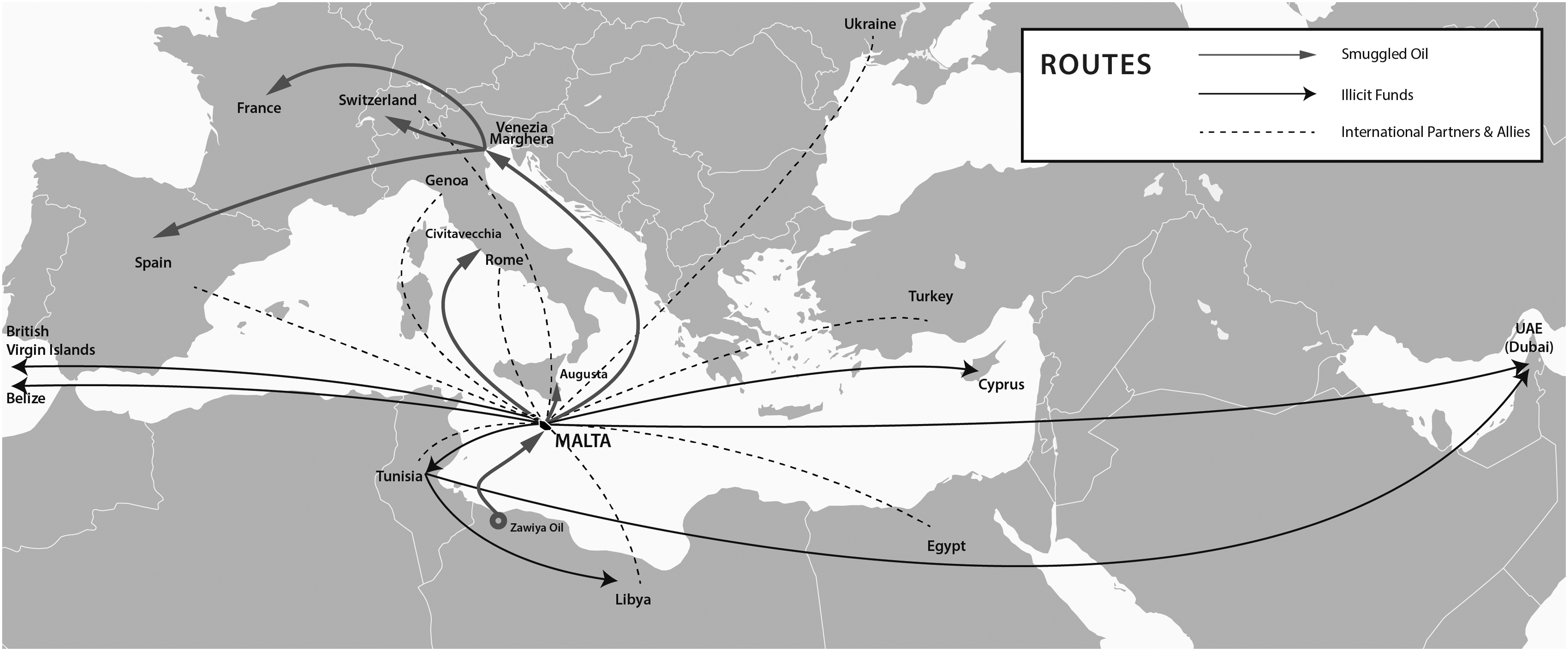
Malta is one of many states that competes globally for criminal money. A criminal consortium, reportedly led by businesses in Libya and Italy and headquartered on the Maltese Islands, plundered the natural resources of a war-torn country. The expropriation of oil from Zawiya Oil Refinery, and subsequent smuggling, illegal profiteering, fraud, and money laundering continued unhindered for at least five years. Clearly the effectiveness of state monitoring, legislative controls and enforcement are limited against the growing hegemony of the global crime nexus. In the Maltese case study, criminal opportunities emerged to the South and to the North of the archipelago. After the NATO invasion in 2011, Libya became war-torn and unstable, creating “a perfect environment for the growth of organised crime” (Bagnoli, 2022, p. 337) and fostering greater opportunities for these networks “to team up with international criminal groups” (Bagnoli, 2022, p. 310). To the North of Malta in Italy, organised crime syndicates such as ‘La Cosa Nostra’ have grown exponentially in global power over drug, oil, and human trade (Federal Bureau of Investigation, 2005).
Thus, the wider nexus of money laundering goes beyond the jurisdictions directly involved as it is an intrinsic part of the global capitalist system. The capital accumulation process, “expansive and often explosive” (Sweezy, 1997, p. 1) in wars, environmental destruction, and labour exploitation has also led to the gradual erosion of nation states’ sovereign powers. It has “undermined their effort to manage their borders’ and the ‘ability to control their own currency” (Rothkopf, 2012, p. 35). At the same time, transnational corporations have taken centre stage as key players in shaping globalisation by determining the nature and extent of trade, foreign investment and financial flows. It is in their short-term interests to avoid taxes, collude in crime and corrupt the political and legal systems. Forming an integral part of the neo-colonial agenda driven by profit maximisation through the exploitation of labour and local resources, transnational corporations exert significant socio-economic and political influence over governments, particularly small ones. In the process, they “play nation-states against one another as they venue shop for more attractive tax or regulatory regimes” (Rothkopf, 2012, p. 35). Indeed, within this context of transnational business hegemony, Malta competes for criminal money against off-shore islands like the Caymans or Guernsey and against on-shore tax havens such as Delaware, USA for supplies of hot money from developing countries and for tax-evading company’s profits.
Money laundering acts as an oppressive tool of imperialism promoting the existent strata of exploitative practices between rich and poor nations, between capitalist and working classes. Ciocchini and Greener (2021, p. 1612) argue that “we should take seriously the continuing importance of structures of neo-colonialization: the Global system of accumulation founded on various matrixes of inequality, facilitating dispossession, appropriation and exploitation”. Increasing international corporate activities in developing nations has furthered the spread of illegal financial flows and capital flight (Bakre, 2013). This has led to an increased convergence of crimes such as pillaging resources, slave labour, fraud, bribery, money laundering and corruption. Even a small island state such as Malta can play a pivotal role in the wider global nexus of money laundering and related crimes. Through money laundering; “the West maintains a shadow financial system that allows corrupt or tax evading multinationals and individuals across the globe, to hide and launder ill-gotten gains. As long as this system persists, illicit money will continue to flow out of mostly the world’s poorest nations” (Baker, 2012, para 3). More than US$1 billion leaves developing world countries through illicit flows every year, with much of the money ending in tax-free spaces (Kar & Spanjers, 2015). Indeed, Baker shows that for every dollar of development aid sent to developing countries, ten dollars flow back as capital flight (Baker, 2013). Thus, “much of the onus for meaningful progress to combat money laundering globally should be placed on the world’s most developed nations” (Baker, 2012, para. 3).
Dissecting the Nexus
This analysis of oil smuggling and money laundering is just one example of how the current neo-imperialist capitalist system fosters a nexus of crime orchestrated by corporations, criminal syndicates and the state. By focusing on a small island with particular historic, local, regional and global opportunities for fraud and corruption to flourish, it contributes to the academic discourse on economic criminology by clarifying the origins, methods and effects of collusion between companies, state institutions, and criminal syndicates. The chosen theoretical lens drawing from Marxist economics and critical realist criminology has its strengths in teasing out the interlinks and clarifying the historic and contemporary forces that strengthen this nexus of crime. The study concludes that the primary forces advancing the crime nexus are global corporate strategies to ensure cheap access to oil and to promote money laundering, together with local state connivance in these crimes. The opposing force to prevent increasing corruption and fraud comes primarily from regulators and citizens. The limitations of the analysis mainly rest on the difficulty in gaining access to vital information and the narrative of denial that these issues are of primary importance to our everyday lives.
Despite limitations of sub-judice proceedings and a persistent lack of transparency, we have drawn on reliable sources to analyse how a criminal syndicate made inroads into the energy sector facilitated among others by an oligopoly of oil importers and a state that supplied storage tanks for dirty oil. This begs the question to what extent are other sectors of the economy being influenced by this nexus and how is money laundering linked to other state and corporate crimes such as corruption, tax evasion, fraud, arms and drugs smuggling and environmental destruction.
Malta is currently dominated by big business with powerful forces in the executive, legislative, judicial and administrative sectors that thrive on the deregulation of financial and labour markets, increased cheap and precarious labour, and the rise of the financial sector and on-line gaming. The nexus acts as a cartel that defies integrity and transparency. This morphing cartel of criminal syndicates, big business and politicians undermines democracy and increases inequalities, enabling more crime and more injustice. It has become a major part of the finance capital accumulation process.
Every criminal act carries socio-political and economic effects. Global money laundering has a myriad of repercussions ranging from economic, political, and environmental to social. Economically, money laundering threatens fair trade and economic competition, displaces legitimate business, widens the hidden economy, and drains the state of resources needed to provide basic services (OECD, 2012). Politically, it undermines good governance, corrodes the fundamental tenets of democracy, erodes public trust in public institutions and reduces politics from a transformative force for social change to one that serves specific interests. Environmentally, it violates regulations that protect biodiversity, as in the case of oil spills when illicit oil is bunkered at sea. Socially, it increases inequalities and unfairness by strengthening the domination of a few to the misery of the many (Briscoe, Perdomo and Burcher, 2014; Hock et al., 2023). Overall, it undermines national and international democracy, security and peace (Briscoe et al., 2014), furthering social instability and inequality. As a result, the nexus of money laundering destabilizes society, as it strengthens the domination of economic, political and criminal wealth.
Clearly, money laundering is “a cross-geography, cross-branch and cross-business challenge. Financial institutions are challenged with regulatory laws across geography and markets” (Patel & Thakkar, 2012, p. 179). Due to its intricacy across different spheres and borders, money laundering constitutes a global challenge that requires a global response. Many national and international efforts have been set in place to provide necessary legal or regulatory tools to prevent and address money laundering as also reflected in increased spending in the policing of money laundering across both the public and private sectors, but also increased research on the topic to promote more evidence-based practice (Hock et al., 2023). Yet, from a review of over 1000 sources carried out by Hock et al. (2023), the evidence on ‘what works’ in the prevention, detection and curtailment of money laundering tends to be limited, despite the academic integrity of studies. Various tools and strategies such as risk assessment, due diligence, compliance standards, internal audit, datamining, and registers of beneficial owners were considered as “promising”. Other measures such as external audit, compliance industry and financial penalties, restraining/freezing orders and blacklisting were categorised as “unclassified” while other measures such as codes of conduct and debarments upheld “no supporting evidence” on reducing money laundering (Hock et al., 2023). While “this does not mean the tools and strategies do not work, there is just no quality evidence to show they do” (Hock et al., 2023, p. 1), it remains the case that scientific analysis is still considered paramount in policy development and implementation. On a global level, the Financial Action Task Force, and other supranational institutions such as the United Nations, the World Bank, the Bank for International Settlements, and the International Monetary Fund all have anti-money-laundering objectives. Yet, international legislation, including international criminal law is “weak and ineffectual” (Rothe & Collins, 2011, p. 28) in addressing system criminality (Bassiouni, 2010), justifying support for the expansion of existing regulatory frameworks to extend culpability from the individual level to private entities and nation states (Rothe & Collins, 2011, p. 26). Such a framework would in turn emphasise the importance of “international responsibility and collective liability” in the effective resolution of such systemic crimes (Rothe & Collins, 2011, p. 33). Despite the significant potential benefits accruing from such regulatory mechanisms, addressing systems criminality within the context “of real politik involved in enforcement of international law…, issues of sovereignty and the current limitations of international law, applying accountability in terms of complicity, knowingly or unknowingly, or even those acting implicitly, will indeed prove to be difficult” (Rothe & Collins, 2011, p. 33).
Moreover, tackling money laundering is superficial and largely ineffective as it is principally focused on the possibility of destabilising capitalist financial markets, without regard for its social, political, and environmental costs. As exemplified by Min Zhu (2016, para. 5), Deputy Managing Director of the IMF, “Effective anti-money laundering and combating the financing of terrorism regimes are essential to protect the integrity of markets and of the global financial framework”. Thus, anti-money laundering actions are paradoxical, as they are primarily targeted at protecting the current economic and financial system – neo-liberal, imperialist capitalism – the same system which propagates the crime of money-laundering.
Money laundering constitutes both a cause and effect of the neo-liberal capitalist system. Through its illicit enterprise, it expands licit enterprise which in turn is utilized to expand illicit enterprise in an ever-growing nexus of capitalist economic growth (Money), criminal engagement (Muscle) and political influence (Power). The implications of the growing nexus of money laundering are unnerving. The troika that is daily strengthened through crime, capital flight and opacity is changeable and unpredictable. In certain countries, it is big business that currently holds more power than the criminal and political elites, but in other countries, criminal elites are fast increasing their share of political and financial power (Bayart et al., 1999).
The question remains who calls the tune. Is it Power in the hands of the government, Muscle in the arms of the criminals or Money in the bags of big business? Or is it the trio, with greed for big money, status and power as the motor of the nexus? Externally, the troika projects itself as a stable cohesive hegemony, collaborating together for its own collective interests, yet fuelled by diverse and competing motivations and interests. Internally it is characterised by a shifting of balance between money, muscle and political power, making it a dynamic menacing force. Truly, addressing money laundering and its ever-expanding cycle and monopolization of power demands a deeper analysis of the criminal forces in financial capitalism and the emerging collective opposition that promises a dialectical change. Thus, MacManus (2016) predicts a growing interplay between civil society exposure of state-corporate crimes and state corporate strategies of denial and repression.
Money laundering serves to confute licit and illicit enterprise. It blurs the line between blue-collar and white-collar crime and obscures the boundaries of political influence, public policy and corruption. Indeed, “as the cycle of crony capitalism has expanded with the intensification of globalisation…opportunities for corruption, illicit financial outflows and money laundering have increased” (Bakre, 2013, p. 17) in the process reducing transparency and blurring the line between politics, crime and money. Fighting money laundering necessitates actions and relentless local and transnational solidarities against capitalism and towards the creation of new ways to commune (Davis, 2016). Central to this movement is a fresh consciousness of the inner workings of finance capitalism and its growing criminal nexus. People must “re-establish the ideological primacy of the collective over the individual’ and redeem labour’s ‘control over capital, domestically and internationally” (Lapavitsas, 2014, p. 805). People’s banks based on integrity and fairness can take advantage of digital technologies that increase accessibility and reduce transaction costs. Public provision and public property can be reclaimed.
The international Occupy Now Movement exposed the corrupt, violent framework of the financial capitalist system and how it has dominated the world by oppressing and exploiting the majority to the disproportionate benefit of the minority, in the process highlighting that “the current mode of producing goods is neither the only way, nor the best way, of providing for human needs or the necessities of life” (Pearce, 2015, p. 7). However, this could be achieved “by organizing societies and institutions that are egalitarian and democratic with open systems of communication and high general levels of education, in other words, in socialist societies” (Pearce, 2015, p. 7).
Footnotes
Declaration of Conflicting Interests
The author(s) declared no potential conflicts of interest with respect to the research, authorship, and/or publication of this article.
Funding
The author(s) received no financial support for the research, authorship, and/or publication of this article.
