



Abstract
Food production may involve serious harms that lie beyond traditional definitions of crime and are not statutorily proscribed. One example of a criminologically under-researched source of harms is intensive farming. Taking a case study of rising intensive pig farming in Northern Ireland, this paper innovatively applies the state-corporate crime framework to analyse the catalysts for environmental and social harm in the country, expanding the knowledge of complex relationships between political and economic actors from a green criminological perspective and further advancing the agenda of ‘greening’ of state-corporate crime (Bradshaw, 2014). It concludes that a state-corporate symbiosis supports and reinforces a market-oriented, profit-driven model of farming that prioritises efficiency and ultimately leads to ‘lawful but awful’ intensification.
Keywords
Introduction
The processes of food production and consumption illuminate the relationship between society and the natural environment as well as the inner workings of the global political economy; as a result, food has been increasingly used by scholars to explore the world.
Food-focused research has also been developing in criminology. However, some authors note that these accounts are only ‘the tip of the iceberg’ (Gray & Hinch, 2019, p. 19), urging advancement of empirical and theoretical research on the topic within the criminological discipline (Walters, 2007; Cheng, 2011; Croall, 2012). This paper advances both empirical and theoretical research on food in criminology by engaging with the under-researched topic of intensive farming. The importance of studying intensive farming criminologically has been previously identified. Ritchie (2004, p. 179) suggests that the legal practice of intensive farming that ‘impoverishes rural communities, pollutes our rivers, depletes our soils, destroys our wilderness, extinguishes wildlife species, mistreats animals, and sickens and kills people’ should be interrogated rather than taken for granted. Passas (2005) also stresses that intensive farming results in social and environmental grievances. Sollund (2015) concludes that intensive farming should be open for green criminological exploration as it opens multiple avenues for studies of harm construction, denial, and neutralisation. Larsen (2012, p. 44) agrees with this statement, suggesting that industrial agricultural production can also be viewed as ‘structural violence or structural damage’ and its damage-wreaking consequences should be considered criminal in either a judicial or a moral sense.
The main question addressed in the paper is to establish how the process of pig farming intensification takes place in Northern Ireland and understand the workings of power relations that support and reinforce it. By doing it, the paper expands the knowledge of complex relationships between political and economic actors from a green criminological perspective. It demonstrates how, within those relationships, power is exercised, maintained, and ultimately directed to preserve the status quo of neoliberal capitalism. Additionally, the paper further advances the agenda of ‘greening’ of state-corporate crime (Bradshaw, 2014, p. 166) by innovatively applying the state-corporate crime integrated framework to analyse a ‘lawful but awful’ (Passas, 2005; Wyatt & Brisman, 2017) practice of intensive farming.
The paper first presents a literature review and introduces the context of Northern Ireland. It then outlines the theoretical framework that combines the green criminological perspective with the adapted state-corporate crime integrated framework to understand the catalysts for farming intensification harm – motivation, opportunity structures and operationality of control. The paper also introduces the qualitative methodology used in this study and proceeds to discuss the findings. Discussion and conclusion summarise the findings embedding them into the theoretical framework used in this paper.
Literature Review and Northern Ireland Context
As the scholars of political economy of food have been showing, food plays a crucial role in constructing world capitalist economy (McMichael, 2009); its production and exchange, like with any other commodity, came to be dominated by imperatives of profit maximisation. ‘Periods of capitalist accumulation’ have been linked to ‘international relations of food production and consumption’ in a concept of food regimes (Friedmann & McMichael, 1989, p. 5). The concept of food regime describes the way we think about the structuring of the world food order and the relations within which food is produced, and through which capitalism is produced and reproduced (Carolan, 2012). The first food regime (1870–1930s) underpinned the dominance of the British empire in the world and was built on low-cost food imports from the colonies to the UK (McMichael, 2009). The second food regime (1950–1970s) consolidated the geopolitical hegemony of the United States during the Cold War, with American food surpluses being dumped on the Global South countries as a form of assurance that those countries would not turn to communism (McMichael, 2009). The current, third, food regime has been described as corporate (McMichael, 2009), corporate-environment (Friedmann, 2005), and financialised (Burch & Lawrence, 2009). Under it, agribusiness plays the dominant role and all barriers for its profit maximisation – be it the environmental and labour legislation or access to land – are being eliminated. Market rule becomes a political construction serving corporate rather than public or environmental interests (Peine & McMichael, 2005).
The implications of the third food regime for both the environment and society are far-reaching. Ecological fragility of the global food system has been long documented (Goodman & Redclift, 1991; Morgan et al., 2006; Carolan, 2012; Clapp, 2012). Growing production increases ecological disorganisation and destruction, endangering humans, non-human animals, and ecosystems (Lynch et al., 2019). Additionally, the ongoing war between Russia and Ukraine also contributes to deepening food insecurity globally, thus demonstrating the vulnerability of the globalised capitalist food system. The focus of this paper – meat production is a case in point. Meat production in the 21st century is nearly five times higher than in the early 1960s; it has increased from 70 million tonnes to more than 330 million tonnes in 2017 (Ritchie, 2019) and resulted in dramatic changes to both the society and the natural environment.
Criminological research has also been recognising the changes in food industry practices and their broader implications. As a result, the concept of food crime has been introduced, referring to the ‘many crimes that are involved in the production, distribution and selling of basic foodstuffs’ (Croall, et al., 2007, p. 206). Since then, food crime-related research has intersected with white-collar and particularly corporate criminological perspectives (Fitzgerald, 2010; Croall, 2012; Cheng, 2011; Gray & Hinch, 2015). Some of the avenues for research have included food fraud (Flores Elizondo et al., 2018; Lord et al., 2017; Ruth et al., 2018), food poisoning (Tombs & Whyte, 2010), food mislabelling (Croall, 2012), trade practices and environmental law (Walters, 2006), exploitation in food production (Tombs & Whyte, 2007; Davies, 2018), and crimes in the rural context (Donnermeyer & DeKeseredy, 2014), to name a few.
An under-researched case study of Northern Ireland is timely and important for developing a deeper understanding of the processes that underlie intensive farming. Farming has been long characterised by small, usually family-owned, farms: their average size is 41 ha compared to 81 ha in the UK (DAERA, 2018). Yet, the status quo is changing with the policy drive to encourage growth and intensify production. In 2017, it was reported that Northern Ireland experienced a sharp increase in the number of intensive pig and poultry farms. The number of farms went up by 68 percent from 154 in 2011 to 259 in 2017 (The Bureau of Investigative Journalism, 2017). Environmental NGOs and campaigners attributed this trend to a broader shift in farming intensification, in addition to the Northern Irish government’s adoption of the Going for Growth (GfG) strategy in 2012.
In 2011–2015 Programme for Government, the Northern Irish Executive committed to developing a strategy for expanding the country’s agri-food sector in response to what was perceived as a growth in demand for Northern Irish food products (Attorp & McAreavey, 2020). Following that, what was formerly known as the Department of Agriculture and Rural Development (DARD), the Department of Trade and Investment (DETI), and Invest NI worked to set up an Agri-Food Strategy Board (AFSB) responsible for developing this strategy. The Board was appointed for an initial tenure of 3 years from 2012, which was extended for an additional 2 years in February 2015 (Attorp & McAreavey, 2020).
GfG was an industry-led strategy that endeavoured to expand the agri-food sector and set out a vision of ‘growing a sustainable, profitable and integrated Agri-Food supply chain, focused on delivering the needs of the market’ (AFSB, 2013, p. 11). The components of the GfG strategy were described in the 2013 report ‘Going for Growth: A Strategic Action Plan in Support of the Northern Ireland Agri-food Industry’ (AFSB, 2013). GfG aimed to expand supply, secure global markets and reduce costs by ‘industry, Government and the wider stakeholder base, working together’ (AFSB, 2013, p. 11). Its priorities included agri-food exports, with an intention to grow sales outside Northern Ireland by 75% (AFSB, 2013, p. 11), and encouragement of economies of scale at producer and processor levels executed through government-led incentives. The latter implied incentivising ‘larger, more diversified farm units across Northern Ireland, with lower production costs, higher productivity and higher environmental and welfare standards, enabling the promotion of a stronger, more profitable product’ (Montgomery, 2015, p. 8). GfG demanded significant government action; out of 118 recommendations, only 17 were the sole responsibility of industry and GfG authors asked for a government investment of £400 million over 3 years (in contrast with an industry investment of £1.3 million) (Attorp & McAreavey, 2020).
GfG placed an emphasis on growth within specific sectors, notably the pig and poultry. The pig sector has been recognised as having the potential to be successful since it does not rely on government subsidies as a source of income and is able to meet market demand for pork. Comparing the Agricultural Census in Northern Ireland conducted by the Department of Agriculture, Environment and Rural Affairs (DAERA) in 2000 and 2020 shows the evolution of the pig sector in terms of concentration and intensification. In 2000, 808 pig farms in Northern Ireland had a total of 413,480 pigs (DAERA, 2000); in 2019, the number of farms fell to 161, but the number of animals increased to 674,428 (DAERA, 2020). The 2017 census emphasised that ‘a small number of large, highly productive businesses drive most of the change in the sector’ (DAERA, 2018, p. 17). The above-described GfG strategy further encouraged the sector’s expansion. Since the commencement of the strategy in 2012, the total number of pigs rose from 480,317 in 2013 to the above-mentioned 674,428 in 2019 (DAERA, 2020). Despite GfG coming to an end in 2017, it is reported that it embodies the desired direction for the industry (Attorp & McAreawey, 2020). The number of planning applications for new pig farms or pig farm extensions currently appears to be on the rise; according to Friends of the Earth Northern Ireland (2018), these applications would add more than 150,000 new pigs each year to the already existing pig population.
The majority of the GfG report’s recommendations benefitted corporate farming industry actors; GfG is reported to have concentrated power with corporate actors as many of its benefits were directed towards large corporations (in particular, food processing companies), rather than primary producers (Attorp & McAreavey, 2020).
As a result, a consideration of intensive pig farming through green criminological and state-corporate crime lenses is urgent. Power imbalances in capitalism result in a skewed understanding of harm (Stretesky et al., 2013); powerful actors controlling the means of production ensure that not all environmental harms can be punished through law. The process of attaching criminal labels depends on who has the power to label and is related to ‘the political economy of marginalisation’ (Hauck, 2008, p. 639). Law, therefore, becomes a form of legitimisation that produces harm (Henry & Milovanovic, 1996). For instance, state and corporate power are mobilised in different ways in the regulatory context (Walters, 2011) to ensure that possibilities of control are reduced (Kramer et al., 2002). Power relations also work to reproduce the capitalist political economic order as power is often used to reinforce and justify a market model of capitalism (Ruggiero & South, 2010; Walters & Martin, 2013). Those in positions of power protect their vested interests through institutional practice (Kluin, 2013) or use their influence to manipulate events for desired outcomes (Walters, 2011). Power can also be used to legitimise harmful practices through so-called soft power, therefore making avoidable harm appear as necessary (Tombs & Whyte, 2010; Michalowski, 2018). The theoretical framework in this paper, as outlined below, brings the notion of power to the fore by offering a more nuanced understanding of the workings of power in the context of intensive farming and the relations that underlie this legal yet harmful practice.
Theoretical Framework
Environmental and social harms associated with food production have been brought to light by green criminologists (White, 2008; Walters, 2006, 2011; Beirne & South, 2007; Sollund, 2015; Brisman & South, 2018). A green criminological perspective acknowledges that certain food production practices, despite their legality, ubiquity, and social acceptance, cause widespread and long-lasting harms. This critical perspective within criminology sees the need to analyse such harms, the socio-political forces behind them and their consequences (Lynch et al., 2015; Gray & Hinch, 2015; Gray & Hinch, 2019).
Existing green criminological research on intensive farming draws attention to human-animal relationships in food production (Beirne, 2014; Sollund, 2012; Wyatt, 2014). Other criminologists draw on the subject of industrialised meat production less directly. Boekhout van Solinge (2010) investigates deforestation in Brazil linked to agricultural production; Gray and Hinch (2015), while considering transformations of food industry by corporatisation, touch upon agribusinesses’ negative effects on traditional farming. White and Yeates (2019) demonstrate the intersections between the dominant food production practices and climate change. Lynch et al. (2019) engage with the political economy of food by unpacking the notion of food justice. Finally, existing research demonstrates that monolithic power of agribusinesses is highly resistant to regulation (Croall, 2012) and that laws around food production have been manipulated to preserve the interests of agribusinesses (Boekhout van Solinge, 2010). The latter demonstrates the overlap between green criminological and crimes of the powerful research, which has been emphasised by green criminologists (Lynch, 2020).
Green criminologists have been zooming into the intersection of power and environmental harm, considering the links between organised crime and mass production of waste (Ruggiero & South, 2010), and environmental crimes of the powerful in the oil, chemical and asbestos industries (Ruggiero & South, 2010). Some green criminologists applied the concept of state-corporate crime to analyse environmental harms (Lynch et al., 2010; Smandych & Kueneman, 2010; Kramer & Michalowski, 2012; Bradshaw, 2014; 2015; White & Heckenberg, 2014; White, 2018). Yet, Bradshaw (2014) posits that environmental harm and state-corporate crime research have taken two separate trajectories, without much overlap between the two. It is, therefore, crucial for a ‘greening’ of state-corporate crime to take place (Bradshaw, 2014, p. 166), and this paper aims to contribute to it.
Michalowski and Kramer (2006, p. 15) defined state-corporate crimes as ‘illegal or socially injurious actions that occur when one or more institutions of political governance pursue a goal in direct cooperation with one or more institutions of economic production and distribution’. Rather than looking at deviant acts in isolation, the integrated framework proposed by Kramer and Michalowski allows analysis through the lens of vertical and horizontal relations between social institutions and actors (Kramer et al., 2002). The integrated framework (Figure 1) blends together the aspects of core criminological theories (political-economic, organisational, and differential association) to consider state-corporate crime from the perspective of the three levels of analysis: political-economic (macro), institutional (meso), and individual (micro). Furthermore, the integrated framework includes so-called catalysts for crime and harm – they include motivation (goals), opportunity structure (means) and operationality of control. The analysis is rooted in the assumption that deviance produced by interactions between political and economic actors stems from pressure for goal attainment, availability and attractiveness of illegitimate means, and the weakness of social control (Kauzlarich & Kramer, 1998) under the conditions of the political economy of capitalism. Integrated framework. Source: Kauzlarich and Kramer (1998).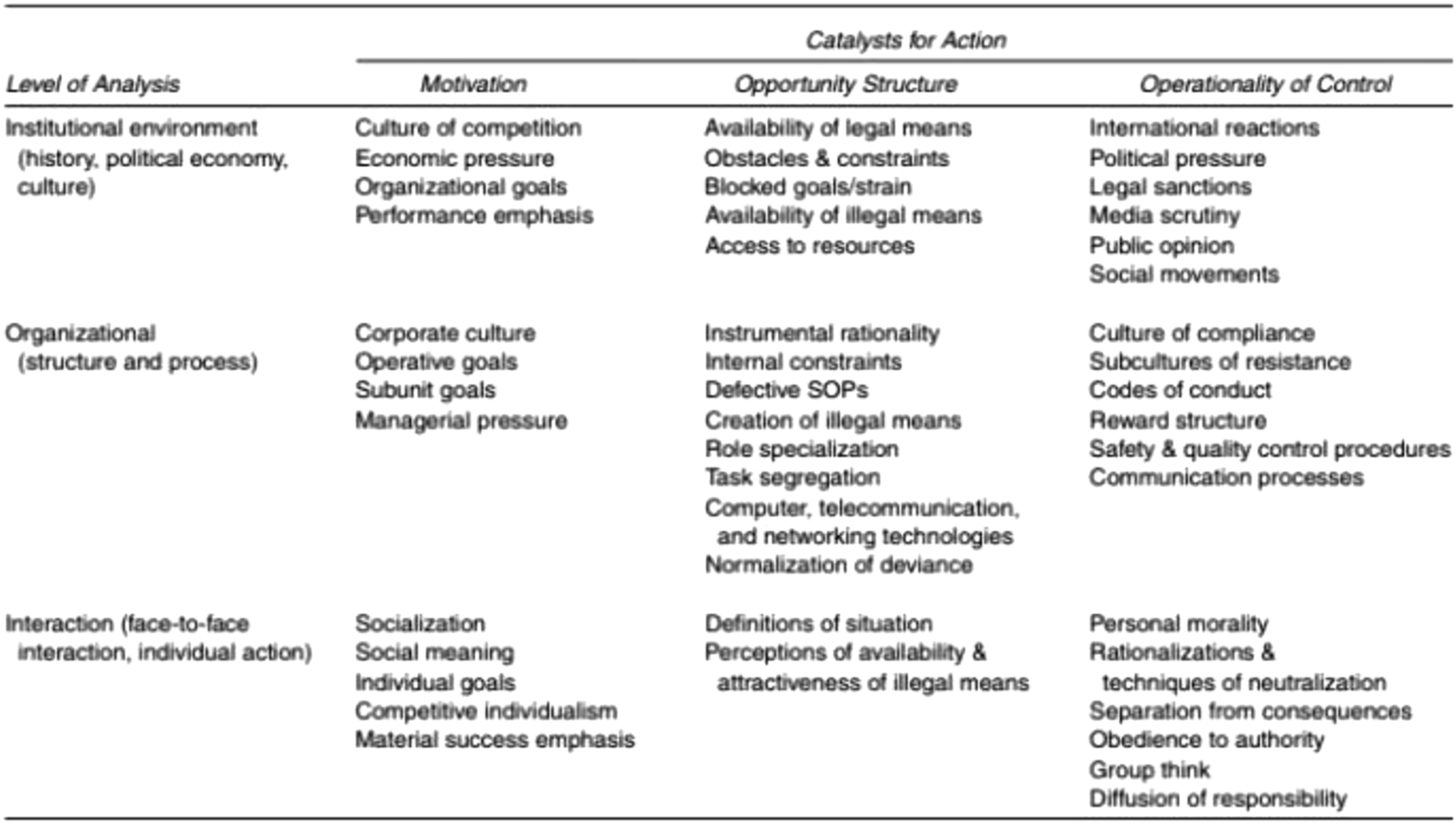
The state-corporate crime framework highlights that illegal and socially injurious actions positioned at the state-corporate nexus are produced both as part of the broader system of economic production and as part of social relationships (Bernat & Whyte, 2017). Regarding the former, they can be seen as what Ruggiero (2013) labels ‘crimes of the economy’ as they are rooted in the global economic forces of supply and demand. Regarding the latter, the state-corporate crime framework sheds light on the relations of power between economic and political actors, and their symbiotic production of socially and environmentally disadvantageous scenarios. It illuminates the constitutive nature of state-corporate relationships, a hypothesis discussed by several authors (Kramer, 1992; Aulette & Michalowski, 1993; Kramer et al., 2002; Tombs, 2012; Whyte, 2014; Bernat & Whyte, 2017). Indeed, there is often no conflict of interest between state and economic actors as they pursue shared or mutual goals. State actors act to enable capital accumulation, while economic actors are crucial for realising capital accumulation (Bernat & Whyte, 2017). Whyte (2014, p. 244) labels this phenomenon a ‘regime of permission’. Such regimes are not only enabled by institutional relationships but originate from power architectures that lie beyond the observable empirical manifestations of power. Such power architectures are embedded in global political economic systems of production and consumption and are needed to uphold capital accumulation. This paper analyses catalysts for farming intensification harm on the national level in Northern Ireland, while embedding the country into the global political economy of meat production.
Methodology
The paper uses a case study approach, which in social sciences is employed to understand a phenomenon in question with a particular attention to the actors within it and relationships between them. The case of Northern Ireland was a foundation for data collection and analysis, and the case study method is used frequently both in green criminology and when examining crimes of the powerful.
Secondary data in this study included legislation and policy documents related to farming. The former included documents from Northern Ireland Assembly. To identify the relevant documents from Northern Ireland Assembly, the website of the Assembly was searched using the key words ‘farming’, ‘intensive farming’, ‘pig farming’, ‘ammonia emissions’, ‘animal waste’, ‘environment’, ‘environmental justice’. Documentation specifically from the Committee for Agriculture, Environment and Rural Affairs was reviewed, including Briefing Papers, Research Papers (2016–2017) and Minutes of Evidence (2014–2015 and 2016–2017). Unavailability of records after 2017 might be explained by the absence of the functioning Assembly at that time. These documents provided an insight into the government strategy in regard to farming and their concerns about the future of the sector.
Policy documents related to the GfG strategy were also examined. The text of the strategy Going for Growth. A Strategic Action Plan In Support Of The Northern Ireland Agri-Food Industry was scrutinised to understand the context behind the strategy, its goals, and the means of achieving these goals. Documents related to the strategy, such as the NI Executive action plan in response to the Going for Growth strategy and the strategy’s progress updates were reviewed. Similarly, annual reports from the Ulster Farmers Union (UFU) (specifically sections on the pork production and the environment) were examined. More generally, publications on the pork sector from the Agriculture and Horticulture Development Board (AHDB) were used to identify the trends in research in the pig industry and application of innovative technologies for the mitigation of environmental impacts from pig farming. Documents under the categories of ‘environment’ and ‘research and innovation’ were analysed for this purpose. All secondary data was analysed using content analysis method. The following questions were asked when reviewing secondary sources of data: “What kind of reality is the document creating? How is the document accomplishing this task?” (Flick, 2014, p. 371). Content analysis enables to order and group large amount of text (Alvesalo-Kuusi & Lähteenmäki, 2016). In the case of this paper it was used to identify the dominant positions taken by the farming industry and draw a picture of the farming industry more generally, its trajectory and its regulation.
Primary data included 16 semi-structured interviews conducted during fieldwork in Belfast in December 2018
1
with two categories of participants: government and farming industry, which are described below in Figure 2: Categories of participants.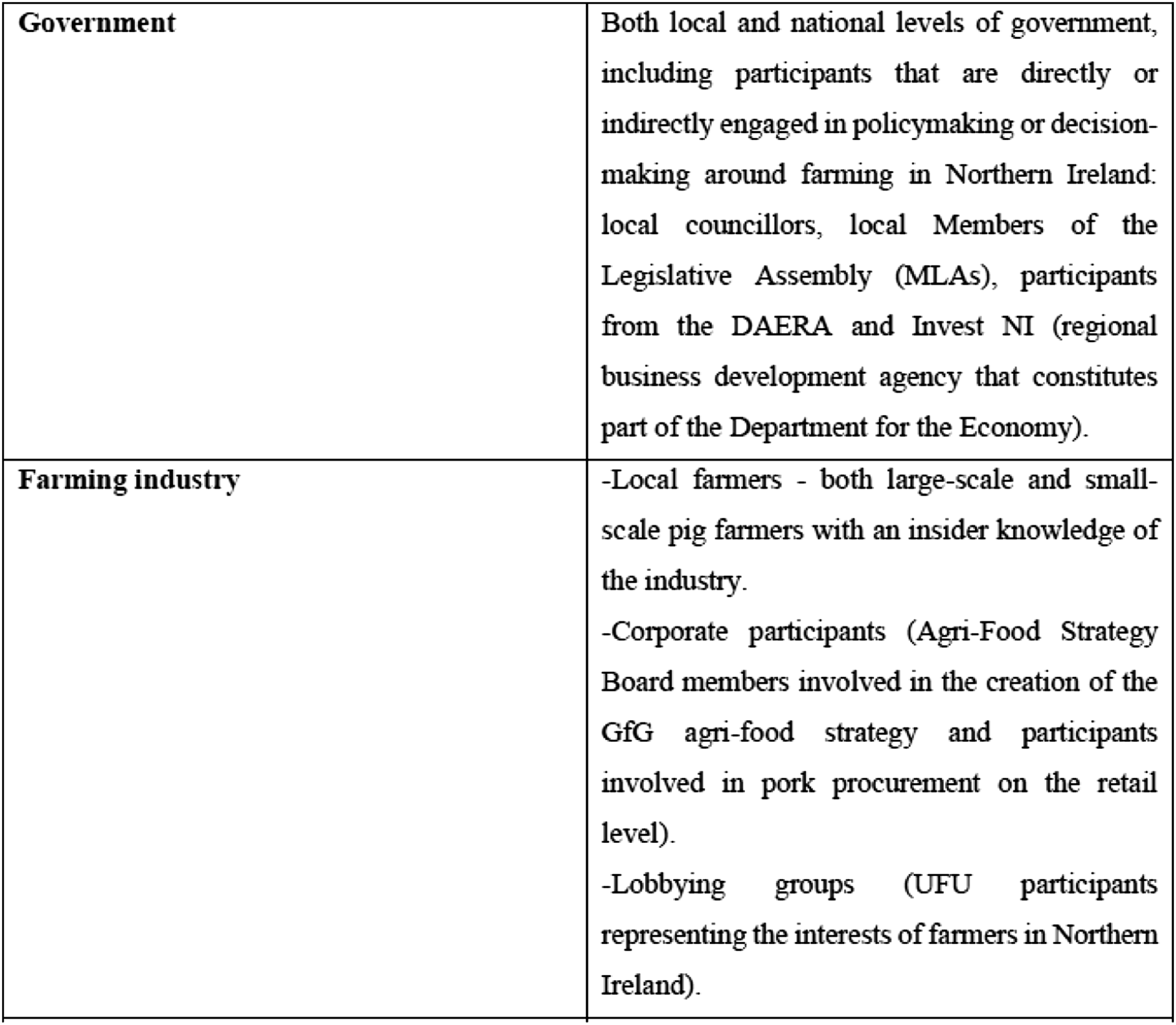
The distribution of the interviews was the following: seven government participants (two local councillors, two MLAs, one participant from the DAERA, two participants from Invest NI) and nine farming industry participants (three local farmers, two participants from the AFSB, one participant involved in pork procurement on the retail level, three participants from the UFU).
An ethical approval was obtained prior to primary data collection. During interviewing, principles of informed consent and confidentiality were adhered to. During interview transcription, data analysis and research write-up, personal details of all participants were codified. Each participant was given a code number (for this paper, the codes were also separated between the government (GOV) and farming industry (IND) representatives to make it easier for the reader - see Appendix 1) and participants’ names were not written on the recorded interviews, or on the typed-up versions of discussions from the interview. The consent forms signed by participants were stored separately from other data.
The analysis of the primary data was performed through thematic analysis. Thematic analysis refers to ‘a process of identifying themes in the data which capture meaning that is relevant to a research question, and perhaps also to making links between such themes’ (Willig, 2014, p. 147). Multiple readings of data helped capturing the meaning of the data (Silver & Lewins, 2014). All interviews were transcribed and then read ‘vertically’ (Silver & Lewins, 2014) – in the chronological order of their collection. The interviews were coded – coding was organised separately for the different categories of participants. Individual phrases, sentences or paragraphs that were considered relevant to the main research question were given a code. All codes were recorded in an Excel sheet and a definition was given to each code to ensure its consistent use throughout the interview data. Afterwards, the interviews were read horizontally (Silver & Lewins, 2014) by code, to assess the internal cohesiveness of the identified codes. Inconsistencies were identified and the second wave of coding took place to rectify these inconsistencies. The process was repeated until it was made sure that the coding is consistent throughout all interviews. Following that, interrelationships between codes were built to organise them into broader themes. At the final stage of analysis, all interview transcripts were read again to make sure that the findings correspond with the contents of the interviews.
It is worth noting some of the limitations of this study, particularly in relation to the case study method. It is still deemed to be a less desirable design than an experiment or a survey (Yin, 2014) and generalisation is a big concern regarding case studies (Bryman, 2012; Gerring, 2007). However, Rothe and Kauzlarich (2016) emphasise that the case study approach is particularly useful for crimes of the powerful research given the ambiguity of links and relationships and Heckenberg and White (2013) posit that the analysis of evolving harms and crimes invites a case study approach that brings together descriptive information and contemporary facts and figures.
Farming Intensification As A State-Corporate Harm
The structure of this section is informed by the integrated state-corporate framework and framed around the three catalysts for harm in intensive pig farming. The section unpacks and analyses the first catalyst for harm – motivation behind farming intensification in the context of the GfG agri-food strategy, proceeding to analyse the second catalyst for harm – the opportunity structure shaping farming intensification. It subsequently analyses the third catalyst for harm – operationality of control in relation to farming intensification, both during the GfG and beyond.
First Catalyst for Harm - Motivation Behind Farming Intensification
Kramer and Michalowski (2012) suggest that the structure and cultural meanings of the broader political economic arrangements shape the goals and means of economic and political organisation. Moreover, the greater emphasis on goal attainment results in criminal and harmful behaviour (Kauzlarich & Kramer, 1998; Tombs & Whyte, 2010; Tombs and Whyte, 2010).
The dominance of the market rule ideology was reflected in the responses, as they revealed the goal of organising farming efficiently as a priority. According to farming industry actors, an efficient industry organises production in line with the rules of supply and demand. The goal of efficiency also implied competitiveness: ‘If you’re going full-on capitalist, the inefficient fall away, only the competitive are left’ (IND005). More intensive production was seen as more efficient and as a standard to aspire to for some respondents (IND009; IND005): ‘Do we need to intensify, or do we need to make our farms more efficient? Those are two things that are not necessarily mutually exclusive. <…> It’s a matter of driving efficiencies - on a land mass of our size, do we need 25,000 farms?’ (GOV005).
The goal of efficiency was also associated with the introduction of automation and new technologies on farms (GOV005; IND008; IND009; IND004): ‘The industry needs to become more efficient and that happens if automation is increased’ (GOV004). Technological innovation was presented as a value neutral (Borgmann, 2017) element of efficiency. Such argument conceals the fact that introduction of automation and new technologies may be linked to intensification of production (IND009; IND001; IND005; IND006): ‘With a sensible application of technology you could solve any challenges in Northern Ireland easily. But that means that we have to get a lot of people to agree, and with 20,000 farmers…’ (IND009).
The goal of efficiency was applied to the animals as some respondents (IND009; IND005; IND006) suggested that the use of livestock genetics should be promoted to result in more ‘efficient animals’: ‘<…> it’s not only about faster growing pigs but about the pigs that suit the system, that are more efficient’ (IND008). Efficiency in animals is linked to profitability of the industry and animal bodies become an accumulation strategy (Harvey, 2006). The desire for profit creates an environment where the development of efficient animals is no longer perceived as abuse, but instead becomes an appropriate means of driving capital accumulation (Nurse, 2013).
Thus, the first catalyst for the environmentally harmful pig farming intensification included the goal of efficiency in meat production formulated within the GfG strategy. Being embedded in the market rule ideology encourages farmers to prioritise economic sustainability and strive to achieve economic efficiency in farming. The latter is characterised by competitiveness rather than cooperation, intensive and technology- and automation-dominated production with a utilitarian approach to animals. It has been suggested that ‘pressure for profits’ is the most compelling factor behind crime and harm (Kramer, 1992, p. 81). The motivation and the subsequent goals set out by the authors of the GfG strategy ignore the environmental externalities arising from the lawful activity of meat production intensification and downplay social harms related to intensification.
Second Catalyst for Harm – Opportunity Structure Shaping Farming Intensification
Kauzlarich and Kramer (1998) claim that the means that are most effective in achieving the set goals are likely to be selected. This subsection discusses the opportunity structure constructed by the GfG authors with the state support to achieve the above discussed goals.
The opportunity structure to achieve the goal of efficiency in meat production included propagating the discourse against small-scale farms by GfG strategy authors, state and industry actors’ provision of material support for technological innovation in farming and material support for research to increase meat production efficiency.
The discourse against small-scale farms appeared within the GfG strategy and found resonance among the corporate farming industry respondents. Considering that growth within the farming industry has come mainly from pig and poultry production (DAERA, 2020) in the last decade, the strategy encouraged further intensification of both sectors. While the strategy presented small farms as ‘a major element of our economy’, it stated that ‘they also present a significant challenge in terms of long-term sustainability’ (AFSB, 2013, p. 23). Moreover, the GfG Chair also suggested to the Agriculture and Environment Committee that only 6,000 farmers were needed for food production in the country (Macauley, 2016). In the interviews, a significant number of respondents also dismissed small-scale farming in favour of large-scale, more intensive farms (IND009, IND004, IND005, IND006): ‘A big unit could be the most efficient, best way to produce food. Small farming looks nice in practice but if those small farmers can’t make enough money to educate their kids, have a car, buy things, they won’t be there’ (IND008). ‘Most small farmers in NI say that they’re quite happy with their small farms, they have a huge connection with their land because that land was handed down through generations. The question is then that it increasingly becomes unviable’ (GOV004).
The discourse of dismissal of small-scale farms translated into tangible actions that served to catalyse harmful farming intensification. The GfG strategy offered little support to small family farms (Attorp & McAreavey, 2020). Its focus on expanding intensive farming served to eliminate the alternatives to the market-oriented profit-driven model of farming, which was exemplified by the critique of subsidies that provide support for small-scale farms; the latter were seen as an antithesis of efficiency by my respondents (IND004; IND005): ‘You can say that the subsidy in the past encouraged the way of farming that isn’t efficient enough’ (IND006).
The first element of the opportunity structure to achieve the goal of efficiency – the discourse directed against small-scale farms – was perpetuated by the GfG strategy authors and validated intensification by reproducing the relations of domination of large-scale, intensive farming businesses over small-scale farms.
The opportunity structure also included material support that addressed technological innovation of production to achieve the goal of efficiency. The GfG strategy authors pronounced it ‘essential that Government seeks to support technologies complementary to agricultural production rather than in competition with it’ (AFSB, 2013, p. 35), as evidenced by one of the comments: ‘the principle was that equipment and technology was needed to manage the land and that would then be supported by the programmes from the government’ (IND009). Under GfG, £250 million of the government funding was initially expected (AFSB, 2013) for the Farm Business Improvement Scheme, eventually amounting to £60 million instead (IND009): ‘We put capital support in place with significant grants so that farmers could buy equipment. We were pretty prescriptive about what kind of equipment we wanted them to buy. Lots of farmers did not want to buy what is called abatement equipment because they saw it as a threat rather than an opportunity to do it better. And that is the dynamic you face. It is easier to do it with big farms – there are not that many of them and you can have a much greater effect than trying to do it with 10,000 smaller farms’ (IND009).
This quote demonstrates that within GfG material support was provided for specific types of farm equipment that mitigates the environmental impact of farming. Nearly all industry actors mentioned the environmental concerns and underscored the importance of environmental sustainability in farming (IND008; IND009; IND001; IND007; IND004; IND005; IND006). Similarly, the text of the GfG strategy (AFSB, 2013) referred to environmental activities. An independent Expert Working Group established in 2014 to produce a strategy reconciling the ambitions of GfG with the interests of the environment claimed that low-emission slurry-spreading equipment can be effective in some cases for mitigating the ammonia emissions (Expert Working Group on Sustainable Agricultural Land Management for N. Ireland, 2016; Davies, 2019). Yet, this technological innovation may be promoting intensification of production; as the above comment demonstrates, material support for technological innovation may be logistically easier to provide for larger farms. Furthermore, technological innovation support may also result in the concentration of capital in the large-scale farms as they invest in the equipment that small-scale farms cannot afford. As evidenced by one of the respondents, ‘all these [abatement] technologies become increasingly expensive and if you want to be a business that can carry that cost, you need to be a bigger business’ (IND005).
The opportunity structure to achieve the goal of efficiency in farming through technological innovation becomes a condition for continued expansion of capitalism. It proves William Jevons’ conclusion (Clark & Foster, 2001) that technology serves to increase production efficiency, not establish resource conservation, and consequently does not resolve the conflict between the environment and the economy (Lynch et al., 2017).
Finally, the opportunity structure included material support for research to increase production efficiency. Scientific research shapes the environment in which the decisions are made by the economic and the state actors (Griffin & Spillane, 2016). Therefore, research can serve as a mechanism that further consolidates the market-oriented and profit-driven approach in farming. Industry actors were keen to recognise the importance of research (IND009): ‘There is a perception of what some people describe as factory farms being worse from animal welfare and environmental points of view. It’s probably the reverse, it’s probably better but you’re probably quite early in that journey that haven’t got research to show it’ (IND005).
The production of knowledge is organised through growing academia-industry collaboration, where the state also played an active role. The latter was particularly emphasised by the GfG authors as they suggested that ‘Government must commission research into measureable, best practice systems for sustainable intensification on-farm’ (AFSB, 2013, p. 36). As a result, several collaborations have been developed. The Agri-Food and Biosciences Institute (AFBI), for instance, is sponsored by the DAERA and was running 63 projects in 2017 with industry co-funding (AFBI, 2017). Some of the AFBI’s work in the pig sector supports increased efficiency (AFBI, 2015). One of the research projects on pig feed efficiency funded by the DAERA promises to ‘yield an extra performance value of at least £1m, if applied across the NI pig industry’ (Ley, 2018). Some of the pork industry funders include Pig Regen, John Thompson and Sons Ltd, Devenish Nutrition, JMW Farms Ltd and Rektify Ltd (AFBI, 2015). The nature of the projects sponsored by the industry echoes the goals that help responding to the broader political economic arrangements in meat production. Pig Regen fund research on efficient diets for pigs, feed efficiency and improving technical efficiency of pig production (Magowan & Ball, 2013). John Thompson and Sons Ltd and Devenish Nutrition provide funding on the efficient use of feed (Devenish Nutrition, 2019), while JMW Farms Ltd and Rektify Ltd fund research on practical management and nutrition (AFBI, 2017). Thus, material support for research into efficient production is employed as a tool that simultaneously seeks ways to increase production and legitimise the decisions made by corporate farming industry actors and the state.
As the consensus around efficient farming is created, alternatives to profit-oriented and ultimately larger-scale, more intensive production are eliminated. Yet, as I stated before, this mode of production also accelerates ecological destruction.
Third Catalyst for Harm – Operationality of Control in Relation to Farming Intensification
State-corporate crime theorists maintain that researchers’ attention should be directed towards establishing how opportunities for deviance are expanded while the possibility of constraint disintegrates in regulatory structures (Ruggiero, 2015). Kramer et al. (2002) suggest that crime and harm may occur when regulatory or social control bodies are either guided by or work for elite interests. Environmental regulation was one of the most discussed mechanisms of controlling the harmful impact of intensification. Several industry respondents emphasised that the Northern Ireland Environment Agency (NIEA) adopts a punitive approach towards environmental transgressions from farming (IND004): ‘<…> our environment agency has only been a police force’ (IND009). ‘In Scotland the Environment Agency does advocacy and trains people but it also comes in with penalties. In NI we don’t really have the advocacy and education part, it goes straight to penalties. There are different ways to change behaviour and education is one of them’ (IND005).
In these comments, environmental regulation is portrayed as a ‘big stick’ (White, 2013, p. 58) and consequently ineffective. These comments also suggest that a ‘police force’ approach implies a ‘single-minded enforcement of the rules’ (Pearce & Tombs, 1990, p. 27). This line of thinking resonates with the neoliberal ethos in regulation, where regulatory bodies are seen as inflexible, purposefully searching for violations, overly bureaucratic and sluggish (Bardach & Kagan, 1982). As a result, the GfG authors encouraged the farming industry to ‘engage with Regulators in order to develop an agreed regulatory environment which adds value, is proportionate, informed and has a risk-based approach to regulation’ (AFSB, 2013, p. 16). This plea was reflected in the interviews. The respondents argued in favour of what can be described as a consensus perspective that ‘requires that strict enforcement and prosecution are minimised in order to encourage the active participation of business in ‘self-regulation’’ (Whyte, 2004, p. 133). Respondents advocated for advice rather than punishment from the environmental regulator as well as for working in close collaboration with the NIEA (IND007): ‘There is a stick and obviously no one likes to be beaten. There is a problem, but we do not see it from the same viewpoint, so it is about working on the solution collaboratively’ (IND005). ‘We should have a much more driven agenda within the government. The resistance within the government [against] supporting the farmers who want to do the right thing is disgraceful. It should be much more supportive in principle. You have to be able to sit down with the Environment Agency and say – let us do it the best we can. [we might not always agree] but if we can do it better than we are doing it today, then we are making progress’ (IND009).
The conciliatory stance taken by the respondents aimed to ensure that environmental regulations do not challenge the industry’s economic sustainability. Moreover, the respondents recognised the existence of the environmental challenges and aimed to contribute to their regulation to ensure that structural reorganisation of farming could continue. The desire for a predictable regulatory environment also manifested in actively advocating against an independent environmental protection agency in Northern Ireland (IND008; IND006). It serves as the empirical evidence for the discussions on the neoliberal attack on environmental regulation (Czarnezki & Fiedler, 2016; Faber, 2008; Whyte et al., 2004). It was aptly summarised by one of the respondents: ‘You constantly get into market-driven factors versus regulatory-driven factors, and regulatory-driven factors are driven by what the market wants’ (IND005). The hegemony of capital in regulation also involves emphasising the costly nature of regulation, which was seen as detrimental to the overarching ambition of profit-making: ‘It is challenging, it adds a lot of cost – sometimes it puts people off. They spend thousands on ammonia assessments before they even start the project’ (IND005). ‘So if there is a market for that product, are we better off supplying it here and focusing on doing it better? Or you put so many controls and regulations that it becomes unprofitable - you lose your income, you lose your farmers, you lose your rural community <…>’ (IND006).
Therefore, in addition to being structured around consensus, environmental regulation in Northern Ireland also possesses the characteristics of neoliberal regulation, where regulation by the state is shifted towards the regulation by the market (Whyte et al., 2004).
Moreover, when the interests of profit are threatened, the farming industry is capable of tampering with the existing regulatory systems. The farming industry in Northern Ireland participated in shaping the regulation for its own benefit and creating ‘a mandate on how to develop the economy the right way’ (IND009) with the NIEA. For example, a Judicial Review taken by the UFU against the NIEA and the then Department of Agriculture about breaches of the Common Agricultural Policy (CAP) support cross-compliance was in favour of the UFU position (UFU, 2017). The Review aimed ‘to defend [the UFU] members against unfairness and to protect the wider industry from harsh treatment for minor mistakes’. Another instance was the Memorandum of Understanding between the NIEA and the UFU signed in 2017, which contributed to the creation of the collaborative regulatory environment between the industry and the environment agency. The memorandum aimed to ‘help the farming community unlock the commercial advantages that excellent environmental performance can generate in competitive global agricultural markets’ and ‘improve environmental outcomes through a more effective partnership approach’ (NIEA & UFU, 2017, p.1). Similarly to the Judicial Review, the Memorandum also encouraged the NIEA ‘to explore new ways of dealing with low severity incidents’ (NIEA & UFU, 2017, p.8), which, in other words, encouraged the NIEA to adopt a more lenient stance towards low severity environmental transgressions in farming.
Using the context of environmental regulation of farming as it becomes more intensive following the adoption of GfG, I demonstrate how in the context of neoliberal capitalism where capital accumulation is the main imperative, regulatory agencies are vulnerable to regulatory and cognitive capture by the farming industry. However, prioritising the interests of capital at the expense of the environment results in the generation of ecological destruction and disorganisation (Lynch et al., 2017), from both the cumulative impacts of minor environmental infractions and more serious harms associated with intensive farming.
Discussion
The macro level political economy plays a role in creating structural conditions for harm (Bernat & Whyte, 2017) in Northern Ireland. The goals of making production more efficient on the national level consolidated by the GfG strategy serve as the first catalyst for harm and are rooted in a particular context where the drive for capital is an overarching ambition (Kramer, 1992). Embeddedness in the global political economy of capitalism influences the relationship between the state and economic actors (Kramer & Michalowski, 2012). The opportunity structure – a discourse against small-scale farms, material support for technological innovation and research – serves as the second catalyst for harm. Most importantly, it exemplifies the power that emanates from the social relations that centre on economic growth, which guarantee that profit-oriented, efficient meat production prevails and those not fitting within its parameters are excluded. Such opportunity structure demonstrates the vital importance of state power for maintaining the functioning of the neoliberal capitalist regime of meat production. The state, being a facilitator for market mechanisms (Tombs, 2017; Bittle et al., 2018), determines the context within which neoliberal ideology flourishes (White, 2018). The opportunity structure also reveals that the expansion of the farming industry benefits the state as the latter responds to the demands of economic growth necessitated in the context of the political economy of capitalism. It is, thus, in the interest of both the state and corporate farming industry actors to continue creating and reinforcing conditions that safeguard the hegemony of the neoliberal capitalist order. As Wilks (2013, p. 115) articulates it, ‘the alliance with the political elite is of paramount importance. Corporate elite enjoys power, status, and wealth; the political elite enjoys power, status, and election. Both have high stakes in a system that generates income, wealth, and the material benefits of economic growth’. This arrangement resonates with Michalowski’s (2018) characterisation of the neoliberal state as state-corporate symbiosis or a ‘regime of permission’ (Whyte, 2014, p. 244) in which economic power links to and depends on the power of the state. In the political economy of capitalism, thus, state actors act as enablers of capital accumulation while economic actors realise that capital accumulation (Bernat & Whyte, 2017).
State-corporate crime theorists suggest that the chosen opportunity structures are most effective in the absence of strong controls (Kauzlarich & Kramer, 1998). Regulatory context in Northern Ireland presents an insight into the institutional expressions of economic and political power (Kramer et al., 2002). The symbiotic relationship between the state and farming industry actors also works to eliminate the regulatory controls to farming intensification in Northern Ireland, further reinforcing the ideological hegemony of neoliberal capitalism. Social relationships that shape environmental regulation are organised in a manner that creates a favourable regulatory climate for capital accumulation, enabling the industry to pursue their vested interests. Both consensus and neoliberal perspectives are visible in regulation, whereby the farming industry actors advocate for both self-regulation and minimisation of regulation. Moreover, this paper confirms that in the context of neoliberal capitalism where capital accumulation is the main imperative, regulatory agencies are vulnerable to regulatory (Pearce & Tombs, 1990; Whyte, 2004) capture. This leads to the formation of a new type of legitimacy (Ruggiero, 2018) that consolidates efficient, growth-oriented meat production. In each of these contexts, the farming industry possesses power reinforced by political actors for their mutual benefit, which enables them to perform purposive actions for the achievement of their goals (Ruggiero, 2018) and reinforces their ability to compromise regulatory controls for farming intensification. The compromised regulatory controls are the third catalyst for harm.
Relations of power, thus, are essential for realising the goals of meat production embedded in the political economy of capitalism; this ability to produce the intended effects is what, according to Ruggiero (2018), distinguishes the powerful from the powerless. Additionally, while state-corporate relations create, support, and reinforce the political economy of meat production that leads to farming intensification, they also preserve the hegemony of neoliberal capitalism and exclude alternatives to it, ensuring that the environmentally harmful but profitable status quo remains unchanged.
Conclusion
The paper aimed to advance the frontier of food crime and harm research in green criminology specifically and criminology more generally by engaging with the under-researched food production practice of intensive farming. Through a detailed analysis of the workings of power in the context of intensive farming and the state-corporate relations that underlie this legal yet harmful practice, the paper analysed the role of power in legitimisation, normalisation, and regulation of harm.
The paper demonstrated how a ‘regime of permission’ (Bernat & Whyte, 2017, p. 71) for pig farming intensification was and continues to be established by analysing the catalysts for harm – motivation, opportunity structures and operationality of control. The national goals for meat production in Northern Ireland are to drive efficiency of farming. The paper showed how opportunity structures were developed by the state and corporate farming industry actors to meet this goal. Opportunity structures include promulgation of the discourse against small-scale farms and providing material support for technological innovation and research into efficient production. The analysis of the third catalyst for harm – environmental controls for farming intensification – demonstrates how regulatory relationships in Northern Ireland are also conducive to harm.
The paper, thus, expanded the knowledge of complex relationships between political and economic actors from a green criminological perspective and demonstrated how, within those relationships, power is exercised, maintained, and ultimately directed to preserve the status quo of neoliberal capitalism. The study of intensification revealed the workings of the political economy of neoliberal capitalism in meat production. Moreover, it demonstrated how power relations between the corporate farming industry actors and the state operate to secure and perpetuate a growth- and efficiency-driven model of meat production to pursue an overarching motivation of capital accumulation. The adoption of the GfG agri-food strategy in 2012 consolidated this motivation and my analysis of the relations underpinning it demonstrates why pig farming intensification is taking place in Northern Ireland. The workings of state-corporate relations subsequently exclude alternatives to the capitalist order, thus reinforcing its hegemony. This finding is significant for planning the future of farming in Northern Ireland and addressing the existing power imbalances in meat supply chains, both in Northern Ireland and more widely. The ongoing COVID-19 pandemic in particular shone light on the crises that pervade our food system. As a result, the trajectory of food harm research in criminology should continue to expand, and far-reaching implications of food harms need to be further analysed and theorised.
Footnotes
Declaration of conflicting interests
The author(s) declared no potential conflicts of interest with respect to the research, authorship, and/or publication of this article.
Funding
The author(s) received no financial support for the research, authorship, and/or publication of this article.
Notes
Interview List and Codes.
GOV001
COU001
15 December 2018
Government
GOV002
COU002
16 December 2018
Government
GOV003
DAERA001
26 November 2018
Government
GOV004
InvestNI001
28 November 2018
Government
GOV005
InvestNI002
20 December 2018
Government
GOV006
MLA001
11 December 2018
Government
GOV007
MLA002
17 December 2018
Government
IND001
FAR001
12 December 2018
Farming industry
IND002
FAR002
14 December 2018
Farming industry
IND003
FAR003
17 December 2018
Farming industry
IND004
UFU001
08 November 2018
Farming industry
IND005
UFU002
11 December 2018
Farming industry
IND006
UFU003
13 December 2018
Farming industry
IND007
RET001
22 November 2018
Farming industry
IND008
AFSB001
07 November 2018
Farming industry
IND009
AFSB002
18 December 2018
Farming industry