



Abstract
This paper draws upon insider accounts of the nature and techniques of corruption in Nigeria. It draws upon unique access to interview 20 senior officials employed in key public agencies in the fight against corruption in Nigeria and access to 20 case files of prosecutions by the Independent Corrupt Practices and other related offences Commission (ICPC). The paper illustrates their perception of the monolith of corruption faced and shows some of the most common types of corruption confronted such as embezzlement, theft and fraud; procurement fraud; favoritism, nepotism and related acts; extortion and bribery. The paper also illustrates the connection between the private and public sector in corruption and some of the differences that emerge in grand and petty corruption.
Nigeria has gained a reputation as a country with endemic corruption in its political structures and wider society (Ijewereme, 2015; Lazarus, 2018; Lazarus & Okolorie, 2019; Obuah, 2010; Smith, 2007; Sowunmi et al., 2010). There is also a body of evidence to support this reputation from widely accepted indicators, such as those produced by Transparency International Corruption Perceptions Index, where it has regularly been ranked at the bottom of the table as a country prone to corruption (Transparency International, 2020). Criminologists have long neglected corruption and it is no surprise to find limited research on Nigerian corruption from not only this group of scholars, but other disciplines too (Brooks et al., 2013; Brooks, 2016; Lord, 2013; 2014; Lord & Levi, 2017). This paper seeks to add to the thin foundations of research by setting out some findings from a study that secured unique access to senior public servants in Nigeria at the frontline in the fight against public sector corruption, a type of research rarely undertaken beyond the West (Grødeland, 2010; Wolf, 2010). From their accounts the paper explores the scale, characteristics, techniques and perceptions of corruption in Nigeria. Although not an anthropological study in the purest sense, ie using observation and informal conversations derived from immersion in a setting; the unique access of one of the authors, because of their insider status, marks this research as within the bounds of very broad definition of an anthropological approach. Previous anthropological studies have proven to illustrate unique insights on corruption generally not found using more traditional research methods such as interviews and surveys (Ezeh, 2002; Sissener, 2001; Smith, 2007). This paper will begin with a brief literature review, it will then set out the methodology before exploring the findings.
Literature Review
Transparency International (TI, n.d.) define corruption as the “abuse of entrusted power for private gain” and go on to note it …can take many forms, and can include behaviors like: public servants demanding or taking money or favors in exchange for services, politicians misusing public money or granting public jobs or contracts to their sponsors, friends and families, corporations bribing officials to get lucrative deals.
Corruption also occurs in different varieties with some types of corruption prevailing more in some locations than others (Mills, 2012, p. 5). There are also different perceptions of what constitutes corruption from one country and culture to another, although international definitions developed by bodies such as the United Nations have sought to address this. Different countries also experience varying forms and degrees of corruption depending on what specific act or conduct is defined as a corrupt behavior. What is lawful, and therefore what is unlawful, depends on the country and culture in question. While this factor is important, it should not deter exploring a sustainable anticorruption strategy. In fact, the generality of countries and cultures abhor most cases of bribery, fraud, extortion, embezzlement, and most sorts of kickbacks on public contacts. Over a wide range of “corrupt” activities, there is little disagreement that they are morally wrong and dangerous (Klitgaard, 1988). For any anticorruption policy to be effective, it must recognize the forms of corruption that are more devastating, and then deal with the fundamental causes—tailoring it country specific by looking at the whole governance and institutional frame work (the major failings; Shah, 2007, pp. 230).
Thus, knowing the nature and characteristics of corruption prevalent in the public sector of Nigeria will no doubt help in establishing reforms tailored toward curbing the risk factors and enablers of corruption by identifying the sectors and tasks where corruption is preponderant. Indeed, despite the challenge of corruption in Nigeria there is not a deep body of empirical research on the nature or enforcement of it (Auwal, 1988; Obuah, 2010; Odekunle, 1991; Onwuka et al., 2009; Smith, 2007). Corruption in the Nigerian public sector takes many forms, shapes and sizes that can be narrowed down to financial and non-financial—occurring in both political (by politicians) and administrative structures (civil servants working for public bodies). Therefore, while the characteristics of corruption in Nigeria manifest itself through different methods: bribery, nepotism, favoritism, over invoicing, indiscipline, abuse of office, to name some, in terms of its nature, it is mostly monetary or materialistic—occurring both in the realm of grand and petty corruption. Although clearly there are forms of corruption, which are not monetary related, such as securing employment for family member or sexual favors to name some. Corruption in Nigeria manifests itself in different ways, both on a micro and macro level, and it occurs at all levels of society. Corruption also impacts on Nigeria in a wide range of ways from inadequate infra-structre, greater poverty to the standing and perception of the nation around the world (Egulakhe, 2007; Smith, 2007).
The evidence on the nature of corruption, actors involved and its prevalence is conspicuously lacking across several academic papers, newspapers articles and reports from donors and civil society organizations, making it difficult to have a clear picture of the types of corruption that takes place in the country (Heywood, 1997; Martini, 2014). The emphasis here is on public sector corruption as distinguished from corruption more generally. However, such is the nature of Nigerian society it is often difficult to clearly demark between corrupt activities that happen in the private sphere as opposed to the public sphere. In the case of Nigeria, there is unholy symbiotic relationship between the public and private sectors’ corruption, with the private sector aiding and abetting corrupt acts, as will be discussed later in this paper.
Method
It is first important to note that researching corruption in Nigeria is not easy and the bureaucratic (and corrupt) barriers to securing access to persons, documents and services in general are extensive. Studying corruption can also be potentially damaging to a researcher’s career in some countries (including Nigeria) and sometimes even dangerous. One of the authors is an insider employed (but on extended research leave) by the Independent Corrupt Practices and other related offences Commission (ICPC). This gave the researchers unique access to persons and materials, which for many outsiders would be difficult. However, like any insider by their own past views and experience and potential return to the employing organization they can be restrained. The co-author, however, had no such constrains and the authors together argue this combination brings a critical balance to identify the right questions to be asked and draw out as objective evaluation of the data that is possible in social science. In doing this, the paper draws upon 20 semi-structured interviews with senior public servants from the following organizations that represent the most important in the fight against corruption: the ICPC, Economic and Financial Crime Commission (EFCC), Code of Conduct Bureau (CCB), Public Complaint Commission (PCC), Bureau of Public Procurement (BPP), Fiscal Responsivity Commission (FRC), Office of the Auditor General of the Federation (OAUGF), Technical Unit of Governance and Anticorruption Reform (TUGAR), Presidential Advisory Committee on Anticorruption (PACAC), National Salaries, Income and Wages Commission (NSIWC)—and other relevant accountability institutions. The approach was always to seek the most senior relevant official and move down the hierarchy where that was not possible. The authors they have captured a sample of interviews which are representative of these organizations. The space constrains of this article mean it was only possible to quote from 11 of the 20 interviews. The authors also secured access to 20 case files of persons convicted of corruption in the public sector in Nigeria from the IPCPC. One of the authors was given access and case files were selected to represent the diversity of corruption in Nigeria. The data collected from these tools was more than enough for this paper as Graaf and Huberts (2008, p 642) have argued: While there is no ideal number of cases, a number between 4 and 10 cases usually works well…With more than 20 cases, it quickly becomes difficult to cope with the complexity and volume of the data. Examples of real cases of corruption (details of the perpetrator, the type of corruption pursued, the methods used, how it was detected and the outcome of the case, to name some). The causes and extent of corruption. The effectiveness of anti-corruption organizations and the strategies they pursue. The commitment of the Nigerian government to tackling corruption. The strengths and weaknesses of the criminal justice system in pursuing the corrupt. Strategies and solutions for better countering corruption in Nigeria.
Findings
This section will now explore some of findings from the interviews and case files. The section will begin by exploring views on the scale of nature of corruption, before then focusing more on some of the common techniques used to undertake corruption.
The scale and nature of corruption in Nigeria
All the participants recognized that corruption in Nigeria was endemic and had become institutionalized as a part of normal life. As one interviewee summed up: We are in a situation whereby now corruption is pervasive, humongous, institutionalized to the extent that corruption is rewarded…Where in many circumstances one is even required to be corrupt; one will not get his licence to do anything if done through the normal process, it is more difficult than if one just bribes, that means it is required. If one need to get electric meter, it is easier if one bribe than if normal process is followed, that means it is required. Therefore, corruption is rewarded and even required in many instances of public functions. (Senior official, CCB) (the public sector)…has admitted all kinds of unregulated personal activities had become the norm. Merit has been pushed to the back in terms of recruitment into the process of promotion and discipline. Therefore, that has generated a characteristic feature that well it is the norm…. (Senior Official 1, OAUGF) One of the key problems of corruption in Nigeria is that the corrupt that has control over power; it is a very big problem. That is why people kill themselves to get into positions, once in there; it gives one economic power, it gives one political power, it gives influence, it gives everything, so on the strength of that, people do everything possible. Why it that people want to work with the government, they just know that once one gets in there (public office) there is protection. Because there is likelihood of one big man stealing money and he cannot steal it alone, he uses people to become part of the racket, and he must protect them, so that the racket does not burst. You see…. . corruption is complex and systemic; yes, corruption is indeed a crime of opportunity. (Senior Director, NSIEC)
Thus, grand corruption occurs at the highest echelon of government and involves massive government contracts and project financing. It is the type of corruption that has completely incapacitated the development growth of Nigeria because of huge sums of money involved. As one interviewee noted: Frankly speaking, if we are talking about the kind of corruption that has brought Nigeria to its knees it is not because of low salary, if someone says that the corruption we are battling as a country is because of poverty that is a lie. The kind of corruption we are battling, as a country has not linked with being poor, these are people who have the opportunity and they are greedy? One can see a director that has as many as 30 houses and is willing to steal tomorrow. Therefore, what is the connection between that and poverty even if one gives him the salary, the salary is inconsequential. Of course, there are certain things not done properly simply because the workers have a very low salary, but it is corruption that hinder the capacity of the government to pay people good salary. (Senior Official 2, OAUGF)
By contrast petty corruption is practiced by most in society. It includes citizens going about their normal business who may have to pay bribes to do this on the one side, through to low and middle ranking public servants who may be grossly underpaid and depend on small rents from the public to feed their families and pay school fees (Stapenhurst, 1997, p. 313). This can be regarded as corruption of survival or needs (Dike, 2008; Fisman, 2017). Petty corruption happens in different ways—that are as varied as small amount of money exchanging hands (bribe), the granting of small favors by those seeking preferential treatment from public officials and the employment of relations and cronies in minor public positions (Langseth, 2006). This also means though it often involves money, but not necessarily; it can be financial or non-financial or even both.
Otherwise known as “administrative” or “bureaucratic” corruption, the word refers to a situation where corruption is no longer an isolated case but rather it has become the rule not the exception in all public affairs. Whereas the amount of money exchange in the corrupt transaction may appear paltry, it is quite taxing for the ordinary citizens. Examples include paying bribes to get an ID; enroll in school; or have a phone line installed (U4 Glossary, n.d.). Bureaucratic corruption is sometimes referred to as a ‘way of life’ because it has become a routine and generally accepted behavior by the society. Thus, at petty level, the one that most directly affects the aggrieved public is corruption involving countless underpaid or greedy public servants who overcharge the public for services such as granting of driver’s licenses, passports, and business permits (Stapenhurst, & Sedigh, 1999).
Thus, when Nigerians seek a service from their government, they routinely expect that they will have to navigate corruption at all levels of the bureaucracy. Everything from obtaining birth certificates, to registering a company, to applying for a passport, to renewing a motor vehicle registration normally requires some sort of payment in addition to the official fee. Generally, the only way around paying extra money for routine public series is if one has a personal connection to someone with influence—a patron who will use their influence to push on behalf of their client (Smith, 2007, p. 56).
Many Nigerians find going through government bureaucracies harrowing experience and people frequently rely on the aid of intermediaries. In fact, at almost every major bureaucracy that provides essential services, one finds a small number of intermediaries to expedite business. These intermediaries are called ‘touts’ who are either employees of the bureaucracy or private individuals who have cultivated familiarity with the office that enable them go through the bureaucracy easily (Smith, 2007). This means that opportunity is central for both petty corruption and grand corruption to occur. Moreover, the opportunity seems to exist where the public servant has wide discretionary powers.
Figure 1 below illustrates the interlocking nature of these types of corruption. The grand corruption sets the tone for society and starves public services of the resources necessary. For most, petty corruption is necessary to survive and to access basic functions and considered normal by the tone from the top. A consequence is bureaucratic corruption, which normalizes corrupt practices into the structures of the state and society. Petty corruption may amount to more in number of incidents; but grand corruption deserves a bigger status in figure 1 because it sets the tone, creates the economic conditions for corruption to flourish and probably amounts to more in monetary impact.
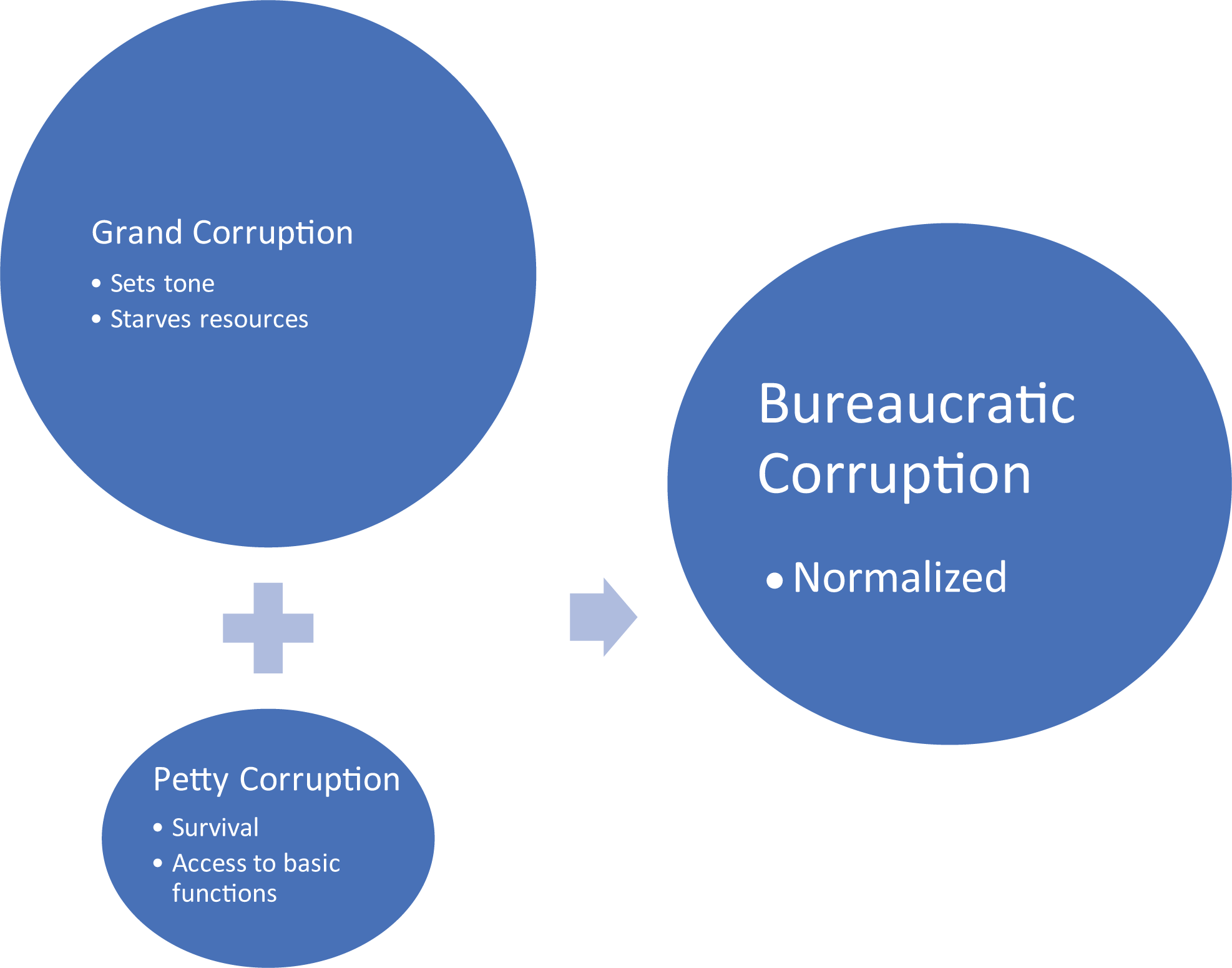
Corruption relationships in Nigeria.
The Techniques of Corruption
The paper will now turn to the main methods used by the corrupt in Nigeria. It will draw upon the interviews and cases analysed for this research. As such the focus will be more upon the techniques of grand rather than petty corruption.
An analysis of the petitions (allegations) made to the dedicated anticorruption agencies (ACAs) during the 2016-19 showed that the corrupt acts most reported to Nigerian ACAs involved embezzlement, abuse of office (including nepotism, favoritism and wide discretionary powers), conflicts of interest/personal interests, mismanagement of public resources (including fraud, theft and misappropriation), and procurement fraud. A review of the 20 convicted case file and the views from the majority of the participants’ shows that nepotism and procurement fraud are the biggest forms of corruption in the public service. Bribery was not relevant, largely because it is under reported and viewed as “an accepted way of life” to get things done (systemic corruption). Similarly, the review of 20 convicted case files collected as data for this paper showed that the corrupt conducts that the ACAs (ICPC) secured most of its conviction follows similar pattern with the reported allegations and were on abuse of office, embezzlement and misappropriation (including over invoicing and contract inflation), false statement frau, extortion and conflicts of interest.
Many of the participants see nepotism, favoritism and procurement fraud as the most prevalent forms of public sector corruption in Nigeria. Similarly, the reviewed 20 corruption cases revealed that nepotism and procurement fraud are widespread within the public service. Thus, the following forms of corrupt practices are generally widespread in the public service:
Embezzlement, Theft and Fraud
In the context of corruption, embezzlement, theft, and fraud all involve stealing of money, property or other valuable items by an individual exploiting his or her position of employment (opportunity). Embezzlement is the stealing of public funds or property by person who is occupying a position of trust or authority for instance, a minister (U4 Glossary, n.d). Fraud entails the utilization of deceit or false information to influence the owner of property to part with it freely. For example, a public official who helps himself to a part of medical supplies, but he is not in charge for its management, would be perpetrating theft; a public official who influences an aid organization to supply in excess of the original specification by falsifying the number of people in need of it would be committing fraud (Langseth, 2006). Endemic and/ or grand scale stealing of public funds seriously hampers ability of the government to administer public resources and provide services (Abel & Blackman, 2014). This is the situation in Nigeria, where despite huge funds from oil in the past years this has not translated into fairly and effective distribution of resources (Human Rights Watch, 2012). A staff of one of the dedicated anti-corruption agencies mentioned that, they have seen corruption in different forms, but generally in embezzlement when he said: Based on where I work the EFCC has seen public sector corruption comes in different forms and types, but generally is in embezzlement of public funds, misappropriation, and money laundering. Now cases decided has shown that this embezzlement and misappropriation are usually also in different guises (characteristics) for instance; it can be what we call over invoicing; that is the person embezzled the by over invoicing, contract inflation. We have also had issues Public servant having companies and using these companies to secure contract, which is against the Code of Conduct law. (Senior Instructor, EFCC)
Procurement Fraud
One of the most common techniques of fraud relates to procurement fraud and this type of corruption will be therefore explored in its own right. Research shows that a vast sum of money has been lost due to overpriced contracts and non-delivery of purchased products services (Oarhe, 2013). An effective public procurement system is a requisite pointer and evidence of good governance through accountable and efficient deployment of public funds for public good. Procurement frauds are multifaceted: ranging from giving advantage information to potential companies for a fee or fraudulently manipulating the bids and tendering procedure to the advantage of the higher bidder [40]. In one interview, a participant enumerated some of the most rampant forms of procurement fraud that they encountered in the course of carrying out their duties: During our review, we discover many things; like bid, rigging is corruption, using fake documents during award of contract, conducting or attempting to conduct occasional fraud by means of fraudulent act; directly or indirectly, attempting to influence in any manner the procurement process to obtain unfair advantage in the contract. Then we have altering any document. (Procurement Officer, BPP) The procurement sector: most times corruption there is orchestrated by the political powers, and then it is being implemented by the civil servants (bureaucrats). They come in the form of ghost contracts, ghost contractors, evasion of monetary threshold set by the BPP. Therefore, instead of a project that is supposed to undergo competitive bidding, they (Officials) do it there; award it to their cronies and friends without due process. (Procurement Officer, BPP)
It is also important to note the symbiotic relationship between public and private sector corruption. While private companies in Nigeria sometimes hire contractors to carry out different tasks, but by far the most lucrative source of business contracts of any kind is the government. Thus, contracts are emblematic of the whole gamut of patronage that dominates the Nigerian political, economic, and social milieu, thereby impacting negatively on its social development (Smith, 2001). Sometimes the public officials award these contracts to companies that they have indirect interest in, or even outright to their own registered companies. The fact that over invoiced contracts are the most common fraud narratives in Nigeria suggests a widespread perception that inflated and bogus contracts are the means by which public officials and their private sector counterpart loot the state treasury (Bayart, 1999; Smith, 2001).
The symbiotic relationship between corruption in the private sector and public sector particularly in the developing economy, is that private sector in the advanced economy like in the US, UK can exist without the public sector, in Nigeria the private sector cannot exist without the public sector, and this makes it harder to control. A staff of one of the dedicated ACAs alluded to the fact that the fight against corruption is difficult to achieve a success because of the connivance between the public officials and their private collaborators: The CCB needs more power, because most of the cases of corruption, some public officials use their friends and relations, who are in the private sectors. We are considering amending our laws to give the CCB, power to deal with some public and private sectors. Because our power is restricted to public sector alone, we do not have any dealing with the private sectors. And ones know the public officers have their own associates in the private sector. So, we are thinking of a way of amending the law to give the CCB the power to arrest private persons who connive with the public officers to defraud the government. (Senior Official, CCB) …. Any road they construct nowadays however good it is, within the next 6 months when trucks and the like with petroleum plied the roads it is gone. Some people have interest in the haulage by trailer, the contractors have interest that road should continue to spoil, so that they continue to get contract. The public servant has interest in awarding contract. One could see the relationship (between the private and public sector—symbiotic), but people always talk about financial corruption. (Member, PACAC) That is the fundamental thing, one cannot say public sector without the private sector, because the private sectors at most times is the beneficiary of the public sector corruption. Is it provision of goods and services; the companies that are in the private sector are part of it. How do you get the public sector corruption? Is it over invoicing, is it construction of roads and dams or jobs has been given and are not been done etc. so at every point in time there is an incestuous relationship between the private and the public sector. (Senior Director, FRC)
Favoritism, Nepotism, and Wide Discretion
Generally, favoritism, nepotism, clientelism and cronyism all involve abuses of discretion United Nations Office on Drugs and Crime (UNODC, 2005). Nepotism and favoritism are very rampant in the Nigerian society. Such infractions ordinarily entail benefit that is not personal to the official but rather advancing the interest of those associated to the public official through: consanguinity relationship, political interest, ethnic or religious affiliations (Langseth, 2006). There is sufficient proof that relatives and special connections play a crucial position in the recruitment of individuals to public posts, as well as in considering promotions and remuneration (Martini, 2014). These characteristics of corruption have been identified by one interviewee as the most common forms of corruption in the public sector and unlike embezzlement, fraud and theft, nepotism and favoritism are not related to financial irregularity: So, beyond money related corrupt practices there are corrupt practices regarding say favoritism in employment where the situation has gotten so bad that virtually every young Nigerian believes that one cannot get a job in the public sector without knowing some big wig. So that is very pervasive, where people cannot get what is due them unless they know somebody, and where also, is so pervasive that people who do not deserve certain things get these privileges because they know someone, so that is very rampant. That kind of corrupt practices is rampant. So, nepotism, favoritism is rampant. And one even finds that beyond employment, it found in organisational human resources processes of appointment, training, posting, welfare issues, one will find corrupt practices creeping into this processes and people within an organisation in a system will believe unless they have godfathers, they will not be promoted as and when due, even when they deserve the promotion. (Senior Official, ICPC) I am going to give a high light based on administrative aspect; I have said it in terms of recruitment, promotion, and deployment there are corrupt tendencies once favoritism nepotism comes in, it has the features of corruption. Mr A because is from the north and he is duly qualified to be given or to be posted to a post of responsibility and then, the chief executive or the man taken decision for that consider him as if he is not supposed to, and pick Mr B from the southwest, or where he comes from. This is what is very common in the public sector today administratively and once the administrative aspect is compromise, it opens for other aspect of corruption (characteristics). That is the procedure are not followed somebody take advantage of that. (Senior Official, NSIWC) When there is no sanction mechanism in place, when there is no enforcement of internal rules, it creates opportunity. When public officer sits in his office and there are no standard procedures as to how he should conduct what he is supposed to do, as regards his schedules, it creates room for him to be discretionary. And in that discretionary, he can do nepotistic acts, he can collect bribe, and he can extort money, he can decide to do all gamut of corrupts acts that we know. (Senior Research Official, EFCC Academy)
Extortion and Bribery
Although bribery is the offer or exchange of money, services, or other valuables to influence the judgment or conduct of a person in a position of entrusted power. The advantage does not have to be directly for the public official at issue—it can be for his wife, children, relatives, associates or even the official political interest, such as a donation to his political party (U4 Glossary, n.d). Extortion depends on compulsion to influence compromise, such as threats of violence or disclosure of sensitive information. Like other types of corrupt practices, the victim can be the public interest, individuals adversely affected by a corrupt conduct or process, or both. In extortion, nonetheless, the real “victim”—is the person who is forced into compliance with the will of the official (UNODC, 2005). Extortion in Nigeria comes in the guise of duress, induce, dishonesty, coercion, threat or promise to the offender that he would avoid danger if he complied with doing something required of him by the extortionist. A review of one of the 20-convicted case files consider for this paper shows the systemic nature of bribery and extortion in the Nigerian public service: A deputy Superintendent of police of the Nigerian Police Force (DSP), in charge of homicide section attached to the office of the Assistant Inspector General of Police (AIG), zone 5 in Benin, Edo state, was sentenced to 7 years imprisonment with hard labour in January 2012. For demanding the sum of N 1,000,000 (One million naira), from a (Suspect). The person against whom criminal complaints were made, and on account of the said criminal complaints being investigated as an inducement to write, secure, procure and confer a favorable report of the suspect in respect of the criminal complaints. (Typewritten Judgement of the High Court-B/ICPC/2/06)
Conclusion
The findings from this research illustrate the endemic status of corruption in Nigeria. All are faced with bureaucratic structures that can only be negotiated by the petty corruption of paying bribes to secure basic services. The higher the status of the person leads to increased opportunities for grand corruption, where the techniques shift to embezzlement, theft and fraud and particularly procurement fraud; nepotism, favoritism; as well as bribery and extortion. The dominance of the public sector in Nigeria and the reliance of the private sector on public contracts leads to the private sector being similarly cloaked in corruption. They can only thrive on illicit capital flowing from the public purse and have to engage in the corrupt schemes to survive.
The dominance of corruption in Nigerian society poses significant challenges for policy-makers. When survival for those at the bottom of society necessitates low level corrupt acts (bribes), where the aspirations of the young are directed at achieving a position of status, which will enable a wider range of potential acts of corruption to take place and that most of those who are at the top, see the methods of grand corruption as normal; presents a challenging conundrum. The paper using interviews with senior officials fighting corruption in Nigeria has explored the techniques of corruption and examined their views on what can be done to address it. Nigeria is a pool of corruption, removing some of the ‘bad apples’ from it will not cleanse the water. This is not to say the situation is without hope. Countries can change. There is clearly evidence that this paper has shown that senior officials involved in the fight against corruption understand the problem, know what needs to be done and have an appetite to do so. However, when everyone is swimming in a pool of corruption, draining it is not a practical solution. Tackling the monolith of corruption will need extensive reforms to address, committed leaders from the President down and change to the culture of Nigeria. Nevertheless as Ijewereme (2015, p 13) has argued, ‘most of the Nigerian rulers who came in as physicians have come out as patients.’ Nigeria needs many leaders who remain ‘physicians’ to implement and persevere with the reforms necessary to significantly reduce corruption.
Supplemental Material
Supplemental Material, sj-docx-1-wcc-10.1177_2631309X211004567 - Confronting the Monolith: Insider Accounts of the Nature and Techniques of Corruption in Nigeria
Supplemental Material, sj-docx-1-wcc-10.1177_2631309X211004567 for Confronting the Monolith: Insider Accounts of the Nature and Techniques of Corruption in Nigeria by Musa Bala Zakari and Mark Button in Journal of White Collar and Corporate Crime
Footnotes
Declaration of Conflicting Interests
The author(s) declared no potential conflicts of interest with respect to the research, authorship, and/or publication of this article.
Funding
The author(s) received no financial support for the research, authorship, and/or publication of this article.

Supplemental Material
Supplemental material for this article is available online.
References
Supplementary Material
Please find the following supplemental material available below.
For Open Access articles published under a Creative Commons License, all supplemental material carries the same license as the article it is associated with.
For non-Open Access articles published, all supplemental material carries a non-exclusive license, and permission requests for re-use of supplemental material or any part of supplemental material shall be sent directly to the copyright owner as specified in the copyright notice associated with the article.
