



Abstract
From the perspectives of school management and individual psychology, this study examines how paternalistic leadership influences teachers’ turnover intention through the mediating mechanisms of emotional labor. This study takes 632 primary and secondary school teachers as the research subjects, and findings reveal that (1) the authoritarian dimension of paternalistic leadership significantly positively predicts teachers’ turnover intention, the moral dimension significantly negatively predicts teachers’ turnover intention, and the benevolent dimension has no significant impact on teachers’ turnover intention; and (2) the mediating effect of automatic regulation in teachers’ emotional labor is not significant between the paternalistic leadership and teachers’ turnover intention. Teachers’ deep acting behavior mediates the relationship between authoritarian and benevolent leadership and teachers’ turnover intention, and teachers’ surface acting behavior has a significant mediating effect on the relationships between the three dimensions of paternalistic leadership and teachers’ turnover intention. The findings extend the existing literature and enrich our understanding of the emotional processes behind turnover decisions in educational settings. This study also offers school leaders actionable recommendations for reducing teachers’ turnover through more strategic management of teachers’ emotional demands, thereby contributing to the development of a more stable and committed teaching workforce.
Plain Language Summary
Teachers’ deep acting behavior mediates the relationship between authoritarian and benevolent leadership and teachers’ turnover intention, but there is no significant mediating effect between moral leadership and their intention to leave. Teachers’ surface acting behavior has a significant mediating effect on the relationships between the three dimensions of paternalistic leadership and their intention to leave.
Introduction
Establishing stable and high-quality teaching staff is a prerequisite for students to receive high-quality educational services and enhance their academic development. Teachers’ turnover rate serves as a crucial indicator of the stability of teaching staff and organizational identification, influencing the development and future of school education, and has always garnered widespread attention (Yin, 2023). Prior to teachers’ actual resignations, their strongest psychological characteristic is turnover intention, which significantly predicts turnover behavior (Peltokorpi et al., 2023). Hence, it is imperative to explore the factors influencing teachers’ turnover intention and the mechanisms underlying its formation.
In terms of organizational management, leadership is one of the supportive conditions that influence teachers’ organizational commitment to the school and is a key factor in encouraging teachers to remain in teaching (Redding et al., 2019). Transformational leadership is widely regarded as a cornerstone for effective school management, reform, and development (Schreurs et al., 2025). It exerts a positive influence on teachers’ psychological well-being by stimulating their intrinsic needs, strengthening professional identity, and fostering continuous growth, thereby contributing significantly to school improvement (Jiao & Liu, 2017). However, due to fundamental cultural differences between Eastern and Western contexts, transformational leadership theory cannot be directly transplanted to China's educational environment (Peng & Xu, 2025). Under the profound influence of Confucian ethics and collectivist culture, organizational members’ emotions, motivations, and behaviors are more deeply shaped by group norms, job requirements, and interpersonal relationships (Ye, 2004). In contrast to transformational leadership, paternalistic leadership—rooted in leader authority—effectively incorporates positive leadership elements from transformational approaches, such as vision inspiration and individualized consideration, while integrating them with traditional Chinese cultural emphasis on organizational norms and interpersonal harmony to refine leadership culture (Luo, 2023). This integration successfully bridges bureaucratic systems and leadership behaviors, thereby promoting the sustainable development of modern school organizations (Xiao, 2021).Paternalistic leadership emphasizes a blend of firmness and leniency, rewards and punishments, which are grounded in unique cultural contexts. Over millennia of management practice, paternalistic leadership has demonstrated its unique value, which has a significant positive impact on enhancing the followability and cohesion of employees, and on the stability and development of organizations (Yu et al., 2017). Therefore, paternalistic leadership may offer a more appropriate framework for understanding how leadership behaviors influence school management practices within traditional Chinese cultural contexts, particularly in motivating, guiding, and developing organizational members.
When examining the organizational impact of paternalistic leadership in schools, teachers’ internal psychological states and behavioral manifestations serve as crucial indicators for evaluating its effectiveness. Studies have shown that individuals’ professional attitudes and psychological perceptions also have an impact on turnover intention, such as teachers’ basic psychological needs (Ford et al., 2019) and emotional labor (Zheng et al., 2023). Teachers’ emotional labor is a multidimensional higher-order variable and a subtle and complex activity reflecting the state of their emotional management and expression, which is closely related to their turnover intention (Kerr & Brown, 2016). However, teachers’ turnover intention is not solely influenced by the external environment but also results from a psychological tug-of-war between external pressures and perceived support, which is the outcome of the synergistic action of risk and protective factors (Huang et al., 2017). Further research is needed to explore how teachers express their emotions in the school management process and whether their expressions have positive or negative impacts on their long-term teaching careers. Therefore, this study examines the relationship between paternalistic leadership and teachers’ turnover intention from the perspective of school management and explores the mediating role of teachers’ emotional labor, which is an individual psychological variable.
Paternalistic Leadership and Teachers’ Turnover Intention
Teachers’ turnover intention refers to the inclination of teachers to leave the school where they work to seek other employment opportunities (Pomaki et al., 2010). According to the Job Demands–Resources (JD-R) model, social support and job stress are two critical antecedents of teachers’ turnover intention (Dicke et al., 2018). The greater the level of social support teachers receive, the more conducive it is to improve their job satisfaction and sense of professional mission, thus preventing and alleviating occupational stress and turnover intention (Al-Mahdy & Alazmi, 2023; Richter et al., 2022). Conversely, in environments lacking social support, individual psychological stressors can trigger job dissatisfaction, which ultimately leads to turnover (Ryan et al., 2017). Empirical studies have shown that school leaders’ provision of interpersonal support to teachers in organizational management can help teachers replenish positive psychological resources, buffer the negative effects of work stress on teachers (Rave et al., 2023), and foster affective commitment to the school, which in turn reduces teachers’ turnover intention (Ford et al., 2019).
In the educational context, paternalistic leadership means that school leaders win the admiration and respect of school members through their personal ethics and moral cultivation, emphasize the discipline and authority within the school organization, and provide personalized care and kindness to organizational members, thereby fostering an environment of mutual respect, positivity, and orderliness (Qian & Walker, 2021). Paternalistic leadership comprises three dimensions: benevolent leadership, moral leadership, and authoritarian leadership (Farh & Cheng, 2000). Benevolent leadership means that the leaders care for and support the needs of the members of the organization, providing patient guidance and personalized care and thus engendering gratitude from subordinates. Moral leadership means that leaders with high personal moral qualities lead subordinates by example, uphold clear distinctions between public and private matters, and earn the respect and admiration of subordinates through personal charisma and exemplary conduct. Authoritarian leadership means that leaders possess absolute authority and control over subordinates, making subordinates obey and rely on them by controlling the behavioral norms of the organization.
Research has indicated that paternalistic leadership, as a resource provider for motivating organizational members, directly influences employees’ work performance and turnover intention (Martins et al., 2022). In particular, when teachers perceive a strong centralist orientation within school culture, paternalistic leadership has a stronger relationship with teachers’ well-being and organizational commitment, and can effectively improve teachers’ identification and emotional commitment to the organization, thus reducing turnover intention (Bellibaş et al., 2024). Studies have explored the direct impact of paternalistic leadership on employees’ turnover intention and found that paternalistic leadership can significantly affect turnover intention (Abbas et al., 2020; Islam et al., 2024). Specifically, benevolent leadership and moral leadership have a significant negative effect on teachers’ turnover intention, whereas authoritarian leadership tends to foster higher turnover intention (Ugurluoglu et al., 2018; Wu et al., 2018). Therefore, we formulate our first hypothesis:
Paternalistic Leadership and Teachers’ Emotional Labor
In school organizations, faced with complex and changing educational demands and tasks, teachers are required to adhere to institutional emotional management norms and adjust and control their emotions in specific situations to accomplish educational goals (Hochschild, 1983; Yin, 2016). Teachers’ emotional labor encompasses three strategies: automatic regulation, deep acting, and surface acting (Grandey & Melloy, 2017). Automatic regulation refers to an individual's natural outflow of emotional expression that aligns with organizational expectations; deep acting refers to an individual's conscious adjustment of their internal emotional experience and external emotional expressions to align with the organization's emotional norms; and surface acting refers to an individual's conscious alteration of their external emotional expressions without changing their internal emotional feelings (Diefendorff et al., 2005).
Studies have found that when teachers perceive higher levels of organizational support and a more positive and cohesive school atmosphere, they tend to mobilize deep acting and reduce surface acting (Yao et al., 2015). Appropriate leadership styles are pivotal in providing social support for teachers and fostering a harmonious work environment, which can help teachers develop effective emotional labor management (Rowold & Rohmann, 2009). The essence of leadership lies in interpersonal relationships—not as a unilateral action or process, but as a complex phenomenon of interaction and connection between leaders and followers. In Chinese organizational contexts, this relationship exhibits a distinct differential order, which heightens subordinates’ perception of superiors’ authority, thereby elevating the level of emotional labor among organizational members (Liu, 2018).As both leadership style and emotional labor are situated in and influenced by cultural context, studies have taken the relationship between paternalistic leadership and teachers’ emotional labor in traditional Chinese organizations into consideration and found that benevolent leadership negatively impacts surface acting but positively impacts deep acting among teachers, whereas authoritarian leadership negatively predicts deep acting and positively predicts surface acting behavior (Huang & Yin, 2024). Previous research has generally shown that benevolent and moral leadership tend to have a positive effect on teachers’ emotional labor, whereas authoritarian leadership has a more negative effect (Wang et al., 2017). However, some studies also suggest that both authoritarian and benevolent leadership may strengthen teachers’ surface and deep acting, indicating that paternalistic leadership can have dual effects on teachers’ emotional labor both positive and negative (Huang & Yin, 2024). Therefore, the effects of the three dimensions of paternalistic leadership on teachers’ choice of emotional labor strategies remains to be further explored. Based on these considerations, this study proposes the following hypotheses:
Teachers’ Emotional Labor and Turnover Intention
The good emotional state of teachers is crucial to both their personal life and work state, serving as a key factor in their sustainable professional development. Emotional labor is regarded as the third kind of labor, along with physical and mental labor, which has a very important influence on the psychology and behavior of the individual (Morris & Feldman, 1996). According to the JD-R model, emotional labor depletes an individual's resources and requires timely and effective resource replenishment, where automatic regulation and deep acting are considered protective factors and surface acting is a risk factor (Hochschild, 1979). Research has shown that when teachers perform surface acting, they often present emotions that do not reflect their true feelings, and emotional dissonance between what is felt and what is expressed can lead to negative emotions such as burnout (Yin et al., 2019), which can adversely affect teachers’ well-being (Näring et al., 2012). More depleting rather than replenishing emotional resources may increase the likelihood of teachers’ turnover (Richardson et al., 2008). In contrast, automatic regulation and deep acting help teachers increase positive emotional experience and reduce negative emotions (Kinman et al., 2011), which can improve teachers’ positive psychological resources and effectively offset the emotional costs associated with emotional regulation, thereby reducing turnover intention (Lee, 2019). Based on these considerations, we proposes the following hypotheses:
Multiple Mediating Roles of Teachers’ Emotional Labor
The JD-R theory is an assumption model that explains employees’ work performance based on organizational context. To better reveal the influencing mechanism that promotes employee growth and achieves organizational goals, leadership styles with characteristics of motivation, support, and connection are incorporated into the model for explanation. Leaders can indirectly reduce people's job burnout and increase job engagement by reducing work demands and increasing work resources (Zhao & Wang, 2022). This framework is particularly applicable to studying the emotional and psychological associations between leadership styles and teachers’ turnover in high-stress occupations such as teaching. According to the JD-R model, studies have shown that paternalistic leadership influences employees’ turnover intention by affecting their psychological factors, such as emotional intelligence (Zhao et al., 2020). Given that paternalistic leadership is a multifaceted and complex leadership style, studies have further examined the effects of different dimensions of paternalistic leadership on employees’ retention intention (Gyamerah et al., 2022), finding that psychological empowerment plays a mediating role between benevolent leadership, moral leadership, and retention intention. This suggests that paternalistic leadership can both directly influence the turnover intention of organizational members and indirectly affect turnover intention by influencing members’ professional attitudes and psychological perceptions.
Under different management and educational contexts, leadership styles can influence teachers’ emotional labor and emotional experiences, which in turn impact related organizational outcomes (Hua et al., 2024). Studies have indicated that emotional labor may serve as a bridge linking paternalistic leadership and teachers’ professional commitment. For example, benevolent and moral leadership styles, characterized by empathy, care, and guidance, enable teachers to experience positive emotions in teaching, in turn leading teachers to generate a more stable commitment to school (Huang & Yin, 2024). Conversely, authoritarian leadership may put more pressure on teachers so that they tend to conceal their true emotions, be prone to burnout and anxiety, and experience negative work outcomes, which negatively affect their professional commitment and job performance (Lee et al., 2016b). Thus, we propose the following hypotheses:
The research model was constructed on the basis of the hypotheses proposed, as depicted in Figure 1:
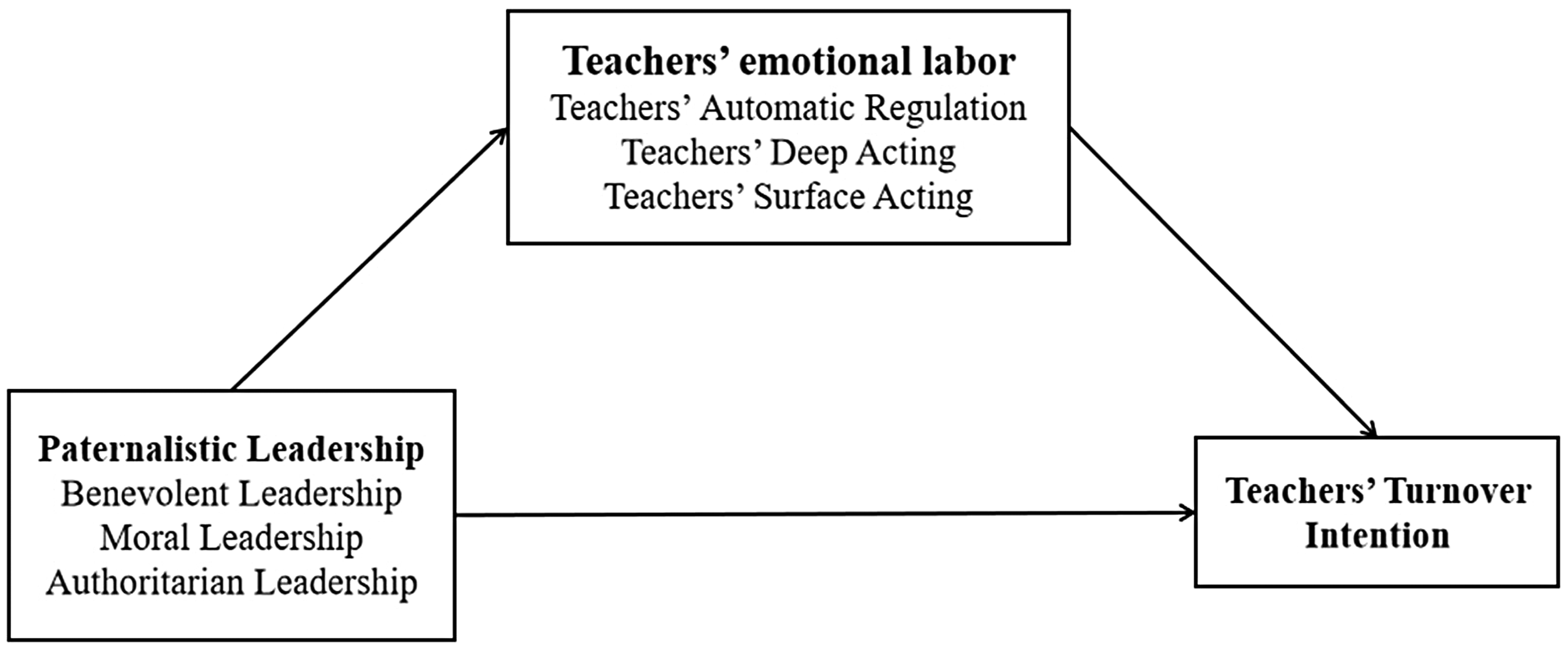
Research hypothesis model.
Method
Sample Selection
A total of 728 teachers from both urban and rural public school were selected to participate in this study across multiple regions in China (Sichuan, Anhui, Xinjiang, and Inner Mongolia), representing a diverse range of socioeconomic and cultural contexts. After eliminating invalid responses such as selective and patterned answers, 632 valid questionnaires remained. The demographic characteristics of the sample are as follows: In terms of gender, there were 132 male teachers and 500 female teachers; regarding teaching years, there were 116 teachers with 5 years or less of experience, 164 teachers with 6–10 years, 129 teachers with 11–15 years, 97 teachers with 16–20 years, 44 teachers with 21–25 years, 43 teachers with 26–30 years, 31 teachers with 31–35 years, and eight teachers with 36 years or more; in terms of age, there were 17 teachers aged 25 and under, 99 teachers aged 26–30 years, 108 teachers aged 31–35 years, 117 teachers aged 36–40 years, 90 teachers aged 41–45 years, 35 teachers aged 46–50 years, 39 teachers aged 51–55 years, and one teacher aged 56 years or above.
Measures
Paternalistic Leadership Scale
In this study, the Paternalistic Leadership Questionnaire developed by Cheng et al. (2000) was adopted, which was divided into three dimensions: authoritarian leadership, benevolent leadership and moral leadership. It was revised based on the school context and consisted of 33 items. A 5-point Likert scale was used, and teachers were required to choose the description that conformed to their situation from “strongly disagree” to “strongly agree” based on their perception of leadership behavior. Specifically, authoritarian leadership included 13 items, such as “He requires me to fully obey his leadership”; benevolent leadership included 11 items, such as “When I encounter difficulties at work, he will promptly give me appropriate encouragement”; and moral leadership included 9 items, such as “He is upright and does not abuse his position for personal gain.” The internal reliability Cronbach's α coefficients of each subscale were 0.913, 0.970, and 0.963, respectively, and the internal consistency reliability Cronbach's α coefficient of the overall scale was 0.938. After testing, the scale fitting indices of the revised model were within a good range: χ2 = 3271.773, df = 492, SRMR = 0.192, RMSEA = 0.095, CFI = 0.874, TLI = 0.865. While the Cronbach's α values for benevolent (α = 0.970) and moral (α = 0.963) leadership were notably high, which could raise concerns about item redundancy, we conducted additional checks. The corrected item-total correlations for all items in these subscales were above the conventional threshold of 0.60, indicating that each item contributed meaningfully to its construct without being redundant. The high alpha values may be attributed to the homogeneous nature of our teacher sample and the high internal consistency of the scales as adapted to the school context.
Teachers’ Emotional Labor Scale
Based on the Emotional Labor Strategies Scale (ELS) developed by Diefendorff et al. (2005) for service industry personnel, this study revised the teachers’ emotional labor scale according to the developmental characteristics of emotional labor among primary and secondary school teachers. It consisted of three dimensions: automatic regulation behavior, surface acting, and deep acting. Automatic regulation behavior included three items, such as “The emotions I display to students are naturally expressed”; surface acting included seven items, such as “When facing students, to display appropriate emotions, I will pretend to feel them in order to respond to students”; and deep acting included four items, such as “When interacting with students, I strive to experience the emotions that need to be displayed to them.” The total teachers’ emotional labor scale consisted of 14 items, with a Cronbach's α coefficient of 0.885. The internal reliability Cronbach's α coefficients of each subscale were 0.873, 0.925, and 0.895. A 5-point Likert scale was used, where teachers selected the description that best fit their emotional management and expression at work from “strongly disagree” to “strongly agree.” After testing, the scale fitting indices of the revised model were within a good range: χ2 = 677.767, df = 74, SRMR = 0.093, RMSEA = 0.114, CFI = 0.913, TLI = 0.893.
Teachers’ Turnover Intention Scale
The Turnover Intention Scale developed by Farh et al. (1998) was adopted in this study and revised based on the school context, with a total of four items. An example item was “I often think about quitting my current job.” A 5-point Likert scale was used, with higher scores indicating greater turnover intention. The internal consistency reliability Cronbach's α coefficient of the scale was 0.794. After testing, the scale fitting indices of the revised model were within a good range: χ2 = 13.278, df = 2, SRMR = 0.095, RMSEA = 0.350, CFI = 0.993, TLI = 0.980. Although the RMSEA value for the turnover intention scale was high (0.350), which may be due to the small number of items (four items) and the simplicity of the construct, other fit indices (CFI = 0.993, TLI = 0.980) indicated acceptable model fit. This is consistent with prior studies using short scales for turnover intention.
Statistical Analysis
The data analysis was conducted using SPSS 24.0 and PROCESS v3.5, developed by Hayes. SPSS 24.0 was used for reliability analysis of the scales, common method bias testing, descriptive statistical analysis, and hierarchical regression analysis to examine the correlations between variables. Based on these results, PROCESS v3.5 was used for hypothesis testing. The mediation effect was tested using a bias-corrected percentile bootstrap method with 5000 resamples of the data.
Results
Common Method Bias Testing
Because this study collected data using a self-report method, common method bias may exist. Harman's single-factor test was conducted for statistical verification. The results showed that the cumulative variance explained by the first factor was 35.82%, which was less than the critical threshold of 40% (Podsakoff et al., 2003). Therefore, there was not serious common method bias in this study.
Descriptive Statistical Analysis
The results of the descriptive statistical analysis, as shown in Table 1, indicated that authoritarian leadership was significantly positively correlated with teachers’ deep acting, surface acting, and turnover intention; benevolent leadership was significantly correlated with the other variables in all pairwise comparisons, showing a negative correlation with turnover intention and positive correlations with all other variables; and moral leadership was significantly positively correlated with teachers’ automatic regulation behavior and deep acting and negatively correlated with teachers’ turnover intention. Furthermore, teachers’ emotional labor strategies were significantly correlated with their turnover intention. Specifically, teachers’ automatic regulation behavior and deep acting were significantly negatively correlated with their turnover intention, whereas surface acting was significantly positively correlated with their turnover intention.
Descriptive Statistics and Correlation Analysis.
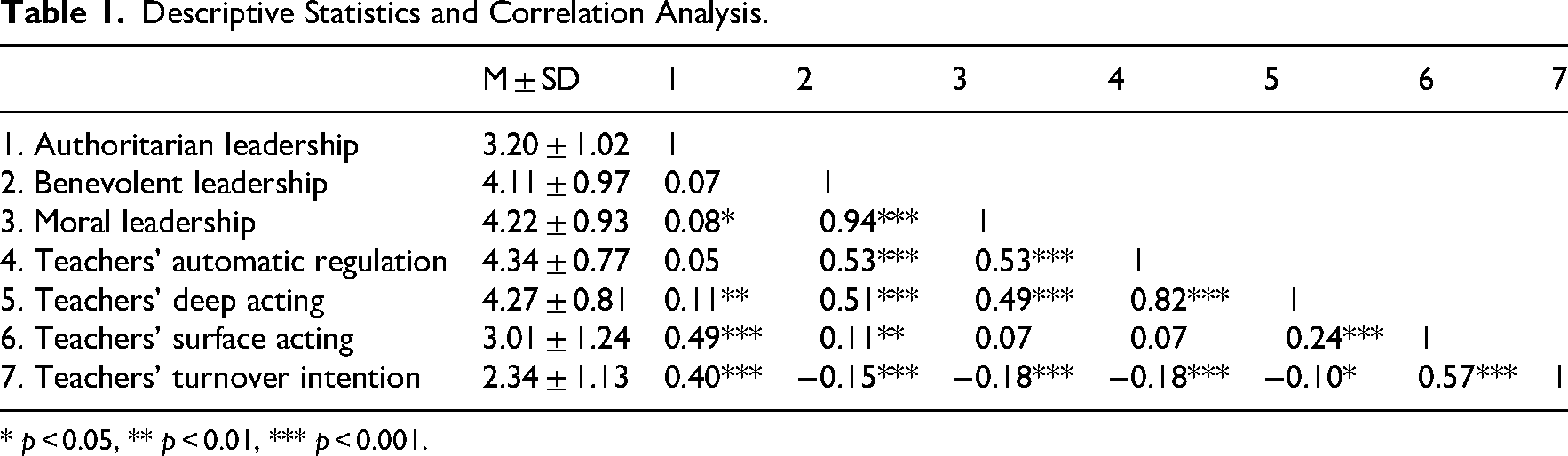
* p < 0.05, ** p < 0.01, *** p < 0.001.
Regression Analysis
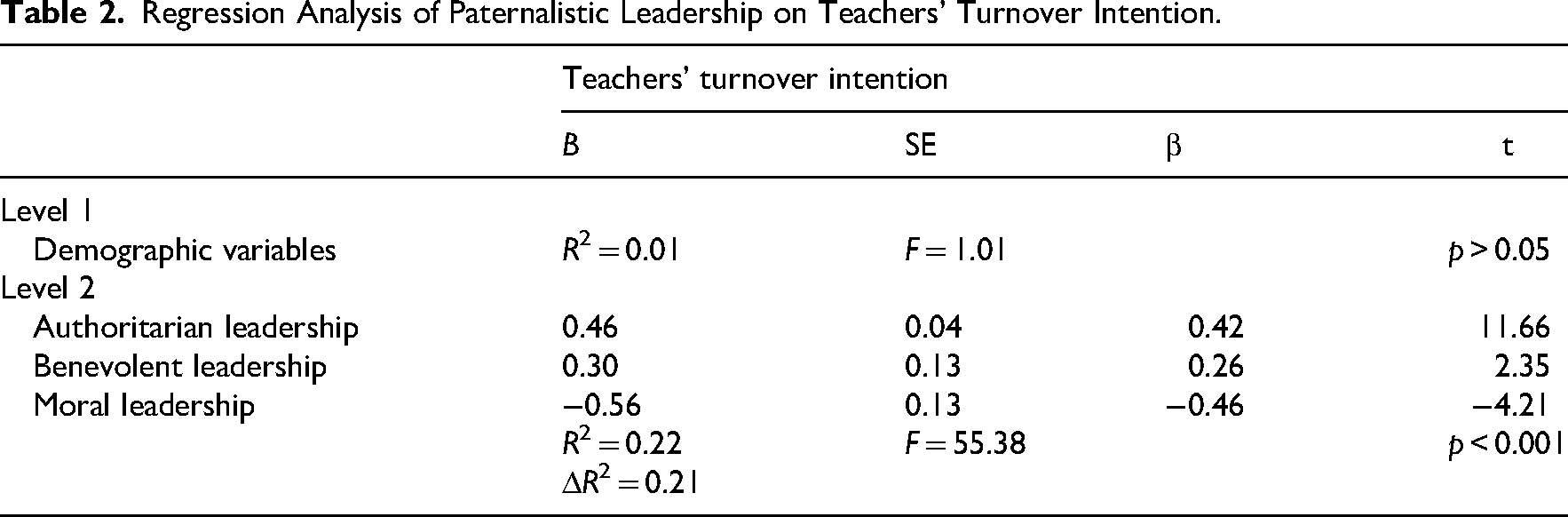
To verify Hypothesis 1, a hierarchical regression was conducted. The results are shown in Table 2, with the influence of demographic variables excluded afterward, authoritarian leadership and benevolent leadership in paternalistic leadership both had significant positive predictive effects on teachers’ turnover intention, whereas moral leadership had a significant negative predictive effect on teachers’ turnover intention. Hypothesis 1 was partially verified, and 21% of the variance of the dependent variable can be explained.
Regression Analysis of Paternalistic Leadership on Teachers’ Turnover Intention.
Mediation Model Testing
Based on the hypothesized model framework, this study used PROCESS model 4 developed by Hayes, which is an SPSS plug-in, to analyze the standardized regression coefficients for the model, as shown in Figure 2. The results showed that authoritarian leadership significantly positively predicted teachers’ turnover intention, whereas moral leadership significantly negatively predicted teachers’ turnover intention. However, benevolent leadership did not significantly positively predict teachers’ turnover intention. After controlling for demographic variables, the relationship between authoritarian leadership and teachers’ automatic regulation behavior was not significant, although it positively predicted teachers’ deep acting and surface acting; benevolent leadership significantly positively predicted teachers’ automatic regulation behavior, deep acting, and surface acting; and moral leadership significantly positively predicted teachers’ automatic regulation behavior and negatively predicted surface acting. The negative relationship between teachers’ automatic regulation behavior and turnover intention was not significant, but deep acting significantly negatively predicted their turnover intention, whereas surface acting significantly positively predicted their turnover intention.
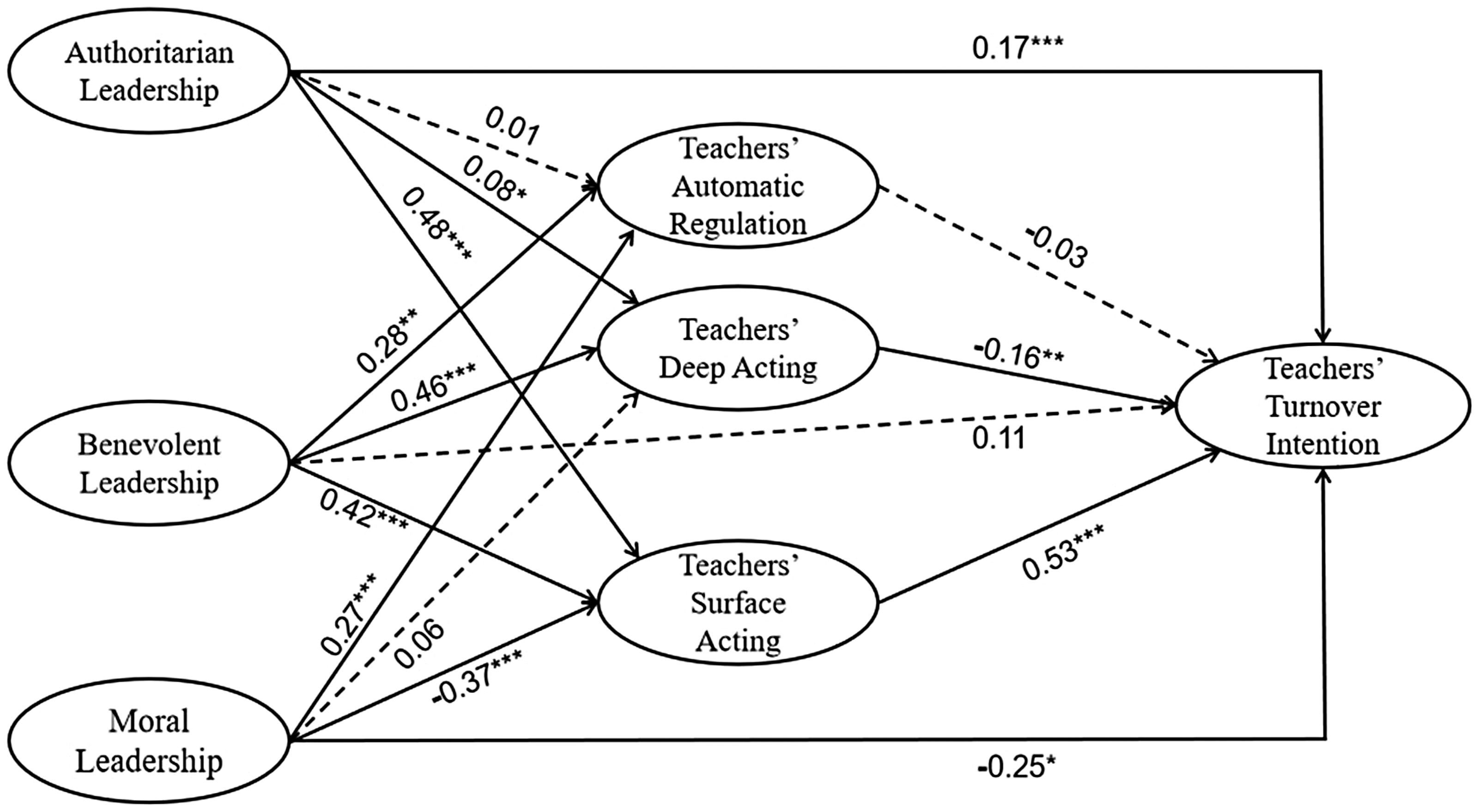
Impact of paternalistic leadership on teachers’ turnover intention through teachers’ emotional labor.
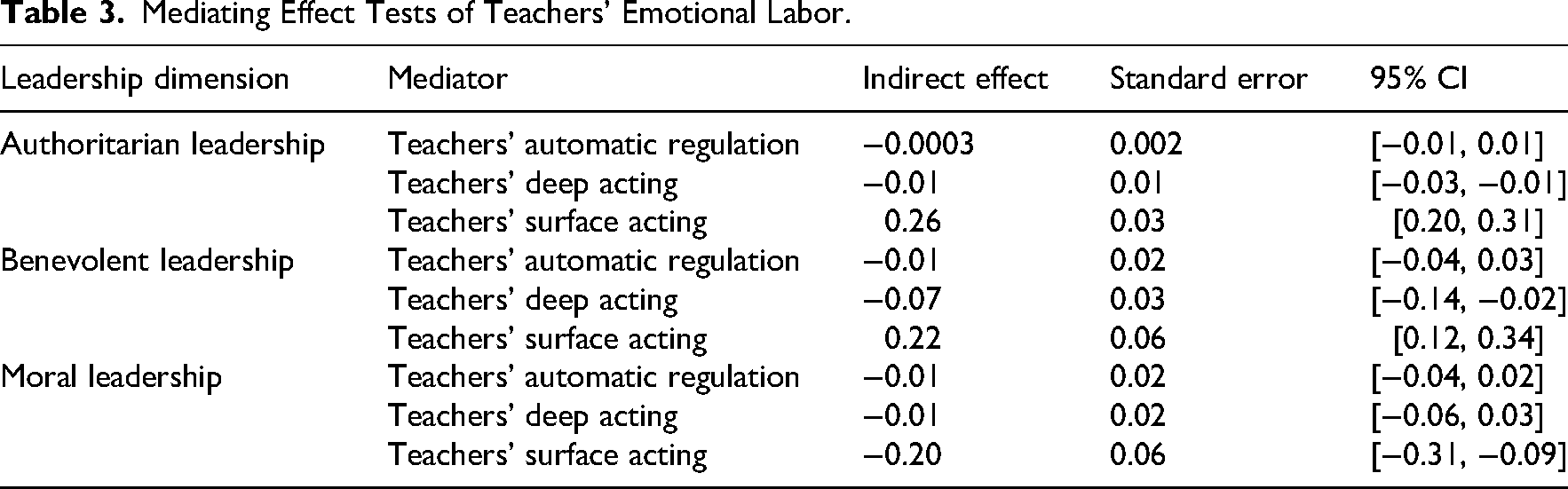
The mediation analysis revealed the total effect of authoritarian leadership on teachers’ turnover intention (β = 0.42, p < 0.001), with a total indirect effect of 0.25, of which the 95% confidence interval (CI) of the path mediated by teachers’ automatic regulation behavior was [−0.004, 0.004], indicating no significant mediation. However, for the paths mediated by teachers’ deep acting and surface acting, the 95% CIs were [−0.0287, −0.0003] and [0.20, 0.31], respectively, which indicated that teachers’ deep acting and surface acting partially both mediated the relationship between authoritarian leadership and teachers’ turnover intention, with indirect effects of −0.01 and 0.26. This finding indicates that authoritarian leadership influences teachers’ turnover intention primarily by increasing their surface acting—a potentially draining emotional labor strategy, while also slightly encouraging teachers’ deep acting that may mitigate their turnover intention to a limited extent.
The total effect of benevolent leadership on teachers’ turnover intention was significant and equal to 0.25 (p < 0.05), but the direct effect was not significant. The specific mediation paths of benevolent leadership to teachers’ turnover intention were as follows: benevolent leadership → automatic regulation behavior → teachers’ turnover intention, with an effect size of −0.01, 95% CI = [−0.04, 0.03], indicating no significant mediation by automatic regulation behavior; and benevolent leadership → deep acting → teachers’ turnover intention, with an effect size of −0.07, 95% CI = [−0.14, −0.02], benevolent leadership → surface acting → teachers’ turnover intention, with an effect size of 0.22, 95% CI = [0.12, 0.34], indicating the mediating effect of teachers’ deep acting and surface acting between benevolent leadership and teachers’ turnover intention. This pattern implies that benevolent leadership exerts contradictory indirect effects: it promotes teachers’ deep acting, which reduces their turnover intention, but also elicits teachers’ surface acting, which increases it. The net positive total effect suggests that the detrimental effect via teachers’ surface acting outweighs the beneficial effect via teachers’ deep acting.
The total effect of moral leadership on teachers’ turnover intention was significant and equal to −0.46 (p < 0.001), with a direct effect of −0.25 (p < 0.05). The 95% CIs for the paths mediated by teachers’ automatic regulation behavior and deep acting were [−0.04, 0.02] and [−0.06, 0.03], respectively, suggesting no significant mediation for these paths. However, the 95% CI for the path mediated by teachers’ surface acting was [−0.31, −0.09], indicating a partial mediating effect of surface acting on the relationship between moral leadership and teachers’ turnover intention, with an indirect effect of −0.20. This indicates that moral leadership reduces teachers’ turnover intention partly by diminishing teachers’ reliance on surface acting, which underscores the role of moral leadership in fostering an authentic emotional climate, thereby reducing emotional dissonance and subsequent desire to leave (Table 3).
Mediating Effect Tests of Teachers’ Emotional Labor.
Discussion
Relationships Between Paternalistic Leadership and Teachers’ Turnover Intention
Previous research has consistently shown that authoritarian leadership significantly positively predicts teachers’ turnover intention (Potipiroon & Chumphong, 2024), whereas there is a significant negative relationship between moral leadership, benevolent leadership and turnover intention (Wu et al., 2018). The results reveal that the authoritarian leadership had a significant positive impact on teachers’ turnover intention and the moral leadership negatively predicted teachers’ turnover intention, which is consistent with previous research. Authoritarian leadership emphasizes the leader's absolute authority and strict control over subordinates, which consumes a large amount of teachers’ emotional energy, leading to emotional exhaustion, and, eventually, thoughts of resignation (Badar et al., 2023). In contrast, moral leaders through setting a moral example and displaying personal charm, fosters trust and respect between teachers and school leaders, which can reduce teachers’ perceptions of work stress and enhance their organizational identification and sense of belonging, thereby decreasing their turnover intention (Nassir & Benoliel, 2023).
However, contrary to previous studies, benevolent leadership did not significantly impact teachers’ turnover intention in this study. Several factors could explain this result. First, teachers’ turnover intention can have complex causes and may be influenced by a variety of factors, such as organizational structure and culture, individual needs, the work environment, in addition to leadership style (Rahimi & Arnold, 2024). Distinct cultural values shape how individuals interpret themselves and their contexts. Within collectivist cultural systems, subordinates typically exhibit higher power distance orientation and are more inclined to acknowledge hierarchical disparities between superiors and themselves. Consequently, when leaders demonstrate benevolent behaviors, the initial reaction of subordinates may be one of feeling somewhat disoriented, which can attenuate the relationship between benevolent leadership and subordinates’ pro-environmental behaviors (Zhao et al., 2018).Although benevolent leadership can provide individualized care and support, this care may not always match teachers’ needs and expectations (Shen et al., 2017). Different groups of teachers have different needs. For example, new teachers might have a greater need for explicit guidance and support, whereas experienced teachers may prioritize professional development and personal achievement. Second, this result may be related to the specific sample used in the study. Most current studies have focused on enterprises, whereas this study focused mainly on the grassroots school environment. Unlike corporate workers, teachers face a lower risk of being laid off. If school leaders display excessive benevolence, which causes teachers to lose tension regarding their work, may affect leaders’ authority and weak the positive influence of benevolent leadership (Xia & Shan, 2019).
Relationship Between Paternalistic Leadership and Teachers’ Emotional Labor
The results showed that benevolent leadership has significant positive impacts on both teachers’ automatic regulation and their deep acting behavior. This may be because benevolent leadership, through personalized care, can enable teachers to feel the care and warmth of the organization, thus promoting teachers’ deep-acting and automatic regulation behavior (Şahin, 2018). However, the study also revealed that benevolent leadership can significantly and positively predict teachers’ surface acting behavior, suggesting its potential negative impact. Recent research has found that excessive benevolence can increase performance pressure and feelings of guilt among organizational members, leading to greater emotional resource depletion (Li & Shen, 2019), which is not conducive to team members’ commitment to the organization (Wang et al., 2019). Contrary to expectations, benevolent leadership is not always associated with positive effects. This may be explained by the dual-effect nature of benevolent leadership: while it provides support, it may also impose implicit emotional expectations, leading teachers to engage in surface acting—a mechanism that ultimately increases turnover intention. This suggests that in educational contexts, the emotional costs of perceived obligations may offset the benefits of support.
The results also found that moral leadership negatively predicts teachers’ surface acting behavior and positively predicts their automatic regulation behavior. As a role model, moral leadership earns teachers’ respect and admiration, fostering high-quality superior–subordinate relationships between school leaders and teachers (Bao & Li, 2019). Especially in the context of traditional Chinese culture, under the subtle influence of the moral prestige of leaders, teachers are more willing to show behaviors consistent with educational goals and professional norms, reduce superficial acting behaviors, and express positive emotions more naturally (Gao et al., 2006). However, it is noteworthy that the study revealed no significant impact of moral leadership on teachers’ deep acting behavior. Unlike benevolent leadership, moral leadership does not directly influence teachers but rather influences them indirectly through the leader's moral character and role modeling.
The study also revealed that authoritarian leadership significantly positively predicted teachers’ surface acting behavior. Authoritarian leadership mainly makes teachers obey and rely on leaders through control and instruction, which may lead teachers losing more emotional resources as they try to coordinating the inconsistency between their own emotional needs and organizational norms. To conserve their own resources, teachers might adopt a defensive or passive attitude in the short term and resort to surface acting rather than genuinely expressing emotions (Bedi, 2020; Qin & Liu, 2016). Consistent with many studies, this study revealed that authoritarian leadership has a negative impact on teachers’ emotional management. However, the study also highlights a positive aspect of authoritarian leadership in that it positively predicts teachers’ deep acting behavior. Based on the JD-R theory, study have revealed that while leadership support and concern can buffer the depletion path caused by job demands, it is important to note that lower job demands are not necessarily better (Li et al., 2015). Particularly under the profound influence of collectivist cultural values, teachers’ emotional states and behavioral decisions depend on their organizational norms. Excessively low job demands may cause teachers to remain within their comfort zone, diminishing their sense of accomplishment from work (Liang, 2020). Authoritarian leaders emphasize school organizational norms, which maybe a driving force for good communication and action execution among teams, and are conducive to teachers’ adjustment of emotional expressions and faster integration into the school's emotional norms (Zheng et al., 2020).
Relationship Between Teachers’ Emotional Labor and Turnover Intention
The results showed that teachers’ deep acting negatively predicts their turnover intention, whereas teachers’ surface acting positively predicts their turnover intention, which was consistent with previous studies (Xie et al., 2023). From the perspective of the teachers themselves, teachers’ deep acting behavior is significantly related to their commitment and well-being (Peng et al., 2023); thus, the more deep acting behavior that teachers exhibit, the more well-being they can feel, and the more it helps reduce their turnover intention. Compared with deep acting, surface acting is a camouflage process in which teachers display emotions that do not align with their inner feelings, leading to greater emotional resource depletion and stronger likelihood of turnover intention (Lee et al., 2016a; Zheng et al., 2023). This study also revealed that there was no significant effect of automatic regulation on turnover intention, which is inconsistent with previous studies. Automatic regulation behavior is an ideal expression of teachers’ internal emotions, which are expressed authentically and in line with organizational norms without consuming psychological resources (Basim et al., 2013). However, with the growing demands placed on teachers, teachers are required to carry many nonteaching responsibilities in addition to their daily teaching work, which requires more emotional labor (Zhang & Zeng, 2023). As a result, the inhibitory effect of teachers’ automatic regulation on turnover intention may be offset by other risk factors under such high-pressure situations.
Multiple Mediating Roles of Teachers’ Emotional Labor
The results indicate that teachers’ deep acting serves as a mediator in the relationship between two leadership styles, authoritarian and benevolent leadership, and teachers’ turnover intention, but there was no significant mediating effect between moral leadership and teachers’ turnover intention. By expressing care and concern for teachers, benevolent leadership fosters gratitude and rewards to school, which reduces teachers’ feelings of work alienation and thereby lowers turnover intention (Long et al., 2014). Authoritarian leadership not only emphasizes personal authority and employee obedience but also reinforces organizational norms and procedures, which can help teachers better adapt to school teaching in terms of cognition, emotion, and behavior, thereby increasing the likelihood of teachers’ retention in their jobs (Wang et al., 2023).
Teachers’ surface acting has a significant mediating effect between the three dimensions of paternalistic leadership and teachers’ turnover intention. Under authoritarian leadership, teachers may frequently engage in surface acting to hide negative emotions to avoid conflict with their leaders, and such emotional labor can lead to emotional exhaustion, thereby ultimately increasing teachers’ turnover intention (Marchand & Vandenberghe, 2016). Generally, benevolent leadership—characterized by care and support—tends to reduce the likelihood of teachers engaging in surface acting, allowing them to express their true emotions and decreasing turnover intention (Huang & Yin, 2024). However, this study revealed that benevolent leadership does not directly predict teachers’ turnover intention, whereas teachers’ surface acting plays a significant positive mediating role in this relationship. This may be because under benevolent leadership, although leaders show care and support, teachers may still feel emotional pressure to meet leaders’ expectations. Especially when leaders have implicit emotional demands, teachers might engage in surface acting to express emotions such as “gratitude” or “loyalty,” even if they do not fully feel these emotions internally (Li & Shen, 2019). This prolonged emotional labor can increase psychological distress, ultimately contributing to increased turnover intention. As for moral leadership, school leaders provide a supportive and fair environment for teachers, and teachers do not need to cover up or suppress their true feelings to meet the expectations of leaders, which reduces the emotional exhaustion and pressure that may be caused by superficial acting, and helps to reduce the turnover tendency of teachers (Lee & van Vlack, 2017). Our findings highlight the critical mediating role of emotional labor, particularly surface acting, which consistently mediated the relationship between all three leadership dimensions and turnover intention. This aligns with the JD-R model's emphasis on emotional resource depletion as a key mechanism driving turnover. The lack of mediation through automatic regulation may reflect the high emotional demands of teaching, which limit the natural expression of emotions.
Implications
This study clarifies how paternalistic leadership influences turnover intention through emotional labor, highlighting the interplay between leadership styles and teachers’ emotional processes. The results of this study not only offer valuable insights into the theoretical underpinnings of teachers’ turnover intention as a psychological tendency, but also provide practical management recommendations for school organizations, contributing to improvements in teachers’ mental health and job satisfaction. For example, considering the influence of paternalistic leadership, school administrators should appropriately adopt an authoritarian leadership style based on the organizational context. An increase in teachers’ deep acting behavior can reduce their turnover intention and leverage the positive aspects of authoritarian leadership (Zheng et al., 2020). School leaders should also exercise caution in employing authoritarian leadership, as it may increase surface acting and turnover intention (Bedi, 2020). That is they should strive for a balanced leadership approach that combines moral exemplarity with conditional benevolence, while minimizing excessive control. Teacher professional development relies on interactions among individuals, colleagues, leaders, organizations, and the environment. Therefore, fostering a positive school organizational climate is a crucial factor in effectively improving the relationship between leadership behaviors and teacher attitudes (Wang, 2016). Particularly under the principal responsibility system, school leaders should avoid autocratic decision-making, enhance democratic leadership capabilities, and cultivate a people-oriented school atmosphere. This integration of systems, environment, and individual leadership can collectively and effectively promote teacher growth (Sun & Chu, 2017). Therefore, schools should strengthen the practice of moral leadership by enhancing the moral image and behavior of leaders, which is of great benefit to build a fair and trustworthy organizational environment. This approach helps teachers align both psychologically and behaviorally, thereby fostering greater recognition of the teaching profession and encouraging more active participation in teaching activities (Wang et al., 2017). In addition, administrators should pay attention to the practical effectiveness of benevolent leadership and explore more effective contexts for its application (Luo, 2023). Briefly, school leaders need to consider both individual and contextual factors comprehensively and adopt management strategies that align with the needs of different teacher groups and organizational contexts, enhancing teachers’ job satisfaction and loyalty.
Limitations and Future Research
This study has some notable limitations that warrant attention. First, teachers’ turnover intention is a dynamic process that may change over time due to factors such as work experience, life circumstances, and environmental changes. However, this study utilized only cross-sectional data and did not capture the full developmental process of turnover intention. Future research should adopt qualitative research methods or longitudinal designs with multiple measurements and follow-up analyses to reveal the changing trends of teachers’ turnover intention, thus providing a more comprehensive understanding of the key factors influencing their evolution. Second, the sample size and scope in this study were relatively limited. Teachers in different types of schools (e.g., public vs. private school) face distinct career pressures and work environments, which may lead to differences in the expression and influencing factors of turnover intention. Therefore, future research directions should emphasize how paternalistic leadership interacts with institutional reforms and teacher professional development. For instance, future research could expand the sample scope to ensure that the findings are more interpretable among a wider group of teachers. Additionally, future research should also focus more on the multidimensional and contextual applications of paternalistic leadership. From an integrated perspective, the effectiveness of dual leadership behaviors in different organizational contexts should be explored, further advancing research on school leadership and improving its practical implications.
Conclusions
This study investigated the relationship between paternalistic leadership and teachers’ turnover intention, as well as the mediating role of teachers’ emotional labor. The main findings of the research were as follows:
Authoritarian leadership significantly positively predicted teachers’ turnover intention, moral leadership significantly negatively predicted teachers’ turnover intention, whereas benevolent leadership did not significantly affect teachers’ turnover intention. The mediating effect of teachers’ automatic regulation behavior between the three dimensions of paternalistic leadership and teachers’ turnover intention was not significant. However, teachers’ deep acting behavior mediated the relationship between authoritarian and benevolent leadership and teachers’ turnover intention, but there was no significant mediating effect between moral leadership and teachers’ turnover intention. Teachers’ surface acting behavior significantly mediated the relationship between all three dimensions of paternalistic leadership and teachers’ turnover intention.
Footnotes
Acknowledgments
The authors thank the participants who take part in this study.

Ethics Statement
The research reported herein was conducted in accordance with ethical standards and has received a formal ethical approval by the ethics committee of Beijing Normal University(IRB Number: BNU202501100001). Informed consent was obtained from all participating students and/or their legal guardians, as appropriate, prior to their involvement. The confidentiality and anonymity of all participants have been rigorously protected throughout the research process; all data were collected and analyzed anonymously, with no personally identifiable information retained. The study's purpose and procedures were fully explained to participants, and their right to withdraw at any time without penalty was emphasized.
Funding
The authors disclosed receipt of the following financial support for the research, authorship, and/or publication of this article: This work was supported by the “Research on Motivation Mechanism and Promotion of School Teachers’ Innovative Behavior in Teaching” of “Major Project of Beijing Education Sciences ‘the 14th-Five Year’ Planning” (Grant No. BFAA23039).
Declaration of Conflicting Interests
The authors declared no potential conflicts of interest with respect to the research, authorship, and/or publication of this article.