



Abstract

Dear Editor
As the field of cancer pain management becomes increasingly intertwined with artificial intelligence (AI), it is imperative to measure not only the scientific importance of associated papers but also their engagement with the public. The Altmetric Scores—which measure public attention on social media, news outlets and blogs—are assumed to correlate with academic citations. 1 This assumption may not hold for AI-directed cancer pain research, as our bibliometric analysis reveals.
A total of 188 articles were initially retrieved from the Web of Science database (Clarivate Analytics, Philadelphia, US) using the predefined search terms “cancer pain” and “artificial intelligence.” After title and abstract screening, the majority were excluded due to irrelevance to this specific intersection. Ultimately, 13 highly cited articles published between 2022 and 2024 were included in the analysis, reflecting a notable surge of interest in this emerging field (supplement).
Due to its novel nature (AI-driven intervention) with significant clinical benefits and media attention, “ePAL: an AI-enabled digital therapeutic application for cancer pain management” titled article had the highest Altmetric Score of (36) among the 13 papers. In turn, the AI-driven telemedicine framework leveraging Conditional GANs garnered the highest total citations and citation index due to its sophisticated design, sound methodology, interdisciplinary nature and relevance to telemedicine innovations. Although ePAL was widely popularized among the general public, the telemedicine study was better received in academia, illustrating a disconnect between public interest and scientific contribution in the field of AI-driven cancer pain management studies.
We analyzed the relationship between Total Citations, Citation index and Altmetric Scores, on AI-related cancer pain literature. Our analysis identifies three key takeaways: Public engagement does not predict academic impact. Using our data, we found that Altmetric Scores and Total Citations are weakly correlated. Most articles scored low for Altmetric score, as evidenced by the near flat line of regression, suggesting that traction on social media does not drive citation counts. Altmetrics do not predict long-term citation trends. The correlation between Altmetric Scores and Average Citations per year was also non-significant. This means that public attention does not directly translate into long-term scholarly recognition. Citation impact remains an academic phenomenon. The only major correlation and the finding that seemed to hold up was between Total Citations and Average Citations per Year, which only confirmed what is already known: that once an article achieves academic notoriety, it is likely to continue to be cited without requiring Altmetric attention.
2
As the authors conclude, this relationship raises an essential question: does Altmetric attention reflect scientific relevance, or is it simply a product of public interest? Our findings indicate that citation trends are primarily academic in nature; AI-related articles on cancer pain have not deviated from standard citation trajectories in response to increased recognition by Altmetric (Figure 1).
Relationship Between Altmetric Score, Total Citations, and Average Citations Per Year in AI-related Cancer Pain Research.
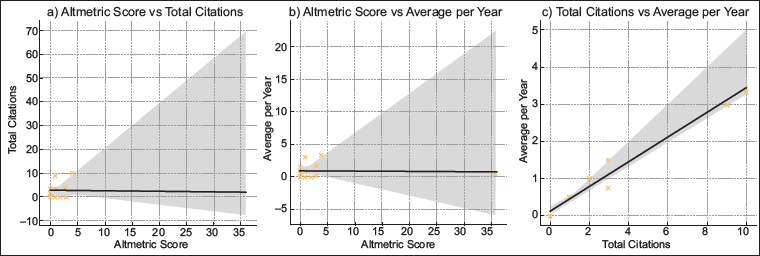
Such divergence has a huge impact on how research about AI is published and received. In summary, Altmetric Scores reveal how much the public is aware of a research article, but should not be confused or conflated with scientific impact. 3 For researchers in AI-driven oncology, strategies suggesting a bridge between the gap of public and academic reach may need to be considered—namely, open-access publishing, AI-driven meta-analyses and targeted dissemination of content both to clinicians and research audiences.
In summary, our results showcase a disparity between public attention and academic appraisal in the scope of oncology AI pain research. Although social media and news articles may promote higher visibility, it does not directly affect citation trends. Research in the future should be concerned with what AI-driven scientific communication would look like in order to maximize both public and academic impact.
