



Abstract
Introduction:
Research exploring the contextual factors influencing the rare instances of autistic people engaging with extreme ideologies is limited. This article explores factors that affected autistic people who engaged with extreme ideologies, from the perspectives of close contacts and clinicians.
Methods:
This article presents findings from interviews with two participant groups: family and friends, and clinicians. We recruited participants through a gatekeeper, professional networks, and social media. We used reflexive thematic analysis to analyze the data.
Results:
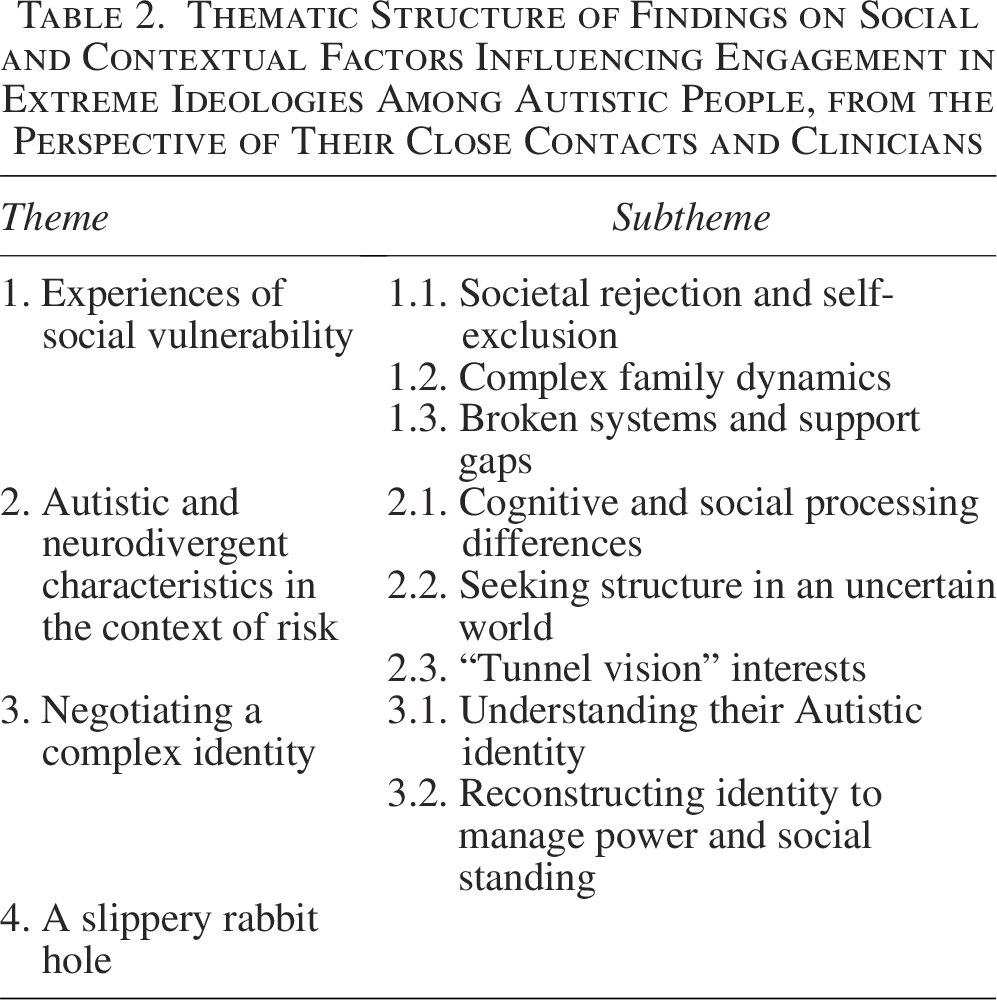
Participants included seven family members and one friend in the first group and five clinicians in the second. Across both groups, we identified four themes: (1) experiences of social vulnerability; (2) autistic and neurodivergent characteristics in the context of risk; (3) negotiating a complex identity; and (4) a slippery rabbit hole. Social vulnerabilities including lack of secure attachments in childhood and social rejection led to a sense of persecution. System-level marginalization compounded the sense of exclusion. A negative autistic self-image was an important factor. Inflexible thinking, differences in social cognition, hyperfixation, and need for structure and routine were identified as neurodivergent features that could find a fit within the ideologies and practices of extremist groups. However, participants emphasized that autism itself did not fully account for this engagement. With limited engagement in prosocial real-world activities and ample idle time, internet algorithms exacerbated exposure to extreme ideologies, which offered provocative explanations for these autistic peoples’ struggles.
Conclusions:
Timely diagnosis, qualified and continuous support structures, neuroinclusive societies, and digital literacy are all key components to preventing autistic people from this harmful engagement.
Community Brief
What was the purpose of this study?
Although the media has reported several high-profile cases of violent autistics with extreme beliefs, there is not much research on this topic. In a previous study, we talked to autistics involved with extreme beliefs or groups about how their autism and life circumstances may have led to their involvement. Some of these autistics were unaware, embarrassed, or afraid to share specific details about their involvement. To fill the gaps in their stories, we wanted to gather information from people who know them well.
What did the researchers do?
We interviewed healthcare providers, family, and friends of autistics engaged in extreme beliefs or groups, using Zoom Health. We read the interview texts, identified important statements, and then identified the ideas linking these statements.
What were the results of the study?
We identified four themes across the data: (1) experiences of social vulnerability; (2) autistic and neurodivergent characteristics in the context of risk; (3) negotiating a complex identity; and (4) a slippery rabbit hole. Family members and healthcare providers noted that autistic people involved in extreme beliefs or groups were often rejected by society. Their needs were unmet by health and education systems, and their families. They isolated themselves and spent many hours on the internet. The constant online activity and internet algorithms led these people toward extreme beliefs or groups that offered simple explanations for their struggles.
Autism itself does not lead to engagement in extreme beliefs or groups. However, certain neurodivergent characteristics such as hyperfixation, black-and-white thinking, and the need for structure and routine might make these groups attractive to some autistics. Family and healthcare providers noted that autistic people with a negative self-image and those who held other marginalized identities (e.g., racialized, gender, and sexual) tried to distance themselves from these identities by joining groups that oppose those identities. Some autistics took other identities to avoid being victims and to feel in control.
What do these findings add to what was known?
This study provides different perspectives of how autism and life circumstances may influence some autistics’ engagement with extreme beliefs or groups. For example, participants reported that difficulty understanding others’ thoughts, feelings, and views that are different from their own may make some autistic people more vulnerable to extreme beliefs or groups. This insight was not shared with us by autistic participants in our previous study.
What are potential weaknesses?
Some parent participants may portray their children as victims who were exploited by hate groups. However, not all autistics who engage in extreme beliefs/groups are fully vulnerable. Readers should interpret participants’ quotes carefully and keep in mind that some autistics choose to engage in extreme beliefs/groups willingly.
How will these findings help autistic adults now or in the future?
Strengthening support from healthcare, education, and family is important to keep autistic peopel from feeling isolated and vulnerable to harmful beliefs/groups. Helping autistics build a positive self-image and addressing their identity issues may stop them from seeking or joining groups that offer false power and sense of belonging. Teaching digital literacy can help some autistics safely navigate online spaces. Technology companies and governments have a responsibility to create safe online spaces.
Introduction
Extremism involves the defense or promotion of in-group supremacy grounded in rigid ideological commitment and expressed through beliefs, social influence, or actions that undermine the rights, dignity, or inclusion of out-groups.1–3 Engagement exists on a continuum—from consuming extremist ideas to actively enacting them. 4 Extremism often emerges when systemic discrimination, marginalization, and social inequities push individuals toward groups that promise belonging and justice.4,5
Recent years have seen growing discussion about the relationship between neurodivergence and extremism4,6–8 as well as efforts to prevent neurodivergent, particularly autistic, people from radicalization. 9 Much of this focus is driven by high-profile media stories, with little systematic exploration.10–12
We define autism as a neurodevelopmental condition marked by social interaction styles that differ from the typical population, the presence of intense or repetitive behaviors, and sensory differences, 13 although other characterizations exist.14,15 The prevalence of autism in extremism is unknown. Available evidence suggests that diagnosed autism in such populations is generally comparable to the prevalence in the general population (∼1%), 16 although emerging evidence indicates possible over-representation in certain subgroups (e.g., incel forums and socially isolated subgroups).15,16
Previous research17–20 suggested that certain autistic traits—difficulties with social interactions and forming meaningful attachments, difficulty with perspective-taking, need for structure, and hyperfixation—can contribute to increased vulnerability to radicalization. Autistic people may fixate on specific interests, 20 such as military history, extremist ideologies, and conspiracy theories, 9 that draw them further into extremist spaces. Social and relationship difficulties may cause some to seek out groups that offer a sense of belonging and social status. 21 Our previous research, 22 which was the first to directly interview autistic people engaged with extreme ideologies, found some overlap with these features. In exploring contextual factors explaining this engagement, we identified that autism alone was not responsible for this participation, and that autistic participants experienced a range of formative and developmental disruptions that contributed to engagement in extreme ideologies, along with early and ongoing experiences of exclusion.
This article extends our broader program of research investigating contextual influences from the perspective of close contacts and clinicians of autistic individuals involved with extreme ideologies. Close contacts’ perspectives can capture experiences not reported or unrecognized by autistic individuals themselves, such as patterns of social engagement, hyperfocused behaviors, or early warning signs of risk behaviors. Clinicians may offer a comparative and pattern-based perspective by identifying recurring observations across cases that may appear only as isolated events to close contacts. 22 The social–ecological orientation 23 underpins this inquiry, situating individual behaviors within intersecting interpersonal, community, and structural influences and enabling an integrated understanding of the multiple levels of these autistic people’s social ecology shaping risk of involvement in extremism.
Methods
Research paradigm and positionality 23
We were guided by a constructivist epistemology, recognizing that researchers are active participants in the research process,24,25 and a relativist ontology, viewing reality as dynamic and context-specific. 26 Our interdisciplinary team collaborated with an autistic advocate (JER) and a former extremist (CP), who drew on their lived experience to help shape the interview guides, refine themes, and review article drafts. We adopted a neurodiversity affirming perspective that views autism as a meaningful dimension of human diversity. We maintain that autism itself is not a driver of hate or violence and that autistic people exercise agency in their choices. We actively considered how our assumptions and biases impacted the research process through reflexive journaling and analytic memoing, 27 and peer debriefing.
Recruitment
CP, the founder of an extremist deradicalization organization, shared the research flyer with his network. Recruitment also occurred via social media (i.e., X, formerly Twitter). Close contacts of autistic persons engaged with extreme ideologies (conceptualized as ranging from repeated online engagement to in-person participation in hate-based activities), who were over age 18 and living in the United States and Canada, were eligible for study inclusion. While we initially intended to recruit family members, the sensitive nature of the topic necessitated broadening eligibility to include friends with meaningful insights. Clinicians experienced with autistic radicalized persons were recruited via the research team’s networks and social media.
Data collection
The senior author (MP), a developmental pediatrician and researcher, conducted one-on-one semistructured interviews with close contacts, in part to connect participants with professional support should distress arise. The first author (SW), a clinician-researcher with no prior ties to participants, interviewed the clinicians. Both MP and SW used tailored interview guides developed by the interdisciplinary research team (Supplementary Appendices A1 and A2). Interviews were 60–90 minutes long, conducted via Zoom, audiorecorded, and transcribed verbatim.
Ethical considerations
This study received ethics approval (095) from Holland Bloorview Research Ethics Board. Participants provided informed consent before being interviewed. Participants could skip questions or withdraw at any time. We deidentified the data before analysis, stored it securely, and assigned unique codes to protect anonymity. Close contacts were informed about support resources during and after the interviews.
Data analysis
We used the six-phase reflexive thematic analysis process28,29 to analyze the data. SW analyzed each dataset through repeated readings, documenting emerging patterns and insights (Phase 1), generated codes inductively and refined them through several iterative rounds of revisiting the transcripts to interpret the latent meanings underpinning participants’ experiences (Phase 2), and streamlined the codes into initial themes (Phase 3). SW and MP met biweekly to evaluate and further organize these themes (Phase 4). The research team met bimonthly to discuss emerging interpretations and refine the final themes by reviewing associated codes and interview extracts underlying each theme (Phase 5). Team discussions revealed notable thematic similarities across the two datasets. Based on these insights, we integrated the findings into a single analysis, while still attending to differences between the two groups. The research team supported article writing (Phase 6).
Results
Participant characteristics
Demographic information is presented in Table 1. Among close contacts, parents (P) and the friend (F) were predominantly female, aged 45–64, White/European, college-educated, and American. Clinicians (C) were mostly White/European, included three women and two men, based in Canada (n = 2) and the USA (n = 3), with diverse clinical roles.
Participants Demographics
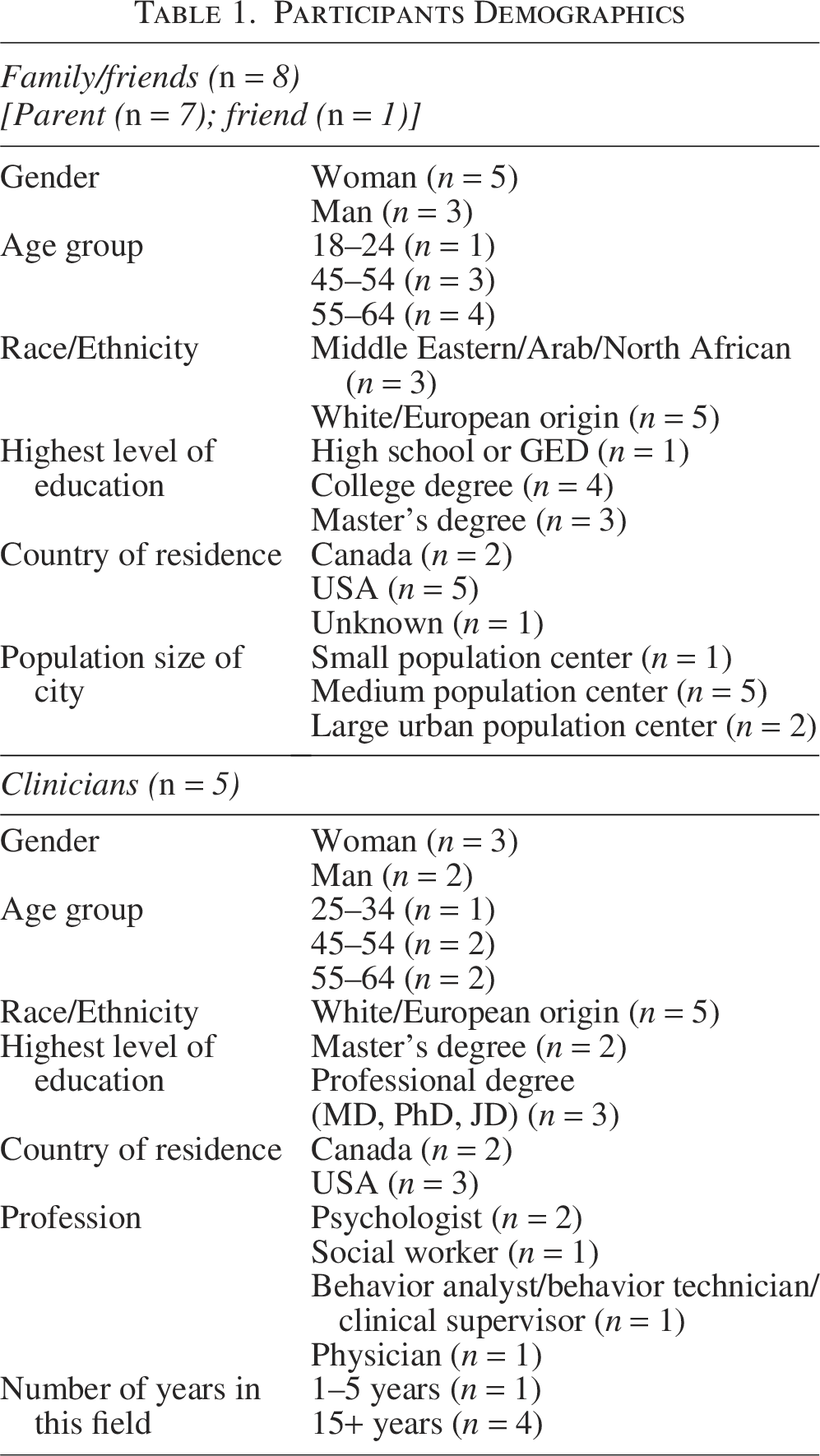
Clinicians described their autistic clients as disproportionately young, White, heterosexual, cisgender males, and nonreligious, although C5 acknowledged this may reflect individuals who have resources to seek professional help. Although we did not collect formal demographic data about the autistic individuals described by close contacts, we can glean from the interview data that they were predominantly young men, with limited formal education and marginal employment, reflecting some patterns observed in the clinicians’ caseloads.
We generated four themes (Table 2): (1) experiences of social vulnerability; (2) autistic and neurodivergent characteristics in the context of risk; (3) negotiating a complex identity; and (4) a slippery rabbit hole
Thematic Structure of Findings on Social and Contextual Factors Influencing Engagement in Extreme Ideologies Among Autistic People, from the Perspective of Their Close Contacts and Clinicians
Experiences of social vulnerability
Participants described how autistic people engaged in extreme ideologies grappled with societal rejection and self-exclusion, complex family dynamics, and systemic failures.
Societal rejection and self-exclusion
Participants reported that these autistic individuals lacked real-life friendships, partly due to societal ostracism, leading to isolation. The lack of social connections restricted their exposure to alternative viewpoints and constrained intellectual and ideological growth.
If you saw some crazy racist statistics and tried to talk to a friend about it, they might question you or challenge it … if you’re not hearing any of those other perspectives, it [won’t] deter you from that path.—C4, psychiatrist
Some of these autistic people engaged in normative social structures yet derived little fulfillment.
At least one client had a job, but they still didn’t feel that they fit. They would kind of self-exclude themselves from society. It’s strange, because you’d think that if someone is able to get a [job]and receive good feedback, [that] he would stay … It’s a much more complex situation. —C2, psychologist
Unfulfilling real-life connections led many of these autistic people online.
Both of [my friends] had jobs but not many close friends. They were kind of alone in real life. I think that might have been part of the reason they were online so much and so deeply into these communities.—F1
C3, a behavior therapist, felt her autistic clients regarded online and real-life connections with equal significance: “As far as the friendships through these online communities, they absolutely identify them as real friendships.” Sometimes online connections became real-life friendships, bringing relief to parents; however, the desire for connection made these autistic people more susceptible to exploitation by predatory groups.
He met some people through various sites that were local. These individuals were in my house and I served them lemonade and cookies. I had no idea. They were leaders and they were grooming him. It feels like he was that loner that they were preying on.—P4
Complex family dynamics
Both groups described that the autistic people they had knowledge of had grown up in fragmented households with disrupted support systems. Some parents expressed guilt over insufficient support during formative years, leaving a void filled by harmful influences.
I feel like I really failed him. It’s a really shitty thing to realize that you let your kid in an environment where he could be preyed upon … Maybe if I had tuned into that a little bit earlier, I could have gotten better support, or I could have been more aware. I feel a great degree of responsibility.—P2
Clinicians noted that even with a seemingly supportive family, some autistic clients struggled to integrate into the family dynamic and sought support elsewhere.
They would live in the house with their family physically. Their social support did not stem from the family, but from people online or people who originally recruited them or turned them on to these groups.—C3, behavior analyst
Broken systems and support gaps
Both groups attributed autistic engagement in extreme ideologies to health and social system failures. However, conflicting views emerged around accountability. Some clinicians recalled cases where parents did not follow clinical recommendations, missed opportunities for diagnosis, intervention, and possible prevention of involvement in extremism.
[Autism] was suggested in early childhood…parents kind of dropped the ball … [The school] picked up some of the areas where [the client] needed support, but they called it a communication disorder, and then parents forgot to ever go back to autism … they never sought resources when he really needed them.—C4, psychologist
Parents contended that clinicians overlooked the nuanced presentation of autism in their children, leading to inaccurate diagnoses and lack of support.
I knew that something was wrong, [but] nobody helped me. I wish the doctors had spent a little bit more time with him to figure it out and had spent time with me to ask questions and just listen. I did not feel listened to, I did not feel heard.—P4
Parents also reported some clinicians declined cases because their personal values conflicted with the autistic person’s ideologies: “The [counselor] said, ‘well I’m extremely left leaning, and I don’t agree with your daughter, so I don’t think I can see her’. It’s like, ‘what? You’re a therapist.’” (P2). Parents discussed broader failures within the health system, such as policies and procedures that restrict access during vanishing windows of opportunity.
[My son] went [to counseling] because I begged him. The counselor came out, invited me to the room and in front of my son said “He doesn’t want to come here. And because his [18th] birthday is in a few months, he doesn’t have to.” I said to myself, “you just ruined the possibility of him getting the little bit of help that he needs.” At this point he was already involved in [extremism].—P4
Similarly, clinicians discussed the implications of “aging out of the system” (e.g., discontinuation of childhood funding and services). This coincides with the transition to adulthood and shift in autonomy, rendering them more susceptible to the appeal of extreme ideologies.
People talk within autism about that big drop off when school services end. That is frequently the time when people turn inwards. As that stuff begins to fade away, they spend more time in their own company, and become more isolated in the everyday world. I see that as a time of great vulnerability.—C5, psychiatrist
Participants also noted that schools inadequately addressed neurodivergent needs, resulting in unmet support and a consequential void.
[My son] always got many strokes for his intelligence … and very little support for who he was as a person … [his] social disconnections, missteps, problems with authority. They said that he had an emotional disturbance. That was absolutely the wrong thing, because their support was to have an aide glom on to him.—P5
Autistic and neurodivergent characteristics in the context of risk
Both groups acknowledged that autism itself is not a sole determinant of involvement in extreme ideologies. Instead, certain facets of autism, namely cognitive and social processing differences, the need for structure and routine, and hyperfixation, may heighten vulnerability when combined with other contributing elements.
If you’re autistic and spend lots of time online hyperfixating on [game], you’re harmless. But if you’re the type who is socially isolated and who really likes history and comes from a sort of right-wing family, or … has some sort of precondition, either based on personal biases like you had a bad experience with a minority in your community, I think that is a recipe for what’s happening.—F1
Cognitive and social processing differences
Some parents and clinicians shared that the individuals they discussed struggled with perspective-taking, finding it difficult to understand and consider others’ thoughts, feelings, and viewpoints that are distinct from their own: “He was discovering what memes were. It became very difficult for him to see sarcasm, or that gray area, or that’s not the intended message but it’s actually satire.” (P3). This difficulty shaped their value system, leading to extreme or rigid views on complex ethical issues.
He started kind of looking at the world like a transaction … He was curious about Darwin and natural selection … ‘why [would] someone [who] knows they’re going to have a deformed baby not abort it?’ He is looking at it as what value do they bring to society?—P3
Alongside this, participants highlighted that many autistic people who were involved in extreme ideologies tended to see things in black-and-white terms. Extremist groups offered oversimplified, dichotomous (e.g., “us” versus “them”) frameworks “… that explain the complexity and the nuances of life away” (P2), appealing to these autistic people’s cognitive style.
I feel like there’s a bit more susceptibility especially if there hasn’t been prior information about how to tell information from misinformation or fact from conspiracy theory. With the folks with ASD, I think there’s a bit more of a vulnerability to hear something and then take it as it is.—C1, social worker
Finally, participants described a spectrum of awareness and understanding of social boundaries and norms among these autistic individuals. Clinicians, in particular, described some of their autistic clients as having difficulty discerning social intentions and foreseeing the consequences (i.e., “the what ifs” (C3, behavior analyst) of their actions.
[You and I] would likely draw the line at some point before we would get into criminal activity. Even if we fervently believed in some of the ideology of these groups, we would draw the line. For the cases that I’ve been involved in, they didn’t even see the line. What line?—C3, behavior analyst
Both participant groups also noted that many of these autistic people actively concealed their engagement. In fact, many parents were oblivious to their child’s involvement until consequences arose.
We had no idea that he had made international contacts. I [was] at a store picking up the [newspaper]because there’s an article that they’ve run about [organization] and extremism. I’m reading this article…and thinking, ‘oh my gosh! My son is involved!’. At that moment, my neighbor calls, ‘FBI, SWAT, the police have a battering ram with their guns pulled on your house’ … By the time I get there, they are combing my entire home. The FBI comes out. I’m holding the newspaper, and I say, ‘I think my son is in contact with these people’. And he’s like ‘you have no idea how far in contact he is’.—P3
Participants attributed this concealment to a fear of judgment, stigma, or repercussion.
The ideology and worldview are often very internal, or something that’s held secretively from other communities, and then when it does come up it almost always leads to some conflict. It becomes another factor for isolation… people that they had an acquaintance with, or that they could politely deal with, no longer will or want to.—C1, social worker
Clinicians interpreted this behavior as evidence of social awareness and agency: “Even though autistic people are supposed to not be good at reading social context, I have many [clients] that would know that in certain circumstances, they have to hide these ideas. [They are] able to closet [their] ideas.” (C2, psychologist)
Seeking structure in an uncertain world
Some participants noted that engagement in extreme ideologies was often preceded by a crisis involving a loss of structure and routine in the autistic person’s life, which was substituted by the certainty provided by the ideology.
The [COVID-19] pandemic threw off a lot of routines [and] a lot of natural places where connection and activity and exploration were happening. So, these [hate] groups then came in to say ‘here’s the answer. Here’s the Black and White of what’s going on to see the world.’—C1, social worker
Participants also described how the rapid pace of societal transformations can generate fear and existential dread for autistic people, prompting attachment to environments, such as hate groups, that offer stability and predictability.
I feel like a lot of institutions are in flux. There’s potential for people to become very frightened and to latch on to security… If you are white and a male, and maybe on the spectrum, I think it could be very frightening, because when you hear change, you’re thinking it’s going to be something horrible.—P5
‘Tunnel vision’ interests
Participants observed that hyperfixation can facilitate immersion in extreme ideologies.
They’re hyperfixating on these internet subcultures that send them into outright ideologies. There’s different flavors of it. For my friends, that flavor was European history and ancient European war…that was enough of a lubricant for them to slide into all sorts of political things that can go along with that. When you’re autistic and you’re consuming so much content online and you’re the type of person that really wants to read into it…if you pick up a book like [redacted], it becomes a personal Bible.—F1
Hyperfixation required significant time investment, which was often enabled by these autistic people’s marginal employment and idle time.
When you look at the search history, you just see hours and hours of it. These are usually people who aren’t working and having minimal commitments and minimal engagement with people during the day. They just go and spend the whole day online.—C4, psychologist
This hyperfixation, participants said, allows these autistic people to develop expertise in navigating the intricacies of coded spaces, terminologies, and culture of online extremist groups.
These groups are shielded by how deeply buried they are on the internet. So you have to be pretty savvy to find the platforms on which they operate, and know how to use them, and know how to cover your tracks…there are walls of vocabulary which require a massive time investment to decode and become part of the conversation with. And I think those are sort of in place to protect groups, and you know you can crack them if you want to. But it’s just, who’s gonna put in the time to learn how to use the right vocabulary so you don’t stand out.—C5, psychiatrist
Immersion in these extreme ideological spaces offered them niche knowledge that, in turn, made them feel empowered.
If he’s curious about that novel thing, he will become an expert. [He’s] a polymath…knows a lot about a lot. Anytime a person on 4chan or Discord or Reddit would mention a book about any of these topics, whether it’s a group, Nazism, or fascism, or whatever, it’s in his hands. …he’s able to speak as though he’s an authority, … and somehow, he becomes super empowered, maybe brainwashed.—P3
Participants acknowledged that hyperfixation can be a double-edged sword, depending on how it is directed.
If somebody who isn’t autistic wants to search rape statistics, they might be done in 20 minutes. This[autistic] guy dove in and just [kept] going and going. That stickiness with a topic and pursuing it for a long time can be such an asset in so many autistic people when it’s applied to certain things. But in this case, I think it can really become a liability.—C4, psychologist
Negotiating a complex identity
Participants described how autistic people engaged in extreme ideologies had varying understandings of their autistic identity; dissociated from immutable identities to cope with societal exclusion; and took on alternative identities to assert themselves.
Understanding their Autistic identity
Participants identified a range of identities and ways of relating to their diagnosis among autistic people who engage in extreme ideologies. Some, often undiagnosed, recognize their difference without understanding the cause. Others, typically diagnosed early, integrate autism positively into their identity. Some accept their diagnosis but remain perplexed by the difficulties they face: “when they have a problem interacting with [women], they will not understand that as being affected by their condition,” (C2, psychologist). Others, often diagnosed later in life, outright reject the label. Clinicians attributed this rejection to the prevailing deficit-based model.
If they knew autistic people at school, it was people who met the 1980’s definition of autism and were having obvious stereotypes or just seemed very different…maybe had an intellectual disability. I think there was a real reluctance to identify with that, because it felt so different from who they were.—C4, psychologist
These negative psychological experiences may have resulted in them rejecting the diagnosis or supports because they already found “ways to make sense of the world in their minds” (C4, psychologist). A clinician identified that a negative sense of one’s neurodivergence could lead to vulnerability to extreme ideologies.
These people who engage in extremism or [are] flirting with it are much less likely to have a positive autistic identity. They’ll think, “I have ADHD,” or have some adjacent diagnosis that they’ve kind of glommed onto and are comfortable with.—C4, psychologist
Reconstructing identity to manage power and social standing
Participants reported that autistic individuals in their accounts who hold multiple marginalized identities struggled with self-acceptance and distanced themselves from those identities. This led to paradoxical identity narratives.
My [grandfather] was in the concentration camp [in World War II] … [My son], for some odd reason, twisted the story and said that my grandfather was … a Nazi sympathizer … to fit his narrative. I also found out that my son was doing Second World War reenactment as the Nazi.—P4
Clinicians stated that aligning with extreme ideologies may be an attempt to externalize their internal conflicts to oppose what they dislike about themselves.
I always think of it like reaction formation. This idea that there’s something about yourself that you’re not comfortable with and really hate. And so, you turn it around and externalize it.—C4, psychologist
The emotional toll of persistent rejection diminished these autistic individuals’ sense of agency, prompting them to seek ways to regain power. Some of these autistic people adopted alternative identities to escape their social reality. Several participants across groups described how gaming allowed these autistic people to assume roles of power and significance, a departure from their reality, and immerse themselves in fantasy worlds: “it’s a power fantasy for people who are really into their white heritage … especially World War II games where they can live in a reality where dictatorships are still around. They can fight as a part of that fascist thing.” (F1).
Many of these autistic people took on the identity of a “troll” by provoking or antagonizing others through inflammatory statements or behaviors.
[My] son was like, “oh, I could get a lot of attention wearing a Make America Great Again hat.” We live in a very liberal area. He would wear that hat around just for shock value.—P5
Participants felt that these provocations served as a self-protective response to convey a message of invulnerability and to reclaim control over their own suffering.
… it makes the people around [them] react strongly, and it’s the troll mentality to kind of get some pleasure from this provocation of other people … by making the Nazi salute or praising the Nazis. It’s as if they are enacting their own rejections, making it more something that they choose instead of being imposed on them.—C2, psychologist
A slippery rabbit hole
Clinicians identified a pattern of engagement across their clients that typically began with proximal or passive consumption of extremist material including “lurking and taking in the information” (C4, psychologist), “hanging out on boards…learning vocabulary” (C5, psychiatrist), and “reading stuff on their own, but not building relationships” (C1, social worker). This passive consumption became reinforcing because “the deeper you go, the more bound you are to it” (C5, psychiatrist).
… he was kind of primed, somewhere on Reddit, or the Chans, Discord and all the other places he spends time. He started seeing things. He would just make off-hand comments. The gender stuff has always been at the core of it. He’s rabidly anti-abortion. Then I started seeing more and more of antisemitism and holocaust denial.—P2
Participants described that the autistic people they knew who engaged with extreme ideas often had “people whispering in [their] ear …feeding [them] ideas” (P5), and adopted resonating narratives as the definitive cause of their experience.
I have a client who has a lot of first dates, but no second dates. At the beginning he was not referring to any ideological material, but the more he progressed, themes from incel material popped up. And at some point, he was not able to describe any of his interaction outside of this.—C2, psychologist
Extreme ideologies were identified as either the entry point or the end point of a “slippery rabbit hole” (C5, psychiatrist). Initial engagement with these ideologies was reinforced by social media algorithms that maximize user engagement by suggesting sensational content. Excessive online activity, amplified by algorithmic reinforcement, exposed autistic individuals to resonant narratives, which, when combined with hyperfixation, create a self-reinforcing cycle of engagement.
… seeing something on the news that’s about a conflict in the Middle East … they go into some research, start falling down the rabbit holes, so to speak, but then find groups that have very clear messages that are saying ‘this is what’s happening now, this is how to be active now, this is how to be part of something bigger than yourself.’—C1, social worker
As these autistic people plunged into these ideological communities, establishing relationships and receiving validation, the ideology became their identity: “You become identified within that community as someone worthy of respect. And then that kind of solidifies a position” (C5, psychiatrist). As their sense of belonging intensified, they further committed to these radical viewpoints (i.e., White nationalist, antisemitic, and misogynistic) and transitioned from passive to active, participatory involvement.
Typically, it starts that they go to rallies. They’re there to hear someone give a speech … and then their involvement in the online portion of these communities becomes more substantial. They might join the organizations and then they are tapped or volunteer to do something more significant, which is typically where the criminal charges come in…they become the foot soldiers for these groups.—C3, behavior analyst
Discussion
This study explored the personal and contextual factors that influenced autistic people who have engaged in extreme ideologies from the perspectives of their close connections, and clinicians who practiced in this area. Consistent with our previous study, 22 close contacts and clinicians linked autistic engagement in extremism to social vulnerability, trauma, and gaps in support systems, while also highlighting novel factors including issues of identity development, cognitive and social processing differences, and the role of unstructured time in facilitating ideological immersion. In our earlier study, we also suggested that some autistic participants retained agency despite apparent vulnerability; close contacts and clinicians in this study support this interpretation.
Social vulnerabilities are a well-documented risk factor for radicalization regardless of neurotype.30,31 However, autistic people may experience an elevated risk due to the frequency and degree to which they experience social exclusion.21,32 Our findings suggest that autistic people who engage in extreme ideologies face significant exclusion beyond the social communication differences described in the autism diagnostic criteria, including interpersonal and systemic mistreatment. Nearly half of autistic individuals experience victimization in their lifetime,33–36 which can contribute to a sense of persecution. System-level marginalization, such as ineffective and time-limited supports, can further contribute to feelings of invisibility and exclusion, echoing a primary finding from our previous work. 22 These constant experiences of exclusion may drive some autistic people toward alternative sources of validation, belonging, and meaning.
Identity played a critical role in autistic engagement with extremist ideologies. Clinicians in this study reported predominantly observing young, White, cis-gender, and autistic males at risk of engaging in extreme ideologies. While there is limited research on demographic characteristics of autism and extremist involvement to substantiate this observation, the broader literature on extremism indicates that perpetrators are frequently White males, independent of neurodivergence.35,36 The group described by our participants occupies a complex intersection of social and racial privilege, and neurodivergent marginalization. This intersection, compounded by hegemonic masculinity norms (e.g., emotional stoicism, self-reliance, and aggression),36,37 may contribute to extremist engagement. This phenomenon warrants further empirical investigation.
A negative autistic identity, usually accompanied by late diagnosis, was perceived by participants as a factor that could make autistic individuals more vulnerable to extreme ideologies—a pattern that can be understood through social identity theory. 38 When a group’s social identity is marginalized or devalued in society, individuals within that group respond in different ways to cope with the negative consequences and affirm their self-esteem. Neurodivergent individuals, including those who are autistic, are frequently devalued and stigmatized in society.39–41 Many respond by masking their autistic identity for social survival.40,42,43 Adopting alternative identities as “trolls” or video game characters may function as a form of masking, enabling these autistic people to trade in their real-life experiences of powerlessness for a sense of control and belonging. 41 Some autistic individuals with overlapping marginalized identities (e.g., racialized, LGBTQ+) may align with groups or ideologies that paradoxically oppose aspects of their own identity.40,41 This can function as social masking allowing them to exchange vulnerability for perceived power, belonging, or validation of self. 44 These enactments, clinicians noted, may also allow these autistic people to reclaim agency, project invulnerability, and transform experiences of marginalization into roles they actively choose rather than passively endure. To our knowledge, this phenomenon has not been examined in existing literature, highlighting important questions for future research on how autistic individuals may strategically leverage social dynamics to manage identity, power, and vulnerability. Preventatively, clinicians should prioritize identity issues in their therapeutic approaches, helping autistic people navigate feelings about their marginalized identities, including being autistic. 45
Parents and clinicians each attributed some responsibility for autistic individuals’ engagement in extreme ideologies to the other group. Parents were frustrated as attempts to seek help for their child were hindered by certain clinicians and restrictive policies. Clinicians were disappointed when parents were nonadherent with clinical recommendations. The reciprocal blame reveals how responsibility is negotiated across interconnected systems—from the microsystem of family to the exosystem of healthcare and education, and the macrosystem of societal norms and values. It also reveals the paradox facing families—expected to enact prevention and recovery strategies while being embedded in and constrained by institutional logics that often abandon them.46,47 Instead of either group being “responsible,” we believe this reflects a system of care that is too often reactive instead of proactive, resulting in make-or-break opportunities that are lost if an overwhelmed parent cannot pursue a clinical assessment, or a clinician decides to endorse a particular policy.
Participants identified facets of autism that may have contributed to vulnerability for engagement with extremism. This should not be expanded to mean that all autistic people are inclined toward such participation. In our previous work, autistic people described “finding a fit”—finally experiencing a sense of acceptance for their neurodivergence—within extremist groups that offered outlets for hyperfixation, social accommodations, predictability, and emotional validation. 22 The present work adds further context, namely participants described how cognitive differences with social thinking can influence initial and ongoing engagement with extreme material, which is supported by clinical record review 21 and a published case. 48 Notably, these autistic peoples’ covert participation in hate-related activities demonstrates agency, adding to the complex and individualized nature of understanding agency and vulnerability in these cases. Tailoring approaches and providing accommodations based on each individual’s profile are central to meaningful prevention and intervention. Another factor increasing risk for engagement with extreme ideologies was related to the desire for order and predictability. 49 The present study highlights the risk of autistic people’s unmet needs for structure during times of significant change. Social isolation and idle time, combined with the alignment of online interaction with their communication strengths, 50 may drive some autistic peoples’ extensive online engagement to find belonging, validation and to protect against further isolation, 21 thus placing them at risk of radicalization. Recognizing critical periods of vulnerability—such as unemployment and education transitions—is essential for timely interventions.
Our findings highlight that algorithms on social media platforms, designed to prioritize content that increase user engagement, 51 may intentionally or unintentionally push vulnerable people, including those who are autistic, into digital ecosystems with sensationalist or extreme content that reinforce negative emotional states. This creates a feedback loop in which exposure to radical ideas is continually reinforced, while alternative perspectives are de-emphasized. Social media companies must take greater responsibility for their role in enabling this process by flagging, removing, and demonetizing extremist content. Policymakers must develop regulations to ensure that algorithms do not prioritize profit over individual well-being and public safety. Also, autistic people who spend significant time online may benefit from neuroinclusive digital media literacy training. Such training might incorporate digital empathy education to recognize the impact of their online actions on others and use varied pedagogical approaches and modalities to accommodate diverse processing styles. 52 Effective prevention requires a collaborative, multidisciplinary approach. 53
Limitations
Parent, friend, and clinician perspectives may reflect informed speculation, as they report perceptions rather than firsthand experiences. We did not ask whether the parents and friend were neurodivergent or had personal experiences with extreme ideologies, limiting our understanding of how their backgrounds shaped their responses. Parents may emotionally frame their children’s involvement in extremism (e.g., emphasizing vulnerability and downplaying personal agency). These accounts should be considered alongside the perspectives of autistic people directly engaged in extreme ideologies. 22 Clinician perspectives were based on individuals who had accessed their services. Their observations may not capture the experiences of individuals who face barriers to care, such as financial, social, or geographic limitations, potentially overlooking factors that influence involvement in extreme ideologies among less privileged populations. Unique sociopolitical landscapes and cultural settings may shape the experiences of autistic people engaging in extreme ideologies, making the results difficult to generalize to non-North American contexts.
Conclusion
Autism alone does not contribute to involvement in extreme ideologies among autistic people. Social vulnerability and self-exclusion played a significant role, often interacting with traits associated with autism, making autistic people more receptive to recruitment strategies. This vulnerability was compounded by the variety of channels through which autistic people were introduced to extreme ideologies. They navigate personal and social identities within contexts that often amplified feelings of isolation and marginalization. We explicitly highlight that autism alone does not account for extremism to avoid contributing to the “violent autistic” stereotype and to situate risk within broader social contexts. These findings call for timely, nuanced, multilevel interventions that promote positive identity formation, support life transitions, and prepare autistic people for what they may encounter online.
Authors’ Contributions
M.P. conceptualized and designed the study, conducted data collection, and contributed significantly to the article draft. S.W. conducted data analysis and primarily drafted the article. The remaining authors participated in team meetings, contributed to the analysis, provided critical intellectual input, and reviewed the article. All authors have read and approved the final version of the article.
Footnotes
Author Disclosure Statement
M.P. has received consulting funding from Roche/Addis and Associates and the Province of Nova Scotia. She has received grant funding from the Canadian Institutes of Health Research, the New Frontiers in Research Fund, and Autism Speaks. No competing financial interests exist for the remaining authors.
Funding Information
This work was supported by the New Frontiers in Research Fund (NFRFE-2019-01579).
Supplemental Material
Supplemental Material
References
Supplementary Material
Please find the following supplemental material available below.
For Open Access articles published under a Creative Commons License, all supplemental material carries the same license as the article it is associated with.
For non-Open Access articles published, all supplemental material carries a non-exclusive license, and permission requests for re-use of supplemental material or any part of supplemental material shall be sent directly to the copyright owner as specified in the copyright notice associated with the article.
