




Abstract
Background:
Up to 94% of Autistic people have sensory responsivity differences, associated with experiences that can range from being distressing to highly pleasurable. Despite the importance of live music in fostering social inclusion, many venues and events are not inclusive, creating barriers for Autistic people. Given the challenges Autistic people face in accessing live music events, our study aimed to explore their experiences to improve inclusivity, using a critical realism epistemological approach.
Methods:
We conducted a qualitative study with 16 Autistic adults aged 21–52 through online focus groups (n = 13), individual interviews (n = 1), and email exchanges (n = 2), allowing for spoken or typed communication. Each focus group lasted 1 hour, and we analyzed the data using reflexive thematic analysis, following good practice guidelines.
Results:
We developed four main themes and two subthemes: (1) “This is a military operation”—Planning to manage uncertainty and overwhelm; (2) “Hating a crowd and loving a crowd at the same time”—Social connection; (3) The duality of an intense sensory environment; (3a) “The music, the vibrations bring out the colors … in my mind”—Immersive sensory joy; (3b) “My brain is screaming at me”—Sensory overload; and (4) “I think the biggest difference, always, is the staff”—Combating stigma and creating safe spaces.
Conclusions:
Our study highlights the positive and negative aspects of attending live music for Autistic people, offering actionable recommendations for inclusivity. Key suggestions include providing advance information, earplugs/quiet spaces, minimizing crowd exposure, and ensuring staff are trained to support Autistic attendees. These measures can help create accessible, enjoyable live music experiences, fostering social connections and reducing isolation for Autistic people.
Community Brief
Why is this an important issue?
Many Autistic people experience sensory differences, making some environments challenging but also offering moments of great sensory enjoyment. Live music is an important way for people to connect socially, but Autistic people often face barriers when attending music venues and events, as they are rarely designed with Autistic people in mind.
What was the purpose of this study?
In this study, we aimed to better understand Autistic people’s experiences of attending live music venues and events and what could make these spaces more inclusive. We wanted to know about their positive experiences as well as their challenging experiences.
What did the researchers do?
We spoke with 16 Autistic adults aged 21–52 years. Thirteen participants shared their experiences in online focus groups, with the option to communicate by speaking or typing. We also offered alternative ways to take part, and one person took part in an individual interview, and two people took part in email exchanges. We analyzed their insights by identifying patterns of meaning in an approach called reflexive thematic analysis. Using this approach, we identified key themes about our participants’ experiences.
What were the results and conclusions of the study?
The findings revealed both the joys and difficulties of attending live music venues and events. Planning was crucial for reducing uncertainty, with participants likening it to a “military operation.” Crowds were a source of both connection and discomfort, as participants described “hating a crowd and loving a crowd at the same time.” The sensory aspects of attending live music venues and events were particularly complex: while the vibrations and music brought immense joy and mental imagery for some, others experienced sensory overload that could quickly lead to distress. In addition, the behavior and understanding of staff played a critical role in shaping whether participants felt safe and welcomed at venues and events.
What is new or controversial about these findings?
Existing research has mostly looked into Autistic people’s engagement with music in terms of music therapy. Very few studies have aimed to understand music engagement that is associated with personal interests. Also, existing research has often not considered how to make different environments more accessible and inclusive for Autistic people. To address this gap, in this study, we wanted to understand more about Autistic people’s experiences of attending live music from their own perspectives. This included understanding more about the enjoyable experiences as well as the barriers at venues and events.
What are potential weaknesses in the study?
Our sample lacked diversity as most of our participants were White women. We aim in future studies to recruit more diverse genders, people of color, and people who are non/minimally speaking.
How will these findings help Autistic adults now or in the future?
Our results and recommendations can help create a more inclusive and enjoyable experience, allowing Autistic people to attend live music and build social connections in a supportive environment. The study recommends practical changes: providing detailed information about events in advance, offering earplugs and quiet spaces, minimizing crowd exposure at key points such as entry and exit, and training staff to better support Autistic attendees.
Introduction
Up to 94% of Autistic people have sensory responsivity differences,1–3 involving complex and dynamic experiences that can range from being considered highly enjoyable to extremely distressing.2,4 Hypersensitivity to sensory input (experiencing it as painful and overwhelming)1,5 can result in sensory overload when subjected to prolonged exposure. This is experienced as stress and fatigue and can cause disorientation and loss of ability to concentrate and think clearly. 6 Sensory hypersensitivity has been consistently linked with mental health difficulties, particularly anxiety.7–9 However, heightened sensory sensitivity means that Autistic people also have sensory experiences that are highly enjoyable and soothing.2,10 Currently, there is a paucity of research that has investigated positive sensory experiences and the associated benefits for Autistic people.
Music has been shown to be a common positive sensory experience for Autistic adults 2 and to have calming or positive mood effects for Autistic people.11–13 Positive sensory experiences can also intertwine with passionate interests (often referred to in literature as “special” interests), 14 and music has been identified as a common passionate interest.15,16 Engagement with passionate interests can be especially beneficial for Autistic people’s well-being 15 and can be a way to socially connect with others. 17 However, prior research has primarily focused on the application and benefits of music therapy for Autistic people, 18 rather than attending to self-guided interest and engagement with music. It is important for research to consider contexts where Autistic people authentically engage with their interests to make sure we understand the benefits for social connection and well-being.
Emergent work has highlighted how Autistic people are disabled by sensory-related factors in environments, including overwhelming sensory landscapes, busy and confined spaces, people lacking understanding of autism, unpredictability, and no space to escape and recover from sensory input. 19 This can make many spaces, such as schools, workspaces, health care settings, and public spaces, particularly challenging.19–22 There has also been a focus on understanding sensory responsivity from an individual perspective, such as investigating sensory profiles and mechanisms, rather than investigating how to remove barriers in society. Consequently, there is an urgent need to build a much stronger evidence base to understand how we can make spaces more inclusive and enabling for Autistic people. 23
Although Autistic adults can find live music venues to be more positive sensory environments, 19 more than a third (48.2%) of Autistic people and their families or carers avoid going to concerts. 24 This is most commonly due to sensory-related factors, including the level of light or noise and the number of people, but there are additional barriers, such as worries related to judgment from other people. 24 Live music events, such as attending venues and festivals to see live acts/groups/bands, orchestras, and DJs, may provide a context to foster social inclusion, as indicated in work looking at inclusion at festivals. 25 Research with general population samples has suggested that attending live music is motivated by the experience and the atmosphere, the engagement and connection with the musicians and the audience, and the novelty related to the multisensory experience. 26 Research with Autistic young people has also indicated that they see music as an avenue to connect with others and to build and maintain social relationships. 12 Improving access to live music venues and events for Autistic people may be especially important as up to 70% of Autistic people report feeling socially isolated, 24 and loneliness has detrimental consequences for mental health. 27 Therefore, ensuring that live music venues and events are accessible and inclusive for Autistic people could be one way to reduce social isolation and improve mental health in this population.
Therefore, in this study we aimed to investigate Autistic adults’ experiences of attending live music from their own perspectives using a qualitative approach. To be able to inform real-world improvements to inclusion at live music venues and events, we sought to understand more about both the positive and negative experiences that Autistic adults have when attending live music.
Methods
Design
We adopted a qualitative research design, using online focus groups and interviews, to amplify the voices of Autistic people and gain detailed insights into their experiences. 28 We conducted the focus groups online using Microsoft Teams, as it is a secure university account-based software that accommodates participants from varied geographical locations and with various communication and sensory preferences. 29 However, we also offered alternative ways to take part for those who would struggle with attending focus groups, such as one-to-one interviews and submitting written responses (e.g., via email). 30
Participants
Our study included 16 Autistic adults aged 21–52 years (M = 30.5, SD = 10.6; n = 2 did not disclose). Initially, 17 participants registered to take part; however, 1 participant did not attend their scheduled focus group and chose not to reschedule. N = 13 took part in focus groups, n = 3 took part in one-to-one interviews (n = 1 video call; n = 2 email exchanges). We collected expressions of interest via email for the study and then followed up with participants to book onto a focus group (or contribute via alternative communication means), 17 people out of those who expressed interest chose to take part. The data at this stage were deemed to be of sufficient quality and depth for analysis. None of the participants reported significant visual or hearing impairments that may influence their sensory experiences when attending live music. Full demographic information is available in Table 1.
Demographic Characteristics
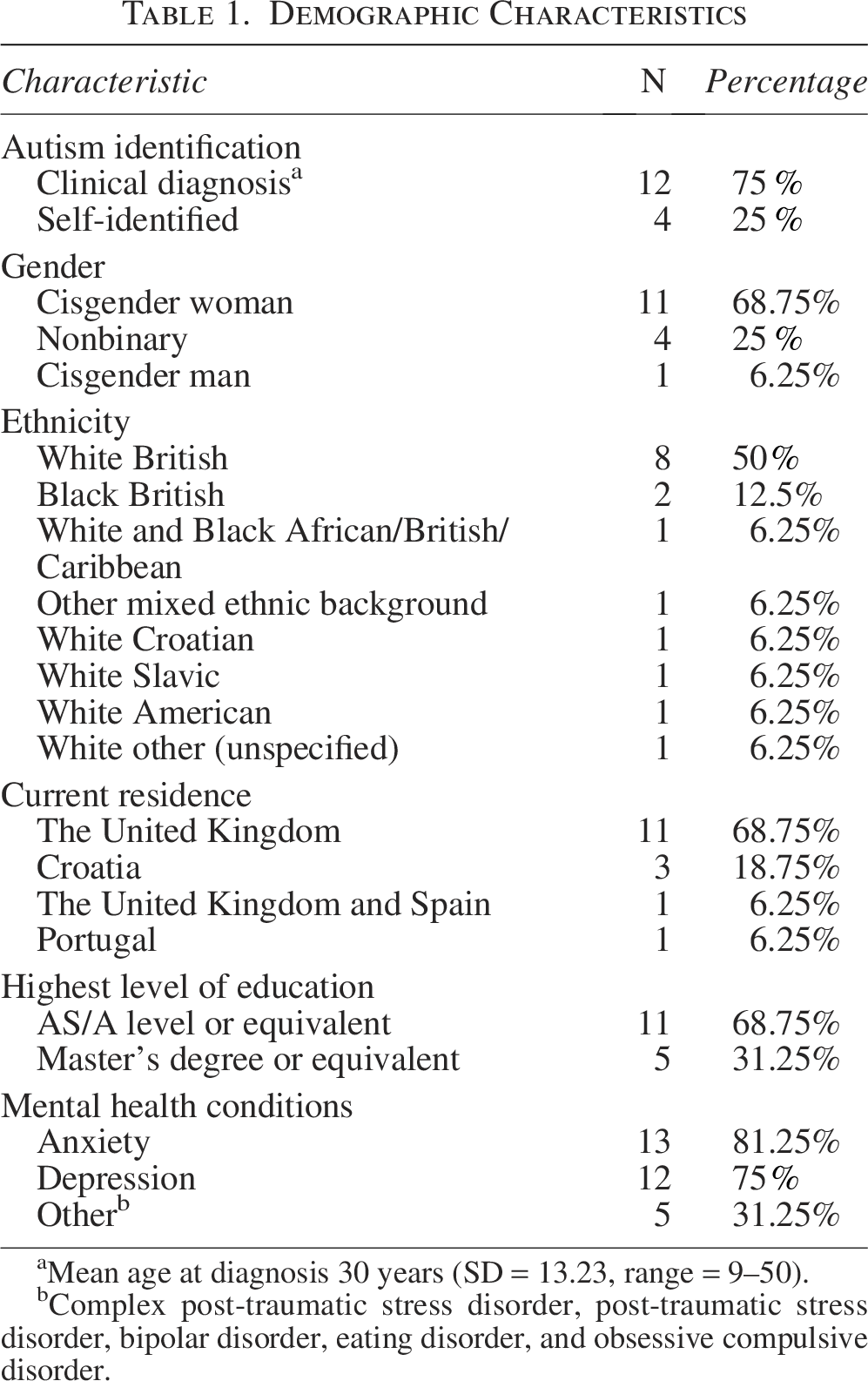
Mean age at diagnosis 30 years (SD = 13.23, range = 9–50).
Complex post-traumatic stress disorder, post-traumatic stress disorder, bipolar disorder, eating disorder, and obsessive compulsive disorder.
Participants were recruited via social media platforms, including X (formerly Twitter), Facebook, and Instagram. Participants were reimbursed £10 for their time via bank transfer or an Amazon voucher. All participants provided informed consent online before participating. Ethical approval was granted by the Durham University Department of Psychology Ethics Committee (approval number: PSYCH-2023–06-05T16_03_48-fmrt96).
Materials
We developed a semistructured interview (see Supplementary Materials). There were five primary questions with additional follow-up prompts to guide the discussion if necessary and to elicit a range of experiences. The opening question was general to allow participants to talk about what was most prominent to them: “Please tell us about your experiences of going to live music events.” Then, questions become more focused on discussing the positive experiences and the barriers (e.g., “What are music venues/event organizers doing well and what could they do better, in relation to accessibility and inclusion?”). The interviewer asked follow-up questions where appropriate to clarify understanding and gain deeper insights into experiences.
Procedure
Participants were first asked to complete a short Qualtrics questionnaire to provide informed consent and demographic data. Concurrently, we scheduled an identification briefing call individually with participants via Microsoft Teams to deter imposter participants who can be attracted to paid online participation. 31 During all Teams calls, participants could communicate using written and/or spoken language, and, other than for the identification call, they could have their cameras off.
We also provided participants with an information pack (see Supplementary Materials), which included detailed information, such as biographies of the researchers, the group schedule, and a code of conduct. A.S. conducted the discussions/interviews, and K.M. facilitated all the focus groups.
We hosted four 1-hour focus groups with 3–4 participants in each group. This was determined based on previous experience that this group size accommodates time for all participants to be able to contribute their experiences. In all focus groups, we had sufficient time to cover the interview schedule and for all participants to have time to speak. We also offered participants the opportunity to email afterward if there is anything they wanted to add, which they did not have a chance to in the focus group, but no participants sent us follow-up information. This suggests our planning was appropriate for data collection. At the beginning of each group/interview, we reintroduced the study and outlined the session schedule, reminding participants to take breaks and ask questions as needed. We then led a brief icebreaker to introduce the participants to each other (state their name and the kind of music they enjoy listening to/seeing live). We then commenced the focus groups/interviews. At the end of the session, we explained the next steps of the research project and provided opportunity to ask questions. Participants were then emailed a debrief sheet and compensated for their time. All sessions were recorded for transcription purposes.
Analysis
We approached this study from a critical realist epistemological standpoint. This considers that cognitive subjectivity mediates attempts to measure reality and that knowledge is situated in social, cultural, and historical contexts.32,33
We analyzed the data using reflexive thematic analysis, 34 which was chosen as the integrated reflexive approach aligns with the critical realist need for reflexivity. 35 We undertook the analysis aligning with good practice guidance to ensure rigor in our analysis and reporting. 36 G.H., who led the analysis, began with familiarization of each focus group transcript and then commenced an iterative process of coding using a combination of semantic and latent codes. G.H. took an iterative deductive and inductive approach to identify patterns of meaning when coding and developing the themes, interpreting the data from both the perspective of our research aims (deductive) and being guided by the data (inductive). The initial coding process was conducted from an inductive approach, with secondary coding of the dataset involving refining these codes from a more deductive approach, considering the aims of the study in interpretations. We took a similar approach in our theme development, ensuring that the patterns of meaning were identified from an inductive approach, while deductively considering the research aims.
We engaged with reflexivity throughout the analysis, recognizing and accepting the subjective nature of both our interpretation and the participants’ accounts. We are a neurodivergent research team, with research and lived experiences related to autism and neurodivergence, and we are all White cis-gender women. At the time of publication, G.M. was a PhD student, A.S. worked on the project as research assistant during her undergraduate degree, and K.M. was the project lead and in a permanent research and education track position. We have reflected throughout the analysis on how our positionality has influenced our interpretation of participants’ experiences. We found that many of the participants’ experiences resonated deeply with our own, and we needed to reflect on when we may have been overly attributing meaning or importance, to ensure the themes remained data-driven. To support this reflexive process, the whole research team discussed the codes and the themes in a series of collaborative, reflexive meetings from early on through to after the writing up of the results. We often questioned alternative interpretations of the data and would question where codes and themes seemed less supported by the data, as this was often an indicator that we had imposed a greater meaning on something, driven by our own experiences. G.H. would bring reflections to the meetings, and between these team discussions, G.H. would re-engage with the data to ensure that the codes and themes were evidenced in the data. The final themes were sent to the participants for feedback, and all who responded confirmed the results resonated with their experiences.
Results
In this qualitative study, we aimed to understand Autistic adults’ experiences of attending live music venues and events. Using reflexive thematic analysis, we developed four main themes and four subthemes related to Autistic experiences of attending live music venues and events. The four main themes are as follows: (1) “This is a military operation”—Limiting uncertainty and overwhelm through planning. (2) “Hating a crowd and loving a crowd at the same time”—Social connection. (3) The duality of an intense sensory environment. (4) “I think the biggest difference, always, is the staff”—Combating stigma and creating safe spaces (see Fig. 1 for all themes and subthemes).
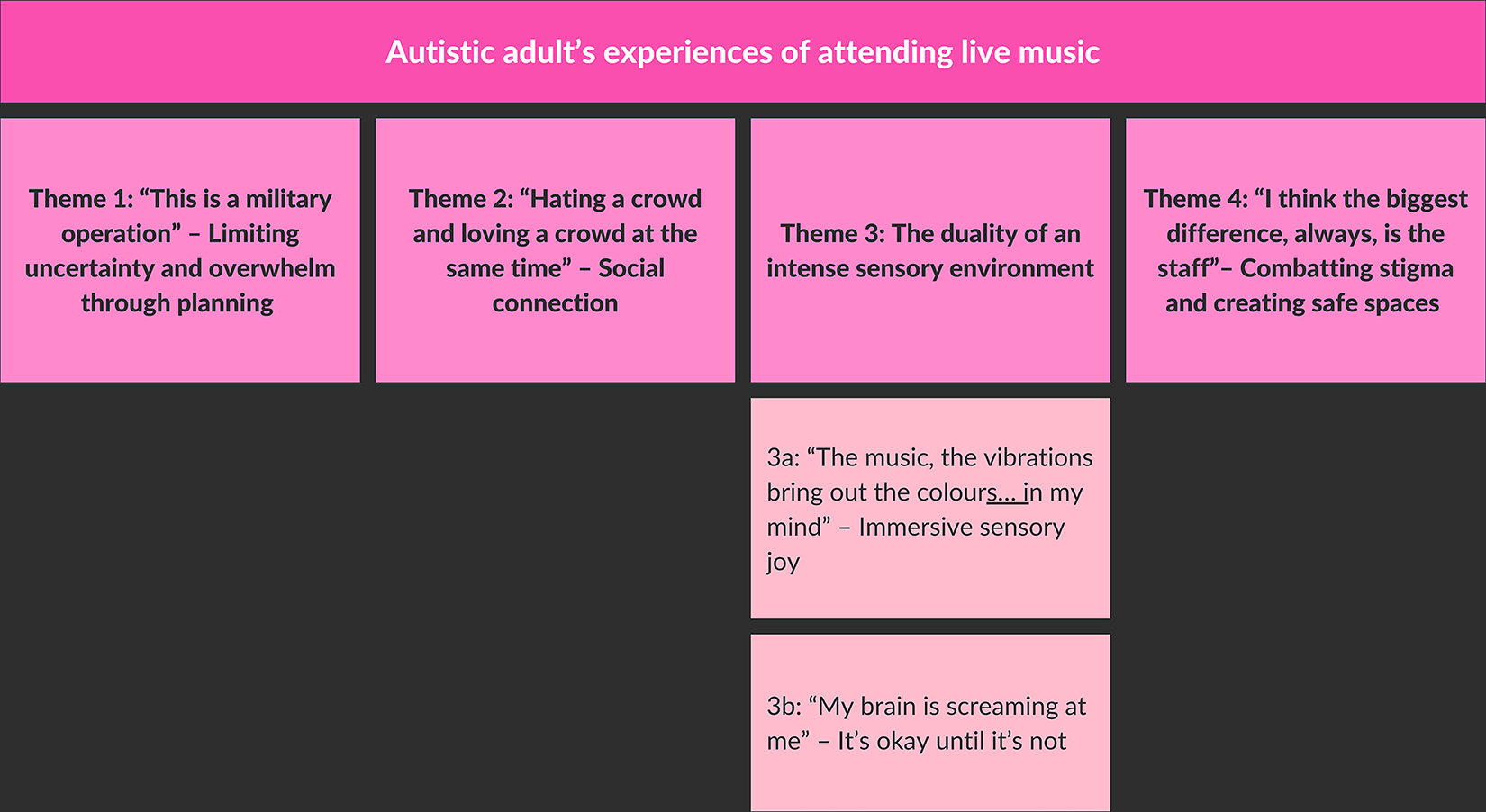
Reflexive thematic analysis themes and subthemes relating to Autistic adults’ experiences of attending live music venues and events.
Theme 1: This is a military operation—limiting uncertainty and overwhelm through planning
Many participants described the vast amount of planning that is a necessary strategy to attend live music events. Planning for every eventuality reduces uncertainty and the likelihood of becoming overloaded, distressed, and anxious. Many of the participants described a timeline of barriers, which start at the point of booking and continue through to arrival at the venue/event. Some participants described challenges of obtaining “accessible” tickets, as speaking with someone over the telephone was anxiety-provoking, and there are rarely options to do this online.
So, it’s always a phone call to get those bloody accessible tickets, rather than do it online.… Because you go online and everyone else can just order a ticket…, but here’s an accessible line you can call, and I hate phone calls. [Sue] 1
Once tickets are booked, many participants described the immense amount of planning they undertake in the lead-up to attending events, such as researching online about what to take, how to get there, what to do at the venue, and the timings of the events. As live music events are sensorily intense environments, having adequate information can limit distress and overwhelm experienced at the events by reducing additional cognitive demands, such as wayfinding and unexpected social interactions. Uncertainty can create anxiety in the lead-up to events. However, music venues and event organizers rarely provide enough information.
I spend a lot of time thinking about, you know, how am I gonna get there? …like what am I gonna take with me that’s gonna fit with the small handbag that I would be comfortable taking to a gig? But also, you know, making sure that I’m not up a creek without a paddle… if I get overloaded. [Kate]
If you just put some thoughts, thoughts like, err how to buy the ticket, how to get the number, how to go in, to enter so that is not hours of queue, so that you arrive already exhausted and without the spoons. [Robin]
Many participants described that public transport (e.g., bus or train) can be unpredictable and socially and sensorily overwhelming, risking sensory overload occurring before even arriving at the event. Driving to events was often preferred, but there is often a lack of information about the availability of parking. Knowing these details could be a deciding factor in whether individuals would attend an event.
I’ve had too many horrid experiences on trains where there was just noisy people watching things on their phones with no headphones. Walking up and down, getting drunk, being in the seat that I bought and having to speak…I just, I just don’t like it. [Nina]
Many participants described that very detailed information would be helpful to reduce uncertainty. This included visiting/seeing videos of a venue or view from your seat before an event, and detailed floor plans. Many participants also described wanting to know details of security measures, so that they can anticipate these social exchanges, and what they are allowed to take into a venue/event, for example, rules about taking in water and snacks, so they do not accidentally break the rules or end up having to navigate a more complex social interaction. This information should be easy to find and access, such as on websites and through booking confirmation emails.
I will get so, so anxious… because of the security measures and so on, I can’t necessarily bring with me like all the stuff that I’d wanna bring with me… I saw Muse at Milton Keynes [UK outdoor venue, 65,000 capacity] last month and it was, I think, one of the hottest days of the year, and I was so anxious, um, the whole time, and I was very like, this is a military operation. Here’s how we’re gonna plan it. [Kate]
Arrival and performance times are not always made clear by venues and event organizers. Many participants carefully considered their arrival time, not wanting to arrive too late or too early. Often, this was to try and reduce exposure to sensory challenges and avoid overwhelm. Some participants also described how the idea of arriving late created anxiety about not being allowed into the venue.
And the kind of unpredictability of when live stuff says it’s gonna start versus when it actually starts makes it quite stressful…and also I don’t know when things will actually start and when you are expected to get there. [Tegan]
I am the kind of person that always arrives too early due to fear of being late and not being able to get in so I arrive way too early instead. [Matt]
Many participants reported that they seek out familiarity when attending live music venues and events as a way of reducing uncertainty, for instance, by attending familiar venues and events and following/seeing the same bands and artists.
I tend to go and see the same bands over and over and over and over. So, my favourite band, I’ve seen 30 times, for example, in the past ten years. Umm and I’ll go to multiple dates on the same tour and meet with the same people. They practically do the same show. So, I like the predictability of that. [Nina]
Theme 2: Hating a crowd and loving a crowd at the same time—social connection
Many participants described the experience of feeling part of something and engaging with and sharing in a passionate interest when attending live music events. Feeling socially connected to others can supersede the challenges associated with being in a crowded space, such as the unpredictable nature and the feeling of being judged by others. A few participants described attending live music events to be an empowering and enriching experience, even though it can be challenging to attend.
Yes, you’re in a crowd and that can be quite scary, but you’re kind of, you’re all focused on one thing. There’s a sense of togetherness. [Kate]
Trying to be in a crowd, while, hating a crowd and loving a crowd at the same time. [Zander]
Finding local venues, local gigs and slowly building myself up and it became really enriching. But it’s still so difficult because, umm, even though music and art sort of like call to me so strongly my everything in my body is also calling to me to go home and hide again… that can be very isolating. [Zander]
I used to be really scared of concerts until I went to one but once I did, I realized I can handle it and that felt kind of empowering. [Matt]
Many participants described music and specific artists or genres as one of their passionate or “special” interests, and some described how attending events is an opportunity to immerse themselves in this interest and share it with others, including friends/family, fellow fans, and the wider audience. Although friends and family can provide support when attending live music events, there are also challenges in navigating differing needs and experiences.
It’s a way of connecting with my special interest and often being able to share those with the people I’m with, who I have dragged to the gig. [Kate]
The very best thing for me is going with someone [who] is confident and happy at gigs so they can do all the worry and I can just enjoy it! [Poppy]
It’s kind of the joy, the networking it gives you with the with the other fans. I, you know, these are people who I consider to be better friends than day-to-day friends. [Nina]
…feeling the pressure if you’re with, like, Neurotypical friends, like, having to explain why you might wanna leave and feeling like you’re making them leave with you as well, which can be tricky. [Claire]
Some participants described how crowds can make accessing merchandise and queuing for food and drink challenging, as there is not always a clearly followed social etiquette. On top of this, there is the added barrier of having to use spoken communication to request food and drink in a loud environment.
…I find queues quite stressful. You know, when people like pushing in, or skipping and like not like always feeling like able to, umm, address that. And, um, the same, like, with at the bar and stuff like that. [Nicole]
Some participants described how being in the middle of crowds can feel unsafe and it is helpful to have control over where they stand or sit if needing space. The behavior of other audience members, such as dancing in the seated areas, pushing, and shoving, and alcohol-related behavior were described as some of the contributing factors.
I’ll send my friend a photo. And she’ll say I cannot believe you’re at an event that is that busy, but it doesn’t feel like that to me cause we’re sort of doing our own thing on the edge… I feel in control because, you know, I’m where I want to be. I’m not stuck in the middle, I’m not surrounded by people in the seats. I can literally walk off to where we want to be. So the outside ones feel much better for me, especially as I say when you can, there’s no, I don’t have to queue and you know you can do it our way sort of thing. [Holly]
However, for one participant, the physical contact with the crowd was part of the experience of attending the punk gigs they like to go to.
I’m okay with, like pogo or hitting and punching me in punk concerts because I’m okay with that type of touch or pressure that it’s not light touch. [Perla]
Many participants described feeling judged by others for expressing themselves in an Autistic way, such as stimming. They described the need to suppress, hide, or conceal these behaviors to avoid being judged by others. However, Robin spoke about their experiences of attending an event of a neurodivergent artist and how this facilitated the freedom for them and others to express their Autistic selves.
They’re excited for things just as much as I am, but they’re going to look at me when I flap my hands and I get upset and umm, that sucks because I kind of want to be part of the wave and I can’t be part of the wave. [Zander]
I could see Aurora and that was just great because she was the first one that was stimming on the stage all the time and people, we were like stimming, jumping, moving, doing whatever we want. [Robin]
Theme 3: The duality of an intense sensory environment
Almost all the participants described the duality of the sensory experience when attending live music events. The first subtheme '“The music, the vibrations bring out the colors … in my mind”—Immersive sensory joy, relates to experiences of immersive sensory enjoyment from the live music, and the second subtheme, “My brain is screaming at me”—It’s okay until it’s not, relates to the challenges that turn an enjoyable sensory experience into sensory overload.
Subtheme 3a: The music, the vibrations bring out the colors … in my mind—immersive sensory joy
Many of the participants described the heightened sensory pleasure from the immersive experience of live music. Numerous participants described how listening to music was an enjoyable sensory experience for them and the opportunity to immerse in this heightened sensory experience was immensely pleasurable. This was further heightened by physically feeling the music. The sensory enjoyment was described by the participants as having emotional, elative, and physical effects, which can have beneficial impacts on their mental well-being. Some participants described their pleasure in the sensory sensation of going to see the same bands and/or attending multiple dates on a tour, which has the added benefit of increased predictability.
… when I listen to music at live concerts, it’s like all of my senses and my body become more awakened and the music, the vibrations, bring out the colors and scenes in my mind… I feel great, I let go of my stress, I “charge my batteries’’ for the next couple of months. [Julia]
I’ll go to multiple dates on the same tour and meet with the same people. They practically do the same show. So, I like the predictability of that. [Nina]
Some participants described the contextual difference of an intense sensory environment at a live music event compared with other contexts. Live music events are commonly not a conflicting and complex soundscape, which is often what makes other environments challenging. Furthermore, the expectation that attending a live music event will be a sensorily intense experience and the fact it will be a discrete event allow the opportunity to plan preparation and recovery time.
I enjoy music… I just find that I’m able to tolerate things, those triggers, much better than you would expect if you had seen me in the, in any other aspect of my life, really… I think it’s… the fact that it’s a set timed event. You know, it’s not like I’m having to go to a concert all day, every day… you can recover afterwards and things. [Kate]
Subtheme 3b: My brain is screaming at me—it’s okay until it’s not
However, the combination of the sensory input with the need to navigate crowds and social interactions could trigger sensory overload and the urgent need to leave the environment. Festivals can present great difficulty as they are often for longer time-periods and have large crowd capacities. Participants discussed concerns around experiencing sensory overload at a festival and not being able to leave easily and/or missing the rest of the festival.
… all of a sudden and my brain’s screaming at me: you need to get home right now and if you don’t do so within the next 5 minutes, you’re gonna throw up. You’re gonna die, umm you’re gonna freak out. [Zander]
I did try and go to Reading Festival [UK open-air weekend music festival, 40,000 capacity] once… I was just in sensory overload the whole week. It was absolutely horrific. I ended up leaving early on the Sunday morning cause I just couldn’t take it anymore… it was just way too much. There were people everywhere… it was a nightmare. [Jemma]
Many participants described common sensory challenges that can contribute to overload. Enclosed venues and outdoor events can be too hot, light shows can be too intense, and the music can be unnecessarily loud or high-pitched.
The main thing for me that bothers me is when the sound is really bad, and you know when it just really hurts your ears. Like I’ve been at gigs before, um, it’s normally more support bands or where somebody’s got, like, a really high-pitched voice or where the sounds just bad. Or if it’s just too loud and I’ve had to like, yeah, leave the room, go into a different room, buy ear plugs from the bar. [Jemma]
Definitely the heat is such a big one - um again with like the sensory issues - and I personally just get so overstimulated as soon as it’s above like 20 degrees. So, festivals are just a bit of a nightmare. [Claire]
…I really hate it sometimes when like the lighting design of shows like they have moments where they like, shine floodlights into the eyes of the audience. Like that’s absolute, really unbearable for me. [Nicole]
Some participants found the sensory experiences, particularly the heat, uncertainty regarding weather conditions, and large volumes of people, at outdoor live music events (mostly festivals) too overwhelming. However, a couple of participants reported that they liked some outdoor festivals due to the greater space they provide.
The site is massive… If you wanted, you know, go off site and just sit and field, an, empty field. We did that last year… there’s just space and it’s, do you know what I mean? Nowhere is crowded, really, even like the main stage. You can stand at the back, you can stand on a table like, and you’ve got space. So it’s just, it’s not like, you know, the whole Reading [festival] type thing where you’re all packed in like sardines. [Jemma]
Many participants described that to avoid experiencing sensory overload, it would be helpful to have earplugs provided at venues and events, as well as easy access to water if feeling overheated. It is also helpful to have access to quiet spaces to take a break and return when ready. This might be a designated quiet room/area or being able to exit the arena or venue to find their own quiet space and return when they want. However, several participants discussed the need for venues to clearly state their policies regarding exiting and re-entering during performances, so that they do not get refused reentry. Often venues suggest that people arrive early if they find queueing problematic. However, extended time at an event can drain resources and risk the likelihood of sensory overload. Being able to take breaks from the environment, either by being allowed reentry or access to a quiet space, is even more important if extended time at the event is likely.
I think there sometimes is this idea that, like, well, if you’re going to a concert, you must not have any issues with sensory processing. And if you have issues with sensory processing, you’re not going to go to a concert, because why would you do that? When actually like, many of us already like live music. We deserve to have those opportunities. We might just need a very short break. [Kate]
A lot of the venues are like, if you want the structure, you have to show up an hour early. No, by the time the band are coming on, I’ll already have had three meltdowns and want to go home if waiting. [Zander]
If it’s something where it’s like stamping or wristband, I think that that is more accessible, at least for me. Because you feel like you have the option of going out and getting some air and being somewhere where it isn’t, like crowded and loud and going back in again. [Tegan]
Theme 4: I think the biggest difference, always, is the staff—combating stigma and creating safe spaces
Most of the participants described experiences of stigma and a lack of understanding from staff at venues. Some participants described challenges and anxiety around interacting with staff at venues. Some participants felt misunderstood and feared being perceived negatively due to differences in communication. Many participants described how the stigma around disability held by staff at venues and events meant they often felt like they needed to conceal or inflate their needs to be understood and supported. Some participants explained that their co-occurring conditions, such as Ehlers–Danlos, contributed to misunderstanding and stigma. Some participants also described distressing and anxiety-provoking encounters with security staff, with some experiencing scrutiny and invasive questioning related to their disability.
Security guards and all that stuff is definitely, err, not a nice experience. [Perla]
I’ve been having arguments with security guards, “cause they’d be telling me you can’t sit there, you can’t sit there. And I’d be like my knees hurt, it’s not my fault!” Umm, so yeah, I know it’s not directly linked to the autism, but with the Ehlers-Danlos being so common… [Jemma]
Yeah, awkward and nervous, asking and explaining. You know what I mean, you almost make an excuse – “Is it okay if I sneak out this door because I’ve got to be somewhere.” I’m not always honest in why as well “cause it just feels like I’m assuming the staff wouldn’t have understanding.” [Holly]
Many participants expressed the need for staff at venues and events to have training so that they better understand and can support Autistic people. This was seen as essential to create safe and welcoming spaces so that Autistic people can enjoy live music. To further cultivate this, it would be helpful for venues and events to communicate, either online or at the venue/event, that the staff have had training. Some participants also suggested that using the widely used Sunflower Lanyard Scheme, which aims to mediate support for people with hidden disabilities, is a helpful scheme if staff have appropriate training and awareness to know what the scheme is.
People who are maybe having a meltdown and somebody who’s not trained, or like the police or security are called or something. And something that makes it a lot better, I mean, it really is the bare minimum we’re asking for… when you have… like a trained member of staff who’s just able to recognize that it’s that. And that umm it’s not somebody being, like, deliberately aggressive or trying to cause an issue. [Kirah]
Venue-wise, I think the biggest difference, always, is the staff. It’s the people on the doors. It’s the people who you see beforehand. Umm especially if you’re queuing. Umm, and it’s the people keeping an eye on you. [Holly]
Discussion
Our qualitative study investigated Autistic people’s experiences of attending live music events. This study importantly highlights that Autistic people experience many positives when attending live music events, but there are often barriers that mean events and venues are falling short of being inclusive. The participants described how live music can be an enjoyable, immersive sensory experience, but that challenges can still cause sensory overload. However, there is a lack of information currently provided by venues and events that could be essential to avoid uncertainty and overwhelm. The participants described that being part of a crowd can be challenging, but it can also facilitate social connection. Lastly, the participants described experiences of stigma and the imperative need for staff training to make live music events and venues feel safe for Autistic people.
Given that previous work has also shown that music is a common interest for Autistic people15,16 that is entwined with enjoyable sensory seeking, 2 it is unsurprising that our participants talked passionately about the immersive sensory enjoyment when attending live music. As engagement with passionate interests and positive sensory input may be beneficial for mental well-being,2,15 being able to attend live music events may be especially important for Autistic people. However, our results also highlight the duality of the sensory experience and that there is still a risk of experiencing sensory overload when attending live music events. Previous work has shown that many spaces are disabling due to sensory-related factors, which have been echoed in the present study, such as challenging sensory input, crowded spaces, misunderstanding of autism, unpredictability, and the need to escape and recover from sensory input. 19 Our work suggests that adjustments and support should be provided at venues and events to ensure Autistic people do not experience sensory overload, such as limiting exposure to unnecessary sensory input, providing quiet spaces or allowing reentry, and providing earplugs or ear defenders.
Our findings also importantly highlight the crucial need for music venues and event organizers to provide more advanced information for Autistic people. Uncertainty can be particularly challenging for many Autistic people and may be a mediator in the relationship between sensory hypersensitivity and anxiety.8,37,38 Reducing uncertainty could help prevent sensory overload as it may reduce the cognitive load when navigating sensory environments. As sensory overload can cause stress and impact concentration and thinking ability, 6 not knowing vital information when experiencing this can create further distress and inability to navigate to a safe space. Furthermore, a need for sameness may be heightened in challenging acoustic environments due to a heightened awareness of the potential dangers of overload and distress.39–41 Therefore, providing ample information about the venue or event, such as what attendees can bring with them, what the security processes are, maps of the site, reentry policies, and views from seats, as well as providing further information on request, can facilitate preparation and reduce uncertainty.
Previous work with Autistic people suggests that shared interests in music can be a good way for Autistic people to connect with others. 12 Our work indicates this applies to live music settings, as our participants described how being part of the audience can facilitate social connection. However, our results show that Autistic people can also experience challenges navigating and being in crowds, particularly when navigating through and to and from the site. This aligns with previous work that indicated that crowds and crowded spaces can be a barrier for Autistic people accessing public spaces and recreational activities.19,42 The participants in the present study described challenges as being due to the unpredictability of crowds and also the impact on social communication, such as when ordering food or drinks. This may be because challenging auditory environments, with the additional sensory challenges in crowded environments, may be cognitive fatiguing and impact social interactions. 41 In addition, our results suggest that Autistic people may feel the need to suppress Autistic behaviors, such as stimming, for fear of being judged by other audience members. Autistic people widely experience stigma and will often mask to avoid negative judgment. 43 This can lead Autistic people to not utilize important regulatory and supportive strategies in challenging environments, such as stimming or wearing earplugs, 19 which could increase the likelihood of distress or overload. Venue and event organizers should consider ways that Autistic people can enjoy being part of the audience and avoid crowds when needed, particularly when entering and exiting and accessing facilities (such as catering) at the site. It is also important to consider individual needs, as although many participants described the enjoyment of being in the audience, some described the desire to sit or stand away from the crowd.
In addition, most of our participants discussed experiences of stigma from staff at live music venues and events. Autistic people commonly experience negative reactions when out in the community, and 42% report that they sometimes feel unable to leave the house because they are worried about people behaving negatively toward them. 24 Experiencing stigma can have consequences for mental health, 44 and so tackling stigma toward Autistic people across community spaces is imperative. As with work that has shown this across many public spaces, 19 our findings highlight the need for staff training on autism at live music events and venues. Previous work has demonstrated the effectiveness of autism acceptance training for reducing stigma, specifically explicit bias, toward autism.45,46 Therefore, introducing evidence-based staff training, informed by lived experiences, could ensure that Autistic people are adequately accepted and supported when attending live music events.
The findings of this study have implications for making live music venues and events more inclusive for Autistic people. Although live music events may be a context that can foster social inclusion, research with festival organizers suggested that improving disability access is not a factor at the forefront of their considerations related to social inclusion at music festivals. 25 In addition, music venues rarely have policies or facilities for disability access (e.g., State of Access Report 2018). 47 Therefore, we can bring awareness to the importance of improving live music event inclusion for Autistic people to venue owners and event organizers and inform adaptations and policies. Furthermore, some venues provide relaxed performances, where the usual rules (e.g., sitting still) and environment (e.g., lighting) are relaxed to support people to be able to engage with theater and music in a nonjudgmental environment. 48 However, these performances can often be tailored toward children and families and may not provide the same sensory experience, such as lighting and sound, of the show that general audiences will experience. Although the provision of these may be beneficial for many, our results suggest that many of the same provisions could be implemented for general audiences, for example, with the provision of advance information and quiet spaces. Furthermore, theaters, many of which also host live music events, may have accessibility approaches that can be adopted at music venues and events (e.g., State of Theatre Access, 2023). 49 This leans more toward an inclusive design approach, designing and adapting spaces to be inclusive for everyone, which may best facilitate social inclusion and feelings of belonging. 50
Limitations
As is often the case in autism research, our sample unfortunately lacked the diversity that is more representative of the Autistic population. This may have been due to our sole recruitment sources being social media platforms. For instance, our sample included predominantly cisgender women and people from a White ethnic background. Furthermore, although we offered alternative ways of communication, the qualitative nature of the study may have attracted participants who were more able to communicate their experiences through narrative means. This may have deterred or excluded participants who were non- or minimally speaking. As certain demographics are widely absent from autism research, such as Black Autistic people 51 and those with intellectual disability, 52 it is important for researchers to not perpetuate this. This is especially important when considering inclusive spaces, as Autistic people with intersecting marginalized identities are likely to experience greater barriers. 53 As this is a new topic of research, in further work we can now work with specific community groups to recruit more diverse samples. In particular, we will aim to recruit greater gender diversity to ensure that the present findings are reflected not just in women, but also represent the experiences of people who identify as other genders.
Furthermore, in this study, we did not formally collect information on the genres of music at the venues and events attended, or on the types of venues and events attended. Although we sought to understand more general experiences in this study, this would have been helpful to provide more context to the results. Therefore, in future work, we aim to understand more about the contextual differences between music genres and types of venues and events.
Conclusion
This study provided new insights into Autistic adults’ experiences of attending live music events. It provides many clear examples of what can turn experiences from enjoyable into distressing and suggests ways that venues and events can adapt their policies and provisions to make these spaces more inclusive for Autistic adults. This includes the following: (1) Providing advance information; (2) ensuring opportunities to have breaks from sensory input, such as providing ear plugs/defenders and/or quiet spaces; (3) providing ways to avoid/take a break from crowds during and before/after the events; and (4) ensuring all staff have training so they have awareness of how to support Autistic people. Future work will seek to investigate the findings in a larger sample and to understand the potential contextual differences between types of venues and events.
Footnotes
Acknowledgments
The authors thank all the Autistic adults who shared their experiences with them as part of this research.
Author Disclosure Statement
No competing financial interests exist.
Funding Information
No funding was received for this article.
Authorship Confirmation Statement
K.M. supervised the study. K.M. and A.S. contributed to the design and data collection. G.H. led the data analysis with input from K.M. and A.S. All authors contributed to the write up of the article. This article has been given solely to this journal and is not published, in press, or submitted elsewhere.
Supplemental Material
References
Supplementary Material
Please find the following supplemental material available below.
For Open Access articles published under a Creative Commons License, all supplemental material carries the same license as the article it is associated with.
For non-Open Access articles published, all supplemental material carries a non-exclusive license, and permission requests for re-use of supplemental material or any part of supplemental material shall be sent directly to the copyright owner as specified in the copyright notice associated with the article.
