




Abstract
This article presents characteristics of geological and tectonic structures of the Kuljuktau Mountains, mineralogical and geochemical features of its volcanic and intrusive rocks and associated mineralisation of critical elements. The Taskazgan graphite, Shaidaraz lithium, and Tozbulak high-purity quartz deposits, and new prospects for rare earth mineralisation have been identified as the most significant critical mineral resources of the Kuljuktau Mts. The Taskazgan graphite deposit is confined to the melange at the contact between the gabbroids and the marbleised carbonate rocks. Rare metal (lithium) mineralisation is associated with pegmatite and aplite veins of the Shaidaraz intrusion. The Tozbulak high-purity quartz vein cuts through the intrusion of leucocratic granites and is the largest quartz manifestation in Uzbekistan. The new U–Pb zircon ages of the Kuljuktau and West Tozbulak intrusive complexes of 353.5 ± 2.1 Ma for the former and 349.1 ± 2.5 Ma, respectively, allowed the refinement of the regional metallogenesis in space and time.
Keywords
Introduction
During the last decade research and exploration of critical metals came into the focus to secure supply for the global green economy,1–3 with review papers on general and regional metallogeny and mineral systems such as lithium,4–6 graphite, 7 rare earth elements8,9 and high-purity silica/quartz. 10 Critical elements (CEs) are metals and non-metals that are considered vital for the economic well-being of the world's major and emerging economies, yet whose supply may be at risk due to geological scarcity, geopolitical issues, trade policy or other factors (www.criticalmineral.org). 11 Uzbekistan has vast, mostly untapped mineral potential of CEs that are urgently required to support the transition to the green economy of the country. The first list of CEs of Uzbekistan has been introduced recently 12 and includes the following elements: Al, B, V, Bi, W, graphite, REE, Co, Si, Mg, Mn, Cu, Ni, Li, Nb, Ta, Ga, In, Ge, Se, Te, Re, PGE, Ti. The understanding of geological structures favourable for accumulations of CEs in Uzbekistan builds on the results of long-term research conducted by the authors (Ref. 13 and references therein), which provides detailed characteristics of stratigraphic and magmatic formations, tectonics and mineral deposits.
Uzbekistan is located at the junction of three continental blocks (Kazakhstan, Karakum-Tajik and Ustyurt), separated by a fold-thrust belt, formed at the closure site between Turkestan and Zeravshan oceans. 13 The metallogeny of the Kuljuktau Mountains (Mts.), which are situated at the western continuation of the Zeravshan Ridge, has been assessed in this article. There are four major intrusive complexes distinguished in the area, including: Kuljuktau gabbro-granitoid (C2), Kyngyr diorite-monzogranodiorite (C2-P1), West Tozbulak syenite-granosyenite (P) and Tozbulak leucogranite (P). The dominant types of mineralisation include gold, rare metals (including Li), and graphite. Gold mineralisation is confined to the suture zone of the thrust structure. Rare metal (Li) mineralisation is linked to pegmatite and aplite veins of the Kuljuktau complex. The Taskazgan graphite deposit is confined to the melange at the contact between the gabbroids of the Kuljuktau complex and the marbled carbonate rocks of the Silurian and Devonian. 14
Due to poor accessibility, the Kuljuktau Mts. remains an underexplored region. The main contributions to its study have been made by Aisanov and Egorov, 15 who carried out geological survey work on the 1:50,000 scale map (M-50 K). The igneous formations of this region were studied by Baranov et al., 16 Likhoidov, 17 Kayumov, 18 Aisanov and Egorov, 15 and others. The stratigraphic division scheme of sedimentary-metamorphic rocks was supplemented by the works of Bukharin et al. 19 and Davlatov and Kim. 20 Geodynamic reconstructions of this region were carried out by Mukhin et al. 21 As a result of these studies, it is widely accepted that the Paleozoic sedimentary deposits of the Kuljuktau Mts. form a continuous section from the Middle Ordovician to the Middle Carboniferous, while at the Ordovician-Silurian boundary, volcanic activity intensified, and at the collision stage in the Carboniferous-Permian, folding and the introduction of granitoid magmatism occurred. In addition, the Taskazgan graphite deposit has been discovered, as well as small gold deposits, but at the end of the last century the area was classed as not prospective and geological studies phased out. A shift in focus to unexplored regions and to modern technologies of extraction and enrichment including CEs resulted in resumed exploration activities in the Kuljuktau Mts. that turn out to be much more complex and perspective than previously thought, giving justification to this research.
This study presents new data on igneous petrology and geochemistry of magmatic complexes in the Kuljuktau Mts. and assesses the potential of this region for CEs for the first time. As a result, several perspective areas of critical mineral resources have been identified.
Materials and methods
Sampling and analytical techniques
During several field campaigns, 100 representative whole-rock samples of volcanic and intrusive rocks, including mineralised specimen, were collected. Figure 1 shows a variety of sampled rocks. For geo-chemical investigations, samples were pulverised to 0.74 mm. The analytical work has been carried out at the Central Laboratory of the Institute of Mineral Resources, Tashkent (Supplement File 1). Three most representative samples of gabbro-pegmatite (Kuljuktau complex) – #244, kersantite (South Tienshan complex) – #244/2 and quartz syenite (West Tozbulak complex) – #277, have been collected for U–Pb zircon age dating.
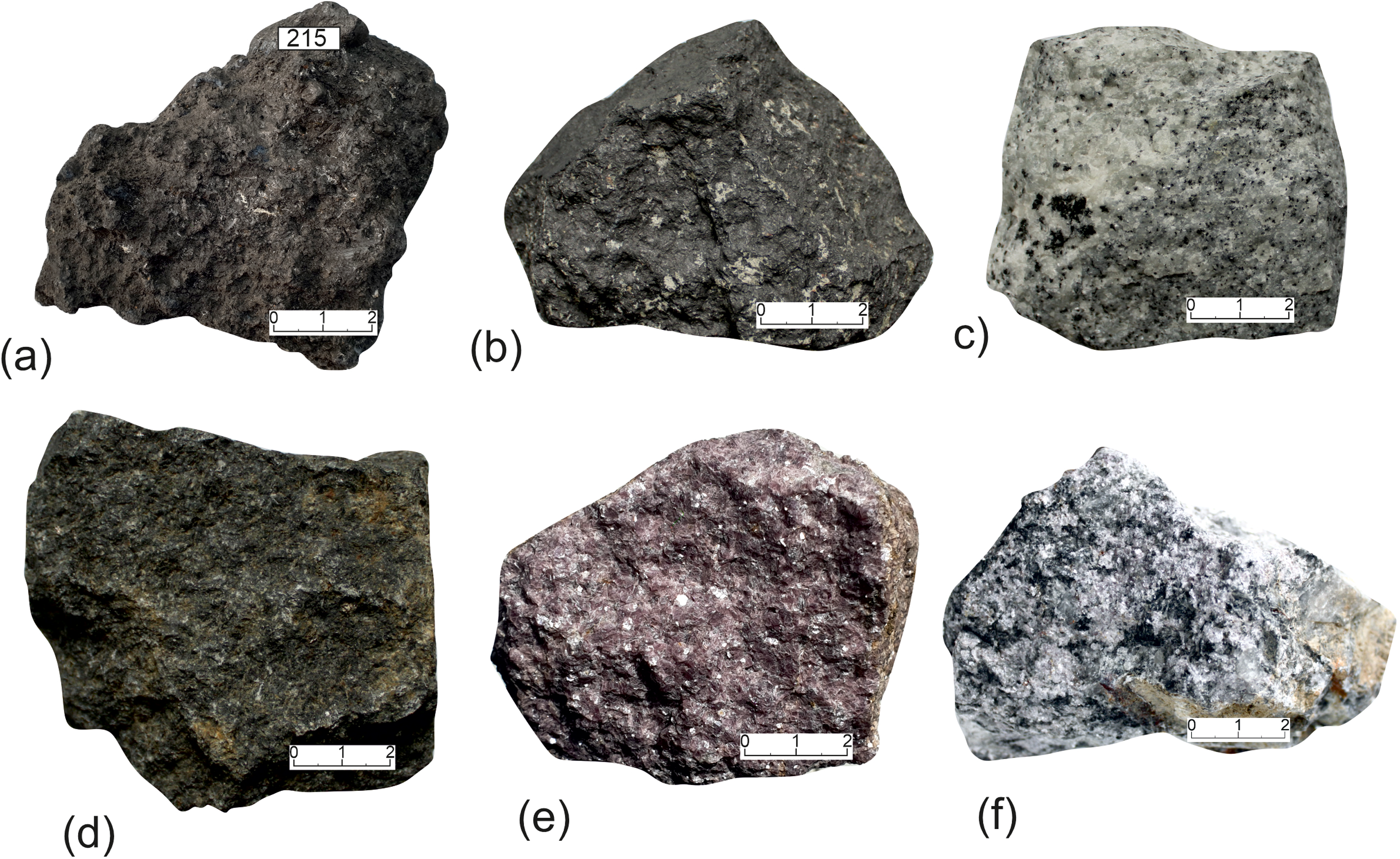
Some typical examples of volcanic and intrusive rocks of the Kuljuktau Mts.: (a) graphite; (b), graphitised gabbro; (c) nepheline syenite; (d) melanocratic gabbro; (e, f) lepidolite pegmatites.
All major and trace element data were processed and plotted using a GCDkit (geochemistry data toolkit) developed by Janoušek et al. 22
Polished thin sections were prepared for all samples, and mineralogical investigation of samples was carried out using transmitted light microscopy and conventional reflected light microscopy to identify minerals and their relative abundances.
U–Pb zircon geochronology
To characterise zircon textures, cathodoluminescence (CL) images were acquired with a Tescan TIMA scanning electron microscope (SEM) at the Natural History Museum, London. The field emission instrument is equipped with four EDAX Element 30 energy dispersive x-ray spectroscopy (EDS) detectors and was operated at 25 kV accelerating voltage, 13–14 nA probe current and a working distance of 15 mm. Zircon CL images were acquired using 0.5 µm pixel resolution (Supplement File 1, Supplement Table S1).
Geological setting
Tectonically, the Kuljuktau Mts. represent a protrusion of the basement of the Turanian plate in the Alpine horst-anticlinal structure. The pre-Mesozoic basement of the Turan Plate on the territory of Uzbekistan was formed in the late Paleozoic as a result of the collision of three sialic massifs, including: Kazakhstan (in the north), Karakum (in the south) and Ustyurt (in the west). The suture zone is part of the South Tien Shan fold-thrust belt, composed of fragments of sections of oceanic crust, volcanic arcs and continental margins. The Kuljuktau Mts. are located in the Kyzylkum segment, 100 km southwest of Muruntau21,23 (Figure 2).
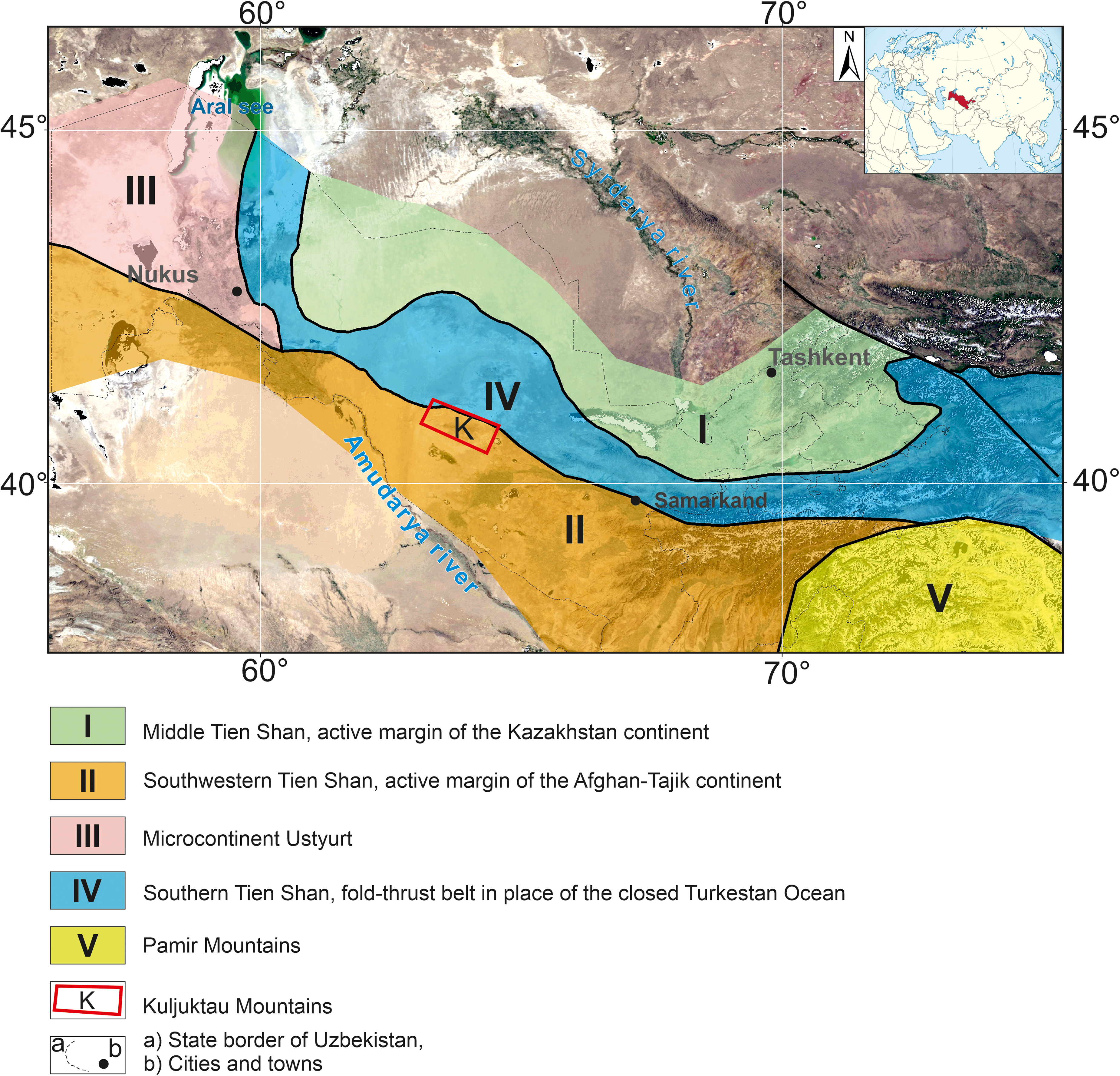
Regional-scale tectonic map showing the location of the Kuljuktau Mts. at the northern edge of the Karakum block.
The sedimentary cover was formed in the Mesozoic and Cenozoic under conditions of low-amplitude uplifts and episodes of subsidence, as a reaction to the closure of the Paleo-Asian Ocean and the Tethys. 24 The geological structure of the pre-Mesozoic basement involves several formations ranging from the Ordovician to the Permian (Figures 3 and 4). 15
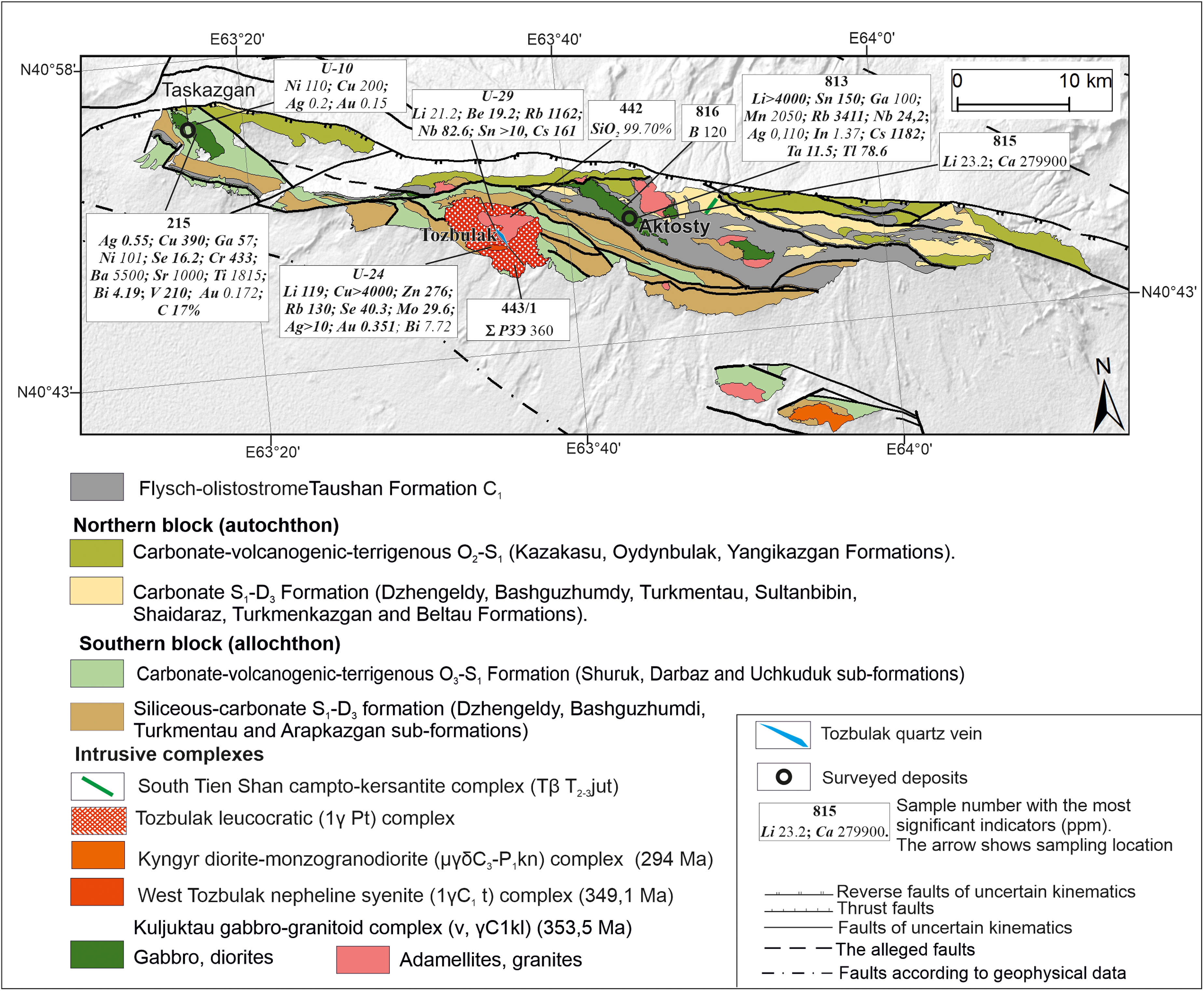
Regional geological map of the Paleozoic formations of the Kuljuktau Mts. with surveyed areas.
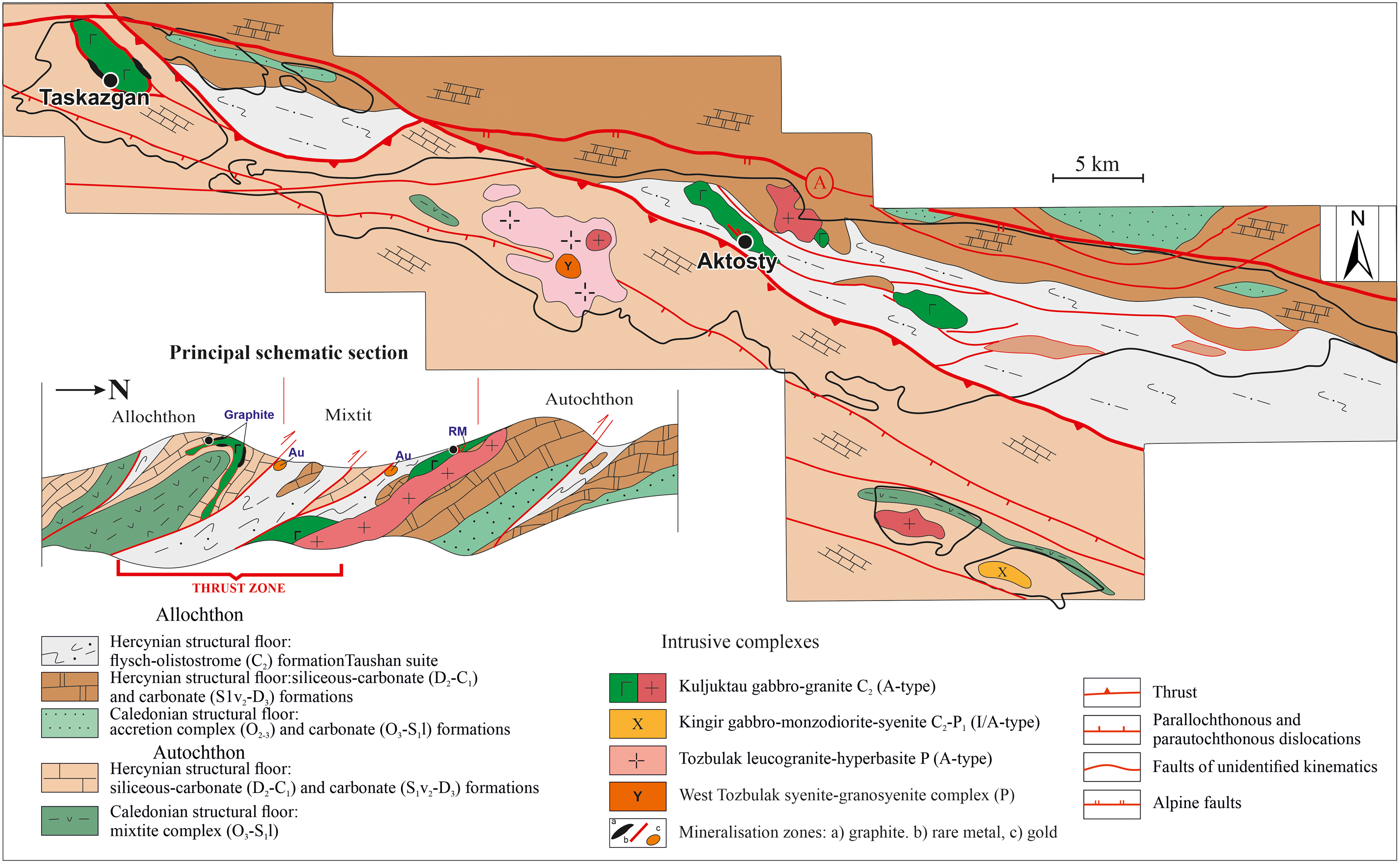
Regional geological map with cross section of pre-Mesozoic formations of the Kuljuktau Mts.
The base of the Northern block (autochthon) is composed of carbonate-volcanogenic-terrigenous O2-S11 Formation (Kazakasu, Oydynbulak, Yangikazgan Formations). The Kazakasu Formation (O2-3, 500 m thickness) is developed only within the northern subzone. The section is composed of interbedded pelitic shales, sandstones with interlayers of conglomerates, gravelites, limestones, siliceous rocks and volcanics. The amount of volcanic rocks is 2% to 5%, represented by lavas, tuffs and tuffites.
Volcanic complexes
The Oydynbulak Formation (O3, 100 m) in the lower part begins with detrital limestones containing chert nodules, followed upwards by layered algal limestones, and clayey limestones and dolomites.
The Yangikazgan Formation (S1, 530 m) is represented by limestones and dolomites. The depositional environment can be interpreted as a shallow-water shelf in an open marine basin. The biostratigraphic age of the formations has been determined by Tulyaganov et al. 25
Above, with an angular unconformity and deep erosion fixing the boundary between the Caledonides and the Hercynides (Figure 5), lies the carbonate S12-D3 Formation with a thickness of up to 3500 m.
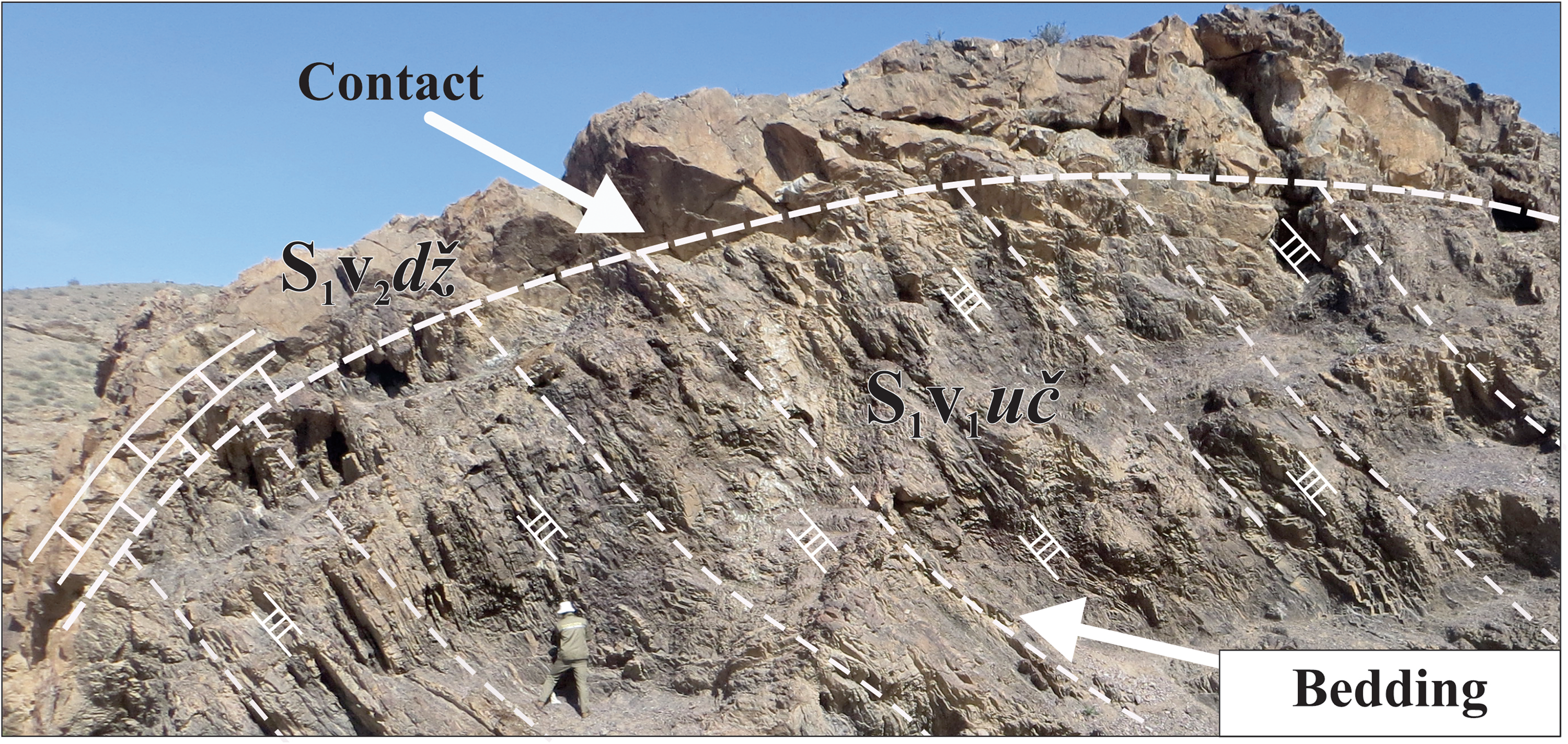
Saddle of the anticline fold at the right side of the Sultanbibi sai with a sharp angular unconformity between Dzhingildy (S1v2dž) and Uchkuduk (S1v1uč) Formations.
The Late Devonian part of the section is represented by platy medium-layered limestones with chert interlayers. 20 The lower part of the Formation is characterised by the presence of almost exclusively carbonate rocks (∼95%), with more than half of them being dolomites. Closer to the top of this part of the section, the role of limestone gradually increases, and the bituminous content and amount of organic detritus increases. Terrigenous admixture, in the form of rounded quartz grains of silt and sand, is present in small quantities everywhere. The section, which accumulated from the end of the Early Silurian to the Late Devonian, was formed under conditions of a shallow, subsiding shelf, which corresponds to the passive margin of a microcontinent. 3
The southern plate (allochthon) is composed of two Formations. The lower, carbonate-volcanogenic-terrigenous O3-S11 Formation (Shuruk, Darbaza and Uchkuduk Formations) is developed on the southern slopes of the Kuljuktau Mts. The lower part of the section (Shuruk Formation) is represented by a mixtite complex, where exotic bodies (olistoliths) of chert, limestone and sandstone are sealed in an aleuropelite matrix with interlayers of gravelites and volcanics of basic composition. The deposits of the Darbaza Formation, overlying the Shuruk Formation, are composed of sandstones, gravelites, and effusive rocks of acidic composition.
The overlying siliceous-carbonate S12-D3 Formation has a thickness of about 3000 m. The lower part of the section of the formation is characterised by the presence of almost exclusively carbonate rocks and is almost identical to the corresponding part of the autochthonous section, while the upper part (Arapkazgan Formation D1-3) is distinguished by the greater role of siliceous rocks, especially at the base, and the predominance of limestones over dolomites.
The mixtite complex is represented by the flysch-olistostrome C1 Formation (Taushan Formation). In the Kuljuktau Mts., the section is represented by the Taushan and Kamystin Formations. 15 The olistostrome formed during the closure of the rift structure, during which the southern block was thrusted over the northern block. As a result, the mixtite complex of the Taushan Formation with a thickness of more than 500 m occupies an intermediate position between the autochthon and the allochthon, in a sub-thrust position. The lower contact is transgressive, with deep erosion, it contacts the Ordovician, Silurian and Devonian deposits. Volcanogenic rocks are represented by small (a few metres) bodies (possibly olistoliths) of altered lavas and tuffs of intermediate composition (andesites, dacites). 26
It should be noted that the gold mineralisation of the Kuljuktau Mts., in particular, the Taushan and Yangikazgan mineral occurrences, are confined to the Taushan mixtite sequence that occupies a sub-thrust position. 26
Intrusive complexes
The Kuljuktau gabbro-granitoid complex (С1kl) is distributed in the western and central parts of the Kuljuktau Mts. Shaidaraz and Taushan massifs (composed of a series of closely spaced dike-like bodies). The Aktosty and Shuruk massifs fit well into the cores of anticlinal folds. The complex contains: (a) olivinites, lherzolites, plagiolherzolites, troctolites, websterites, anorthosites, (b) norites, gabbro-norites, gabbro and gabbro-diorites, (c) diorites and quartz diorites and (d) granodiorites, adamellites, granites. Most common are gabbro, gabbro-norite, gabbro-diorite and adamellite.
Olivinites (entirely serpentinised) are found only in the Shaidaraz massif as lens-shaped isolations (1.2 m × 4.3 m) among norites and gabbro-norites. Lherzolites, plagiolherzolites and troctolites are noted in the Beltau massif. Pyroxenites are found in the Shaidaraz intrusion, where they are represented by augite-hypersthene websterites, and occasionally significantly clinopyroxene and plagioclase-bearing varieties are found. Anorthosites form sheet deposits in the central part of the Beltau intrusion. Norites and gabbro-norites are found in the Shaidaraz and Beltau intrusions. Augite and hornblende gabbros are developed in all massifs of the complex but are most common in Taushansky.
The group of granitoids is comprised of granodiorites, adamellites and granites. There is a strong dominance of granitoids, composing most of the Aktosty and Shuruk intrusions, forming large block xenoliths (up to 3.0 km2) in the Tozbulak intrusion and several small bodies framing the Taushan and Shaidaraz intrusions. The complex represents gabbro-granitoid association of within-plate affinity.
The rocks of the Kyngyr diorite-monzogranodiorite complex (С3-Р1kn) are developed in the extreme southern uplifts of the Kuljuktau Mts., where they form the entire East Kyngyr intrusion, occupying an area of 5.5 km2. The structure of the complex is mostly composed of medium-grained porphyritic amphibole-biotite monzogranodiorites, with numerous autoliths of diorites and quartz diorites of irregularly rounded and oval shape, ranging in size from 5 × 10 to 70 × 80 cm. The absolute age of the main phase of monzogranodiorites, obtained using zircon U–Pb geochronology (SHRIMP), has been determined as 294 ± 2 Ma. 27
Rocks of the West Tozbulak syenite-granosyenite complex (С1zt) are developed in the central part of the Tozbulak intrusion, 2 km west of the Tozbulak village. They form small stock- and dike-like bodies among Devonian limestones and dolomites, which are intruded by leucocratic granites of the Tozbulak complex. The complex represents monzonite-syenite formation: (a) medium-grained biotite-amphibole syenites, syenodiorites, quartz syenites and granosyenites; (b) fine- and medium-grained to coarse-grained and pegmatoid aegirine-hastingsite biotite-bearing nepheline syenites. Dikes are represented by syenite-aplites and syenite-pegmatites. 28 The rocks of the complex intrude Devonian carbonate deposits but are intruded by leucocratic granites of the Tozbulak complex and dikes of the Central Kuldzhuktau complex of Permian age.
The Tozbulak leucocratic complex is developed in the central part of the Kuljuktau Mts., where it forms the main part of the heterogeneous Tozbulak intrusion – elongated in sublatitudinal direction with an area of 50 km2 (Figure 6). This is one of the few complexes of Kyzylkum that is simple in its internal structure and represented by light grey weakly porphyritic medium- and coarse-grained biotite granites, between which an intrusive contact is established with signs of later formation of a medium-grained variety. 18 Granites of the Tozbulak complex occupy at least 80% of the intrusion area. K–Ar age data of biotite from Tozbulak granites gave Permian age of 266 ± 17 Ma. 29
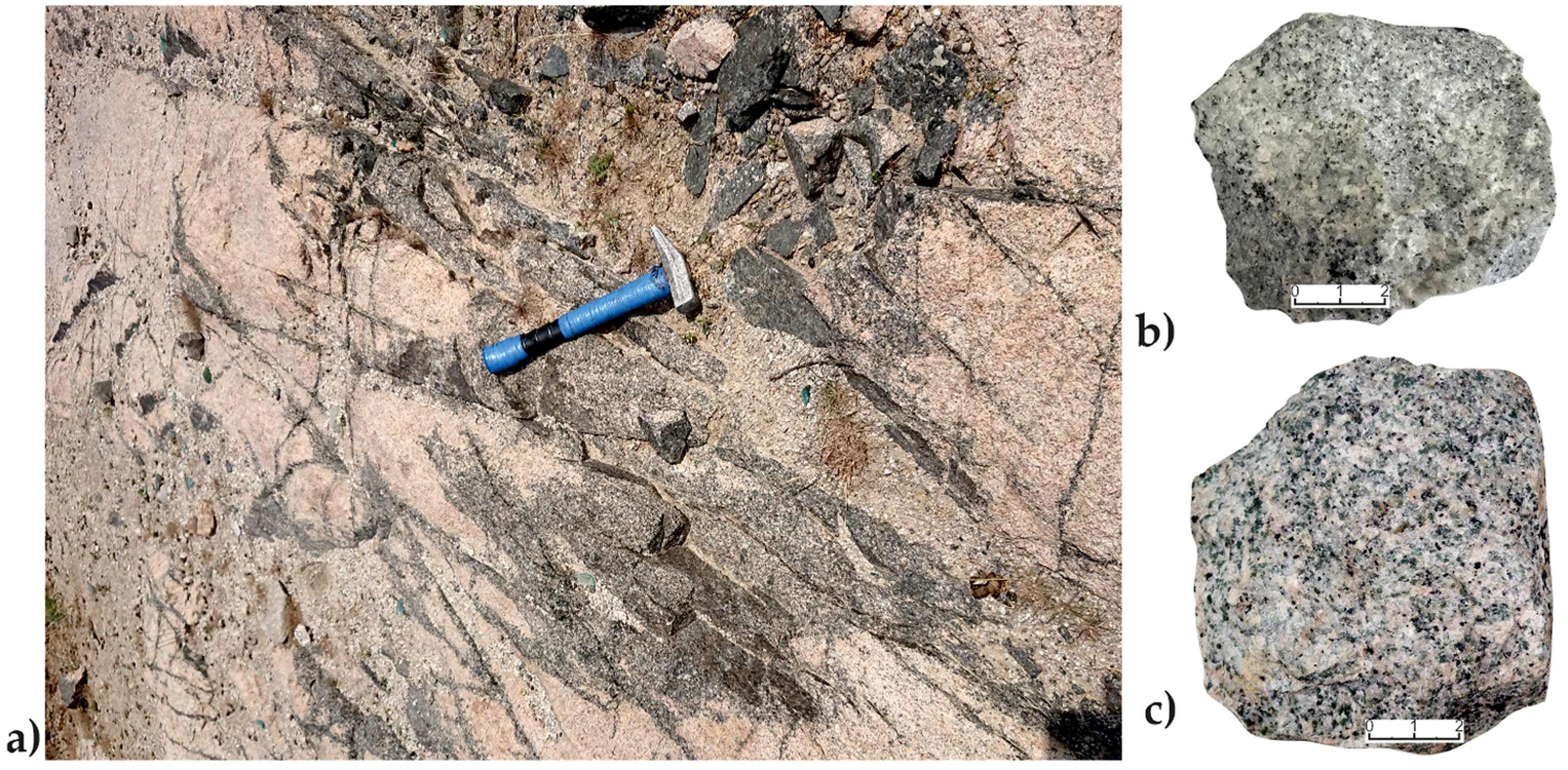
(a) Outcrop of the Tozbulak intrusion, zone of graphitisation in leucocratic granites of the Tozbulak complex; (b, c) graphitised nepheline syenite of the Tozbulak intrusion.
The Central Kuljuktau odinite-diorite-granitoid dike complex is developed throughout the entire area of the Kuljuktau Mts. uplift. The highest concentration of dikes is observed in the central part of the Kuljuktau Mts. around the Tozbulak intrusion. Here they form an extensive dike field (6 km × 14 km), which in its internal structure is divided into two bundles, spatially coinciding with the northwestern and southeastern parts of the Tozbulak intrusion.
The density of dikes in the Tozbulak field reaches 4–5 km per 1 km, thickness up to 10 m, length from 290 m to 4 km. Dikes of diorite porphyry and microdiorite dominate; granodiorite porphyries, spessartites and odinites are developed to a lesser extent. Thin bundles of dikes are known east of the Beltau and Taushan intrusions.
The dikes of the South Tien Shan campto-kersantite complex form a small swarm of three closely spaced subparallel dikes with a thickness of 0.3 to 1.8 m. Externally, these are massive fine porphyry rocks of a dark gray-green colour with an abundance of rounded carbonate amygdules in a brown hematite jacket with a diameter of 1.5–2.0 mm. The phenocrysts are composed of serpentinised olivine, clinopyroxene, and elongated biotite flakes. The fine-grained groundmass is composed of pyroxene, biotite, barkevikite, plagioclase, orthoclase and secondary chlorite and carbonate.
Results
Geochemistry of volcanic complexes
The mineralogical modal composition and the normative chemical composition of the rocks of the Kazakasu Formation identified them as basalts, basaltic andesites, andesite-dacitic porphyrites and rhyolites that belong to the calc-alkaline series formed on intra-oceanic islands and island arcs as based on the data in Table 1 and showcased by Figure 7a–e.
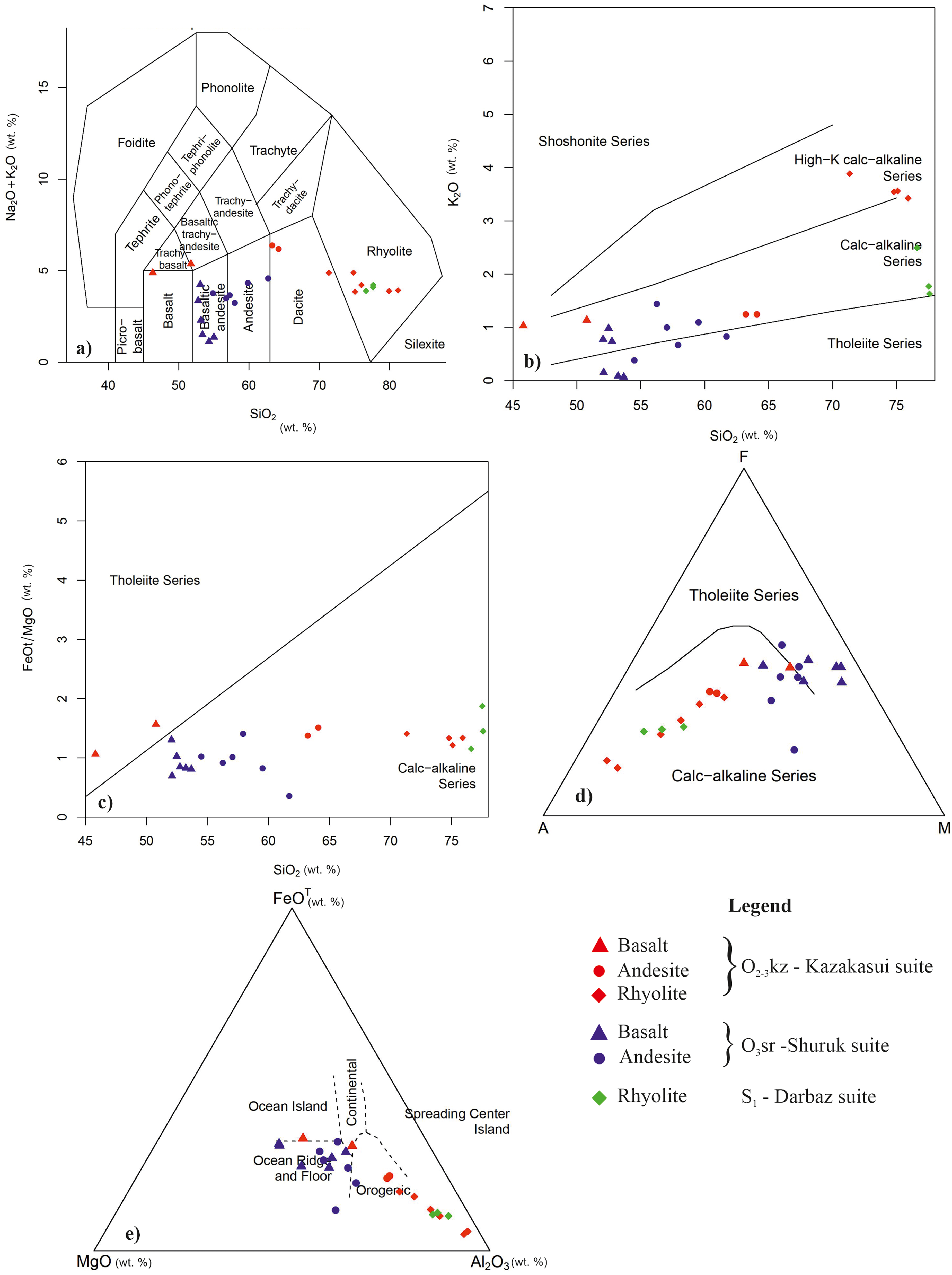
Classification and discrimination diagrams for volcanic rock suite of the Kuljuktau Mts: (a) Na2O + K2O versus SiO2 (TAS) diagram 31 ; (b) K2O versus SiO2 diagram 32 ; (c) SiO2–FeOt versus MgO diagram 33 ; (d) AFM diagram shows the relative proportions of the oxides of alkalis (A), iron (F), and magnesium (M) in igneous rocks 34 ; (e) MgO–FeO–Al2O3 diagram. 35
Major elements (wt.%) of the volcanic rocks of the Kuljuktau Mts.
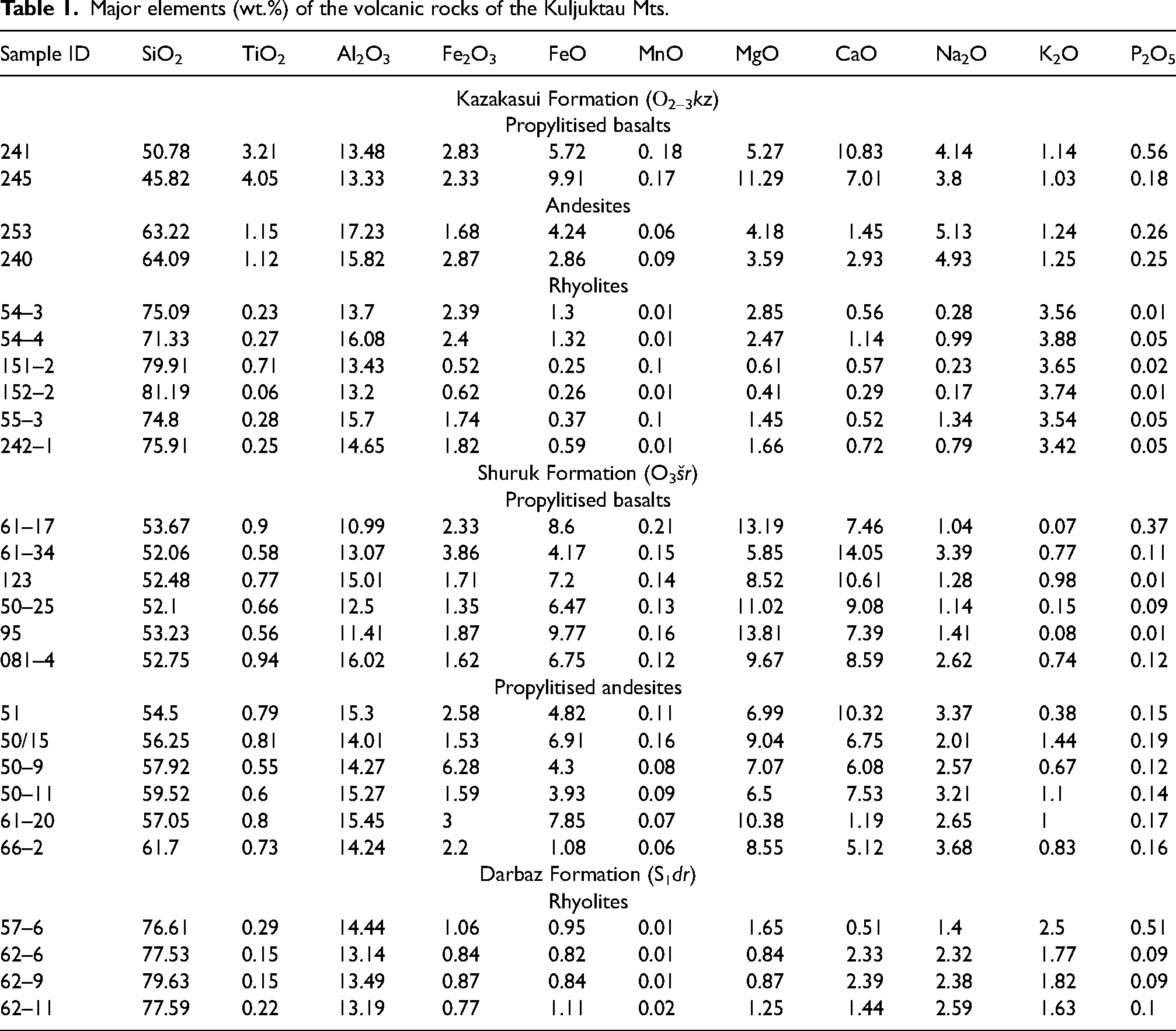
Basalts and andesites of the Kazakasu Formation are characterised by higher concentrations of elements, especially Ce (33 times higher), relative to the average upper continental crust (UCC) values of 30 (Supplement Table S2). Comparing elemental concentrations relative to average UCC values, for basalts and andesites of the Shuruk Formation a different behaviour of elements is observed (Table 1, Figure 7a–d) characterised by higher contents of Ni, Cr, B, As, Bi, Sc, Ag, Mo, W, Be.
The rhyolites of the Kazakasu and Darbaza Formations (Table 1 and Supplement Table S2, Figure 7a–g) differ quite significantly in the content of trace elements. For example, the Cu content in the former is higher, whereas Pb content is much lower in the latter. The contents of B, As, Sc, Zr, La, Ce, Pr, Sm in Darbaza rhyolites are also noticeably higher.
Geochemistry and geochronology of intrusive complexes
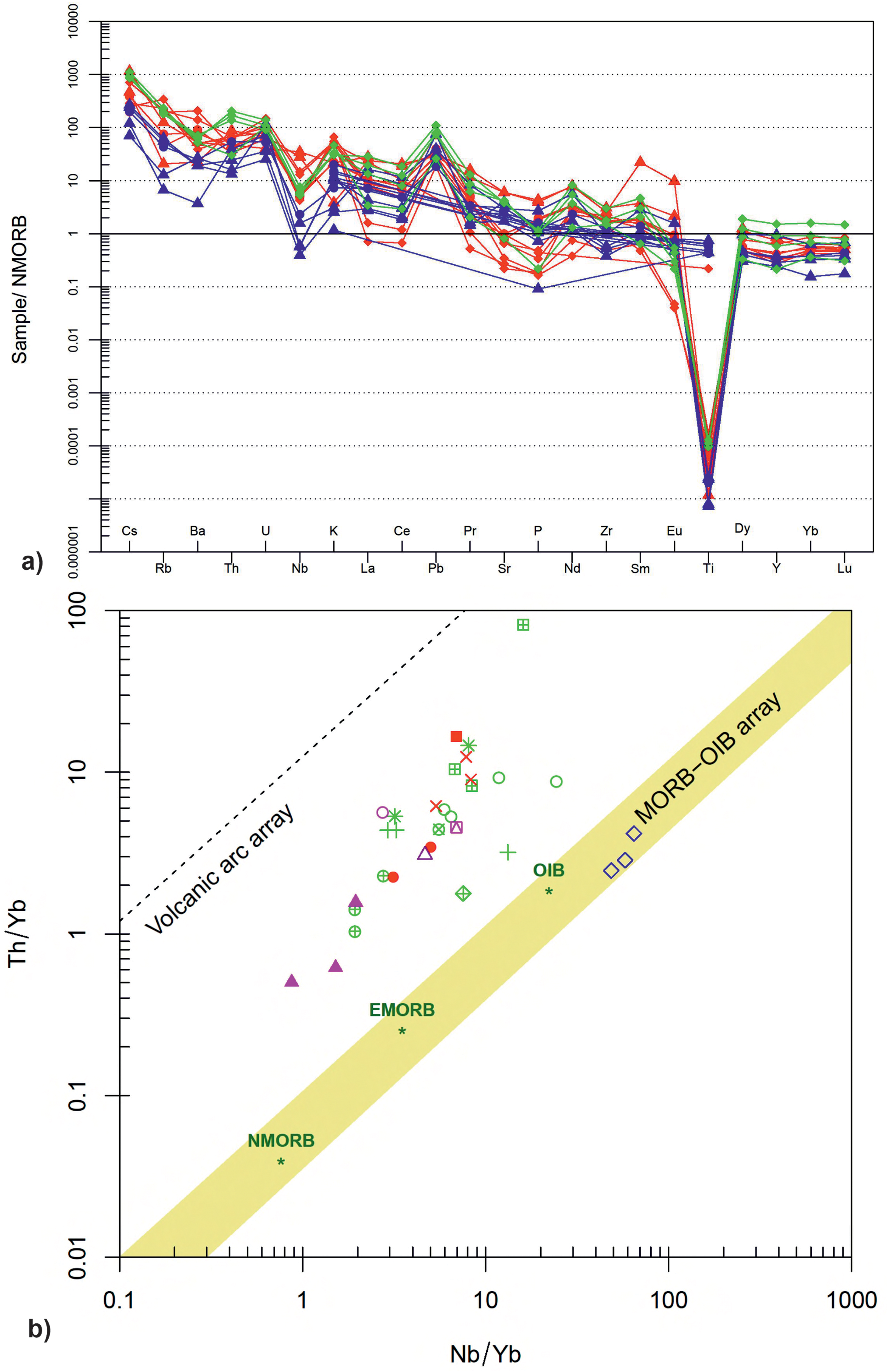
Petrochemical data of the Kuljuktau complex show a regular homodromous change in the composition of the complex units from early ultrabasic to late acidic (Supplement Table S3, Figure 8a). First of all, this is a consistent increase in the total content of silica, potassium, sodium and the total iron content in the rock (Figure 8b–d; Figure 9a, b).
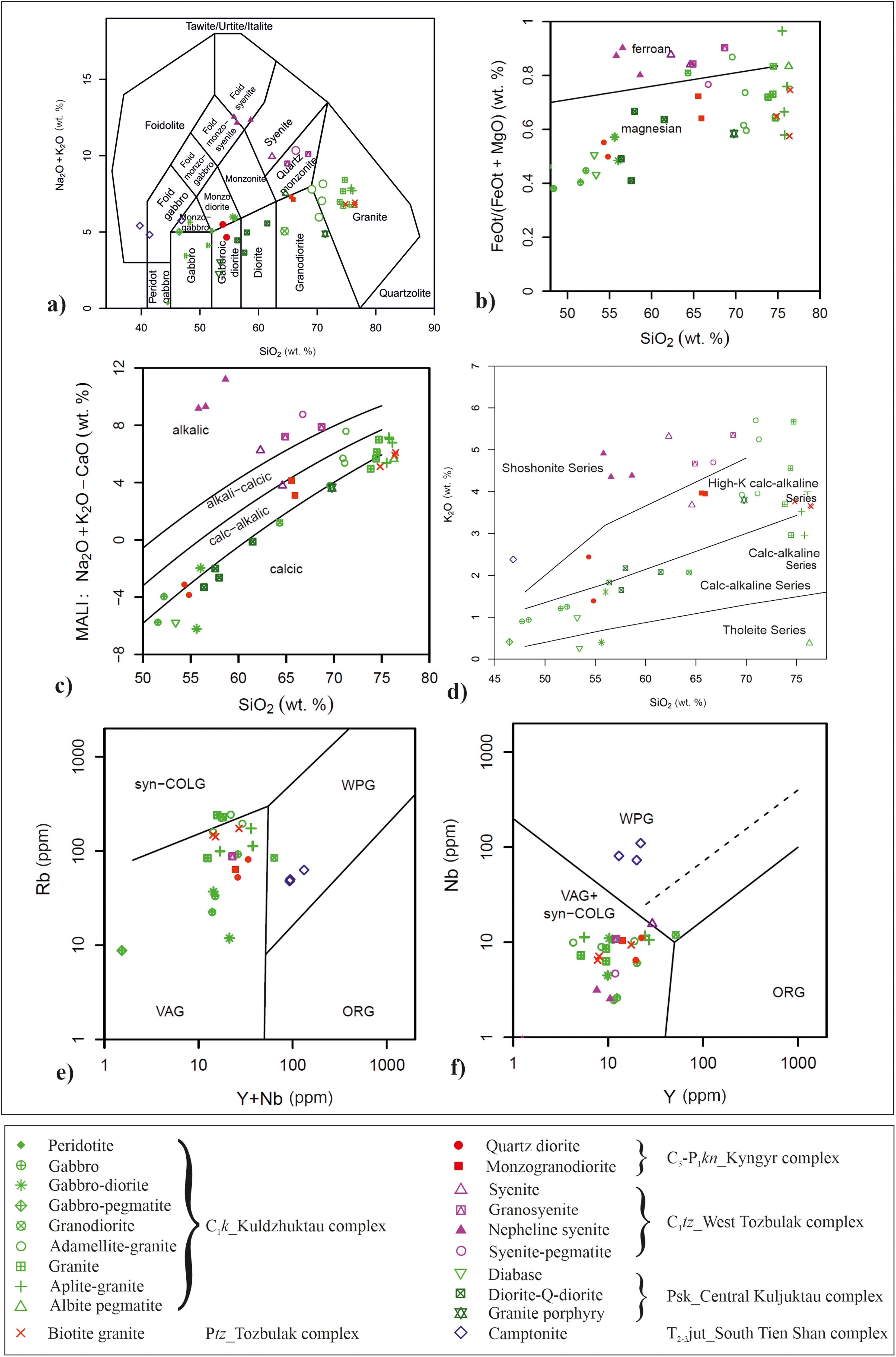
Classification and discrimination diagrams for igneous rock suite of the Kuljuktau Mts: (a) Na2O + K2O versus SiO2 (TAS) diagram 31 ; (b), (c) Granite tectonic discrimination diagrams after 36 ; (d) SiO2–K2O diagram 37 ; (e), (f) Granite tectonic discrimination diagrams. 38 Note: ‘syn-COLG’ – syn-collision granites; ‘WPG’ – within-plate granites; ‘ORG’ – orogenic granites; ‘VAG’ – volcanic arcs granites.
The granitoids of the Kuljuktau complex are calcareous (mainly of the sodium-potassium subtype). They are supersaturated with alumina and consistently contain corundum in the standard composition, which distinguishes them from the granites of the younger Tozbulak complex, which are very similar in appearance. The granitoids of the Kuljuktau complex contain elevated concentrations of trace elements compared to UCC values, including Ni (46 and 7 ppm), Cr (71 and 54), Ba (201 and 153) and Sr (39 and 18). Au (0.04 and 0.01), B (41 and 19), As (42 and 7), Bi (1.25 and 0.33), Zr (72 and 57), Th (23 and 9). New results for the Kuljuktau complex obtained during this study using U–Pb in zircon yield an age of 353.0 ± 4 Ma. Figure 10a is a diagram of sample 214, which corresponds to the early carboniferous age.
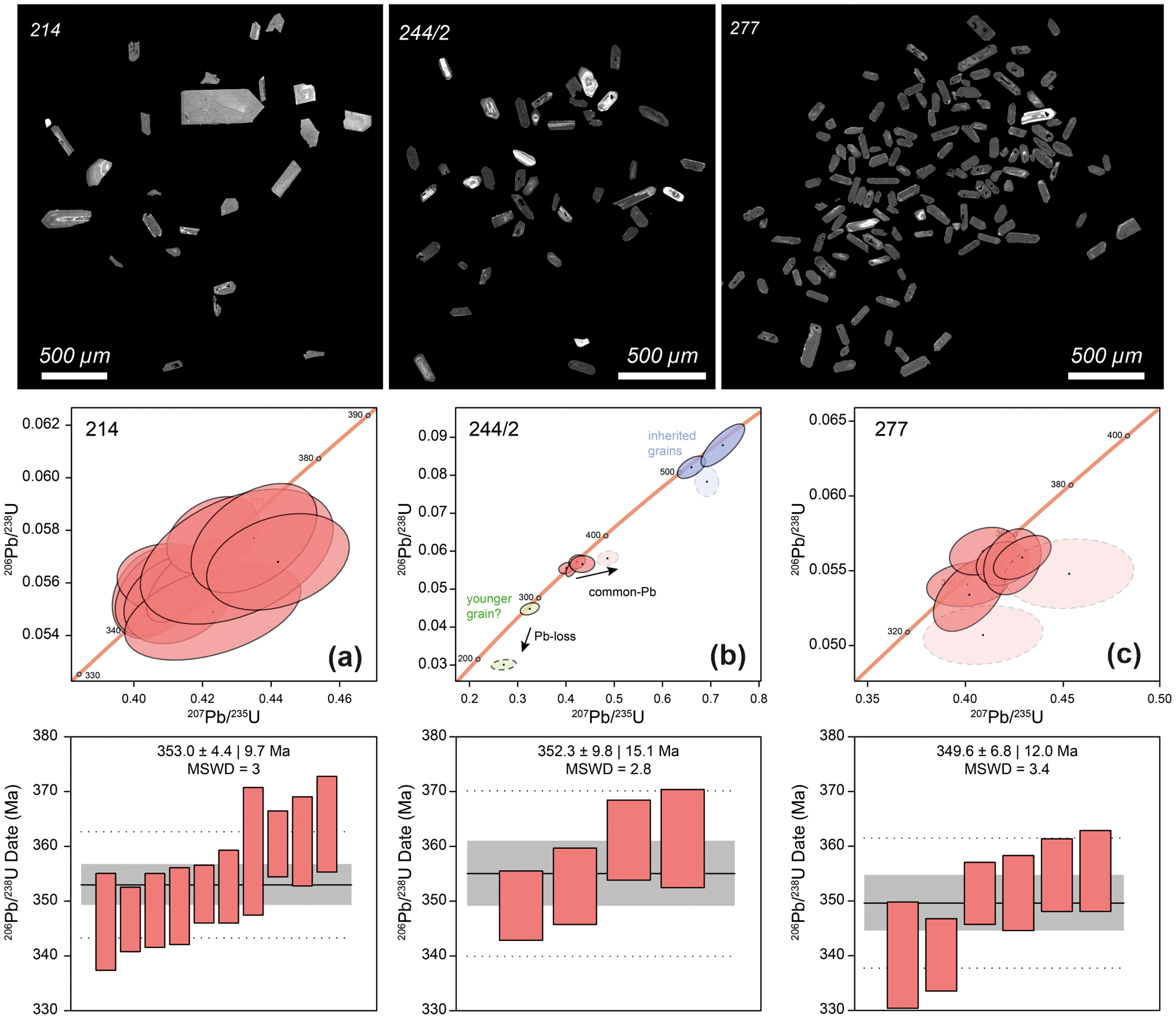
Cl images of analysed zircon populations and U-Pb age concordance and frequency map of samples 214, 277 and 244/2 sampled from intrusive complexes of the Kuljuktau Mts. Wetherill and weighted mean plots of zircons from samples 214, 244/2 and 277. All plots were constructed using IsoplotR. 41 Inherited grains are shown in blue, younger grains are shown in green and grains used in final age calculation are shown in red with a solid line. Discordant grains are shown with a dashed line. Coherent populations of youngest grains with slight overdispersion are seen for samples 214 and 277. Sample 244/2 contains a single younger grain at c. 285 Ma and is excluded from the final age calculation. Uncertainties on the weighted mean including overdispersion are shown in dark grey and including long term laboratory reproducibility of 1.5% (dotted line 42 ).
The rocks of the Kyngyr complex belong to the calc-alkaline series with high alumina content, fixed by standard corundum. Among the trace elements, the amounts of Ni, Co, V, Mo, Re, Sn, B, Bi, Sb, Yb, U, Th are higher relative to the average UCC (Supplement Table S4). Granitoids are represented by diorite-granodiorite series.
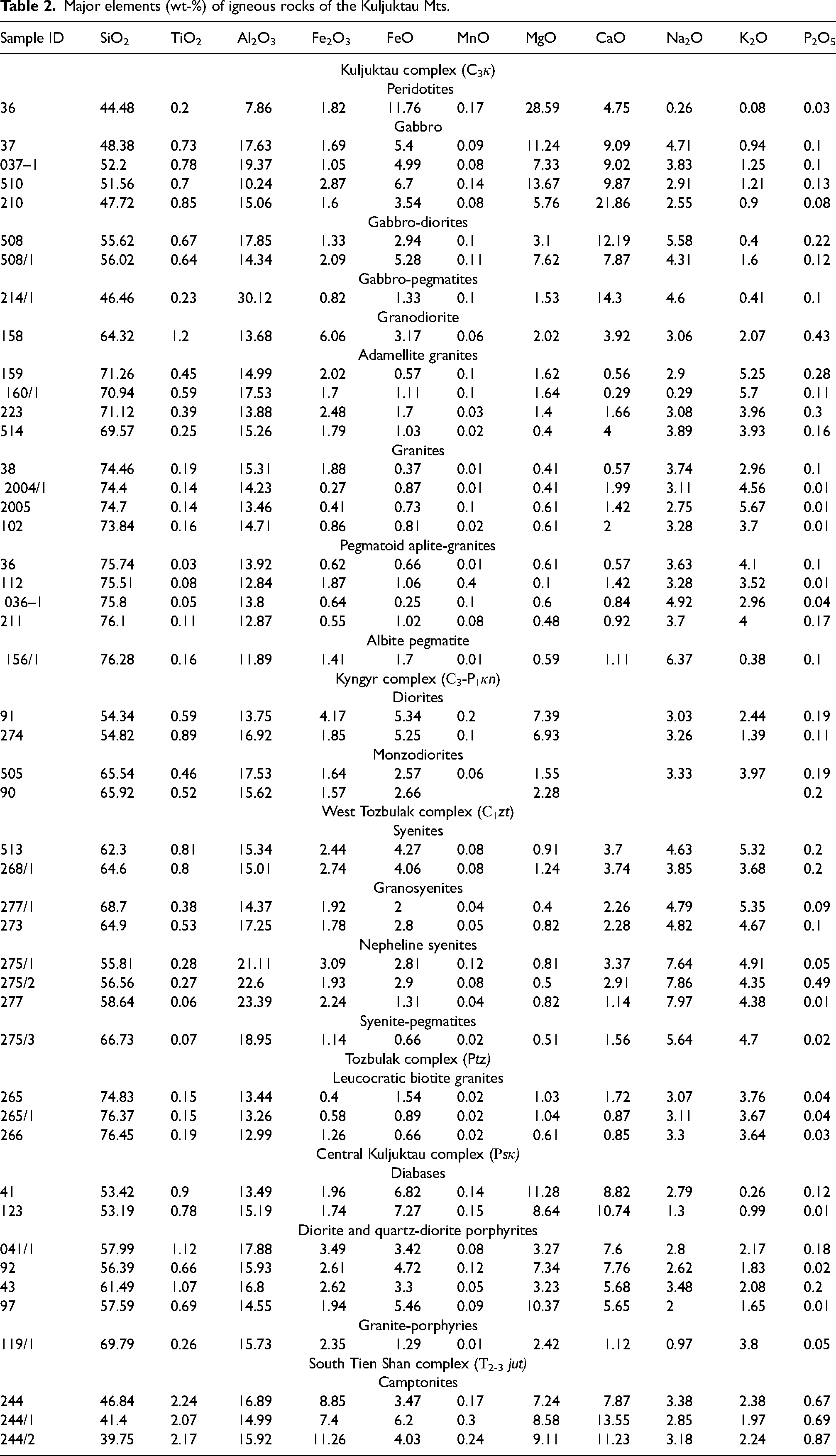
The chemical composition of the rocks of the West Tozbulak syenite-granosyenite complex are characterised by low titanium and magnesium content, high iron content and potassium-type alkalinity (Table 2; Supplement Table S3; Figure 8b–d). Syenites of the West Tozbulak complex are characterised by high contents (compared to UCC values) of Li (95–230 ppm), Rb (291–423 ppm), Mo (4.35–6.9 ppm), Re (0.03 ppm), Zr (206–418 ppm), Hf (1.10–4.45 ppm), Cu (210–260 ppm), Nb (35.8 ppm), Na (3.3 ppm). 28 Data on the absolute age of syenites obtained during this study by the U–Pb method showed an age of 349.6 + 6.8 Ma (Figure 10c, sample 277; Supplementary Table S1), which corresponds to the Early Carboniferous.
Major elements (wt-%) of igneous rocks of the Kuljuktau Mts.
In turn, the leucocratic granites of the Tozbulak complex have increased contents compared to UCC values of Li (39 vs 13 ppm for UCC), Mo (3.10 vs 1.07), Re (0.013 vs 0.004), Be (2.73 vs 1.59), Ag (0.26 vs 0.15), Tl (0.91 vs 0.53), and Se (4.28 vs 1.56). Granites of the Tozbulak complex differ from granitoids of the Kuljuktau complex in higher silica and iron content. Differences between the granitoids of these two complexes are also significant in trace element content (Supplement Table S3, Figure 8).
The chemical composition of the dikes of the Central Kuljuktau complex largely inherits the compositional features of the rocks of the Kuljuktau complex (Table 2). On the classification diagrams (Figure 8) they also fall into the fields of calc-alkaline rocks. The rocks are low-titanium (0.63–1.03%), low-potassium (0.22–2.0%). Identifying petrochemical features include increased contents of standard magnetite (1.19–5.03%) and ilmenite (0.44–2.11%). 43 Of the trace elements the following elements showed higher concentrations than the average UCC: Ni (21–209 ppm), Cr (76–324 ppm), V (80–154 ppm), Mo (0.78–2.46 ppm), W (0.61–9.74 ppm), Ag (0.10–0.21 ppm), Zn (69–76 ppm), As (52–70 ppm), Sb (1, 19–5.11 ppm), Zr (61–152 ppm), Y (8.81–17.0 ppm). Compared to the Kuljuktau and Tozbulak complexes, the total alkali content in the rocks of the Central Kuljuktau complex is reduced, which is a common phenomenon for late-vein rocks of intrusive (granitoid) associations generated by ‘depleted’ (residual) magma. Dikes of the Central Kuljuktau complex show increased concentrations of Co, Ni, V, Cu and Zn relative to UCC.
The camptonite dikes of the South Tien Shan complex are characterised by the chemical composition features inherent in the formation of alkaline basaltoids. On the classification and discriminant diagrams (Figure 8), the rocks of the complex fall mostly into the fields of subalkaline and alkaline rocks of the potassium-sodium subtype, containing approximately 10% each of standard quartz and orthoclase, and on the geodynamic diagrams, into the field of intraplate magmatic formations.
From trace elements list the following elements exhibit high concentrations (compared to UCC values): Ni (110 ppm), Co (44 ppm), Cr (157 ppm), V (147 ppm), Ba (577 ppm), Sr (470 ppm), Mo (2.83 ppm), Ag (0.47 ppm), As (7.5 ppm), Nb (88 ppm), Ta (4.73 ppm), Zr (143 ppm), Hf (3.43 ppm), La (46 ppm), Ce (84 ppm), Nd (35 ppm), U (5.90 ppm) (Supplementary Table S4).
The dikes of this complex have a regional distribution and cut through all known, including Late Permian, igneous formations of Central Asia. Geochronological dates using potassium-argon method are available and range from the Paleozoic to the Jurassic. This study using the U–Pb in zircon method showed that most of the zircons in the sample were captured from the host rocks; only single grains indicate the boundary interval of the Triassic and Jurassic (Figure 10b, sample 244/2).
Geochemical data of mineral deposits and occurrences
Below are brief descriptions of analysed mineral deposits and mineral occurrences that comprise the CE potential of the Kuljuktau Mts. Samples from three objects have been analysed for ore and trace elements. The results of the analyses are given in Supplementary Table S4 and the location of all samples is shown in Figure 3.
At the Taskazgan graphite deposit, in addition to 17% C, the following significant contents of trace elements have been established in the graphite sample, including Cu, Cr, Au, Ni, V. Particularly high values are Se – 16.2 ppm, which exceeds average UCC by 324 times and Bi – 4.19 ppm or 465.6 times of average UCC.
The Aktosty Li-bearing pegmatites are characterised by high contents of Li > 4000, Rb – 3411, Cs – 1182, Sn – 150, Ga – 100, Nb – 24.2, Ta – 11.5, Ta – 78.6 ppm, of which the most important is the content of rare-alkaline elements.
The Aktosty quartz vein exhibits SiO2 content of 99.70%. In the albitisation zone of leucocratic granites of the Tozbulak REE-bearing massif, the ΣREEs is 360.2 ppm, which is more than 2 times higher than UCC.
Discussion
Geodynamics and metallogeny and links to critical mineral resources of Central Kyzylkum
Summarising above features of the chemical composition of the Kuljuktau volcanics, the formation of volcanics of the Kazakasu Formation occurred under oceanic conditions, while the chemistry of andesites and rhyolites corresponds to the differentiated oceanic tholeiites, and high-titanium basalts most of all correspond to the formation of alkaline olivine basalts characteristic of intraplate oceanic islands (seamounts).
The geodynamic regime of formation of the basalt-andesite formation of the Shuruk formation corresponds to the regime of ensimatic island arcs, and the andesite-dacite-rhyolite formation of the Darbaza Formation corresponds to the regime of the ensialic island arc.
The findings of this study make it possible to suggest that the areas of manifestation of the Kazakasu Formation are the most perspective for the discovery of mineralisation of Au, Ag, Fe, Mn, Cu, rare metal (RM) and REEs. The areas of occurrence of rocks of the Shuruk and Darbaza Formations can be considered perspective for Au–Ag and RM mineralisation.
Based on concepts of modern geodynamic settings, the Kuljuktau complex most accurately corresponds to the settings of back-arc rifting on an active continental margin. The Kuljuktau complex is associated with the Taskazgan deposit of high-quality graphite and zeolites. In addition to graphite, there are good prospects for Cu–Ni mineralisation, 16 also increased concentrations of Pt, Pd, Rh, Se and Te in graphitised gabbros in analogy with mineralisation of Norilsk-type deposits. The formation of the Tozbulak complex is associated with the post-folding development stage of the Kuljuktau. Based on this and on the rather simple features of the internal structure and composition, it correlates well with rocks of the granite-leucogranite formation type. In the nearest exocontact of the Tozbulak intrusion, vein bodies of leucogranites with signs of weak greisenisation are found, containing up to 50 ppm of Sn. Rare earth mineralisation has been established in albitisation zones.
The Central-Kuljuktau complex completes with a relatively long-term developing intrusive series of the region, the various units of which are connected paragenetically, linked through a common magmatic chamber of continental tholeiitic magma. The main target metals and minerals include gold and graphite. Gold mineralisation is confined to the suture zone of the thrust structure. The Taskazgan graphite deposit is confined to the melange at the contact between the gabbroids of the Kuljuktau complex and the marbleised carbonate rocks of the Silurian and Devonian. In addition, rare metal (Li) mineralisation is noted, confined to pegmatite and aplite veins in the Shaidaraz intrusion, as well as manifestations of rare earth mineralisation.
Critical mineral potential of the Kuljuktau Mts.
The Taskazgan graphite deposit
The Taskazgan graphite deposit is associated with the Kuljuktau gabbro-granitoid intrusive complex. In the area of the deposit, this complex is represented mainly by gabbro, norites, with small bodies of harzburgites and peridotites, which were intruded in the form of multilayer protrusions into the carbonate sequence along gentle tectonically weakened zones along the suture of the regional thrust with many feathering faults. After intrusion, the sill-shaped bodies were folded, which can be observed on the modern erosional section where the outcrops of gabbroids and limestones are subject to folding (Figure 11).
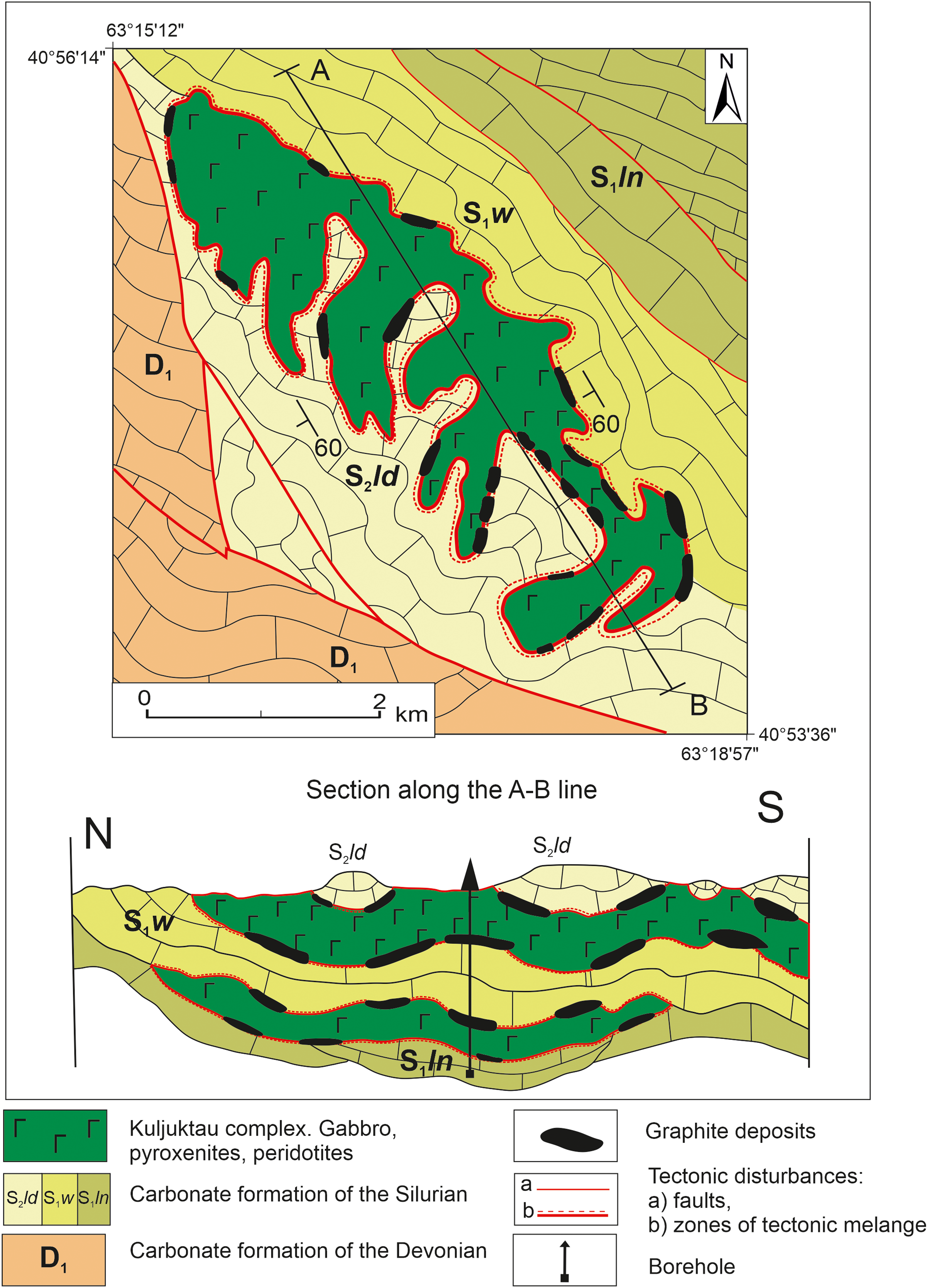
Local geological map and cross-section of Taskazgan graphite deposit.
Along the contacts of gabbroids with host limestones (both underlying and over-lying), a melange zone up to 10–15 m thick develops, represented by graphite, which contains numerous bodies of host limestones and gabbroids with graphite veinlets. At the same time, the thickness of graphitised endocontact gabbroids reaches 0.5–1 m, and graphitised limestones up to 10–14 m. Drilling operations have established that the gabbro massif in the section is a multilayer body, traced to depths of 500 m.
Despite multiple previous studies of the Taskazgan deposit, its genetic type remains debatable.
As is known, there are three sources of carbon in nature as the initial material for the formation of graphite: magmatic emanations (including products of mantle degassing), carbonate rocks, and organic remains (as well as coals) among sedimentary rocks.
This study of the Taskazgan deposit found no evidence of contact skarns. Graphitisation of the Kuljuktau rocks is observed everywhere in sedimentary and igneous rocks in the latitudinal direction along the Hercynian thrust zone and can be traced to the east along wells and individual outcrops, both in the Early and Late Paleozoic rocks. Graphitisation has a superimposed character (carbon metasomatism) due to carbon-containing (CO2 and CH4) gas–fluid mantle flows penetrating along deep fault zones, forming graphite deposits in favourable structural settings (Figure 12). This is evidenced by the composition of the graphite ore, most of which consists of graphite − 17%, sericite and muscovite − 18% and zeolites − 25% 44 as well as the isotopic composition of carbon in carbonated gabbro and Silurian limestones (δC13 = −16.39‰), indicating its deep-endogenous origin. 45 The Taskazgan deposit is the only known Uzbek graphite deposit in Western literature. Reserve estimates ranged from a potential of 2.3 Mt of ore containing 15% graphite 46 to 6.1 Mt of ore containing 1.1 Mt of graphite, 0.5 Kt of Co, 3 Kt of Cu and 10 Kt of Ni. 47
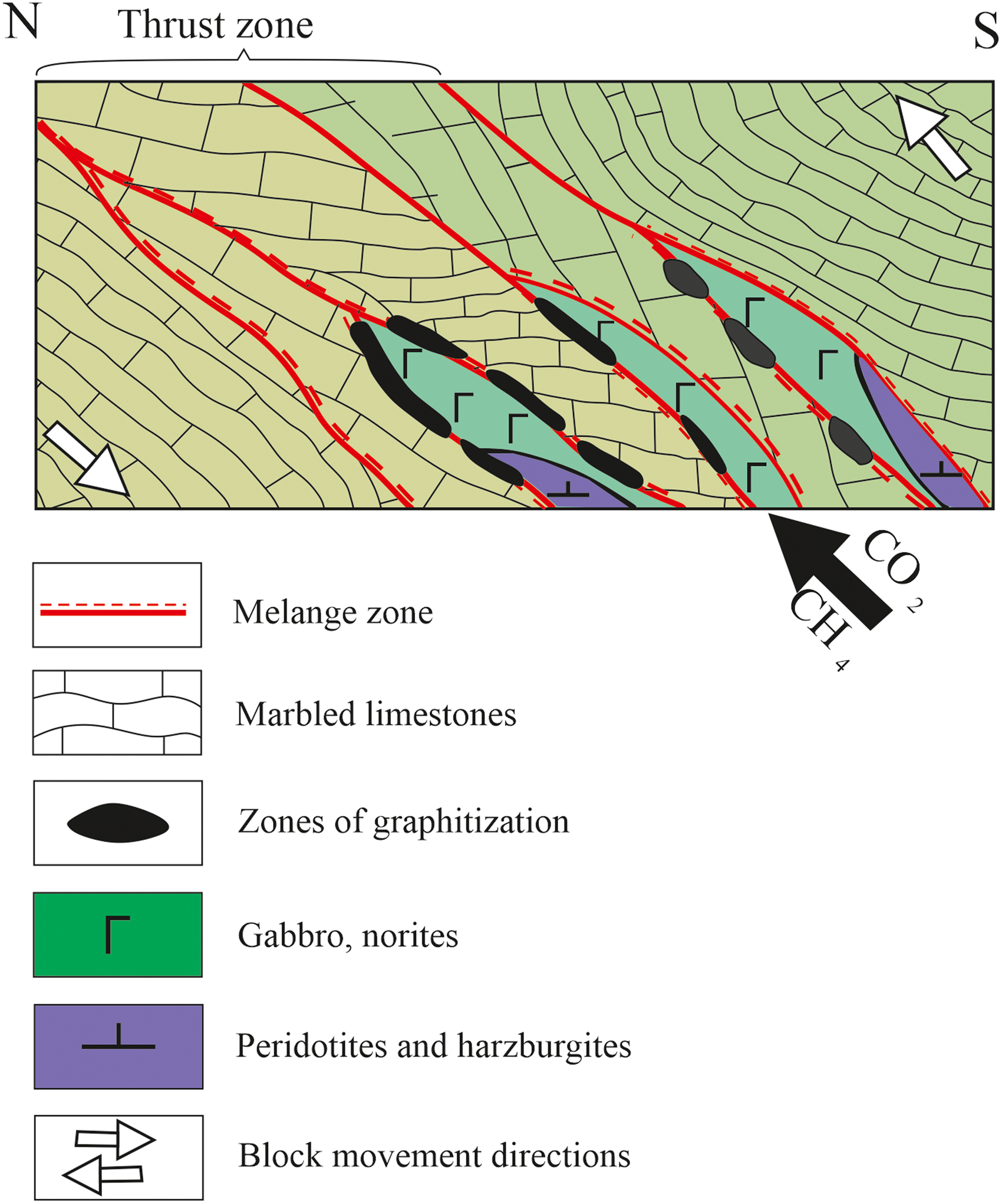
Scheme of formation of the Taskazgan graphite deposit shows how carbon-containing (CO2 and CH4) gas–fluid mantle flows penetrate along deep fault zones of riftogenic nature and forming graphite deposits in favourable structures.
The Aktosty lithium mineral occurrence
The lithium mineralisation is associated with lepidolite-spodumene pegmatites cutting through the gabbroids of the Shaidaraz intrusion. 50 The Aktosty-Shaidaraz pegmatite field (Figure 13), identified on the southern slopes of the Kuljuktau Mts., stretches from southeast to northwest for 6 km. Pegmatite bodies are vein-shaped and lens-shaped, less often, irregular in shape.
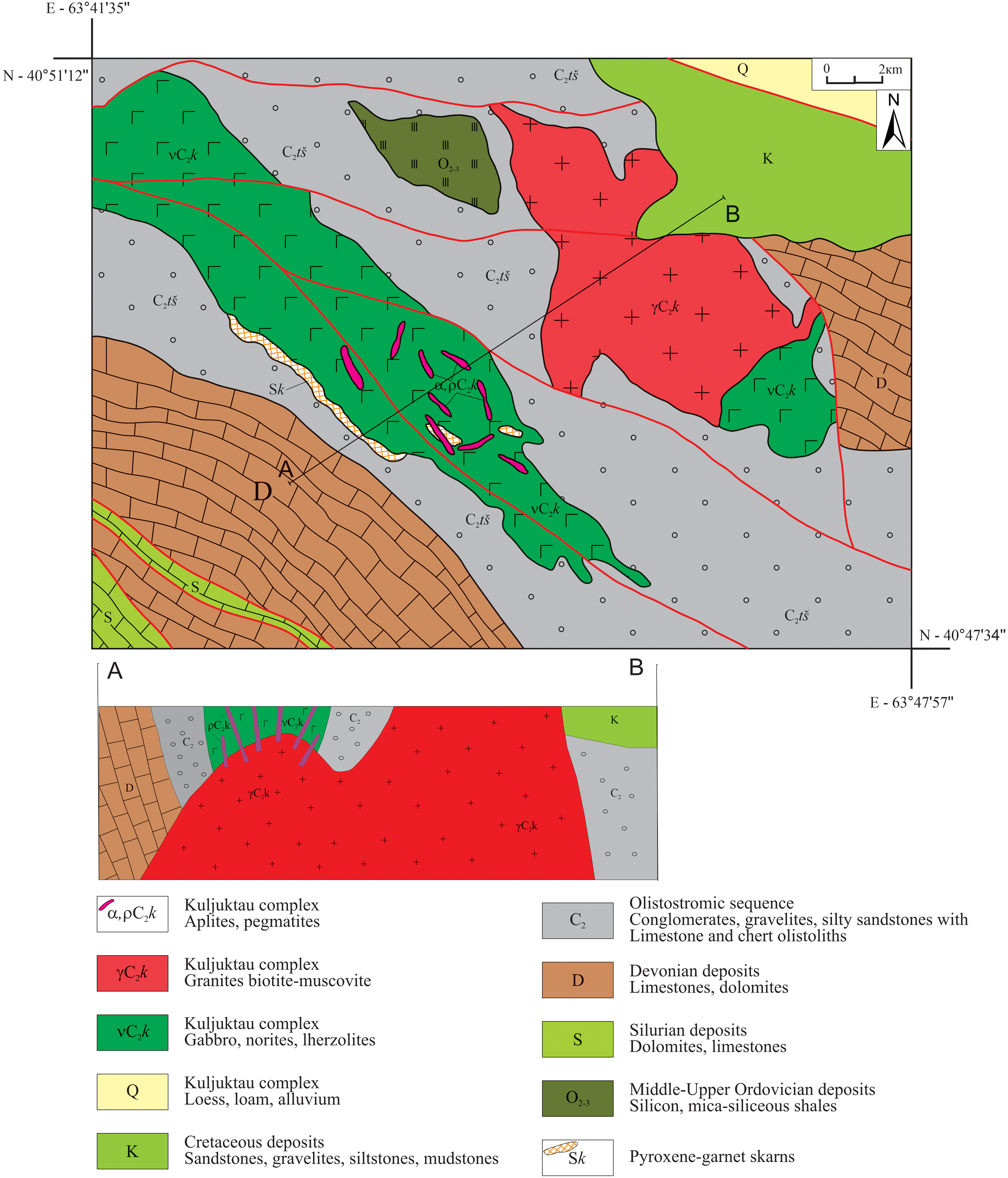
Local geological map of the Aktosty-Shaydaraz mineral occurrence and its cross-section.
They are grouped en-echelon into vein series of oligoclase-microcline pegmatite veins with schorl and lepidolite, unevenly distributed in the pegmatite field. The host environment of the pegmatite veins is massive gabbro and gabbro-norites, known as the Shaidaraz gabbroic intrusion.
Mineral composition distinguishes two types of pegmatite bodies: predominant olicoglase-microcline-tourmaline and quartz-feldspar-lepidolite-spodumene. Pegmatites of the second type are of greatest interest. The pegmatite bodies vary from tens of centimetres to 20 m in thickness and from a few to hundreds of metres along strike. The largest ‘Lepidolite 1’ vein is a lens-shaped body with a thickness of 1.5–2 m and a length of up to 400 m. In one of the lepidolite samples the following percentages (wt-%) were determined: Li2O – 1.95; Rb2O – 1.0; Cs2O – 0.094; Ta2O5 – 0.006; Nb2O5 – 0.014. 29
Perspectives for REEs
There are no deposits of rare earth elements identified in the Kyzylkum region to date. Rare earth mineralisation is however, found in nepheline syenites 46 and albitisation zones of the Tozbulak intrusion. Albitisation zones with a thickness of up to 20 m and a length of up to 1.5 km are characterised by increased contents of ΣREEs (600–800 ppm). The enrichment of REEs is mostly due to light REEs of La and Ce, which is also accompanied by an increased Y content exceeding 100 ppm. Recently, REEs in Cretaceous brown-ironstone sandstones and kaolinised clays have been found 48 in Mesozoic sedimentary rocks that are subject to verification work.
Perspectives for high-purity silica
One of the largest manifestations of pure vein quartz in Uzbekistan, cuts through the central part of the Tozbulak intrusion of leucocratic granites. Quartz is milky white without foreign inclusions. The thickness of the vein reaches 200 m, and the length is 3.0 km. The Akbuiro quartz vein of similar composition was formed on the eastern continuation of the belt in the Kvrvtyube intrusion, from which technical silicon of high purity has been produced. 49
New U–Pb zircon ages
The obtained absolute age data allows the clarification of the age of the studied intrusive complexes. The age of the Kuljuktau complex was previously determined mainly by the age of the host Taushan Formation, which was conventionally dated as Upper Carboniferous, the age of the West Tozbulak complex was conventionally dated as Permian. The obtained new age data of 353.5 ± 2.1 Ma for the former and 349.1 ± 2.5 Ma for the latter indicate the early Carboniferous age of the formation of these complexes, which will require further refining of the stratigraphic scheme of the region.
Conclusions
The Kuljuktau Mts. have been formed at the active margin of the Karakum-Tajik continent with the activation of magmatism and manifestations of thrust tectonics in the Ordovician-Silurian and in the Carboniferous-Permian, which were accompanied by carbonaceous metasomatism.
Chemical composition of andesites and rhyolites of the Kazakasui Formation corresponds to the differentiated oceanic tholeiites, and high-titanium basalts correspond to the formation of alkaline olivine basalts that are characteristic of intraplate oceanic islands (seamounts). The geodynamic regime of formation of the basalt-andesite formation of the Shuruk Formation corresponds to the regime of ensimatic island arcs, and the andesite-dacite-rhyolite formation of the Darbaza Formation corresponds to the regime of the ensialic island arc.
The new ages of the Kuljuktau and West Tozbulak intrusive complexes of 353.0 ± 4 Ma and 349.6 ± 6.8 Ma, respectively, allowed the refinement of the stratigraphic scheme of the region. Magmatic complexes and tectonic structures of the last stage control the placement and distribution of metallic and non-metallic deposits and mineral occurrences.
Empiric assessment of the resource potential of the CEs of the Kuljuktau Mts. is significant:
The Taskazgan graphite deposit is associated with gabbroids occurring in the suture zone, and in addition to the main commodity of a high-quality graphite, also contains high contents of Ni, Co and PGEs. The development of technologies for the complex extraction of metals allows it to be considered as the most significant deposit in the studied region.
The resource potential of lithium in the Kuljuktau Mts. is associated with lepidolite-spodumene pegmatite veins that need to undergo a focused study, and the exploration of this region is currently on-going. The resource potential of lithium may increase with intensification of exploration work on the western and eastern flanks of the suture zone under the Mesozoic-Cenozoic cover.
The high-purity vein quartz deposit hosted in the Tozbulak granite intrusion is one of the largest of this type found in Uzbekistan and can be considered as an important source of metallic silicon for solar panels as the country transits towards the green economy. The Tozbulak intrusion also hosts rare earth mineralisation found in nepheline syenites and albitization zones.
Supplemental Material
sj-docx-1-ape-10.1177_25726838241307175 - Supplemental material for Geology of critical mineral deposits of the Kuljuktau Mts., Central Kyzylkum (Uzbekistan)
Supplemental material, sj-docx-1-ape-10.1177_25726838241307175 for Geology of critical mineral deposits of the Kuljuktau Mts., Central Kyzylkum (Uzbekistan) by Rustam Mirkamalov, Farid Divaev, Rustamjon Uzokov, Alla Dolgopolova, Reimar Seltmann, Robin Armstrong, Yannick Buret, Cindy Broderick, Rustam Khalmatov, Nigora Oripova, Yulia Mun and Marina Mizernaya in Applied Earth Science
Supplemental Material
sj-xlsx-2-ape-10.1177_25726838241307175 - Supplemental material for Geology of critical mineral deposits of the Kuljuktau Mts., Central Kyzylkum (Uzbekistan)
Supplemental material, sj-xlsx-2-ape-10.1177_25726838241307175 for Geology of critical mineral deposits of the Kuljuktau Mts., Central Kyzylkum (Uzbekistan) by Rustam Mirkamalov, Farid Divaev, Rustamjon Uzokov, Alla Dolgopolova, Reimar Seltmann, Robin Armstrong, Yannick Buret, Cindy Broderick, Rustam Khalmatov, Nigora Oripova, Yulia Mun and Marina Mizernaya in Applied Earth Science
Supplemental Material
sj-docx-3-ape-10.1177_25726838241307175 - Supplemental material for Geology of critical mineral deposits of the Kuljuktau Mts., Central Kyzylkum (Uzbekistan)
Supplemental material, sj-docx-3-ape-10.1177_25726838241307175 for Geology of critical mineral deposits of the Kuljuktau Mts., Central Kyzylkum (Uzbekistan) by Rustam Mirkamalov, Farid Divaev, Rustamjon Uzokov, Alla Dolgopolova, Reimar Seltmann, Robin Armstrong, Yannick Buret, Cindy Broderick, Rustam Khalmatov, Nigora Oripova, Yulia Mun and Marina Mizernaya in Applied Earth Science
Supplemental Material
sj-docx-4-ape-10.1177_25726838241307175 - Supplemental material for Geology of critical mineral deposits of the Kuljuktau Mts., Central Kyzylkum (Uzbekistan)
Supplemental material, sj-docx-4-ape-10.1177_25726838241307175 for Geology of critical mineral deposits of the Kuljuktau Mts., Central Kyzylkum (Uzbekistan) by Rustam Mirkamalov, Farid Divaev, Rustamjon Uzokov, Alla Dolgopolova, Reimar Seltmann, Robin Armstrong, Yannick Buret, Cindy Broderick, Rustam Khalmatov, Nigora Oripova, Yulia Mun and Marina Mizernaya in Applied Earth Science
Supplemental Material
sj-xlsx-5-ape-10.1177_25726838241307175 - Supplemental material for Geology of critical mineral deposits of the Kuljuktau Mts., Central Kyzylkum (Uzbekistan)
Supplemental material, sj-xlsx-5-ape-10.1177_25726838241307175 for Geology of critical mineral deposits of the Kuljuktau Mts., Central Kyzylkum (Uzbekistan) by Rustam Mirkamalov, Farid Divaev, Rustamjon Uzokov, Alla Dolgopolova, Reimar Seltmann, Robin Armstrong, Yannick Buret, Cindy Broderick, Rustam Khalmatov, Nigora Oripova, Yulia Mun and Marina Mizernaya in Applied Earth Science
Footnotes
Acknowledgements
This publication has been produced within the framework of the Grant ‘Resourcing low-carbon technologies for green economy of Uzbekistan’ (REP-24112021/70), funded under the MUNIS Project, supported by the World Bank and the Government of the Republic of Uzbekistan. The statements do not necessarily reflect the official position of the World Bank and the Government of the Republic of Uzbekistan. Prof. David Lentz is thanked for the helpful guidance on earlier version of this manuscript. The authors appreciate constructive comments of the two reviewers that led to the improvement of the manuscript.
Data availability
Data is contained within the article.
Declaration of conflicting interests
The authors declared no potential conflicts of interest with respect to the research, authorship and/or publication of this article.
Ethical approval and informed consent statements
This article does not contain any studies with human or animal participants. All research was conducted to the highest possible ethical standards.
Funding
The authors disclosed receipt of the following financial support for the research, authorship, and/or publication of this article: This research was funded by grant to project REP-24112021/70 ‘Resourcing low-carbon technologies for green economy of Uzbekistan’ under the MUNIS Project, supported by the World Bank and the Government of the Republic of Uzbekistan.

Supplemental material
Supplemental material for this article is available online.
References
Supplementary Material
Please find the following supplemental material available below.
For Open Access articles published under a Creative Commons License, all supplemental material carries the same license as the article it is associated with.
For non-Open Access articles published, all supplemental material carries a non-exclusive license, and permission requests for re-use of supplemental material or any part of supplemental material shall be sent directly to the copyright owner as specified in the copyright notice associated with the article.
