



Abstract
The rare metals mineralisation in Um Safi area occurs in the acidic volcanics (mainly rhyolite and volcanogenic tuffs). The microscopic investigation revealed that they are highly altered and subjected to several alteration processes where the hydrothermal solution played the master role in redistribution of the rare metals. The mineralogical study configured three groups of rare metals mineralisation including: (a) rare metals of the radio-elements (thorite), (b) rare metals of the trace elements and REEs (zircon, xenotime, chernovite, ferro-columite, allanite, bastnäsite and cerianite) and (c) rare metals of the base metals (tungsten minerals and cassiterite). The assemblage of Wolframite–Heubnerite–cassiterite–copper and fluorite associated with sulfides indicating magmatic to hydrothermal transition mineralisation. The hydrothermal fluids rich in F and As cause the alteration of some primary minerals such as xenotime, allanite and wolframite into the secondary chernovite, bastnäsite and schellite, respectively. The study also clarified that the emplacement of granitic offshoots into rhyolite played an important role in the re-distribution of some rare elements.
Keywords
Introduction
Um Safi area occupies a small part of the Precambrian basement rocks of the central Eastern Desert domain and lies between Idfu–Marsa Alam and Qena–Safaga tectonic zones. The Precambrian basement rocks occupy the extensive exposures of the Arabian–Nubian Shield, that characterised by great concentration of rocks possessing strong oceanic affinities which are predominant over the continental ones. 1 Pan-African volcanic rocks constitute extremely important rock units within the Egyptian part of the Arabian–Nubian Shield comprising older metavolcanics (1100 Ma), 2 younger metavolcanics (761–612 Ma), 3 and Dokhan volcanics (630–560 Ma). 4 It is built up of ophiolitic mélange and associated island arc rocks, together with subordinate immature poorly-sorted molasses of Hammamat sediments, late tectonic bimodal volcanics and intrusive granites. 5 The Central Eastern Desert is distinguished by age older than 570–670 Ma 6 and compressional mode of formation. 7
Um Safi acidic volcanics had been previously described as ‘felsite’ by several authors8–11 that extruded in a volcano sedimentary association. El-Ghawaby 9 recorded uranothorite, xenotime, zircon and columbite as fracture filling in the sheared parts of Um Safi felsite. Different modes of mineralisation associated with different alteration processes was recorded by Abdalla, 11 who suggested the pervasive greisenisation of the apical parts of Um Safi felsite led to predominance of the disseminated type of Zr, Y, Nb, Th and U mineralisation, while fluoritisation and hematitisation processes are restricted to the fracture system.
The acidic volcanics of Um Safi area were first described as rhyolite and tuffs by Ibrahim, 12 who attributed them to the Arc-assemblage which is tectono-stratigraphically older than Hammamat, younger gabbros and younger granites. The author (op. cit.) recorded considerable number of rare metals mineralisation including; kasolite, columbite, uranothorite, cassiterite, zircon and allanite.
These rocks show different degrees of subsolidus autometasomatic processes including argillisation, silicification and fluoritisation. 13 Th is predominant over U in the rhyolite of Um Safi, on contrary U is predominant over Th in the pyroclastics as well as in the younger granites, where kasolite is recorded as secondary uranium minerals as well as some U-bearing minerals such as plumbo-betafite, columbite, betafite and uranothorite.14,15 The high radioactivity and mineralisation are controlled by syngenetic processes which is indicated by the existence of the recorded radioactive minerals, as well as post-volcanicity alterations which is indicated by ferrugination process and kaolinitisation process. 16
Um Safi rhyolite underwent to multistage of hydrothermal processes including; albitisation, greisenisation, ferrugination, silicification, flouritisation, illitisation, hematitisation and calcitisation. 17 These multistage alterations led to significant enrichment in some rare metals such as Th, U, Bi, Cu, Zn, Mo, Ag; 18 moreover, the behaviour of REE of rhyolite indicated apparent correlation with the REE behaviour of mantle. 19
Rare metals (HFSE including REE) are critical to economic progress, the Clarke values of rare metals are typically in the tens of ppm range, implying that thousands to hundreds of thousands of enrichment of these metals is necessary to generate commercially significant deposits. 20 Um Safi acidic volcanics are considered as promising rocks for rare metals. The aim of the present work is to clarify the origin and modes of occurrence of the newly discovered rare metals mineralisation in the altered rhyolitic rocks in Um Safi area, Central Eastern Desert, Egypt.
Methodology
Twenty-two representative samples were collected from Um Safi acidic volcanics (14 samples from rhyolite and 8 samples from volcanogenic tuffs) (Figure 1). Eight representative samples were prepared as thin sections and examined microscopically by transmitted light polarised microscope (Olympus BX53) attached with digital camera to throw light on the various processes of alteration in the investigated volcanics. The heavy mineral study was conducted on the sand size fractions (2–0.063 mm) of the collected 22 representative samples using bromoform (specific gravity = 2.89 g/cm3). The mineralogy and chemistry of the mineral grains were determined using microscopic examination, SEM attached with EDX micro-analyser. The confirmation of some mineral species was carried on by XRD. The above-mentioned studies were carried out at the laboratories of the Nuclear Materials Authority, Egypt.
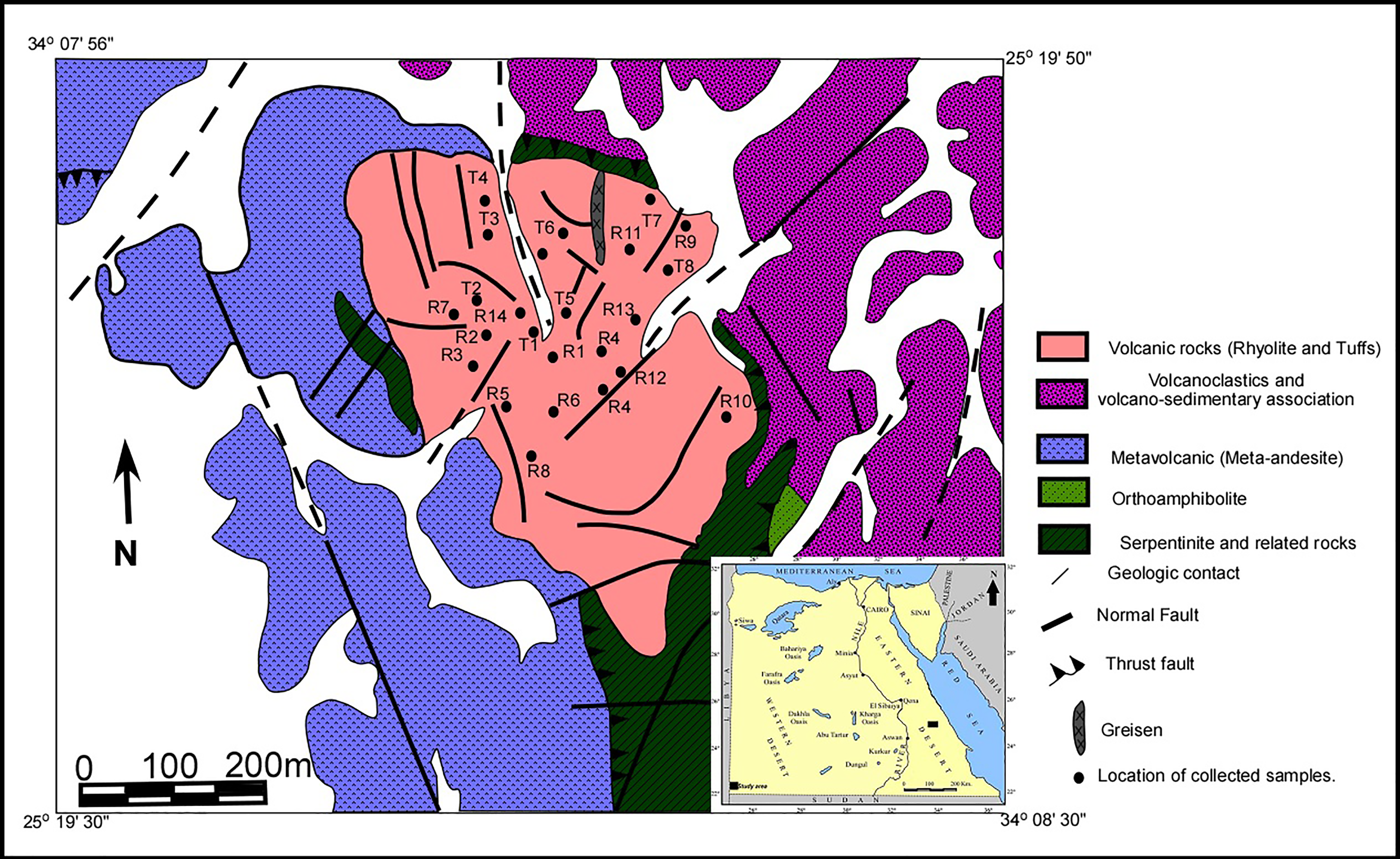
Geological map of Um Safi area, Central Eastern Desert. 12
Geological outlines
Um Safi area is bounded by Latitudes 25°19′38.83″ and 25°19′50.14″ N and Longitudes 34°08′4.49″ and 34°08′18.79″ E. The acidic volcanics of Um Safi form relatively moderate to high relief hills (600 m) extruded in the volcano-sedimentary association (slate, phyllite, banded iron formation and schist) and serpentinites with sharp structural contacts. They exposed in the central part of Um Safi area as small oblate body forming three hills striking NW–SE, covering an area about 0.3 km2 (Figure 1).
Um Safi acidic volcanics originated from successive eruptions of rhyolitic lavas and their volcanogenic tuffs. Rhyolite is very fine-grained rock that brecciated and fractured along the marginal parts of the extrusion and along the main faults in the area. This rhyolite is intruded by offshoots of pink microgranite with gradational contacts (Figure 2a), where the microgranite is surrounded by thermal transitional zone. Rhyolite is characterised by yellow to buff colours according to processes of kaolinisation, sericitisation and the other processes of alteration (Figure 2), where it is invaded by N–S sub-vertically greisenised microgranite. 12
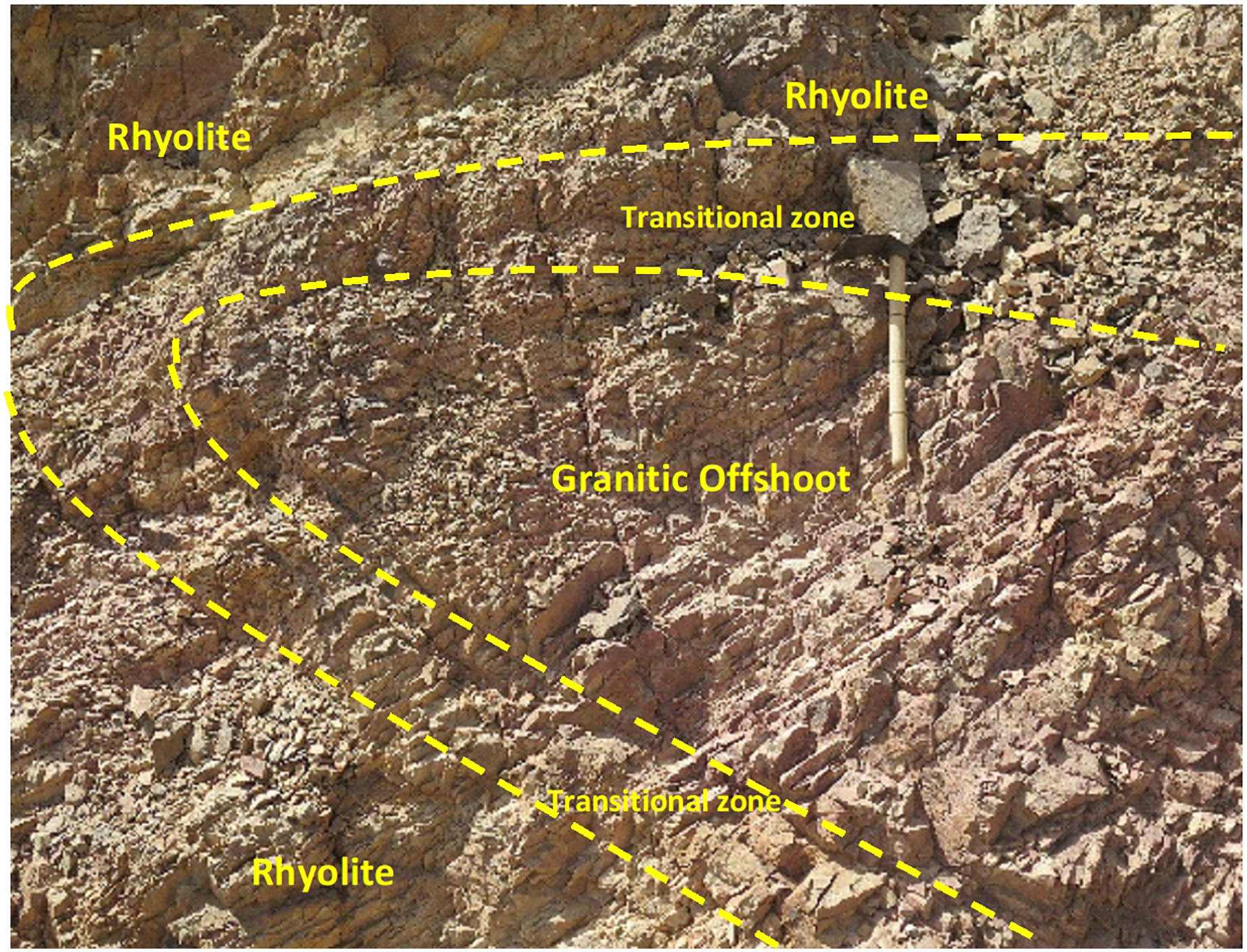
Field photograph showing offshoot of microgranite surrounded by transitional zone intruding Um Safi rhyolite with gradational contacts.
Tuffeceous rocks found associting rhyolite in the field; they are characterised by flesh color and could be categorised according to their appearance into compact tuff (Figure 3a) and laminated tuff (Figure 3b). Both of them characterised by presence of obvious lithic fragments and pink fluorite crystals.
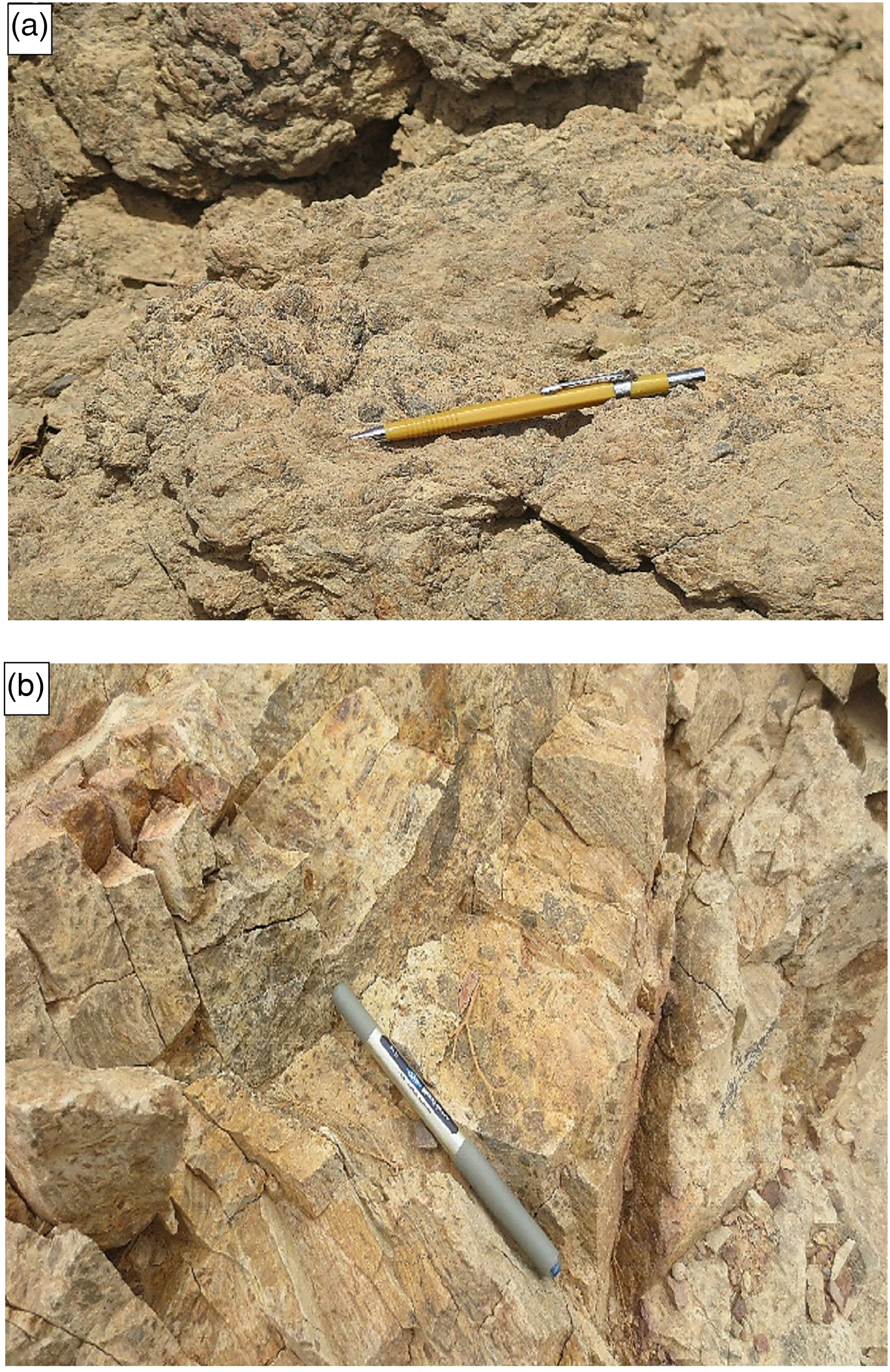
Field photographs of Um Safi volcanogenic tuffs showing: (a) compact lithic tuff with crystals of fluorite and (b) laminated lithic tuff with crystals of fluorite.
Petrography
The microscopic examination shows that the studied acidic volcanics of Um Safi are highly altered and represented by rhyolite and the associated volcanogenic tuffs.
Rhyolite
It is hard rock ranging in color from yellow to buff. Microscopically; it is composed essentially of quartz and K-feldspar with few crystals of plagioclase and muscovite, embedded in glassy quartz-feldspathic groundmass (Figure 4a). Quartz is found as microcrystalline anhedral crystals less than 200 µm in size (Figure 4b). Potash feldspar occurs as subhedral to euhdral crystals of sanidine and mostly sericitised (Figure 4c). Plagioclase is recorded as anhedral zoned crystals. The rock was subjected to different types of alterations such as; silicification, sericitisation, ferrugination, albitisation and muscovitisation (Figure 4a and b), Fluorite is recorded in the investigated rhyolite as anhedral crystals that are filling cavities, they are mostly colorless and occasionally violet in color (Figure 4d).
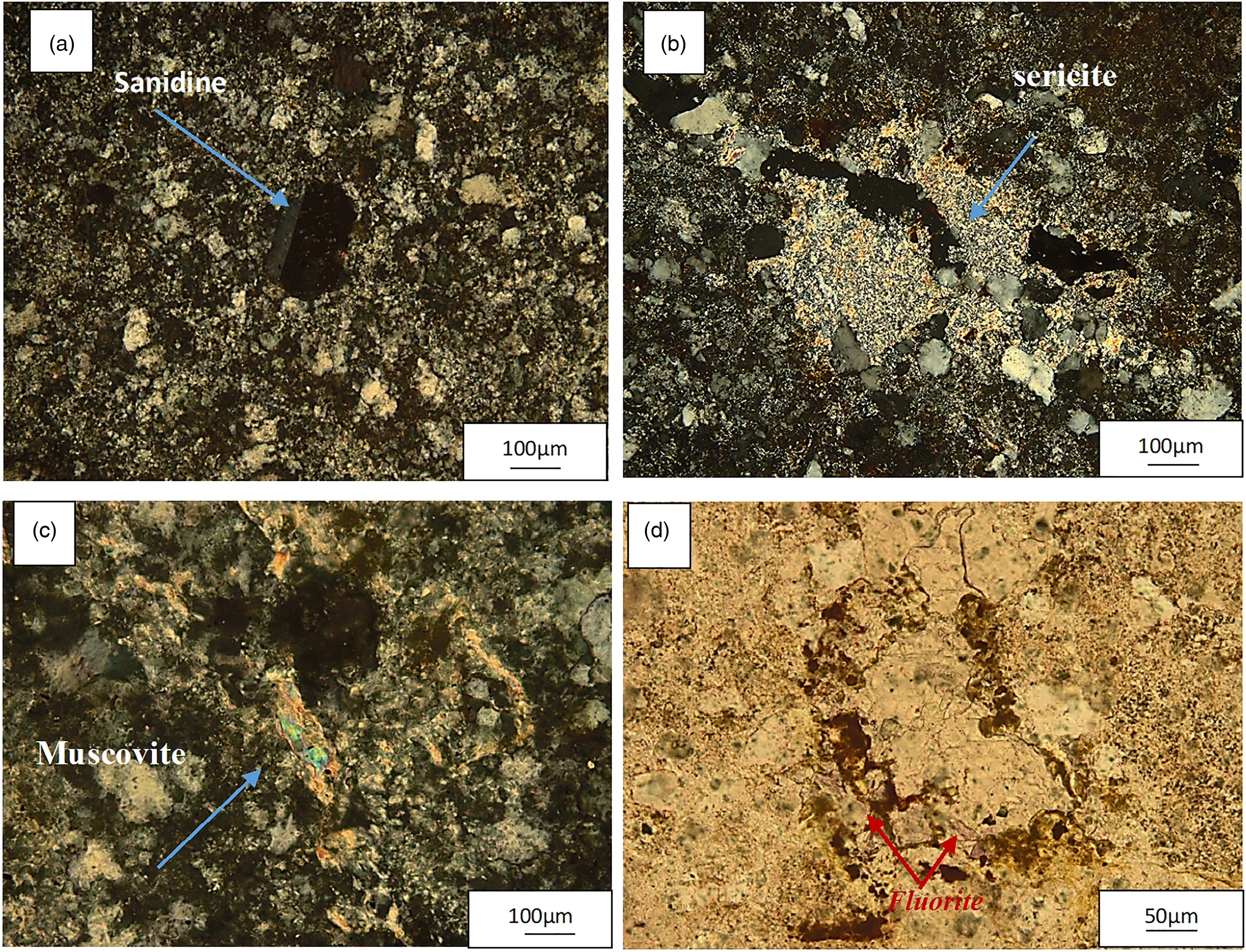
Photomicrographs of Um Safi rhyolite showing: (a) euhedral crystal of Sanidine, XPL, (b) sericitzation and silicification of potash feldspar, XPL, (c) muscovite associating sericitised k-feldspar, XPL and (d) cavity filled by violet fluorite, PPL.
Volcanogenic tuffs
The studied volcanogenic tuffs are reddish grey in color with compact or laminated appearance. Both of them composed of potash feldspar and quartz; the former is compact, and composed of microcrystalline quartz, k-feldspar and perthite that are embedded in a glassy quartz-feldspathic ground mass with sericitisation (Figure 5a).

Photomicrographs of Um Safi volcanogenic tuffs: (a) sericitisation and silicification of the K-feldspar in volcanogenic compact lithic tuffs, XPL; (b) alignment of microcrystalline quartz and potash feldspar in volcanogenic laminated lithic tuffs, XPL; (c) chalcedony with comb structure in volcanogenic laminated lithic tuffs, XPL.
The latter composed of successive laminations of quartz and potash feldspar as aligned microcrystalline crystals causing the lamination (Figure 5b); quartz also recorded as chalcedony characterised by comb structure (Figure 5c). Both of them enclose lithic fragments of rhyolitic composition, essentially of potash feldspar and quartz with hematisation (Figure 6a). Occasionally, it encloses spherulites of potash feldspars and quartz (Figure 6b).
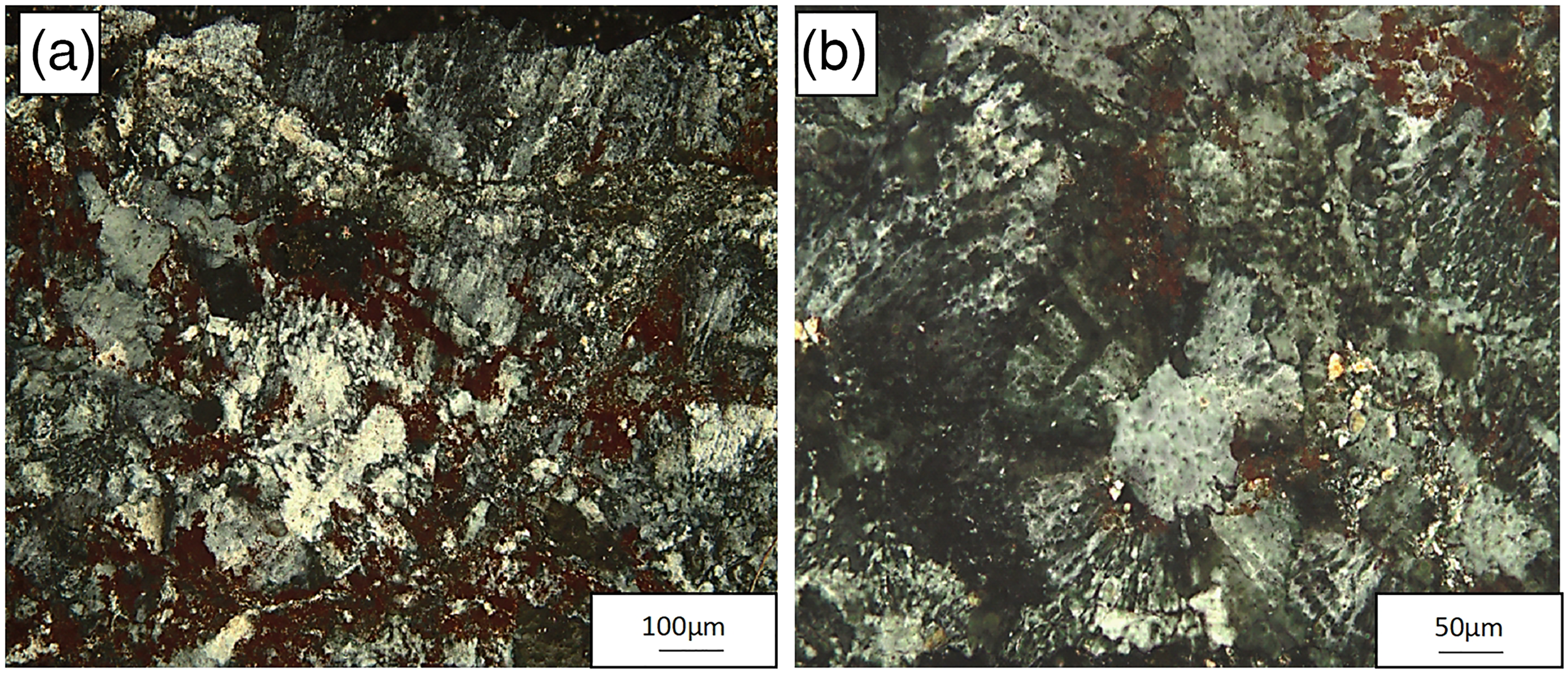
Photomicrographs of lithic fragment of rhyolitic composition showing: (a) microcrystalline quartz and K-feldspar with silicification and hamatisation, XPL; (b) spherulitic texture of potash feldspar and quartz, XPL.
Mineralogical study
The mineralogical investigation shows that the rhyolite of Um Safi exhibits large number of rare metals mineralisation. The separated minerals in this study were classified into three groups: (a) radioactive minerals, (b) REEs-bearing minerals and (c) base metal minerals.
Radioactive minerals
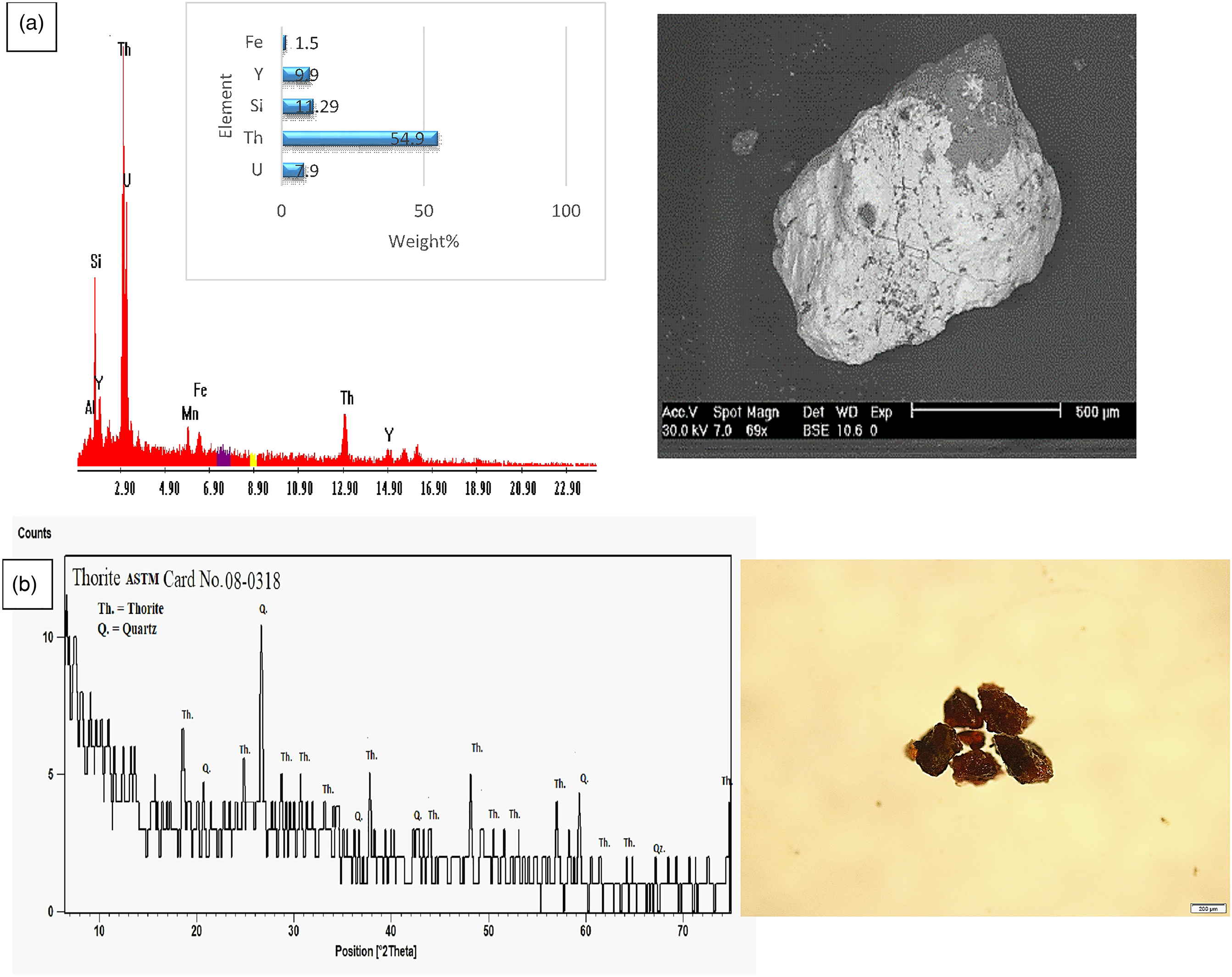
(a) EDX pattern and BSE image of thorite and (b) XRD-pattern and stereo-photomicrograph of thorite.
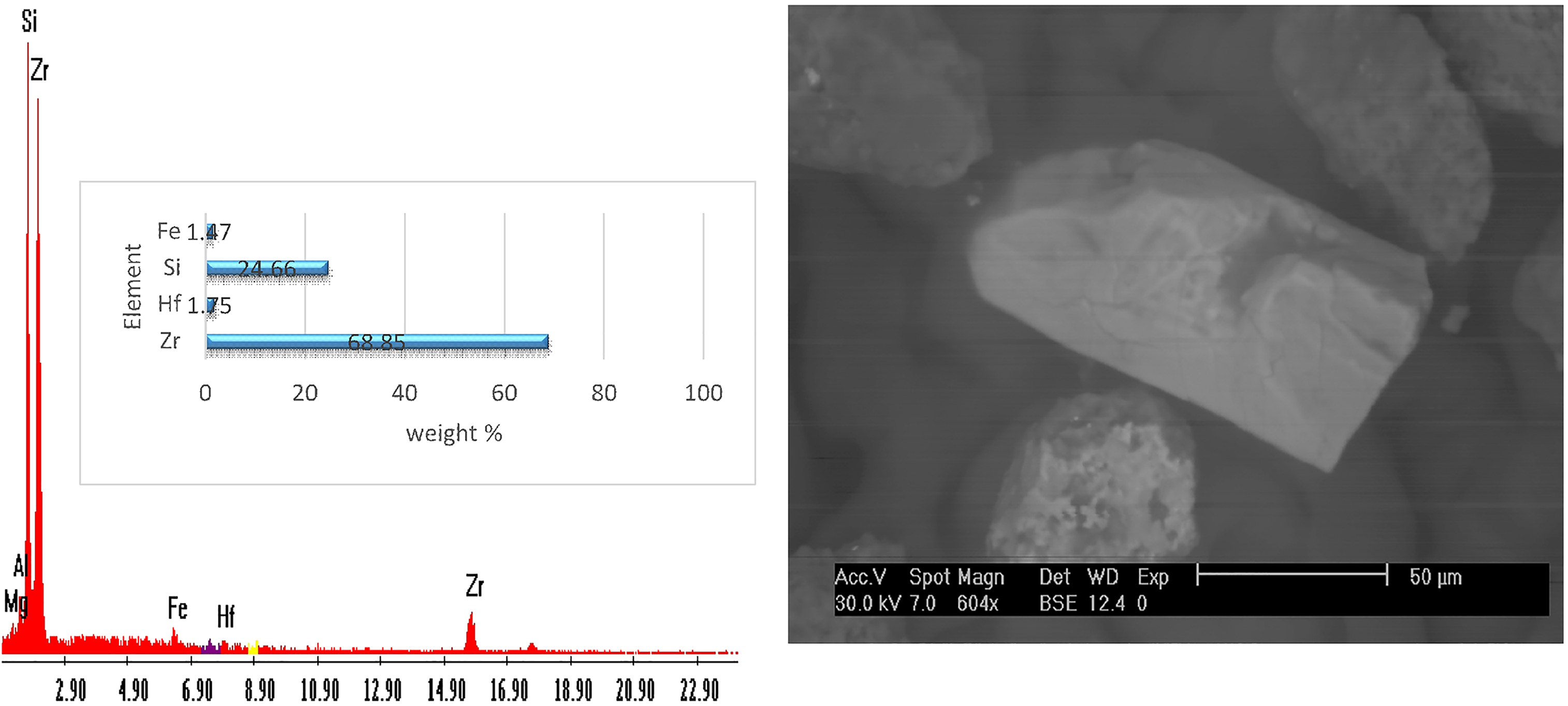
EDX pattern and BSE image of zircon.
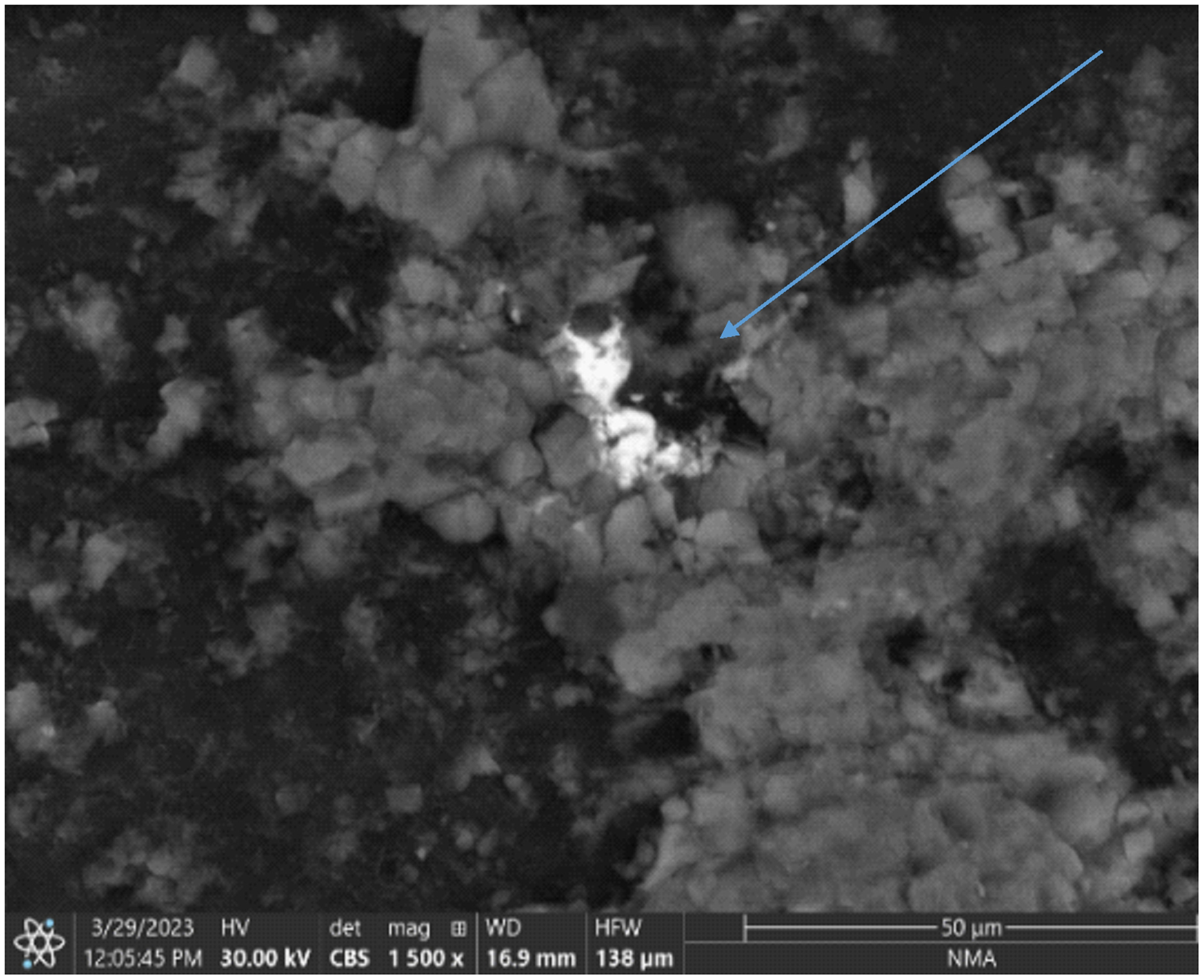
BSE image of gel-like zircon and columbite.
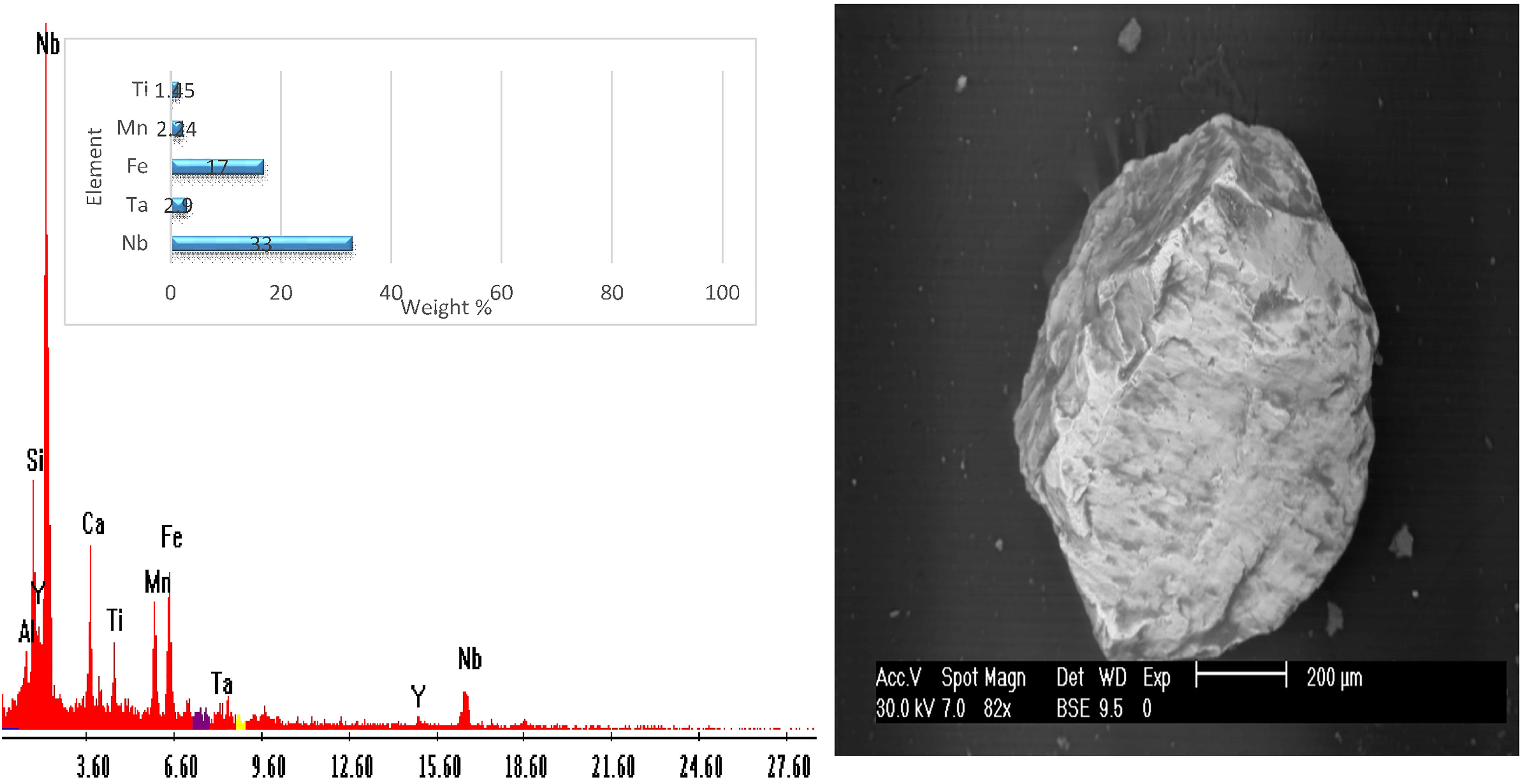
EDX pattern and BSE image of Fe-columbite.
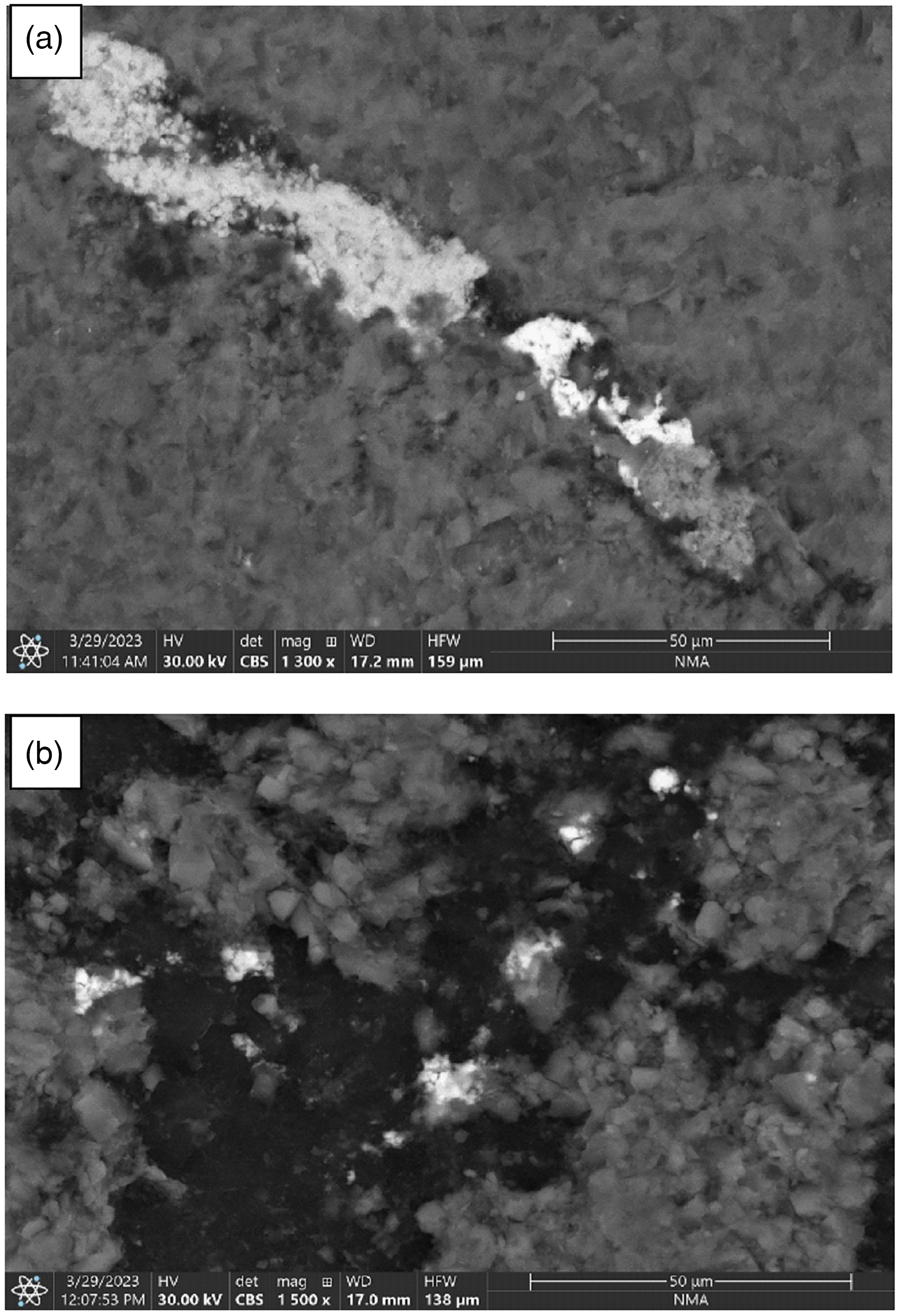
BSE images of (a) fissure filling columbite and (b) specks of columbite with gel-like zircon.
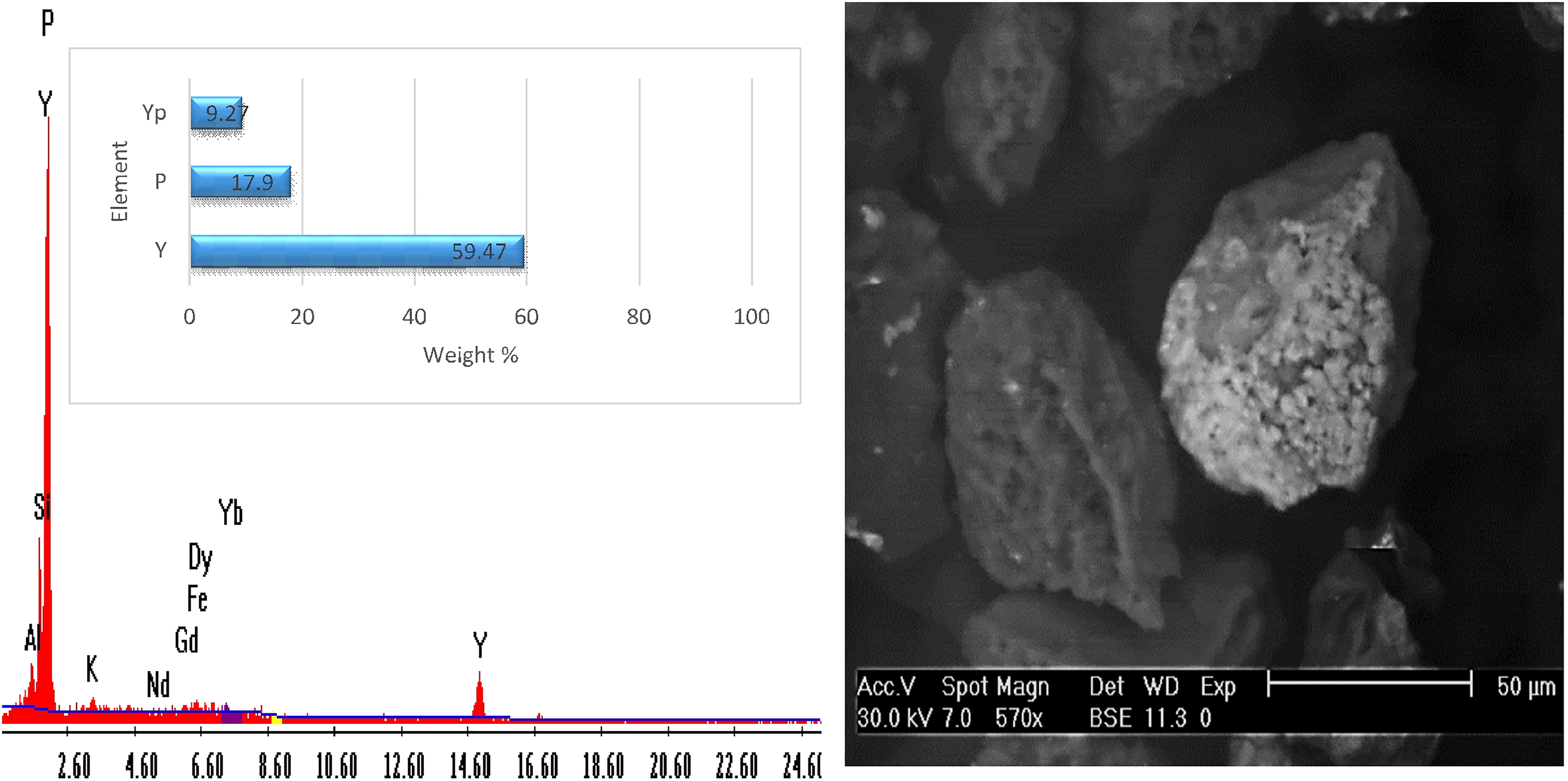
EDX pattern and BSE image of xenotime.
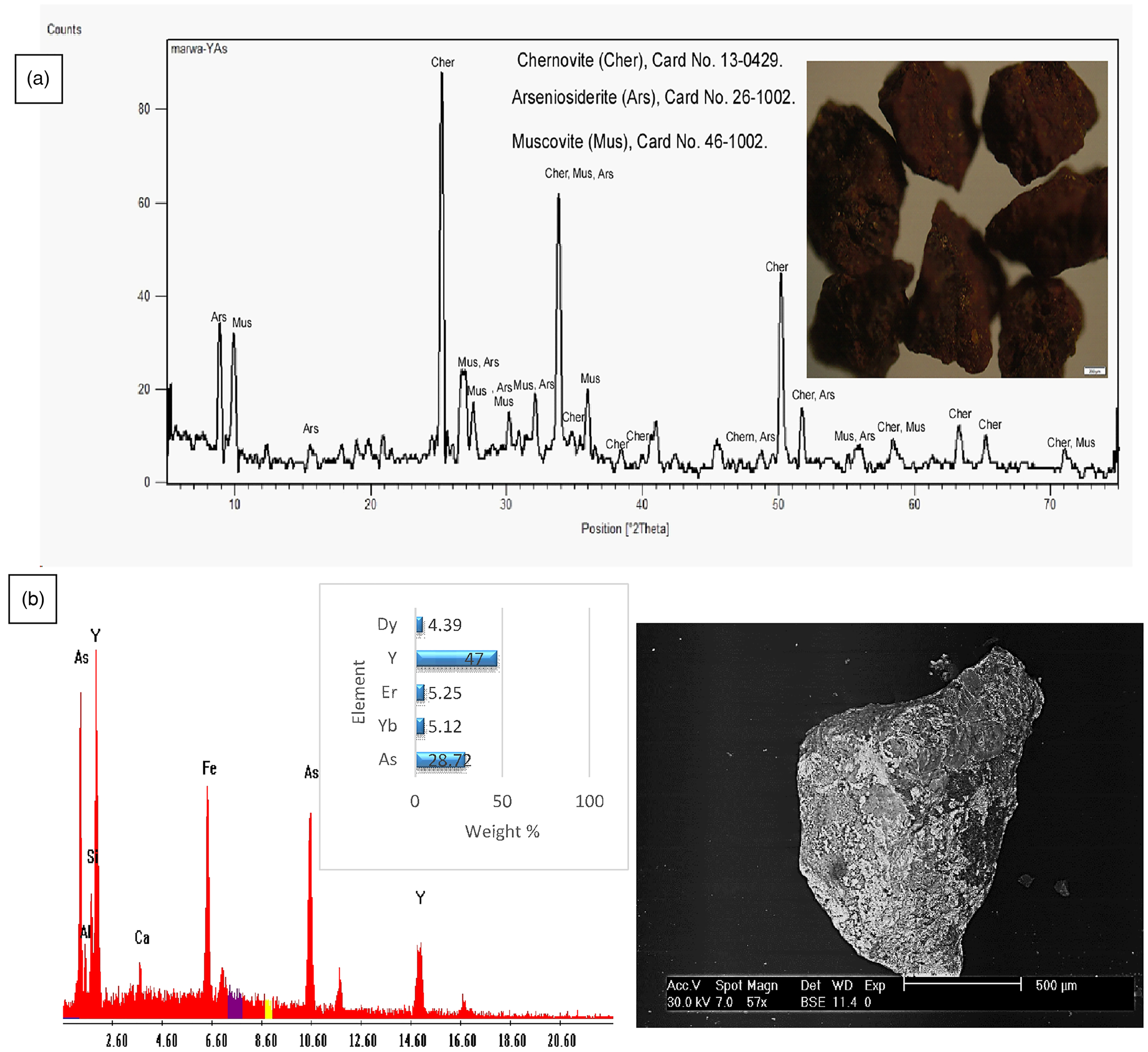
(a) XRD pattern and stereo-photomicrograph of chernovite and aresenosiderite minerals and (b) EDX pattern and BSE image of chernovite and aresenosiderite,.
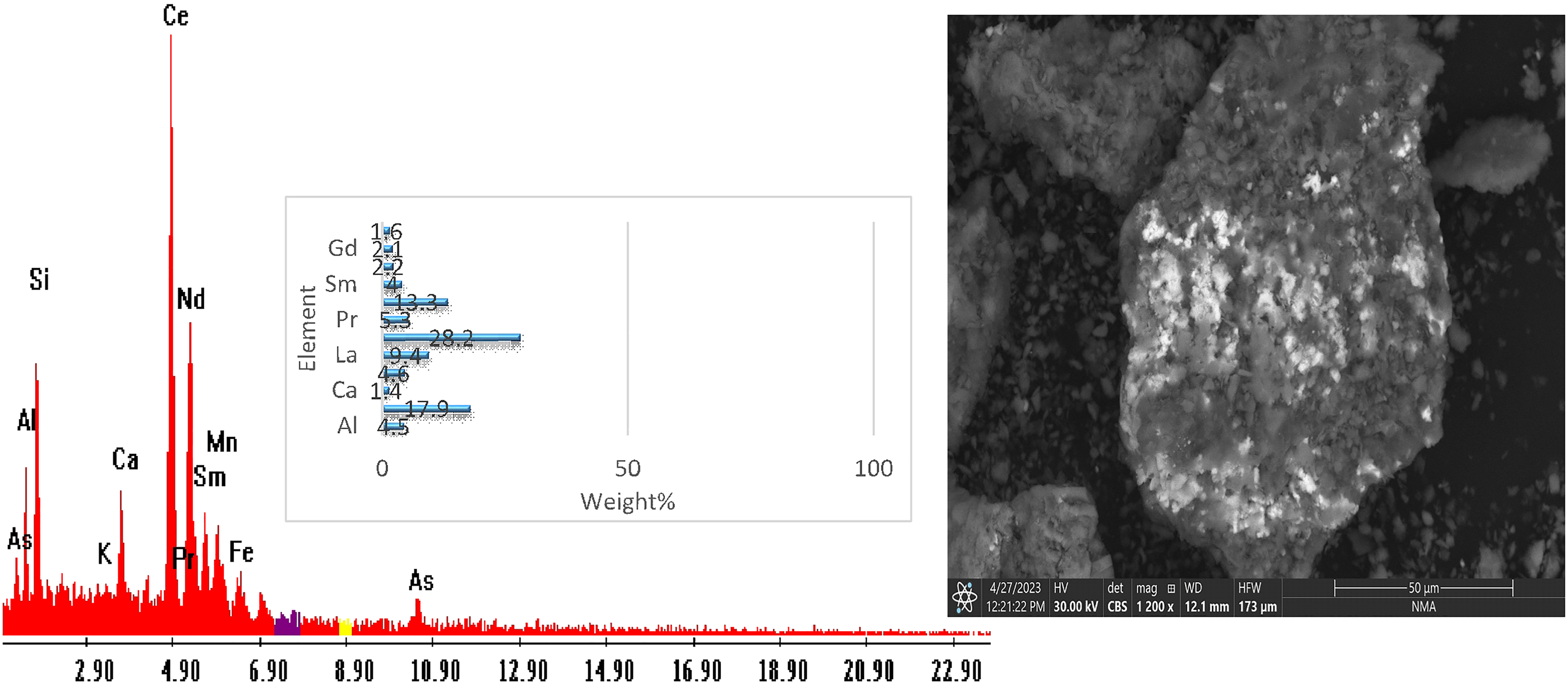
EDX pattern and BSE image of allanite.
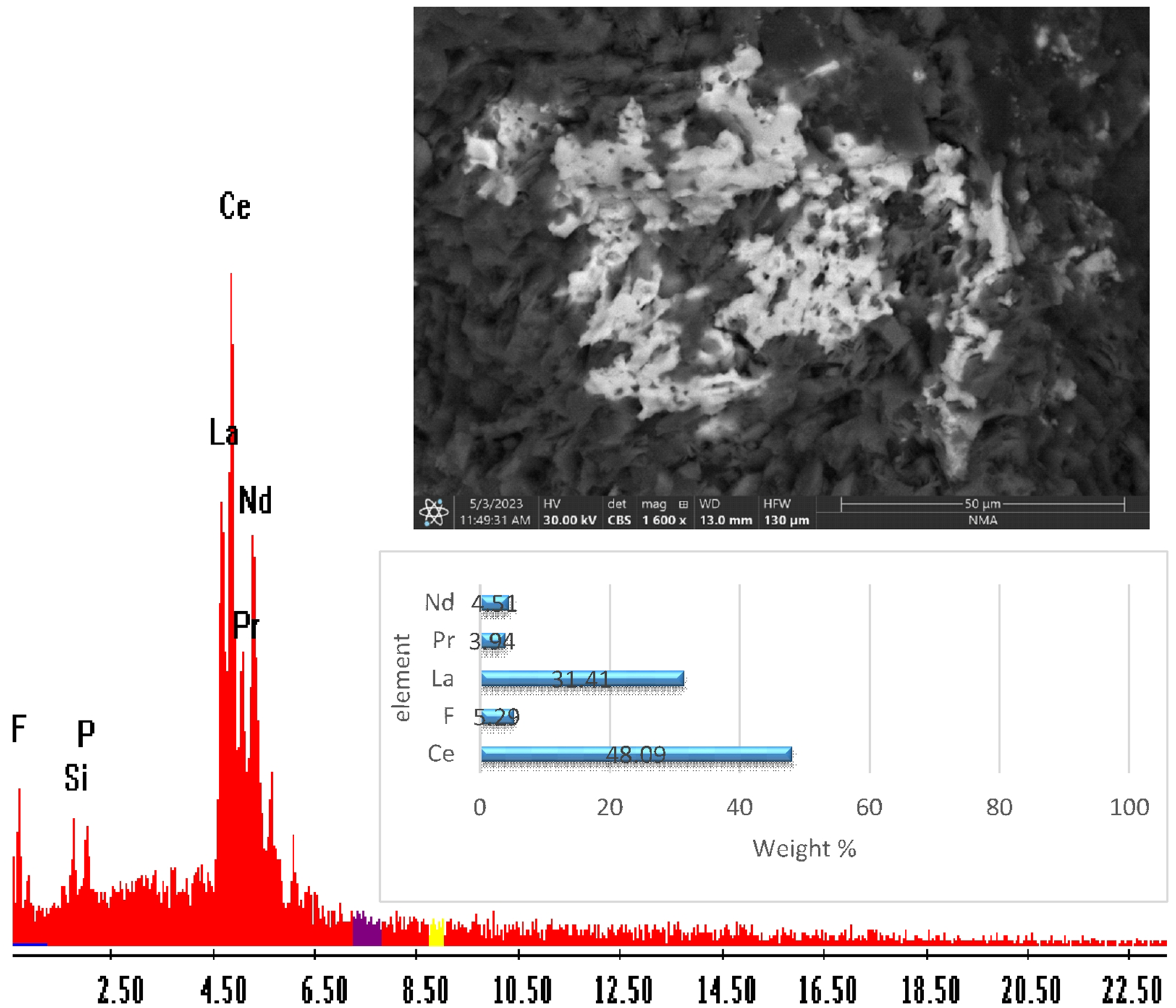
EDX pattern and BSE image of bastnäsite.
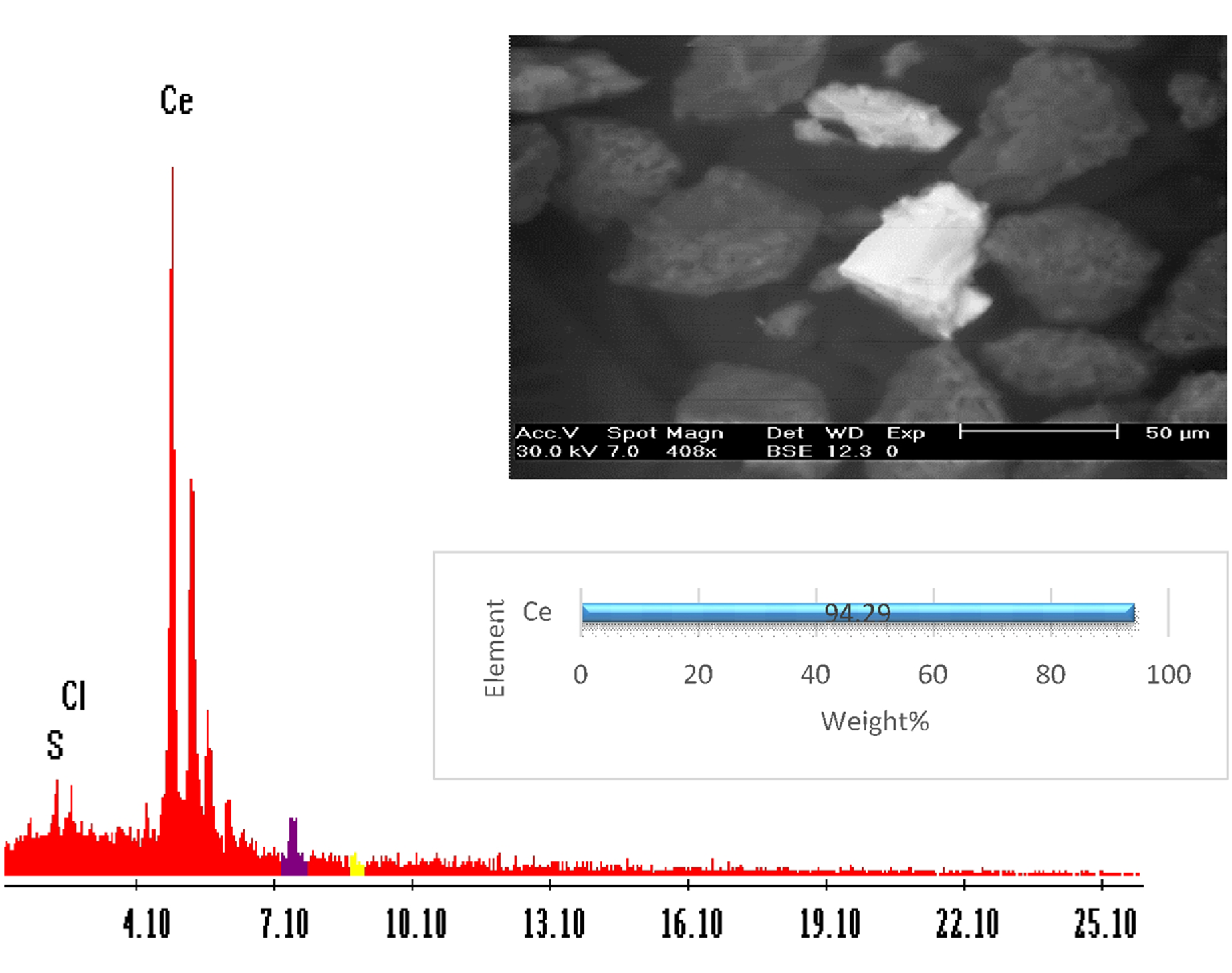
EDX pattern and BSE image of cerianite.
They are confirmed by XRD and their pattern is shown in Figure 17a. Wolframite, heubnerite and scheelite were discovered as black euhedral crystals mixed of the three minerals in the current investigation. Their composition has been shown by EDX analysis as W (39.55%), Ca (32.11), Mn (24.34%) and Fe (4%) (Figure 17b).
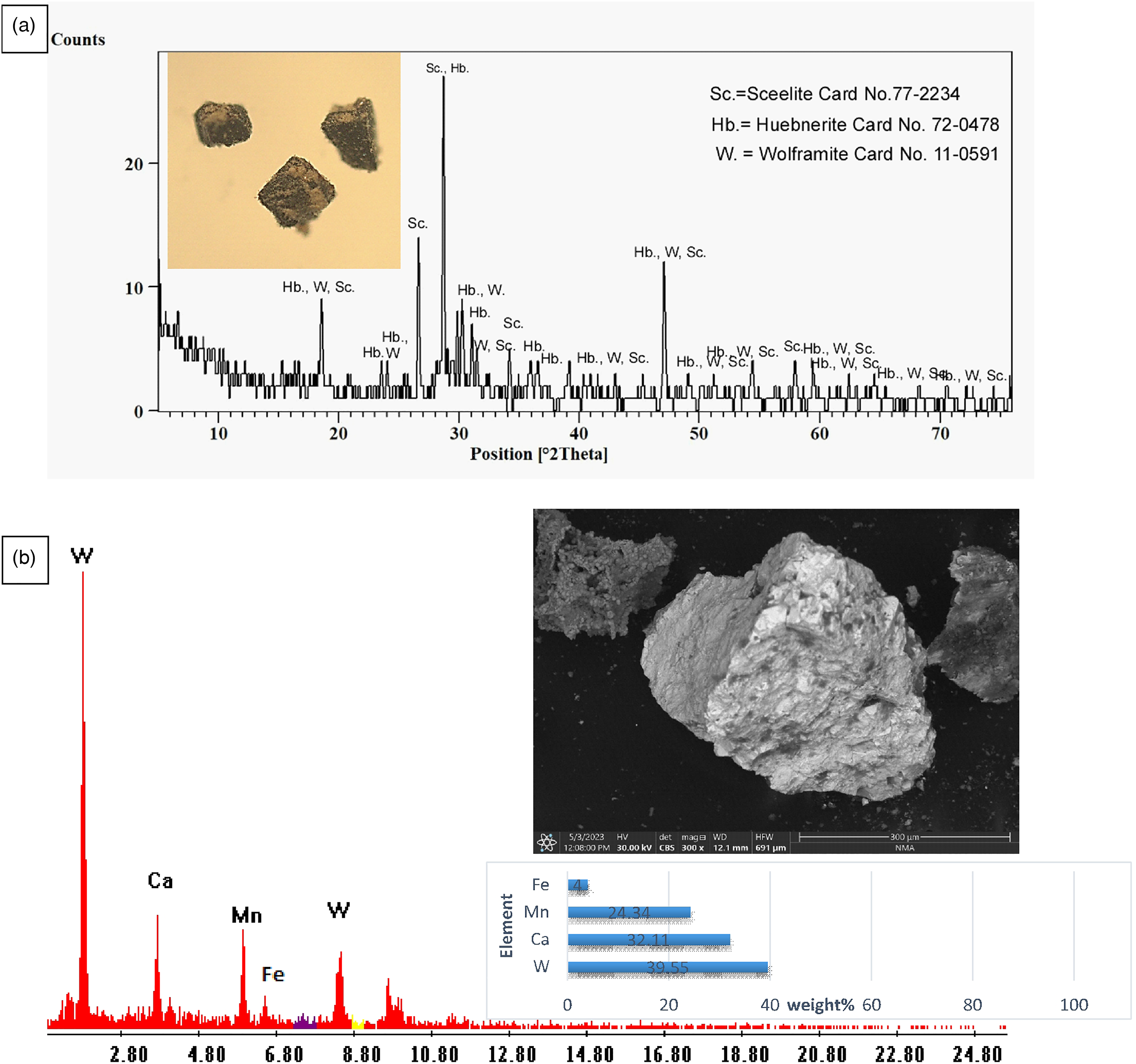
(a) XRD pattern and stereo-photomicrograph of tungsten minerals and (b) EDX pattern and BSE image for composite crystal of wolframite, heubnerite and scheelite minerals
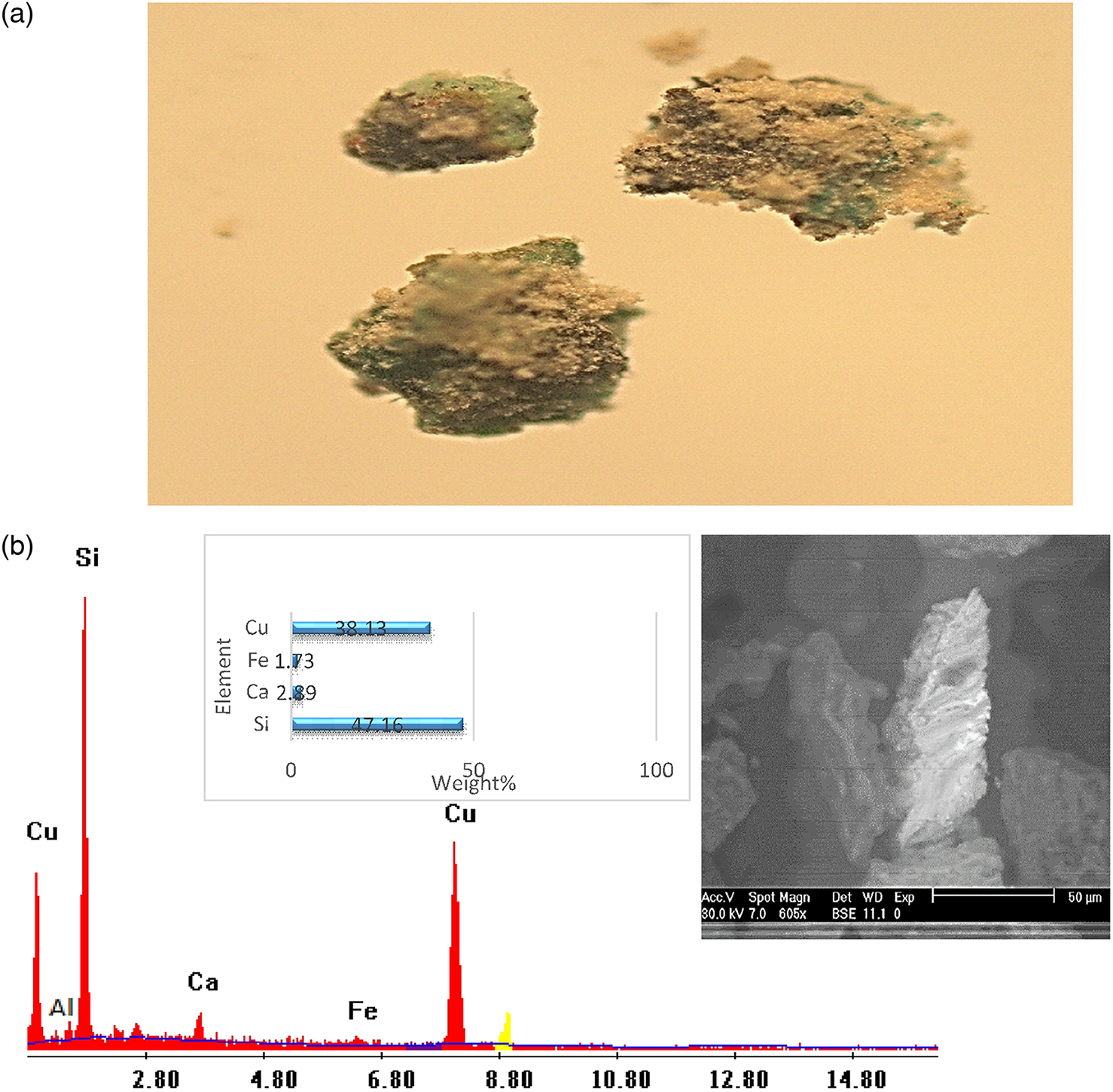
(a) Photomicrograph, and (b) EDX and BSE of chrysocolla.
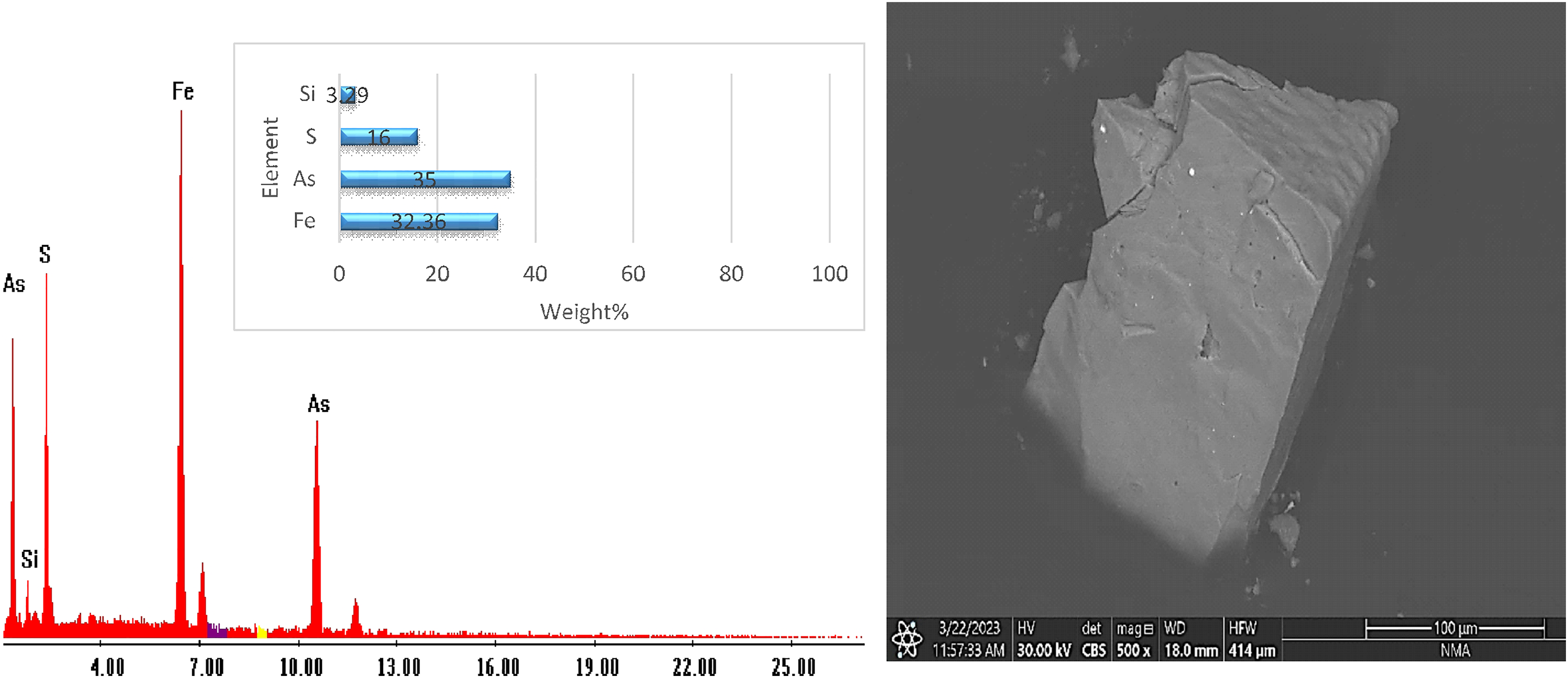
EDX pattern and BSE image of arsenopyrite.
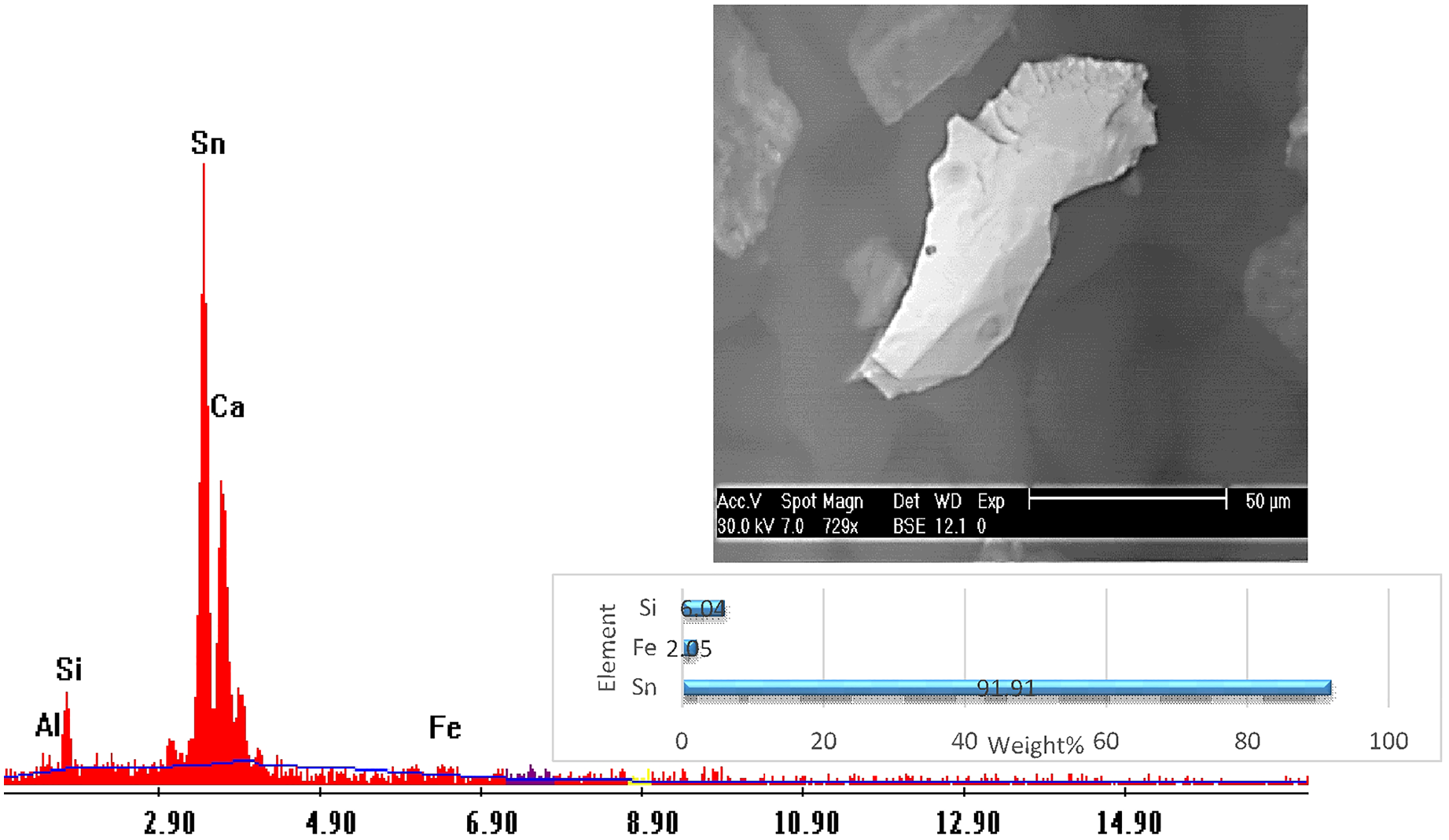
EDX pattern and BSE image of cassiterite.
The rare metals are associated with other minerals such as
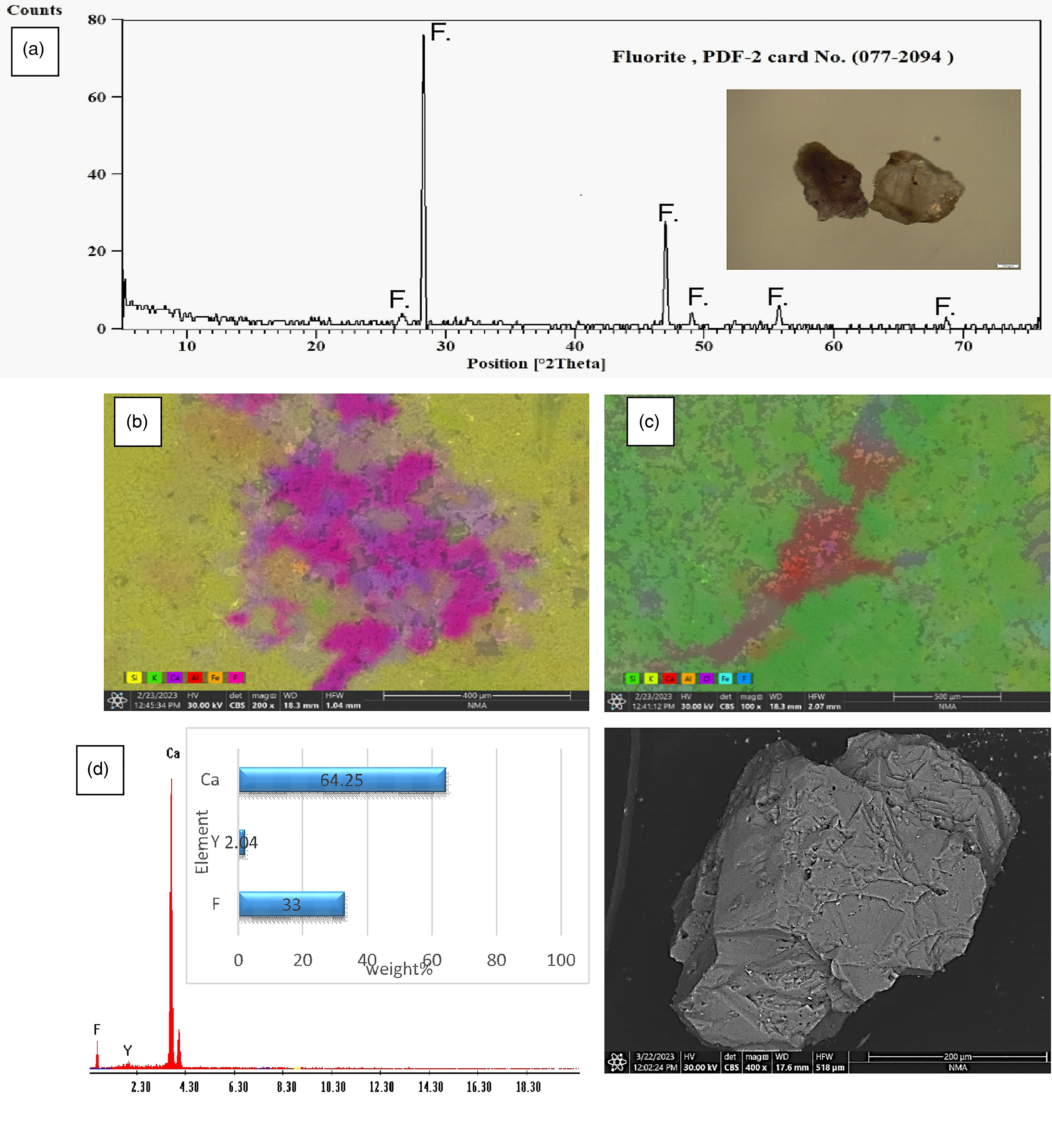
(a) XRD and stereo-photomicrograph, (b) color SEM showing the void-filling, (c) fracture filling, and (d) EDX & BSE image of fluorite.
Pyrite is recorded in the volcanogenic lithic tuffs as euhedral cubic crystals in which Fe represents about 54.3% and S (45.7%) (Figure 12a). Pyrite is completely oxidised into martite in the investigated rhyolite (Figure 22b).
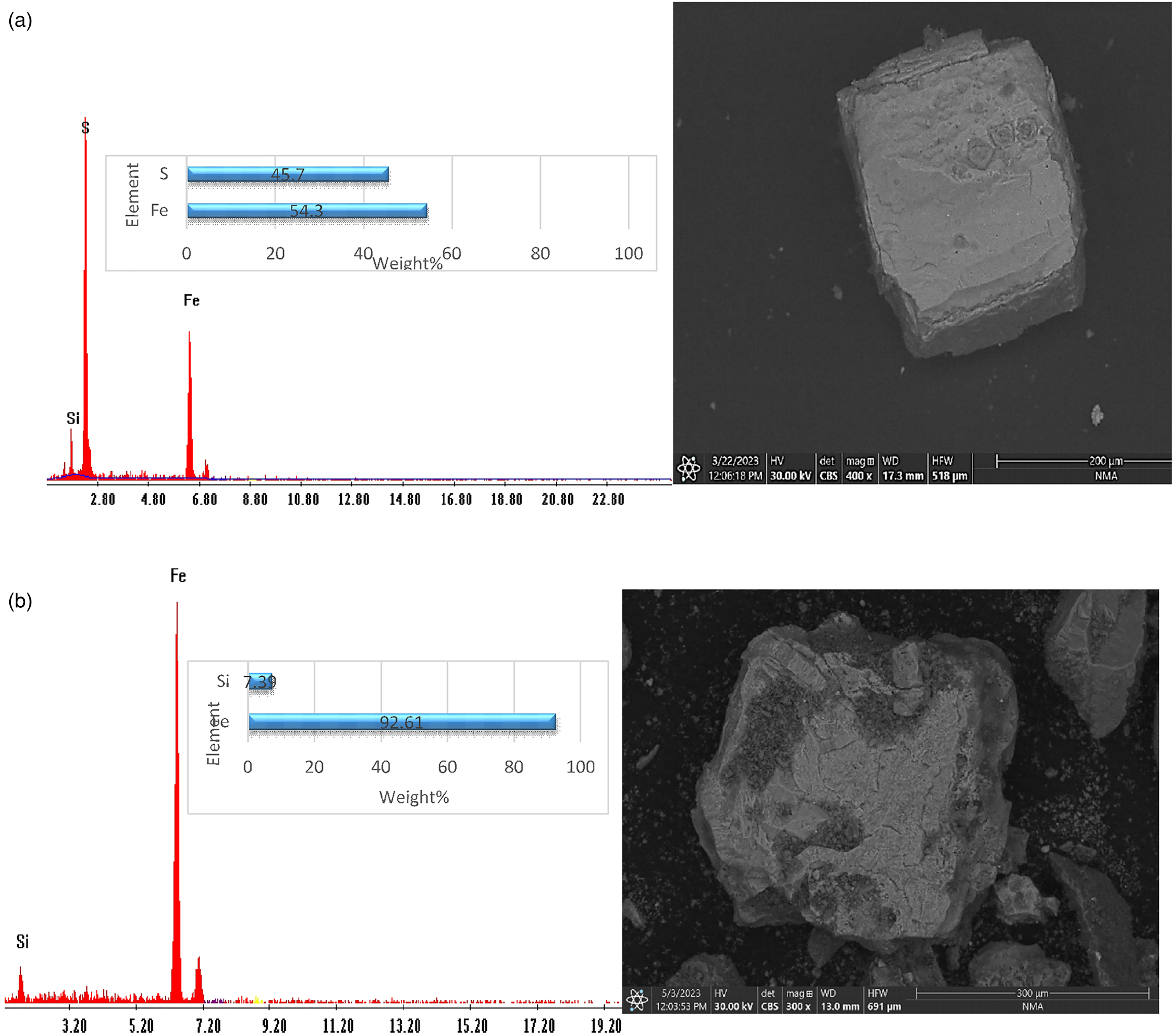
EDX pattern and BSE image of (a) pyrite and (b) martite.
Geochemical characteristics of Um Safi acidic volcanics
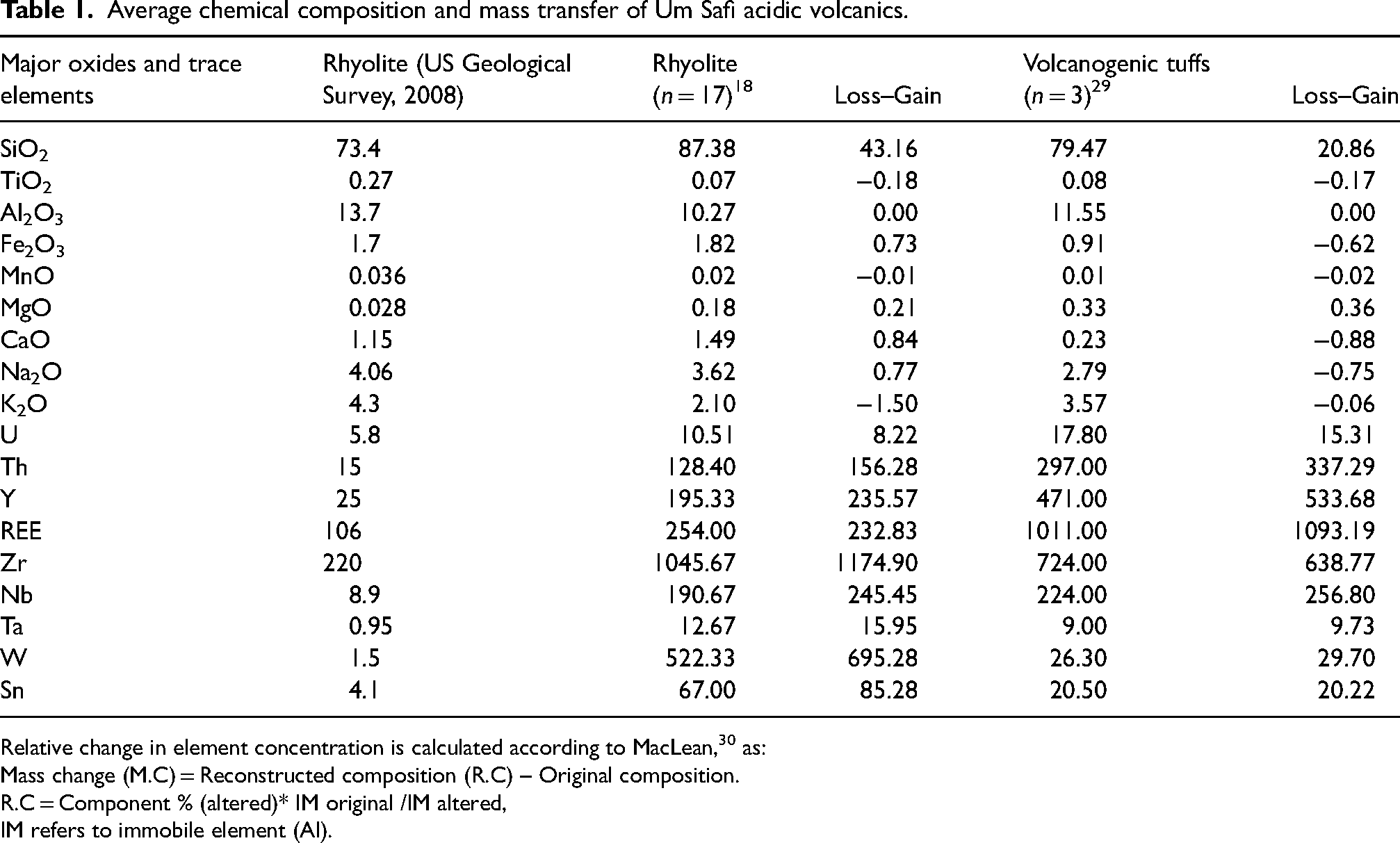
Ragab 18 studied the geochemical characteristics of the altered rhyolite of Um Safi, clarifying that it shows high contents of W, Zr and Sn (522, 1045 and 67 ppm, respectively). She added that the altered rhyolite characterised by predominance of HREE over LREE and attributed their enrichment together with Y to influx of F-rich pegmatitic phase. On the other hand, Abdel-Bary 29 studied the volcanogenic tuffs and clarified that they have high contents of Th, Y, Nb and REE with average contents as 297, 471, 224 and 1011 ppm, respectively (Table 1). These data confirm well with the minerals obtained in the present study, the high concentrations of W, Zr, Sn, Th, Y and Nb can be attributed to the presence of their minerals as confirmed by the mineralogical investigation.
Average chemical composition and mass transfer of Um Safi acidic volcanics.
Relative change in element concentration is calculated according to MacLean, 30 as:
Mass change (M.C) = Reconstructed composition (R.C) – Original composition.
R.C = Component % (altered)* IM original /IM altered,
IM refers to immobile element (Al).
Because of the mass and chemical changes caused by hydrothermal alteration, MacLean's 30 approach is used to calculate the mass change in the investigated volcanics. Assuming that Al is the best isocon since it is the least movable during alteration. These calculations show that the majority of significant cations are eliminated during various alteration processes, with the exception of SiO2, which is considerably concentrated due to the silicification process, particularly in volcanogenic tuffs (Table 1). The enrichment in iron fits well with the hematitisation process in the investigated rhyolite, which increases also Ca due to the formation of void-filling fluorite. Hematisation process in rhyolite is also a better accumulator of Y, U, REE, and several chalcophile elements such as Pb, Zn, As and Cu. 31 The increase of Na in Um Safi rhyolite suggests Na-Metasomatism that may concentrate more Y, which increases in parallel to Ca probably due their coexistence in secondary fluorite. Also this Na-metasomatism led to the formation of albite (Figure 23). The enrichment of U and Th in the investigated volcanics can be attributed to the presence of thorite mineral. The strong enrichment in W, U, Zr, Nb, Y and REE is attributed to their liberation from accessory minerals such as wolframite, zircon, columbite, xenotime and allanite.
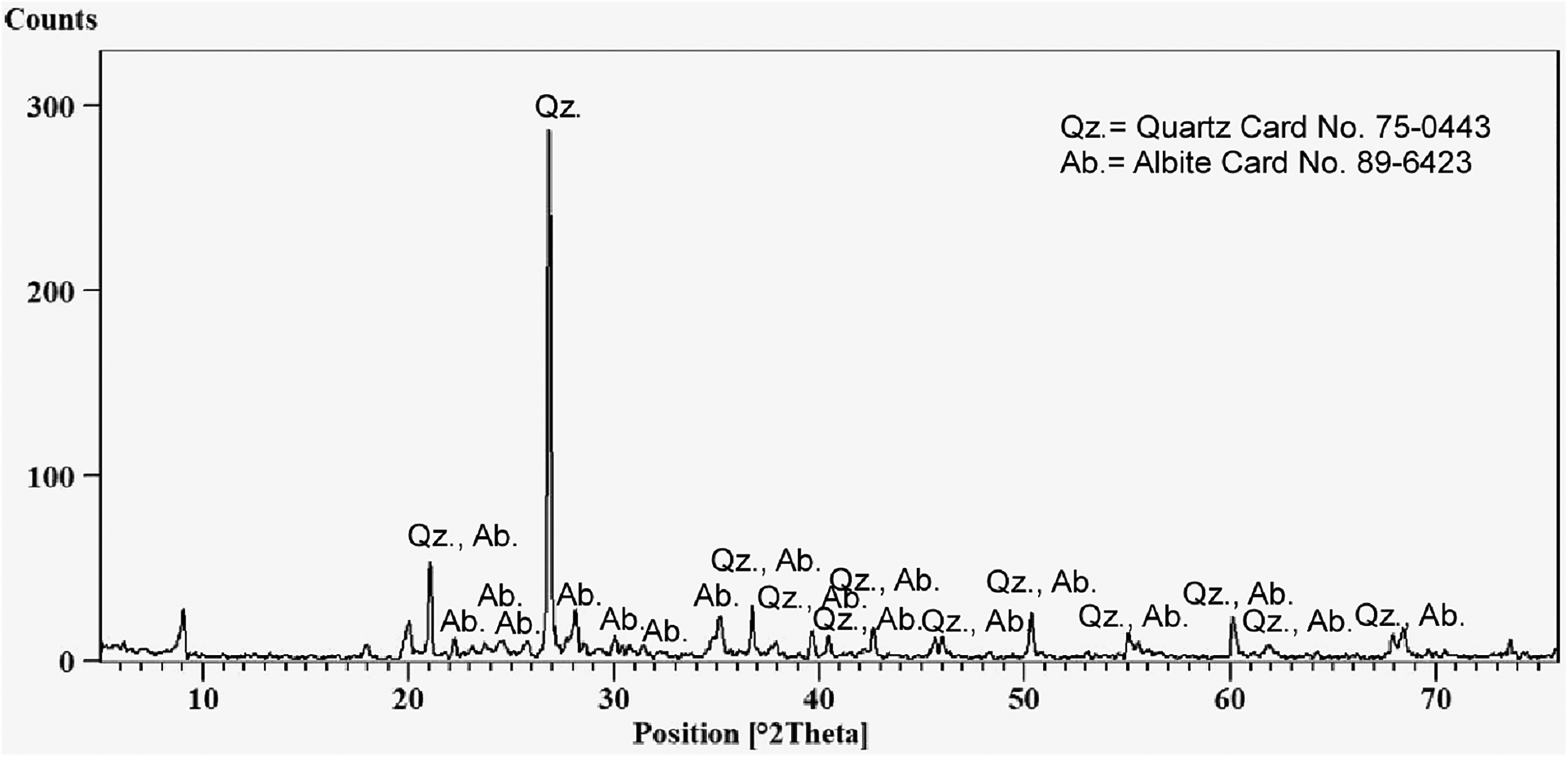
XRD pattern of albite and quartz.
Discussion
The previous studies which conducted with the volcanics of Um Safi attributed the origin of their rare metals to the effect of excessive hydrothermal metasomatic alteration processes (Ibrahim, op. cit.; Ragab, op. cit.). The structure evolution of Um Safi area shows a final structure episode of faulting (strike slip faults) in several trends led to the emplacement of post granitic dykes. 12 These rare metals mineralisation are structure controlled and occur in many forms such as accessory minerals, disseminated minute dispersion, filling the micro-fissures or as coating the surfaces of joints.
The petrographical and mineralogical investigations reveal that Um Safi volcanics were affected by the following alterations silicification, sericitisation, ferrugination and albitisation. Later oxidation reactions such as muscovitisation and hematisation are common. Fluorite acts as secondary filling in the cavities that resulting from dissolution of quartz. The scarcity of plagioclase, the presence of albite, the various alteration processes and the occurrence of secondary silica as well in the investigated acidic volcanics led to the following discussion on the genesis of the recorded rare metals mineralisation.
There are many evidences supporting the effect of alkaline metasomatic reactions on Um Safi acidic volcanics including: (a) their chondrite-normalised REE patterns showed tetad effect of M-type and notable negative Eu anomaly, and the high fractionation of Nb/Zr, Y/Ho, La/Sm and Nb/Ta geochemical pairings (Ragab., op. cit.), (b)the presence of cerianite (Ce) mineral which is exclusively associated with alkaline rocks and supports the oxidation of part of Ce into Ce4+ 32 and (c) the observed sericitisation process during the petrographic study.
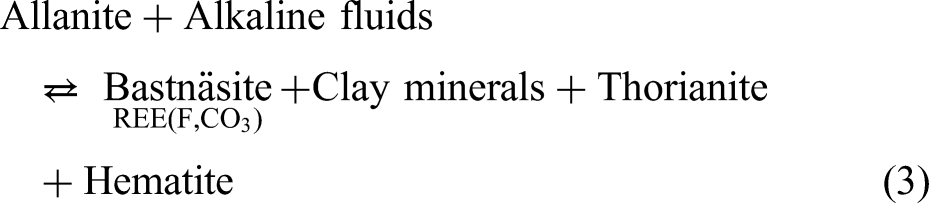
The origin of hydrothermal fluids is debatable, whether they derived from magma or heated by convection currents and then acted on magmatically pre-enriched rocks (El Kammar et al., op. cit.). Many rare metals, including Nb, Zr, W and REE + Y, have been remobilised and precipitated as a result of oxidation–reduction and pH changes. These ascending hot fluids were alkaline and oxidising. The subsequent reactions of these hot fluids with the hosting rhyolite, as well as mixing with meteoric water, caused some physico-chemical changes in these fluids, resulting in diverse mineral transformations, as reflected by the following reactions:
Primary quartz was dissolved by the alkaline solutions, as estimated by the following reactions (El)
31
: The recorded syngenetic minerals include thorite, zircon, xenotime. Thorite may be formed by magmatic differentiation or as a product from breakdown of a variety of minerals including allanite,
34
zircon,35,36 monazite
37
and bastnänsite.
38
Xenotime mineral controls the distribution of Y and HREE and to a less extent, Th and U, during anatexis.
39
The presence of alkali cation (K+) in xenotime supports the assumption of alkali metasomatic reaction. The existence of the Th–Y–Zr mineral group as bright patches or zones in the altered phases as a result of significant, late- to post-magmatic fluid-rock interaction followed by alteration processes was used to discuss the intermediate solid solution reactions.
40
Tungsten mineralisation is attributed to highly fractionated granites and dominated by greisen, quartz-vein, skarn and porphyry types.21,22 Wolframite (Mn, Fe WO4) is the prober ore mineral of tungsten, that associated with tin in the granites. Heubnerite (MnWO4) is an end-member in the wolframite group. Scheelite (CaWO4) is a calcium tungsten oxide mineral that exists in high-temperature hydrothermal veins and less commonly in granite. Wolframite mineralisation invariably accompanies greisen, while scheelite mineralisation is mostly associated with skarnisation.23–25 The replacement of wolframite by scheelite or vice versa is frequently observed in granitoids-hosted tungsten deposits.41,42 The hydrothermal solutions perform this replacement. In case of Um Safi volcanics the Mn and Fe of wolframite were replaced by Ca that was derived from plagioclase causing the formation of secondary scheelite. Arsenopyrite is the most common arsenic sulphide mineral in the hydrothermal and magmatic ore deposits that is formed under high temperature and a reductive environment.
43
Cassiterite which is found in high-temperature hydrothermal veins, granitic pegmatites and greisens associated with granites, microgranites and quartz porphyries, where it is frequently associated with other oxides such as wolframite, columbite, tantalite, scheelite and hematite.
44
The association of wolframite, Heubnerite, cassiterite, copper, fluorite and sulphides is recognised as a distinctive feature of magmatic to hydrothermal transition mineralisation. The transition interval from the orthomagmatic stage, dominated by condensed crystal-melt interactions, to the hydrothermal stage, dominated by condensed crystal-melt-magmatic volatile phase interactions, involves highly mobile and reactive volatile constituents that leave abundant signs of their activity. Sulphur, chlorine, fluoride, alkalis and metals such as Cu, Pb, Zn, Sn, W, Mo, Au, Li, As and others are carried by magmatic fluids.45,46 In Um Safi volcanics, the occurrence of this mineralisation can be attributed to the effect of the intruded off shoots of greisened microgranite into rhyolite forming this mineralisation. The original magmatic xenotime (Y-phosphate) is altered to chernovite (Y-arsenate) by significant replacement of the primary phases by As-rich fluids with high oxygen fugacity (fO2) (Ondrejka et al., op. cit.).
The reaction of resulting soluble Na-silicate took place with plagioclase forming albite this explains the rarity of plagioclase in the examined thin sections and the existence of albite associating quartz as proved by XRD.


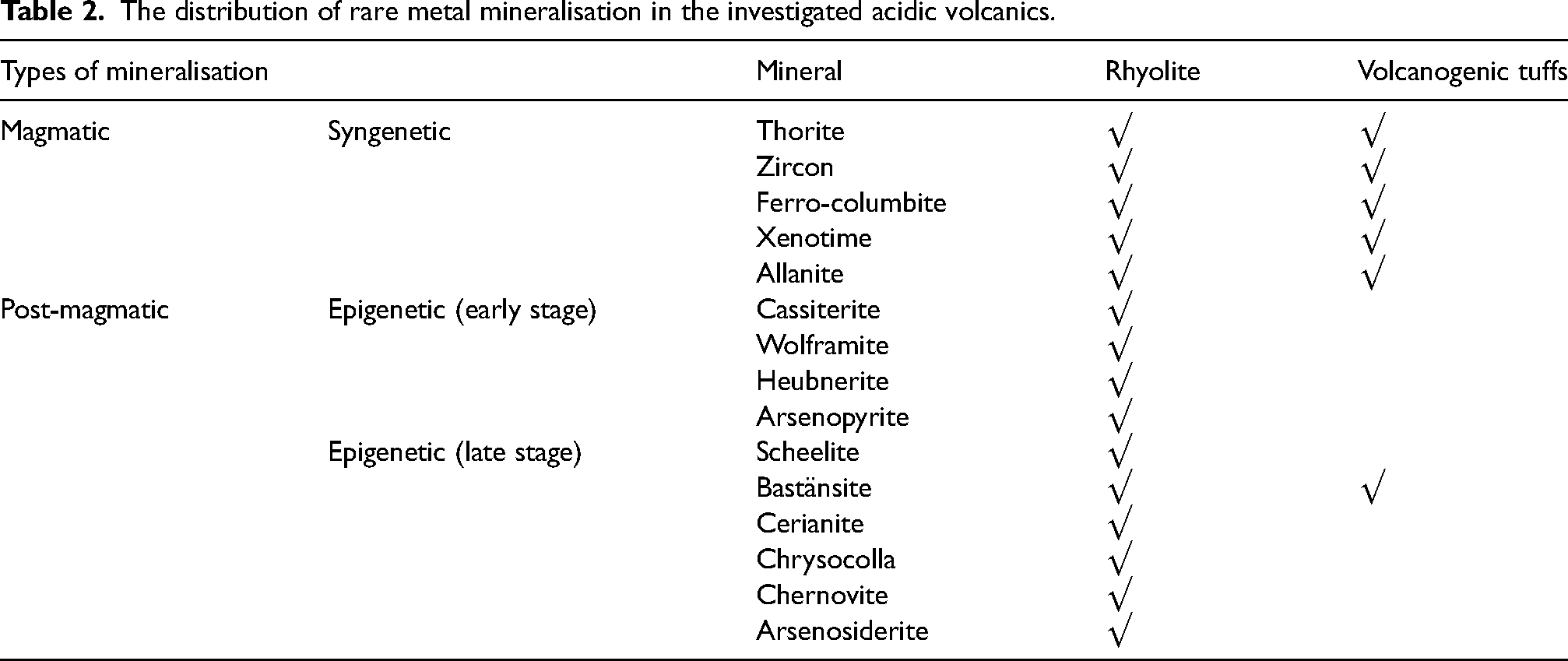
The distribution of the identified rare metals mineralisation in the investigated acidic volcanic rocks is summarised in Table 2.
The distribution of rare metal mineralisation in the investigated acidic volcanics.
Conclusion
The acidic volcanics of Um Safi area exhibit considerable number of some important rare metals. The origin of these mineralisations can be summarised by the following:
The mineralisation in Um Safi acidic volcanics took place through syngenetic, early and late epigenetic stages. The syngenetic mineralisation can be observed by the presence of zircon, xenotime, allanite, ferro-columbite, pyrite and thorite. The emplacement of greisen and granitic offshoots led to the passage of post magmatic fluids into the acidic volcanics and resulted in the formation of the early stage epigenetic mineralisation. Greisen, which is one of the most important primary sources of cassiterite, tungesten minerals (wolframite and heubnerite) and arsenopyrite, is recorded intruded into the investigated acidic volcanics, explains the existence of these minerals in the magmatic-hydrothermal transitional zones. The evolving fluids accompany greisen and granitic offshoots are dispersed with their loads along faults and fractures, which explain the occurrence of mineralisation as disseminated minute dispersion, filling the micro-fissures or as coating the surfaces of joints. The mixing of alkaline hot fluids with meteoric water changes their physico-chemical conditions and continuous interaction with rhyolite caused several alteration processes, which include dissolution of quartz albitisation, sericitisation, hematisation and muscovitisation. These hydrothermal fluids were rich in F and As cause the formation of secondary fluorite and arsenosiderite. These fluids also cause the alteration of some primary minerals such as xenotime, allanite and wolframite into the secondary chernovite (where Y-ions of xenotime are partially replaced by As-ions during post magmatic alteration of the rhyolite by As-rich fluids
47
), bastnäsite and schellite respectively forming the late stage epigenetic mineralisation. The mass balance calculations reveal that most of major cations are removed during different alteration processes except SiO2, which is highly enriched due to the silicification process. The hematisation process in rhyolite accumulates Y, U, REE and some chalcophile elements like Pb, Zn, As and Cu. The presence of zircon, xenotime, thorite association strongly suggests the intermediate solid solution reaction, and the existence of zircon, ferro-columbite and xenotime as aggregates with anhedral habit can be interpreted by the effect of fluorine on the high field strength elements as it increases their solubility.
Recommendation
The author strongly recommends the investigation of the post-granitic dykes and Greissens as she believes that these rocks are the principal sources for the rare metals in Um Safi area. Also, the investigation of the stream sediments in Um Safi area is recommended.
Footnotes
Acknowledgements
The author sincerely thanks Prof. Dr Ashraf El Azab (NMA) for suggesting the point and for his fruitful discussions during all phases of this research work and reading the manuscript. Deep thanks also go to Prof. Dr Ehab Abu-zeid (NMA) for critical reviewing of the manuscript and for his valuable comments. Prof. Dr Ibrahim El Aassy and Prof. Dr Ibrahim Hassan (NMA) for their valuable comments and discussions after reading the manuscript.
Declaration of conflicting interests
The author declared no potential conflicts of interest with respect to the research, authorship, and/or publication of this article.
Funding
The author received no financial support for the research, authorship, and/or publication of this article.