



Abstract
A comprehensive approach for material measurement, tracking, and reconciliation of actual and planned is required for a successful metal accounting system. For ore and metal accounting, the mining industry has mostly relied on spreadsheets to track material flow. The broad use of spreadsheets in metal accounting and mining operations is investigated in this paper. The paper also provides a comparative review of four commonly used software packages, namely (a) Deswik, (b) MineRP, (c) Snowden, and (d) Mapteks’ MRT systems. The capacity to track materials in real-time from the pit or underground to the surface is a standout feature for all the applications. Although there are limitations in dealing with discrepancies in production variables such as mass, grade, fragmentation, density, spatial coordinates, and moisture content, a conceptual data verification and reconciliation process with an improvement strategy aligned with best practices for effective ore tracking at mines is proposed.
Introduction
The mining industry tends to lose potential value because of poor ore reconciliation and a lack of proper real-time tracking systems. There has been development in different mine planning systems to address this challenge. Mining companies have refined their software to track value on both surface mines and underground mines. This has led to the innovation of various ore tracking systems such as the radio frequency tags of South Africa and Metso Processing Technology Innovation (radio-frequency identification transponders). There is a need for an agile mine planning system that allows real-time material tracking flows to understand where the ore material that is blasting ends up. Now, most of the software tracks the value until the stockpiling stage or until the belt grade is determined, after which the function is relegated to the plant metallurgist, hence a need to bridge that gap.
Various data processing software and smart devices have been used to collect, analyse and store the data received over a period in an operating mine. The popular software used for ore and metal accounting in the mining value chain is Microsoft Excel spreadsheets. The general use of the spreadsheets for metal accounting and mining production is discussed, with specific reference to (AMIRA P754, 2007) code for metal accounting. Furthermore, the functionalities and gaps of some industry-leading software companies for mineral resource planning and management such as Snowden, Deswik, MineRP, and Mapteks's MRT are explained.
Despite the restrictions concerning data verification and reconciliation of planned and actual discrepancies, the article proposes a conceptual framework for ore tracking to enhance effective ore tracking and reconciliation at mines.
Industry practices for metal accounting
According to AMIRA P754 (2007: 6), spreadsheets are vulnerable to errors and possess unjustified computations because the formulae in spreadsheets lack clarity and are not always explained and recorded with the spreadsheet. Another choice would be to use the available commercial metal accounting software package. Hence, the use of spreadsheets for metal accounting must be avoided. Basic errors that occur when entering data into a spreadsheet or acquiring data from a spreadsheet and recommendations to avoid the input errors are outlined in Table 1.
Data entry errors and recommendations.
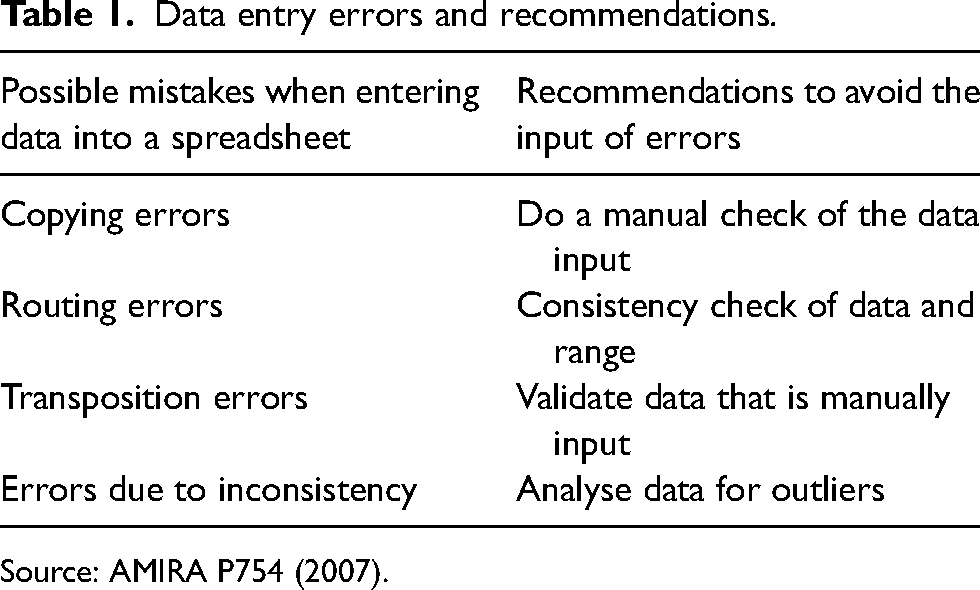
Source: AMIRA P754 (2007).
Mineral processing engineers use spreadsheets to solve mass balance problems. Although the use of spreadsheets is not ideal from previous discussions, special computer programs are available to solve these complex problems (Roman, 1992). Some examples of spreadsheet programs used to solve mineral industry problems include (Excel, Lotus, and Quattro Pro) extensively discussed by (Meloy and Williams 1992b, 1993; Meloy et al., 1992; Merks, 2000; Williams et al., 1991, 1993, 1995). In recent times, Yousef et al. (2022) developed a systematic framework for an approach to metal accounting known as Intelligent Metallurgical and Metal Accounting Information Management System (MMAIMS).
The general use of spreadsheet software programs
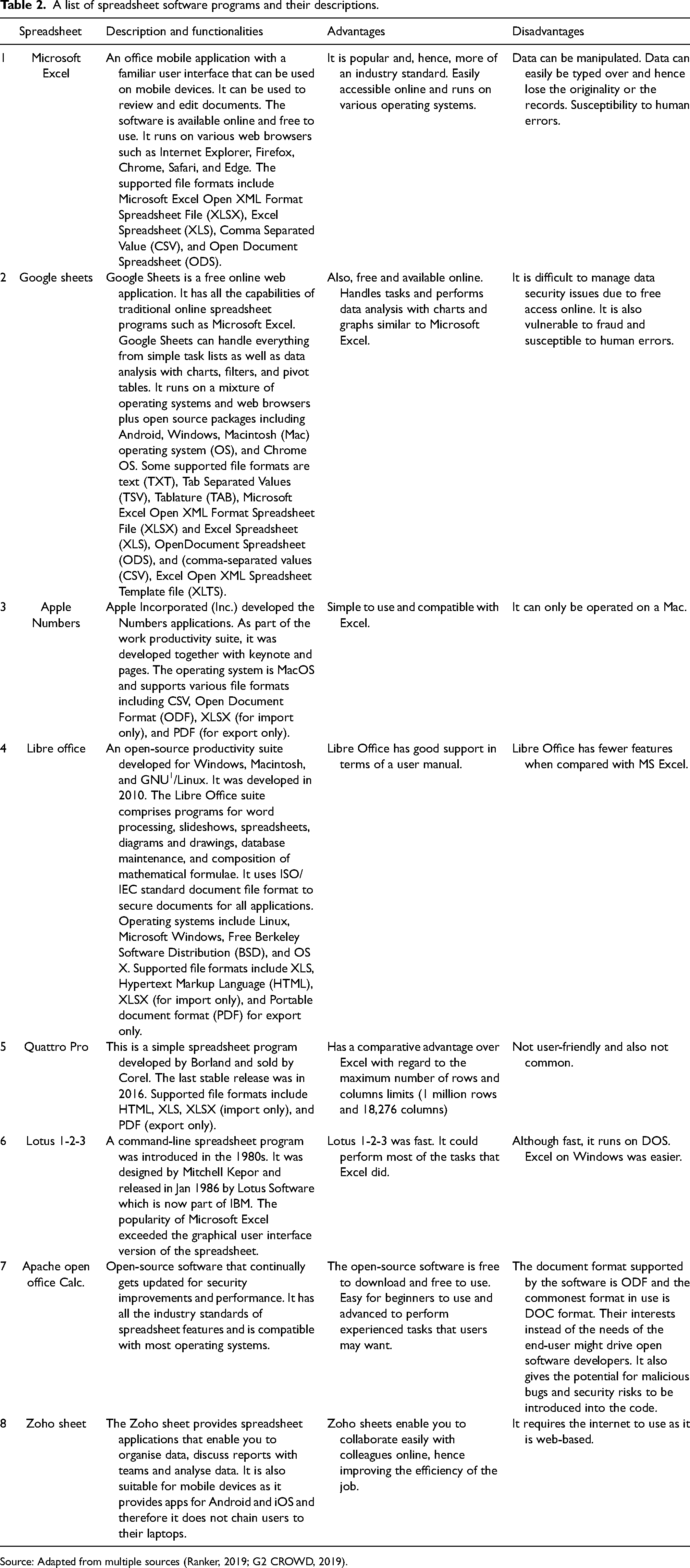
Spreadsheets are still widely used in ore and metal accounting, but they can be difficult for end users to understand. Spreadsheets are compatible with specific operating systems and supported by specified file formats. Table 2 shows a list of several of these spreadsheet programs, together with information on their data formats and operating system compatibility.
A list of spreadsheet software programs and their descriptions.
Spreadsheets for mining production
An effective mine management production relies on the reporting of accurate mine production data. This may be a challenge for production supervisors to understand the importance of reporting accurate data, because of a drive to meet production targets and budget requirements. Lotus Software (which became part of IBM) developed the lotus ‘1-2-3’ for tracking production data. According to Phillips and Musick (1987), Lotus software became the industry standard throughout the 1980s and the 1990s. The spreadsheet format is in categories such as:
labour and benefit; data on production; detailed breakdown; operating cost; and capital recovery and other fixed costs.
Although there are various spreadsheet software available online as outlined in Table 2, some of the criteria to consider when choosing software for a project would be the purpose of the project, its availability, and security issues associated with the use of that software. The subsequent sections discuss some industry-leading software and its functionalities in the context of mine planning and reconciliation.
A review of modern metal accounting and mine planning software programs
The mine planning software companies have often introduced improvements in their software programs with unintended consequences (Nwaila et al., 2020). Although an advanced methodology for measuring the utilisation of mine planning software for decision-making in South Africa was developed by Genc (2015), this section revises some of the functionalities of the mine planning and reconciliation software programs such as Snowden, Deswik, MineRP, and Maptek's resource tracking system.
Snowden
The Snowden Company consults in the fields of geological resource estimation, mine planning-related problems, and technical support to mining-related businesses at the corporate level (Snowden, 2023). The Snowden software and the tasks that they perform are outlined in Table 3.
Snowden Software functionalities.
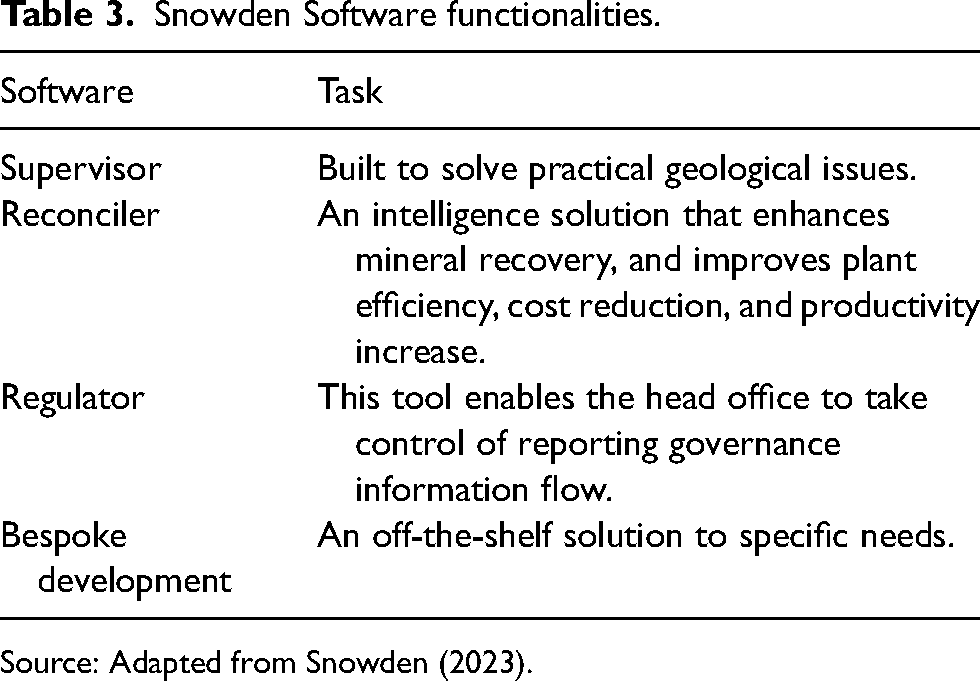
Source: Adapted from Snowden (2023).
Deswik Software program
The Deswik Software was designed to enable high-performance technologies that meet the demands of modern mining. Some of the tools developed and their descriptions in the Deswik suite of software programs for mine planning, geology, and survey are depicted in Table 4.
Deswik software suite and descriptions.
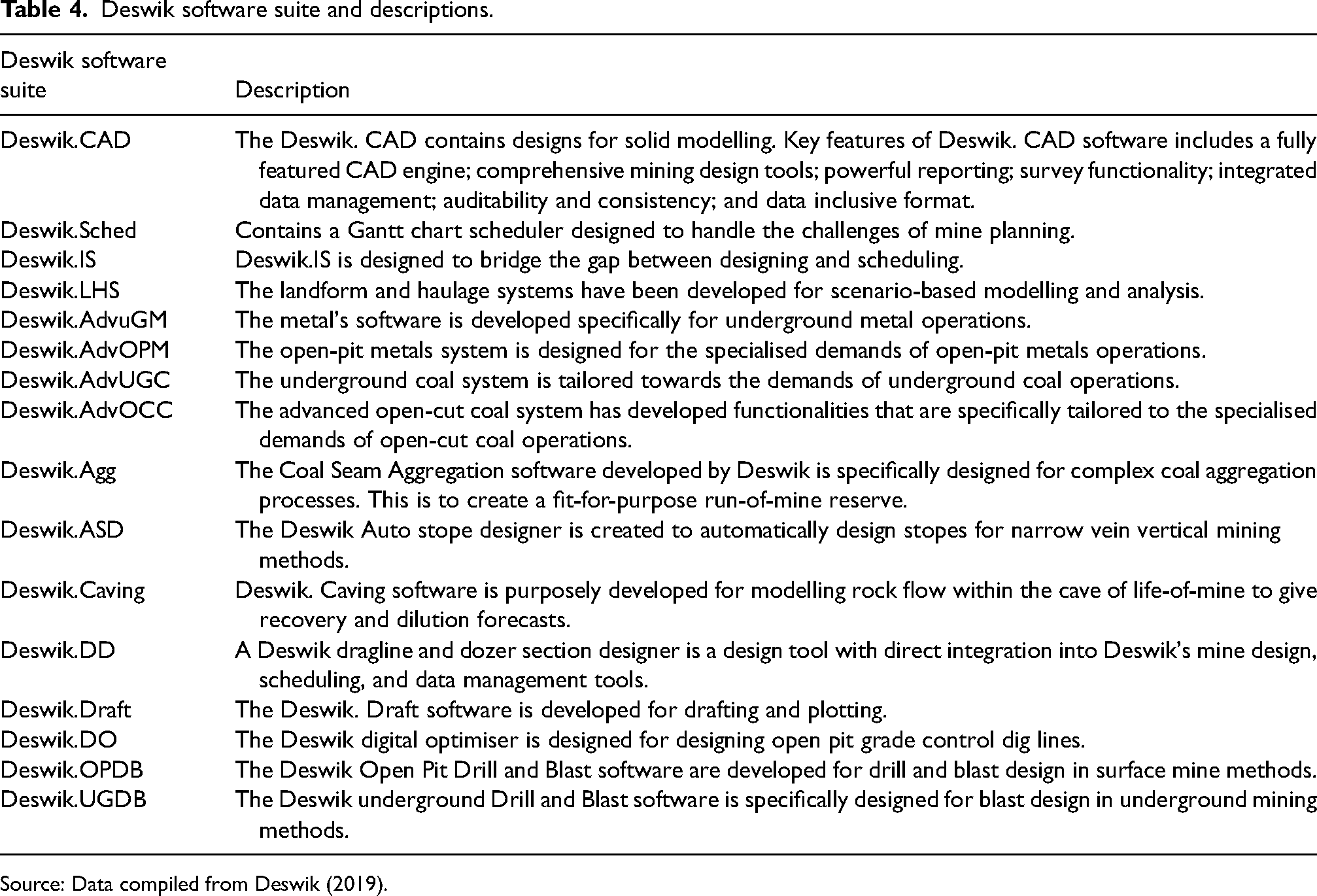
Source: Data compiled from Deswik (2019).
MineRP software
The MineRP solution is an enterprise resource planning for mining that connects the science of mining with the business of mining. Although their enterprise resource planning solutions span various sectors including the oil and gas sector, construction, and government, the focus here is solutions developed for mining. The specific categories developed for mining are managing mining data, understanding the mineral asset, determining the asset potential, and operating efficiently (Table 5). MineRP defines a digital twin as a full representation of the physical assets and processes that are connected (MineRP, 2023). The software can create a 3D spatially intelligent digital twin of the state of the operation and its assets (MineRP, 2023).
MineRP mining software solutions.
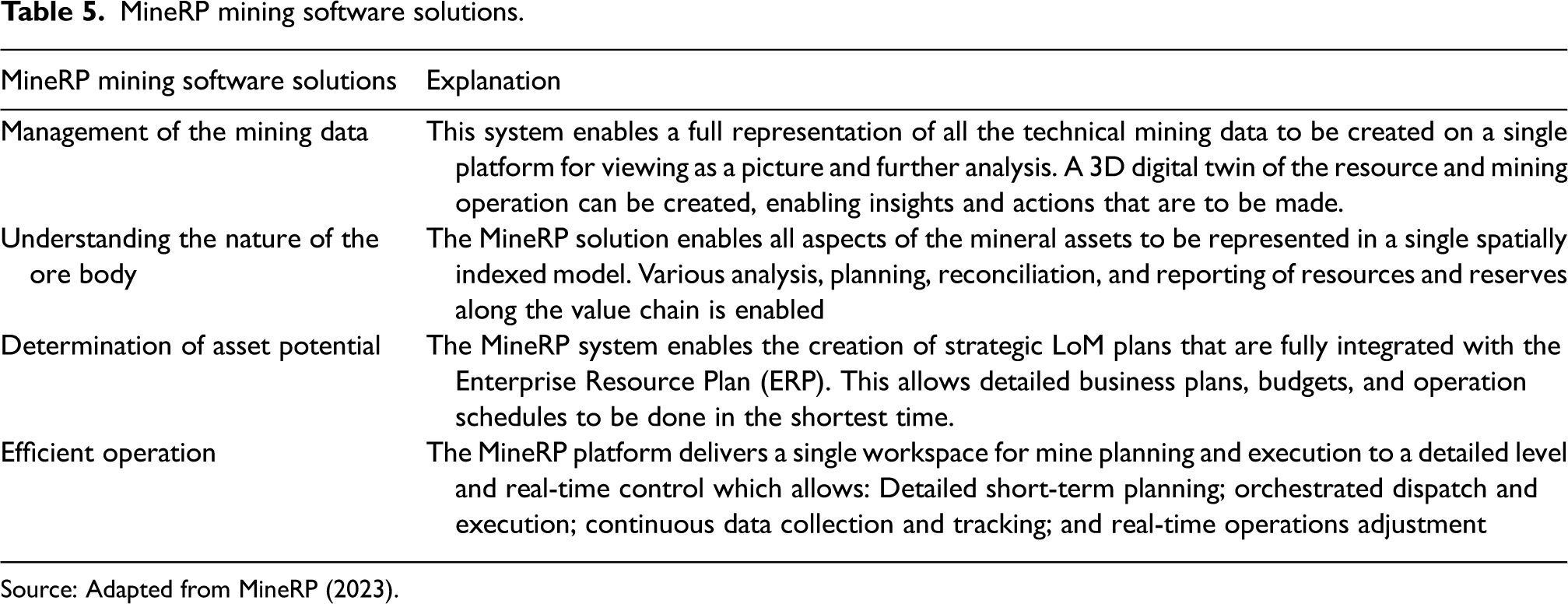
Source: Adapted from MineRP (2023).
Maptek's resource tracking system
Maptek's resource tracking (MRT) system is a cloud-based system for the management of materials from in-situ rock to run-of-mine (ROM) and through the plant. Some of the benefits of the MRT system are:
for effective stockpile measurement; dump stockpile compliance; optimise yield through the plant; and resource model reconciliation (Maptek, 2021).
Comparative and gap analysis of Snowden, Deswik, MineRP, and Maptek software solutions
A comparative analysis of four different mine planning and reconciliation software was conducted based on the required function for ore or metal accounting and reconciliation and outlined in Table 6. It was deduced from Table 6 that MineRP has the potential to combine all the technical data in a mine into a single platform, enabling further analysis and viewing in a single platform. The digital twin representation of physical assets, as well as the production status of the MineRP software, gives it an advantage as a practice software solution for both metal accounting and mine production. Deswik, on the other hand, has developed several software suites for planning, geology, and survey, but these have not been integrated. The Snowden software also has several functionalities for ore and metal accounting but is not integrated into a single platform. Maptek's MRT system has additional functionalities for material tracking and compliance to plan measurements. The outstanding functionality of all the software is the ability to do real-time ore and metal tracks from underground to the surface and in the metallurgical process.
Comparative analysis of Snowden, Deswik, and MineRP software.
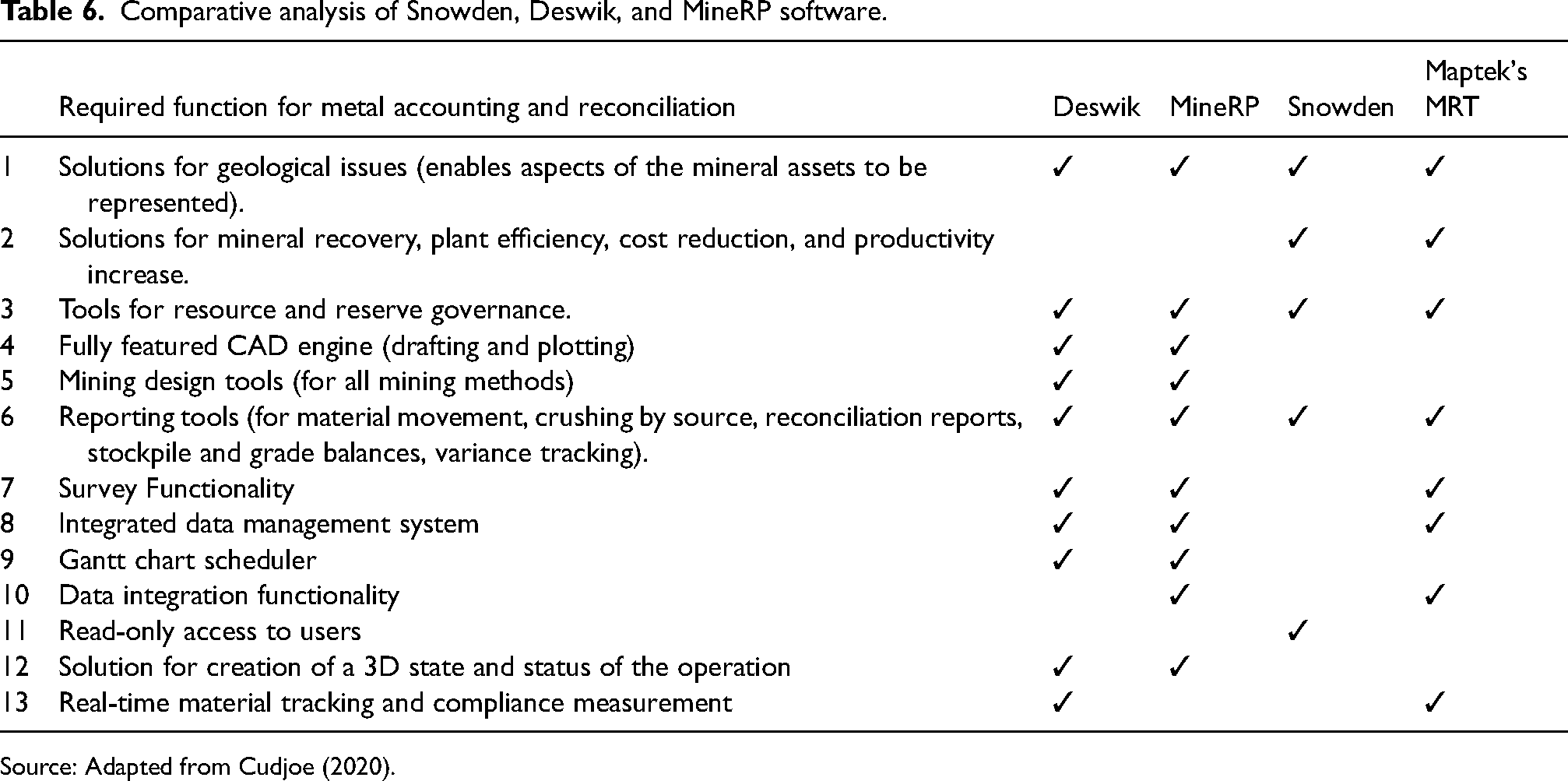
Source: Adapted from Cudjoe (2020).
Although this section focuses on the four main software for material tracking, it is worth mentioning that the software functionalities for metal accounting and reconciliation of the mining and metallurgical process form a major component of the concept of digital twins and Mining Metaverse discussed by Stothard (2023). The next section explains the development of a data verification process for material reconciliation at measurement points in the mine production value chain.
Data verification and reconciliation at measurement points
The framework for the data verification and reconciliation process is depicted in Figures 1 and 2, respectively. In the data verification process, the variable of interest is first measured with a defined sensor. The discrepancy in terms of what was planned and expected is then determined. The impact of the discrepancy has to be determined and the risk assessed. A significant question would be an acceptable level of discrepancy. The tolerance limit for each measurement variable is required to enable an assessment of the measurement's compliance with existing protocols. A decision is then made in terms of the acceptance or rejection of the measurement variable (e.g. calibrate scale or re-take measurement) and an action in terms of the generation of a variable measurement report. A detailed workflow is outlined in the reconciliation process and depicted in Figure 2. The first step is to measure the variable of interest; determine the discrepancy; determine the risk; control the risk to assess the impact of the discrepancy; decide on tolerance or control limits; assessment of compliance to measurement protocols; action required depending on the outcome of the previous themes; and generation of a report on the specific measurement variable. An improvement strategy would be required towards best practice.
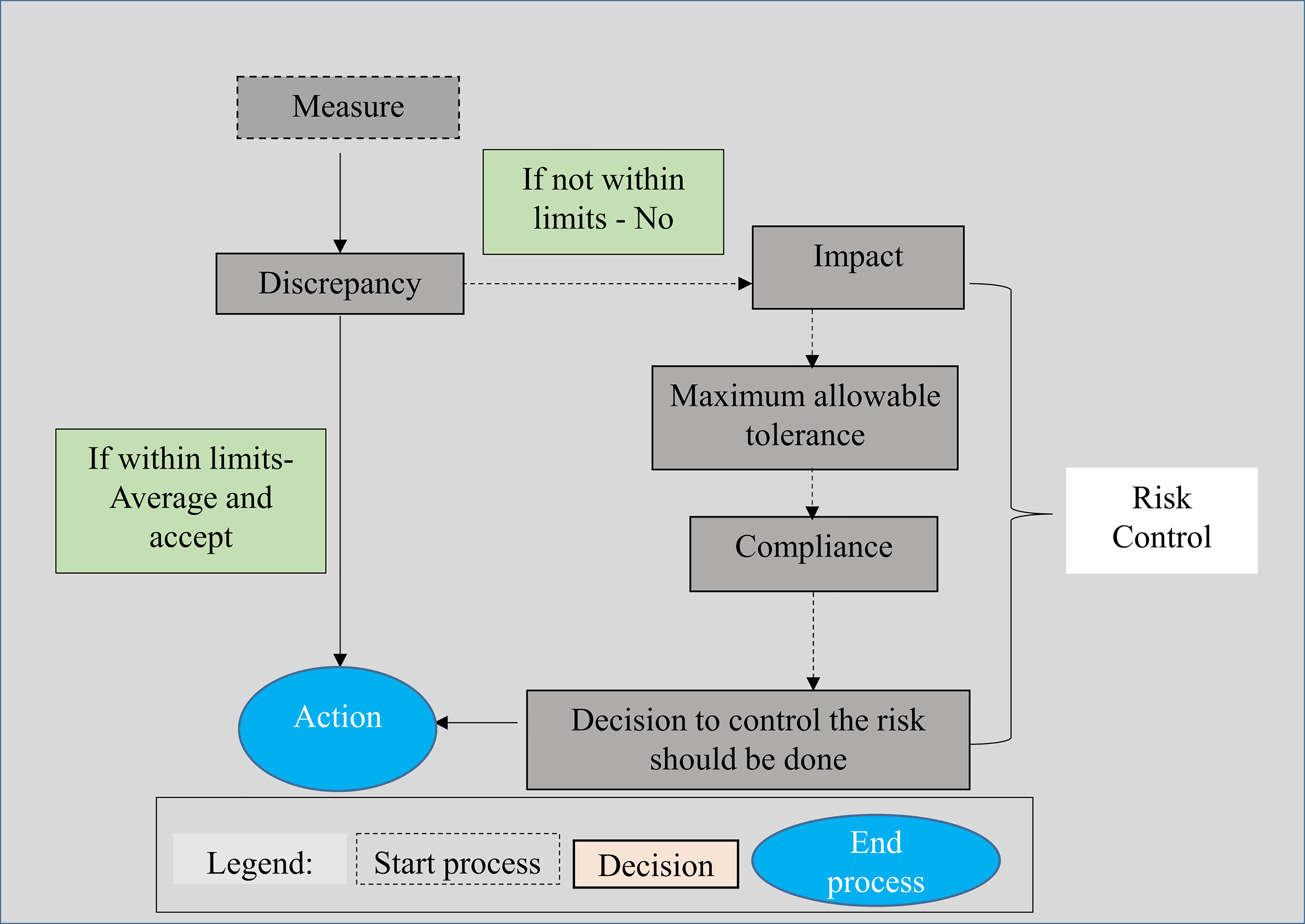
Framework for data verification. Source: Adapted from Cudjoe (2020).
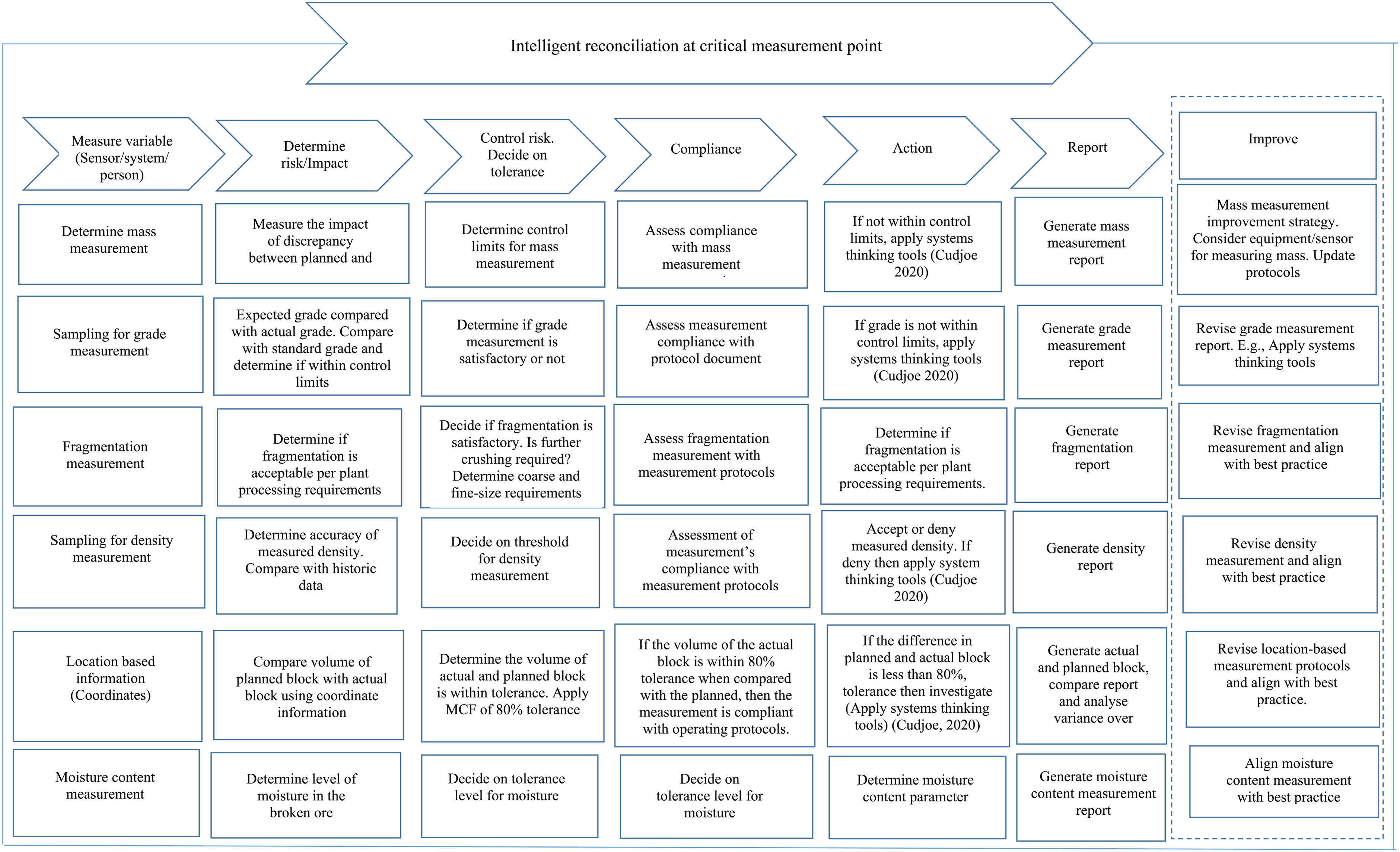
Intelligent reconciliation process at the measurement point. Source: Adapted from Cudjoe and Cawood (2022).
Conclusion
Various software programs are required to analyse the data obtained. The paper discussed the general use of spreadsheets for metal accounting and mining production. A list of spreadsheet software and their descriptions, file formats, and compatibility with operating systems is outlined in Table 2. Although the most popularly used spreadsheet in the mines is the Excel spreadsheet, others that have been used in the past for both mining production and metallurgical accounting are the Lotus 1-2-3 and Quattro Pro. The functionalities and gaps of some industry-leading software companies for mineral resource planning and management such as Snowden Optiro software, Deswik, MineRP, and Maptek's resource tracking system were discussed in the paper. In the author's opinion, the functionality to create a real-time digital twin of the status and assets of the operation makes it outstanding for real-time ore tracking and reconciliation.
Although there are limitations to data verification and reconciliation of discrepancies, the paper proposes a conceptual framework for the process outlined in Figures 1 and 2. In this framework, the variable of interest is first measured with a defined sensor, the discrepancy in terms of what was planned and expected is determined, and the risk is assessed. The tolerance limit for each measurement variable is required to enable an assessment of the measurement's compliance with existing protocols. A decision can be made in terms of the acceptance or rejection of the measurement variable and an action in terms of the generation of a variable measurement report.
Footnotes
Acknowledgements
This work was compiled as part of research work at the Wits Mining Institute (WMI), University of the Witwatersrand, Johannesburg, South Africa. The author also acknowledges the University of Johannesburg and Sibanye-Stillwater Digital Mining Laboratory (DigiMine).
Declaration of conflicting interests
The author declared no potential conflicts of interest with respect to the research, authorship, and/or publication of this article.
Notes on contributor
Monica N.M. Cudjoe was appointed as a Lecturer at the Department of Mining Engineering and Mining Survey, University of Johannesburg, Johannesburg, South Africa. Before this appointment, she was a postdoctoral fellow at the Wits Mining Institute, University of the Witwatersrand.