




Abstract
To date, few scholarly discussions on ethical implications of epigenetics and epigenomics technologies have focused on the current phase of research and development, in which researchers are confronted with real and practical ethical dilemmas. In this article, a responsible research and innovation approach, using interviews and an expert meeting, is applied to a case of epigenomic test development for cervical cancer screening. This article provides an overview of ethical issues presently facing epigenomics researchers and test developers, and discusses 3 sets of issues in depth: (1) informed consent; (2) communication with donors and/or research participants, and (3) privacy and publication of data and research results. Although these issues are familiar to research ethics, some aspects are new and most require reinterpretation in the context of epigenomics technologies. With this article, we aim to start a discussion of the practical ethical issues rising in research and development of epigenomic technologies and to offer guidance for researchers working in the field of epigenetic and epigenomic technology.
Keywords
Introduction
Epigenetics, the study of molecular mechanisms that control the activity of genes, is accelerating. To bolster epigenetics research further—and ultimately, to reap its fruits for the advancement of human health—high-throughput technologies need to be developed that are sufficiently reliable, feasible, and affordable to allow for the large-scale study of epigenetic mechanisms in human cells. Such new technologies may come to mark the rise of “epigenomics,” much to the likes of the rise of genomics as a vital field of research following the wider availability of microarray and next-generation sequencing technologies in the early 2000s.
One of the better-studied epigenetic mechanisms is DNA methylation, or the covalent addition of methyl groups to sites in the DNA sequence, thus inhibiting DNA transcription. DNA methylation thus regulates gene expression (ie, switches genes off) and alters gene function. Existing technologies for the mapping of DNA methylation patterns across the genome, such as whole-genome bisulfite sequencing (WGBS) and Infinium 450K technology,1,2 have shortcomings. Various groups around the world are therefore developing new and more accurate, convenient, and cost-effective technologies for DNA methylation profiling.3,4 Once epigenome-wide technologies become more widely available, they can be used to study the correlation between epigenetic markers and health and disease—notably cancer—on a much larger scale.
One promising area of application is public health, notably population screening for cancer and precancerous conditions. For instance, specific DNA methylation patterns have been associated with cervical cancer and its premalignant stages, 5 opening up possibilities to use epigenomics to improve on existing cervical screening programs. 6 Currently, a Dutch research group is developing and clinically validating a novel assay using its MeD-seq technology based on a methyl-dependent restriction enzyme, for genome-wide DNA methylation profiling in cervical cancer. 7 The use of epigenomic technologies in screening programs raises questions concerning their ethical, legal, and societal implications (ELSI) inter alia for risk communication, informed consent, individual and societal responsibility for health, and stigmatization and discrimination. ELSI arise not only with the implementation of new technologies but also—already—during the phase of research and development, in which researchers may be confronted with pressing research ethics issues such as the responsible usage of human samples and data, publication of research data and privacy protection, informed consent, and the handling of incidental findings.
There is a small but growing body of literature on the ELSI of epigenetics and epigenomics (for a recent review of this literature, see Dupras et al). 8 Some of the existing ELSI discussions have been judged “too speculative,” 9 as they may build on hyperbolic or “unlikely and at times overly deterministic vision[s]” 10 of the power of epigenetics. Consequently, they offer little practical guidance on the responsibilities of researchers and test developers who are currently dealing with practical ethical issues. 9 To address this void, we have taken a responsible research and innovation (RRI) approach 11 to the case of research and development of MeD-seq technology for cervical cancer screening at Erasmus MC, University Medical Center Rotterdam, and DDL Diagnostic Laboratory (DDL) in the Netherlands, using interviews and involving stakeholders to identify and discuss ethical issues arising in the phase of research and development of epigenomics screening technologies.
Methods
RRI entails the “collective” or collaborative study of ethical and societal implications of innovative products or services. 12 By bringing together stakeholders, including researchers, patients, health care professionals, manufacturers, policymakers, to imagine and deliberate the future applications of an innovation, it helps to ensure that the technology becomes aligned with the needs, values, and expectations of users and other stakeholders. 13 RRI must be done in a pro-active and timely fashion so that its results can be incorporated in the design and development process.
Our research team (E.B., I.B., M.T.) conducted regular meetings with members of the research and development group at their workplaces at Erasmus MC and DDL, as well as on-site observations in the laboratories at Erasmus MC and DDL. Also, we held unstructured individual and group interviews with other stakeholders, including clinicians, patient organizations, and officials responsible for the national cervical screening program. The interviews were held between September 2018 and September 2019 at the work offices of the experts or over the telephone, and lasted between 1 and 3 hours. The aim of the discussions, interviews, and observations was to identify ELSI in epigenomic test development. Also, we conducted an informal review of the literature using the search terms “epigenetics” or “epigenomics” and “ethics” in PubMed in October 2018 to identify ELSI in epigenomic test development.
On February 8, 2019, we organized an interdisciplinary expert meeting at Erasmus MC, Rotterdam. Participants included the research team, a bioinformatician, a biotechnology expert, a developmental biologist, the director of a diagnostic laboratory, a pathologist, a philosopher of medicine, a medical risk communication expert, a representative of a patient organization, a gastroenterologist, a gynecologist, a coordinator of the national cervical screening program, and a senior policy advisor of the Royal Dutch Medical Association. We presented a draft overview of ELSI identified based on the literature and discussions, interviews, and observations (see Table 1). The expert meeting was aimed at the corroboration and completion of our draft overview of ELSI in epigenomic test development and prioritization of the issues. It lasted for 2 hours. It was audiotaped. A report was written by E.B.
ELSI of epigenomic test development (flagged as important by experts).
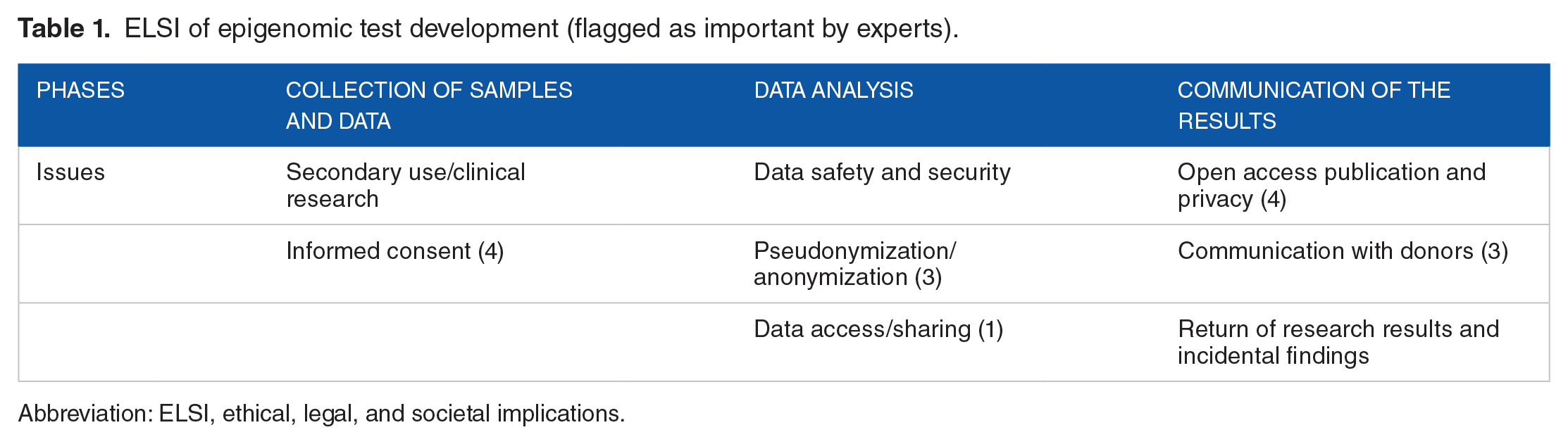
Abbreviation: ELSI, ethical, legal, and societal implications.
Ethics
In the Netherlands, interview studies are mostly not subject to the Dutch Medical Research Involving Human Subjects Act. Ethics approval, therefore, was not necessary. All participants gave oral consent for their participation in the interviews and multi-stakeholder meeting as well as for the publication of the results of the research project.
Results
During the process of epigenomic test development, the researchers are trying to find and clinically validate sets of epigenomic markers that can reliably distinguish cases of disease from healthy controls. The ELSI they encounter pertain largely to the responsible handling of human biospecimens and data. The use of data and samples was 1 theme we identified in some articles,14,15 among the 25 articles (out of 127 articles) that were included for full-text review, based on relevance. Other themes we identified were intergenerational and parental responsibility 16 ; biopolitics and eugenics 17 ; discrimination 18 ; psychiatry and mental health 19 ; and the agenda of the ELSI-discussion itself on epigenetics. 9 These themes referred mostly to imagined future applications of epigenomics technology, but did not pertain to the process of test development and were thus not further used in our study.
In the process of test development, 3 subsequent phases can be discerned: the collection of samples and data, the analysis of data, and the communication of the research results (see Table 1).
First, in the phase of collecting human biospecimens and/or data, researchers can either gather samples prospectively and specifically for their test development activities or make “secondary use” of stored samples that have been previously taken in the course of clinical care, screening, or research. Under what conditions may test developers use stored samples taken in the context of clinical care or screening or clinical research? Is adequate informed consent in place for the research activities of the test developers?
Second, when analyzing data, researchers must ensure that the data are safely and securely stored, processed, analyzed, used, and shared. What standards for data safety should researchers adhere to? Will anonymization be possible? Will pseudonymization suffice to deidentify samples and data? Under what conditions may data and samples be shared among researchers and research institutions?
Third, when researchers communicate and disseminate the results of their work, they are confronted with issues related to the privacy of their research participants. Journals often ask for raw research data to make these (publicly) available online. Could the data be re-identified and could this lead to privacy risks for donors? Should donors be informed about the results of the research activities in which their samples or data have been used? What would be appropriate ways of communicating research results with these publics? Should donors be informed about individual research results or incidental findings?
Participants in our expert meeting agreed with the table presented to them of ELSI arising in 3 phases of research and development. They considered issues about informed consent and open-access publication of most importance (both issues were flagged as important by 4 participants). Issues of pseudonymization and anonymization and communication with donors were also deemed important (flagged by 3 participants). Issues about data safety, data sharing, and the return of research results and incidental findings were flagged by 1 or 0 participants. During the phase of analysis, data safety and data sharing—within the research group, and with other researchers—did not raise concerns, as it was felt that current data protection measures at research laboratories are sufficient to protect the privacy of research participants. Also, the return of research results and incidental findings were seen as less important, as it was felt that the epigenomic technology that was being developed required only limited epigenomic data from research participants, with little chance of detecting incidental findings.
Discussion
The ELSI identified in this RRI case study are different from most of the ELSI of epigenomics that have thus far been discussed in the academic literature, which includes cautionary analyses of potential future (mis)use of epigenetic data and its impacts on parental and societal (moral) responsibility, legal proceedings, and (bio)political theory. 8 The issues that are confronting test developers today are not new, nor are they specific to epigenomic technology. They include some of the classic issues of research ethics and data protection legislation. Fr the context of epigenetic research and epigenomic test development, however, they require what is called “specification”: “a process of reducing the indeterminateness of general norms to give them increased action-guiding capacity, while retaining the moral commitments in the original norm.” 20 Below, we, therefore, specify existing norms for the 4 priorities established in our expert meeting. The priorities “pseudonymization/anonymization,” “open-access publication,” and “data access and sharing” are discussed together under the heading “privacy and publication of data and research results,” as they are closely related.
Informed consent
When researchers expose human subjects to interventions for research purposes, in many countries, regulatory frameworks governing human subjects research come to apply. This usually implies that researchers must submit a research protocol for evaluation by a research ethics review committee, and ask for specific and written informed consent from research participants. The research required for epigenomic test development, however, could just as well be conducted based on previously collected samples. The secondary use of stored, de-identified data or samples for scientific research is exempt from ethics review and the informed consent requirement in many countries. 21 For the secondary use of biospecimens acquired for diagnostic purposes in hospitals, for instance, opt-out procedures are generally put in place. Patients are (more or less actively) 22 informed that their biospecimens will be stored and used—anonymously—for scientific research unless they object or “opt-out,” which often requires an administrative action.
The conditions under which secondary use is allowed, however, tend to diverge between states, regions, and institutions in the United States 23 as well as in Europe. 24 In France, for instance, there are special requirements for genetic analyses of previously collected materials, and thus, opt-out procedures are not accepted. 24 Such requirements are usually proposed because such usage (ie, genetic analysis) is considered to be “sensitive” and/or to pose risks for donors or research participants. In many countries, laws or policies have been set up to promote the safety of genetic data and/or to protect citizens, patients, or research participants from discrimination based on genetic information.25,26 Although such laws or policies may not formally apply to epigenetic data, 27 there may be aspects of epigenetics, including its potential for re-identification of individuals and the medical risk information contained in epigenetic data, which would qualify it as sensitive and/or associated with privacy risks, too. Thus, these aspects may offer grounds to consider asking for explicit informed consent from research subjects—rather than relying on opt-out procedures—for epigenomics research.
At the same time, there seems to be growing support, however, for less explicit and broader consent, 28 which is commonly defined as “consent to future research with specific limitations.” 29 This accords with an established criterion for the secondary use of samples or data, namely, that the conditions agreed on in the initial consent should also apply to secondary uses. 30 Concretely, the secondary use should involve “related conditions” 31 to the condition for which the sample or data were originally collected. If a sample was taken in screening for cervical cancer, for instance, secondary usage should be limited to cervical cancer research.
Although people are generally willing to donate left-over samples for research, 32 this willingness has limits. People are generally more willing to donate data than biospecimens. 33 They support data sharing with researchers in other academic institutions, but less so with national or federal repositories, 34 or the pharmaceutical industry. 35 Some are especially concerned about data sharing for commercial gain. 36 Thus, it is not self-evident that when people consent to secondary use, they (also) consent to future research that may be deemed sensitive (eg, genetic or epigenetic analyses, the development of pluripotent cells or organoids), to research that may give donors other (personal) reasons to withhold consent (eg, research in indigenous populations, data sharing with national or federal institutions, data sharing with commercial enterprises) or to research involving other medical conditions.
Informed consent has a 2-fold aim. First, it is meant to express respect for the autonomy of donors or research participants, 37 and should ensure that they are not coerced or deceived. 38 The limitation that any secondary research usage of donated specimens should be in line with the condition for which the specimen was originally collected, especially within an opt-out procedure, helps to prevent donors from feeling misled when they find out, for instance, that their specimens have been used in epigenetics research projects. Second, informed consent is meant to help protect donors or research participants against harm. To do so, it should be coupled with adequate governance and an “ongoing process of providing information to or communicating with donors.” 29 Secondary use should take place within a governance structure that keeps data safe and secure, that protects donors’ privacy and other interests, and that oversees that the secondary use is in line with the condition for which the sample was originally collected and with other agreements.
Informed consent for the use of samples or data may thus be explicit or implicit (eg, based on an opt-out policy), and specific (ie, for a specific research project) or broad (ie, for research in line with the condition for which the sample or data were collected or for unspecified future research purposes). At any rate, donors should be able to place justified trust in those who are responsible for the storage, use, and sharing of—implicitly or explicitly—donated samples and data.
Communication with donors or research participants
First, the sharing of research results is considered an ethical requirement of involving human subjects in biomedical research. Researchers have to publish and disseminate research results. 39 This is seen as part of the public accountability by which researchers are held, and which is “necessary for realizing the social and scientific value of health-related research.” 40 At a minimum, this implies that researchers should make research results, including negative results, available through publication in peer-reviewed (international) scientific journals or presentations at academic conferences. As a best practice, researchers may (arguably) reach out to research participants or (biobank) donors and inform them about the aggregate or summary results of their research projects, 41 for instance through mailings, newsletters, websites, or participant gatherings. Researchers may also use popular media to disseminate and discuss their research results with the general public.
This responsibility of researchers to engage in broader communication activities may be especially important for the field of epigenetics, which is little-known to the general public. As the field is rapidly evolving, it relies on the willingness of human research participants and donors to make data and biospecimens available for (secondary) research. The “temporal dynamics in epigenomic measurements” 42 can only be understood through longitudinal studies based on a long-term commitment by research participants. For this type of long-term commitment, it is important that (prospective) research participants understand the objectives and the relevance of the research, and develop and maintain trust. Institutions using opt-out procedures for the secondary use of clinical data or samples should ensure sufficient information provision and awareness among donors. 43 If institutions and researchers fail to inform and educate research participants or donors about the goals and results of their epigenetic research activities and about data sharing with researchers in other academic institutions or commercial enterprises, they risk squandering their trust. Participant engagement (eg, through [annual] summary reports of research activities) may help to avert these risks.
Second, researchers may need to consider the feedback of individual research results and incidental findings to participants or donors, when this could lead to medical benefit. Taking their cue from existing ethics guidance in the fields of genetics and imaging, Dyke et al 44 propose that epigenetics researchers should inform research participants or sample donors about “clinically valid and actionable” individual research results. As for lack of evidence, validity and actionability are presently difficult to determine, and feedback responsibilities at this time are limited. Dyke et al 44 further suggest that epigenetics researchers are not expected to actively search for individual research results beyond their standard research practice.
Theoretically, however, in epigenetics screening test development, 3 types of findings that researchers may stumble on, are imaginable. First, as the new screening test is being refined, reclassification of control samples or data may happen, such that these become labeled as cases (or early stages) of cancer rather than controls. Second, as the new epigenetics-based screening test involves sequencing of the entire genome, pathogenic germline mutations may be found related to the cancer detected through screening and may have implications for the health of the donor as well as for family members. Third, abnormal findings may be detected that are unrelated to the condition screened for (in this case, cervical cancer), but may be of relevance to the health of the donor (eg, genetic or epigenetic abnormalities that may be associated with increased risks of neurodegenerative disorders). This third type of findings would be considered truly incidental findings.
As epigenetic abnormalities are potentially reversible or modifiable, they may be more likely to be clinically actionable than genetic abnormalities. In theory, receiving information on epigenetic incidental findings thus increases the chance that it may lead to medical benefit for research participants, and can be considered to “empower” and enhance participants’ autonomy. 18 However, it may also have psychological and social implications that may be equally or more serious than those associated with genetic incidental findings. Epigenetic markers may, for instance, reveal information about past exposures and (early) lifestyle factors,45,46 potentially implicating oneself and/or others in having (partially) caused disease. They may uncover a range of characteristics that may be considered sensitive information, such as “socioeconomic status, gender, ethnicity, or living conditions (eg, childhood maltreatment, substance abuse, smoking, physical inactivity, exposure to sexually transmitted diseases, and bodyweight),” 47 although it should be noted that the associations between epigenetic data and lifestyle factors are not yet fully understood and are likely very complex. Thus, epigenetic screening test results may lead to justified or unjustified concerns regarding individuals’ responsibilities—and those of third parties’ (eg, parents, employers)—for medical conditions. Also, concerns regarding stigmatization or discrimination may arise 18 : individuals may be blamed when epigenetic data show that unhealthy lifestyles, which are (perceived as) subject to choice, lead to increased risk of disease and/or members of vulnerable ethnic groups or other socioeconomically disadvantaged groups may be stigmatized based on shared epigenetic traits. Further research efforts should aim at mapping the benefits and harms associated with the feedback of (types of) individual epigenetics research results, establishing what findings should be reported (and whatnot), and developing modalities for doing so effectively while minimizing potential informational harms for research participants and their family members.
Privacy and publication of data and research results
Research involving human subjects can only be ethically justifiable when it adds social value and contributes to scientific knowledge or human health. 48 Research results should thus be communicated so that they can be utilized. Around the world, open-access publication of scientific research is actively encouraged. 49 Today, almost 50% of scientific papers are published open access; they can be viewed by anyone online at no charge. 50 Ideally, this applies not only to aggregated research results but also to individual-level research data. Data sharing helps to advance health science 40 and to reduce waste. Also, by allowing the validation and replication of research results, it promotes scientific rigor, transparency, and accountability in science. Many scientific journals are thus asking authors to share research data in publicly accessible databases; some may refuse publication otherwise. This requirement raises ethical concerns, however, related to the privacy of those from whom the research data are derived. Researchers may reasonably wonder whether epigenetic data should be made available in online research databases, and how to strike a balance between data accessibility on one hand and data protection on the other hand.
The privacy of individual research participants or epigenomic data donors will only be violated, we contend, when 2 conditions are met: first, the epigenomic data are identifiable/re-identified—or can be brought to bear on the individual—and second, the data are somehow sensitive; they reveal something about the individual. In the case of epigenomic data, the data may reveal something about an individual’s (future) disease risks, previous exposures (eg, to toxic substances, early childhood stress), or past or current behaviors or lifestyles (eg, smoking) or biological states (eg, biological age). Privacy is breached when such sensitive information is shared with others without the individual’s consent. And harm ensues when such information is used to discriminate (eg, in health insurance premiums) based on epigenomic information.27,18 While data sharing is an important ethical imperative, also in epigenomics research, data donors should be protected against the risks of de-identification and publication of sensitive personal information.
It is currently often argued that anonymization or complete de-identification is no longer possible. Identifiability is not bimodal; rather, it “exists on a continuum.” 51 It has been shown that technically, individual research participants might be re-identified based on matching within or between large biomedical data sets. 52 Consumers using direct-to-consumer genetic testing services such as 23andMe increasingly share their test results through social media or patient platforms. Big biomedical data sets are arising in a variety of settings, including “social infrastructures, like the state’s administration, financial systems, telecommunications networks, civil aviation, or the Internet.” 53 Linkage and triangulation with—the growing number of—such publicly accessible online data sets, make re-identification of individual research participants or research data donors more and more likely. To prevent re-identification, researchers may redact, remove, or mask potential “identifiers” such as single nucleotide polymorphism (SNP) or DNA sequence data from genome-wide DNA methylation data sets, 54 although this will lead to loss of complexity and allelic information. Also, researchers may no longer be in a position to guarantee that de-identified data will remain anonymous and commit to the principle of confidentiality. It should be noted that the (theoretical) loss of the possibility for anonymization need not be problematic. There are sound arguments for preferring coding or double-coding of data to anonymization, both in terms of scientific usefulness and potential personal benefit to the donor. 21 Citizens are increasingly demanding control over personal data, including, research data, and may wish to know, monitor, and control the use and re-use of their data. This is another argument in favor of (double-)coding rather than anonymization of research data. Finally, even with anonymized data sets, there is a risk of re-identification. The risk of re-identification may be especially problematic in the context of epigenomics, as epigenetic or epigenomic data may not be covered by genetic data protection measures, such as the Genetic-Information Non-discrimination Act (GINA) in the United States, and similar legislation aimed to protect against misuse of genetic information in countries such as Canada, Germany, and other European countries. 55
Also, researchers may seek to limit or control third-party access to their research data. Instead of uploading individual-level research data in open-access online research databases, researchers may provide access to requesting peers on a case-by-case basis. Epigenomic research groups have, for instance, established so-called Data Access Committees that assess research protocols and qualifications of applying researchers beforehand, to help ensure—and monitor—responsible re-use of data. 14
Although the chance that, eg, SNP-data contained in epigenomic data sets will be used to re-identify individual data donors and reveal something sensitive, at present, seems low, researchers should point out, as part of the informed consent process, that there are privacy risks involved in research participation. Also, they may need to take technical steps to mask or erase potentially sensitive information from epigenomic data sets before making these publicly available or set up structures to control third-party access to their research data. It has been suggested before that a “new generation of researchers [should be educated] to think more carefully about personal genomics and privacy.” 56 We conclude that the same holds for epigenomics.
Conclusions
The RRI approach taken in this study shows that researchers who are conducting epigenetic research and developing epigenomics technologies are confronted with a range of research ethical issues, notably in the areas of informed consent, communication with donors or research participants, and privacy protection when publishing data and research results. While these issues are not exclusive to epigenomics research, some of the practical problems encountered by epigenomics researchers require “specification” of existing research ethics guidance. For instance, biospecimens or data acquired in a diagnostic context could be re-used for epigenomic test development without the explicit informed consent of research participants if the re-use is limited to related conditions and embedded in a data governance structure in which research participants may place trust. Also, there may be reasons in favor of more active policies for the handling of individual research results and incidental findings, as epigenetic abnormalities are potentially reversible or modifiable, and may thus be more likely to be clinically actionable than, eg, genetic abnormalities. Finally, current laws and regulations for the protection of the misuse of genetic information may not apply to epigenetic data. Even if they do, researchers may need to take measures to protect the privacy of data donors, by redacting epigenomic data or setting up structures for data access control.
Footnotes
Acknowledgements
The authors thank Professor Dr Joost Gribnau, Dr Wim Quint, Ruben Boers, and Joachim Boers, as well as all members of our societal valorization panel, for valuable discussions.
Funding:
The author(s) disclosed receipt of the following financial support for the research, authorship, and/or publication of this article: This article is a result of a research project titled “Epigenome-wise: ethical, legal and societal issues of new assays for DNA-methylation in cancer diagnostics and screening” (grant no. 313-99-332), which was funded by the Netherlands Organisation of Scientific Research (NWO), within the Responsible Innovation (MVI) program. The MVI program stimulates public–private partnerships. DDL Diagnostic Laboratory, a state-of-the-art laboratory specialized in (molecular) diagnostic testing and diagnostic assay development, is involved in the research project as a private partner.
Declaration of conflicting interests:
The author(s) declared no potential conflicts of interest with respect to the research, authorship, and/or publication of this article.
Author Contributions
EM and IB designed the research project. All authors were involved in the interviews, discussions and expert meeting. EB drafted the manuscript. IB and MT revised the manuscript critically for important intellectual content. All authors reviewed and approved the manuscript.
