




Abstract
The present study used data from the National Crime Victimization Survey from 1994 to 2020 to examine reporting behaviours of respondents. The study aimed to identify if the presence of a weapon, and an offender being a stranger, impacted whether a victim reports the crime to law enforcement. Demographic variables (e.g., sex, age and income) and crime incident-related variables (e.g., relationship to the offender, distance from home, violent crime and the number of crime incidents) were used to examine the effect on reporting behaviour. Two binary logit models were run and found that the presence of a weapon, the offender being a stranger, victims who are female, a closer distance to the respondent’s home, violent crime and fewer number of crime incidents in the last year were associated with higher odds of reporting. The odds of reporting a crime were over two times larger when the offender had a weapon, providing support for weapons continuing to impact reporting behaviour. An interaction effect was run and suggests that the year of victimization does not impact the relationship between weapons and reporting behaviour.
Introduction
Why a victim of a crime decides to report a crime is not well known in literature. Most cities in the United States use data from their local jurisdictions to assess their crime rates, but a critical part of controlling crime is examining the dark figure of crime. While crime statistics can be used to introduce policies to help control crime, often the police do not have a full picture of crimes. The dark figure of crime is referred to as crimes that are not reported or included in statistics and can be important to study to inform policies. 2 To better understand how to control crime throughout the United States, researchers must first know why individuals are not reporting crimes to the authorities. With more information on reporting behaviours, policies can be implemented that are aimed at increasing reporting behaviours to help control crime.
The development of the National Crime Victimization Survey (NCVS) has helped gather statistics that the police often do not have. The NCVS has been conducting research since 1973 and collects detailed information about victims of crime including demographic information, their relationship to the offender, crime-reporting behaviours and additional information about the crime. 3 With the large increase in violent crime, it is imperative to better understand not only why crime occurs but why some individuals choose not to report it. The present study aimed to better understand crime-reporting behaviour throughout the United States from 1994 to 2020. The study examined both individual-level and incident-level factors that may have impacted a victim’s decision. The findings from the study can inform criminal justice agents and the public about non-reported incidents of crime and promote policies to increase future reporting.
Literature Review
Previous research has shown that most crimes are not reported to the police, and we know very little about why some crimes are reported and others are not. 4 Prior studies of national data have indicated that approximately half of the non-lethal serious crime victimizations in the United States are reported to the police, but the percentage of crimes reported to the police may depend on the crime type. 5 Research has also indicated that the number of crimes reported to the police has increased for both males and females and most types of crimes. 6 Although reporting rates have increased, there is still a lot unknown about why crimes are not reported, and examining reporting behaviours can help future policies.
The NCVS is a nationally representative sample of U.S. households and members of households 12 years and older that provides annual estimates of crime victimization. Unlike traditional measures of crime statistics, the NCVS provides contextual details about crime incidents, including victim demographic information, victim–offender relationships, weapons used, injuries and reporting behaviours, and can capture crimes that are not known to the police. 7 In a study of the Uniform Crime Report and the NCVS from 1973 to 2013, it was found that the NCVS is a more valid indicator of long-term trends in violence for crimes with the exception of robbery. 8 The NCVS can be used to examine individual factors and characteristics of the incident that may influence a victim’s choice to report the crime to the police.
Individual Factors
Several studies have examined the mistrust of police as influencing victims reporting behaviours, but a recent study of Chicago crimes indicated that Chicago residents, who have a documented history of distrust of the police, did not have lower rates of reporting serious violence to police indicating that trust of the police may not be important as other factors. 9 An additional study found that rates of reporting increase as the victim’s age increases. 10 The study highlighted that those who are younger are less likely to report crimes than older adults. Additionally, crimes that have a female victim were more likely to be reported to the police than crimes with male victims. 11
Further, a study examining victim behaviour found that victims who were not married had a 50% decreased odds of reporting a crime to the police compared to married individuals. 12 Studies examining the influence of income on crime reporting find mixed results as some studies have found no effect and some have found that an increase in socio-economic status is related to an increase in the reporting of crimes. 13 The prior studies illustrate that individual factors of a victim may influence whether they choose to report their victimization to the police.
Characteristics of Incident
Gottfredson and Gottfredson (1980) developed a framework to better understand reporting behaviours and developed three characteristics of the incident that may change a victim’s reporting behaviour. 14 The framework emphasized that the seriousness of the offence, the relationship between the victim and the offender and the prior record of the offender influenced a victim’s decision to report the crime to the police. 15 A more recent study found support for the Gottfredson and Gottfredson framework when observing reporting behaviours in stalking victims. 16 The victim’s relationship with the offender was an influencing factor in reporting behaviours, as victims who know their offender were less likely to report their victimization. 17
The Gottfredson and Gottfredson framework was especially strong for the seriousness of the offence. One of the most important factors in whether a victim reported the crime to the police was the type of crime. 18 Particularly, property crimes were less likely to be reported, and violent crimes were more likely to be reported to the police. 19 The type of crime has consistently been related to crime-reporting behaviours. 20
Further, prior studies have also shown that rates of reporting were influenced by additional characteristics of the incident including whether a victim sustains an injury and whether a weapon was used during the commission of the crime. 21 The study by Baumer and Lauritsen that identified weapons as influencing reporting behaviour was based on census data from 1973 to 2005, which is more than 15 years old. An additional study found that 56% of crimes committed with a weapon present were reported to the police, but only 38% of crimes committed by an unarmed offender were reported. 22 The type of weapon may include a firearm, knife or another type of weapon but any type of weapon presence was associated with increased reporting. 23 The respondent may believe they are at greater risk of harm to themselves if a weapon is present leading to their greater likelihood of reporting, like the fact that victims are more likely to report violent crimes to police than property crimes as the seriousness of the offence is important in reporting behaviour. 24
While prior research has consistently shown that individuals who engage in violent crime are more likely to offend close to their home, research has failed to examine if the distance from the victim’s home to the crime influences their likelihood of reporting. 25 Research has also failed to examine if the number of crime incidents that a victim reports experiencing in the past year is related to their reporting behaviour. The prior literature on reporting behaviours indicates that both individual-level characteristics of the victim and the characteristics of the crime itself impact whether a victim chooses to report the crime to the police.
Current Study
The current study aimed to extend prior literature on crime-reporting behaviours by examining whether the demographic characteristics of the victim and the incident-related variables influence victims reporting behaviours in the United States. The study further examined interactions between the year of the incident and weapons presence. Based on the previous literature on crime reporting, the present study posited three hypotheses as follows:
Hypothesis 1: Crime incidents in which the offender has a weapon will be reported to law enforcement more than incidents where no weapon was present. Hypothesis 2: Crime incidents in which the offender was a stranger to the victim will be reported to law enforcement more than incidents where the victim knew the offender. Hypothesis 3: The interaction between year and weapons will be significant in whether a victim decides to report the crime.
Methodology
Data Collection
The data for this study came from the NCVS Concatenated File 1994–2020. 26 The NCVS is an annual survey aimed to capture trends in victimization. The major advantage of the NCVS is that it is a self-reported survey that is capable of revealing information about victimizations that may not be reported to the police. Households were surveyed to gather data on their experiences and reactions to criminal victimization during the last 6 months and were conducted either in person or by phone with data collected from all individuals ages 12 and older in the home. The crime incidents that were reported by individuals in the households served as the units of analysis for the research.
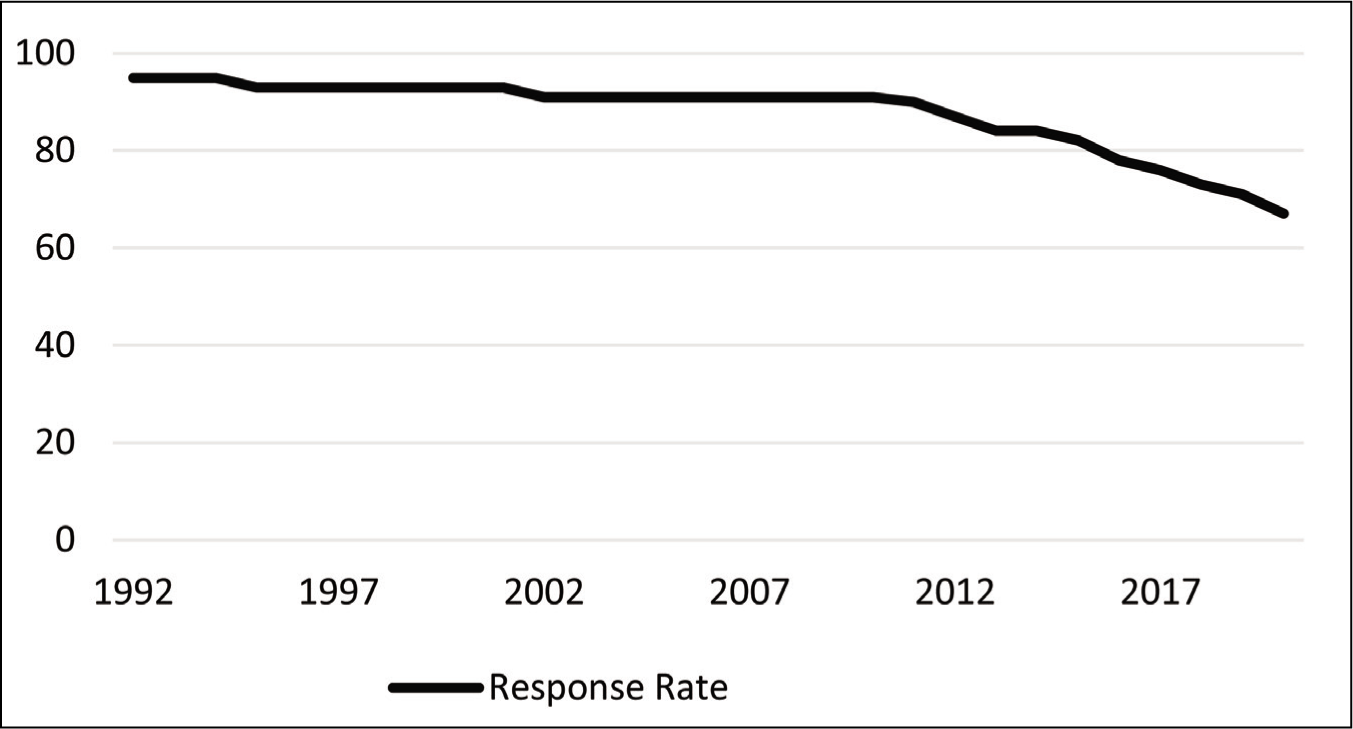
The NCVS uses screener surveys to identify individuals who have experienced a crime incident in the last year. The sample was representative of individuals ages 12 and older from households in the United States. The population size was 198,451,445. After accounting for the complex sampling design, the number of incidents that were included in the analysis was 70,758. The response rate of the survey has varied over time. The response rates were steadily decreasing from 1992 to 2010 but then began to dramatically decrease as shown in Figure 1. 27
Response Rates of the NCVS from 1992 to 2020.
Dependent Variable
The focus of the present study was the respondents’ decision to report their victimization. The self-report made it possible to examine differences in reporting, including their decision to report, and factors that influenced the decision. The variable V4399 in the survey dataset was used for the dependent variable, reporting to the police, which was measured with a dichotomous variable coded 1 for incidents that respondents reported to the police and code 0 for incidents that were not reported to the police. Incidents in which the respondents reported they did not know if it was reported were counted as missing values.
Independent Variables
The independent variables in the study were separated into individual-level and incident-level variables. The individual-level variables included household income, age and sex. The incident-level variables included weapon use, the relationship to the offender, distance from their home, the number of crime incidents and the type of crime. Different years of the survey had different numbered questions, so some questions were combined.
Individual-level Variables
Several variables were included as measures of the individual-level characteristics of respondents. The variable household income was variable V2026 in the dataset and was originally a categorical variable but was converted into a continuous variable. The conversion of a categorical variable to continuous helps to provide a more interpretable measure of income. 28 The income was transformed using midpoints of the categories. 29 The income ranged from 2,500 to 224,499.5. Age was measured as a continuous variable, created from the variable V2042, with a range of 0 to 96. Finally, the sex of the respondent was V2045 and was coded as 0 for males and 1 for females in the dataset.
Incident-level Variables
The incident-level variable of weapon used was V4049, V4084, V4051–V4057 based on different years including questions on weapon use. A weapon being present during the incident was coded as 1 and 0 if no weapon was present. An interaction variable was used between the variable year and weapon. The respondent’s relationship to the offender was V4241, V4521 and V4256 in the dataset and was coded as 0 if they knew or had seen the offender before and 1 if the offender was a stranger. The violent crime was V3049, V4068–V4106 and V4112–V4119 in the dataset and was coded as 0 for other crime (including property) and 1 for violent crime. The variable had many questions within the survey that asked what happened in the incident and were combined to include all violent crimes.
The number of crime incidents was V2073 in the dataset and was reported by the respondent in the survey as a continuous variable from 0 to 18. Due to a large positive skew, the data was transformed in Stata. The crime incidents variable was transformed using an inverse hyperbole sine transformation as it is used to transform right-skewed variables that include zero or negative values. 30 The minimum stayed at 0, but the maximum changed to 3.58 with a mean of 1.30. Finally, the distance from the respondent’s home was V4043 in the dataset and was coded as 1 for at home or next door, 2 for within a mile or less, 3 for 5 miles or less, 4 for 50 miles or less and 5 for more than 50 miles.
Analytical Approach
The NCVS collects data from a repeated cross-section using a complex sampling design that involves both clustering and stratification. Given the complex design, steps were taken to take this into account when analysing the data. Specifically, a strata variable was used to account for the sampling design and included the variables the year of the survey, pseudo-stratum code and series. A series incident weight was also used to produce more reliable estimates, and clustering was completed as it provides a useful approximation of the estimated sampling error. The stratification and clustering were completed in Stata using codes egen and svyset. 31 Additionally, multiple imputations were used in the study to account for a large amount of missing data (m = 30 imputations). After accounting for the legitimate skip patterns, there were still a large number of missing values between the dependent variable and independent variables. Based on the large sample size, 30 multiple imputations were used as prior research has indicated that the power falloff was less than 1% for 40 or more imputations but was approximately 4% for 20 imputations. 32 Per the Stata Multiple-Imputation Reference Manual (2021), 33 the command mi impute chained was run.
A binary logistic regression model was used to examine if weapon usage, household income, age, sex, marriage status, relationship to the offender, type of crime, number of crime incidents reported and the distance from the respondent’s home impacted whether a respondent reports the crime to the police. The data were input into Stata version 16.1, and the statistical test was also run using Stata. 34 Correlations were run and multicollinearity diagnostics were examined. A VIF of 1.09 was found and none of the variables reached a correlation of concern. Two models were run to determine whether additional variables help to increase the reporting behaviours including demographic and crime incident-related variables. Specifically, the first model examined the relationship between all variables. The second model added an interaction variable between the year and whether a weapon was present to indicate if the relationship between weapons and reporting behaviour depended on the year.
Results
Descriptive Statistics
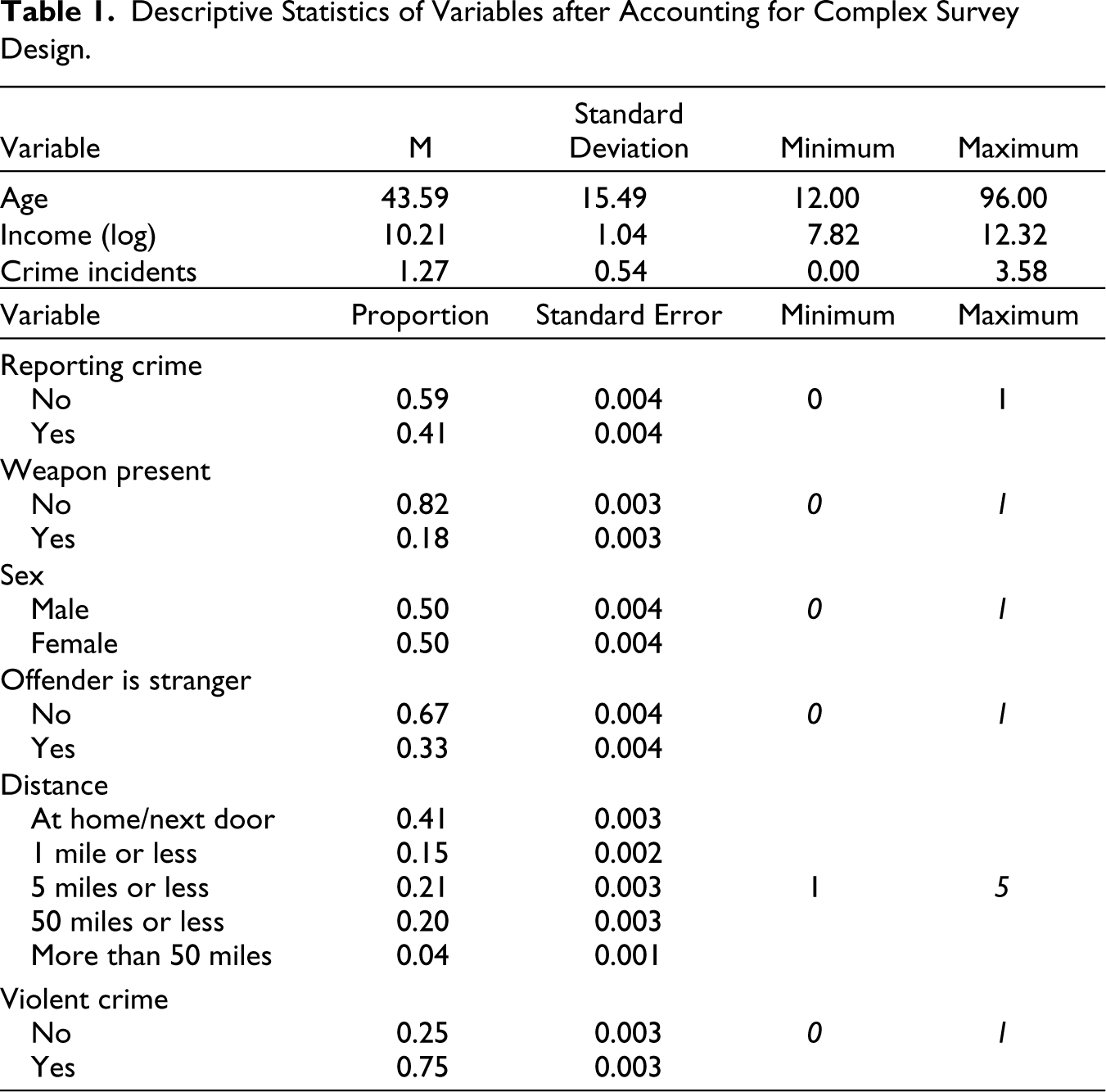
Table 1 reports the descriptive statistics of continuous variables, including the meaning, standard deviation, minimum value and maximum value for age, income and crime incidents. The average age of the respondents was 43.59 (SD = 15.49). The income was logged and had an approximate mean of 10.21 (SD = 1.04). Additionally, the mean of crime incidents after transforming the variable was 1.27 crime incidents (SD = 0.54).
Table 1 further reports the descriptive statistics including the proportion, standard error, minimum and maximum of categorical variables including whether a respondent reported a crime, whether a weapon was present, the sex of the respondent, whether the offender is a stranger, the distance of the crime from the respondent’s home and whether the crime was violent. Approximately 41% of respondents reported the crime to the police. Only 18% of respondents reported that a weapon was present, and Table 2 shows a cross-tabulation between weapons and crime reporting. Further, 33% reported that the offender was a stranger to them and 50% of respondents were female. Most of the cases, approximately 77%, were within 5 miles of the respondent’s home. Finally, most cases were reported to be violent at approximately 75%.
Descriptive Statistics of Variables after Accounting for Complex Survey Design.
Cross-tabulation of Reporting Behaviour and Weapons Presence.

Binary Logistic Regression
Two binary logistic regression models were run on Stata. The models were run after accounting for complex survey design using stratification and clustering and using multiple imputation for missing data. The first model (Table 3) examines the relationship between reporting a crime and all the dependent variables including whether the offender was a stranger, the distance from the respondent’s home, the number of crime incidents that the respondent reported in the past year, whether the crime was violent and the sex, age and income of the victim. The focal variable weapon (β = 0.699; p = .000) was statistically significant (p <.05). The odds of reporting a crime to police were 2.01 times larger when the offender had a weapon. The variable of an offender being a stranger (β = 0.497; p = .000) indicated that the odds of a respondent reporting a crime to the police were 1.64 times larger if the respondent did not know the offender. Further, the distance (β = −0.242; p = .000) revealed that the odds of a respondent reporting a crime to the police were 1.27 times larger if the crime was closer to their home. The only demographic variable of the victim that was significant was sex, as females were 1.13 times more likely to report than males.
Logit Models of Reporting Behaviours after Accounting for Complex Survey Design.
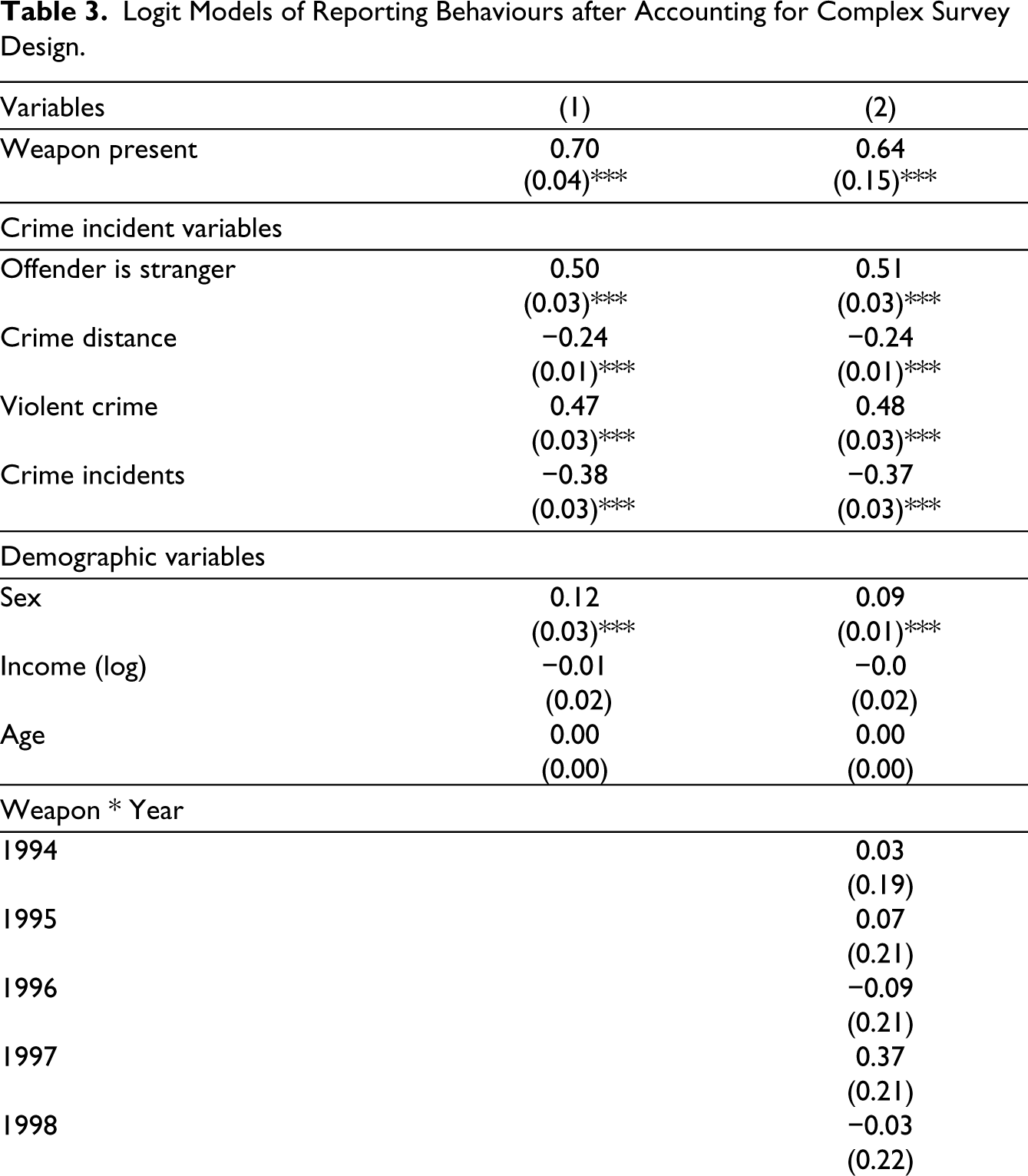
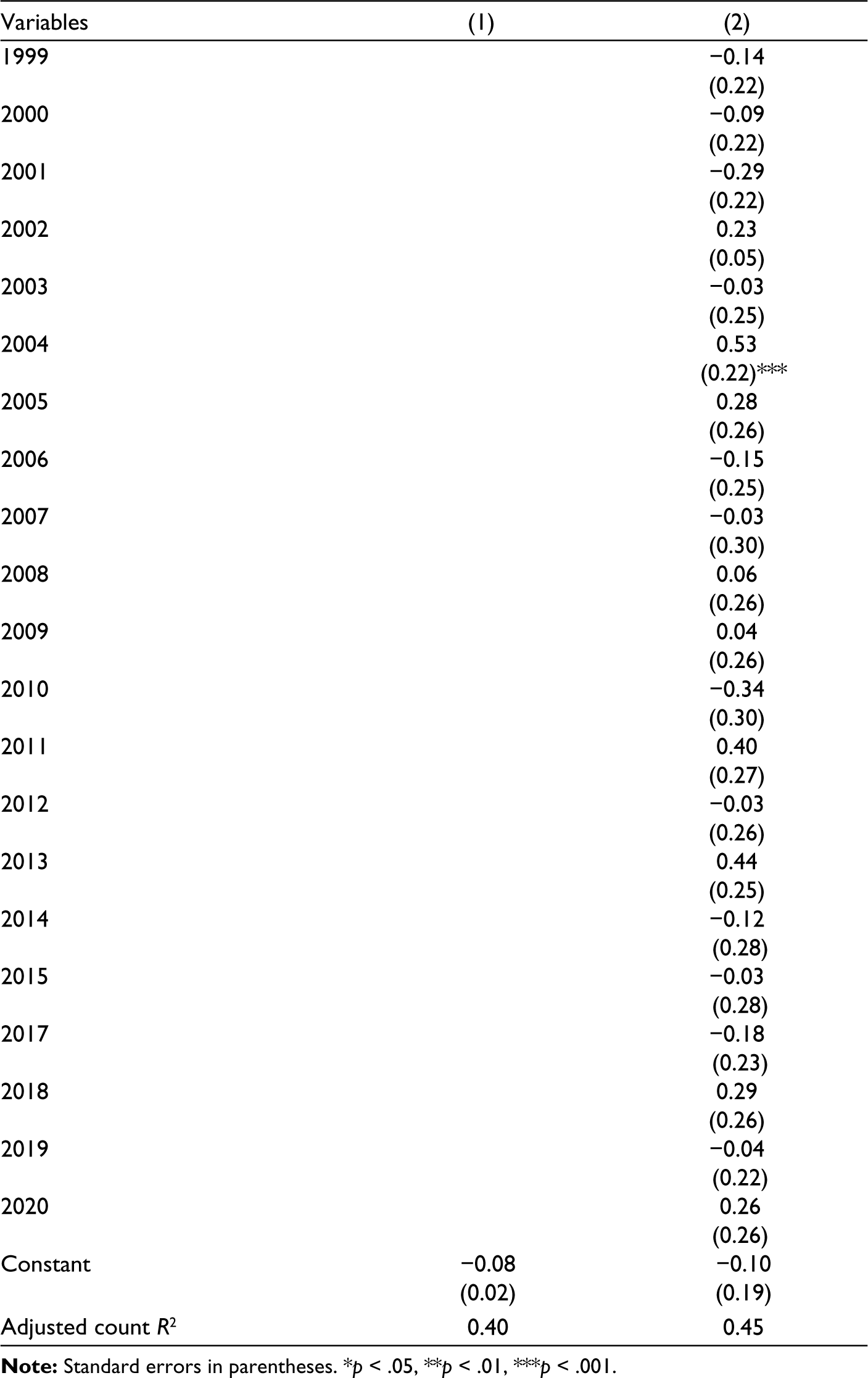
Further, the variable violent crime (β = 0.472; p = .000) and the number of crime incidents reported (β = −0.382; p = .000) were significant (p < .05). The odds of reporting a crime are 1.60 times larger if it is a violent crime compared to property or other crime. Interestingly, the odds of reporting a crime were 1.47 times smaller for each one-unit increase in the number of crime incidents the respondent experienced in the last year. The model was statistically significant indicating that changes in the weapon, whether the offender was a stranger, the distance from the respondent’s home, violent crime, the number of crime incidents in the last year and the sex of the victim influenced decisions to report the crime. The discrete change in weapons was also predicted with the other independent variables set to their means or mode. The discrete change of a weapon is 0.126, indicating that the chance of reporting a crime increased by about 13% when a weapon was present. The model had an adjusted count r-squared value of 0.40, indicating that approximately 40% of cases will be correctly predicted.
The second model included all variables from the first model but added in an interaction variable between weapon presence and the year of victimization (Table 3). The demographic variable sex (β = 0.091; p = .003) was statistically significant (p < .05). Specifically, the odds of reporting a crime to the police were 1.13 times larger for females than for males. The demographic variables income and age were not statistically significant. The variable of an offender being a stranger (β = 0.497; p = .000) indicated that the odds of a respondent reporting a crime to the police were 1.64 times larger if the respondent did not know the offender. Further, the distance (β = −0.238; p = .000) revealed that the odds of a respondent reporting a crime to the police were 1.27 times larger if the crime was closer to their home. The variable violent crime (β = 0.484; p =.000) and the number of crime incidents reported (β = −0.367; p = .000) were significant (p < .05). The odds of reporting a crime were 1.62 times larger if it was a violent crime compared to other types of crime. Interestingly, the odds of reporting a crime were 1.44 times smaller for each one-unit increase in the number of crime incidents the respondent experienced in the last year.
The interaction between weapon presence and year found that only the year 2004 was significant (p < .05). The results suggest that the relationship between weapons presence and whether a victim reported a crime was not impacted by the year of the victimization. The model was statistically significant, indicating that changes in the variables weapon, age, sex, income, whether the offender was a stranger, the distance from the respondent’s home, the type of crime and the number of crime incidents correlate with decisions to report the crime. The model had an adjusted count r-squared value of 0.45, so approximately 45% of cases were correctly predicted, which slightly increased from the first and second models.
Discussion
Significance
In the present study, several contributions to understanding reporting behaviours were made. The model that had the largest adjusted count r-square value was the interaction model that included all variables and the interaction between weapon presence and year of victimization. The adjusted count r-squared value was 0.45, indicating that almost half of the predictions in reporting behaviour were correct based on the model. However, the results suggested that the relationship between weapons and reporting may not be impacted by the year the victimization occurred, but other characteristics of the victim and the crime may influence reporting. Specifically, the odds of reporting a crime were approximately two times larger when the offender had a weapon, and the chance of reporting a crime increased by about 13% when a weapon was present.
Further, the sex of the respondent was important as the odds of a female reporting a crime were 1.13 times larger than for men. This is consistent with prior research that indicates females report crimes at greater rates. 35 While the difference is both substantively and statistically significant, it does not explain the variation as much as weapons but should be further investigated into why there are differences between genders. The results also indicated that demographic variables were not as influential in the decision to report the crime as the circumstances of the event. The offender being a stranger, crime distance, crime incidents and violent crime were all significant and increased the odds of reporting. The odds of reporting further increased by 1.60 when the crime was violent. The characteristics of the incident were significant in the model, but there was only a small change in the amount of values expected to be predicted correctly. The current study used data from 1994 to 2020 and the large timeframe allowed us to examine interactions between weapon presence and the year and found that the year of the victimization may not impact the relationship between weapons and reporting.
Support for Hypotheses
The first hypothesis in the study was that crime incidents where a weapon was present would have a higher likelihood of being reported to law enforcement. In both models, support for the hypothesis was found. The presence of a weapon had a large impact on reporting to the police. The second hypothesis was that respondents would be more likely to report the crime to law enforcement if the offender was a stranger. There was also support for this hypothesis. In both the second and third models, the offender being a stranger was significant in reporting the crime. Specifically, when a victim did not know the offender, the odds of reporting the incident to the police increased by 1.64. Finally, the third hypothesis was not supported. The relationship between weapon presence and reporting behaviour was not impacted by the year, with the exception of one year. While the hypothesis is incorrect, it suggests that other factors may be more important in the decision to report the crime and that weapons presence is impactful irrespective of the year.
Limitations
The present study had several limitations. First, the data was from the NCVS and included years 1994 to 2020 but did not include the two most recent years, and data from 2016 was missing. The Census Bureau had yet to release the data from 2021 at the time of the analysis, so the data were several years behind and there could be important changes that have an impact on reporting behaviour, especially with the pandemic impacting all aspects of life. There was also a large amount of missing data from the survey, and while multiple imputation was used to counteract this, this issue issue still should be considered. Further, the variable injury sustained was not included as it had a large amount of missing data but should be considered in future research as it may influence reporting behaviour.
Conclusion
The current study provided support for weapons presence and a stranger as an offender influencing a respondent’s decision to report a crime to the police. While the presence of a wepaon has previously been found to influence reporting behaviour, the present study indicated weapons were still impactful in the decision, potentially more so than characteristics of the victim and other characteristics of the crime. The study illustrated, however, that the presence of a weapon was not the only factor that influenced the decision as the variables including the presence of a weapon, the offender being a stranger, a shorter distance from the victim’s home, a smaller number of crime incidents, violent crimes and females having a larger odds of the victim reporting the crime to police also increased reporting behaviour. The study further indicated that the relationship between weapon presence and reporting was not influenced by the year the crime occurred.
Although there are several limitations in the study that need to be addressed, the study provided some evidence that these variables influence crime-reporting behaviour. Future research should examine if an injury does influence reporting behaviour and should try to determine why females were more likely to report crime than men and what can be done to increase men’s reporting behaviours. The presence of a weapon increases the perceived danger of the crime leading to the victim potentially reporting the crime more often, but future research needs to assess how to change the perspective of danger even if a weapon is not present. Future research should further study differences in crime-reporting behaviour based on the year and if what impacts a victim’s decision to report has changed over time. As crime continues to trend upward in the United States, future research must continue to explore why victims do not report crimes and what can be done to increase reporting.
Footnotes
Declaration of Conflicting Interests
The author declared no potential conflicts of interest with respect to the research, authorship and/or publication of this article.
Funding
The author received no financial support for the research, authorship and/or publication of this article.