



Abstract
Recently, there has been an increased societal focus on the boundaries of sexual behaviours. During a time when victims and survivors of unwanted sexual experiences are encouraged to come forward, it is vital to understand what makes people respond negatively to such disclosures. This study aimed to examine how endorsement of stereotypical ideas of Child Sexual Abuse (CSA) and response to CSA disclosures are related to various forms of attitudinal intolerance (i.e., racism, sexism and sexual prejudice). We used a survey and vignette methodology with a sample (N = 160) of undergraduate students. Results indicated that endorsement of CSA myths was positively related to all other variables of attitudinal intolerance. With regards to a response to a CSA disclosure, belief in the disclosure decreased as attitudinal intolerance increased. Similar to rape myth endorsement, endorsement of CSA myths may represent another form of intolerance, which only partially translates into a negative response to a CSA disclosure. Implications for intervention are discussed.
Introduction
In the past few years, conversations about sexual harassment and violence have increased. Movements such as #MeToo and #Timesup have highlighted the prevalence of sexual misconduct. Despite the positive effects of greater visibility of the scope and nature of this problem 3 , 4 there are indications that it has also resulted in an increasingly polarized narrative. 5 During a time when victims and survivors are increasingly encouraged and supported to speak up about their experiences, it is vital to understand how and why skeptical responses to such disclosures occur.
Negative responses to disclosures of unwanted sexual experiences are not limited to adult victims. It is estimated that one in eight children will have experienced at least one incident of sexual victimization before they turn 18. 6 There is a gender difference in victimization, with one in three girls and one in seven boys experiencing sexual abuse in childhood. 7 The negative consequences of Childhood Sexual Abuse (CSA) are well-documented and include psychological, 8 social 9 and sexual problems. 10 Further, a history of sexual victimization increases the risk of revictimization later in life. 11
Disclosure of CSA is vital for victims accessing resources to mediate the negative consequences of CSA, and often a disclosure is the only way abuse is discovered and stopped. Nevertheless, most victims of CSA delay disclosing their experiences. 12 Research found factors associated with delayed disclosure include the victim being younger when the abuse happened, and in cases of intra-familial abuse. 13 Other findings suggest the delay of disclosure also increases if the abuse is more severe or occurs at a higher frequency. 14 Often cited barriers to disclosure include a fear of not being believed or a fear of being blamed for the abuse (see for a review). 15 For victims of non-stereotypical CSA, such as those who were abused by a female perpetrator or for male victims, the barriers are even more numerous. 16
Skeptical Responses to Victims
Unfortunately, victims’ fear of negative responses to their disclosure is warranted. 17 , 18 Although particularly adult victims typically report receiving supportive responses, 19 the impact of a (perceived) negative response is significant (Easton, 2019). Indeed, a disclosure that does not result in support or that triggers negative responses from the recipient of the disclosure may be more detrimental to the victim than non-disclosure (Easton, 2019; Swingle et al., 2016).
Several decades of research have documented individual differences that predict likelihood to engage in victim-blaming or to disbelieve a victim. Much of this research centers on the endorsement of rape myths, which are stereotypical beliefs about rape. 20 Endorsement of these beliefs is associated with a more skeptical response to victims of sexual violence. 21 One of the most reliable individual differences in rape myth endorsement is gender, with men more likely to respond skeptically to victims of sexual violence than women, regardless of whether the victim is male 22 or female, 23 straight 24 or gay, 25 adult 26 or child (de Roos & Jones, 2021). Other variables associated with an increased tendency to respond sceptically are lower levels education 27 and dark triad personality traits. 28
Victim-blaming as a Specific Form of Intolerance
Allport et al. 29 suggested that prejudice against a group or topic may be the result of rigidity and intolerance in cognition. Following from this, social dominance theory holds that some groups should be dominant over others, and that oppression based on group membership is inherent to our need to ascribe hierarchy to our membership of a group. 30 This view would explain why intolerance in various areas seems to be related. Indeed, research has found strong links between sexism and racism, 31 as well as sexism and homophobia/sexual prejudice. 32 Whilst these constructs are related, they are not perfectly correlated, meaning they reflect unique domains of intolerance.
More recently, some research has suggested that endorsement of rape myths, or inflexible, stereotypical ideas about a specific topic, is related to other forms of intolerance. Aosved et al. (2006) found rape myth endorsement was related to racism, sexism, homophobia, ageism, classism and religious intolerance. Similarly, DeJong et al. 33 found a link between sexism, racism and homophobia and endorsement of male rape myths (stereotypical ideas about the rape of men). These findings suggest rape myths endorsement may be a similar domain of intolerance, indicating a broad, inflexible cognitive style.
In a similar vein, fundamentalist religious ideas have been linked to more negative attitudes toward rape victims. 34 Specifically, when religion was central to male participants, they were more likely to engage in victim-blaming towards a female victim of rape. For female participants, an inverse relation between prayer frequency and endorsement of rape myths was found.
To date, research into intolerance in relation to response to victims of sexual violence have almost exclusively focused on adult rape myths. Child sexual abuse myths 35 are similarly stereotypical ideas about sexual violence perpetrated against children. For example, a commonly endorsed CSA myth is that CSA allegations are often false (endorsed by > 20%, N > 3,000). 36 These myths have not been widely studied in relation to other areas of intolerance. Exceptions include a recent study by Alcantara et al. 37 who found that participants who scored high on social dominance regarded a child’s CSA allegation as less credible. Similarly, Magalhães et al. 38 found gender differences in CSA myth endorsement could largely be explained by men’s higher social dominance orientation. More research is needed to determine the extent to which skeptical responses to CSA victims delineate a similar topic where intolerance may manifest.
The Present Study
With an increased spotlight on victims and survivors of sexual violence, including perpetrated against children, it is vital to understand why people may respond skeptically to CSA disclosures. Raising awareness through movements such as #MeToo may be insufficient if victims are met with responses from people with a broadly intolerant cognitive style that may manifest as victim-blaming. The present study aims to add to our understanding about how intolerance towards CSA victims relates to other forms of intolerance. We seek to do this through use of questionnaires focusing on various domains of intolerance and a vignette of a CSA disclosure. First, we expect to find a gender difference in the various measures of intolerance, with men scoring higher. Second, we expect to find a positive association between intolerance across different areas and religiosity on the one hand, and both endorsement of CSA myths and sceptical response to CSA disclosure on the other hand. Third, we expect that CSA myth endorsement can be predicted from intolerance and religiosity. Finally, we include exploratory analyses to examine how these results are affected by participant and victim gender.
Methods
Participants
Participants were undergraduate psychology students from the United Kingdom (N = 160) who participated for class credit. This sample size was sufficient for 80% power. The age ranged from 18 to 47 years old (M = 20.85, SD = 5.19). The sample was largely female (85.9%), with four participants describing their gender as non-binary or other (2.5%). The majority of the sample identified their sexual orientation as straight or heterosexual (83.8%) with some students identifying as bisexual (11.3%), gay or lesbian (1.3%), or another sexual orientation (3.8%). With regards to racial background, nearly half of students identified as White (45.0%), around a fifth identified as Black (22.6%) or Asian (20.6%). The remaining students identified their racial background as mixed (6.2%) or other (5.8%).
Materials
Religiosity
This scale is a combination of two religiosity measures developed by Friesen and colleagues. 39 The measure of religiosity is comprised of three items about religious views (e.g., ‘How religious are you?’). The religiosity premeasure is also comprised of three items expanding on the previous scale (e.g., ‘Having a spiritual life is important to me.’). Participants are asked to rate each statement on a 7-point Likert scale (1 = strongly disagree, 7 = strongly agree). Scores are summed and higher scores indicate a greater degree of religiosity. Internal reliability in this sample was excellent (α = 0.93).
Sexism Scale
This scale 40 is comprised of 15 items, and 2 subscales measuring classical sexism (‘Women are better suited to look after children and old people.’) and modern sexual prejudice (‘Society treats men and women the same way.’). Each item is scored on a 5-point Likert scale (1 = strongly disagree, 5 = strongly agree). Item scores are summed with higher scores indicating more prejudiced attitudes. Internal reliability in this sample was acceptable (α = 0.80).
Modern Racial Prejudice Scale
This scale 41 is comprised of 17 items, and 2 subscales measuring classical racial prejudice (‘Immigrants are generally not very intelligent.’) and modern racial prejudice (‘Racist groups are no longer a threat toward immigrants.’). Each item is scored on a 5-point Likert scale (1 = strongly disagree, 5 = strongly agree). Item scores are summed with higher scores indicating more prejudiced attitudes. Internal reliability in this sample was excellent (α = 0.95).
Attitudes Towards Homosexuality Scale
This 20-item scale 42 assesses sexual prejudice. It asks participants the extent to which they agree with each statement (e.g., ‘It would be beneficial to recognize homosexuality as normal.’). Each statement is rated on a 5-point Likert scale (1 = strongly disagree, 5 = strongly agree). Item scores are summed with higher scores indicating more prejudiced attitudes. Internal reliability in this sample was good (α = 0.83).
CSA Myth Scale
This 15-item scale 43 assesses endorsement of CSA myths on three subscales: blame diffusion (‘Children who act in a seductive manner must be seen as being at least partly to blame if an adult responds to them in a sexual way.’), denial of abusiveness (‘It is not sexual contact with adults that is harmful for children. What is really damaging for the child is the social stigma that results once the “secret” gets out.’) and restrictive stereotypes (‘Most children are sexually abused by strangers or by men who are not well known to the child.’). Each statement is rated on a 5-point Likert scale (1 = completely disagree, 5 = completely agree). The scale had good internal reliability in this sample (α = 0.86).
Vignettes
Participants were presented with the following vignette:
You’re talking with your friend Zoe about #metoo. She was one of the people who reposted the status on her Facebook wall. She tells you she reposted the status because from when she was thirteen until she was fifteen, her mom’s boyfriend would come into her bedroom at night when everyone was asleep. She tells you he would undress and get under the covers with her. He would touch her and rub against her and ‘do some other stuff’. It only stopped when her mom broke up with him because she had to move to a different city for her job. Zoe has never told anyone about what happened to her, but now that more people are speaking up, she feels that she can too.
To create a vignette with a male victim, the mention of ‘Zoe’ was replaced with ‘Philip’, and mention of ‘she’ with ‘he’. Participants were then asked to indicate the extent to which they believed the vignette, to what extent they blamed the stepparent, and Zoe/Philip, and how harmful they felt the situation was for Zoe/Philip. All questions were rated on a scale of 1–100 (1 = not at all, 100 = entirely).
Procedure
The study was programmed in Qualtrics, and students accessed the survey through the university’s participant platform. First, students were asked to agree to consent to participate in the study. They were, then, randomly allocated to read the vignette with a male or female victim, after which they answered the vignette questions. They, then, filled out the remaining questionnaires in randomized order. Finally, they completed brief demographic questions. On the last screen, participants were presented with a debrief form.
Results
Preliminary Analyses
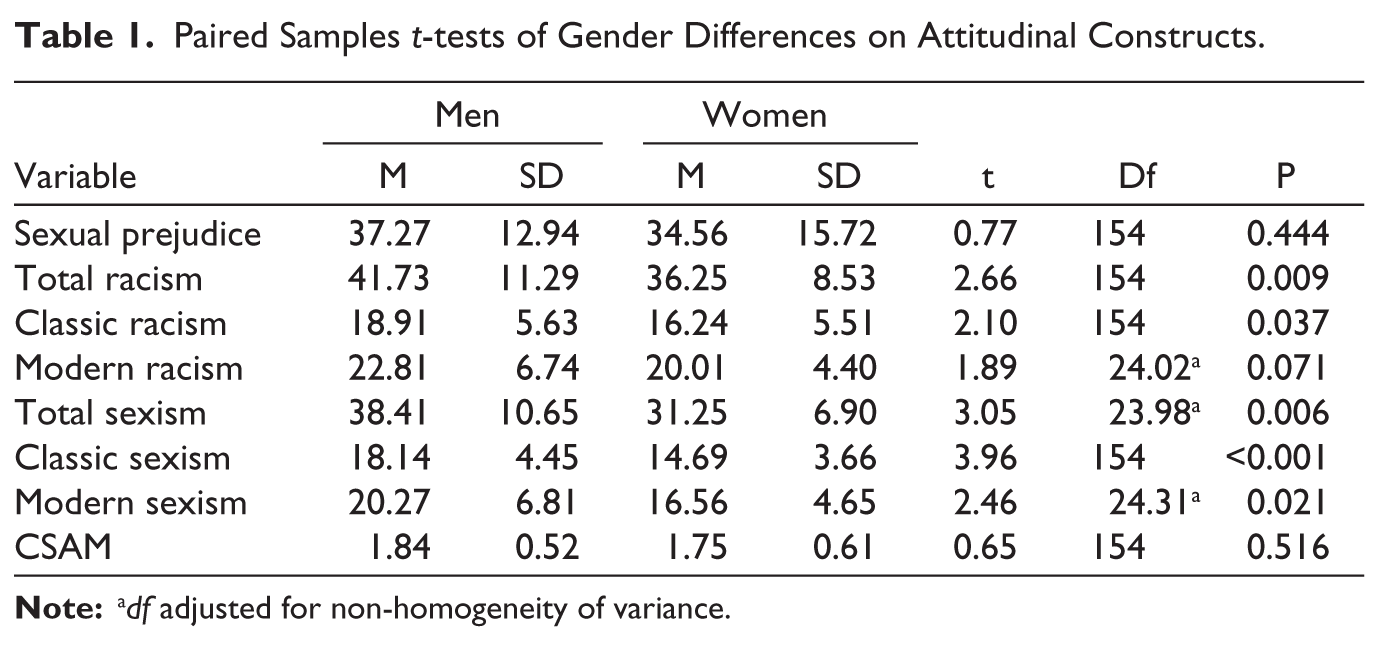
To test established gender differences in the attitudinal constructs, we conducted a series of paired samples t-tests. Male participants reported higher scores on racism (overall and classic) and sexism (overall, classic and modern). No other gender differences were found. Results are displayed in Table 1. Due to the much larger proportion of women in this sample, Welch t-tests were performed with bootstrapping of 1,000 samples. These tests showed the same pattern of gender differences across all variables.
Paired Samples t-tests of Gender Differences on Attitudinal Constructs.
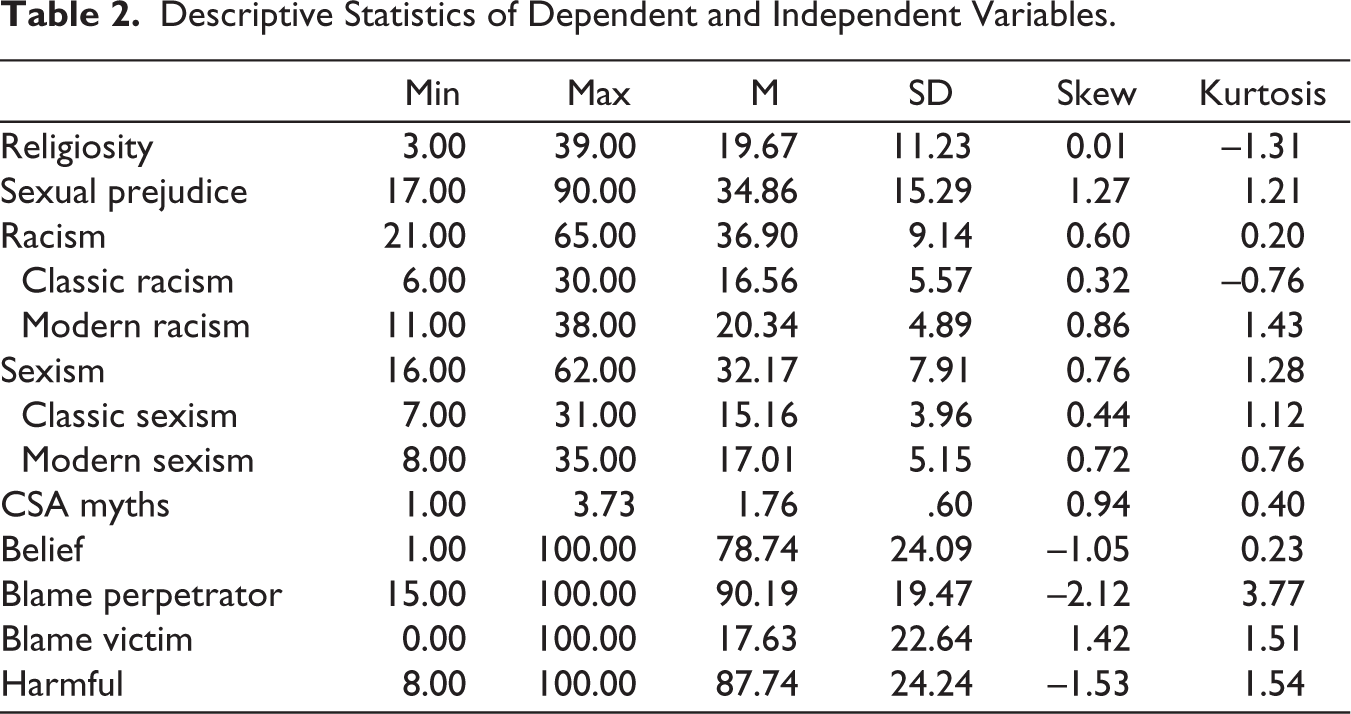
Descriptive statistics of all dependent and independent variables are displayed in Table 2. Generally, participants leaned toward lower levels of prejudice, and supportive responses to a sexual abuse disclosure.
Descriptive Statistics of Dependent and Independent Variables.
Attitudinal Constructs and Response to CSA
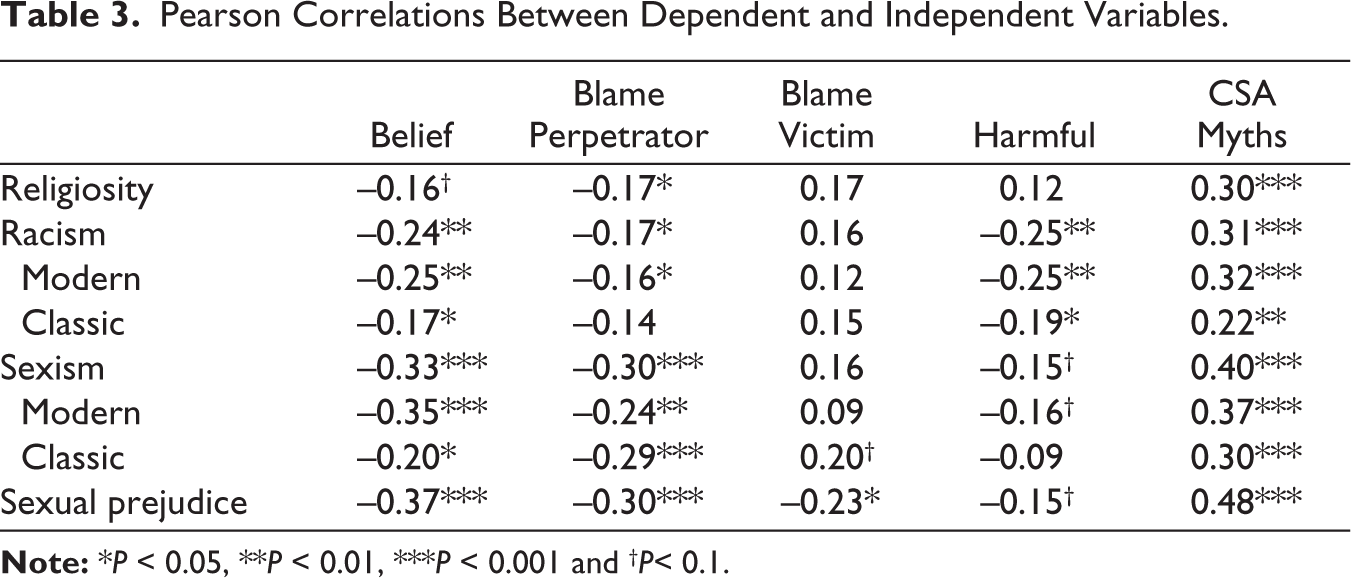
Next, we examined correlations between the independent and dependent variables. Results are displayed in Table 3. Prejudiced views in nearly every respect were positively correlated with endorsement of CSA myths but did this not necessarily translate into a less supportive response to disclosure. Blaming the victim was only associated with prejudiced attitudes towards homosexuality, and classic racism was not associated with blame allocation. With regards to perceived harmfulness, only overall and modern racism were positively correlated. In terms of religiosity, greater religiosity was associated with higher CSA myth endorsement, as well as with less blame being allocated to the perpetrator.
Pearson Correlations Between Dependent and Independent Variables.
To determine whether endorsement of CSA myths could be predicted from religiosity, sexism, racism and homophobia, a multiple regression was conducted. A significant model was found (F (4, 151) = 16.30, P <0.001) which explained 30.2% of variance in CSA myth endorsement. Sexual prejudice (β = 0.32, P = 0.001) and racism (β = 0.17, P = 0.047) emerged as significant predictors.
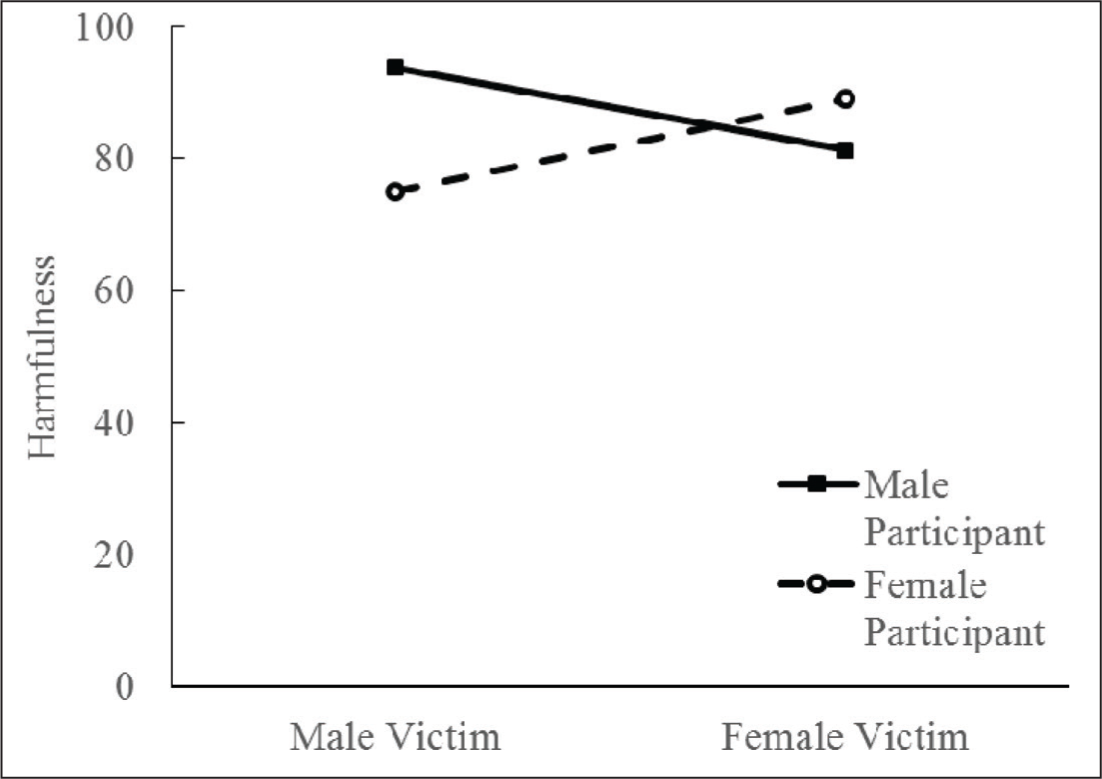
Finally, to examine the effect of victim and participant gender on response to the vignette, we conducted a series of ANOVA’s with victim and participant gender as predictors and belief, blame allocation and harmfulness as outcome variables. Male gender of victim and participant was coded as 1, female gender of victim and participant as 2. None of the main or interaction effects were significant for any of the outcome variables, except for harmfulness. There was a significant interaction effect of victim and participant gender on harmfulness, as displayed in Figure 1 (F (1, 149) = 6.03, P = 0.02). To examine how the prejudice and religiosity variables in combination with victim and participant gender affected harmfulness, we conducted a multiple linear regression using the overall prejudice scores for each domain, the religiosity score, and victim and participant gender as predictors. Male gender of victim and participant was coded as 1, female gender of victim and participant as 2. A significant model was found (R2 = 0.16; F (6, 145) = 4.76, P < 0.001), with religiosity (β = 0.22, P = 0.02), sexual prejudice (β = –0.25, P = 0.02), victim gender (β = 0.21, P = 0.006) and racism (β = –0.21, P = 0.03) emerging as significant predictors.
Interaction Effect of Participant Gender and Victim Gender on Perceived Harmfulness.
Discussion
This study set out to examine whether various areas of intolerance and religiosity are related to how people perceive sexual abuse of children. To this end, we conducted an online survey study, which used a vignette of a CSA disclosure and various questionnaires. Consistent with previous research, we found that male participants scored significantly higher on measures of racism and sexism.
Surprisingly, we did not find this gender effect for endorsement of CSA myths or sexual prejudice. The measure we used to assess sexual prejudice may reflect homophobic attitudes that are dated (i.e., ‘Homosexuals do need psychological treatment,’ ‘Homosexuals should not be allowed to work with children.’). Indeed, more recent scales focus on more subtle beliefs such as that homophobia is no longer an issue and that sexual minorities are too demanding. 44 Future research should use a more recent scale to assess sexual prejudice. The lack of gender difference in endorsement of CSA myths may be at least partially explained by the low variability in endorsement (range = 1–3.73). This low variability could reflect an increased awareness about sexual abuse of children, with participants more knowledgeable about stereotypical ideas about sexual abuse.
Overall, participants scored low on various measures of intolerance. In terms of response to CSA, participants leaned towards believing the vignette, finding the experience harmful, and blame was more likely to be allocated to the perpetrator than the victim.
As expected, all measures of intolerance and religiosity were positively and significantly correlated with endorsement of CSA myths. However, the pattern in relation to response to the CSA vignette was more complex. People who indicated they were more religious allocated less blame to the perpetrator and were marginally less likely to believe the vignette. This is consistent with previous research that has demonstrated religiosity is associated with negative perceptions of victims of sexual abuse. 45
People who scored higher on racism, sexism or sexual prejudice were less likely to believe the vignette, but only racism was linked with perceiving the vignette as less harmful. The effects of sexism and sexual prejudice were marginal. Contrary to expectations, sexual prejudice was negatively associated with blaming the victim. Some research has suggested that sexual prejudice relates to victim-blaming only if the victim is gay and male. 46 , 47 The vignette used in this study varied the gender of the victim who was abused by an adult male, which could explain the inconsistent effect of sexual prejudice on victim-blaming. Finally, all measures of intolerance were negatively related to blaming the perpetrator, indicating that higher scores on intolerance were linked to less blame allocated to the perpetrator.
Sexual prejudice and racism were both significant predictors of CSA myth endorsement, which supports the idea that CSA myth endorsement can be characterized as an area of intolerance. It is likely that sexism did not emerge as a significant predictor here, due to the high correlation between sexism and racism. 48 Finally, when looking at the effect of participant and victim gender, we only found a significant interaction effect on perceived harmfulness of the vignette. Male participants were more likely to find the vignette harmful if the victim was male, and the reverse was true for female participants. Although this finding is contrary to expectations, it could be explained by perceived similarity between participant and victim. Further, these findings support previous research that has suggested believing a disclosure, allocating blame and judging harmfulness are distinct processes. 49
Implications
This study provides support for the idea that, similar to rape myth endorsement, endorsement of stereotypical ideas about CSA may reflect an area of intolerance. We might expect children to be a ‘special’ category of victim due to their age, and thus less prone to typical, negative narratives such as those that centre on false allegations 50 or ‘blurred lines’ of consent. 51 However, it seems that stereotypical perceptions of CSA are similarly related to other attitudinal constructs of intolerance, which hints at a cognitive inflexibility that manifests in various areas.
Interestingly, intolerance across areas did not necessarily translate to a negative response to a CSA disclosure. The strongest and most consistent associations were found between intolerance and lower belief in the disclosure. Not believing a disclosure may be a function of an individual’s response to a perceived threat from the out-group, which in this case is CSA victims. Blame-allocation and perceived harmfulness may be secondary processes that would become relevant only if the vignette was believed. As such, they may require more careful consideration of the information contained within the vignette.
These findings have several practical implications. Previous research has suggested that interventions that target intolerance may also reduce rape myth endorsement. 52 CSA myth endorsement may benefit from these interventions in a similar manner. Further, considering prejudice can be characterized as a negative response to perceived threat to the individual, 53 this reasoning can also be applied to child victims of sexual violence. In this regard, self-affirmation has shown promise in circumventing racism, 54 sexism 55 and rape myth endorsement 56 as well as negative reactions to CSA disclosures. 57
Limitations
This study has several strengths, such as examining a variety of areas where intolerance may manifest, the inclusion of religiosity, and the use of both a vignette and the CSA myths scale to measure how people perceive CSA. Nevertheless, there are several limitations to note. First, the sample was overwhelmingly female, educated and white. Several studies have demonstrated that university populations show less variability in terms of intolerance, 58 as well as less scepticism in their response to inappropriate sexual behaviour. However, even with limited variability, we did find several hypothesized effects, which suggest these effects may be larger in a general population. Second, the victim portrayed in our vignette disclosed abuse that happened between ages 13 and 15. Teenage victims are more likely to be held (partially) responsible for their victimization and there is an expectation that they ‘should resist’ the abuse. 59 Had the victim been younger, perhaps the vignette would be considered more believable and harmful. Future research should examine whether younger victims are indeed viewed as less culpable, which may lead to more tolerant and supportive responses.
Conclusion
This study found that endorsement of CSA myths can be characterized as intolerance or cognitive inflexibility in a similar manner as rape myth endorsement. Endorsement of these myths was positively correlated with racism, sexism, sexual prejudice and religiosity. With regards to responses to a disclosure of CSA, belief in the disclosure was most associated with measures of attitudinal intolerance. Blame allocation was only related to racism. The findings of this study have implications for interventions targeting intolerant beliefs, as such interventions may also indirectly affect how people perceive and respond to sexual abuse of children.
Footnotes
Declaration of Conflicting Interests
The authors declared no potential conflicts of interest with respect to the research, authorship and/or publication of this article.
Funding
The authors received no financial support for the research, authorship and/or publication of this article.