



Abstract
Anumula Shashank, a second-generation entrepreneur, considered himself fortunate to have inherited a loyal customer base of chai (tea) enthusiasts for his Café Niloufer. The café had previously sold an average of 20,000 cups of Irani chai daily, and even the 2019 pandemic had not impacted these Irani chai sales. Shashank faced competition from local and international chains, prompting him to explore new avenues to differentiate and stand out in the crowded market. On a fine 15th June morning in 2022, Shashank headed to a meeting with the owner of an 18,000 square feet facility in Himayat Nagar, Hyderabad, Telangana, India, contemplating the launch of a modern format tea café.
He took over the company’s reins from his father, Mr Anumula Babu Rao. Rao had purchased Café Niloufer from its previous owner and transformed it into a well-known brand, serving the famous ready-to-drink (RTD) Irani chai, samosa and Osmania biscuit. Café Niloufer operated solely from a single outlet in Red Hills, Hyderabad, India.
Shashank strongly felt the need to balance preserving Café Niloufer’s heritage with embracing change. As he was looking for a new space to launch the modern café, he had been grappling with a crucial decision. Should he continue their time-tested Irani tea cafe format, which had been successful for decades, or should he explore alternative business models to stay relevant and profitable in the changing market?
Background
Mr Anumula Babu Rao was born in Laggam, in Dahegaon Mandal, Adilabad district, in the Indian state of Telangana. After completing his education in Chandrapur, he came to Hyderabad in 1975 with limited experience. With sheer hard work, sincerity and commitment, young Babu Rao impressed his employer, who allowed him to work as a service boy for their second outlet, ‘Café Niloufer’, located at Red Hills, Hyderabad. Babu Rao (1978), who started as a service boy (Aranha, 2023), became a cashier, tea master and manager within 3 years of working at Café Niloufer (refer to Figure 1). As the café owner had some other plans, he offered Babu Rao to run the café on a daily rental basis, parting a fixed amount with the owner of the café.
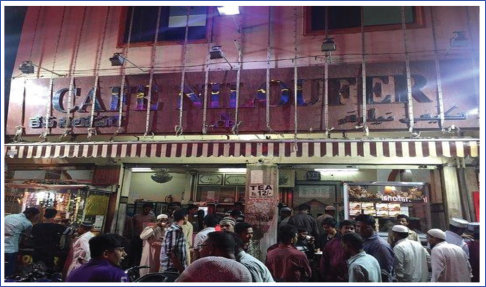
In 1993, Babu Rao acquired the premises and owners of the brand Café Niloufer from the owner by paying ₹3 lakh 1 ($4,640.39). He sold only Irani chai 2 and Osmania biscuits through Café Niloufer’s only outlet, located at Red Hills, Hyderabad. This outlet sold around 20,000 cups of ready-to-drink (RTD) every day. For the next four decades, Irani chai and Osmania biscuits were the only products in the company’s product portfolio.
Second-generation Entrepreneur
When I had arrived at ABR Café and Bakers Pvt Ltd, I found a company with a predominantly vocation: the focus of the business was on Tea and Osmania Biscuits.
3
I could quickly see that the value was in the brand. Niloufer was a strong brand with a four-decade-long tradition and solid participation in the tea business. (Shashank)
Shashank took up the baton from his father Mr Anumula Babu Rao in 2016. His MBA degree had taught him some critical lessons for growing his family-run business. Thus, the first change he wanted to bring about was revisiting Café Niloufer’s brand, tone and messaging. To get a holistic first-hand understanding of the business, he chose to work closely with all the departments before assuming the role of managing director. Based on his hands-on experience, he planned to make the company more professional and service-driven, specifically to attract the younger generation. Thus, he decentralized the process for facilitating easy decision-making. The company had implemented six sigma practices to maintain consistent quality and delivery of its bakery products.
Shashank had gained expertise in blending tea in large quantities and retaining the same unique taste. He and his team had developed an innovative RTD tea dispenser for its corporate customers.
Shashank knew that if he were to grow the company, he had to capitalize on the reputation that Café Niloufer had built in its four decades of existence. For instance, he needed to build upon the popularity of Niloufer chai, as it had been extremely popular among consumers. On average, Niloufer used to sell about 20,000 cups/day of RTD Irani chai; interestingly, even the ongoing COVID-19 pandemic could not affect its sales. However, Shashank knew that sustaining its future growth based on just Irani chai would be difficult. He had to explore new potential areas for relevant growth of the company. He was contemplating adding new product lines that would give impetus to expand his current market to newer segments.
Shashank had also recently seen a trend where new players entered the organized tea business to exploit an opportunity of a demand–supply gap. Competitors like Chai Point, Vahdam Tea, Teabox and Chaayos used different business models to expand their business both in India and abroad. These companies, in fact, used technology and new-age service delivery partners to expand their business, both online and offline (Craft, 2023). By the end of 2020, ABR Café and Bakers Pvt Ltd, the parent company of Café Niloufer, had garnered a revenue of 25 crores ($3,866,990) and aimed to achieve a turnover of 100 crores ($15,468,000) by 2024. 4
Indian Tea Market Trends
Post-COVID gains for tea industry:
Tea emerged as a plant-based functional food geared by the wellness aspect, discovery of premium tea and consumers’ quest for understanding of many layers of taste and variants available to them, eco-friendly packaging. and rise of online marketing over the offline and innovative manner of marketing tea. Mr Raj Bansal, President, Tea Board of India (Ghosal, 2021)
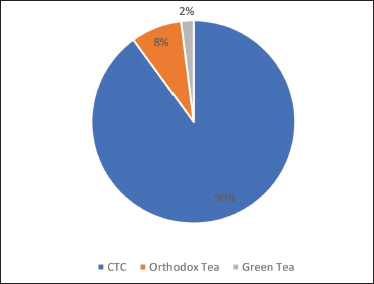
Significant growth in the food and beverage industry was one of the key factors that created a positive outlook for the tea market in India. The country was among the largest producers and consumers of tea across the globe, and tea had emerged as one of the most cost-effective and healthy beverages. Moreover, the increasing consumer preference for premium and packaged tea brands provided a thrust to the market growth (refer to Figure 2). Tea manufacturers used multi-layered packaging to store and distribute tea, to minimize the instances of adulteration and spoilage and to maintain the fragrance and freshness of the tea leaves. In line with this, growing consumer awareness regarding the health and medicinal benefits of organic and green tea variants also contributed to the rising tea consumption in India. There was a shifting preference toward novel fruit, herbal and other speciality varieties that aided in relaxation, reduced anxiety and minimized the risks of developing chronic medical ailments. Other factors, including rising expenditure capacities of the consumers, along with the proliferating online retail channels, were anticipated to drive the tea industry in India toward growth (IMARC Group, 2024).
Café Business Expansion
The tea cafe business in India had witnessed several major shifts and trends over the years, driven by changing consumer preferences, market dynamics and global influences. Many tea cafes had expanded their menus beyond traditional tea offerings to include a wide range of beverages like coffee, smoothies and speciality drinks to cater to diverse customer preferences. In an effort to enhance the customer experience and increase revenue, many of them had added food items, including snacks, sandwiches and desserts. Customers had the option to customize their beverage orders, including ingredients, sweetness and other variations according to their preferences. Customers could gather, work and connect with the tea cafés, which hosted events, open mic nights and cultural programmes.
The emergence of health-conscious consumers had led to the incorporation of herbal teas, organic ingredients and wellness-focused offerings. Tea cafes had started promoting the health benefits of different teas. Some tea cafes had incorporated elements from different cultures, introducing international flavours and blending them with Indian tea traditions. They had also been focusing on sustainable and eco-friendly practices, from sourcing organic and fair-trade teas to reducing single-use plastic and promoting eco-friendly packaging.
The rise of premium tea offerings, including single-origin teas, speciality blends and high-quality loose-leaf teas, aimed at attracting a more discerning clientele willing to pay a premium for a superior tea experience (Kumar, 2022).
Tea Culture in Hyderabad
The city of Hyderabad was India’s fifth-largest city and had been well-known for its love of diaspora, along with a blend of cultures. In fact, Hyderabad’s food culture had always been diverse, whether it was chai, biryani or haleem. The love of Irani chai among Hyderabadis had been a common sight, as hordes of people could be seen sipping chai in Irani cafes at any point of the day. Most Hyderabadis had grown up loving the traditional mix of tea and Osmania or moon biscuits (Go Heritage Run, 2016). Sulemani tea—strong, no milk, served with lemon—or Pauna—a light, creamy-milky tea—had both been widely available. Due to the large-scale consumption of tea in Hyderabad, it had been considered one of India’s top five markets. Tea consumption in Hyderabad was believed to be higher than the national average. In a study conducted by a government university, tea consumption in Hyderabad had stood at around 302 g per person, and the city had been gradually embracing the concept of tea bars. These tea bars were nothing but trendy establishments that made tea the central part of the menu while serving Italian and Continental cuisines. The increasing popularity of cafes and lounges specializing in beverage variations was expected to drive the industry forward in the following years.
Competition
On the basis of processing, the market was segmented as at-home consumption (retail sales), accounting for around 70% in terms of India’s domestic market and 30% for the out-of-home or HORECA segment (institutional sales). The market was also segmented on the basis of infusion used in making black, green, Oolong, white and other types of teas. At the broader level, the tea market was divided into organized and unorganized sectors (EMR, 2023). Consumers had purchased packaged crush, tear, curl (CTC) tea for at-home consumption and had used RTD tea while socializing formally or informally. The growing popularity of cafes/lounges that primarily provided variations of beverages was projected to propel the business further in the coming years (Te-A-Me, 2012).
RTD Category
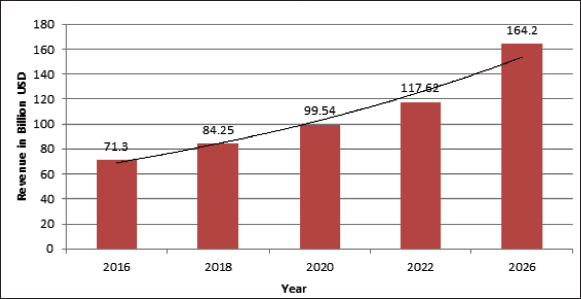
RTD teas were pre-packaged tea beverages that were convenient for consumers who wanted a quick and refreshing drink without the need for brewing or steeping tea leaves. RTD teas came in a wide range of flavours, including classic black tea, green tea, masala chai, lemon tea, peach tea and other fruit-infused varieties. The market for RTD tea had been growing steadily (refer to Figure 3) due to increasing consumer awareness about health and wellness, as well as the convenience of on-the-go beverages. The availability of these products in convenience stores, supermarkets and online platforms had contributed to their popularity. RTD teas in India had appealed to a wide range of consumers, including young adults, office-goers and individuals looking for a refreshing and healthier alternative to carbonated soft drinks.
Café Niloufer has been up against a quickly rising organized companies that was virtually non-existent until a few years ago. Though still in its infancy, this industry has seen a fast expansion in recent years and a high level of user interaction. Some of the well-known start-up companies in the RTD tea business are Chai Point, Chai Garam, Chai Thela, Chaipatty, Tpot, Haazari, Chai Break, Tea Trails Café, Chayos, Vahdam Tea, Teabox and others (Te-A-Me, 2012).
CTC Category
India was one of the largest producers and exporters of tea globally, and a significant portion of its tea exports was CTC tea. CTC tea was widely consumed in India, and it was the primary type of tea used in the production of chai, the traditional Indian spiced tea. The strong, robust flavour of CTC tea made it well-suited for brewing with spices and milk, which was common in Indian chai.
CTC teas came in various grades, which were classified based on the size of the tea granules. Some common grades included broken pekoe (BP), broken orange pekoe (BOP) and broken orange pekoe fannings (BOPF). The grading system helped determine the quality and price of the tea. Its strong flavour and wide availability made it a common choice for those looking to brew a robust cup of tea.
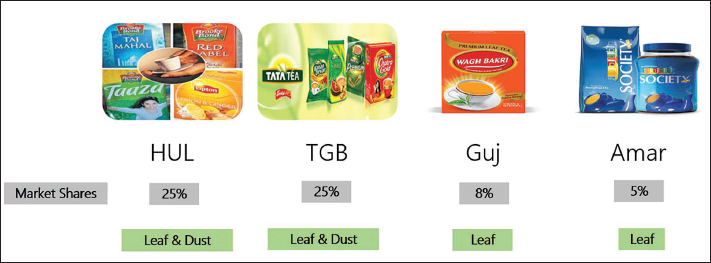
There is significant competition among packaged tea brands in the CTC category to capture the market by competing on price and offering discounts. Leading firms such as Tata Global Beverages, Hindustan Unilever, Gujrat Tea Processors, Amar Tea, Godrej, Pataka Industries, Organic India, Hasmukh Rai and Madhu Jayati had launched various flavours. The first four companies control a sizeable market share of 63%, with popular brands like Tata Tea, Red Label, Lipton, Wagh Bakri, Tetley, Society and Taj Mahal (refer to Figure 4) found in many Indian homes. Café Niloufer had also launched a new product category of tea powders in the organized CTC (Singh, 2023) tea market by launching three different variants at different price points—Niloufer platinum tea powder (premium), Niloufer double delight (medium) and Niloufer super dust (economy).
Challenges
Café Niloufer, despite having existed for four decades, was confined to only a small café outlet in Hyderabad, while other popular tea companies and cafes had already expanded across the country, with defined sales budgets, promotions and product lines.
Area Requirements
Shashank had not yet made a decision on the specific type and scale of the business model he wanted to pursue. He was aware that actual space requirements varied based on the specific business concept, the number of customers he had planned to serve, the kitchen or storage needs, and the overall ambience he had wanted to create. Additionally, factors such as location and local regulations influenced the space required for his tea business. He had to start with a crowded and popular location, most likely near a market, school or college because that was where he could get the most customers. He would have had to conduct a thorough feasibility study and understand the specific needs of his chosen business model before finalizing his space requirements.
Marketing
Marketing was crucial for the success of Café Niloufer’s business, given the competitive nature of the market and the diversity of consumers. Developing an effective marketing strategy for Café Niloufer’s business had involved a combination of online and offline tactics to reach a wide audience and build a strong brand presence. To grow his tea business, Shashank needed to create awareness about it. He knew that if people were to learn about his business, he had to maintain the quality of the products he served. Shashank had planned to create a new customer base first, then send out flyers and promotions to inform people about the kind of services he was providing.
Distribution
Shashank had known that distribution played a crucial role in the growth of his tea business. It had been essential for getting his products to his target customers efficiently and effectively. An effective distribution strategy had allowed his tea business to access and cater to these diverse markets, helping him reach a broader customer base. Partnering with various retail outlets, including supermarkets, local grocery stores, speciality tea shops and even online marketplaces, had made his products more accessible to customers. He had believed that if he could make inroads in the CTC category, that business would help him complement his existing RTD Irani chai business. Specifically, in Café Niloufer’s case, it had had little presence in restaurants, which had been an essential segment in the institutional channel (Sarda, 2022).
Opportunities
Technology Integration
Many tea cafes adopted technology, such as mobile apps for ordering and loyalty programmes, to enhance the customer experience and streamline operations. To reach a wider customer base they have partnered with online delivery platforms, such as Zomato and Swiggy, and also have developed in-house delivery services. Offering subscription services has given customers choice of receiving curated selection of teas regularly, helping the cafes promoting brand loyalty and enjoying repeat business (Sarda, 2022). Expansion through franchise models has become popular, allowing established tea cafe brands to reach a wider market.
Targeting New Consumer Segments
Tea cafes in India can target a variety of consumer segments to maximize their business opportunities. Millennials and Gen Z, working professionals, tea connoisseurs, health and wellness enthusiasts and late-night crowd are more likely to seek out modern tea café experiences. Tea cafes can focus on premium and speciality teas, and offer rare and exotic tea varieties that cater to those with a refined palate. They can promote herbal teas, organic options and other teas with health benefits. 5 Highlight the nutritional aspects of your tea offerings. Pairing tea with food, such as tea and dessert combinations, and offering late-night snacks and unique beverages.
By targeting these consumer segments, tea cafes in India can tailor their offerings, marketing strategies and ambience to meet the specific preferences and needs of each group. Understanding the evolving tastes and trends in the tea industry was vital for long-term success and growth.
New Tea Variants
Since the British era, chai has been an essential component of Indian culture (Pal, 2016). Consumption of black tea, herbal teas and fruit teas in India has expanded dramatically because of the trend for a packaged variety of natural components and the pursuit of well-being (Indian Tea Association, n.d.). The newest kids on the block were wine, chocolate, flower components and other exotic components. Experiential choices were created, such as whole tea menus with unique flavours like wine, chocolate and floral aspects, with variations and full tea menus. In recent years, the tea cafe sector has piqued the interest of investors as more urban consumers with higher disposable incomes spend on branded mugs of hot beverages.
Evolving Tea Business Models
Tea, also known as ‘Chai’, in Hindi, is one of India’s oldest and most traditional (Paisabazaar, 2024) beverages. Tea can be consumed at any time of day, whether it is in the morning for bed tea or in the afternoon for post-lunch tea. The operation of a tea stall or the establishment of a tea-selling business is considered a profitable investment. Until a few years ago, there was no such thing as a tea café (Lall, 2019). The demand–supply gap in this market was noticed by big players in the business, who saw an opportunity to develop a chain of tea shops (refer to Table 1). As Shashank thought about expanding his business, he might evaluate the following business models.
Evolving Tea Business Models.
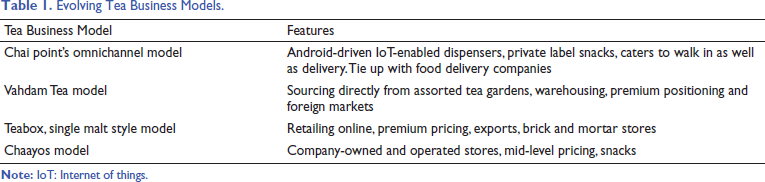
Chai point’s omnichannel model: This model caters to both walk-in and delivery customers. The chai dispensers are Android-driven internet of things (IoT)-enabled with an average price of tea at around ₹80/cup ($1.07/cup) and lower for the vending machine model. The contribution of food is around 37%. Customers can also place orders online through Uber Eats, Zomato and Swiggy. In this model, the company sells its private-label snacks that are both traditional and healthy and appeal to a wide range of customers.
Vahdam Tea model: This business concept is based on eliminating the middlemen in the tea industry by sourcing directly from a collection of about 100 different tea gardens across India. Foreign markets account for nearly all the company’s revenue. The company chose New Delhi as the location for its warehouses for two reasons. The first is that New Delhi’s airport has direct and faster access to foreign airports for export, and the second is that the city’s dry environment is more suited to tea longevity. Vahdam Teas are considered premium, with prices ranging from $10 to $15 per 100 g and a box of teabags costing $4 and $6.
Teabox, single malt style model: This business model focuses on online commerce, worldwide markets and starting at the top of the pricing pyramid. Foreign markets account for over 70% of the company’s sales. The company sells 200 different teas, ranging from ₹4,500 per kg (Darjeeling black) to ₹2 lakh per kg (Badamtam). The company has complemented its online presence with offline or bricks-and-mortar stores at airports, complexes, malls and other places.
Chaayos model: The company owns and maintains all the stores, and the teas are a unique Assam CTC blend. The company’s fundamental driving principle is ‘Meri wali chai’. That is the model on which the Chaayos model was based. Customers have diverse preferences for tea; therefore, the company attempts to provide them with what they desire. Compared to Starbucks, where the cheapest coffee beverage starts at ₹220 ($2.96), the Chaayos model at a mid-level pricing point runs between ₹60 ($0.80) and ₹160 ($2.15) for each drink, playing at a lower price and consumer segment. Chaayos’ business approach also focuses on snacks and tea. Snacks, including things like vada pav, egg bhurji and sandwiches, make around 40% of Chaayos sales.
Way Forward
As he waited to meet the owner of an 18,000 square feet facility in Himayat Nagar, Hyderabad, Telangana, he came across an interesting article on the tea business in a business newspaper. He had some spare time, so he created a table and listed the main features of each tea business model that was popular in India. After analyzing the tea business models, Shashank felt that these business models made sense only if his company had been a start-up. Café Niloufer had already been a four-decade-old company, so he needed to analyze the beverage industry and its current trends globally to scale up the business. Such an analysis helped him identify uncontested market space for his tea business. It was better to create a new business model than to follow the existing business models of other competitors.
Footnotes
Declaration of Conflicting Interests
The authors declared no potential conflicts of interest with respect to the research, authorship and/or publication of this article.
Disclaimer
This case is written solely for educational purposes and is not intended to represent successful or unsuccessful managerial decision making. The authors may have disguised names, financial and other recognizable information to protect confidentiality.
Funding
The authors received no financial support for the research, authorship and/or publication of this article.
