



Abstract
My Indian
Keywords
The Entrepreneurs and Origin
‘My Indian
By mid-2014, Shan was inducted into the role of a full-time CTO. This was required as the venture had a substantial technology capability base. Thus, a dedicated member at the top management team was required. By early 2015, My Indian Stay became the largest player in Goa by beating all the competitors. This was significant because Goa as a state located in western India was a big market for domestic as well as lucrative foreign tourists. In mid-2015, the firm received seed funding of US$0.2 million from Edelweiss (My Indian Stay, 2021c). In the year 2016, the venture launched pan-India operations with a new interface. This was done with advanced technologies with a secured messaging facility but with a secured calling facility. By mid-2016, the mobile-based application of ‘My Indian Stay’ was launched. This was an advanced technology customer interface that Shan had developed. In business–customer interaction a negotiation functionality was launched. In ‘My Indian Stay’ business model, the agent–partnership programme was launched. A referral programme was also launched, and initiatives on corporate outreach were carried out. By the end of the year 2016, the inventory management system for hosts was launched. By the end of the year 2016, the venture reached 40,000 plus room bookings and grossed revenue of ₹44.5 million (My Indian Stay, 2021a). Thus, by the end of the year 2016, ‘My Indian Stay’ became one of the largest players in India in terms of number of properties listed.
The business scenario altered significantly, however, by early 2020, because of the COVID-19 pandemic and its associated economic and physical lockdown. The COVID-19 pandemic turned the travel, hotel, tourism and allied industries into a tailspin. These industries suffered loss of both revenue as well as margin. For weeks, there was stoppage of all business activities. Shan during a late March evening in 2020 sitting at his home reflected on what needs to be done so that business continuity be achieved smoothly and quickly once unlock phases come up. Shan given the realities of COVID-19 pandemic became immersed in thoughts regarding how to ensure business sustenance and continuity for My Indian Stay (My Indian Stay, 2021c). Shan was pondering regarding whether to completely stop the operations of My Indian Stay or rework on the scope of business of My Indian Stay so that it could undertake a viable business during the pandemic. Furthermore, for a while in the end week of March 2020, Shan also had a lot of time to contemplate regarding shaping the future in terms of how to reopen phase-wise the operations of My Indian Stay (My Indian Stay, 2021b).
My Indian Stay: Offerings and Market Space
My Indian Stay was a story of win-win for both the hosts as well as the customers. For hosts, it was good because the firm followed a host-focused business strategy. It based upon the application of innovative system-based solutions improved the performance of hosts, thus it helped the hosts. It was one of the largest players in India in terms of the number of listed properties with lead positions in certain key markets like the state of Goa. According to Shan, hosts secured listing advantages in terms of reaching the target audience. ‘My Indian Stay’ had been focused on vacation rentals (VR) and non-hotels (NH). Both VR and NH were niche segments and were a part of the niche strategy (high focus, high margin but low competition) by ‘My Indian Stay’ (My Indian Stay, 2021d). It followed primarily a close relationship with hosts, as the venture only showcased its self-aggregated inventory. Finally, the venture had a high technology focus and it strove to automate the entire life cycle of the guest experience. Thus, the firm was supportive of hosts as well as provided customers with great properties which were exclusive and premium in nature.
‘My Indian Stay’ focused on the alternate accommodation (AA) space that was VR and NH. VR plus NH had a marketplace of $15 billion in India by the year 2019 (My Indian Stay, 2021b). VR plus NH enabled India’s half a million unutilized homes for securing for rentals by the year 2019. It had the vision of being the go-to platform for homestays. Shan wanted the firm to be a full stock marketplace capturing a significant portion of outbound traffic from abroad getting into India. This was for the marketplace segment. The business had three segments of business verticals which targeted namely marketplace, managed services and smart homes. The managed service vertical had a market size $3 billion in India, having margins around 30% (My Indian Stay, 2021d). In smart homestays, there was a possibility of global play. This included providing next-generation security surveillance and logistical control wherein the management as well as solutions were based upon one-click legal compliance. There was a global opportunity in this space.
‘My Indian Stay’ had not only deep expertise and understanding of the supply side by it was also one of the largest players in India. It had the lowest cost for property sourcing, and this enabled rapid scale-up with limited cash burn. It had achieved 100% year-on-year growth in property listing. For continuous engagement with the property owners (hosts), Shan had developed a channel manager app (My Indian Stay, 2021d). This App ensured higher retention for the property owners. ‘My Indian Stay’ focused on leisure markets with a strong presence in Goa, and had been increasing presence in the states of Kerala, Himachal Pradesh and Rajasthan. By October 2017, the venture was getting a 15% commission for the booking and by February 2020, it had footprints in about four hundred locations with more than 10,000 listed properties having 50,000 rooms (My Indian Stay, 2021d). The focus was on the leisure market and was centred on capturing the early adopters for vacation rental concepts.
Industry Characteristics
In the Indian lodging industry, there were primarily two segments namely hotels and non-hotels. Hotels had standardized rooms. These were available for instant booking with serviced accommodation. This had been the traditional lodging option. Non-hotels (NHs) were non-standardized and self-serviced accommodations. NH were requested and approved by owners and was an upcoming lodging option. Indian hotel industry in the year 2015 had a size of US$7.4 billion with branded hotels having a size of US$4.3 billion and unbranded hotels having US$2.1 billion (My Indian Stay, 2021b). It was expected that by the beginning of the year 2020, the Indian lodging industry would be US$18.1 billion (registering a CAGR of 40% growth) with branded hotels share being US$7.3 billion and unbranded hotels having a size of US$3.1 billion (My Indian Stay, 2021b). Thus, the Indian economy alone possessed a growth potential in the NH category. The global NH to hotel ratio was 6:1 while for India, the ratio was 1:2. Furthermore, in the NH category, there was tremendous growth opportunity in online channel as currently, only 10% of supply was online (My Indian Stay, 2021d). Thus, Shan believed that there was a substantial opportunity for an organized player for aggregating supply. The NH segment consisted of bed and breakfast dorms, tents, independent bungalows, serviced apartments, self-catered apartments, villa, cottage/hut and guest houses. In the AA space, there were B2B/guest houses and VR services. B2B guest houses had been a conventional stay option being professionally run; however, there was limited growth possibility in this sector. B2B guest houses could reach higher growth through online channels. VRs were using unutilized supplies (wherein the infrastructure existed) but required to be serviced. There was scope for exponential growth as it was an upcoming lodging option (refer to Table 1 for details).
Substantial Growth in Apartments.

My Indian Stay: Organizational Journey and Niche Strategy Operations
My Indian Stay had embarked on a journey to develop a host-centric approach to provide half a million homes by the year 2020. Shan was interested to achieve this by aggregating half a million unutilized properties and compete ultimately with hotel rooms. The platform according to Shan leveraged technology to create India-centric solutions for host engagement, inventory management, channel manager-led marketing management solutions and operations and property management (My Indian Stay, 2021a). This was done through technology solutions with partners. The new venture utilized smart homestay solutions by providing integrated check-in and check-out facilities with managed services. Furthermore, through technology, adherence to legal and government compliance was also maintained. ‘My Indian Stay’ has been in a space, wherein there had been both a tremendous shortage of good-quality products and services and yet having substantive unutilized inventory of low-quality properties. According to Shan, there was a shortage of 0.2 million hotel rooms in India by the year 2018. Unused homes in Indian long-term rental space were very poor (varying between 1% and 2%) for most cities (Owler, 2021). Shan had the opinion that the utilization of these vacant apartments into revenue-generating NH would not only increase the return uptake to the apartment but also yield high returns. This was a scope that the venture had to cater for. There were, however, inherent challenges in developing the NH space in India.
According to Shan, the challenges were mostly regarding the non-aggregation of supply, lack of awareness and finally cultural barriers. Thus, there had been a low demand for NH accommodation in India. However, Shan felt that these challenges could be managed by enablers. The first enabler was economic benefits due to improved return to hosts, catering to customer preference as there were more choices and increased benefits in the community. The second enabler was trust as a 360° feedback system, which provided a holistic review system. This was based on trust and transparency for both the host and the customer (My Indian Stay, 2021d). Furthermore, both hosts and customers gained financial security of transactions because of the deployment of advanced financial technology in web-based transactions. The fourth enabler was the demographic presence of a large and growing number of young Indians with high disposable income.
According to Shan, there were also certain inherent advantages of the application of VR in web-based platforms. Being a part of sharing economy brands, VR stays had a stronger appeal, especially with young consumers. Furthermore, the web-based availability of VR stays provided a unique set of offerings with advantages that were difficult in a commercial context. Finally, because of lower operating costs, there were enhanced possibilities of securing price advantage vis-à-vis traditional commercial provider. By the year 2019, web-based industries have emerged like the rise of sharing economy in cabs on demand. In terms of online VR listings, there were 28,000 plus properties in India by the close of the year 2019 (Owler, 2021).
In the NH category, the low online penetration was because of a lack of awareness and poor accessibility of technology. To tackle these challenges, futuristic initiatives were required. ‘My Indian Stay’ educated owners for better utilization of their underutilized assets and in generating higher revenue. It developed a system which ensured that hosts could be selective in hosting guests. The venture provided a two-way review and verification system to build trust with hosts and customers. Shan deployed mobile-based solutions to easily inform customers regarding updated prices and availability to owners. My Indian Stay also faced on-ground challenges in property discovery because of cultural and language barriers as well as because of distributed and scattered supply. It had scouts at the local level who interacted with homeowners in a culturally sensitive and economically prudent manner. Furthermore, the venture through inventory management systems always attempted to increase inventory captured per property by lowering the reach-out costs towards on-boarding operations. The firm thus had created robust on-ground foot soldiers who had a very good understanding of local property vendor’s pain points. Furthermore, foot soldiers had deep insights about the local market. ‘My Indian Stay’ with a seamless technology platform offered flexible solutions to a wide range of functionaries while building a sustainable community of vendors. Thus, it had built a successful business model by leveraging technological expertise coupled with local operational insights.
According to Shan, it was important for the new enterprise to understand the Indian traveller in totality. Indian leisure travellers sought value for money (lower costs but higher space), customized service and authentic experiential travel. Indian religious travellers on tour sought proximity to religious places and the ability to pre-book as their preferred. Indian business travellers sought accessibility to the workplace from stay venue. This had to be secured and easy. NH had advantages over hotels in providing economical rates, leisure amenities, proximity to markets and other essential amenities. However, the disadvantages stemmed from a lack of standardization of experience, consistency, loyalty-related benefits and conference room facilities. ‘My Indian Stay’ had also developed a unique service proposition for the NH segment. It had added differentiation through inventory differences by providing a wide range of self-managed but unique properties; some of these properties were as big as a villa. Hotels represented standardization unlike unique properties. Also, customers around the world could interact with property owners on pan-India basis through an interactive web-based platform. The property owners were located in a fragmented manner in dispersed locations via a technology platform. The interactive interaction between the customers and owners developed trust according to Shan.
‘My Indian Stay’ because of the platform, created flexibility in functionality and offerings. The app provided scope for self-listing by property owners and the booking mechanism was also convenience. Thus, the booking manager costs were front-loaded. Hotel bookings were plain vanilla with instant booking in a standardized manner. The firm was also incorporating additional services such as local food cooked by owners, networking with local communities full of focal anecdotal stories led by the owner’s social network. The local owners also liked to provide the guests with guidance on local travel and sightseeing. This way of providing NH could not be matched by hotels. Hotels, however, had the benefits of privacy and footfalls serving attendants. Finally, NH stays by ‘My Indian Stay’ was value for money and were almost half of the rate of the hotels from the same category. Thus, NH offered high quality, wide variety of technology-based unique experiences to customers at relatively lower price points. These were the points of differentiation that the venture offered relative to other competitors (Crunchbase, 2021).
‘My Indian Stay’ had enhanced the user interface for AA. The new venture minimized the steps to simplify the process for listing by the hosts for property and customer-seeking rooms. It made these processes hassle-free without compromising on security. The founders had also empowered customers by providing all details regarding properties through the visibility of product offerings. Furthermore, it offered personalized offerings based upon customer preferences and not product selection. It applied streamlined consumer interface imagery for enhanced consumer comprehension.
According to Shan, there was the application of a stronger attribute index with specific filters. ‘My Indian Stay’ also applied dedicated online digital marketing efforts for enhanced online booking ability and higher digital conversion. Thus, this dedicated online channel on AA not only helped it to reach more relevant clientele but also to score higher over the hotels in terms of customer interface. The building blocks for AA marketplace as practiced by the new venture had a mix of both offline and online modules. This mix brought success to the business model. There were five building blocks of AA lodging, these being operations, technology, pricing, team and distribution.
In the offline module, operations came first, and it involved strong on-ground operational systems and expertise towards onboarding a property. It also involved training the staff and developing their skills so that the staff could enforce minimum quality standards. The online module involved technology. Because of technology, the venture offered real-time tracking of inventory by assisting property owners with calendar and chat tools. Technology provided options for instant information across platforms. Technology also provided a two-way guest and host verification process to address security. The enterprise further through an online module helped in dynamic pricing. This provided complete price independence to vendors. Furthermore, for pricing, it shared market inputs and intelligence through the local business development teams to analyse performance with other properties in the local cluster. Thus, technology helped in the discovery of price. Another offline capability with the new enterprise was the skilled business acumen of its team.
‘My Indian Stay’ very critically focused on property sowing. It had a property-servicing strategy in place. Property sourcing was carried out by a three-dimensional initiative, namely, ‘feet on street’, ‘call centre’, and ‘self listing’. Under ‘feet on street’ there were its foot soldiers interacting with property owners and managers (in person) developing relationship and assisting in the on-boarding process. Second, the call centre, teams made seasonal sales pitches to the owners and managers for properties. The calls were made directly to the property owners and this helped them to list the properties. This assistance by call centres was in response to the opportunities and traction generated by the platform.
According to Shan, ‘My Indian Stay’ also planned for future property sourcing through new initiatives like travel ambassadors and real-estate collaborations to be initiated. Travel ambassadors were a sponsored tourist engagement programme where in the travellers performed the function of ‘feet on street’ for action like assisting in property verification and audit. Furthermore, travel ambassadors also actively engaged with property owners to analyse, review and context creation. Under the aegis of real estate, collaboration would be sought with real estate developers to increase the utilization of unsold properties (home inventory) which were nearing completion. Also, direct contact with home purchase regarding investment purposes was sought by offering prospects of higher rentals. The new venture in the NH space had three major types of accommodation namely partial accommodation, complete accommodation with resources and complete accommodation without resources. By February 2020, the average property rate at ‘My Indian Stay’ was about ₹15,000 and the average number of rooms per property was about seven (Tracxn, 2021). The geographical market reach of the enterprise has been depicted in Table 2.
My Indian Stay—Geographical Market Presence in February 2020.
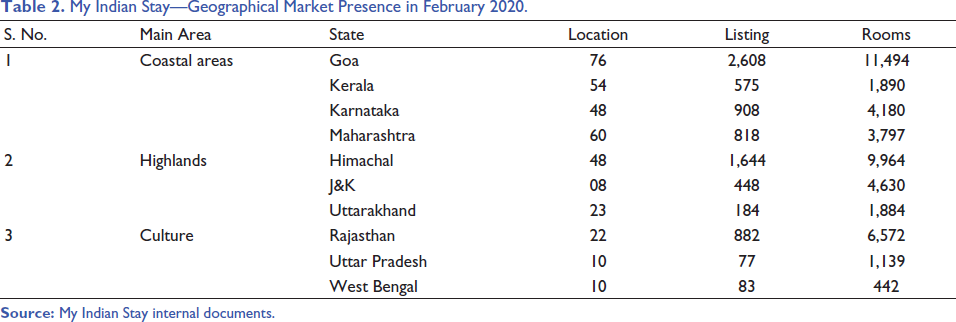
‘My Indian Stay’ dominated the Goan market (4,500 plus bookings by February 2020); Goa was the largest tourist market in India. It had the highest depth of listing of property listing amongst all OTAs (with 2,500 plus listing with around 33% verification level by February 2020). The firm had achieved this market leadership because of a carefully constructed hybrid supplier sourcing strategy engaging with an efficient on-boarding process. The venture also demonstrated good vendor engagement behaviour change by becoming one of the trusted points of service for property owners with digital marketing techniques. This was done to attract demand to the platform. According to Shan, they premeditated to expand to other leisure markets in India with AAs like in the states of Punjab, Tamil Nadu, Odisha, Gujarat, Madhya Pradesh and north-eastern states. Furthermore, they also planned to expand to high-demand metros and tier-1 cities like Delhi, Ahmedabad, Mumbai, Pune, Kolkata, Hyderabad, Kochi, Bangalore and Chennai (Chandra, 2015).
My Indian Stay: Technology Resources and Capabilities at Work
Through technology strategy, ‘My Indian Stay’ had created vendor lock-ins (My Indian Stay, 2021d). In traditional models’ property owners were not obliged to provide inventory information exclusively to one player. This was challenging for the venture as it would suffer the loss of market share while property owners (hosts) would have to incur high maintenance costs and efforts for catering to multiple digital profiles to secure higher footfalls. It offered the solution of a liked website. This entailed the creation of a direct website for property owners with back end link extended by the platform. The benefits of this venture were that the property owner was permanently linked to the site. For hosts of ‘My Indian Stay’ the benefits were that the direct website resulted in higher online discoverability and lower commissions’ outlay. The solution development was through channel managers. Existing channel managers were provided access to property owners linked to the extant platform. It hosts additionally benefited from one-point management of digital profiles. On the other hand, the enterprise had the ability to monitor all inventory information flow and higher vendor commitment. The technology architecture adopted at ‘My Indian Stay’ had three components namely ‘consumer-facing modules’, ‘back end architecture’ and ‘property management services’ (Tracxn, 2021). In the consumer-facing modules, there was a search and filtering mechanism, review and feedback mechanism, reservation management system, direct website and call centre support. In the back-end architecture, there was a secured payment gateway integration two-way communication system with privacy controls, click-to-call and SMS platform, booking engine and central inventory management system (My Indian Stay, 2017). Channel managers were being developed. In the property-management module, there were listing management tools, smart access tools, calendar and pricing controls, reservation management systems, feedback score card and mobile app for inventory control (Crunchbase, 2021). The technology platform with a rich set of functionalities created a win-win for both guests and hosts. The platform was rich with images and videos of property and attributed indexation for information availability. Reservation add-ons were done by availability calendar and reservation management systems, while relation-building was done through feedback and reviews and local-centric information. It facilitated customer adoption through both digital marketing and conventional marketing initiatives. Conventional marketing involved billboards posters, while digital marketing involved social media, search engines and such others. The platform functionalities spread across search inquiry and reservation payment and check-in, stay and check-out.
COVID-19 Pandemic and Associated Economic Plus Physical Lockdown: Challenges Ahead
Shan on a late March 2020 evening was looking at the setting sun. The journey has been so far so good. My Indian Stay was sitting on a fertile bed for growth. The COVID-19 pandemic and associated economic plus physical lockdown altered the business landscape. Shan was contemplating how everything changed for the new venture. What strategies would need to be embarked on to sustain business during the unlock phase was critical. The strategies towards business continuation would involve new capabilities to apply new technologies, new ways for customer interaction and most importantly out-of-the-box thinking to continue and even enhance the relationship with hosts. Shan was pondering what inputs had to be provided to the platform for growth once the COVID-19 restrictions were relaxed and travel and stay were allowed (My Indian Stay, 2021b). Strategy planning was as good as its execution. Shan was pondering what hurdles he had to climb to execute his strategy well in the unlock phase of COVID-19. The journey for the future beyond the early 2020s had to be better than the healthy beginning made in the early 2010s by ‘My Indian Stay’. The question was what to do and what not to do for Shan in the unlock phase.
Footnotes
Declaration of Conflicting Interests
The authors declared no potential conflicts of interest with respect to the research, authorship and/or publication of this article.
Funding
The authors received no financial support for the research, authorship and/or publication of this article.
