



Abstract
The growth of Indian Terrain Fashions Limited (ITFL), a stock exchange-listed fashion brand, is explored through the lens of sustainable, circular business models, policies and practices. Starting at a small pace, the company’s commitment towards sustainability looks promising. The company is poised to create and add more value for the customers as well as society in its commitment to sustainability through digital endeavours, aiming for a closed-loop circular model and supply chain transparency. The journey is traced with reference to the RESTART business innovation model in achieving the triple bottom line (people, profit and planet) through the steps of circularity and a triple-layered business model for value creation, using the secondary data available on the ITFL website and Annual Report 2019–2020. Interviews published in media, business analysis reports from the ITFL website and annual general body meeting and ITFL website are also taken as secondary data. The main purpose of this study is to trace the journey of ITFL in its sustainable practices. Also, the challenges and obstacles that lie ahead in its business commitment highlighted are identified for its prolonged journey.
Indian Terrain
As per the India Infoline website, the Indian textiles and apparel (T&A) industry contributes about 4% of the total worldwide apparel market. Every year, the Indian apparel market grows by more than 5% and is expected to increase by approximately 7% in the near future.
The T&A industry is one of the largest sectors of the Indian economy in terms of its economic output, foreign exchange earnings and employment. The Indian readymade garments industry accounts for about 50% of the total industry. According to the Confederation of Indian Industries, India can reach $65 billion in T&A exports (implying a 10% CAGR) by 2026. Together with this growth, domestic production and consumption could reach USD 160 billion (Indian Rupees 12,000 billion).
The domestic Indian apparel market is often broadly classified into menswear, womenswear and youth wear. Currently, the menswear segment holds the principal share in the apparel market (Figures 1 and 2); it accounts for around 41% of the market. The womenswear market share is close to 38%, while kids wear accounts for 21% of the market and is growing.
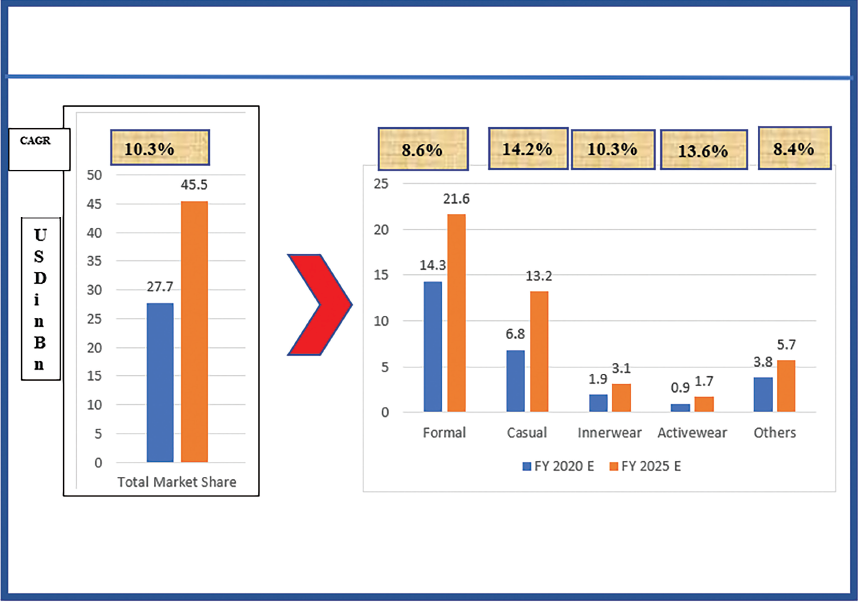
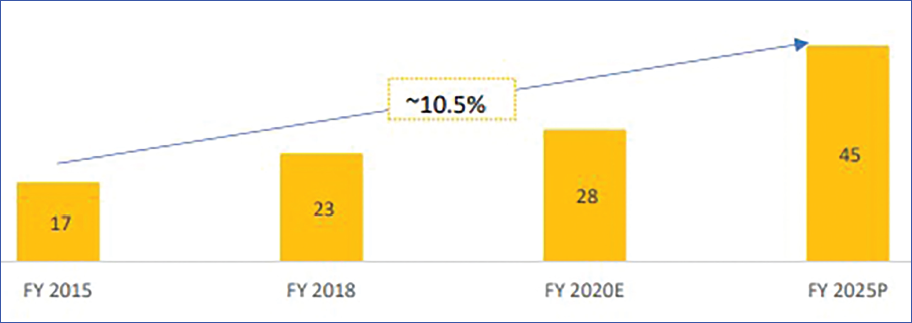
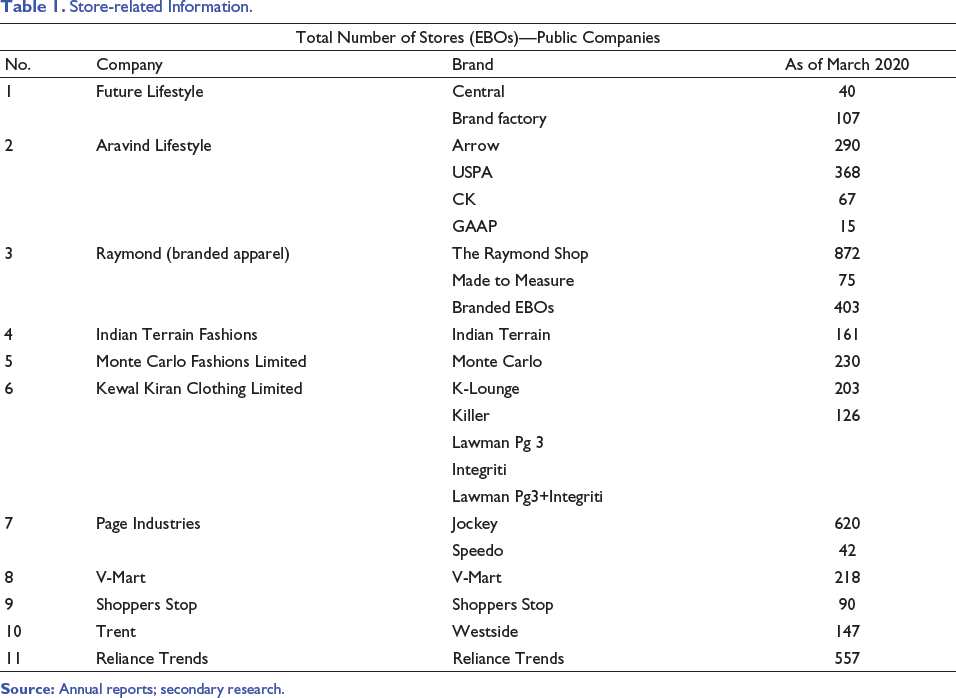
Indian Terrain Fashions Ltd (ITFL) came into existence in 2009, as an off-shoot of Celebrity Fashions Limited. After a year, it became an independent entity. The company was listed on the Indian stock exchange in 2011. With a market capitalization of USD 16.4 million (Indian Rupees 1,230 million), the company posts increased revenue and opens more retail stores every year. ITFL, with its presence in more than 200 cities in India, has 161 exclusive stores (Table 1), 380 plus departmental stores and over 1,400 plus multi-branded outlets, in addition to serving customers through online platforms. It dominates in menswear, boys’ wear and fashion accessories, which are sold through a combination of wholesale channels as well as direct-to-consumer.
Store-related Information.
ITFL is one of the prominent readymade clothing companies in India, catering to the premium menswear and boys-wear segments. As organizations throughout the world started improving their product standards and enhancing value in their supply chain, with a lesser environmental footprint, creating value for all stakeholders and for the society at large, India, an emerging market, cannot be left behind. Large players such as Aditya Birla Fashion and Arvind Lifestyle have already ventured into sustainability, while other fashion brands are still not on the horizon to take up this strategy to create value for the whole ecosystem.
Anita is the Chief Sustainability Officer (CSO) appointed by the ITFL organization to guide the company on its challenging journey towards sustainability. The CSO has around 20 years of experience in developing and implementing sustainability practices in several companies related to the textiles and fashion industry. To start, the CSO gathers knowledge about the company’s strategy and operations to chart out the path towards circularity and sustainability.
The terms sustainability and circularity are being used interchangeably; any product and processes that aim to reduce the environmental footprint and enhance society or community living standards are considered to be sustainable. Sometimes brands use these concepts for greenwashing or to embed them into their strategy. Moving from being reactive to proactive, sustainability is a long marathon race with lots of experiments to be explored and learned by the brand on its journey to achieve circularity. Sustainability is all about people, planet and the economy, whereas circularity is about recycling resources and reducing the environmental footprint.
The CSO understands that ITFL has been changing its strategy and striving to change its value chain to facilitate its journey towards complete circularity and sustainability in the future. Since sustainability at ITFL is at a nascent stage, the public documents and website show some visible efforts in committing to transparency and bringing about changes in some of the product categories, which is normally the first step in achieving circularity.
She decides to strengthen, promote and accelerate the corporate social responsibility (CSR) initiatives after approval from the chairman and to help create a new product line with minimal environmental impact. She studies ITFL’s strategy and operational journey with existing theories and models, especially to chart out its possible further circularity and sustainability path. The study holistically views the entire journey with respect to the sustainable fashion component, suggesting some paths to move towards a circular business model with the goal of increasing resource usage efficiency and benefiting the economy, environment and society.
To develop circularity, product design, material selection and manufacturing operations have to be oriented. The CSO understands that ITFL’s product categories include shirts, trousers, T-shirts, jeans, shorts, sweaters and accessories such as belts, bags, wallets and socks. It posted revenue of USD 56.27 million (Indian Rupees 4,220 million), registering a growth of 6% in the previous year. This growth was across both the menswear and boys-wear businesses (Table 2). The growth in menswear was due to their product lines and product mix in various apparel and accessories categories. In boys’ wear, their strategy was offering a smart and aggressive product and pricing strategy relative to their competitors’ offerings. Though boys’ wear contributed only 10% of the revenues, it also witnessed growth. Indian Terrain continues to invest in promoting the brand through various marketing initiatives and campaigns aiming for greater brand recall and increased sales every year.
ITFL 11th AGM Annual Report Final 2019–2020.

Being a contemporary menswear and boys-wear apparel brand, ITFL prices its apparel products in the mid to premium range, targeting both upper- and middle-class consumers. Witnessing the growth of the youth and working population’s preference for casual wear, there is an increasing demand for smart casuals. ITFL has working men between 25 and 45 years as its target customers who are ’affluent, fashion-conscious and have masculine sensibilities’ and has managed to differentiate itself as a premium and smart casual brand through its designs and superior quality products.
With a turnover of over USD 120 million (Indian Rupees 5,400 million) in October–December 2020, Indian Terrain manages 1,500 plus stores across formats like exclusive brand outlets (EBOs), multi-brand outlets and large format stores. It has refreshed its brand strategy to develop a friendly ecosystem to strengthen its customer community.
Looking at the financial statements, the CSO gathers information about ITFL’s sales. The sales rose by 49.69% to USD 13.73 million (Indian Rupees 1,029 million), with the net profit reported as USD 0.20 million (Indian Rupees 15 million) in the period ending December 2021, as against a net loss of USD 1.04 million (78 million) during the previous quarter ending December 2020. Hoping to soon reach over USD 200 million (Indian Rupees 15,000 million plus), she finds that the company is rightly focused on young Indians who are fitness-conscious and want to lead a healthy life. She conducts meetings with several directors, especially with the chairman and managing director and understands that the brand wants to create its unique identity and continue in that particular direction.
While analysing the market conditions, she understands the data from the Statista 2018 report, which states that the Indian kids-wear apparel market contributed around 20% of the apparel market in India in that year, and the projection is expected to reach nearly USD 22.67 billion (Indian Rupees 1,700.25 billion) by 2028. A large number of players, including start-ups, are continuing to occupy space in kids wear. Businesses involved in the premium kids-wear segment, such as Lilliput, ABFRL, Arvind Lifestyle, Max Lifestyle and some start-ups offering organic kids-wear, are in the fray along with ITFL. This sector has been quite unorganized compared to the menswear and womenswear sectors. With brands positioning and strengthening this category, she figures out that the kids-wear segment is growing exponentially.
Though other brands are competing with each other on various dimensions, there are very few brands that have sustainability in their plans. Among them are homegrown brands ABFRL, Arvind Lifestyle and foreign brands such as Zara, H&M, Lacoste, etc. ITFL became a member of the Fairtrade Association in October 2020, India, and thus sees that this would create a competitive advantage in their sustainability journey. While on its journey, challenges and opportunities for ITFL that lie ahead are also explored, along with the existing policies and practices. With sustainability in its strategy, the CSO charts out the circular and sustainable journey of ITFL from the perspective of its current business model and sustainable policies and practices.
Circular Economy and Sustainability
Circular economy is defined as ’a regenerative system in which resource input and waste, emission and energy leakage are minimized by slowing, closing and narrowing material and energy loops. This can be achieved through long-lasting design, maintenance, repair, reuse, remanufacturing, refurbishing, and recycling’. While sustainability aims to meet the ultimate benefit for all stakeholders, the environment, the economy and society without compromising the future needs of this planet. Though the main beneficiaries of the circular economy appear to be the economic actors that implement the system, the main goal of the circular economy is to increase the resources and product lifespan as much as possible, and its utility is rediscovered and regenerated.
Large clothing retailers need to move away from linear business models and shift to experiment with circular models through value-creation strategies. There is evidence showing the advantages of using circular economy principles during the product design stage and emphasis on the business model strategies in a circular business model. It also reports the challenges that lie along the path of circularity. In such a model, it becomes imperative to create both upstream and downstream value chains and value propositions to bring into action a sustainable business model that guides a number of strategic questions to be framed to create innovative business models.
Some of these strategies relate to the CSR initiatives’ effect coupled with stakeholder engagement across the supply chain with visibility in its processes, on financial performance. It shows positivity in the direction that CSR’s social and environmental dimensions enable firms to have better financial options in their business.
High sustainability organizations are bound to set up measures for transparent business processes and partner commitment, to be even more prepared for the long journey and show higher estimation and exposure of non-financial data. There is evidence that highly sustainable organizations fundamentally beat their peers over the long term, with reference to stock markets as well as financial health.
The CSO looks for some directional input and comes across the Ellen MacArthur Foundation (2015). The foundation’s mission is to develop and work on creating and promoting awareness of the circular economy through documents and videos for businesses and the public. In its report ’Towards a circular economy’, compiled in collaboration with McKinsey, Marks & Spencer, etc., it talks about the limited economic opportunity in a linear model and shows, with examples, the economic potential for firms transforming into circularity and signals the forward flow of firms towards a circular economy.
Looking ahead, the CSO also comprehends there are challenges during the shift to a circular economy, and it involves identifying the challenges to be faced ahead in transitioning to the circular economy model, both in production and consumption.
The CSO gets a 360-degree view of the company’s strategy and operations, market intelligence and develops programmes and a roadmap to accelerate the sustainable journey through circular economy practices. His findings of how the company could support the implementation programme for collaborators and customers viewing the context, strategy and competition, using its resources to build capabilities are described below.
Collaborators
The company’s investment in its high-quality human talent is vital, as its business practices involve design, procurement and retailing. Consequently, the company consistently invests in monitoring, controlling and improving the development of human capital efforts. The company has listed employees’ safety, welfare and development as one of its top priorities. Therefore, the CSO has structured its approach to recruiting, training, development, appraisal and retention of key team leaders and other employees in accordance with the company’s policy direction.
After collaborating with other teams in the company, it was decided to plan a foray into biodegradable polybags, and the brand has set goals to increase its sustainable production by making over half of its products eco-friendly and responsibly sourced within five to seven years.
Currently, the company works with a few certified suppliers and is planning to establish visible traceability in their supply chain. Strengthening the supply design network to facilitate training and certification of suppliers, reinforced by a sustainable sourcing strategy, the creation of tier 1, tier 2 and tier 3 suppliers and continuous assessment of suppliers by creating a scorecard are all planned for different time horizons (short term, mid term and long term), with a special focus on supplier relationship management. The suppliers at different levels will supply recycled yarns, fibres, fabrics and other accessories, as well as cut-sew factories. These suppliers will be continuously graded based on their quality conformance and delivery times.
The CSO plans to outsource the reverse logistics activities to a 3PL company, including warehousing, to free up resources for strengthening their core competencies in designing, material and quality management.
Resources and Capabilities
The CSO has created a roadmap and within a period of two to three years, plans to produce at least 50% of its portfolio collection in men’s and boys’ T-shirts using organic cotton, recycled polyester, recycled cotton and natural sustainable fibres such as bamboo and hemp. Over time, the sustainable product range will be expanded to other product categories such as shirts, trousers, jackets and shorts. To minimize the environmental impact, the brand has introduced a separate collection called the ’Earth Khaki Line’ (SS20 collection)—a range of men’s trousers, shirts and polo T-shirts dyed using naturally occurring pigments. Khaki line products are primarily made using cotton, wool or combinations of these fibres, as well as blends of synthetic fibres (ITFL 11th AGM Annual Report Final 2019–2020). 1
To utilize resources efficiently, the CSO plans to use more recycled fibres, and the brand’s initial journey has begun with product sustainability. It envisions using organic dyes from naturally available materials and stepping up the system of reuse and recycle in the product-making process. The vision expands to using recycled polyester for accessories such as zippers and buttons for the jeans and khaki line.
The brand’s hub-and-spoke distribution wheel with a centralized warehouse can effectively function for reverse product returns, including damaged and used garments returned by customers. Additionally, the CSO is convinced that the company is financially strong enough to invest in recycling technology for post-consumer-used products on a small-scale level. Another option for the brand is to partner with experts and organizations equipped with technical know-how in recycling products.
Context and Competition
When comparing ITFL with competitors in the menswear segment, such as Allen Solly (ABFRL-Aditya Birla Fashion Retail Limited), Color Plus, Mufti, Monte Carlo and other international fashion brands such as Zara, H&M and Lacoste, which operate in the mid to premium lifestyle segment, it is evident that domestic-grown companies such as ABFRL and Arvind Lifestyle have sustainable practices, in addition to ITFL (Table 3).
Revenue Benchmarking (Figures in Indian Rupees as Given in the Original Publication).
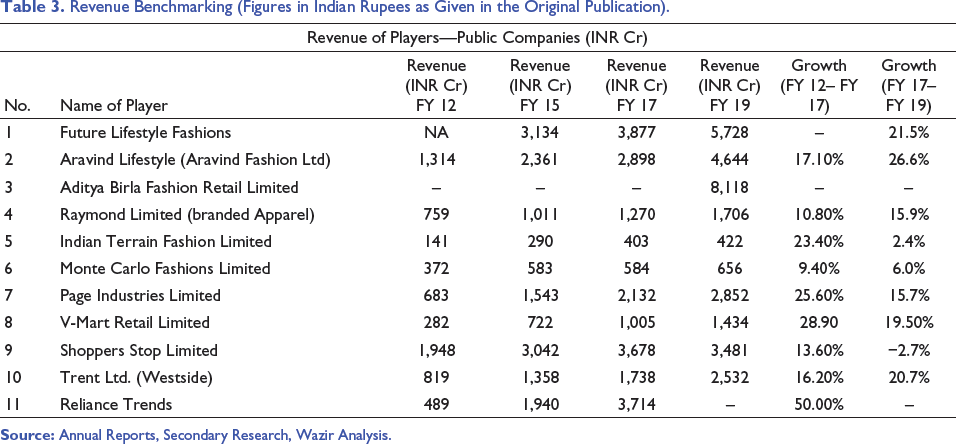
Fashion and lifestyle retailers such as Aditya Birla Fashion and Arvind Lifestyle, which are sustainable companies, are category leaders with a presence across value, premium, super-premium and luxury segments, offering a balanced portfolio across segments including men’s casual wear, formal wear, women’s formal, casual, ethnic wear and kids wear.
ITFL’s business model primarily focuses on pan-India retail and distribution with an emphasis on in-house design and external outsourcing activities. The CSO chose this business model strategically to achieve a better return on investment and reduce working capital in a capital-intensive industry. To mitigate risks and avoid uncertainties associated with outsourcing, the company has entered into long-term contracts with suppliers and implemented quality assurance procedures.
ITFL’s product range includes T-shirts, shirts, knitwear, shorts, trousers and jackets for both menswear and boys-wear categories. The brand caters to the upper-middle class, with an average price realization in the range of USD 20–40 per unit. While its prices are slightly higher than some of its competitors, its superior product quality and differentiation provide better operating margins.
The CSO is aware that the company is driven by the philosophy of ’Clothing that makes you feel good’. Sustainability is one of its pillars, and she is committed to achieving the status of a sustainable and circular fashion company over time. The company’s partnership with Fairtrade India could prove to be leverage in marketing campaigns and help gain a larger market share among environmentally conscious youth. She believes that her company is one of the very few Indian main street brands that have partnered with Fairtrade India. To continue this journey, the future focus is on collaborating with like-minded business enterprises and supply chain partners to become a sustainable fashion brand in India.
The company’s strategy, as outlined in the company report, includes more substantial marketing investments, increased focus on direct-to-consumer channels, improving operational efficiencies and providing better returns to stakeholders. In 2017, the company reshaped its strategy and business model to incorporate sustainability in its products and processes, earning the sustainability tag. In October 2020, ITFL partnered with Fairtrade India (What we’re doing, 2021), marking the beginning of its sustainability journey. In this pact with Fairtrade India, ITFL committed to partnering with farmers, particularly in Gujarat, to produce better products with a reduced environmental impact. The initial steps in this journey are impressive, and sustainability remains an uncharted territory for most homegrown brands, with only a few big players making strides in this direction. The brand has begun to view its impact through a different lens, aiming to create social, environmental and economic impacts. It remains to be seen if this journey will be cyclical, rather than linear, unlike the majority of homegrown brands operating in India.
Fairtrade India, a not-for-profit organization focused on fair trade in the country, collaborates with approximately 2 lakh artisans and farmers through many member organizations. Fairtrade’s work contributes to better income and production for farming communities while also promoting environmental sustainability. A Fairtrade label on Indian Terrain products signifies sustainable trade practices with a minimal environmental footprint, implemented in both farms and factories. It ensures fair prices for farmers’ produce, prohibits harmful pesticides and forbids child labour, among other ethical practices. ITFL’s Managing Director mentioned in a press meeting that being labelled as a Fairtrade member for its clothing products is a step towards sustainability, addressing the growing imperatives of trust, sustainability and quality through their association with Fairtrade India.
Strategy
According to the CSO, the company has four strategic pillars to strengthen and grow their business. Information from Indian Terrain data sources reveals that sustainability is one of their strategic pillars, with three other pillars being EBO retail, D2C push, expansion into new towns and new partners in the wholesale business. In continuation of the journey towards circularity, the CSO decided to focus on product circularity, and there is a long road ahead to address sustainability in multiple stages:
1. Strategizing: Adapting the company’s business model to include social and environmental performance and long-term economic benefits. The brand has a tie-up with Fairtrade, which supports farmers and reduces carbon footprint by using organic products. It has also established a non-profit organization (NPO) called ’itnaturetrust’ (Indian Terrain Nature Trust- Our Initiatives, 2021) as part of its CSR initiatives. The purpose of this NPO is to improve the lives of tribal communities in the North-East and other parts of India by providing education, renewable energy options and livelihood opportunities, among other things. The brand has the potential to collaborate with other NGOs and marginalized communities through its consistent social media engagement. Measures for assessing social impact need to be incorporated, and the brand has invested in IT and data analytics. Setting social objectives and metrics would be an achievable journey, as it has already initiated some social programmes.
Considering its environmental impact factors, the brand has started using eco-friendly materials and production processes. Therefore, the CSO has decided to seek top-level commitment to invest in recycling technology to minimize the brand’s environmental impact.
Comparing these initiatives with a triple layout business model for separate value creation (Figure 3)–one layer for all stakeholders, a second layer for the environment and a third layer for society at large–the next stage towards sustainable development is within ITFL’s reach. Financially, ITFL has posted profits in the last three-quarters, despite poor sales due to the COVID-19 pandemic.
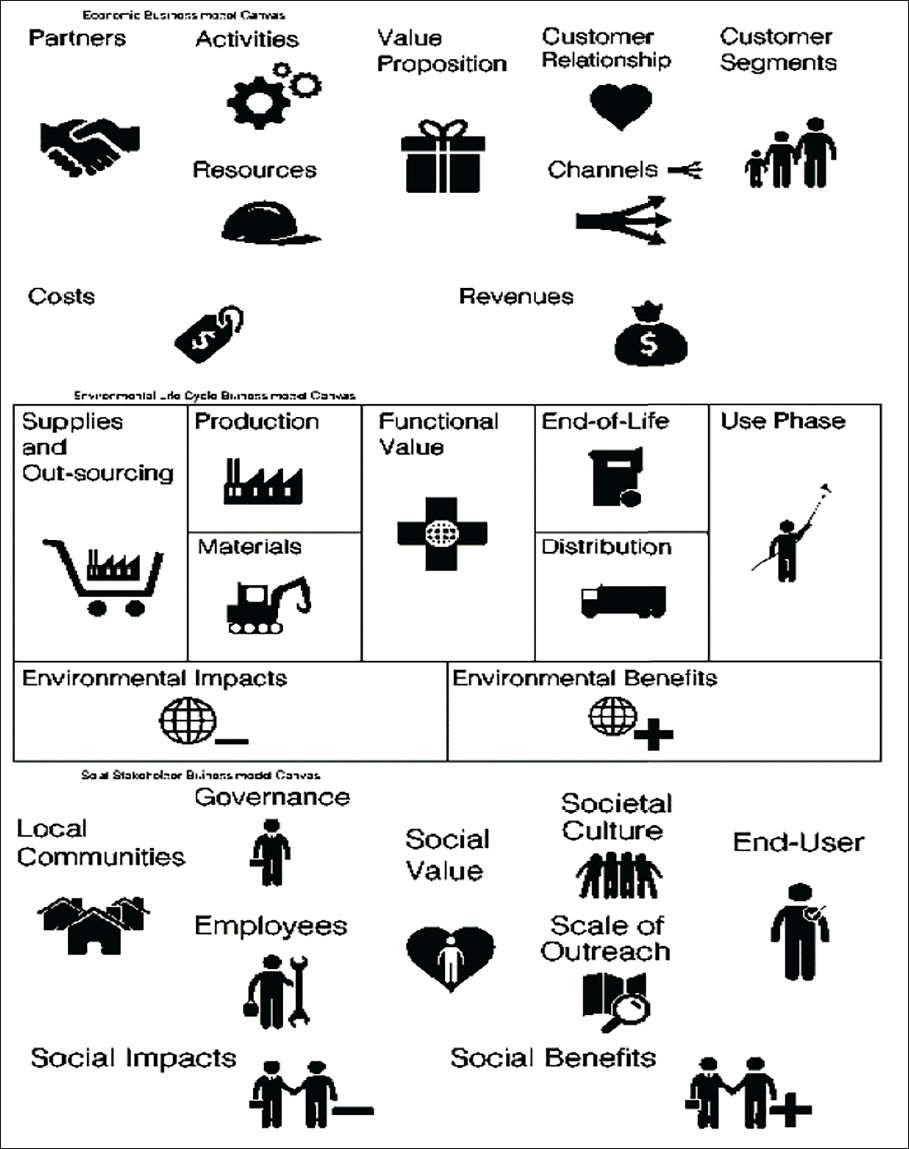
2. Organizing, implementing and scaling: This phase involves training and equipping employees to meet future sustainable goals. Design is a crucial starting point for sustainability, and the brand has hinted at its goal of using eco-friendly products. However, circular design needs to prioritize product longevity, and technical staff coordination with designers is essential to implement resource-efficient product and process strategies. While the brand has begun using recycled yarns for T-shirts, true recycling or upcycling in design involves not just recycled yarns but also efficiently utilizing consumer-used clothing to create more value in the supply chain. The brand should conduct awareness and promotional campaigns for its recycled T-shirts. Efforts to establish integrated collaboration between the technical team and the design team could lead to innovative materials and the infusion of new technology to offer a variety of sustainable products in a cost-effective manner with a reduced environmental impact, increasing the possibility of a closed-loop product circular model.
3. Maintaining sustainability: It refers to creating and maintaining reports and standards for business transparency in the supply chain. ITFL is now a member of Fairtrade, and the association has its standardized reporting system. The brand is also a certified organic cotton user and adheres to organic textile standards for its T-shirt category. The brand could further consider obtaining Oeko-Tex certification for its dyeing and chemical processes. Planning to obtain ISO certifications for its processes, once it sets standards for visibility and transparency across its supply chain and aligns with various supply chain partners to move towards circularity, would be the next steps. All of these are initial steps towards achieving circularity.
Value Chain
ITFL’s value chain comprises in-house design, an in-house procurement team, outsourced manufacturing and in-house managed branding and distribution. The company’s operations involve in-house design based on the latest fashion trends and customer preferences. The in-house procurement team sub-contracts the design orders and specifications to selected suppliers, ensuring raw material quality and superior product standards at every production stage, including the quality of raw materials.
The brand also has a facility to refurbish garments returned from stores for minor defects, minimizing waste and reducing costs. As a result, the operational value chain has reduced capital expenditure and delivered better value to its shareholders. In a linear business model, the supply chain partners, prime activities and resources, value proposition, customer segments and relationships, multiple channels, cost structure and revenue streams are all oriented towards the product’s end of life, leaving a larger carbon footprint. In contrast, in a circular business model, the product’s lifespan is extended significantly as customers reuse upcycled or recycled products, ultimately reducing the product’s environmental and social impact.
Business Responsible Policy
As part of the sustainability journey, the CSO decides to act based on policies framed according to the National Voluntary Guidelines: Business Responsible Policy. The company mentions its compliance with certain standards in its Annual Meeting Report, which includes the following principles:
Businesses should conduct and govern themselves with ethics, transparency and accountability. Businesses should provide goods and services that are safe and contribute to sustainability throughout their life cycle. Businesses should promote the well-being of employees. Businesses should respect the interests of all stakeholders, especially those who are disadvantaged, vulnerable and marginalized. Businesses should respect and promote human rights. Businesses should respect, protect and make efforts to restore the environment. Businesses, when engaged in influencing public and regulatory policy, should do so responsibly. Businesses should support inclusive growth and equitable development. Businesses should engage with and provide value to customers and consumers responsibly.
Analysing these principles, the CSO maps the advantages and drawbacks of sustainable growth:
Principle 1: The brand has notable procedures in place for sustainable sourcing, including transportation, and promotes recycled products to its customers.
Principle 2: ITFL values its employees and provides safety training and employee association opportunities.
Principle 3: The company needs to start mapping its internal and external stakeholders for the sustainability journey, as integrating these stakeholders into the supply chain is critical for the next steps.
Principle 4: This pertains only to the company and does not cover its suppliers, NGOs, NPOs or other supply chain partners. The company has yet to take clean development mechanisms and energy efficiency initiatives, but it has identified and assessed potential environmental risks.
Principle 5: The company has undertaken COVID-19 safety campaigns and awareness programmes for the benefit of society.
Principle 6: The company has engaged in a wide variety of CSR initiatives, which are listed on the company’s website. However, it has not initiated a social impact assessment.
Customers
The CSO’s primary agenda is to educate and create awareness among customers regarding sustainability, even though the brand has primarily engaged customers on product aesthetics and functionality. To spread the sustainability message, the CSO plans to create social media content and launch influencer marketing campaigns.
ITFL adopts a customer-centric approach and has served approximately 4–5 million customers to date. Through its membership programme, Indian Terrain connects and engages with customers at the time of their purchases, fostering customer loyalty and repeat purchases, thus reducing customer acquisition costs. The brand has also invested in customer analytics to enhance its retail store offerings, optimize inventory levels and build brand loyalty.
ITFL plans to incentivize customers to use recycled/upcycled products through its engagement on social media platforms. With over 200 EBOs, the brand allows customers to return their used garments for recycling, which are then sent to a centralized warehouse for sorting and recycling.
The Road Ahead
Scaling circular economy practices is essential for sustainable activities, but it faces challenges such as changes in legislation, the need for new technology, creating innovative materials, changing consumer behaviour, shifting public mentality and closing material product loops.
The CSO identifies other challenges for ITFL, including the company’s debt and liabilities, which may slow down progress towards circularity. There may also be apprehension about short-term stock price movements when investing in better processes for long-term benefits, as transformations are complex and time-consuming. Tension exists between investing in resource-efficient processes and increasing shareholder value.
Efforts to obtain a better CRISIL rating further delay the sustainability journey. With sustainable cross-collaboration yet to take shape, except for its parent company Celebrity Fashions, which has been involved in white-label production for overseas brands, traceability in the supply chain requires alignment between the company’s processes and its supply chain partners’ visibility. The company’s top management’s commitment to investing in eco-innovations to support sustainability is possible if it reshapes its business model and strategy towards a circular approach. Scaling sustainability across all products and supply chain partners simultaneously with economic growth is another challenge.
Looking into the opportunities ahead, the circular economy holds promise but requires a long-term commitment. The company plans to optimize its raw material and transportation costs for the reverse supply chain to recycle/reuse its products through network optimization. The brand has already invested in data analytics, and additional investments in social and environmental lifecycle assessment measures can be tackled simultaneously with developing recycling infrastructure.
The brand has the capability to build a sustainable framework, and one option is to adopt a 360-degree ‘RESTART’ business model as outlined by Sveinung Jørgensen and Lars Jacob Tynes Pedersen in ‘Restart Sustainable Business Model Innovation’. This framework provides the structure and foundation to transform a linear business model into a complete circular model:
Redesign: Business models are adjusted to prioritize societal and environmental benefits within the core business model.
Experimentation: Controlled experiments are conducted on business model innovations to determine what will succeed and what will not.
Service Logic: Embedded services are introduced into products or access takes precedence over ownership, promoting less resource waste and more effective production planning.
The Circular Economy: Adoption of a cradle-to-cradle approach instead of a linear economy, emphasizing a take–make–waste model. Companies can opt for a shared economy, closed-loop model, reduced costs, mitigated environmental impact, optimized resource allocation, risk control and new revenue generation methods.
Alliances: Collaborations and partnerships with organizations that share similar objectives and values, benefiting each actor along the supply chain.
Results: Prioritizing material sustainability, communicating and convincing all stakeholders about the company’s position and movement towards sustainability.
Three-dimensionality: Setting objectives to achieve social, environmental and financial goals, using metrics to monitor these objectives and communicating these measures and procedures while rewarding stakeholders, including customers or any supporting groups or actors in the company’s sustainability journey.
The CSO is confident that ITFL is already moving towards circularity and aims to gain commitment from all its employees and supply chain partners to progress towards sustainability. To gain a first-mover advantage in transforming into a circular and sustainable model, the brand plans to adopt a holistic approach rather than a piecemeal one in its business model, incorporating core social and environmental values, setting objectives and maintaining and reporting performance assessment metrics.
The transformation could be consistent or parallel with the introduction of a separate sustainable product-service line with a closed product loop, considering the conservative culture and mindset of Indian consumers. As an established brand, concerns about product sales may be real, so another option is to opt for parallel product circularity without cannibalizing other product lines. With its listing on the stock exchange, the company can create value for stakeholders with the unique RESTART business model created by Jørgensen & Pedersen, an enterprise business model that cannot be easily imitated and offers multiple long-term benefits for achieving sustainability. By selecting the appropriate triple-layered model and RESTART model, integrating all actors and components across the sustainable supply chain, educating customers and creating awareness campaigns, the CSO believes the brand can differentiate itself in the fashion business, leading to increased market share and growth for both itself and all supply chain actors, thereby increasing market capitalization.
Footnotes
Declaration of Conflicting Interests
The authors declared no potential conflicts of interest with respect to the research, authorship and/or publication of this article.
Funding
The authors received no financial support for the research, authorship and/or publication of this article.
