



Abstract
In March 2020, Nitesh Raj, the Co-Founder and Managing Director of Value Creed, was keenly observing the changes around the world due to the COVID-19 pandemic. Small to mid-size companies such as Value Creed, with specialized offerings, faced a harder time retaining their employees and often lost them to bigger multinational companies. Value Creed’s core expertise lies in Information Technology Consulting, focusing on the energy trading and risk management)/commodity trading and risk management industry. During this tough period, Nitesh aimed to overcome challenges and achieve a future-ready workplace with low employee turnover, high retention and satisfaction. This case is in two parts: Part A describes the Dilemma of Nitesh Raj and Part B describes how emerging technology and digitalization initiatives have supported innovative HR strategic initiatives for introducing technology-driven employee welfare programmes focusing on managing the uncertainty after the COVID-19 pandemic, thus creating a workplace of joy.
Keywords
Case Study
Part A: The Dilemma of Nitesh Raj
In March 2020, Nitesh Raj, the Co-Founder and Managing Director of Value Creed, was keenly observing the changes around the world due to the COVID-19 pandemic. Value Creed’s Hyderabad office (India) had a team of 20 talented people when the pandemic hit. Very soon, due to the pandemic restrictions at the workplace, all employees started working from home. Nitesh sat in the empty office and pondered over the news of layoffs and technology giants biting the dust across the globe. Nitesh had never seen such global chaos in his career, and indeed, he needed to prepare the business at Value Creed for what was coming.
He got up and went to the pantry to get a cup of coffee. He had a mixed set of questions that needed to be addressed. He wondered, ‘How do I manage my existing team in the pandemic? What should be my retention strategy? How do I attract more talent? What should I do to impact my employees’ lives positively? How to create a joyous workplace?’
Having a small team to manage seemed like a blessing during the pandemic, but Nitesh was aware of upcoming challenges. Organizations worldwide started leveraging technology mediums and digitization/digitalization to drive their business. While digitization focuses on managing the data, it also emphasizes building processes for workflow management in a digital world. The information technology consulting business was booming.
The Core Expertise Challenge
Value Creed’s core expertise focused on the ETRM (energy trading and risk management)/CTRM (commodity trading and risk management) industry. This being a niche area of expertise, it resulted in several projects for Value Creed in the pipeline over time. The HR team at Value Creed realized a need for a more extensive workforce with a specialized skill set. Value Creed emphasized hiring skilled resources with experience in the ETRM/CTRM industry. With growing competition in this sector, this created an additional challenge.
Poaching of Employees
HR Senior Manager worked closely with Nitesh to ensure that the attrition rate remained low. She narrated from her experience that small to mid-size companies such as Value Creed, with specialized offerings, face a harder time retaining their employees and often lose them to bigger multinational companies (MNCs). Value Creed was wary of poaching trained, highly skilled employees.
Why Is It a Problem for Decision-makers?:
Losing highly skilled and trained laterals to competitors was a massive problem Nitesh was determined to solve. Being a small company, there is no scope for bulk hiring for Value Creed, and ETRM being a niche industry, the tools and technology used to support the clients need specialized skill sets and training. Due to this requirement, the pool of resources with this specialized experience is limited. Smaller companies, like Value Creed, invest time, resources and efforts to train the cohort of university recruits and make them billable for client projects.
This practice is often challenging to follow in the bigger MNCs. Other competing companies poach and employ such employees who are ready to take on the projects, especially for MNCs; it saves them money, time, and effort on the training.
How Much Is the Poaching in the Industry?:
HR Senior Manager’s experience and internal research pointed out that out of every 20 new employees hired at the MNCs in the ETRM industry, four lateral employees are poached from smaller specialized firms. The main reasons for employees quitting and becoming poachable include:
Unrealistic salaries
Onsite opportunities
Permanent work-from-home opportunities
Less effort in training university recruits
9-to-5 culture
Relaxed environment
If the employees are not engaged with their work and colleagues on a human level, they will always be an easy target for the competitors.
Nitesh wanted to create a happy work culture where every employee of Value Creed is committed to staying and growing with Value Creed for years to come.
His years of corporate experience taught him that employee engagement was becoming synonymous with other concepts like employee satisfaction, retention and experience. This directly impacted the scope of company growth and its development.
Digitalizing Employee Engagement
Employee engagement is viewed as an HR strategy. In the world of digitalization, Nitesh believed that if the company could use technology-driven employee welfare programmes to integrate emotional and physical aspects of work with employee engagement, it could become a significant determinant of organizational success and positively impact employees’ lives.
The Pace of Digital Engagement and How It Is Changing the Workplace Scenario:
Digitalization has made its way into automating workplace engagements. Most traditional automated processes are not intelligent; they automate a transaction processing system, for example, a tactical process collecting applications for a job posting. However, over time, digitalization has created artificial intelligence (AI) algorithms that can factor in deviations and aid decision-making. For example, intelligent processes have aided activities such as managing applications and hiring decisions. In many forms, digitalization will affect the future course of all organizations. Digital resources will require wise management by business decision-makers. They will replace and, in many instances, complement some of the hunch-based traditional decision-making methods in organizations to help improve productivity and efficiency. Digitalization and AI have a transformative impact on HR functions. It has played an essential role in data-driven recruitment and employee engagement decision-making by ensuring transparency and fairness. It reduces the probability of human error in judgment, thus ensuring ethically and empathetically enabled HR practices.
Nitesh aimed to achieve a future-ready workplace with low employee turnover, high retention and satisfaction and facilitating it using innovative HR strategies by introducing technology-driven digitized employee welfare programmes focusing on managing the uncertainty after the COVID-19 pandemic, thus creating a joyful workplace.
The Company
Founded in 2016, with headquarters in Dallas, the United States, and Hyderabad, India, Value Creed has grown. It has created its mark in transforming managed services, specifically in the ETRM and CTRM industries. The names are used for various solutions provided using software tools that support trading and risk management of commodities. Since commodity pricing is volatile, this portfolio analysis provides energy companies, suppliers and consumers with a transparent comparison of complex portfolios. The company specializes in commodity trading, risk management technology and business process optimization. The company offers expert-driven managed services, business process outsourcing, cloud enablement and complementary technologies to help customers achieve optimal value from their C/ETRM software investments.
Initially, the company had an operational team of 15 employees and provided platform support services for Allegro Application and other Advisory services. By 2023, the company expanded its employee headcount to an active team of 125+ workers based in five locations across the USA, Europe, Canada, Singapore and India. At this time, they initiated support services for leading CTRM platforms like Allegro, Openlink Endur, RightAngle & iRely, thus adding the delivery capability to its services portfolio. The company generated revenue of 8.2 million in the financial year 2022. As seen in Figure 1, Value Creed was recognized as the ‘Employee First’ culture by YourStory for having an employee-friendly workplace in September 2021.
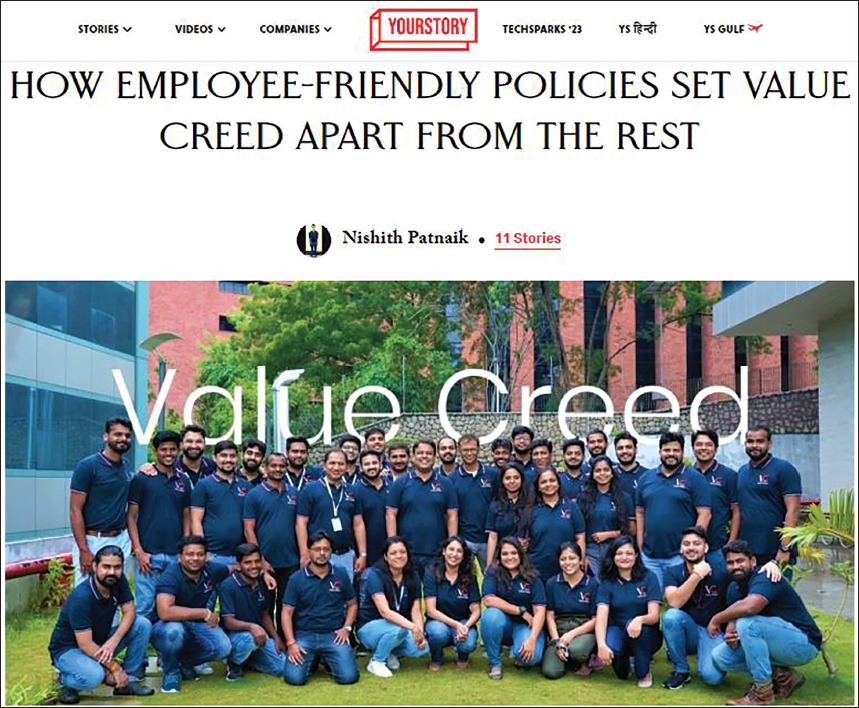
It was also listed in the Economic Times in May 2022 as small and midsize companies that are future-ready after the pandemic. It has also been recognized as having the best learning culture in an organization.
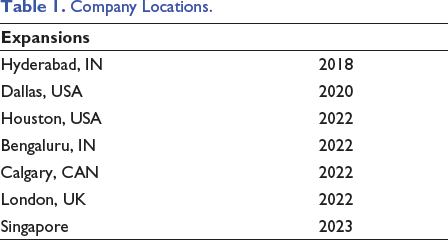
The company grew very quickly, with offices in India and abroad (Table 1).
Company Locations.
The services provided by the company can be summarized as follows:
Managed Services: CTRM managed services allow customers to improve their ROI as their needs change with the help of analytics and optimizations with proactive and reactive services that ensure the application runs efficiently without any unresolved problems.
Implementation/Upgrades: They provide software implementation services, which are carried out all the way from software selection based on the client’s business requirements to software development life cycle (SDLC) operational requirements and upgrades.
Expertise on Demand: Provide bridges to gaps in the client’s bottom-line needs with technical and functional experts available on demand to meet clients’ needs at any given point.
Data Storage and Reporting: Complex business data storage and reporting is initiated utilizing data extracted out of various systems using PowerBI or Tableau.
Testing Services: Automated and manual testing services using QMetry integrated with JIRA to ensure testing is documented and repeatable for specific departments in companies that require it.
Cloud Services: Cloud experts can design, optimize and provide best practice support needed for a successful cloud implementation and maintenance for ample data storage and management.
Business Process Outsourcing: Business consultants equipped with CTRM software and Energy knowledge are effectively enquired to supplement clients’ short-term and long-term BPO needs.
Robotic Process Automation: RPA services enable commodity producers, traders and providers to rely on software robots to do repetitive, documentable tasks performed by front, middle and back-office employees.
DevOps: A set of cultural philosophies, practices and tools that quickly improve an organization’s capacity to deliver applications and services.
The HR Senior Manager of Value Creed narrated, ‘Post-pandemic, the organization was growing very quickly. By 2023, with an employee base of more than 130 employees located globally, the company constantly connected with the growing employee base to ensure that employee engagement and joyous work culture remain a strategic priority.’
Nitesh wanted to use the organization’s key strength of digitalization. Hence, they deliver emerging technology solutions to clients to create employee welfare programme experiences that develop a culture of happiness and satisfaction for their employees.
Nitesh’s Dilemma
In a company strategic goals meeting, Nitesh said that to achieve his company goals, every business head must proactively identify and address the organizational obstacles. The goals set for the years 2020 and 2021 had to be optimized by the operational demands arising from the impact of the pandemic. These goals were very different from everyday business since they had the challenges of sailing smoothly and yet sustaining post-COVID-19 pandemic.
He pointed at his PowerPoint slide and reviewed the bullet points individually. Each point signified the need for an innovative strategic approach to employee engagement to embrace overarching post-pandemic impact. He said:
The projections for hiring trained resources increased significantly due to the high demand for tailored IT consulting services. How can the need be met during the pandemic?
Being a small company focused on niche technology, how can resources be made aware of the job openings? What will make them trust the company and join amid the pandemic? What marketing techniques should be used to attract talent?
With the increase in job opportunities worldwide, how to retain in-house talent? What should be the strategy to engage the employees and lower the attrition?
How to ensure the safety of the employees during the pandemic? How to keep them informed on the essential guidelines?
During work from home, how to entertain and engage employees? What will be the effects on their mental and physical health? What can be done for employees who live away from their families?
With a small team, the HR services were easily managed by outsourcing. But without the in-house HR team, who will drive the initiatives and engagements required for the employees? Who will handle the high load of resumes and job openings?
What are the methods to implement remote onboarding? How to make sure that the company is compliant with the labour rules?
What will be the aftereffects of the pandemic? What are the steps to make the company ready for the future?
The Meeting Ended with Three Crucial Points to Be Taken Forward:
First, it was clear that to achieve these goals, Nitesh should have an efficient and reliable in-house HR team to drive the initiatives for a future-proof company. Having a team will release him from day-to-day tasks, and he can focus on more strategic initiatives. Although this would be a cost overhead, the benefits will overpower the costs.
Second, organizations were operating remotely during the pandemic. Digital content and process improvements with digitalization becoming the new normal after the pandemic, adapting to the latest technologies and using available platforms to engage, retain and hire employees were essential.
Third and most importantly, every initiative and communication should instil the human factor and personal touch.
How did Value Creed attain these innovative approaches to business? Part B of the case study discusses some of the measures taken by Value Creed.
Part B: Value Creed’s Digitalization Initiatives Towards a Workplace of Joy
Digitalization has made significant inroads into creating automated processes. In a conversation with his team, Nitesh discussed how automation has crept into operational processes in business organizations over the years, and more so during the pandemic. Organizations were working in online or hybrid modes. During and post-pandemic, it was crucial to ensure employee engagement by introducing employee welfare programmes built on the pillar of digitalization. There are numerous advantages to transforming a business into a digital business. It improves the effectiveness and efficiency of organizations. Apart from that, it also boosts productivity.
The digital revolution has led to some genuinely new product and process creations. Some of these transformations have led to truly digital business where every element of the business processes is digital, be it the product, the payment facilitation, or the recalibration of processes based on responses. On the other hand, most businesses incorporate digitalization partially.
Nitesh knew that organizations would have to evaluate the necessity and the expected returns on investment to decide on building the data architecture for digital strategy and train the HR team.
Value Creed addressed the problem in two parts:
Addressing Challenges During the COVID-19 Pandemic
During the Pandemic—Hyderabad Headquarters (March 2020–August 2021):
The news of the lockdown was a nightmare for every company, particularly for the HR department. The companies were not prepared for the uncertainties. In the initial days of the pandemic, Value Creed closely observed the impact. Senior Manager, Corporate HR at Value Creed, was working with a strength of about 50 employees. She anticipated the upcoming challenges that had to be dealt with through innovative approaches to tide over.
The HR team heavily engaged with employees to understand the challenges that arose from remote environments and the lack of resources. Team managers and critical resources were involved in important decisions and communications. The HR team also tried to reduce the stress levels in different teams by actively resolving problems.
Using competitive branding and recruiting techniques leveraging advanced tools helped the HR team adjust to the new digitized virtual environment. Virtual onboarding became the new normal, where IT assets were sent via courier and paperwork was done using Acrobat tools.
The company arranged vaccination camps for employees and their families. Regular HR connections and communications were sent to spread awareness and precautionary guidelines to the workforce.
The employees who were married/local to the city had the advantage of living with their families, whereas the young group who travelled to work for the company from different parts of the country was stranded in the town.
Therefore, the HR team and the managing director took personal care of employees who struggled during the lockdown or contracted the disease by keeping connected using digital mediums and delivering essential medicines, groceries and care packages.
With the help of team managers, the work was divided to balance the screen time. The HR team held online contests and activities where employees had to participate with families, like cooking, best family selfies, house tours and entertainment.
The team managers identified backups for respective projects. Learning material was standardized in video formats so that it is quickly available in case of emergency. The team members with the bandwidth were tasked with documenting the processes. The IT issues were effectively solved using online tools like TeamViewer and Anydesk.
Various online activities were conducted to introduce new teams. Many forums were presented for discussion and debates on nationwide topics and safety measures.
Managers conducted regular checkpoints and scrums to identify challenges across the teams in virtual work environments. Employees falling behind were given special attention, and overworked employees were given breaks.
Addressing Challenges Post-pandemic—Multiple Locations
As the country set to open up again and employees started returning to the office, new challenges were awaiting at the doorstep. From August 2021 to January 2023, Value Creed’s headcount increased to 200%. In addition, new offices were functional in four locations, adding to the organization’s diversity.
Managing Director Nitesh, along with Corporate HR Senior Manager, listed the following common issues for the team strength of 100+ for all locations:
The Launch of LearnSmart by Value Creed
Several employee welfare programmes were introduced to manage the uncertainty post-COVID-19 pandemic using Emerging technologies and digitalization. Value Creed introduced Employee First policies catering to employees’ needs above others. This initiative became part of the ‘LearnSmart by Value Creed’ programme introduced in March 2022, a 360° programme focused on competence, wellness and enjoyment.
Emerging technologies and data management supported the three major components of the ‘LearnSmart’ employee welfare programme.
Competence:
Recent studies suggested that a high-performing employee expects holistic career development and contribution to the company’s success from the first day of joining a company. Not providing a clear path and directions to reach the next level demotivates the employee further, leading to unproductivity. The L&D Team, under Nitesh’s leadership, developed the LearnSmart Career Accelerator programme, where employees received a clear roadmap of the exciting tasks and challenges to be completed to move up the ladder.
LearnSmart has two models. The first one is divided into three categories, namely:
Cohort is a training programme for fresh-out-of-college candidates, including college interns.
Fast leadership is a training programme focusing on imparting leadership and managerial skills to employees with 2–5 years of experience within the organization.
Executive—training programme focusing on imparting strategic and executive leadership skills to employees with more than five years of experience within the organization.
The second model focuses on continuous learning through regular sessions arranged by the mentors within the organization on various helpful topics. These sessions ensure knowledge transfer amongst employees of different departments.
Wellness:
Putting the ‘human’ back in ‘human resources’ was one of the biggest lessons learned by the companies after the pandemic. Still, for Value Creed, this practice was fundamental from the beginning. Nitesh adopted the ‘Employee First’ practice, which the Human Resource Department of Value Creed adopted. ‘Employee First’ is about understanding the life experiences employees are going through to support them not just in their experience as workers but in their lives. In addition, the wellness initiatives under LearnSmart drive and reinforce healthy lifestyles, bringing benefits to the employee, employer and the community.
Under the wellness programme, HR promoted a healthy lifestyle using sports, yoga sessions, health camps, etc.
Employees identified their favourite sport and set up clubs. Management supported the initiative by investing in tournaments, playing grounds and uniforms.
Many quarterly and yearly health check-up camps were set up to identify early problems.
Mindfulness was promoted through yoga sessions and by creating an environment where employees are not afraid to seek help if they struggle with stress or other mental issues.
Enjoyment:
The old proverb ‘All work and no play make Jack a dull boy’ is another way to highlight the importance of fun in the workplace. The Managing Director personally invests time with HR to brainstorm ideas to engage employees and create a more positive and fun atmosphere in the office. The activities not only help with engaging the employees but also promote bonding and camaraderie amongst different teams.
The employees heartily participate and suggest ideas for fun activities and celebrations. The employees love spending their free time in the gaming zone and participating in online tournaments. The lively parties and celebrations also ensure togetherness and good times.
‘We don’t just hear our employees; we listen to them. Unfortunately, employee wellness programmes are often viewed as a “nice to have”, not a workplace imperative. Still, wellness is a tremendous opportunity to help employees see the value of adopting healthier behaviours. The essence of these programmes is to address employees’ specific needs, maximizing their engagement and participation at the workplace’, Nitesh Raj, Managing Director, narrated.
Competence, wellness and enjoyment are the three essential pillars of every organization’s success. In addition, employee-friendly programmes are the key to successful employer branding and attracting great talent. Keeping that in mind, HR Senior manager, under the guidance of Nitesh, developed various programmes that broke the stereotype of a typical workplace. These programmes also addressed the issues faced during the pandemic and post-pandemic and helped the team overcome the fear of coming to the office, establishing a sustainable workplace culture.
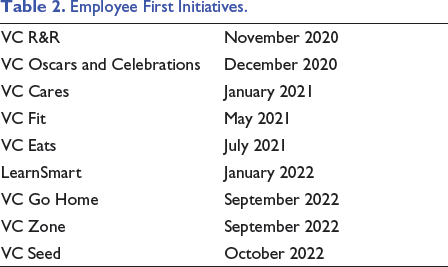
Value Creed launched the following employee-first initiatives as they moved towards digitalization (Table 2).
Employee First Initiatives.
VC Cares:
Value Creed implemented this initiative during the pandemic in 2020, focusing on employee health and well-being on many levels—how employees feel, their mental health and whether they are vaccinated, among other things. Being proactive about employees’ physical and psychological health, developing skills to detect problems early and helping them were game changers in winning employees’ trust. The HRs also focused on employees’ families through specific programmes to earn their trust and increase their happiness quotient. Digital Data collection and analysis from several quarters was set up to build this initiative.
Value Creed’s COVID-19 vaccination camp was the first initiative under VC Cares. The camp was organized on the company premises for employees and their family members for doses one and two. The camp saved the cost and trouble for the employees and their families to visit the hospitals amid the pandemic. In addition, during a time of uncertainty when even the biggest companies were laying off employees, the initiative created a great sense of safety and trust in employees and their families for the company.
The HR team went above and beyond to help the employees in quarantine. They delivered groceries, medicines and other essentials to make employees feel they were not alone in the tough times. In addition, medical leave, pharmacy allowance and free online doctor consultations helped the employees recover.
The annual employee survey helped management better understand the employees’ concerns. Keeping the study anonymous brought real problems to the table. Employees used the digital platform to voice their opinions on how to add more value to the organization and participate in forming important HR policies.
The Managing Directors, COO and HR leaders conducted skip-level meetings with the employees that helped them know their employees better. A skip-level meeting is where the manager’s manager meets with the employees without the manager present. It also helped perform the RAG analysis for identifying focussed employees and grouped them accordingly to focus on those unhappy with the company.
With the help of managers, HR systems created a positive work environment that supported mental and physical health. Without a supportive culture, employees will not take advantage of the benefits provided by the company because of stigma. Wellness camps like Yoga, complete body check-ups, dental, blood donation, etc. helped raise awareness for various mental and physical issues and provided guidance for those who needed help.
VC Fit:
Aimed at encouraging employees to make healthy choices, exert a positive influence on teamwork, and build camaraderie, HRs came up with various fitness activities with the help of managers.
Upon realizing that most team members love sports, the management started sponsoring the equipment, play area and branded jerseys. As a result, more and more employees spend their free time playing sports, promoting camaraderie and fitness. It also helped strengthen the friendships and the sense of belongingness so that they would not leave the company.
Inducing healthy competition keeps employees engaged and increases team bonding. Competitions like the Walkathon, Cricket championship and indoor game tournament were big hits and kept most people engaged and healthy.
VC Eats:
The HRs knew that most employees living far from their families struggled to get home-cooked food and often fell sick due to lack of nutrition. Introducing the VC Eats dinner programme reduced everyday stress and promoted a balanced, nutritious diet for the employees. This added perk proved to be a selling point in recruitment and increased employee satisfaction.
VC Go Home:
Achieving a perfect work–life balance is vital to lead a successful career. Therefore, the management motivated employees to adhere to shift schedules and finish their tasks within the timeline. As a result, employees stick to their schedule and complete the work on time, leaving their laptops in the office so they spend the time at home doing what they love.
VC R&R:
Rewarding employees for their contributions increases ownership, hard work and pride. In addition, recognition connects them to the organization, elevates performance and increases their likelihood of staying. Having multiple channels and levels of recognition, like peer-to-peer, monthly, quarterly and annual, ensures ample opportunities for everyone to be in the hall of fame. The healthy competition also motivates different teams to perform their best and gain the limelight in the organization.
Monthly displays of the best performers on office televisions and exciting rewards like Amazon gift cards, expensive gadgets, certificates and trophies boost happiness and satisfaction, allowing them to flaunt their achievements on social media.
VC Oscars and Celebrations:
Celebrations are the key to a happy workplace that brings a sense of belongingness and boosts morale. It is also a great source of engagement and promotes office culture. So whether it is a birthday, a work anniversary, an onboarding of a new employee or the company’s wins, the HR team makes sure to celebrate and include everyone in the celebration.
More significant celebrations like the VC Oscars, an annual awards night, and retreats were more sophisticated and provided a bigger platform for everyone to come together and celebrate each other’s success.
VC Zone:
HRs invested in engaging in virtual games and activities by inviting employees to share their ideas. Oculus, a virtual reality headset packed with hundreds of games, and PS4, a video game console, were the game changers in employee engagement, resulting in minimum work-from-home requests.
VC Seed:
The company encourages innovation and entrepreneurship and supports viable ideas. This programme was a great way to boost competitive strength and create solutions that made a difference. In addition, employees appreciated the innovative environment where their ideas were heard.
LearnSmart:
Nitesh and the L&D team ensured that every new employee had a path to follow from the day of their appointment. The LearnSmart 360° career accelerator programme provided a roadmap for a successful career with expert guidance, giving them more opportunities to add value to the company. A career development plan is necessary to keep the employee motivated and engaged.
LearnSmart Cohort helped recent graduates learn the skills needed to grow in their careers. Dedicated trainers and mentors helped young professionals identify their potential, thus leveraging it to develop advanced skills required in the industry.
Soft skills, client interaction and learning through test cases and live projects were some techniques to fast-track growth.
Through the LearnSmart FAST leadership programme, managers identified the potential candidate who could be the next-in-line manager to lead the team. This programme helped in succession planning and provided a path for deserving employees to climb the ladder through the guidance of top management.
The LearnSmart Executive programme provided leadership training to seasoned professionals with real-life examples and case studies. This training enhanced their decision-making and crisis-handling skills, making them successful leaders.
LearnSmart Learn by Example was a platform for employees to meet and learn about the inspiring journeys of industry leaders. The HR team invited global leaders to share their knowledge with the team through online/offline mode. As a result, the employees could relate to the leader’s journey and adapt to career-enhancing habits.
Role of Emerging Technologies and Digitalization
After the pandemic, the company needed to adapt to the latest technologies and be future-ready to achieve the abovementioned initiatives. With the latest advancements in AI, the HR and IT (Information Technology) departments evolved to maximize the output in various tasks:
Employee Self-service Portal: Leveraging the skills of the in-house developers, corporate HR proposed the ESS portal that reduced the efforts on routine manual tasks like leave application, leave balance tracking, leave approvals, editing employee information, etc.
Workplace of Joy
In 2023, employee satisfaction and positive feedback were the success metrics for the organization. Introducing programmes like VC Cares, VC Fit and VC Zone broke the stereotype of a typical workplace and changed employees’ perspectives. When employees are happy, they share happiness with their families, which leads to overall high employee satisfaction—achieving this after the pandemic has been a significant achievement at Value Creed. Creating a joyous workplace depends on knowing the employees and listening to them. Managing Director Nitesh and his HR team ensured that employees’ feedback was heard and worked upon. Seeing the suggestions implemented at the workplace increased employees’ trust in the organization.
Digitalization was a critical factor in creating innovative approaches to employee engagement. Using emerging technology platforms for collaborative experiences led to sustaining and managing the impact on employee wellbeing post-pandemic.
The engagement activities created healthy competition, which led to the strengthening of camaraderie. Moreover, transparency between employees and top management created a feeling of mutual respect and ownership. Sitting once again in his office cabin, Nitesh Raj wondered whether he had been able to develop his dream workplace of joy. Employees seemed happy and satisfied. Has the attrition rate been reduced? Has he and his team successfully measured it? How can emerging technology and digitalization be used to calculate the outcome of the effort and investment that his group has put in to improve employee engagement? He has to sit down with his team to discuss these points.
Footnotes
Declaration of Conflicting Interests
The authors declared no potential conflicts of interest with respect to the research, authorship and/or publication of this article.
Funding
The authors received no financial support for the research, authorship and/or publication of this article.
