




Abstract
Experiential learning through digital technologies has been a buzzword in the higher educational system in recent times, which is advancing with the pace of technology. One such experiential learning tool, simulation games are widely used in a variety of industries as well as in the higher education sector, as a learning and assessment tool. The simulation-based learning helps students to acquire skills like decision-making and critical thinking which are very important for B-school students for stepping into the professional world. This case study is about one such India-based organization, Learnbiz Simulations, which provides services of designing and conducting business simulation games. The case focuses on exciting value propositions, journey and a variety of challenges faced by Learnbiz simulations in the area of client outreach and market expansion to B-school students, MDPs, corporates for in-company training and recruitments. The case links with the theories of digital marketing strategies for enhancing customer outreach to B2B organizations as well as technology adoption and business growth potential. The case studies about how the company can deploy the phenomenon of marketing of simulation products by Learnbiz simulations to facilitate experiential learning in higher education in light of regulatory emphasis on outcome-based pedagogy. The case further explores the phenomenon of customer outreach and the use of digital media for creating brand awareness among tech-savvy young generation. In light of ongoing discussions over the New Education Policy in the Indian Education System and the outcome-based education as advocated by the Washington Accord-based National Board of Accreditation, there is an immense opportunity for deploying business simulations as a part of an active learning process in the B-school education.
On a cool Delhi winter evening, Akash Goel, designated partner, looking after Concept Design and Development and Sales at Learnbiz Simulations LLP1 was brainstorming over the question ‘Where do we go from here?’ with the other two designated partners, Ankit Aggarwal and Ashish Goel. Young, ambitious and enthusiastic Akash, who is a mechanical engineer from Delhi College of Engineering and an IIM Kozhikode graduate in Finance and Strategy was thinking of the possibilities for the growth of Learnbiz simulations in a relatively new industry of educational simulation games for higher education students. The question was still unanswered, and there was more ambiguity than clarity about the path ahead in their minds as the team dispersed at the end of the day. However, this is the excitement for the player in an attractive and relatively nascent industry that is currently shaping the future of higher education.
Wide-level acceptance of simulation games as learning tools in higher education is currently a challenge, particularly in an emerging economy like India. In light of this fact, Learnbiz as a budding organization, providing services in the area of developing and conducting learning simulation games, has acquired its initial traction with client base among impressive IIMs and IIT institutes. After initial growth, Learnbiz has faced challenges in the area of business growth and creating brand and category awareness among majority of B-schools in the tier I and tier II cities of India to create their pan-India presence. B2B customers of Learnbiz were corporate clients as well as they deployed simulations in the process of recruitment and training, the company had difficulty to tap corporate sector. Ms. Roopa Gajwani, who was a senior Consultant with Learnbiz for Mumbai region, works for business development of simulations offered by Learnbiz, expressed her concerns to Aakash Goel in this regard ‘Acquiring a new client is becoming difficult and lengthy process, though we are good at retention among top notch clients’. ‘We need to strike a chord with young minds which are looking forward to the new, exciting and experiential ways of learning’ Aakash shared with Ms. Roopa.
Background
The use of simulation games as a pedagogical method is well established through its effective use. In recent times, there is proven effectiveness of simulation games as a learning tool and the students learned by engaging with the strategic decision-making simulation game. Student learning was found to be enhanced through the use of simulation games, in two ways, namely, simulation games as a catalyst for learning and as a vehicle for learning (Loon et al., 2015). Simulation games have created a disruption in the higher education-teaching methods as well as in the corporate training and development methods (Ahmed & Sutton, 2017). It also brought out the importance of simulation games and experiential learning in bringing innovations in teaching pedagogies at business schools and the development of students’ skills competencies through simulations and achieving management-related learning outcomes (Lohmann et al., 2019). In the light of these important implications about learning through simulations, Learnbiz is an attempt to leverage the growing opportunities this industry offers and enhance learning methods at B-schools.
The management education system and corporate training programmes have started using simulations and online app-based games as a learning tool which is gradually becoming an important and integral part of the overall teaching mechanism of academic system (Faria et al., 2009; When compared with other forms of active learning, simulations and games show unique advantages (Ampountolas et al., 2019; Beck et al., 2019; Farashahi & Tajeddin, 2018). Simulations and games are creating an impact not only on cognitive learning outcomes but also on the skills, values and employability of learners (Asiri et al., 2017) The bibliometric study of 1,200 relevant Scopus-indexed documents published between 1960 and 2019 verified that simulation-based learning is being used to teach a wide range of functional management subjects. This shows there is a great demand potential for simulation-based learning creating an attractive industry for Learnbiz.
Despite all the benefits of simulations in learning, there have been few contrarian views of researchers as well. Management education is required to keep up with the current system and processes as well as anticipate future developments. Management education needs to focus on alignment of its curriculum to the best extent possible with the demands of business. At the same time, recognizing its objective to educate students in a culture of liberal education, it is not only about the change in pedagogy from regular to simulation but the change adoption in the overall content is also very important.
Company Overview
LearnBiz Simulations LLP1, headquartered at Delhi, is a limited liability partnership firm which was incorporated on 24 June 2009, with total obligation contribution of INR 61,10,713 and designated partners as Mr. Ankit Aggarwal, Mr Aakash Goel and Mr Ashish Goel. It is a simulation and assessment company that specializes in business simulation games. Currently, the company offers a portfolio of 29 learning simulation games addressing diverse topic domains in the post-graduate management programme. These simulations can be included in the academic curriculum or used as stand-alone exercises. These allow students to learn by doing, applying conceptual information and assessing how well they have applied what they have learned. It also improves students’ abilities to analyse circumstances and solve business challenges using data-driven judgements.
The company collaborates with both educational institutions and corporate clientele. Its products are designed to be cost-effective, subject-specific and based on the Indian business models. The simulation games are created with students interested in management careers in mind, all the way up to senior executives in the corporate world. The goal is to learn in a fun yet practical way to apply methods and to see what works best. The partners of Learnbiz like Cengage, B3 Solutions, Campus Levers, Classel and Dare to Compete, provide support in the development of various products. The content is being developed at Learnbiz with the help of experts from IIM—Ahmedabad, IIT—Madras, CMC, XLRI and IIT—Bhubaneswar.
LearnBiz Simulations has created simulation-based learning and assessment solutions for management concepts in economics, finance, marketing, operations and strategy that are high-quality, cost-effective and simple to use. The simulation games are offered through the web-based interface and may be simply integrated into course pedagogy or utilized to run stand-alone student activities and assessment through contests. These aid in nurturing critical thinking and analytical skills for the development of future business leaders in both academia and industry. ‘Company has been acknowledged as one of the “Top 10 Leadership Content Partners & Providers” in the world, and has been honoured at the Leadership 500 Excellence Awards’ Mr Aakash Goel proudly shared.
Business management higher education institutes deploy company’s broad collection of games to impart experiential learning, which are focused on a number of academic areas, to evaluate and reinforce classroom learning by imitating a competitive atmosphere and a real-world business scenario. Participants play the role of leaders and management executives in global corporations, making decisions while competing with their colleagues and having fun.
While approaching elite clients among IIMs and IITs, Mr Aakash has always been very clear and always shared with their elite clients about the unique value-propositions offered by Learnbiz, as the following:
Company has created simulations for most of the key courses included in the MBA curriculum in India. Faculty may simply deploy simulations via the cloud and students can play them from anywhere, not just within the classroom. Analytics are used to assess students’ relative performance for debriefing and grading reasons, and students can compare their simulation performance to that of participants from other institutes across the world. Functional contributions were drawn from actual expertise in the manufacturing, IT, banking and consulting areas. Value creation through inputs from experienced professors of IITs and IIMs who are involved in content creation.
Competitive Advantage of Learnbiz Simulations
One of the major competitive advantages of Learnbiz simulations is that they have business simulation games with various modules developed for all the major business domains like marketing, finance, economics, HR, organizational behaviour, operations, leadership, strategic management and project management. Students learn and understand the management concepts in various games of simulation under different scenarios and constraints.
Finance and economics modules give emphasis on developing students’ decision-making skills by providing them to work upon challenges of different monopolistic competitive scenarios of macro- and micro-environment. Students get a lot of exposure about the operations of banks, decisions regarding working capital management, portfolio management, CAPEX policy and project-financing decisions.
One such real-life example is the game ‘Bank on Us’ which is an interactive online simulation game that helps students to learn the functioning of traditional banks and develop the required management skills. The game requires students to apply banking concepts and business sense in a decision-making setting to achieve the objectives of running a profitable bank. As a top-level management executive, students have to take up to 17 critical decisions in a simulated economy and regulatory environment understanding the macro-picture of managing a bank and importance of cohesion of all the functional areas for deliverance of outstanding business results. They experience the difficulty of making short- and long-run decisions in the face of uncertainty and learn the importance of prudent risk-taking as well as effective introspection of financial statements to make key capital and expense decisions.
When client organizations of Learnbiz conducted this simulation, students were keen and interested to apply concepts such as interest rate, overall economy, economic statement and New Regulatory Requirements of the Central Bank and also the values of those parameters of the bank.
Students could visualize and experience the change in customer growth rate and the default rates when they themselves made changes in GDP and bank-related Norms of CRR, SLR. They were very excited and happy to virtually experience changes of various parameters affecting the GDP and vice versa such as capital adequacy requirement, cash reserve ratio requirement, statutory liquidity ratio requirement, repo rate, reverse repo rate, G-sec return and share price. The entire exercise was very competitive as everyone was trying to increase GDP and reduce interest rates. Students were happy to experience the change in capital markets with respect to share prices due to changes in macroeconomic indicators. There were many positive testimonials from the clients.
Marketing area simulations focus upon skill building in the areas of understanding customer multi-attributes and customer segments, FMCG sales and distribution, supply chain, product focus, negotiations and market research. Operation management area simulations focus upon practical areas like capacity planning, project management, risk pooling and so on. HR domain simulations focus on skills like leadership, organization structure, ITeS strategy, consulting and corporate strategy.
Industry Overview and Relative Positioning of Learnbiz
The industry of online simulation products for higher education learning is quite recent with Capsim, a US-based company formed in 1977, being the pioneer and oldest company in the world, as well as in India (2001 onwards) offering simulations for experiential learning. The firm registered with its official website
Tata Interactive Systems had acquired a German player in 2004 which was the main supplier to the biggest distance education university of the time, that is, Phoenix University, but could not sell anything in India.
‘Markstrat’ was present largely in the industry due to the support of an IIM Ahmedabad professor who influenced all his FPM/FDP students to use it. Still there were no subject-specific simulations in the market other than marketing (Markstrat) and strategy (Capstone) areas, respectively, and both of them were too pricey, being foreign products.
As the decision-makers at Learnbiz were aware that merely being low cost and positioning it that way does not sell by itself, unless the best clients in the industry are also using it, thus the positioning of Learnbiz was never as a ‘low cost’ proposition, but as a subject-specific suite used by top institutes and companies. The only positioning change which happened over a period of time was saying it provides ‘automatic evaluation’, when the mere proposition of ‘experiential learning’ did not work out.
Mr Aakash and Ms. Roopa with the other two founders had the brainstorming session earlier regarding the growth way ahead for Learnbiz. Learnbiz had an elaborate portfolio to offer games in multiple domains of management education, it clearly had the opportunity to penetrate the market, captivate the young minds as Mr Aaksh earlier stated. Ms. Roopa proposed the above positioning proposition as worked out by the marketing team by thoroughly studying the below advantages Learnbiz simulations offered can also be highlighted in client communications:
Risk-free learning: Business simulations are safer platforms for students to learn how to navigate the landscape of a real organization/company before venturing out with a poorly executed business concept and losing all of their funds. Multiplayer environment: Students create management teams for a virtual firm that competes for a share of the consumer pie against other enterprises in the same market. Interactivity: Students not only receive the chance to engage with their teammates on the decision-making process but also cooperate with instructors/facilitators in re-aligning their tactics, as they use the model of being played across several rounds. Realistic approach: Allows students to take on the role of a protagonist in their company’s story and decide its faith by making decisions in a high-stake scenario. Rewards: Students’ most important rewards are those that will help them develop their business decision-making abilities, holistic thinking, collaboration, proactive pivoting and problem-solving skills, all of which will be beneficial for them in the long run of their career.
Major Issues and Challenges Faced by Learnbiz
Expressing her concern over the current situation in the market, experiencing deferred purchase decisions by clients after multiple demo sessions and hands-on trial, Ms. Roopa shared the findings of market intelligence team at Learnbiz with respect to current challenges with Mr Aakash, ‘Considering scenarios from Indian B-schools, targeting B-schools for implementing simulations in their education pedagogy is still at a nascent stage, we need to address few challenges before our subscriptions pick up’. Following challenges are faced by Learnbiz as understood by market intelligence team:
Building customer outreach: Sales teams at Learnbiz face difficulty in customer outreach and lead conversion although first conversion leads to endless repeat orders but effort for the first conversion may seem endless, given the society-wide education level as well as a high-resistance quotient of the faculty.
Adoption of simulations in teaching pedagogy by faculty members: It is a vicious circle which does not seem to be breaking as Learnbiz has so far offered its products to hardly 80 colleges in a decade (there used to be close to 4,000, now 3,000 colleges offering MBA/PGDM programmes in India).
Low brand as well as category awareness level among limited B-schools offering management development programmes: The company also has another segment for its products in the form of corporate training which has categories, one is MDPs (management development programmes) at B-schools, which are offered by B-schools to the various companies and the other one is in-company training. The challenges are that only the elite colleges (less than 20) have the power to pull and host corporate training. Whenever faculty using simulation in the full course is involved in MDP, simulation is used.
Low rate of success in offering corporate training simulations: Regarding the domain of in-company training, Learnbiz has tried its hand but has not been successful, except ONGC DGM Level Programme which was a clubbed programme with IIM-B and IIM-C during which they successfully used simulation.
Building Customer Outreach
Sales team at Learnbiz had identified several methods that are important for effective customer communication, messaging and building structured communication programmes. Various tools that are used are brochures, handbills, paid advertising, community/public events/workshops, promotional items, social media campaigns, short promotional videos, telemarketing and social media marketing and so on. The company had defined two primary objectives of their Customer Outreach Programme to be implemented at LearnBiz, first one is to raise customer understanding of products and services to a higher level, and second one is to contact consumers who do not use the LearnBiz services using the methods like telemarketing, e-mail marketing and social media advertising. Online marketing strategies definitely boost the sales success of B2B companies as explored by Binder (2019) in the study on the influence of digital marketing strategies on the sales revenue and its usefulness in future. Learnbiz needs to strive hard to improve upon the digital presence for their B2B business model for corporate clients.
The tools of social media which are engaging component of B2B marketing communication bring out the roles of personal relationships and interactions between sales representatives as well as the influence of B2B marketers in addition to the importance of content creation in social media (Huotari et al., 2015). The content created for various games and simulations at Learnbiz was by eminent experts from academicians as well as from industry. This is an important value proposition which needs to be used effectively by salespersons for marketing as well as branding purposes.
The students improved their confidence and thus their decision-making skills relating to day-to-day operations due to simulation learning (Ampountolas et al., 2019). Word-of-mouth referral marketing also significantly impacts the member growth and acquisition at social networking sites with traditional marketing vehicles (Trusov et al., 2009).
Digital Media to Create Brand and Category Awareness
Learnbiz also has two big challenges of creating awareness about brand as well as about simulations, as an enhanced way of teaching pedagogy. Final consumer being young generation within the age group of 20–25 years who make use of digital platforms more so as per segmentation, Learnbiz can improve its brand visibility through digital presence and by finding means and ways to leverage upon digital marketing opportunities to expand in new markets.
The practice of using social media platforms to enhance online presence, forming social, business networks and advertise digital products and services has gained a traction. Learnbiz simulations had deployed use of the new social media marketing tools such as wikis, podcasts, online videos, folksonomies, podcasts, dashboard, news sharing, photo sharing, story sharing, message boards and live portals, posts on social networking sites to reach a wide or audience targeted.
In the age of Facebook, Instagram, WhatsApp and Twitter social media marketing has become a critical component of any marketing strategy. It’s difficult to think of a marketing plan without taking into account the importance of social media. By using various media, the company affects the consumer awareness of the brand, spreads information about themselves and the brand, educate consumers, create a brand image and social media is one of the most powerful, profitable and effective platforms for companies to increase its visibility amongst its target customers (Domazet et al., 2017). By spending few hours on social media and on companies’ page, firms reported a huge increase in queries and business turnover as well (Ghoshal, 2019).
Opportunities and Path Ahead: A Futuristic Outlook
Learnbiz simulation should utilize social media more effectively to create brand awareness as it is BTL (below-the-line) tool being cost-effective as it needs less spending on advertising expenses to reach a larger base of customers. The usage of blogs and social or business networking sites can help to get more attention from other social media sites to their own website. As a result, Page Rank may rise, resulting in more visitors from major search engines. Other marketing techniques, such as a paid advertising campaign, are enhanced by using social media. Participation in relevant forums and replying to questions may aid in the development of trust. User profile data from social media sites may be used to target advertising to a specific set of people.
In light of ongoing discussions among regulatory bodies and educational institutions over New Education Policy and the Outcome-based Education as advocated by the NBA (National Board of Accreditation), there is an immense opportunity for deploying business simulations as a part of an active learning process in the B-school education.
Learnbiz simulations have business development opportunities in the following areas like market expansion to new niche segments in the corporate sector and B-schools planning for NBA accreditation which emphasize upon innovative pedagogy in teaching–learning process. Further product-line expansion with focus on advanced games for inculcating higher order thinking skills, market penetration to high school education in subject areas like business studies and economics as well as virtual brand community which is a non-geographic specialized society established on an organized system of social relationships among brand aficionados can be used, innovative simulations based on the concept of flipped classrooms, algorithms, predictive and financial modelling can be generated. Quality of user-generated content includes pictures, videos, text, and audio, and specific simulations for identifying competencies to support recruitment and appraisal processes to suit the requirements of the corporate clients.
Presently being at the crossroads of future growth opportunities as well as current challenges, it would be interesting to see how the future gamut of opportunities unravels for the organization Learnbiz and how does the company deploy strategies at its disposal. Will the organization be able to improve its customer outreach to ensure its market expansion through strengthening its digital presence and captivating young minds? Aakash Goel seems confident about his brainchild Learnbiz to touch new heights of success and so Ms. Roopa with the rigour of her marketing team to go digital.
Annexure A
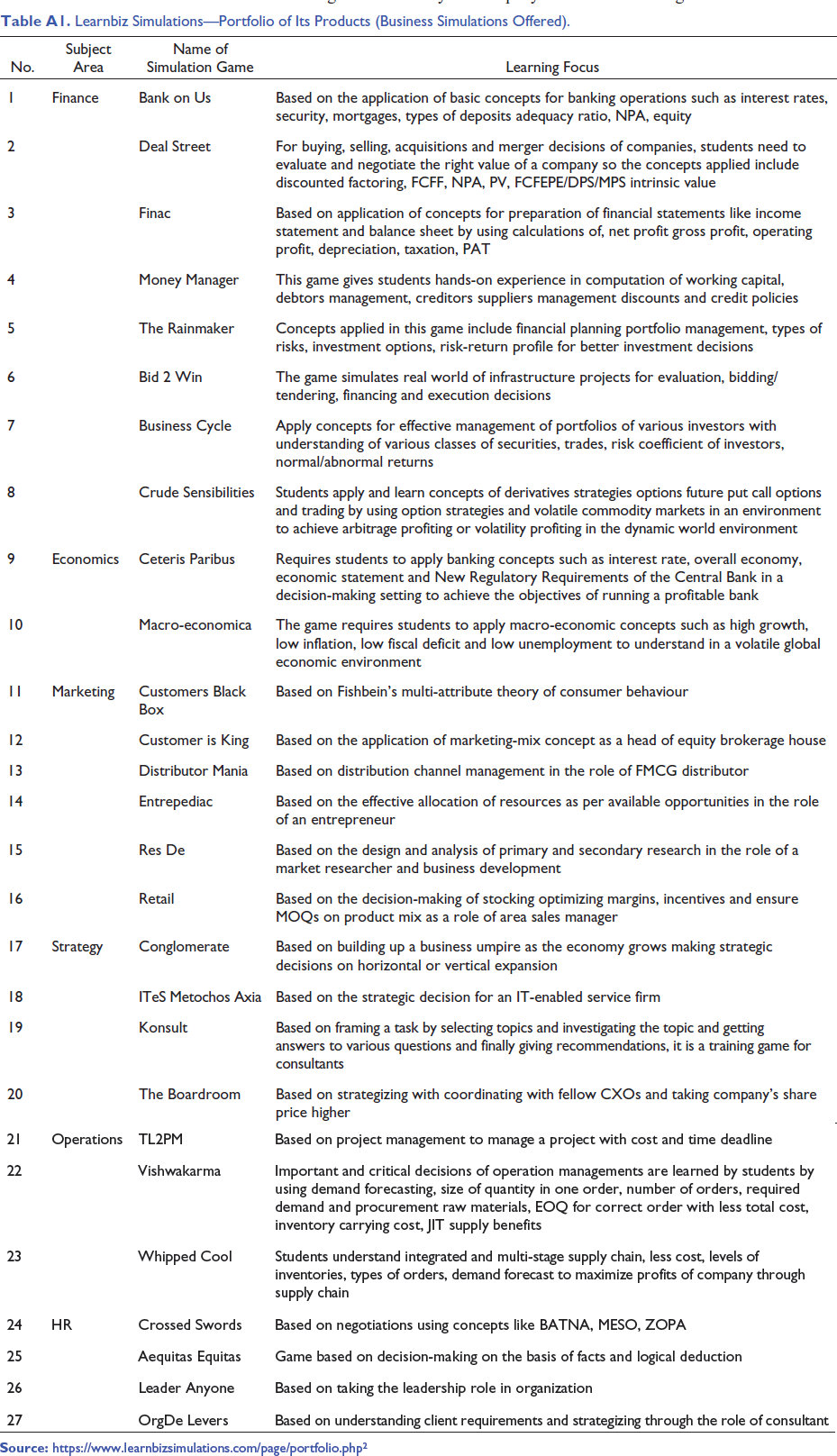
The table A1 describes the different simulation games offered by the company in the area of management domains.
Learnbiz Simulations—Portfolio of Its Products (Business Simulations Offered).
Annexure B
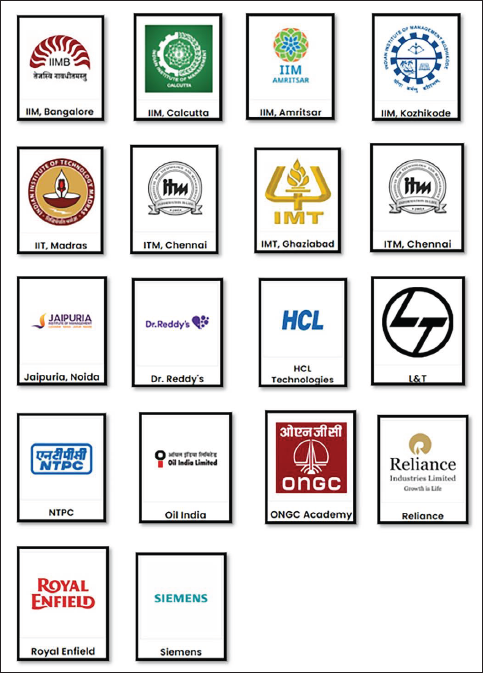
The list of various reputed clients, companies and business schools which are using Learnbiz Simulations in their curriculum as well as training programs (Figure B1).
Discussion Questions
What are the key challenges for a new service like learning through business simulation?
How to create brand awareness and customer’s attention towards simulation games?
How can the brand improve its digital presence?
What are the opportunities that can be leveraged upon to expand in new markets?
Footnotes
Dclaration of Conflicting Interests
The authors declared no potential conflicts of interest with respect to the research, authorship and/or publication of this article.
Funding
The authors received no financial support for the research, authorship and/or publication of this article.
