



Abstract
The case discusses the pitfalls of hasty decisions taken to achieve instant success. The case also highlights how unethical practices erode the image of the organization and sets in malicious culture. The Radiance Group, founded by Sarabhai Karmarkar (1930–2005), one of the largest private sector companies in India, with petroleum and energy as it core business, has always been an ambitious company. Sarabhai, the founder of the company, was a man of high aspirations. Since the very inception of the company, Radiance Industries Limited’s only vision was Profit Maximization. Sarabhai Karmarkar believed in utilitarian philosophy which preaches that end justifies the means.
After the demise of Sarabhai, Vithalbhai Karmarkar, eldest son of Sarabhai, became the director of the company. He was an intelligent and sharp minded young man, full of new ideas and energy. He wanted to explore new ideas and diversify into new products and markets. In his haste to make Radiance grow exponentially, Vithalbhai committed many mistakes which proved to be fatal for the brand.
The case discusses the setbacks that strategic myopia can lead to. The case further discusses the long-term damage that unethical means can cause. The case emphasizes upon the importance of ethical conduct for gaining customer’s loyalty and trust.
Keywords
Introduction: The Group
The Radiance Group, founded by Sarabhai Karmarkar (1930–2005), is one of the largest private sector companies in India, with petroleum and energy as its core businesses. Group’s annual revenues are over US$ 30 billion. The Radiance Industries Limited is one of the Fortune Global 500 companies.
The Group has its expertise in exploration and production of oil and gas, refining of petroleum and marketing of petrochemical. Radiance is a global leader in its businesses and is counted among the top 10 producers of petrochemical products in the world. Radiance Petrochemical is the flagship company of the Radiance Group. It enjoys global leadership for the promotion of major petrochemical products.
The Radiance Industries has earned repute in the production of various kinds of petrochemical products ranging from crude oil to natural gas exploration. The other strength of Radiance is its incomparable capabilities in production of other variants of petrochemicals. The popular brands of Radiance are Redaaz, Radelene, Radeclair, Radeon and Radalpipe.
Scandals and Controversies
Radiance has always been an ambitious company. Sarabhai Karmarkar, the founder of the company, was a man of high aspirations. Being born into a large family belonging to lower- middle class, he had witnessed many hardships in his childhood. He had realized the importance of money quite early in his life. He started his career in 1935 as an accountant in a private firm, but soon realized that making entries in a ledger was not his cup of tea. He started trading in junks, which was a profitable business in Bombay those days. With his sharp intelligence, extraordinary analytical skills and sheer hard work, his business expanded with every passing day. Since the very inception of the company, Radiance Industries Limited’s only vision was Profit Maximization. Sarabhai Karmarkar believed in utilitarian philosophy which advocates the attainment of end, rather than justification of means. Thus, Sarabhai never hesitated to take any step required to get the desired result. Sarabhai would often say that his biggest foe was his own success. Sarabhai was an incredible entrepreneur with a clear-cut vision and everlasting tenacity. He knew the art of bending rules or having rules bent for him. He was an impeccable visionary as well as a shrewd manipulator. As the company is moulded by its founder, his character and beliefs get interwoven with the structure of the company. Profit maximization became the sole mission of Radiance Group as well. Radiance group believed in rewarding its shareholders handsomely. ‘Maximum profits to our shareholders’ became the guiding principle of Radiance Group of Industries.
To achieve its goal, Radiance used all kinds of tactics to gain undue advantages. In India and in most countries of the world, there exists a close nexus between business and politics. Sarabhai, more than many of his fellow industrialists, understood and appreciated the importance of ‘managing the environment’, a euphemism for keeping politicians and bureaucrats happy. He made no secret of the fact that he did not have an ego when it came to paying obeisance before government officials. The bureaucracy too has, by and large, favoured Sarabhai, as many babus got accustomed to receiving expensive hampers on the festival of Diwali. He realized that it was crucial to be friendly with politicians in power.
Radiance forayed into textile sector in 1950s. The company, in its infancy period, traded only printed fabric to various international markets. Within a short period of time, Radiance Textiles established a strong business links, with trading partners from countries like Saudi Arabia, Dubai and with other Gulf countries. By 1970, the company was already manufacturing textile products for export market and extended business to other countries. Subsequently, it made significant inroads into European and North American markets, including UK, France, Spain, Italy, Germany and USA. The mid-1980s was a period during which the Radiance group got locked in a bitter turf battle with Madras Textiles headed by T. N. Iyengar. The two corporate groups were producing competing products. In 1985, the Mumbai police accused a general manager in a Radiance group of conspiring to kill Iyengar, a charge that was never established in a court of law. Radiance group instigated another controversy when it imported ‘spare parts’, ‘components’ and ‘balancing equipment’ of textile manufacturing machinery to nearly double its production capacities. The competitors provocatively claimed that Sarabhai had ‘smuggled’ in a plant. These are hardly the only controversies involving the Radiance group. Two senior executives of the Radiance group, including one who was known to be close to Sarabhai, was accused of violating the Official Secrets Act after a Cabinet note was found in their office during a police raid. One of these executives reportedly had links with a mafia don. Earlier, there had been a major uproar in the stock exchanges over alleged cases of ‘switching’ of shares and the issue of duplicate shares. Some of these transactions pertained to Sarabhai’s personal physiotherapist. Amir Naqvi, a Member of Parliament, levelled many allegations against the Radiance group. He distributed a voluminous bunch of photocopied documents to journalists that included the letter in which a Radiance group company had sought to ‘buy peace’ with the income tax department. The MP accused the Radiance group companies of manipulating their balance sheets and annual statements of account.
The plethora of scandals and controversies surrounding the Radiance group never affected Sarabhai’s supporters. His supporters—and there was no dearth of them—would argue that there was no businessman in India whose track record was lily-white, and they were happy as long as they were rewarded handsomely.
The Next Generation
In April 2005 Sarabhai passed away at the age of 87. He was survived by three sons and one daughter. The market was buzzing with speculation about the future of Radiance. All speculations were put to rest when Vithalbhai Karmarkar, eldest son of Sarabhai, became the director of the company.
Vithalbhai Karmarkar was the eldest son of Sarabhai. He was an intelligent and sharp young man, full of new ideas and energy. He had studied abroad and did his master’s in business administration from a leading university of US. Before joining Radiance, VT, as Vithalbhai was popularly known among his friends, had served in 3Degrees, California, as an intern. VT has seen the changing face of world economy and he was exposed to the aggressive corporate world abroad. He wanted to bring similar dynamism in Radiance as well. He wanted to explore new ideas and diversify into new products and markets.
India was also going through makeover. The liberalization policy of 1990s was showing its effects on the market dynamics and consumer behaviour. The automobile sector was one which was witnessing revolutionary changes. Every other day one or the other multinational company was launching a new car in India. General Motors, Toyota, Hyundai had already become familiar names on Indian roads. As the economy was booming, there was a massive increase in the income level of people. Standard of living was improving, and masses were willing to buy vehicles. Government launched many ambitious infrastructure development projects in country like Golden Quadrilateral Highways and construction of expressways. Upgradation of highways, booming mining sector, improvisation of urban roads, construction of flyovers, and many more development processes were boosting the automobile sector and leading to high demand for passenger as well commercial vehicles across the varied segments, that is, two wheelers, three wheelers, four wheelers, light and heavy commercial vehicles. As the number of vehicles on Indian roads was increasing, demand for petroleum products was also projected to increase in days to come.
Lubricants: A Lubricating Business Opportunity
Radiance was not directly into the production of lubricants; it was instead vertically integrated with three renowned companies, Masteroil, Smooth and Erani, among whom the entire market was shared. Radiance was supplying crude oil to them, who in turn were processing it into lubricant oil and marketing it as well. Thus, Radiance was the sole supplier of crude oil to those three giants. Unlike other countries where demand for lubricant was witnessing stagnation, its demand was projected to be high in India. The total production of automotive lubricants in India was approximately 8% to 10% of global lube. Indian market was growing at approximately 7% per annum. Automotive lubricants are further divided into diesel lubes and petrol lubes. Diesel lubes comprised 70% of the market and petrol-based lubricants cover the rest. As diesel lubes are used mostly by commercial vehicles, which cover greater distances, their market share was higher. It was a lucrative business and the absence of Radiance in that product category was bothering Vithalbhai. As such VT, decided to extend the brand in the unexplored product category.
Expanding the Wings
A lubricant is a blend of base oils and performance enhancing additives as required by engine, gear box and other application areas. The main purpose of lubricants is to lubricate the moving parts of the vehicle to reduce friction, minimize the wear and tear by providing smoothing and ensure trouble free performance for increased length of time. At the refinery, the crude oil is refined into gasoline, diesel, kerosene, LPG, naphtha and base stocks (Lube). This base stock is further processed, blended and strengthened with required properties to make different kind of lubricants. Sarabhai had entered in this product category through forward integration with a leading brand of lubricants, Masteroil in 1987. Later, he extended the integration with Smooth and Erani as well. Sarabhai was of the view that crude oil exploration was the core competency of Radiance and they should remain restricted to it. Manufacturing and marketing lubricants was therefore entrusted with people having the needed core competencies for such business. VT, however wanted Radiance to diversify into the business of lubricants and launch a brand of its own. Lubricants were a new product category for Radiance. Since Radiance was lacking experience in this category, VT started exploring the surreptitious means to gain an edge over its competitors.
With these clandestine intentions, the company started luring the employees of Masteroil, Smooth and Erani. Radiance being a giant, commanding a larger market share and stronger brand awareness was able to bait the middle level management of its three most important vendors. Naina Apte, Senior Manager, Marketing was entrusted with the job of getting information from Erani. Naina, a well-connected resource person, immediately contacted Rahul Makheeja, Manager, Operations at Erani. He was promised the job of vice president in Radiance for revealing the details of operations at Erani. Similarly, Anurag Narang of Radiance got valuable information from Harish Majumdar of Masteroil through bribing. Confidential information from Masteroil, Smooth and Erani was leaked by the employees and given to Radiance. With the promise of job in Radiance and other appealing offers, Radiance was successful in extracting valuable data from them.
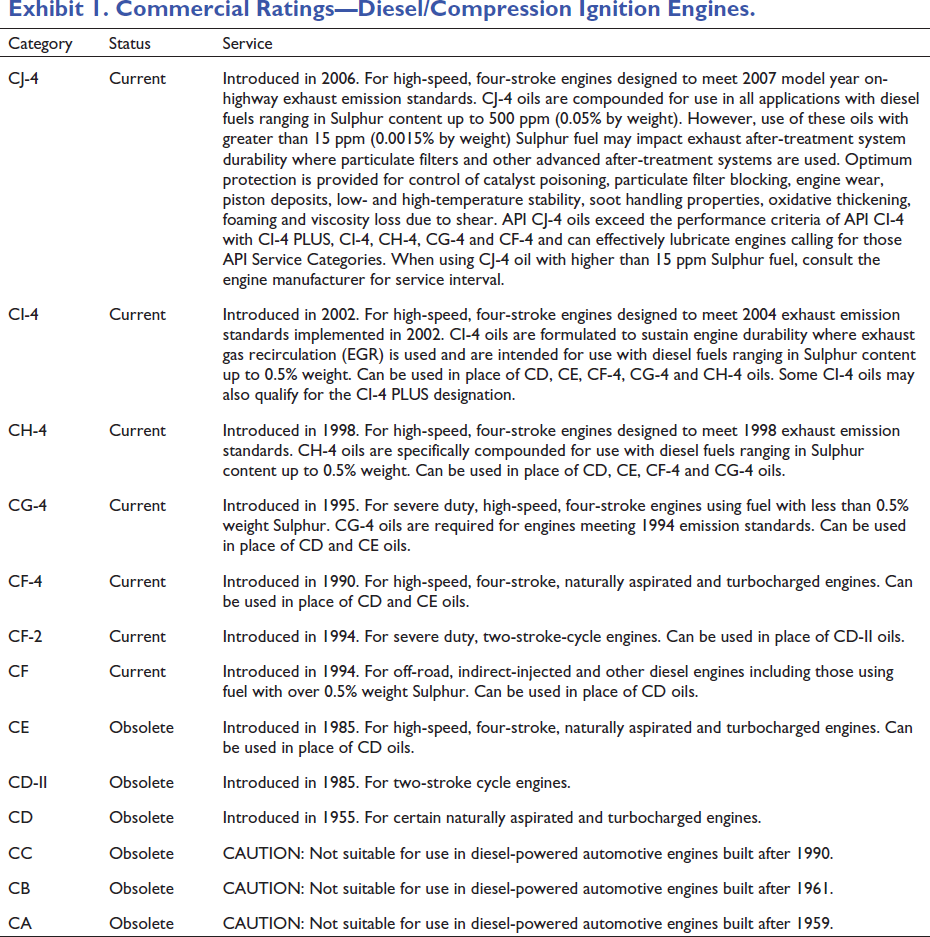
Lubricants are commercially graded based on their quality and their properties (see Exhibit 1). Lubricant oil so far was available in the market in three grades CJ, CF and CH only. Masteroil, Smooth and Erani were producing lubricant oil up to the grade of CH. The finest and highest grade, CI was not being produced by any of the players. Masteroil, Smooth and Erani neither had the adequate infrastructure nor capital to produce CI grade of lubricant oil. VT viewed the absence of the existing major players in the category of high-grade lubricants as a business opportunity. VT opined that launching a brand in high-grade lubricants segment can provide a competitive edge to Radiance.
Launching Redistar
Radiance having acquired crucial information from its vendors, Masteroil, Smooth and Erani, finally entered the business of lubricant oil in 2006. The very first product that Radiance launched was Redistar. Redistar was a premium lubricant oil of CI grade. Redistar was the first CI graded lubricant to be made available in India. As there was no other product in direct competition with Redistar, it enjoyed first mover advantage to begin with. Radiance left no stone unturned to make Redistar a huge success. Redistar was marketed quite aggressively. Marketing department was working round the clock to make the product a big hit. Huge budget was allocated for the marketing and distribution of Redistar. The company had paid handsomely to a renowned cricketer to endorse the product.
Redistar was meant for heavy-duty commercial vehicles and were technologically superior to the existing offerings in the market. The initial acceptance for the product was good. Radiance had a widespread distribution channel across the nation. One of the largest consumers of lubricants in India are truck fleet owners. The truck fleet owners possess number of trucks which runs across the country covering long distances. The fleet owner segment in India is highly scattered. It is estimated that there are roughly 800,000 roadworthy trucks and these are owned by many fleet owners spread across the length and width of India. The size of the fleet varies tremendously from small single truck owners to mammoth corporations with more than 1,000 trucks offering a wide range of services. Radiance had established good networking and customer relationship with the truck fleet owners over the years. Fleet owners being bulk buyers were given concessions and benefits. For example, truck fleet owners were issued a customer loyalty card, Fleet Card, which enabled the cashless purchase of fuel and lubes from designated retail outlets of Indian Oil through flexible prepaid and credit facilities. The Fleet card aimed at solving the needs of fleet owners/operators and offered many benefits which included an exciting rewards programme, personal accident insurance cover and vehicle tracking facilities. Each fleet owner was issued one fleet control card and vehicle-specific fleet cards for every vehicle enrolled under the programme. Backed by Radiance’s vast infrastructural network as well as service providers through its dedicated site
Radiance had launched Redistar as a premium product. Thus, it was priced heavily. The price of Redistar was much higher than the prices of lubricant oils available in the market. VT had made it clear from the very start that price of Redistar would not be compromised on any account. Thus, the preferential rates that were normally offered to fleet owners, was not extended to Redistar. The purchase of Redistar was not linked with customer loyalty card, thus it did not add to the reward points earned by the buyer. Flexibility of payment on credit was also refused in this case.
Commercial Ratings—Diesel/Compression Ignition Engines.
Three Musketeers of Ace.
Brewing Competition
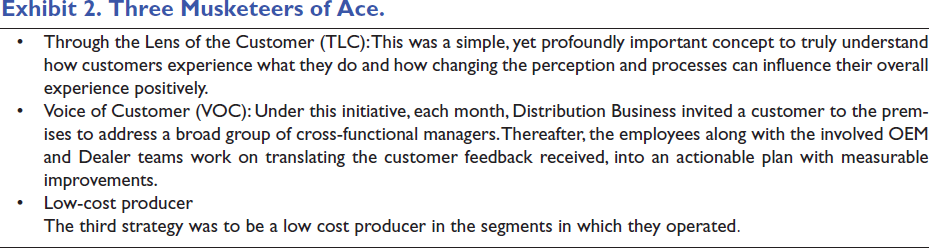
Ace was one of the leading brands of petrochemical products worldwide. In India, Ace entered as a joint venture between Manhattanland Inc., USA and Rovers Sales & Services (India) Ltd, a wholly owned subsidiary of Rovers India Ltd, one of the India’s fastest growing lubricant marketers and producers of quality branded automotive/industrial products. Products included automotive lubricants, transmission fluids, gear oils, hydraulic lubricants, automotive filters, specialty products, greases and cooling system products. Ace also offered Car Shine, car care products for automotive cleaning and maintenance. Ace has come a long way since they started out operations in India in 1998. Ace was a growing and a promising company having base of 54 stock points delivering products and services to 500 distributors for industrial trade and about 3,000 institutional customers. Customer satisfaction and customer retention has been the driving force behind Ace continual growth. The company has always been conservative in allocating budget for advertising and promotion. In 2006, Bob Andrew was appointed as CEO of Ace, India. Bob was a lively, enthusiastic and ambitious young man. He was entrusted with the responsibility of bringing a radical change in Ace, India. Bob studied the business environment in India quite well. In his very first address to his team members, his focus was on customer satisfaction. He planned an initiative called Customer Support Excellence (CSE), which inculcated in every employee the practice of placing the customer first and providing real value to the customer. To accomplish the target he formulated three-pointed programme, which he called ‘three musketeers’ (see Exhibit 2).
The Final Nail
Just after a few days of the launch of Redistar, Ace launched CI graded lubricant oil, Velocity. The first mover advantage that Redistar sought was soon challenged. Ace has not invested hugely in marketing. It focused its attention on its bulk buyers instead. Ace designed special sales promotion programme for the truck fleet owners. They were offered 5% discount. The rate of discount was increased to 10% if the payment was made in advance. In addition to this, the fleet owners were given credit period of 45 days. As a result of these strategic moves Ace was grabbing more and more market share everyday which was becoming worrisome for Redistar.
The finest grade of lubricant oil, CI, is used to be recommended for new vehicles in the first place. If used in old vehicles, vehicles start consuming more petrol. To accomplish the sales target, the salesforce of Redistar started selling it for old vehicles as well. The truckers realized that using Redistar was leading to reduction of mileage of their trucks. As a result, the truck fleet owners stopped buying it. They started avoiding Redistar even for new vehicles as they feared that it may lower the mileage. Thus, the market share of Redistar began to dwindle and they suffered a major setback.
Bad word of mouth spread like wildfire, and it ultimately resulted in withdrawal of Redistar.
Footnotes
Declaration of Conflicting Interests
The author declared no potential conflicts of interest with respect to the research, authorship and/or publication of this article.
Funding
The author received no financial support for the research, authorship and/or publication of this article.
