



Abstract
The case is based on Indore Municipal Corporation, a city government in Madhya Pradesh, India. It revolves around the challenges a city government navigated through to become the cleanest city in India in the cleanliness ranking (Swachh Sarvekshan). In 2014, the Indian government launched the Clean India Mission. The cleanliness of cities was assessed in this mission based on several metrics, and Indore was placed 25th in 2016 among 73 cities and has continued to rank first in the country in subsequent years. Waste management was a major problem for the city, and the key to waste management is waste segregation. In order to transform, Indore had to go for segregated waste collection from residential and commercial sectors. Waste segregation cannot happen without effective citizen engagement as it is the citizens who generate waste and if they collect it in a segregated manner at their end the disposal can also happen in a similar fashion. This requires mobilizing citizens towards a new habit. Mobilizing residents in a country and city with compounded diversity in literacy, education, culture, religious views and customs was a complicated undertaking that required significant investment and political resolve. Also, before involving the community, the system needs to be redesigned so that it aligns with the altered practice at the citizens’ end. Citizens need to believe that their efforts were manifesting into something fruitful for society. The Municipal Commissioner was in a dilemma as to what kind of engagement strategy would work. Would information, education and communication be enough, or it required something more and beyond. This case tries to demonstrate the specific challenges and impacts that such a campaign brings and the learnings it generates in terms of citizen engagement, institutional arrangements and mechanisms of governance to benefit most and importantly envisage how the change can be sustained for long.
Keywords
Introduction
Indore is the most populous city in Madhya Pradesh. It is a city with a population of over 2.8 million people; see Exhibit 1 for more information. Located 190 km from the state capital Bhopal and within 57 km from the nearby sacred city of Ujjain and 20 km from Dewa, the city has been facing a population influx from the surrounding areas. As the migration from the vicinity grew, Indore has become densely populated city in Central India. The population here grew at a rate of 3.18% since 2020. With this growing population the volume of municipal solid garbage grew from 750 MT/day in 2011 to 900 MT/day in 2017 and to 1,029 MT/day in recent years, so did the pressure on municipal administration to manage it sustainably. Overall, 30% of the city’s populace resides in slums making the waste management process even more cumbersome. The chemical analysis of waste generated in Indore city gave an idea about the waste mix as shown in Exhibit 2. It clearly shows that most of the waste that needs to be segregated was organic that constitutes to 65% of the total waste generated, which is mostly kitchen waste that originates at household levels. This kind of analysis was extremely useful in strategizing and focusing the city governments’ efforts in address the issue at hand said the Municipal Commissioner.
In 2014, Indore city Municipal Council and Municipal Corporation (city government) came under fire due to multiple Public Interest Litigations filed in the state high court of Madhya Pradesh for the civic body’s inability to deal with municipal solid waste, resulting in severe environmental issues and unsanitary conditions leading to public health implications. With the introduction of the Clean India Mission for cities in 2014, there was also increasing pressure from the central government on the city governments to clean Indian cities.
The Municipal Commissioner at the city government recognized that tackling municipal solid waste without waste segregation was impossible and that managing mixed garbage was an expensive attempt. The key to waste management is waste segregation at the source. Waste segregation cannot happen without effective citizen engagement as it is the citizens who generate waste and if they collect it in a segregated manner at their end the disposal can also happen in a similar fashion. This was a massive task for the city government to change the behaviour of all citizens. The Municipal Commissioner was constantly contemplating; what measures could be adopted to make it a people’s movement, what would persuade citizens to segregate waste at their premises and dispose of it in a similar fashion when the collection van arrives. Mobilizing residents is a huge task in a country which is highly diverse in terms of literacy, education, culture, religious views and customs, was a complicated and humungous task that required patience, passion, investment, political will and people’s participation. It was a complex challenge in terms of citizen engagement, as it necessitated fundamental behavioural changes at each individual household level irrespective of social and economic status. It had to be a universal change. Given this level of universality in behaviour change the government was concerned about whether this waste management project would achieve the expected results. The main question in front of the administration was how to nudge people to change their behaviour and create a citizen-led campaign for ‘waste management’.
Challenges
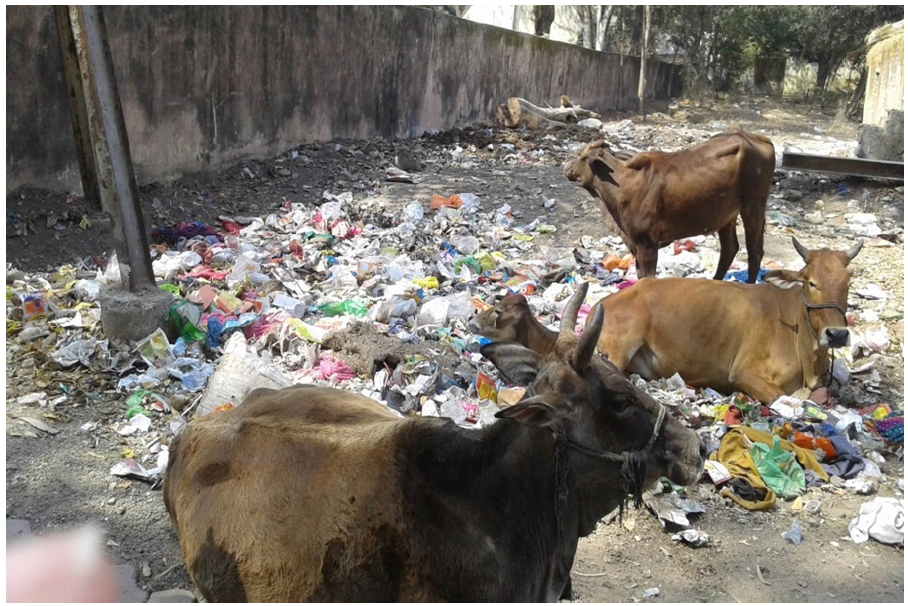
In the year 2016, solid waste was a municipal function that was poorly managed, both at the city government’s end and at the citizen’s end. There was no systematic waste collection process. A piecemeal approach to waste management was followed. Household waste was collected by corporation workers in some parts of the city, while private organizations were employed in some other parts. The waste collectors were known as ‘Jagirdars’ and their services were utterly ineffective. Most of the time citizens as well as waste collectors would dump the collected waste in open government lands or unoccupied plots, causing an eyesore for the city posing serious health and hygiene challenges. The city was cluttered with approximately 1,300 large overflowing community waste bins that were inadequately handled and maintained. These bins were used to collect litter on streets and roads, as well as by households to dispose of uncollected waste. The wastebins were frequently overflowing, and animals were feeding themselves on the waste (see Figure 1). The Jagirdars, who were also waste collectors, used to own the cows and leave them to roam around the city to feed themselves, only bringing them back during milking times. As a result, the Jagirdars had a vested interest in keeping the city filthy. The mayor brought these issues to the city government’s attention, as well as the standing committee and the state government. At the same time, the Swachh Bharat Mission was also knocking the doors of the city government. Both the executive and political wings were eager to turn this difficult position around. This kind of situation required overhauling the entire system from top to bottom. Moreover, it involved the union of sanitary workers who would oppose any change that would affect them. It was a challenging situation for the city government. Without putting the city systems in place nothing can be expected from the citizens. To initiate a mass behaviour change campaign, it is necessary that the trust of the citizens be maintained across the whole time period. If they feel that they are the only ones supposed to change and the system doesn’t operate as per the change mandate it is quite easier for them to fall back to previous habits. Moreover, they will never have the required trust for any change management campaigns. Hence one set of challenges was internal that is to change the system in place. Pertinent measures were taken by the city government to streamline the process by covering the whole of the city under door-to-door (D2D) waste collection coverage. Indore city government established scientific waste disposal processes, transfer stations were built and operated properly, and contracts with outsourced agencies were drafted with strict adherence to the contract’s terms and conditions. However, all of this would have been for naught if citizens did not properly segregate their waste. The key to waste management is segregated garbage collection, and the major stakeholders in this aspect were citizens or waste creators.
The second set of challenges was external. The Commissioner and the Mayor knew that changing the city’s image in terms of waste management would not be possible without extensive participation from the citizens. This required mass mobilization for adaptation of altered practices in waste management as far as household waste was concerned. But before engaging in behaviour change a massive transformation was required in the system and processes. The citizen participation ladder (Arnstein,1969), which depicts the degrees of engagement indicates that for such a widespread change to happen higher-order participation of partnership and citizen control is required to achieving the desired outcomes, see Exhibit 3 for more information.
Partnership of the Executive and Legislative Wing of City Government in Indore
Cities in India are governed by both an elected and an executive branch. The Municipal Commissioner of the corporation is appointed by the state government, while the mayor is an elected entity. The Mayor of Indore was elected indirectly by the municipal councillors in 2015. Any transformation programme to be successful in Indian cities had to be driven by process and engagement. Designing a systems process is relatively simple but getting to know people’s pulses and encouraging them to adapt to a change in behaviour to align with the process of change is a complex task. Both the Municipal Commissioner and the mayor were puzzled as to how to go about mobilizing a large number of people to change their attitudes and behaviours regarding waste, particularly waste segregation. The political wing was in full support of designing interventions to nudge citizens towards the new set of expectations. This was realized by approving the bylaws for segregated waste collection along with penalties for non-observers. Various factions of the community would object to the different campaigns and enforcement drives carried out by the city government. Without support from the political wing, the executive machinery cannot perform at its best given the federal structure of urban governance in India. At the executive end also the corporation’s solid waste management (SWM) department had a highly fragmented organizational structure, including many outsourced agencies to operate the SWM process. The city government needed support from civil society organizations to help with this tremendous undertaking, in addition to overhauling the entire department from within. However, being aware of these challenges with the partnership of the executive and legislative wing, the decision to move forward with waste management was made, but a big question was looming ‘Would such a change be achievable with a diverse group of citizen base of differing ages, educational backgrounds, cultures, and religious beliefs’? One of the most difficult issues the city had, was getting such a diverse population to agree on common behavioural norms.
System Design
The system as mentioned above was highly fragmented. The agenda designed by the city government was to make the city bin free, litter free and dust free. This not only required mass mobilization for adaptation of altered practices in waste management but also system change right from capacity building of staff, designing of process, procuring materials and infrastructure development. The first step that the city government took under the leadership of the commissioner was to set the house in order in terms of staff availability, demand assessment, route rationalization, resource allocation and monitoring. The staff attendance was brought under control by introducing on-site biometric attendance. The sanitation workers were supposed to mark their attendance on site by way of a biometric system to ensure their availability. Each worker was assigned a beat (a stretch of road) to do the regular sweeping and the workers in the ward were kept under the supervision of a supervisor who also controlled attendance and site presence. The salary was linked with attendance and was deposited directly in the bank accounts of the sanitary workers so that there is a minimum level of manipulation and role of intermediaries like sanitary labour unions. There were around 8,000 workers who were being paid previously but hardly there was a 30% presence on the field which led to improper cleaning and unhygienic streets and roads. The second aspect is D2D collection coverage. The citizens were mandated initially to give their waste to the collection vans and not dump it in the community bins. With the D2D collection process, the community bins were removed in a phased manner. There were around 1,300 community bins in the city.
Overflowing Community Bins with Animals Feeding on Waste.
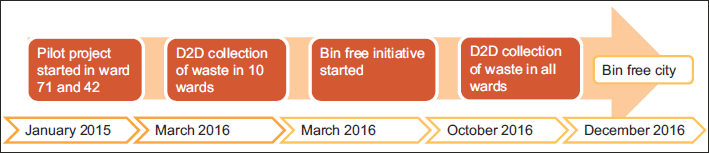
To make the D2D collection process smooth the city government conducted a pilot in two wards to ascertain the demand for resource allocation. Route maps were designed for efficient movement and timely pick up of waste. It was experimented in the pilot wards. The results were encouraging, and the government deployed more vans than cycle rickshaws for waste collection to minimize time and manpower for collection and at the same time increase the coverage in each trip. From two wards the D2D system was escalated to 10 wards and then the whole city with 85 wards covering an area of 525 sq. km and a population of 35 lakhs (urban agglomeration) as per census 2011 (see Figure 2).
Scaling up Bin Free Initiative in Indore.
To create an effective waste collection and disposal system, scientific mechanisms were identified and implemented. An appropriate number of new transfer stations were constructed, and the contracts were entered with outsourced agencies regarding waste disposal, which was drawn out with strict enforcement of the terms and conditions to achieve better outcomes. The city government ensured that the system was designed and adhered in a manner with minimal to no failure to close the service delivery to ensure that the citizens trust the system. The city government was quite sure about this, unlike previous times when the actions were different than the promises, which left the citizens confused and puzzled.
Civic Engagement and Behavioural Change
The emphasis on source segregation and collection, doorstep collection services, compost recycling and 18 other value-added materials around recycled waste was based on a partnership model in which the city government collaborated with Civil Society Organizations (non-governmental organizations—NGOs and private consultant firms) as well as citizen groups such as residential associations, market associations, religious leaders, self-help groups and so on. The horizontal and vertical integration of each of their tasks and responsibilities formed the foundation of the tripartite partnership concept. Municipal staff, media, socio-economic groupings, economically poorer areas, youth and school children and educational institutions were all a part of a variety of information, education and communication (IEC) programmes. IEC actions aimed at three levels of change: raising awareness (conscientization), assessing the acceptability of new norms (internalization) and finally adopting them (new behaviour). Individuals, communities and large groups of people adopted new behaviour patterns as a result of these factors.
A number of initiatives were taken, such as D2D awareness generation by NGO employees and regular citizen feedback on services, the nomination of Radio Jockeys as Brand Ambassadors for IEC mass outreach regular play of Brand Ambassador singer Shaan’s Indori Swachhata Song and its periodic updating, accommodation of grassroots technological innovations, formation of Dabba Gang and Wanar Sena (monkey army comprising of children) to check open defecation. Use of cultural events to spread awareness, the inclusion of younger generation, particularly students and children, the introduction of systems that allow citizens to reach out to the city government, creation of links between waste generators with waste processors and users, verification of progress and complaints through 311 app and other means. All of these represent lesser levels of participation, mostly at the information stage, which is also relevant in behavioural interventions. Its purpose was to inform citizens about what was expected of them.
The city government’s key concern was to turn expectations into action. There were various levels of intervention beginning in 2016 when the city launched a pilot project of waste segregation at source and D2D collection from two wards. The absenteeism of sanitation workers was a big challenge that required attention of the commissioner. So, he began by dividing the task of sanitation workers into wards and then further subdivided into beats spanning 500–800 sq. m, which were administered by a single sweeper known as a ‘Safai Mitra’. To assure garbage collectors’ presence on the field, on-site biometric attendance was implemented. Before engaging the citizens, it was critical that the SWM system be in place so that residents could see the results and build trust that their efforts have visible outcomes and were not in vain.
Indore city government designed a reward and punishment system to improve waste management system efficiency and establish accountability among corporation staff members participating at the grass-roots level, which is crucial for the success and sustainability of this cleanliness program. Once the systems, processes and infrastructure were in place, the massive effort of influencing and educating citizens began.
The city began the citizen connect exercise with the support of NGOs to build a bridge between expectation and action. Social volunteers were recruited and attached to the tipper vans to move across the wards during collection times. These social volunteers played a big role in handholding and educating the citizens on the spot about segregation. Their main role was to ensure that only segregated waste gets into the collection van. If the social volunteer fails to convince any household, then they can bring in the assistant health officer and ward councillor to initiate enforcement mechanisms. It turned out to be a success though it’s a high-budget item in the city’s municipal account. Even today the social volunteers accompany the tipper vans and ensure that the D2D collection happens on time in an expected manner. They are control agents on the field. This strategy of social volunteers acted as a key point for behaviour change. A massive change campaign was launched, which planned a combination of enforcement and citizen handholding. Through socio-economic profiling, the city was separated into target groups: areas with high, medium and low incomes, youth and school children, commercial institutions, religious places and educational institutions. The city administration used a strategic approach to citizen involvement by utilizing all points and means of interaction with various sources such as street plays, posters, radio talks, ads (both print and electronic), youth conventions, religious places, school advertisements and so on. The usage of public relations campaigns, such as filmmaking, videos, jingles, bulk SMS, WhatsApp, wall writings, wall paintings, hoardings, talk shows, bus panels, commercials and so on, made a big difference in reaching and educating people. These were all strategic measures aimed at raising knowledge regarding waste segregation, its necessity, and the process.
The social volunteers proved to be facilitators for attention, retention, reproduction and motivation. In Indore, the city government’s team used a combination of models, including a live model, a symbolic model and a verbal instructional model, to teach locals about waste segregation. The live approach was used in the street performances, where the artists showed trash separation, but the symbolic model saw the city deploy a large number of posters and print media to raise awareness. The city government employed model radio jockeys to teach people about different forms of waste and how to separate and store them for disposal in a verbal instructional model. These were really powerful learning tools. However, as previously said, learning does not always translate into behaviour change, thus the challenge continued for the city government. People were aware of the new initiative of waste segregation, but they made few efforts to translate it into behaviour. Due to the extensive IEBCC campaign over a lengthy period of time, segregation messages received adequate exposure. In order to reproduce and motivate people to change, proper incentives and disincentives had to be institutionalized. Creating an incentive for a big population was a time-consuming process that could result in unforeseen consequences. As a result, the government deployed suitable levies, penalties and fines for people who litter in public spaces and do not segregate at home such measures ensured that people are motivated enough to put what they learned into practice and translate it into behaviour. Overall, it can be said that a graduation approach to behavioural change was adopted by the city government to bring this massive transformation at the grass-root level.
Closing the Loop
Making cleanliness a sense of pride allowed the city government to engage individuals in this campaign while incorporating a behaviour change to ensure their efforts were sustained. The city government recognized that creating a transparent process and building the trust of citizens in the city government is a prime task to take citizen participation to the next level. Citizens must see tangible results of their efforts to continue sustaining them. This action created a level of sincerity for the citizens to trust the system and work towards change. Creating on-ground engagement by the city government officials also helped citizens take the cause seriously. The Municipal Commissioner could be seen in the field interacting with Safai Karamcharis, citizens and councillors. This reflected the seriousness and intentions of the city government. Visible changes and faster response time to issues with the complaint’s app helped the citizens to trust the cause. A complete service delivery loop from the system’s end resulted in trust and satisfaction. People have started owning the city. Every person became a responsible citizen, understanding their civic responsibility to keep their cities as clean as their own homes.
At the management level, the city government understood the change could not occur over time, thereby implemented the process step by step first through D2D collection and then educating and enforcing segregation therefore, they could tackle one scenario at a time. The city government involved various stakeholders including their officials through training, building their capacity, facilitating them with required assistance, and equipment, and creating a system of accountability by introducing effective monitoring mechanisms like biometric for attendance four times in a day for Safai Karamcharis. The officials at the ward level have been given yellow enforcement vehicles and walkie-talkies to connect to other officials for any issue that has been raised. All officials, including the Municipal Commissioner, were connected with the walkie-talkies. This gives a sense of accountability to officials and promotes responsible behaviour among them as they feel superiors are engaged proactively in the system.
Cleanest City of India
After a year of hard work, Indore was named India’s cleanest city in 2017. The city climbed the rankings rising from 25th in 2016 to first place in 2017 under the Clean India Ranking. The city government was successful in making the city a bin-free place. There were no community bins on city streets or anywhere else. Waste was properly disposed of in the collection vans allotted for residential and commercial households. The household waste collection was provided with maximum coverage for D2D collection. People had begun to separate waste into wet and dry waste. The collection vans arrived at each doorstep at the allotted time and collected segregated waste in the collection vans’ divided chambers. People had begun to use segregation as a practice. The social volunteers hired by the city government used to be on the field along with the collection vans. They provided on-the-spot training to people who were not properly segregating their waste. Training interventions that occurred at the time of action resulted in a higher rate of adoption. People could see that their efforts had resulted in the city being ranked first in the Cleanliness ranking, which inspired residents to continue supporting the municipal administration in its efforts to keep the city cleaner and more habitable. Even after on-the-spot training, there were certain non-confirming elements who refused to segregate waste. They simply refused to collaborate with the city government’s expectations. The city administration began an enforcement campaign for such citizens, in which they refused to collect waste from households that did not segregate their waste. Those households were also inspected to identify any illegal disposal of non-collected waste in the city so that monetary penalties might be imposed on them. This type of micro-level enforcement drive aided in improving adherence to the practice and motivating people to engage in the behaviour on a regular basis.
Swachh Survekshan Tool
The clean India ranking tool (Swachh Survekshan) is an evolving tool that continuously adds newer components in the ranking to keep the city initiatives towards the Swachh Bharat Mission agile. That is also one of the drawbacks for Indian cities that are not much equipped to handle the shifting focus (see Exhibit 3) of ranking tools announced every year. It’s an annual exercise that started in 2016 and covers just 73 cities and now has become a massive exercise for the Ministry of Housing and Urban Affairs by expanding the assessment to more than 4,000 cities in India. The ranking tool broadly covers four components, namely, Service level progress, Certifications, Direct Observations and Citizen Feedback. The weightages of these components along with the internal weightages of sub-components under each major component keep changing as per the change in the focus of Survekshan. The total ranking score started from 2,000 marks in 2016 from 4,000 marks in 2018 to 5,000 marks in 2019 to a stabilized score of 6,000 in 2020. It’s out of these maximum scores that the cities are evaluated in each component and Indore has kept its number one position since 2017 which is an exemplary task keeping in mind the changing focus, weightage and newer initiatives added to the ranking.
Conclusion
The city government understood that the prerequisite for any large transformation process involving citizens is to create an efficient system. It made a significant investment in streamlining the SWM processes and systems in the city. Major expenditures were also made in the development of infrastructure, processes and backend operations to coincide with the changed behaviour required to achieve the goal of a clean city. Further to which they ventured into building IEBCC for individuals to follow a variety of behaviours, including waste segregation, in order for Indore to be judged as the cleanest city of India. It is important to note that in the case of public service, the systems should be designed in such a way that they accept the desired behaviour of the people. Failure to complete the service delivery loop from the systems end would have resulted in distrust and unhappiness, and citizens would have felt deceived despite their efforts to adjust to this changing behaviour. This necessitates strict monitoring, discipline and compliance in order to sustain the change. Maintaining the status of citizen motivation in a city service such as SWM is extremely difficult more so in the context of waste as it is an ever-occurring activity. All productive actions produce waste, so it was extremely challenging to sustain what was started. The city government did manage to initiate change but was facing major dilemmas prominent being ‘What are the efforts needed to sustain this change? How challenging it will be for city government to continue with this status of desired changes in public behaviour?’
Questions for Discussion
How long do you think the IEC campaign, monitoring for compliances and enforcement drive will continue to make the change in behaviour from temporary to permanent as these kinds of campaign demand much investment?
Do you think this is a temporary status and once the push is over the city would bounce back to the status before the change? Individuals find it easy to revert to comfortable behaviour.
How important is system change and performance in the light of city service where the role of citizens is of prime importance?
How do you think that the city government took the IEC and BCC champaign in terms of citizen engagement to a level of citizen control as per the citizen participation ladder?
Footnotes
Annexures
Declaration of Conflicting Interests
The authors declared no potential conflicts of interest with respect to the research, authorship and/or publication of this article.
Funding
The authors received no financial support for the research, authorship and/or publication of this article.
