




Abstract
The case study titled ‘Carbon is the new black: A case of EKI Energy Services Limited’ showcases the phenomenal growth achieved by a young startup based in Indore promoted by a visionary entrepreneur Mr Manish Kumar Dabkara who had a vision and foresightedness to enter the Carbon Credit Market when no big player in the country was leaping in this field. The case study chronicles how EKI Energy Services Limited created a space for itself and has become a name to reckon within the Carbon Credit Market. The case study emphasizes the Initial Public Offer of EKI Energy Services and how it created a buzz in the stock market when its share price skyrocketed. The study also throws light on the international agreements on Carbon Credit trading mechanisms under the aegis of the United Nations viz. Kyoto Protocol and the Paris Convention. Further, the case study discusses opportunities and challenges, which lie ahead of EKI Energy Services Limited in the Carbon Credit Market.
Introduction
Over the last few decades, climatic change has emerged as an alarming issue. Climate change is negatively impacting people’s life and health. It endangers the vital constituents of adequate health—good air, secure drinking water and shelter, and carries the power to weaken the years of advancement in global health. Climate change is already impacting health in a myriad of ways. Every time an organization uses a resource that relies on burning fossil fuel, it creates carbon emissions. When these emissions enter the atmosphere, they bring change in climate by confining heat, and cause respiratory disease from air pollution. Reducing emissions is challenging, something that does not take place overnight, and with the present system of energy & land use, preventing any carbon oxide emission is not currently possible for most organizations.
EKI Energy Services Limited: The Journey so Far
To help businesses and organizations to attain their climate goal by reducing emissions, Mr Manish Kumar Dabkara dreamed to set up a pioneering company contributing well-thought solutions with its objective to revitalize the Earth to low carbon and climate-durable global economy. Using natural energy without harming nature was thought towards aligning the future with global growth. He was a MTech in Energy Management from prestigious School of Energy and Environmental Studies, DAVV Indore. He was certified energy auditor and certified energy manager from Bureau of Energy Efficiency, Ministry of Power. In a view of doing a business of a kind that contributes to society and serves as a beneficiary to the environment, EKI was instituted in the year 2008. EKI today has been proposed as an enriched and dependable brand offering strategic solutions to organizations to attain their climatic objectives. The organization has surfaced as India’s sizeable Carbon Asset Management Company and is in the domain of climate change, carbon credits and sustainability solutions. With an all-embracing presence globally, EKI has made the trade of carbon credit effortless and has shown remarkable performance in sustaining the global environment.
The Initiative of the United Nations
The Kyoto Protocol
The United Nations, the world’s only truly universal global organization, has taken cognizance of these gases, which are endangering the planet. As its initiative, on 11 December 1997, the Kyoto Protocol was embraced at the third conference of the party to the treaty and commenced in the year 2005 on 16 February owing to the complex ratification process. This protocol was a set of rules for the International Framework Convention on climate change to reduce greenhouse gases (GHGs) that cause climatic changes. At present, there are 192 Parties to the Kyoto Protocol. In August 2002, India signed and ratified the protocol. The United Nations Framework Convention on Climate Change was operationalized under the Kyoto protocol by committing industrialized countries and economies in transition to restrict and reduce GHG emissions in line with clear individual goals. This protocol defines the legally mandatory goals and schedules for lowering GHG emissions of industrialized nations that authorized the Kyoto Protocol.
Flexible mechanisms were incorporated under this protocol, which set aside the developed nations to meet their GHG emission ceiling by purchasing GHG emission reductions from elsewhere; this process stands out as a Carbon Offsetting Mechanism. Although carbon offsets are often presented as emissions reductions, they do not reduce emissions (Reyes & Gilbertson, 2009). These can be obtained either from projects that reduce emissions in developing nations in the Clean Development Mechanism (CDM) or the Joint Implementation scheme (JI) or under International Emission trading as of developed nations with excess allowances. As per Article 12 of the Kyoto Protocol, the CDM permits emission-reduction (or emission removal) projects in emerging countries to gain certified emission reduction (CER) credits. One CER equals one tonne of carbon dioxide. Industrialized countries trade and make use of these CERs in a way to meet up a part of their emission reduction goals in the Kyoto Protocol. Parties that have shown commitments have agreed to limit or reduce emissions to 5% below 1990 levels between 2008 and 2012 under the Kyoto Protocol (Annex B Parties). These levels were expressed as levels of allowed emissions, or assigned amounts, at around the 2008–2012 commitment period. Further, from 2013 to 2020, the commitment period was extended in Doha Amendment to the Kyoto Protocol on 8 December 2012. The amendment was put in force on 31 December 2020. Countries that have emission units to spare (emissions permitted to them but not ‘used’) were allowed under Article 17 of the Kyoto Protocol to sell this excess capacity to countries that are over their targets. Thus, a new commodity was created in the form of emission reductions or removals. It is known simply as trading in carbon, as carbon dioxide is the principal GHG. Carbon is traded like any other commodity. This is known as the ‘carbon market’. Carbon Trading started in 1997 when some 180 countries signed the Kyoto Protocol. However, the United States pulled out of the Kyoto Protocol in 2001 and other countries also followed later.
As part of its strategy to meet the 5% comprehensive GHG emission reduction target, the Kyoto Protocol created four types of carbon credits. A carbon credit is a certificate that provides a holder with the right to emit the equivalent of one metric ton of carbon dioxide or any other equivalent GHG. When a credit is sold, the buyer is purchasing the seller’s allowance of emissions (United Nations Climate Change, 2019).
The four types of carbon credit are Assigned amount units (AAU) issued by an Annex I Developed Country Party; A Removal Unit (RMU) issued by an Annex I Party based on land use, land-use change and forestry (LULUCF) activities; An Emission Reduction Unit (ERU) generated by a joint implementation project; and A CER was generated from a clean development mechanism project activity under Kyoto Protocol.
Transfers and acquisitions of these units have been tracked and recorded through the registry systems under the Kyoto Protocol. The largest emissions trading market in the world is the EU Emissions Trading Scheme, established in 2005 whereby some 12,000+ power stations and manufacturing plants trade carbon credits (EU Allowances or EUAs) to meet their emission reduction goals (United Nations Climate Change, 2000).
Paris Agreement
To deal with climate change and its negative impacts, the Paris Agreement was accepted in the year 2016 as a landmark environmental arrangement. In 2016, India also ratified this agreement. The agreement aimed to considerably minimize the global GHG emissions to lessen the global temperature rise in this century to 2°C beyond pre-industrial levels through following ways to limit the rise to 1.5°. Commitments from all major emitting countries to cut their climate-altering pollution and to strengthen those commitments over time were included in this agreement. The settlement gives a way for developed nations to help developing nations in their climate relief and change efforts. Additionally, a framework was created for the transparent monitoring, reporting and racketing up of countries’ individual and collective climate goals. Contrasting the Kyoto Protocol, which created legitimate binding emissions reduction goals (also punishments for denial) for only developed nations, the Paris Agreement entails that all countries do their part and reduce GHG emissions. Under Paris Agreement, no language is integrated on the commitments countries should make, nations can willingly set their emissions goals, and countries suffer no consequences for falling short of their proposed goals (EKI Energy Services Limited, 2021a).
In 2011, the Chairman and Managing Director of EKI Energy Services Ltd., Mr Manish Kumar Dabkara, along with his team begin an assignment which had sight about net zero carbon and climate adaptable global economy. EKI Energy strives towards fabricating a fit balance uniting environment and human life along with presenting carbon sustainability consulting services. Undertaking numerous projects worldwide, and operating with leading brands and leaders around the world, the organization is dedicated to constructing future in a good shape to live in.
EKI Few Offerings
Carbon Offset Standards
Clean Development Mechanism (CDM)
Voluntary Carbon Standards (VCS
Airport Carbon Accreditation
Renewable Energy Attributes
Carbon Footprinting & Neutrality
Purview of EKI
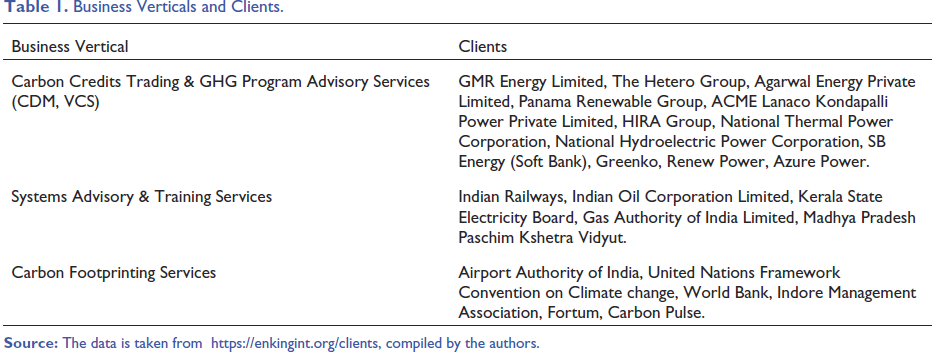
EKI Energy Services serves both government and private entities in the areas of waste management, power generation and clean development system at airports. It has a global presence serving Australia, the USA, Germany, Europe and over 20 nations, etc. EKI offers end-to-end services for carbon offset and has been providing prompt, efficient and quality-oriented services consistently to over 2,000 clients globally. The organization works with the clients to provide clarity on climate-related issues and produce both profitable and sustainable outcomes for them (see Table 1).
Business Verticals and Clients.
The Initial Public Offering (IPO) and Financials of EKI
Mr Manish Kumar Dabkara decided to expand company’s operation both within and outside India, and to finance a part of its working capital, he decided to raise funds from market (EKI Energy Services Limited, 2021b). EKI Energy Services Ltd taped the capital market in March 2021 through its IPO. The company raised ₹18.62 crores by issuing 1,824,000 shares of ₹10 each. The fixed price band offered to the investors was ₹100 to 102 with a lot size of 1,200 shares. The shares were finally issued at ₹102 per share to investors and got listed on the SME Platform of the Bombay Stock Exchange.
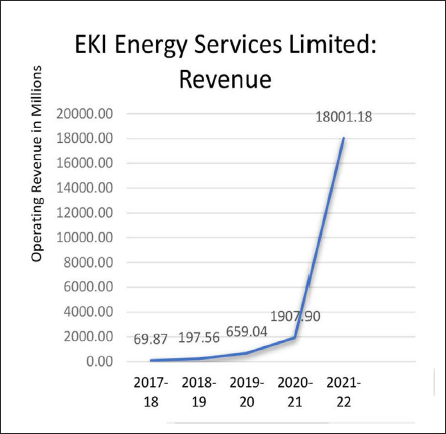
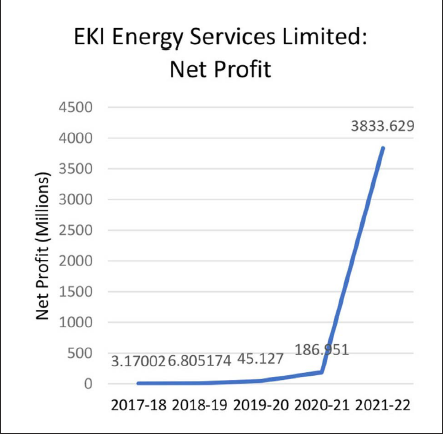
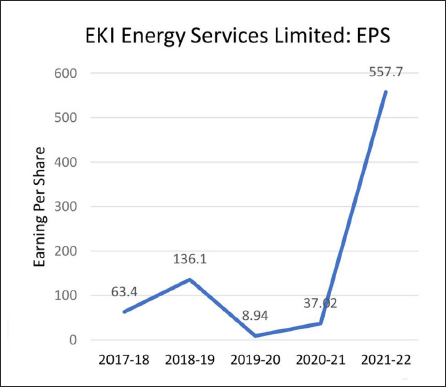
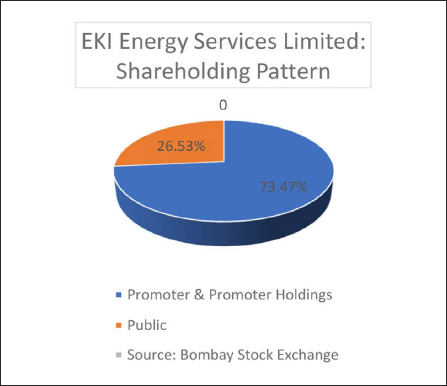
In one year, shares of EKI Energy Services touched the 8,000 mark and surged to its 52-week /high of 12,599 on 24 January 2022. The stock was trading in the range of 7,250–7,500 as of 1 July 2022, giving approximately a 7,000% return on the issue price. On 4 July 2022, the company declared the bonus shares of 3:1 to the shareholders. The stellar performance of the company’s stock was in line with the sound financial health and growth of the company. Its annual growth in total revenue was a massive 843%, operating profit margin grew by 28.68% and net profit margin grew by 21.29% year-on-year basis in FY 2021–2022. The company reported total revenue of ₹1,907.90 million in FY 2020–2021 and ₹18,001.8 million in FY 2021–2022, indicating that the business of the company had grown by almost 9.43 times year on year (see Figure 1). The company reported a net profit of ₹3,833.63 million in FY 2021–2022, almost 21 times the jump from ₹186.95 million of net profit in FY 2020–2021 (see Figure 2). The company reported a diluted EPS of ₹557.70 in FY 2021–2022 (see Figure 3). The company in its quarterly presentation report to investors reported an ROE of 176.5% and ROCE of 236.7% on annual basis in FY 2021–2022. The company had reduced its debt liabilities to 0.8 crores and strives to become almost a debt-free company as of March 2022. The shares of the company have gained exponentially on BSE and the market cap rose to 50,936.3 million as of 1 July 2022. The promoter and promoter group holding in the company was 73.47 and public holding stood at 26.53%, which includes stake holding of Foreign Institution Investors, Domestic Institution Investors and the public as of July 2022 (see Figure 4). In its annual report 2021, the company declared that 99.5% of its revenue came from its vertical of climate change and sustainability advisory and carbon offsetting and the remaining from business excellence and advisory services and electrical safety audits.
Factors Behind EKI’s Growth
Multiple factors contributed to the phenomenal growth of EKI Energy Services Ltd. The carbon credit market was at its peak from 2005 to 2011 and then it started to shrink when then US President Donald Trump withdrew from Paris Agreement on climate change mitigation citing reasons that these agreements were not in the interest of US Business and the economy. The carbon credit market witnessed its low phase during 2012–2013 to 2019–2020. In 2017, Joe Biden took the charge as US President, and he revoked the Donald Trump decision in 2021 and decided that the United States would remain committed to the Paris Agreement climate risk mitigation target. It triggered organizations across the globe to pledge to climate goals and aim to become net zero emission companies. The voluntary market for carbon credits picked up and resulted in an increase in carbon credit prices in International Market. The increased demand and prices of carbon credit had a favourable impact on the top-line and bottom-line revenue of EKI Energy Services Limited (Jaykumar, 2021; Prasad, 2021).
Mr Manish Kumar Dabkara and his team got a breakthrough when Shell Overseas Investment planned to form a joint venture with EKI Energy Services, a much-needed push required for climate actions in India. In 2021, he formally launched a joint venture with Shell Overseas investment BV (a unit of oil major Royal Dutch Shell Plc) to set up Amrut Nature Solution Private Limited for carbon emission reduction through nature-based solutions (Gupta, 2022a). EKI Energy Services Ltd holds 51% and Shell Overseas Investment BV holds 49% stake in the joint venture. The joint venture would invest $1.6 billion over five years in the restoration and protection of the forest, the adaptation of sustainable agricultural practices, the adaptation of organic farming practices, development of coral reefs, Seagroves, urban green spaces, cultivation of bamboos and projects by farmer’s organization. The joint venture would work on the conservation, enhancement and restoration of natural ecosystems such as the forest, agriculture and wetlands. These projects aimed to reduce climate risks and protect biodiversity. The projects would be implemented on ground level first and then would be developed as carbon credit projects. The projects would be registered under the international GHGs mitigation programme. Carbon credit registration would be done by the joint venture. These nature-based solutions would lead to the generation of carbon credit for the international or compliant carbon market. The carbon credits would be sold to companies in India trying to become net zero emission companies. Shell also intends to become a net zero emission energy business by 2050. The joint venture could be a game changer for EKI Energy Services Limited for increasing its share in the carbon credit market and its trading, as the joint venture had a target to generate 115 million carbon credits which could be sold and traded in the market.
Mr Manish Kumar Dabkara planned to expand its presence in the global carbon market and grab business opportunities in overseas countries. He floated a subsidiary EnKing International (
Green Cooking Initiative: A Way Forward
A substantial portion of the revenue of EKI Energy Services was derived from carbon credit trading. Therefore, it was necessary for Mr Manish Kumar Dabkara and his team to implement a backward integration strategy, which not only ensure the supply of carbon credits for trading but also achieve the sustainable goals of the United Nations (Economic Times, 2022). He started a green cooking initiative in line with the sustainable development goals of the United Nations. A new company named GHG Reduction Technologies Private Limited was incorporated in 2018 in which EKI Energy Services Ltd holds a 49.5% stake and the remaining stake was with corporate and individual investors. In this new venture, a manufacturing facility was set up at Nashik (Maharashtra) for manufacturing 3 million improved metal cook store per year. This manufacturing facility was set up on 9,000 square feet currently manufacturing 0.1 million cook stoves per month, since April 2022. The company intends to increase production gradually. Under this initiative, improved metal cook stoves would be supplied to rural households globally under the brand name ‘Agneeks’ as efficient cooking stoves. Agneeks cook stoves would replace traditional and inefficient mud stores across rural households. The stoves are 30% more efficient, a healthier and safer option for women, would reduce consumption of firewood as fuel by 45–55% and prevent up to 4,000 kilograms of carbon dioxide emission per year. The reduction in GHG (carbon footprint) would generate carbon credits for the company. The company in the first phase would manage the manufacturing and distribution of cook stoves, and then in the second phase, it would manage the generation and supply of carbon credits to companies globally. This new green cooking initiative would manage the backward integration of the carbon credit supply chain to EKI Energy Services Limited. It would help EKI Energy Services Limited to have a leadership position in the carbon credit market (Economic Times, 2022). The company had lined up other future projects such as safe and clean water/light emitting diode (LED) implementation for community development for the carbon credit supply chain. These strategic decisions not only would help the company to ensure the supply chain of carbon credit but also ensure the community’s wellbeing through employment creation, savings in health costs and enhancement of indoor air quality inside homes.
Snippet: The Rise of EKI Energy Services
The Paris Agreement sets a stage for the voluntary carbon markets.
The USA showed commitment towards the Paris agreement and accepted to achieve the carbon emission targets. This triggered the large corporationand led to explosive demand for carbon credits (Gangarde, 2022).
Due to a dearth of competitors in this industry that facilitates the trading and consulting of carbon credits, EKI was able to establish itself and start offering complete end-to-end solutions to the carbon market’s dealers. EKI Energy Services had an unexpected windfall and took advantage of the situation.
EKI Energy Services Ltd. Bags contract as carbon credit service provider from Indore Smart City Development Ltd (PV Magazine, 2022).
Opportunities for EKI Energy Services Limited
Purchasing carbon credits is one way for companies worldwide to address emissions they are unable to eliminate. McKinsey estimates that the voluntary market for carbon credits has grown significantly in recent years. The market size in 2030 could be between $5 billion and $30 billion at the low end and more than $50 billion at the high end depending upon different price scenarios and underlying factors. McKinsey estimates that demand for carbon credits could increase by a factor of 15 or more by 2030 and by a factor of up to 100 by 2050 (Blaufelder et al., 2021).
The carbon credit market in India is set for accelerated growth, especially with the commitment made at the COP 26 climate action summit to achieve ‘net zero’ emissions by 2070. The government is pushing for a uniform carbon trading market through policy changes and legislation. According to Refinitiv, a data analytics company, the value of traded global markets for carbon dioxide permits increased by 164% last year to a record €760 billion ($851 billion). The voluntary carbon markets touched a record high of S$1 billion in 2021. In India, carbon is expected to touch $100 billion by 2030 (Nordeng, 2022).
India is the largest exporter of carbon credits, and the government is considering changes in legislation for implementing a carbon trading scheme that will subsume the present tradable certificates. In March 2022, the Ministry of Environment, Forest and Climate Change (MOEFCC) advised the Bureau of Energy Efficiency (BEE) to develop a carbon trading scheme for the energy sector by broadening the scope of the existing energy-saving trading mechanism (Kumar, 2022). The Indian Parliament-The Lok Sabha passed the Energy Conservation (Amendment) Bill, 2022 on 08 August 2022, which provides for the establishment of carbon credit markets and brings large residential buildings under the energy conservation regime (The Hindu, 2022).
Risk Factors
Despite having tremendous opportunity, EKI Energy Services Limited was prone to certain key risk factors in the carbon credit business. There was no sound regulation for the carbon credit market. International carbon markets are complicated to regulate without a proper global legal framework. Many countries have different views and positions on GHG norms (Kyoto Protocol) and hence on the carbon market. The company had operations in various countries and is exposed to operational and financial risk due to the weak or non-existence regulations for trading and transfer of carbon credits and disclosure norms. As of now, carbon credits are traded in two kinds of markets, one is a voluntary market, and the other is a compulsory market. In a compulsory market, the country has set certain guidelines, whereas in a voluntary market, there are no such guidelines. India as of now comes in the voluntary market. In India, the government has planned to introduce guidelines and a platform for carbon credit trading (Singh, 2021). Whenever any regulation is made and implemented in any country, there has been a possibility that it may not be in favour of the business or that any change in regulations of carbon markets and trading rules may hurt the company’s operations and financial position.
Another risk for the business of EKI Energy Services Limited was the lack of demand for their services from organizations, especially in the voluntary market. Developing countries such as India and China were exempted from binding agreement requirements of the Kyoto protocol, as they were not the biggest contributors to GHG emissions. However, in absence of binding targets, organizations of these countries are not mandated to reduce or neutralize emissions. If the necessary legislation is not in place or there is insufficient information to move towards voluntary carbon neutrality, customer demand may be impacted and business operations may be slowed down.
The company is exposed to one more risk. There is a possibility of a drop in the prices of carbon credit in the market due to changes in carbon credit market dynamics, which may affect the revenues of EKI Energy Services Limited. Carbon pricing is dependent on the supply and demand of carbon credits. Organizations are investing in renewable energy projects in developing countries, which will generate carbon credit and will lead to an increase in the supply of it to developed countries. An increase in supply will reduce the price of carbon credit, which will affect the operating margins of the company. The carbon credit market has significant price volatility, and any unfavourable movement in the price of carbon credit would lead to a drop in the operating margins of the company.
EKI Energy Services Ltd is exposed to counterparty default risk. The company has been trading in carbon credit exposures to counterparties. A substantial portion of the revenue of EKI Energy Services comes from carbon credit trading; however, there is a considerable risk involved in it. Any default or fraud by the counterparty may affect the operations and financial conditions of the company.
The market had witnessed fluctuations in foreign exchange rates. The business of carbon credit trading of EKI Energy Services Limited involves transactions in foreign currencies such as US Dollars, GBP, Euro or Australian Dollars. Any depreciation in Indian Rupees visa vis these currencies would make import of the company expensive and would affect the profitability. On the other hand, appreciation in Indian Rupees visa vis these foreign currencies would lead to lower sales realization on exports, and it affects the sales and profitability of the company. EKI Energy Services Limited is exposed to foreign exchange risk.
If the company failed to get repeat orders from existing clients and bring new clients on board, then it may lead to a business risk for the company. This may affect the operational business and financial condition of the company. Other factors also like fraud or error by employees or third-party associates or any malfunction in the IT system increase the operational risk to the company (EKI Energy Services Limited, 2021).
The Road Ahead
EKI International Company is one of the very few carbon credit players in India, but slowly and gradually they are facing competition from new players who are entering the field in India and already established players in the global market. In the context of this competition, what would be the future options for EKI Energy Services Limited when their monopoly and pioneering vision would be put to test?
Although India is the major beneficiary of carbon trading and carbon credits are traded on the Multi Commodity Exchange of India (MCX), it does not possess a suitable policy for the trading of carbon in the market. The National Commodity and Derivatives Exchange Limited (NCDEX) asked the Centre to put into place an appropriate policy for permitting the trading of CERs, carbon credit, in the market. India also has a massive figure of carbon credits sellers, but under the present Indian law, European market-based buyers are not permitted to enter the market. But if the carbon trading market is regulated in India under the new laws, what challenges would EKI International face? What if the law would put restrictions on selling carbon credits outside the country?
The Kyoto system under UNFCCC was internationally approved mechanism for reducing carbon emissions and controlling carbon credit market. It was effective for five years between 2008 and 2012. Doha Amendment had extended the commitment period from 2013 to 2020. Then, the Paris agreement was adopted in 2015 and implemented in 2016. However, there was general uncertainty as to what will be agreed in Post-Kyoto Protocol negotiations on GHG emissions. In 2021, Glasgow Climate pact was agreed by 197 countries. It was a new international regulatory framework governing the generation and sale of carbon credits. What new international agreements by the United Nations in future would affect the business of EKI Energy Services Limited?
In an era when Industries and Governments were talking about reduced emissions and sophisticated production processes such as making power on-site with renewables and other climate-friendly energy resources, examples include rooftop solar panels, solar water heating, small-scale wind generation, fuel cells powered by natural gas or renewable hydrogen, and geothermal energy. What would be the long-term future for EKI Energy Services Limited?
Carbon credits could generate these positive outcomes only when the integrity of the credits is ensured. The regulation of carbon markets had been limited and fragmented, so there were justifiable concerns that some credits might lead to little more than greenwashing. How could EKI address these concerns?
As the world was discussing alternatives to carbon trading such as a tax on carbon, which had the same effect of reducing the emission and raising revenue for the government, how such implications would affect the future of EKI>
The specialist had concern that in future in India, farmers would be allowed to sell carbon credit how it would impact the course of EKI.
As it is soon to be a global organization based out of a Tier III city in India, EKI international should build a global team of employees who can take it to greater and unparalleled heights.
The world also feared that Carbon Trading alone would not be successful in managing Climate Change by 2050 and drastic measures need to be taken, considering all the above strategies, expansion plans and problems EKI should address.
Footnotes
Declaration of Conflicting Interests
The authors declared no potential conflicts of interest with respect to the research, authorship and/or publication of this article.
Funding
The authors received no financial support for the research, authorship and/or publication of this article.
