



Abstract
India claims the third position in the world alcohol industry and is an ₹ 35 billion (
On 10th January 2021, Ankur Jain, CEO of Bira-91, was sitting in his office at Scindia House in Delhi, India. Ankur was amazed with the Bira’s performance so far in an overcrowded alcohol market. By this time Ankur was quite sure of Bira’s competitive strengths. But this time competition was not the only threat, the big threat in the form of COVID-19 was on its way. Sipping his beer, Ankur was analysing the probable effect of ongoing COVID-19 pandemic on the industry and on Bira in particular. He was simultaneously trying to figure out the future strategy to expand his beer business. His main concern was to recover the piling losses of his company which had not achieved the Break-even point since its inception in 2015. The job was not easy considering the existing pandemic situation. The domestic craft beer brand that has established itself as a household name among Indian consumers was now planning to expand in new markets. The big question in front of Ankur was ‘Why do people choose Bira 91 over other brands’? Apart from the Beer itself, the answer, obviously, lies in its advertising. Keeping an optimistic approach to the situation, Ankur was geared up to handle the tough situation.
Background
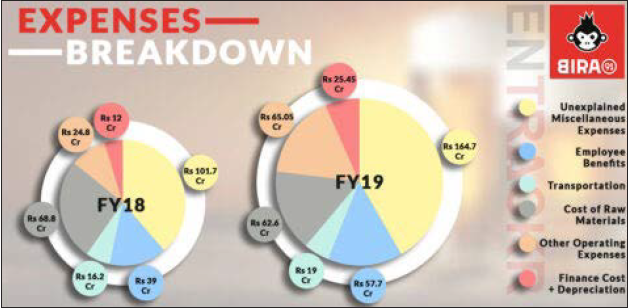
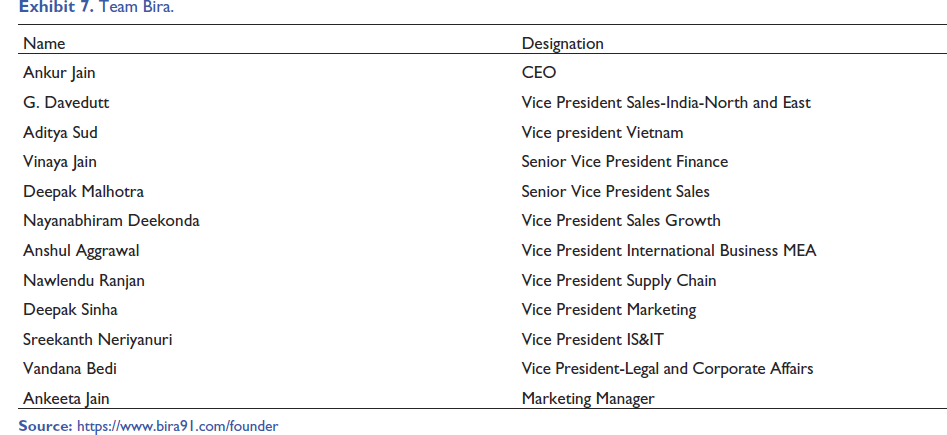
It was the year of the Cricket World Cup (2019), the time when all beverage companies were closely monitoring their sales, when G. Davedutt, V.P. Sales, (refer Exibit 7) of newly launched Bira 91 was ready to test its metal in beer market. A cool evening in February 2019 gave birth to a hot discussion on beer table. The V.P. of Bira 91 was having a retrospection of his beer journey of last five years. This was too short a journey to decide the fate of a company, but the young brand had made its presence felt, in every Beer outlet of modern India within a short span of five years. It was the time to critically evaluate what Bira 91 had achieved in these years and what made them stand in the market. Happy with its journey, the MD of Bira 91 was quite satisfied with the brand’s performance and discussed the ups and downs of brand. There were lessons to learn from strategic moves that Bira 91 had successfully implemented and devised its strategy to capture the crucial present year’s sales (Abhirup, 2017). The results of financial year 2018–2019 were not very encouraging and contrasting with the performance of financial year 2018, the revenues’ growth of B9 Beverages had sustained in financial year 2019 by registering a nominal growth of 15.4% amounting to ₹ 2.49 billion which was a better performance in comparison to the previous financial year’s revenue, that is, ₹ 2.1 million in financial year 2018. Meanwhile, the company’s losses doubled from ₹ 1.38 million in financial year 2018 to ₹ 27.5 million in FY19 (
Company Profile
Ankur Jain, a first-generation New Delhi-based entrepreneur started Bira 91 (where 91 stands for India’s ISD code) craft beer in the year 2015 (under the registered company name B9). The product was the brainchild of Mr Ankur Jain. The curious engineer who never used to settle for less was highly dissatisfied with the way beer was produced in India. The drink which was top seller in the drinks market in the Western world, was not in great demand in India. There seemed to be something missing in the Indian beer market (
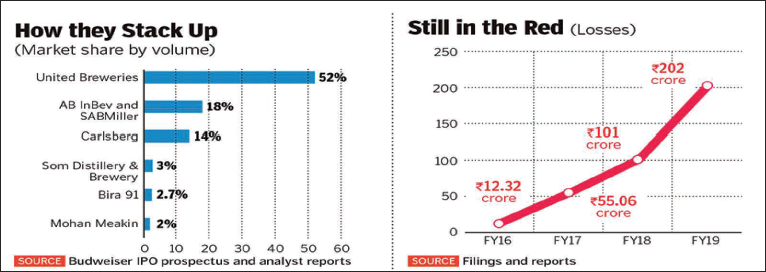
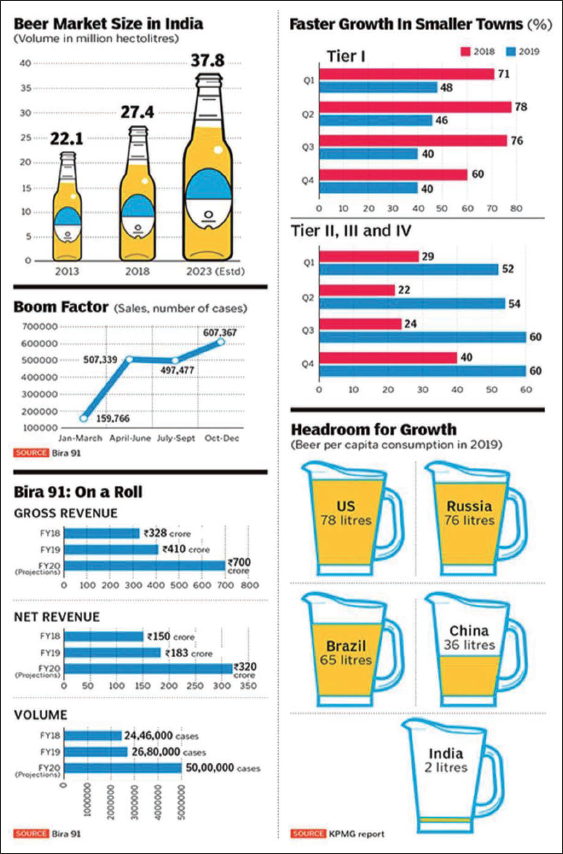
With a clear intention of revolutionizing Indian beer market, Ankur launched a first-of-its-kind hand-craft beer in two flavours of blonde and Ale. It was the time when country’s breweries’ king ‘United Breweries’ was in trouble for various other reasons. It was the right gap for a new product to pitch in. His choice for Indian market was for basic two reasons; firstly, Indian beer market was at a nascent stage especially for crafted beer and secondly the visible gap in the beer market (see Exhibit 3). The new product was first pilot tested in Bengaluru and Delhi (cities of India) markets, after its success in these markets the product was launched across Nation. In a short span of two years, the company registered an unprecedented growth in product demand (doubling every month). Bira 91, in two mild flavours soon became the loved brand of India. White was an ale beer having citrusy taste and also low in bitterness and Bira Blonde for strong beer lovers. Interestingly both the variants contain less than 5% (4.9%) alcohol, which was less than many alcohol drinks available in the market. With just two products in its portfolio, the brand captured the Indian market and chilled beer became hot favourite of Indian consumers. The company owned the largest craft beer dispense network of its own in India which ran across bars and restaurants in the country. With a huge distribution network coupled with a great demand for its both variants, the company plans to add a new product frequently to be relevant to its target customers. The company planned to expand its market to other countries as well with a basic vision of ‘Imagined in India, crafted for the world’. A lot of marketing efforts had been put in by the founding team to create and sustain craft beer market in India. The product was well designed with a striking name and attractive packaging. The company captured a considerable market share and became a challenger to market leaders in a short duration. All this happened as a result of the marketing strategies adopted by Bira 91.
Market Scenario of Indian Alcohol Market
Drinking alcohol had never been a climatic requirement of the country. In the interiors of the country and in ethnic cultural society, public drinking was taboo. Even in modern societies, beer was never a preferred beverage over other alcoholic drinks. It was because of these reasons that global brands had always found it difficult to foray in Indian market. Moreover, the tax on beer which is relatively higher in the country made it an expensive affair for multinational companies to operate in the country[3] (
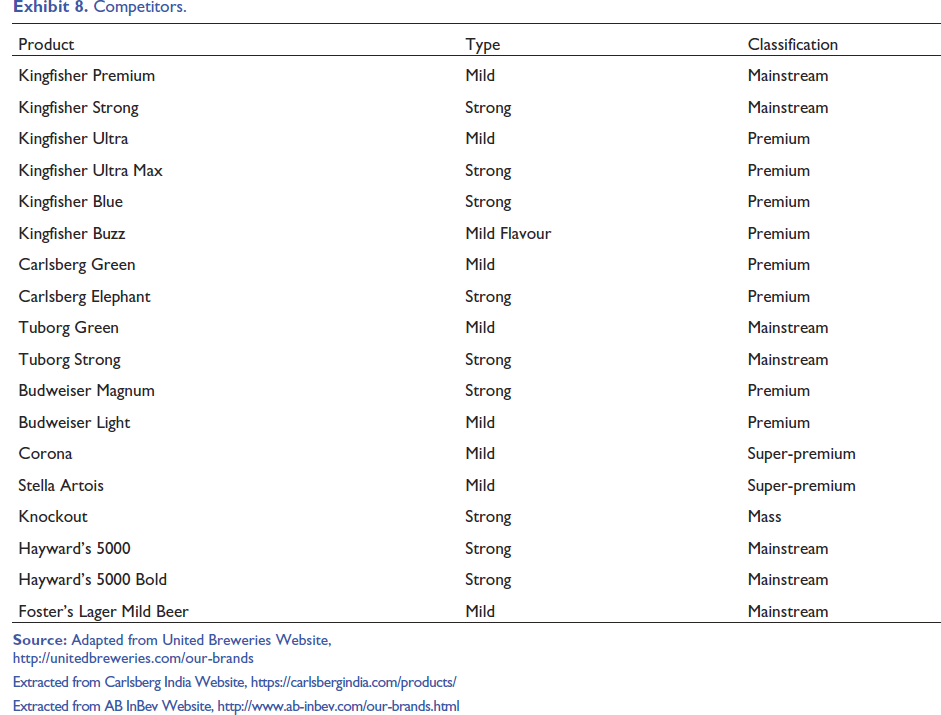
A good proportion of drinking population preferred strong beer containing more than 8% alcohol which was offered by the major players like Kingfisher, Kalyani Black Label, Carlsberg Elephant, Budweiser Magnum and Miller ACE (refer Exibit 8). After the entry of Bira 91, Kingfisher continued its leadership till the year 2016 (AIBA) (Abhirup, 2017) even after losing its 4.3% share (in terms of volume) to competitors from 2011 (Euromonitor International, market research report) (
Impact of COVID-19 on Beer Industry
Beer, having a shorter shelf life found it difficult to survive the COVID-19 stroke in India that too at the peak season of summer. The first countrywide lockdown that was administered had a severe impact on the sales of beer as the distribution outlets, microbreweries, and restaurants were closed for days together. That was the time when the entire industry suffered huge loss. Sales of alcoholic drinks suffered loss of sales for 40 days in two subsequent lockdowns. On top of the effect of pandemic, World Health Organisation (WHO) advocated about connection of low immunity to consumption of alcohol. Statement of WHO went against the hopes of beer producers even after the ban was lifted. The industry got the next severe jolt when government introduced the COVID cess (levied to meet the extra expenses due to pandemic) on liquor in different states of the country. This slashed down the price margin to a great extent. Passing on the additional burden to customer actually shifted customer interest to inferior quality, that is, cheap beers. Introduction of online ordering of beer and home delivery proved to be a silver lining for beer producers. But this service was started in selected states of Maharashtra, Punjab, Chhattisgarh and West Bengal. This move not only increased the sales of beer but also introduced the culture of drinking beer at home in an otherwise conservative society [13]. However, the move could not do much good to the industry as outlet prefers hard liquor to beer because of customer demand.
The fact that beer need to be consumed chilled made the sales more complicated as the beer in lockdown if needed to be consumed, need to be stored in family fridge which was not very fit for traditional society leading towards switch of consumers to other alcoholic drinks (
So How Did Bira Do It
As advertising on mass media about alcohol drinks in India was prohibited, Ankur made Bira 91 available at pubs and restaurants silently without much noise. The POP (Point of Purchase) display was used for creating awareness about the product. It did not take much time for Bira 91 to impress the taste buds of Indians. Soon Bira 91 became a must on every drink table.
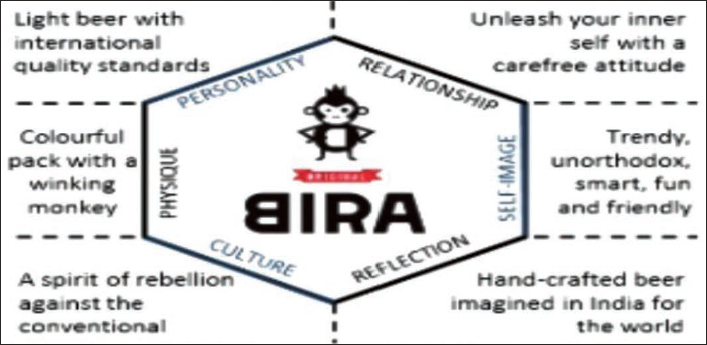
Mascot of Bira 91 was so eye catchy and fun-loving that it was quite irresistible for beer lovers. The mascot was intentionally designed as a monkey, because there is a monkey inside each one of us, who just want to get out of his/her crazy self. Bira 91’s primary target was urban millennials who are fun-loving and money stands for fun and accessibility. Monkey shows the spirit of rebellion against conventional.
A reverse ‘B’ was indicating the rebellion millennia’s anti-traditional attitude. Combination of B with a funky monkey just did the trick. Number 91 associated with reverse B is the county code of India that gave it a Desi (regional) flavour. To make it big, Ankur hired a consultant from Belgium who himself was a brewmaster and begin to get the brewed drink in Belgium containing French as well as Belgian malts. The tagline ‘Imagined in India’ was a clear indication of personalisation to Indian consumer. On the consultant’s advice, the brand also started to sponsor corporate events for promotional reasons. At this stage, Ankur’s wife Ankeeta Pawa joined Bira 91 in 2016 as Community Manger and took the charge of its brand visibility. In January 2018, she became the marketing manager. Ankeeta, who was a commerce graduate, brought with her experience in Program and Campaign Management and Marketing Communication which she had gained in her previous employment. It was this year when Bira 91 kept aside a huge budget for advertisement on recommendation of Ankeeta to widen brand visibility (see Exhibit 5). In the year, 2017–2018 company’s spent on advertising and promotion accounts for 30%–35% of its revenue and the key highlights were as stated.
Finance
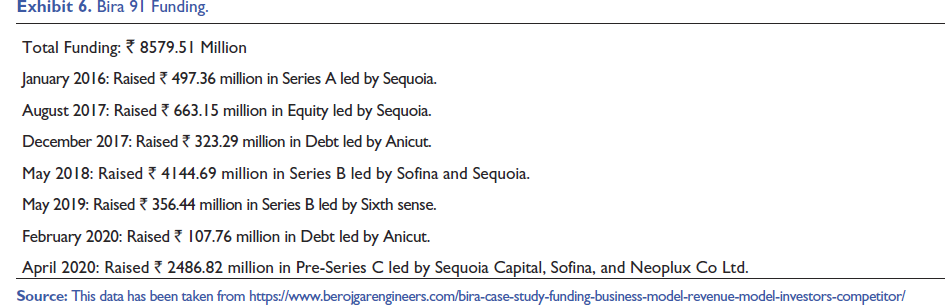
Arranging finances for the newly launched Bira 91 was a challenge until Sequoia team performed a test for Bira 91’s potential in Indian market. Undoubtedly the test results were mind-blowing. By October 2015, Sequoia finally joined hands with Bira 91 nine months after its launch and financed the venture by $50 million.
Pricing
In India, liquor is taxed at flat rate irrespective of alcohol content this was precisely one of the reasons that liquor lover in India tends to bend towards hard liquors that gives a sense of value for money. To pilot test the product, Bira 91 adopted penetration pricing which resulted in loss of money on every sold bottle but at the same time captured a larger pie of the market of craft beer. Ankur’s team was sure that the product is going to rock the market with its taste and price combination. In the mid of 2016, the long-time consuming brewing process resulted in severe shortage of product in the market. The huge admirers of Bira 91 got upset with the sudden non-availability of their favourite drink. On one hand, consumers were upset about not getting Bira 91, on the other hand company faced the real problem of unfulfilled demand of its newly launched product. It took four months for Ankur to acquire a brewery in Haryana (State in India) at a very high cost than what Ankur estimated at the beginning. The situation posted many questions in front of Ankur and his team. The investors and channel partners also started to question the credibility of Ankur and his newly launched business venture. The situation was taxing for the entire team of Bira 91, but instead of breaking the team’s confidence, the situation made the team more robust and competent. Ankur sat with his team and chalked out a five-year plan for his company on various aspects of business like, supply chain management, human resource management, marketing strategies and capital arrangements. It was funny that such a severe condition of the company was being perceived by the competitors as a marketing gimmick[2] (
While many Indian consumers used to focus on pricing and alcohol content, Ankur based his business on the belief that there are a large group of consumers who will pay more for superior quality product and a ‘cool’ brand that they can associate with. He liked to say, from early on, that young Indian consumers are willing to choose ‘taste over testosterone’. Testosterone has long been part of the branding and positioning for incumbent beer; Bira 91, in contrast, speaks to more irreverent, urban young consumers. With the launch of new products, the company started to expand its digital presence. In September 2016, the marketing team of Bira 91 launched Hot stuff, featuring Rocky Singh and Mayur Sharma who looked for hottest chilliness and Indian cuisines in the country. The eight-episode series was very much liked by Indian viewers and in short span of time achieved 4.5 million views. The company tied up with the Indian popular online radio ‘Sawan’ and started many playlists like, brew playlist, Asal Hustle by Bira 91 and the Bira Hip Hop Channel. The company also signed agreement with online food delivery apps like Zomato and restaurant search. The same year in November, Bira 91 launched 360-degree hip-hop platform and, featured live music shows, web series, etc. The company also partnered some of the top Indian hip hop stars to ensure original programs for the new Bira 91’s channel. To connect with the youngsters, Bira Free Flow roped in a youth icon, that is, a Delhi-based rapper Prabh Deep, for the launch of his album ‘Class-Sikh’.
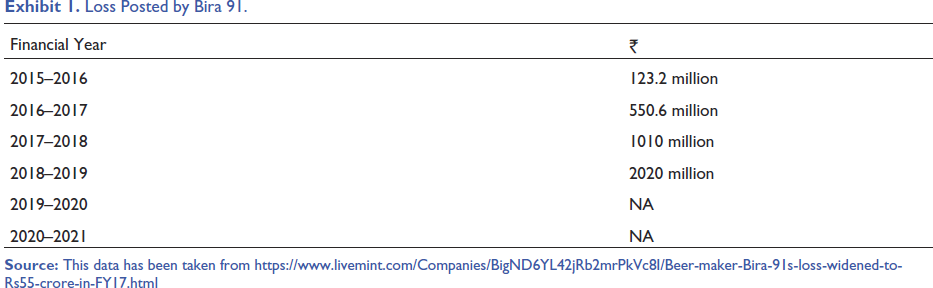
Despite the incredible success of the brand within three years, Bira 91 was continuously incurring losses which were far from recovery. The company made a loss of ₹ 123.2 million in the first year of its launch which widened to ₹ 550.6 million in the year 2016–2017 and finally in the year 2017–2018, the total loss of the company from its operations was ₹ 78 billion (see Exhibit 1). Ankur was of opinion that the company would achieve break-even point by the year ended 31st March 2019. However, Bira 91 had diversification plans into non-alcoholic drink markets like juices, sports drinks, carbonated drinks, energy drinks and sparkling water (
Bira 91, an Indian craft beer brand, which was launched by B9 Beverages in 2014, had partnered with Omnicom Media Group-owned agency OMD India to engage potential customers and fans across traditional and digital channels to gain competitive advantages in the market using marketing strategies to leverage its performance. OMD has grown up as a developed media accomplice for its program of clients—a blend of brands like Apple, Beiersdorf, Sony, Mercedes Benz, Renault, Wipro, Au Bank, to give some examples. The agency has received double-digit growth and number of awards over the past few years, including being named the Best Agency in Mobile Marketing at the Mobby’s and having five of its planners named to India’s Top Digital Planners list in 2016 by BW Businessworld and Digital Market Asia.
The Vice President-Marketing of Bira 91, Deepak Sinha, said that the partnership with OMD India would support Bira 91 in delivering unique and memorable customer experiences in India and globally through the diverse range of products. The partnership with OMD would add value to the potential customers of Bira 91 by sharing the success stories of this Indian craft beer brand using OMD’s vast experiences and expertise. Thus, Ankur and his team postponed the new non-alcoholic product launch to sometime in year 2021 (
When Bira first went on sale, its price was comparable to that of premium beers on the Indian market (refer Exhibit 9). However, Bira established a new price range in the established segment by establishing a reference price point of 100 after raising funds from Sequoia Capital India Advisors and shifting production outsourcing from Belgium to India. Bira adopted an HQLP (high-quality low price) positioning for urban millennial. The company was also able to compete at a lower price point in the premium beer market because it did not spend a lot of money on mass marketing campaigns.
The Dilemma
In spite of diverse organisational challenges, Bira 91 was poised to register its presence in the whole India and globally through implementing its market expansion strategy, but the top-level management was clueless during the COVID-19 pandemic scenario. The marketing environment was disruptive and catastrophic in nature and the CEO, Ankur Jain was hunting for an idea to find a cost-effective way to deal with expansion challenges in light of this pandemic scenario and competitive business environment. Numerous big questions were hammering on his mind like what to do next, what to communicate with customers and through which media and how frequently to communicate. Despite having opportunities of getting financial support from Kirin, it was getting difficult for Ankur and his team to design expansion strategies. Overseas expansion had its own challenges of exploring the new market and spreading the business within the country was difficult on the ground of higher tax bracket product. Moreover, branding in the country through advertising was restricted by advertising authority of India. In such a scenario, Deepak put his head to analyse the company’s strengths and weaknesses to formulate market expansion strategies.
Bira’s Strategy
The packaging and logo are Bira’s branding strengths. The monkey in the logo has a hairstyle, though! On its official merchandise, the monkey was also used as a mascot to show moods, actions, and as a funny character. The beer’s packaging is kept fun and uncomplicated without any extravagant additions. It usually uses this neutral, pastel colour scheme for its creatives, giving it a very fun vibe and making it an obvious choice for younger people. One of Bira’s strengths has been organizing events. It organises music and food festivals to unite its beer community and enhance their experience by utilizing their product. In addition, the company has begun producing its own featured playlists on a number of music streaming platforms in conjunction with music artists. A tactic, that only a few brands in the country employs. When it comes to social media, the brand stands head and shoulders above the competition. It does this by building areas of strength for a Facebook people group that deliberately advances the lager brand on their own records. While other brands spend a lot of money on celebrity endorsements, Bira just encourages its customers to share their experiences with the product through giveaways, shoutouts, and other means. making it truly a brand that people can relate to.
The excellent brand strategy and marketing strategies have enabled the company to begin selling its beer internationally in nations such as the United States, the United Kingdom, Thailand, the United Arab Emirates, Hong Kong, Singapore, and soon Australia as well. They also had an online series with Rocky and Mayur called Bira 91 HotStuff. In this series, Rocky and Mayur go to India to find the hottest chilis and pair them with the hottest dishes and Bira 91.
Conclusion
The handcraft beer had brought a new dimension to Indian beer industry which was mostly overshadowed by other alcoholic drinks offered by big players in the industry. Claimed to be the youngest population, India is all set to taste the new hand-crafted beer. The millennial and centennials were early adopters. The company, to a great extent, has been successful in creating its image in young minds and has done considerably well in the target segment so much so that it had faced a shortage of supply. The new entrants like Bira 91 though had captured a considerable market share in short span of time, need to conduct proper market research to arrive at proper expansion strategies to claim a bigger pie.
Disclaimer
The information contained in this case study is to be used only as a case study example for teaching purposes. The information in the case study is factual based on secondary data collected from various sources mentioned in the reference section. Opinions and story formulated by the author are intended to stimulate class discussion.
Exhibits
Loss Posted by Bira 91.
Indian Beer Market Share.
Bira 91 Funding.
Team Bira.
Competitors.
Extracted from Carlsberg India Website,
Extracted from AB InBev Website,
Pricing Strategy of Beer Industry.

Footnotes
Declaration of Conflicting Interests
The authors declared no potential conflicts of interest with respect to the research, authorship and/or publication of this article.
Funding
The authors received no financial support for the research, authorship and/or publication of this article.
