




Abstract
Food is a basic need for everyone. We struggle throughout our life to satisfy this need. The delicious food attracts and makes food lovers reach anywhere to get this. Convenience, quality and affordability are critical elements for the food business. This idea has attracted Mr Deepinder Goyal and Mr Pankaj Chaddah to start Zomato. Being a first mover in this unique food app market Zomato has struggled a lot. Before tasting its success, it was a loss-making company for a considerable period. This case study presents the key strategies followed by Zomato to achieve success till Initial Public Offer (IPO). It highlights how a loss-making company and food aggregator such as Zomato has succeeded through relationship and communication strategies maintained by the company and its co-founder Deepinder Goyal. This case study is based on understanding the significant issues and success faced by the company has been managed through public relationship management since its inception. It is completely developed from secondary sources and publicly available data and reports. This case is developed to discuss the essential strategies and steps taken by Zomato to improve its position till IPO. It highlights the inception, significant steps to break even, its success through relationship marketing, competitors’ effect, risk factors and future course of action.
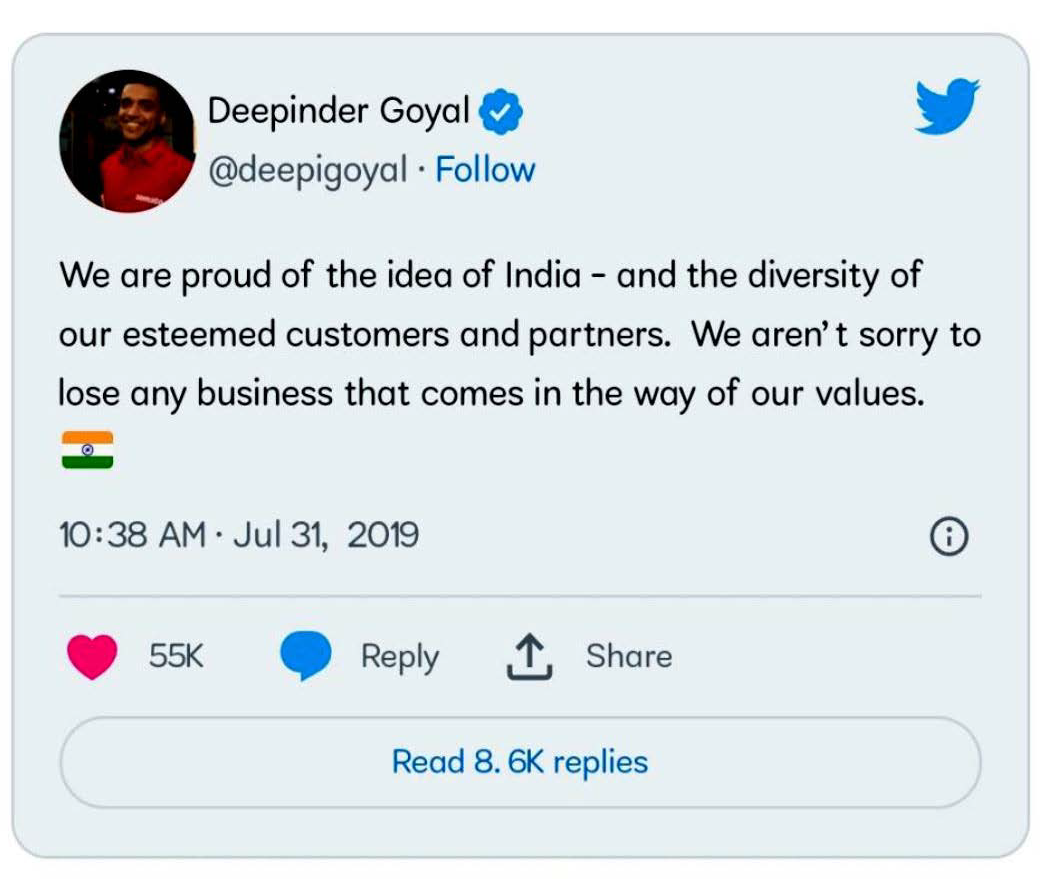
A post dated on 30 July 2019 has heated the Twitter environment of Zomato. A person refused to take food from a Non-Hindu delivery boy. Immediately, the Zomato PR team responded, ‘Food does not have a religion. It is a religion’. There were some appreciation and distractions for this tweet, which later led to the brand’s crisis. Before this, in December 2018, the video of a delivery person who had eaten the sealed food downsized the image of Zomato, and Mr Pankaj Chaddah, one of the key founders of Zomato and who rendered 10 years of profitable service, left the organization in March 2018. The market share of Zomato starts decreasing, giving an advantage to the prime competitor Swiggy. These incidents have made Zomato a loss-making company for a considerable time. There were a list of controversies where Zomato found itself entrapped. Deepinder Goyal, the founder, and CEO of Zomato, confidently handled these situations with the help of the PR team. A tweet posted by him on 31 July 2019 about the incident of a Non-Hindu delivery boy shows his responsibility and value towards customers and delivery partners (Figure 1).
According to Zomato’s DRHP, its losses are more than revenues until December 2020. However, Zomato is India’s first-ever online food delivery brand that strides towards a $1.1 billion public offering. Even though it is a loss-making company, Indian people have trust and hope for its growth. It has proved from the success of the IPO. But how do the customers or investors believe in Zomato’s success?
The Inception
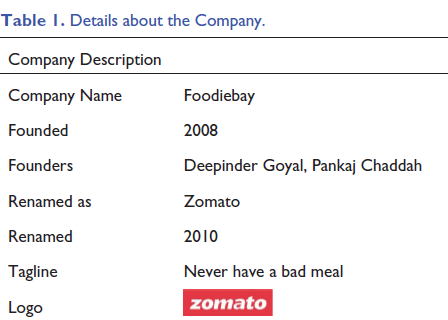
Deepinder Goyal and Pankaj Chaddah, the alumnus of the Indian Institute of Technology and colleagues in Bain & Company, Delhi, planted the seed for Zomato in 2008 (Table 1). Earlier, they named it Foodiebay, prologue to Zomato, as a solution to the long-time waiting of their office employees to get a chance to order during lunchtime. They created a website called
Details about the Company.
In 2008, when they had just started Foodiebay (Zomato), the idea was surrounded by many obstacles. The usage of smartphones and the internet was significantly less. Touchscreen mobile phones with inbuilt mobile apps did not exist, and the internet penetration in India was below 5%. Restaurants and food courts largely depend on distributing pamphlets, paper flyers, and catalogues through the daily newspaper. But a customer could not get the information about which restaurant’s food is delicious, whose menu is unique, and who can provide better services. Deepinder Goyal and his partner have targeted this unique opportunity by allowing customers to post reviews, ratings, and aggregated menus by restaurants and contact details. Soon, others around their vicinity started using their services and listing menus of professional restaurants in Delhi. It was the first success they tasted, extending their services to other metropolitan cities like Kolkata and Mumbai.
When they received a terrific response from users and massive traffic for the Foodiebay platform, they decided to make it international. In November 2010, they changed their name to Zomato from Foodiebay because it is simple, precise and easy to memorize, reducing confusion with eBay’s website. They devised the idea of developing a mobile application that needed funding to make it more user-friendly.
Overview of the Online Food Delivery Industry in India
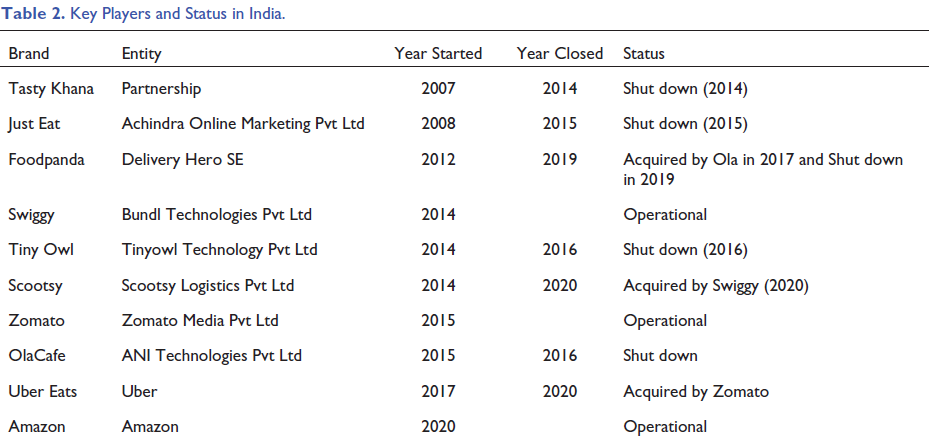
The Online food delivery services market is the fastest-growing industry in India. The industry is in hyper-growth now even though it was seeded almost a decade ago. The main theme behind the growth of the food delivery market around the world is Consolidation. In India, this consolidation made a rapid duopoly between Swiggy and Zomato who make deeper geographical penetration by controlling 47% and 45% of market shares, respectively. Amazon was the new entrant in the market in May 2020. Since 2007, many players entered India whereas two players have been successfully ruling the Indian market (Table 2). Both Zomato and Swiggy received considerable funding especially in 2018 to expand their operations through restaurant partnerships and riders. The learnings from international markets help to improve the strategy of Indian players. Developed markets focus to increase the Average Order Value (AOV) while players in the emerging markets target to increase the order volumes. Meituan, the largest food delivery platform in the world earns prime revenue levels through a larger customer base and high orders per user even though earns low AOV compared to emerging players in the market. Swiggy is the follower of this strategy. Similarly, different strategies are being followed by different players across the globe. Conversion of single-purpose apps to multi-use super apps is another strategy to provide vast convenience services to consumers. Providing multiple services such as grocery, medicine, ride-sharing, cloud kitchen, among others in a single app increases the sustainability of Indian players.
Key Players and Status in India.
Zomato’s Business Model
Acquisition
The unique idea of Deepinder Goyal and Pankaj Chaddah was attracted by Mr Sanjeev Bikchandani, the founder of
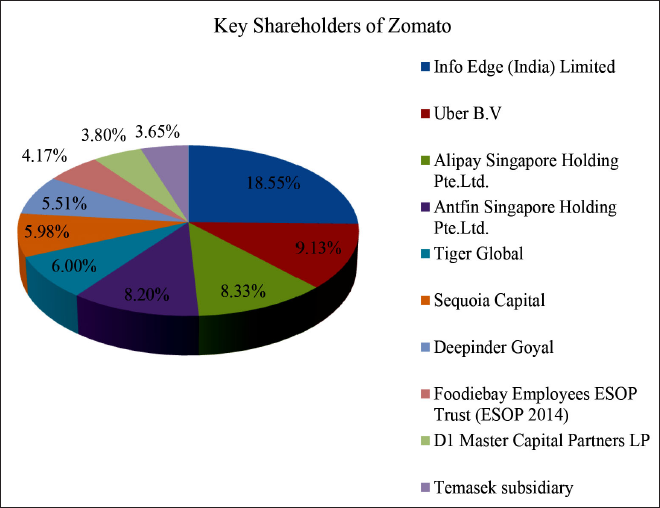
Key Shareholders and Their Holding Percentages in Zomato.
Major Acquisitions and Their Purpose.
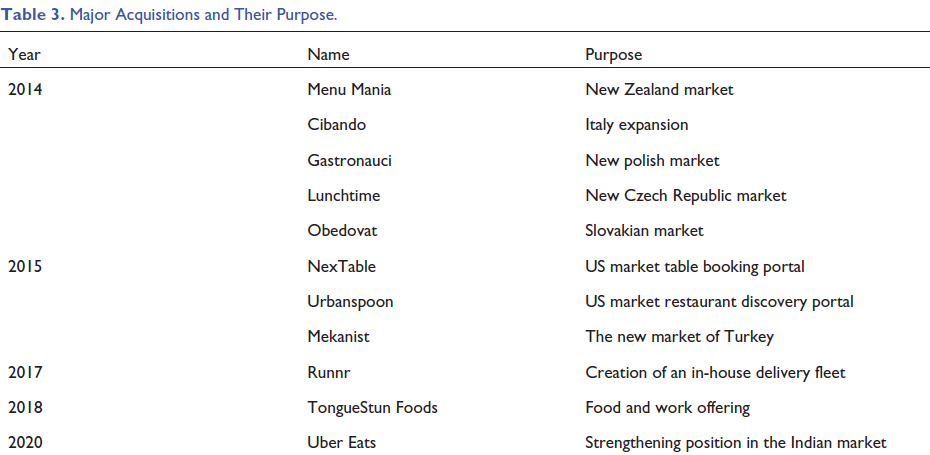
Expansion and Business Transformation
Even though Zomato has been successful in delivery, its significant goal was to grab the restaurant market for both the demand and supply sides. It is evident from the ventures that include (a) Food delivery, (b) Dining-out, (c) Hyperpure and (d) Zomato Pro (Table 4)
Revenue, Cost Drivers and Uniqueness of Zomato Offerings.
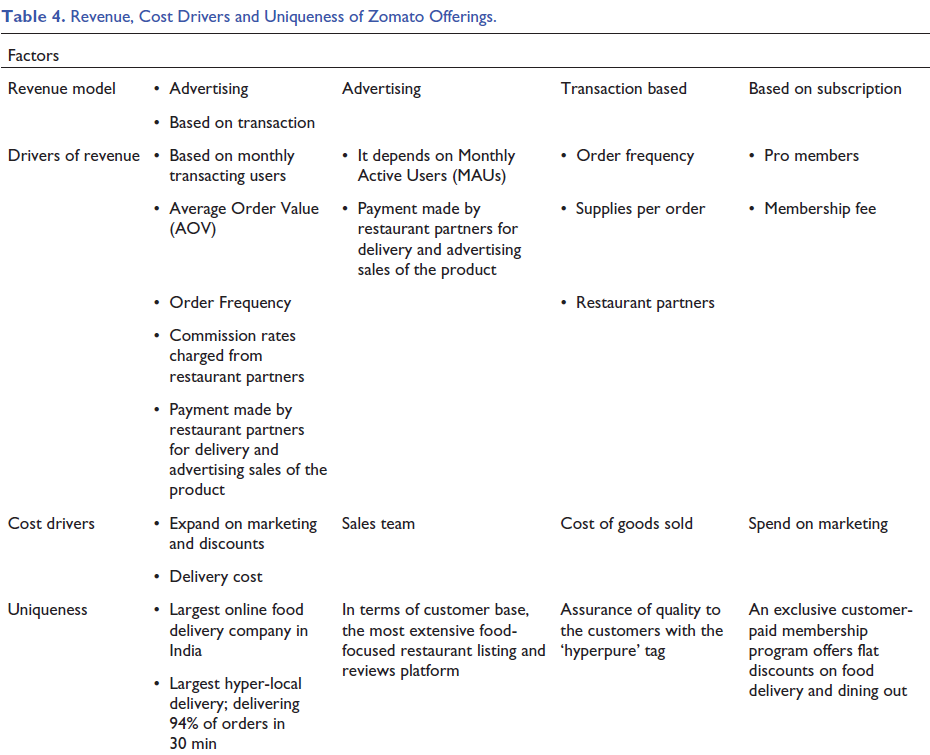
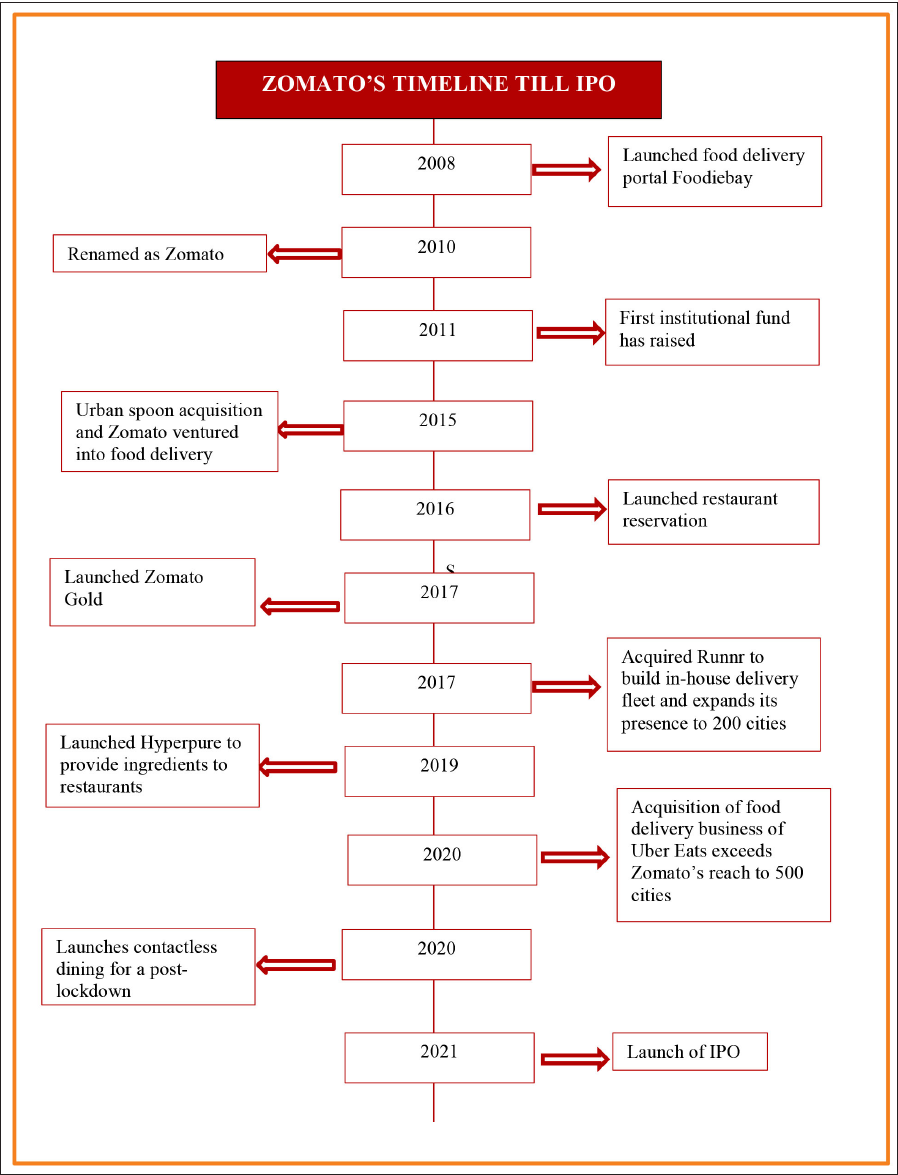
The food delivery app allows customers to order online and get the order at their doorstep. Delivery partners, who are well trained, make the delivery hassle-free with less human intervention. If the customer wants to reserve a table, the dining-out platform lists the restaurants, photos, ratings and reviews and allows customers to reserve a table and pay online. Zomato starts supplying quality ingredients to restaurant partners through Hyperpure. Zomato Pro is a paid membership program exclusively offered to customers who purchase a membership by paying a fee. It is an agreement with selected restaurants to provide discount offers to the Pro members across food delivery and dining-out services. In 2020, during the first phase of COVID-19, when the restaurants were shut down, Zomato started delivering groceries. But Goyal ended their service as soon as the Government lifted the lockdown. In July 2021, Goyal announced its plan to venture into the grocery delivery marketplace again on a pilot basis. Zomato’s major steps till IPO can be observed in Figure 3 in the form of a timeline.
Zomato’s Operating Model
Zomato is a user-friendly app that provides food delivery services, user reviews, menus of nearby restaurants, and ratings. Zomato considers Customers, Delivery Partners and Restaurant Partners as pillars and key stakeholders of the company. Placing an order in Zomato is straightforward. It starts with ordering food in a restaurant by exploring various restaurants through the app. Then the restaurant receives the order and starts preparing the meal. Customers can estimate the arrival time by tracking their orders. Once the food is ready, it is given to the delivery providers who deliver the meal at the customer’s preferred location. And finally, from the available payment options, customers can pay for the order and give reviews and ratings based on their experiences. Zomato has removed the long waiting hours at restaurants and ensures prompt food delivery at the customer’s doorstep, which delights food lovers. Zomato also allows new food market members who want a robust online presence to promote their products. Currently, the primary revenue source for Zomato is through advertisements, food delivery, and subscriptions to Zomato Pro. The revenue, cost drivers and uniqueness of the online reliable base services are shown in Table 4.
Zomato’s Strategy, Strengths, Opportunities and Risk Factors
Strategy and Strengths
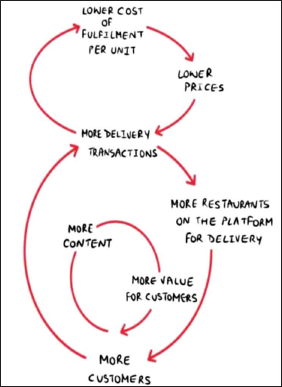
Technology and unique content have made the flywheel strong. Zomato believes that huge content increases customer base, and more customers give richer content and vice versa. A more customer base increases food delivery transactions, which leads to the number of restaurants on the platform for delivery. If the number of delivery transactions increases, it decreases the cost per unit and ultimately lowers food delivery prices, reducing the prices for customers. This cycle is interlinked and helps the company increase customer and restaurant partners’ loyalty. Continuous focus on economics and growth is Zomato’s long-term strategy.
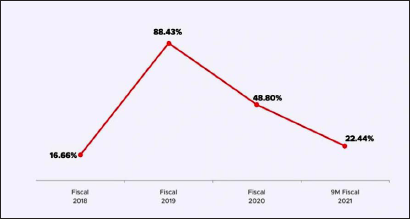
Goyal said, ‘We know that whenever the industry grows, Zomato grows along with it’. Even though it has been facing losses, it continuously made considerable investments in advertising and sales promotions. It is believed that the investment has resulted in the customers’ repeat purchases and made them loyal. As a result, the increase in repeat orders leads to a decrease in the cost of advertising and sales promotions over time. As a percentage of total income, Zomato spent advertising and sales promotion expenses, as shown in Figure 5. The expenses on advertising have been decreasing based on total income gained.
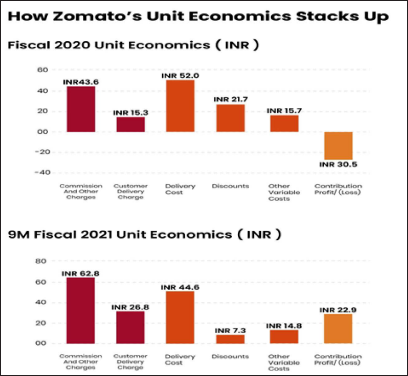
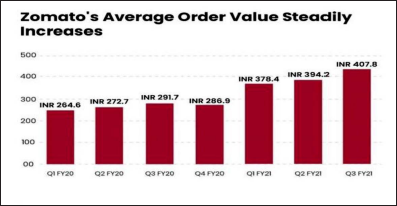
It is essential to understand the unit economics of Zomato to estimate its profits/losses. The profit per order is calculated based on the commission charged by the company from restaurants in addition to the delivery charges collected and by subtracting delivery costs, discounts, and other variable costs from it. Figure 6 shows unit economics for the year 2020 and 9 months of unit economics from the year 2021. It generated ₹22.9 profit per order in the financial year 2021 against the ₹30.5 loss per order in 2019. The main reason for gaining this profit is the AOV, while to gain profits in food delivery companies, the AOV should reach 400. After the COVID-19 pandemic, Zomato’s AOV has increased from 395 to 400 in the current year, which is the base for reaching profits per order (Figure 7). Deepinder Goyal’s leadership, positive decisions and a strong team are the most significant strengths that positively impacted the brand and led to the success of the IPO.
Opportunities
In FY20, Zomato reported revenue of ₹2,486 crore, but its losses broadened to ₹2,451 crore. Even though it is a loss-making company, its valuation is far above its global peers. Tech-based companies such as Zomato needed huge investments initially, but as the unit economics started evolving, they needed to attain the growing opportunities in India. As India is one of the youngest nations in the world, with a mean age of 28 years, as against 38 in China and the US, there is an enormous scope for the food delivery industry to grow. The following are the opportunities in India for the food delivery companies.
Scope to increase the food delivery market as 43% of the Indian population has internet access, but only 9% are online food delivery users. If internet access increases, then the opportunity for the food delivery market will increase.
According to World Economic Forum, India will be the third-largest consumer market by 2030 by developing infrastructure, industries, education, job opportunities and income.
India has a large working population in the age bracket of 20–59 years.
World Bank estimates that 34% of the Indian population (466 million people) will reside in urban in 2019. As per United Nations Population Division, it will grow to 37% by 2025. So, there must be an increase in purchasing power of the urban population with the most substantial growth across industries.
Risk Factors
Along with the opportunities, Zomato has some risk factors which need to consider for consistent growth in the future.
AOV: Should maintain and increase AOV, increasing the business’s revenue. If the history of net losses is repeated, it will threaten the business’s growth.
Competition: Swiggy is the main competitor for Zomato as it is a two-player or duopolistic market for the food delivery business in India. Amazon started its operations in May 2020 but not aggressively acting. If it expands its business assertively, it will lead to a drastic change in the margins. Along with the cloud kitchens, chain restaurants, with their delivery mechanisms and other traditional offline ordering channels, come under the threat of competition.
Commissions: As Zomato is listed in IPO, if it increases its commissions to increase profits for the investors, it may diversify restaurant partners and customers.
Technological development: Zomato must update its technology to improve customer responsiveness to remain competitive.
Disputes Surrounding Zomato
Disputes with Customers
Nowadays, sharing bad or good information through social media channels such as Facebook, Twitter and Instagram is elementary. Zomato faced many controversies from customers that were shared on social media. Some controversies have increased the company’s credibility, and Zomato has paid the customers in some disputes. In the controversy of unfair trade practice, State Consumer Disputes Redressal Commission has ordered Zomato to pay ₹10,000 and a free meal to the customer named Ajay Sharma for deficiency in providing services and unfair trade practices. In this case, Zomato has violated the delivery scheme ‘on-time or free food’ in the case of a customer who paid an extra amount for on-time delivery. Apart from this, customers used to express their complaints and negative opinions on food delivery and other services through Twitter regularly.
Disputes with Restaurant Partners
Restaurant partners are another critical stakeholder whose support is keen for the company’s success. But sometimes, the strategy followed by the company may lead to a distraction in the relationship. The #Logout campaign started in Gurgaon in 2019 and has delisted more than 12,000 restaurants from food delivery. Nearly more than 500 companies blocked Zomato in Ahmedabad. They felt that the deep discounts offered by the company had eaten away at their profits. Even though these apps help the restaurant partners to get a more significant number of customers, they believe that the deep discounts may switch customer loyalty from restaurants to food apps which gives them control over the market. They also continued boycotting Zomato Gold services because of its deep discounting.
Disputes with Delivery Partners
Delivery partners, who are essential assets of the company, have been expressing dissatisfaction due to less basic and variable pay, job security, etc. Frequently, they used to go on strike in demand of their benefits. Being gig workers, they demand fair wages and permanent employment. For instance, in 2019, nearly 6,000 Zomato delivery partners went on strike across Mumbai and Bengaluru. They logged out of the app, protesting a decrease in payment for each delivery from ₹40 to ₹30. They also raised their voices against the company on the issues of delivery of beef and pork and non-Hindu boy’s religious issue.
Managing Disputes Through Relationship Marketing Strategies
Relationship marketing strategies are a form of integrating marketing communication wherein a company needs to develop its image in various disciplinary roots such as Business Marketing (Interaction & Network approach), Marketing Channels, Services Marketing, Database and Direct Marketing (Möller & Halinen, 2000). Goyal and his team have maintained a strategic relationship with customers, delivery partners and restaurant partners, the company’s key stakeholders. Zomato believed in relationships and concentrated on satisfying the different needs of the stakeholders. Goyal’s timely interaction and strategic response with stakeholders turn them loyal to the company. Zomato is not just serving food for us; it entertains and engages through its unique marketing strategies across all the available platforms. As of today, Zomato has 1.4 million Twitter followers. It often asks a question or flashes an advertisement related to the occasions or issues loaded with humour and ends with the message. Few examples like as the tweet ‘Guys, Kabhi Ghar ka khana bhi Kha Lena chahiye’ (reverse marketing), as a message on women’s day ‘Cooking is her choice, not her duty’ cast by the father of P. V. Sindhu (India’s first world badminton champion) and many more have developed positive brand image in the minds of customers.
Relationship with Customers
Goyal has not limited his relationship with the consumers or the public to the business. He maintained his relationship by providing a menu of different restaurants according to customers’ locality, budget and preferred tastes. He also handled customer grievances, maintained emotional bonds, entertained with timely interactions and promotions, and did help in times of emergencies. A customer needs a good product, timely delivery, prompt service, immediate response and problem-solving ability from the company to turn delighted or become a loyal customer. Zomato has also faced some issues from customers as discussed earlier. Still, they have solved at the right time adequately by Deepinder Goyal, which turned so many customers loyal to the company.
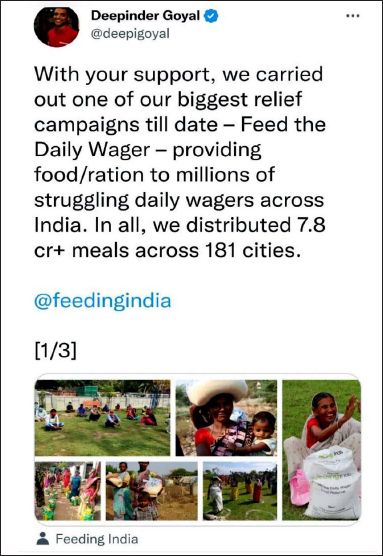
According to science, we remember 20% of what we read but 80% of what we see. Zomato ideally applies it through its advertisements. It spent a considerable amount on the advertisement to create repetitive advantage and brand remembrance. For instance, if we spend one hour watching any video on YouTube, we come across a Zomato advertisement at least once or twice, depending on the nature of the video we watch. It gives the advantage of brand awareness and increases sales. Zomato also provided entertainment through humour-based advertisements, making people think with message-oriented advertisements. It also attracts through timely discounts and offers. During the COVID-19 pandemic, it came up with a Zomato app feature, ‘Priority delivery for Covid emergencies.’ Delivery partners and restaurants took this order on a priority basis and helped needy people. Deepinder Goyal and Zomato team extended their support through the endeavours namely, ‘Feed the Daily Wager’ and ‘Help Save My India’. Through ‘Feed the Daily Wager’, they distributed nearly 78 million meals for free to needy people who were poor and lost access to daily work. Zomato joined with Delhivery to supply oxygen concentrators and related supplies to help families and hospitals in need (Figure 8). Customers are of different natures. A company should be able to satisfy as many segments as possible to succeed. Zomato got successful in this aspect which is reflected in its IPO.
Relationship with Delivery Partners
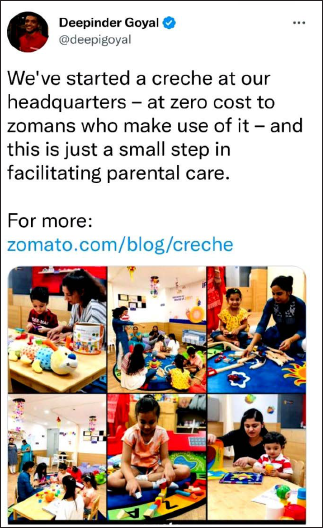
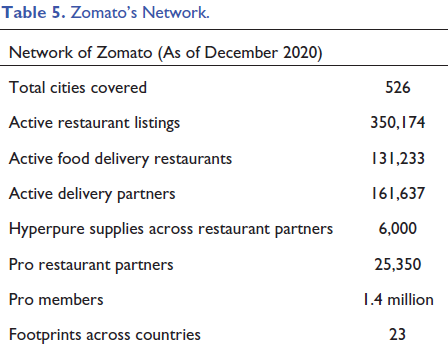
Goyal and Zomato always consider delivery partners as a critical part and backbone of its community because they are the ones who have direct contact with the customers. It always reflects in Deepinder Goyal’s tweets. Zomato also faced a crisis through an employee strike from a group of delivery workers in Howrah, West Bengal continuing the issue of ‘Food is Religion’. Some of the delivery partners expressed their unwillingness to deliver beef and pork. Zomato released an official statement clarifying the nature of the job they have to do in a country as diversified as India, and later they settled the issue. We can see Goyal’s support and value to the delivery partners through the above-discussed issues (Figure 9). Zomato provides earning opportunities to 161,637 active delivery partners in India (Table 5). Deepinder Goyal and Zomato team always stands to help their delivery partners by providing insurance benefits and assistance in two-wheeler financing. Goyal encourages women delivery partners in their fleet. Zomato applied a parental leave policy to men and women equally and started free crèche at their headquarters to facilitate parental care (Figure 9).
Zomato’s Network.
Relationship with Restaurant Partners
Zomato believes restaurants as the foundation for their business and success. Deepinder Goyal maintains a strong relationship with restaurant partners and produces timely support. Zomato displays the list of restaurants on its online discovery platform for free. This feature helps restaurant partners to find new customers and increase the demand for their products. Zomato helps in the industry’s growth by providing access to the market and a sophisticated digital marketing platform, availing a large fleet of delivery partners, and allowing them to expand beyond the physical limitations of small and large restaurants. In 2019, Zomato faced a campaign #logout from restaurants against huge discounts through the Zomato gold program. Soon, Goyal apologized on Twitter, sent an email to all gold restaurants declaring ten changes in response to their concerns, and came out with the new idea of extending Zomato Gold to delivery.
Future Course of Action
During the pandemic, many companies struggled to run their businesses, and many have shut down their operations due to unending obstacles. But we could not say all companies were unsuccessful in this traumatic phase. Some companies grabbed the opportunity to arise out of it and went successful, like Zomato. ‘Rome was not built in a day’ is a suitable notion for Zomato. A food tech unicorn, origins Gurugram has become synonymous with food. Its journey was a roller-coaster ride till it was listed on the Indian stock exchanges to raise funds. Zomato’s journey has undergone several struggles and has taken some inspirational steps to sustain itself in the competition. Its timely decisions were keys to the success of its journey. But the risk factors such as competition, AOV, commissions, technological development, and keeping the promises to stakeholders after the IPO may alter the future of Zomato. Goyal’s leadership is one of the best assets for Zomato. Even though, will he be able to maintain strategic decisions in the future is questionable? Although entrepreneurial skills and innovation positively affect business performance, it has not been proven the same strategies will be helpful to deal with future market changes. Zomato tended to be more proactive and less passive to deal with the future.
Footnotes
Declaration of Conflicting Interests
The authors declared no potential conflicts of interest with respect to the research, authorship and/or publication of this article.
Funding
The authors received no financial support for the research, authorship and/or publication of this article.
